





Quick Summary
- In a 791-person randomized experiment, one professional with AI matched a two-person team without it on solution quality.
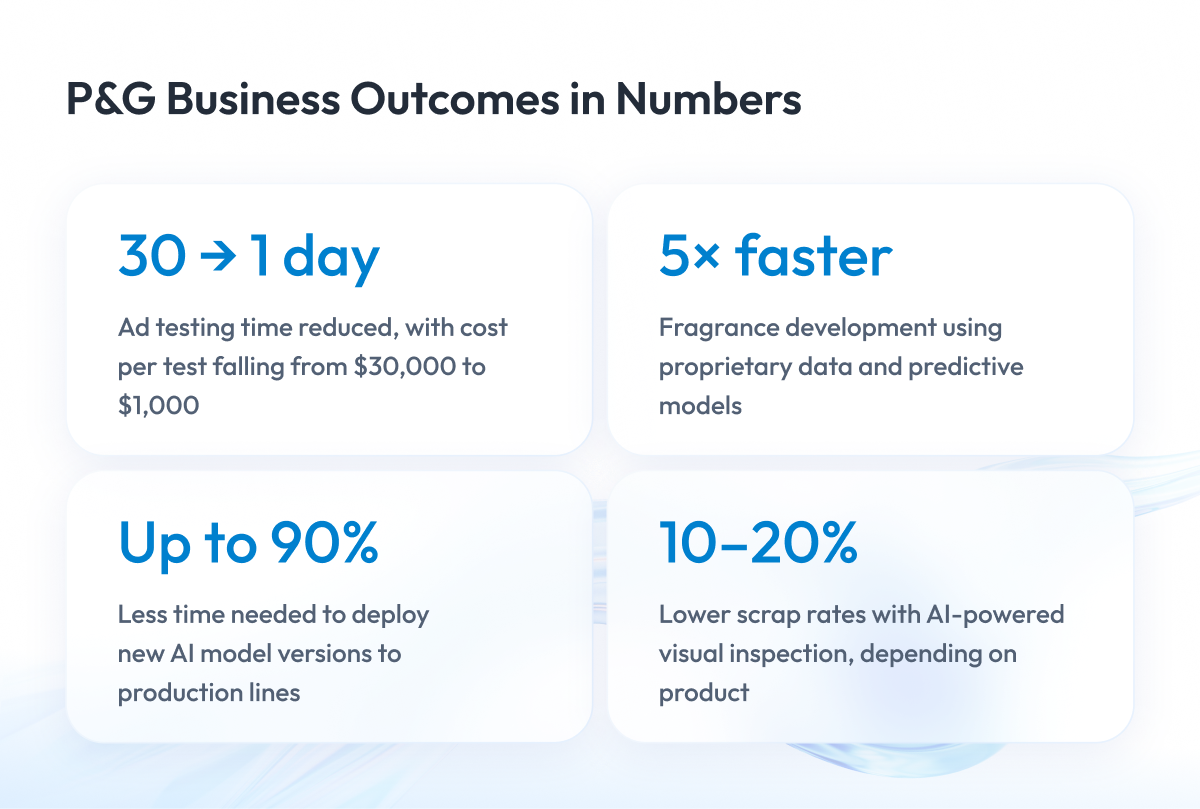
- Pampers AI Studios cut a single ad test from 30 days and $30,000 to one day and $1,000, supporting more than 140 optimized ads a year.
- Models trained on P&G’s own data moved AI-generated product claims from 33% to 100% “highly appealing” across two feedback rounds and sped fragrance development five times.
- Cloud-to-edge deployment with Microsoft cut new model version rollout time by up to 90%, and AI visual inspection with Siemens reduced scrap rates by 10 to 20%.
- P&G’s approach sequences reachable data, tested human-AI configurations, domain-specific models, and fast evaluation, with a deployment path that ends in an operator action.
In 2023, P&G’s chief brand officer put a number on a Pampers ad test: one day and $1,000. The traditional version took 30 days and $30,000.
A year later, 791 P&G professionals took part in a randomized experiment. One person working with AI matched the output quality of a two-person team working without it.
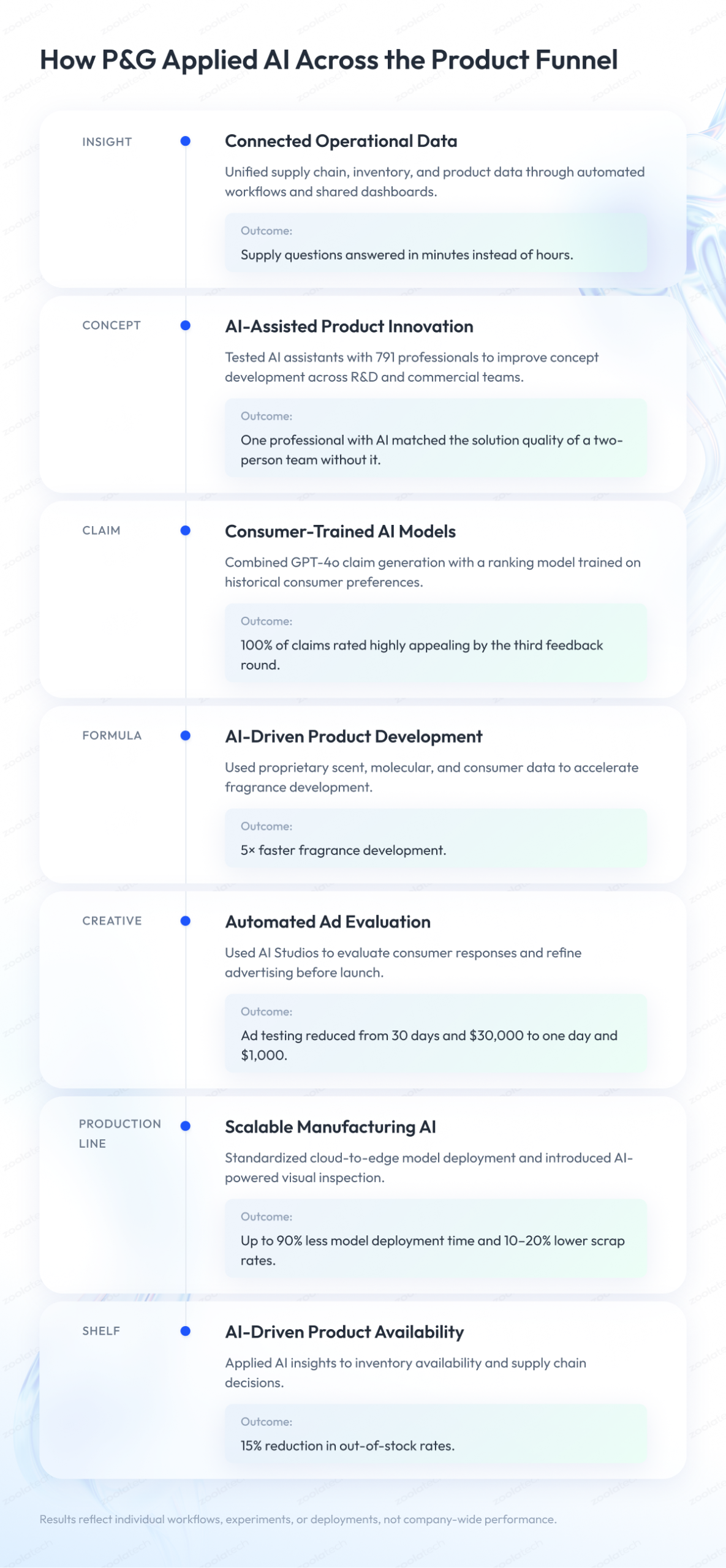
Those two facts come from different corners of the company. What connects them is a product funnel: insight, concept, claim, formula, creative, production line, shelf. P&G has published AI results at every one of those steps.
The measured ones are narrow:
- A Pantene launch workflow ran five times faster than the usual initiative timeline
- AI-generated product claims went from 33% to 100% “highly appealing” across two feedback rounds
- Deploying a new model version to a production line takes up to 90% less time
- Scrap rates fall 10 to 20% on lines with AI visual inspection
Each number belongs to one workflow or one experiment. P&G reports them that way. This case study keeps them that way.
The Problem: A Product Funnel Where Judgment Was Slower Than Ideas
P&G sells in 180 countries, runs plants in more than 35, and collects over two million consumer research touchpoints a year. Ideas were never scarce. Deciding which ones were right was slow, expensive, and siloed.
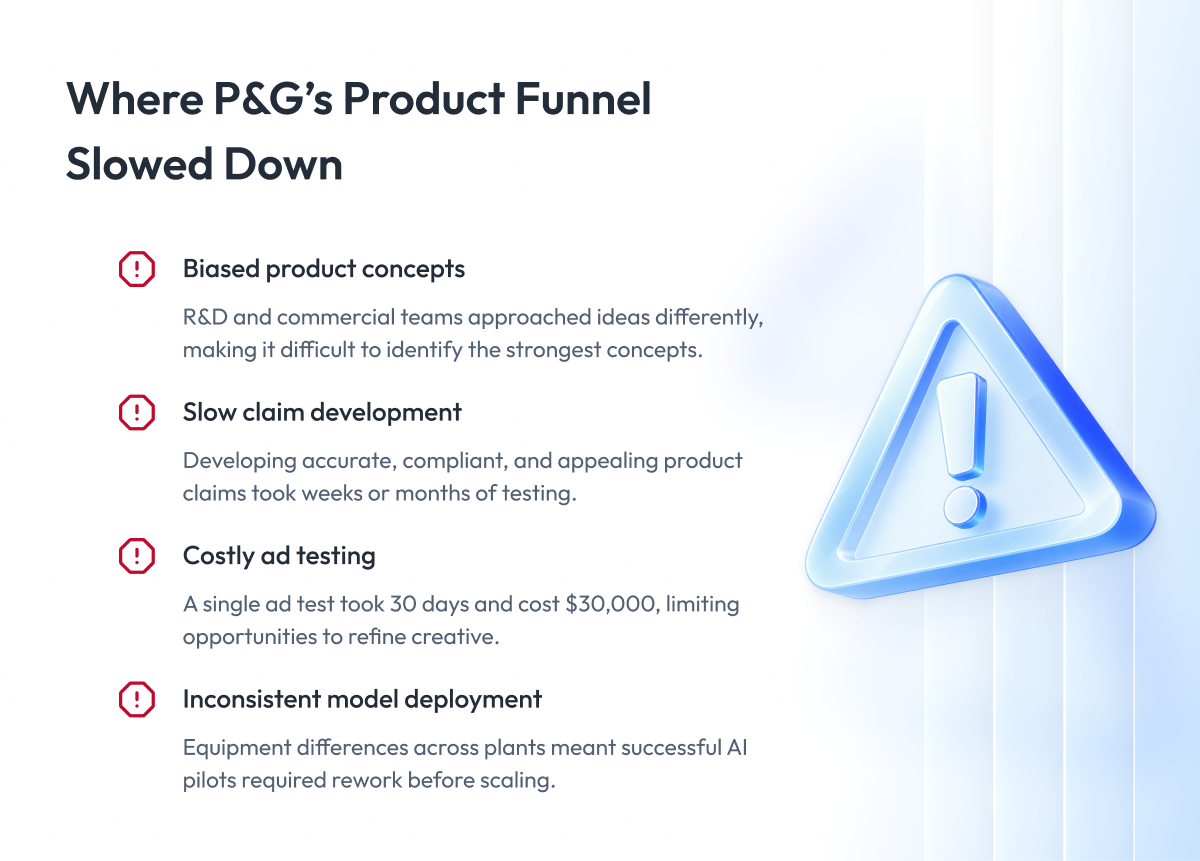 The friction showed up at four points in the funnel:
- Concepts carried their author’s bias: R&D professionals proposed technical ideas, commercial professionals proposed commercial ones, and nobody could tell early which were best.
- Claims took months: writing a product claim that was true, legally clean, and appealing meant weeks or months of draft-and-test cycles.
- Ad tests took a month: at 30 days and $30,000 per test, a creative team could not afford to test a revision before it shipped.
- Models did not travel between plants: equipment varied by country and by line, so a quality model that worked in one pilot needed rework in the next.
Underneath sat a data problem. In Personal Health Care alone, 5,000 products built from 22,000 components lived in systems that took hundreds of expert hours to join.
A routine supply question took two or more hours a day to answer.
Generative AI could make the ideas cheaper still. That was not the bottleneck.
P&G’s work went into the other half: making the verdict on an idea, a claim, an ad, or a unit on the belt as fast as the idea itself.
What Procter & Gamble Delivered
P&G’s investor decks, R&D publications, partner case studies, and one peer-reviewed experiment make the sequence reconstructible. The dates are publication dates. They do not describe one program.
| Period | What P&G delivered | Evidence type |
| 2021 to 2022 | Lima and Guangzhou “lighthouse” plants; 47,000-image liquid-stability dataset | WEF program reports; research dataset |
| 2022 | Multiyear Microsoft collaboration on cloud-to-edge manufacturing AI began | Partner account |
| February 2023 | Pampers AI Studios: one-day, $1,000 ad tests | Executive first-person account |
| May to July 2024 | Randomized experiment on AI and teamwork, 791 professionals | Peer-reviewed, published June 2026 |
| December 2024 | Perfume Development Digital Suite: fragrances developed five times faster | P&G R&D report |
| January 2025 | ChatPG passes 30,000 users | P&G adoption report |
| June 2025 | AI-driven insights cut out-of-stock rates by 15% | P&G outcomes report |
| August 2025 | Azure IoT Operations: model version deployment time cut up to 90% | Partner customer story |
| September 2025 | Claim Advisor paper: retrieval, generation, and ranking for product claims | Workshop paper, P&G coauthors |
| February 2026 | AI Factory architecture and Pantene Sunkiss Glow 5x example shown to investors | Official investor slides |
| September 2026 | Siemens Visual Inspection Cockpit expanded worldwide; scrap down 10 to 20% | Supplier deployment report |
Laid along the funnel, those deliveries form seven capabilities. Each one puts a faster verdict next to a faster generator.
| Funnel stage | Capability | What it does |
| Insight | Core data lake and AI Factory platform | One governed source for research and operational data |
| Concept | GPT-4-based assistant; consumer digital twins | Raises concept quality; balances R&D and commercial views |
| Claim | Claim Advisor | Generates claims, then ranks them like a consumer would |
| Formula | Perfume Development and Molecular Discovery suites | Shortlists scents and molecules from proprietary libraries |
| Creative | AI Studios ad testing | Scores a draft ad in a day instead of a month |
| Line | Cloud-to-edge deployment; Visual Inspection Cockpit | Ships models to plants; rejects defects at line speed |
| Shelf | AI-driven availability insights | Forecasts demand and positions inventory |
How Procter & Gamble Built It
The funnel below is a synthesis. P&G has never published it as one diagram. The stages are as the company describes them; the connections between them are editorial.
Insight: make the data reachable first
P&G’s 2026 investor deck shows its AI stack as three blocks. A core data lake fed by consumer research and operational data. An “AI Factory” of infrastructure, models, agents, evaluation, interfaces, and governance.
And users, from data scientists to all employees.
The unglamorous version of that lake sits in Personal Health Care supply chain. P&G automated the joins with KNIME workflows that merge bills of materials, supplier, inventory, and logistics records into shared dashboards.
| Supply chain data | Before | After |
| Answering supply and demand questions | Two or more hours a day | Minutes to near-instant |
| Finding a product’s parts | Hours across multiple systems | Seconds |
| Dedicated data navigators | 10 or more | Zero |
| Regional review meetings | Daily, per region | One global decision meeting |
None of this is an AI result. It is what the next six stages stand on.
Concept: run the experiment before the rollout
Before scaling generative AI into product development, P&G tested it. Between May and July 2024, 791 professionals from four business units worked on live innovation problems. Harvard and Wharton researchers assigned them at random to four conditions.
The study appeared in Organization Science in June 2026.
| Condition | Who | Quality versus solo, no AI |
| Solo, no AI | One R&D or commercial professional | Baseline |
| Team, no AI | One R&D plus one commercial professional | +0.24 standard deviations |
| Solo with AI | One professional plus a GPT-4-based assistant | +0.37 standard deviations |
| Team with AI | Two professionals plus the assistant | +0.39 standard deviations |
Three findings shaped what came after:
- A person with AI equals a team without it. The two conditions were statistically indistinguishable on quality.
- AI erased the expertise silo. With AI, R&D and commercial people both produced balanced concepts.
- AI did not improve selection. Unaided teams picked their top-rated idea about half the time. AI-assisted participants did so about 37% of the time.
Two caveats travel with it. Quality was scored by 19 trained evaluators on P&G’s criteria, not by market results.
And the time savings often quoted, 16.4% for individuals and 12.7% for teams, come from the working-paper version. They are not in the journal text.
For Pantene Sunkiss Glow, teams later built “twins” of the target consumer from the research database and brainstormed against them in real time. A package mock-up existed within a day.
Claim: generate with GPT-4o, rank with a model that thinks like a consumer
Claim Advisor splits claim writing in two. GPT-4o generates candidates from approved claims and images. A separate Phi-3 model, fine-tuned on 100,316 examples from past MaxDiff consumer studies, ranks them.
The ranker is the point. It imitates the best-worst choice consumers make in a MaxDiff survey, so it tracks what consumers would pick, not what reads well.
| Round | Who wrote the 30 claims | Rated highly appealing |
| 1 | Human team | 20% |
| 2 | Claim Advisor, after round 1 feedback | 33% |
| 3 | Claim Advisor, after round 2 feedback | 100% |
This is iteration, not a controlled comparison. Each round learned from the last. Legal review still follows, by people.
Formula: proprietary libraries behind the models
P&G’s chief R&D officer reports that a Perfume Development Digital Suite lets the company develop fragrances five times faster. It pairs a scent and molecular library with consumer-acceptance models.
The 2026 deck adds a Molecular Discovery Suite behind the Unstopables Luxe fabric enhancer. The CIO said molecule identification that typically takes six to eight years can happen in as little as six months.
That is a best case for one step, not a finished product.
The older, more measurable work is in formulation testing. P&G researchers published more than 47,000 labeled images of fabric softener vials so that convolutional networks could flag instability without destructive testing.
- Model does: shortlists molecules and scents; flags unstable formulations from images.
- Person does: safety, stability, and regulatory work, unchanged.
- Published figure: fragrance development 5x faster; molecule timing a transcript best case.
Creative: a one-day ad test
In Pampers AI Studios, open-ended consumer reactions to a draft ad feed a model trained on decades of historical ad responses. The score guides revision. It is the clearest before-and-after in the P&G record.
| Ad test | Traditional | AI Studios |
| Elapsed time | 30 days | 1 day |
| Cost | 30,000 | 1,000 |
| Ads optimized per year, Pampers | Not stated | 140+ |
A test that takes a day can change the ad before it ships. A test that takes a month cannot. This is the experiment’s selection problem, solved with tooling.
Pampers’ 2022 U.S. results, 10% sales growth, 17% higher ROI, and 15% media savings, came from a bundle of targeting, media, and creative changes. The one-day test is one input.
Line: build in the cloud, run at the edge, reject on the belt
P&G’s manufacturing problem was variation, not modeling. Its VP of IT has said equipment differences across countries “made things difficult when we went to scale.”
The fix, built with Microsoft since 2022, separates where a model is trained from where it runs:
- Line data flows up: sensor and quality data lands in an Azure data lake.
- Models are built once: data scientists train and retrain in the cloud.
- Models ship down: Kubernetes-packaged models deploy to plant edge devices through Azure Arc and MQTT.
- Operators keep control: they tune tolerances and schedule version upgrades around production.
- Inference becomes a task: a flagged anomaly triggers an operator inspection.
The published result: deploying a new model version takes up to 90% less time. That is a release figure, not a build figure.
Inspection goes a step further. The Visual Inspection Cockpit, built with Siemens, was expanded worldwide in September 2026.
It runs P&G’s deep learning models on GPU industrial PCs at full line speed. Inference is wired directly to alerts and rejection actions.
| Line system | Model does | Person does | Published figure |
| Predictive quality, Azure | Flags anomalies from edge data | Inspects; tunes; schedules upgrades | Model version deployment up to 90% faster |
| Visual inspection, Siemens | Classifies and rejects at line speed | Commissions; handles material changes | Scrap down 10 to 20%; commissioning 5 to 10x faster |
| Touchless operations | Runs lines and warehouses unattended in shifts | Supervises; intervenes | Scaling to nine sites, per CAGNY 2026 |
Shelf: availability as the last metric
P&G reports that AI-driven insights reduced out-of-stock rates by 15%, without disclosing geography or period.
The Guangzhou “lighthouse” plant offers a fuller picture. It faced a 45% rise in e-commerce demand.
A three-year program of AI, automation, and digital twins delivered 30% lower inventory, 15% lower logistics cost, and 99.9% on-time delivery, per the World Economic Forum.
That is a program result, not an isolated AI effect.
Where the model is allowed to act alone
Lining the stages up exposes a rule P&G never states but follows. The model acts on its own only where a wrong call is cheap and reversible, or where a physical check happens anyway.
| Funnel stage | Model acts alone? | Why |
| Concept | No | Experiment showed AI-assisted selection was worse |
| Claim | No | Legal and scientific review follow ranking |
| Formula | No | Safety, stability, and regulatory stages unchanged |
| Creative test | Partly | Score is advisory; humans revise the ad |
| Line, predictive | No | Anomaly triggers an inspection, not a stop |
| Line, visual inspection | Yes | Reject decision is binary, immediate, and auditable |
| Shelf | Partly | Recommendations within human-set service targets |
Adoption followed the same logic. By January 2025, ChatPG, P&G’s internal assistant, had more than 30,000 users. One employee had trained over 1,600 colleagues.
The Harvard researcher behind the teaching case on P&G’s AI Factory credits uptake to three things: close work with intended users, experimentation days, and business teams owning the problem.
Business Outcomes in Numbers
P&G’s figures do not share a method. Some come from a randomized trial, some from the company, some from vendors, some from conference transcripts. The tables below grade them rather than add them.
Experimental
| Figure | What it measures |
| +0.37 SD solo with AI; +0.39 SD team with AI | Rated concept quality, 791 participants, preregistered |
| Solo with AI equals team without AI | Statistical equivalence on quality |
| Best-idea pick rate about 50% vs 37% | Unaided teams versus AI conditions, exploratory |
Company-reported with a stated baseline
| Figure | Baseline |
| Ad test 1 day, $1,000 | 30 days, $30,000 |
| Claims 100% highly appealing by round 3 | 20% in human-written round 1 |
| Sunkiss Glow execution 5x faster | Traditional initiative timeline, not quantified |
| Fragrance development 5x faster | Prior process, not quantified |
| Supply chain data navigators 10+ → 0 | Manual integration, hundreds of expert hours |
Partner-reported or program-level
| Figure | Limit |
| Model version deployment up to 90% faster | Release workflow only; no absolute times |
| Scrap down 10 to 20% | By product; baseline scrap undisclosed |
| Inspection commissioning 5 to 10x faster | Versus bespoke vision systems |
| Out-of-stock down 15% | No geography or period |
| Guangzhou inventory down 30%; 99.9% on time | Three-year multi-technology program |
Not used as evidence here
| Figure | Why it stays out |
| Molecules in 6 months vs 6 to 8 years | Best case from an executive remark; not a finished product |
| Concepts in minutes, 10x as many | Third-party transcript; no baseline |
| $50 million incremental sales in India | Investor Day remark; slides inaccessible |
| 65% of development AI-powered; $1.1 billion AI budget | No primary source found |
| ChatPG 30,000+ users | Adoption, not return |
Conclusion
P&G’s AI record is often told as a list of tools. Walked as a funnel, it is a list of verdicts made faster.
The experiment set the terms. Generative AI raised the quality of what people produced and flattened the gap between specialists. It did nothing for their ability to choose.
Everything P&G built afterward closes that gap at one stage. A ranker trained on 100,000 consumer choices. An ad test that returns in a day. A camera that rejects at line speed. A deployment path that ships a model in a tenth of the time.
For enterprises mapping their own funnel, the question is not which model to buy. It is which stage has the slowest judgment relative to its generation.
That is where production AI engineering, data platforms built for evaluation, and cloud-to-edge delivery earn their keep.
The model is rarely the bottleneck. The verdict is.
Disclaimer: This is an independent case study review, not a Zoolatech project. It is based on publicly available sources, including P&G’s investor presentations and R&D publications, peer-reviewed research, partner case studies, and press coverage.
Questions You May Have
What did P&G’s AI experiment actually prove?
In a 791-person randomized study, one professional working with AI matched the concept quality of a two-person team without it.
Did AI help P&G pick better ideas?
No, unaided teams chose their top-rated idea about half the time while AI-assisted participants did so about 37% of the time.
How much did AI cut P&G’s ad testing cost?
Pampers AI Studios brought a single ad test down from 30 days and $30,000 to one day and $1,000.
What AI result has P&G measured on the factory floor?
AI visual inspection with Siemens cut scrap rates by 10 to 20%, and cloud-to-edge deployment with Microsoft cut model version rollout time by up to 90%.
Which P&G AI figures should be treated with caution?
Best-case claims such as molecules identified in six months and concepts generated in minutes come from executive remarks without a stated baseline.
Where does P&G still keep a person in the loop?
Everywhere except visual inspection on the line, where a reject decision is binary, immediate, and auditable.