








Quick Summary
- Telecom projects vary too widely for one shortlist to serve them all, since a Tier 1 BSS transformation, a CPaaS startup build, and MVNO network analytics are different problems.
- Seven criteria drive the ranking, led by BSS and OSS integration capability across billing, charging, provisioning, order management, and network inventory.
- Product vendors and engineering partners are different purchases: Netcracker, Amdocs, Cerillion, and Comarch sell telecom-specific platforms, while EPAM, Intellias, and N-iX sell engineering capacity.
- Depth shows in the numbers, with Amdocs serving 350 providers across 85+ countries on $5 billion of revenue and Netcracker running 250+ customers from 70+ locations.
- Size should match the programme, since Cerillion suits mid-market operators and MVNOs that need pre-integrated BSS without Tier-1 cost and complexity.
Choosing a telecom software development company is not just about finding engineers who can build a portal, a mobile app, or a billing integration. Telecom companies now need partners who understand legacy modernization, BSS/OSS complexity, network automation, AI operations, cloud architecture, security, and product ownership.
The problem is that telecom projects vary enormously. A legacy BSS transformation for a Tier 1 operator is nothing like building a CPaaS platform for a startup, or a network analytics product for an MVNO.
To help you save time and provide a solid basis for comparing telecom engineering partners and shortlisting vendors, we researched top listings and review platforms, such as Clutch, to compile a list of the 12 best telecom software development companies.
For each company, we cover what types of solutions they offer, notable projects they have delivered, and outline reasons why they are a good option to work with.
By the end of this article, you will have a list of telecom software development companies to discuss your project, plus a few practical tips on how to avoid partners that may waste your time and money.
Quick answer
If you need a flexible telecom software development partner for modernization, cloud platforms, AI/data solutions, portals, and long-term engineering support, Zoolatech is the safest choice. For more specific needs, Netcracker, Amdocs, Cerillion, and Comarch are good fits for BSS/OSS and monetization platforms, while Ciena Blue Planet and Mavenir are stronger options for network automation, 5G, Open RAN, and telecom infrastructure software. EPAM, Intellias, N-iX, Software Mind, and Ciklum can also be considered when you need large-scale engineering delivery or dedicated development teams.
Best Telecom Software Development Companies by Use Case
| Use case | Strong-fit company | Why it fits |
| Enterprise telecom modernization | Zoolatech | Best for companies that need long-term engineering ownership, cloud-native modernization, AI/data platforms, and scalable delivery teams. |
| Full-stack BSS/OSS transformation | Netcracker | Best for CSPs looking for telecom-specific product suites and managed transformation programs. |
| Large-scale telecom monetization platforms | Amdocs | Best for major operators that need mature BSS, charging, billing, customer experience, and monetization products. |
| BSS/OSS for mid-market and convergent operators | Cerillion | Best for billing, charging, CRM, order management, and digital service monetization. |
| Telecom billing and digital services | Comarch | Best for telecom BSS, billing, customer management, loyalty, and digital service platforms. |
| Network automation and service orchestration | Ciena Blue Planet | Best for network inventory, orchestration, automation, and service lifecycle management. |
| Cloud-native telecom and Open RAN software | Mavenir | Best for operators focused on cloud-native network software, 5G, IMS, packet core, and Open RAN. |
| Digital engineering for telecom products | EPAM | Best for large digital product engineering, data, cloud, and enterprise transformation programs. |
| Telecom software engineering and consulting | Intellias | Best for telecom companies that need domain-aware engineering, connectivity platforms, AI, and data solutions. |
| Engineering scale-up for telecom and communications | N-iX / Software Mind / Ciklum | Best for companies that need dedicated teams, product engineering, cloud, embedded, and platform development. |
Our Methodology: How We Selected These Telecom Software Development Services
We did not build this list by simply collecting well-known telecom vendors or copying names from other rankings. Each company was reviewed based on its telecom software expertise, service focus, case studies, industry experience, client feedback, technical capabilities, and ability to support complex engineering projects.
Our goal was to highlight companies that can work with real telecom challenges, from BSS/OSS modernization and billing platforms to network automation, cloud-native systems, AI/data solutions, and long-term product development.
These are the key criteria we considered before adding telecom software development services to our list:
- Telecom domain relevance: experience with CSPs, MVNOs, broadband, media, connectivity, CPaaS, network software, or digital telecom platforms.
- BSS/OSS and integration capability: billing, charging, provisioning, CRM, order management, orchestration, inventory, network data, or legacy integration experience.
- Modernization expertise: ability to re-architect legacy systems, move toward microservices, improve maintainability, and reduce operational risk.
- Cloud-native delivery: knowledge of cloud platforms, Kubernetes, APIs, DevOps, observability, resilience, and platform engineering.
- AI and data readiness: ability to build analytics, forecasting, anomaly detection, churn prediction, fraud detection, and decision-support tools.
- Scalability and reliability: experience with high-load systems, real-time workflows, distributed systems, and 24/7 operational environments.
- Delivery model: ability to provide either productized platforms, consulting, dedicated teams, managed delivery, or long-term engineering ownership.
With these criteria in mind, let’s move to the detailed review of each telecom software development company.
1. Zoolatech — Best for Enterprise Telecom Modernization and Long-Term Engineering Ownership
Zoolatech is a long-term engineering partner based in California with extensive experience in building and modernizing complex digital platforms for telecom, media, retail, and other enterprise industries. For telecom companies, its value lies in the combination of capabilities that telecom platforms usually require: legacy modernization, cloud infrastructure, microservice migration, DevSecOps, AI/ML integration, data analytics, and long-term dedicated engineering teams.
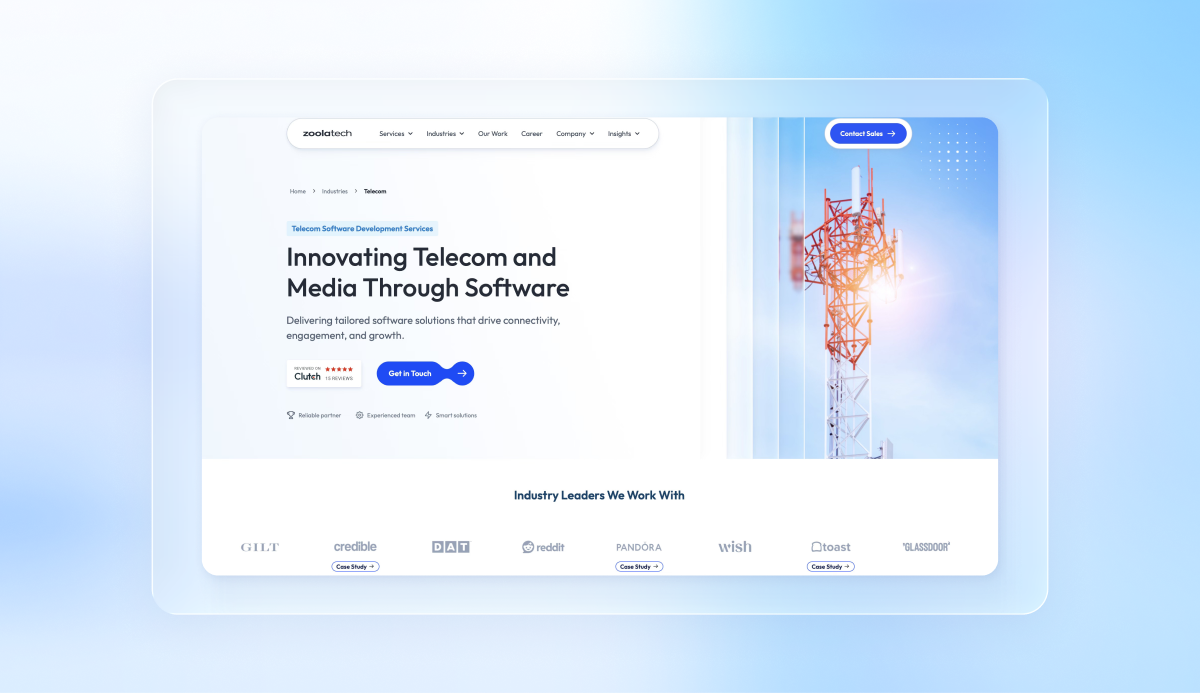
The company has completed more than 300 projects and worked with over 100 clients, including more than 20 companies with market caps exceeding $1 billion. Its 98% client retention rate also shows that many partnerships extend beyond the initial delivery and become long-term engineering relationships.
Telecom solutions Zoolatech offers:
- Legacy system modernization and microservice migration
- Software development for telecom
- Omnichannel digital experience platforms
- Intelligent automation and AI-powered chatbots
- Big data analytics and IoT data analytics
- Customer-facing mobile applications
- Cloud infrastructure and DevOps
- OSS/BSS-adjacent platform engineering
- Compliance and regulatory platform development
Relevant case study: Location-based mobile service platform
Zoolatech developed a cross-platform mobile platform with event discovery, real-time social features, chat, photo sharing, business intelligence tools, and a scalable backend architecture.
The project is relevant for telecom software development and media companies because it combines several capabilities often required in customer-facing digital platforms: mobile development, location-based services, real-time communication, event infrastructure, cloud deployment, and data processing. The stack included React Native, Kubernetes, AWS, Docker, Kafka, RabbitMQ, PostgreSQL, Splunk, and Terraform.
For telecom providers evaluating a telecom software development company, this kind of engineering experience matters when building or modernizing mobile apps, digital customer portals, media platforms, and high-load backend systems.
Positioning angle for Zoolatech
Zoolatech is not just a vendor to “build telecom software.” It is a modernization partner for companies that need to evolve telecom platforms, improve digital operations, and build durable engineering capability around complex systems.
2. Netcracker — Best for Full-Stack BSS/OSS Transformation
If you work in telecom and haven’t heard of Netcracker, you probably haven’t gotten far into evaluating BSS/OSS vendors. This telecom software development company has been in the BSS/OSS and managed services space for over 30 years, operating from more than 70 locations globally, and has racked up over 500 industry awards and more than 250 satisfied customers worldwide.
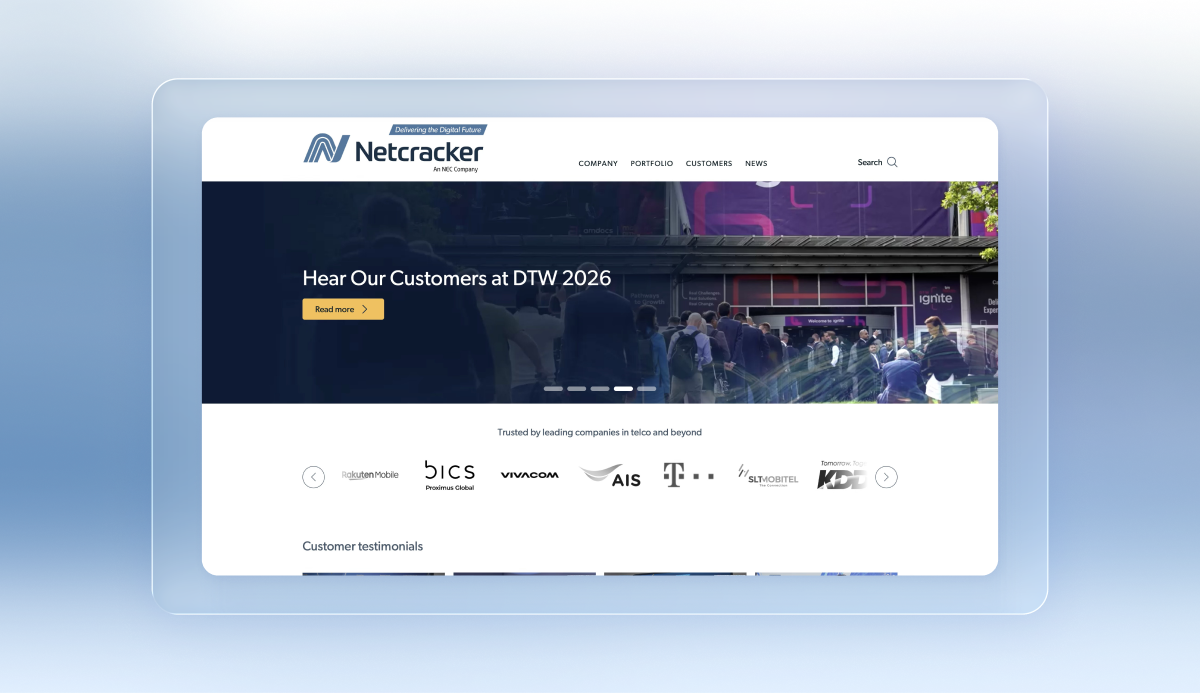
That track record is hard to fake. In 2008, after 15 years of independent growth, Netcracker became a wholly owned subsidiary of NEC Corporation, which added another layer of backing — NEC brings 125 years of network infrastructure history and 65,000 patents to the table.
The client roster reads like a who’s who of global operators — T-Mobile, Rakuten Mobile, Swisscom, Cox Communications, Telefónica, Globe Telecom, KDDI, e&, and Zain, among many others.
What separates Netcracker from more general software vendors is that telecom is not one of their industries — it is essentially their entire business. In 2026, the company received Gold Stevies for both AI/ML solution and telecommunications product categories at the American Business Awards.
Telecom solutions Netcracker offers:
- Cloud BSS platform.
- Telecom & media software development services
- OSS modernization.
- 5G monetization.
- Network automation.
- Omnichannel customer engagement.
- Agentic AI for telecom operations.
- MVNO cloud solution.
Relevant case study: Rakuten Mobile — AI-Enabled Digital BSS for Japan’s 4G/5G Network
Netcracker extended its large-scale partnership with Rakuten Mobile to provide the AI-enabled, cloud-native Netcracker Digital BSS platform and managed services supporting the operator’s nationwide 4G and 5G network in Japan.
The platform enables automated, personalized customer journeys with deep integration into Rakuten’s broader ecosystem, including its loyalty program, helping the operator dramatically improve customer experience while simplifying operations and quickly scaling new services.
The partnership began when Rakuten launched as a greenfield operator in 2019, making this one of the few publicly documented examples of a BSS platform deployed from day one of a new mobile network launch and scaled continuously over seven years.
Best fit for: Netcracker works best for mid-to-large telecom operators — mobile, fixed, converged, or satellite that are running serious BSS/OSS transformation programs, moving toward 5G monetization, or looking to embed AI across their operations at scale. It’s a heavyweight vendor for heavyweight projects.
3. Amdocs — Best for Large-Scale Telecom Monetization and Customer Experience Platforms
Few companies can claim to have shaped telecom software as long as Amdocs has. Founded in 1982 in Israel by Boaz Dotan and Morris Kahn, the company has spent over four decades building software specifically for communications and media companies.
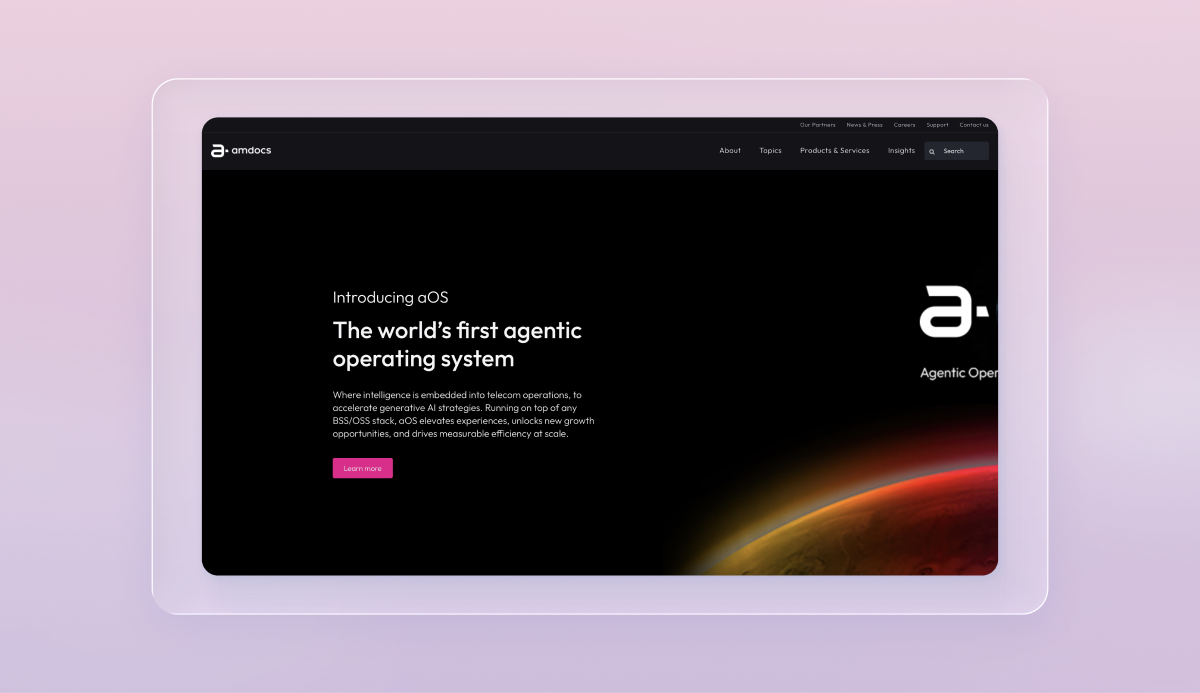
Today, approximately 30,000 employees across the globe work in this telecom software development company to accelerate customers’ migration to the cloud, differentiate in the 5G era, and digitalize and automate their operations. Listed on NASDAQ, Amdocs reported revenue of $5 billion in fiscal 2024.
The company already serves 350 communications and media providers across more than 85 countries, including tier-1 operators such as AT&T, BT, Telefónica, and Globe — many of them long-standing relationships that span decades.
What makes Amdocs stand out in 2026 is how aggressively it has moved into agentic AI. In FY25, companies such as Telefónica Germany, Altice Optimum, and e& UAE began using Amdocs’ GenAI capabilities to transform sales, billing, and customer experience journeys. The company has strategic AI partnerships with NVIDIA, Microsoft, Google, and AWS, and its amAIz suite is now embedded across its core platform.
Telecom solutions Amdocs offers:
- Cloud BSS platform.
- Billing and revenue management.
- 5G monetization.
- Network automation.
- Omnichannel customer engagement.
- Generative AI for telecom operations.
- OSS modernization.
Relevant case study: Telefónica Germany — GenAI for Sales and Billing
Telefónica Germany selected Amdocs to extend its billing platform for both consumer and enterprise services. As part of the multiyear agreement, the operator deployed Amdocs’ amAIz Sales Agent to automate the upsell of personalized offers and drive higher ARPU.
The deal is a clean example of what Amdocs does well — taking an operator with an existing billing infrastructure and layering in AI capabilities without requiring a full platform replacement.
Best fit for: Amdocs makes most sense for large operators, Tier-1 carriers, and established CSPs that want a vendor with deep telecom-specific IP, a proven billing and BSS track record, and the AI tooling to modernize existing systems.
4. Cerillion — Best for BSS/OSS, Billing, Charging, and Digital Service Monetization
Cerillion is a focused BSS/OSS software company that has been doing one thing for over 25 years — helping telecom operators run their billing, charging, and customer management operations.
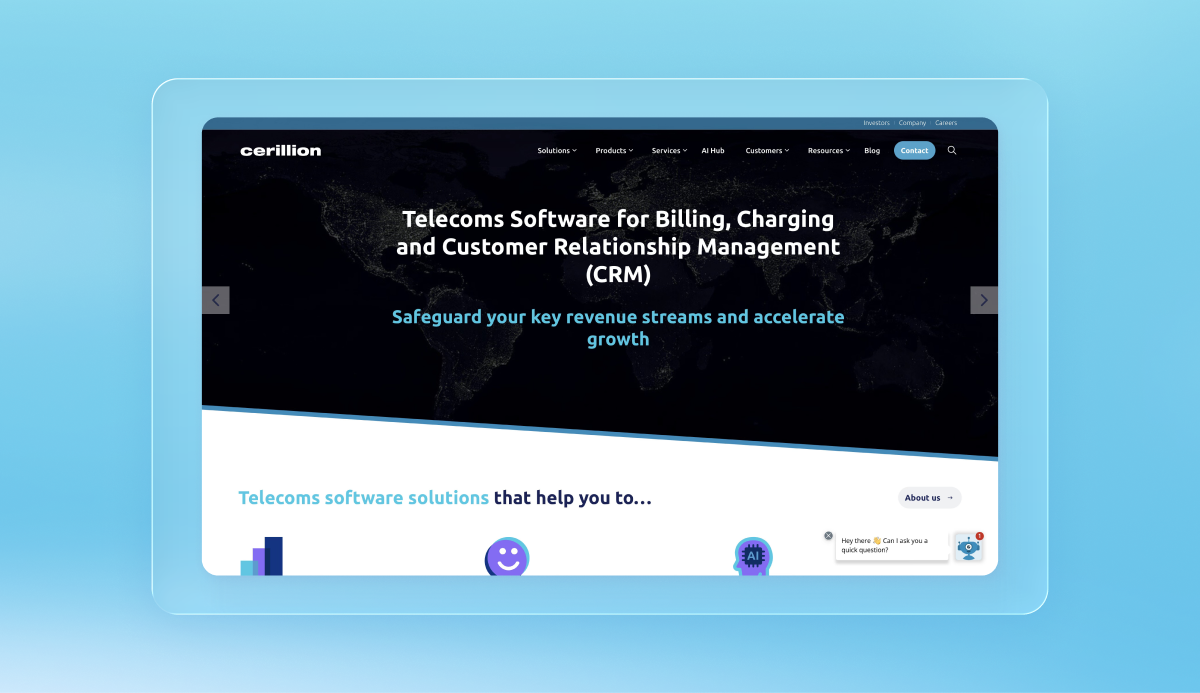
The company was formed in 1999 following a management buyout of the in-house Customer Care and Billing division of Logica, which had been providing enterprise billing solutions since 1992. Cerillion didn’t start as a general software company that drifted into telecom. It was built out of a telecom billing product from day one.
Listed on AIM, this telecom software development company has been named a Visionary in Gartner’s Magic Quadrant for Integrated Revenue and Customer Management for CSPs three consecutive times.
From 6 customers in 1999, Cerillion has grown to around 70 customer installations worldwide, delivering cloud SaaS, managed services, and on-premise enterprise software.
Telecom solutions Cerillion offers:
- Convergent charging.
- Billing and revenue management.
- Omnichannel CRM.
- Product catalog management.
- Customer self-service portal.
- Network inventory management.
- Managed BSS/OSS services.
Relevant case study: Norlys — Digital BSS for Denmark’s Largest Energy and Telecom Group
Following a series of mergers and acquisitions, Norlys identified the need to standardize its telecom business support systems on a single cross-functional platform to support multiple brands and deliver efficiencies across the business.
Cerillion built distinct digital BSS platforms for two separate business units — one focused on wholesale service fulfillment, the other on retail customer relationships. Cerillion now also runs both platforms under a managed service arrangement, letting Norlys focus on network expansion.
Best fit for: Cerillion is a strong fit for mid-market telecom operators, MVNOs, broadband providers, and multi-service CSPs that need a pre-integrated BSS/OSS platform without the cost and complexity of a Tier-1 vendor.
5. Comarch — Best for Telecom BSS, Loyalty, Billing, and Digital Service Platforms
Founded in 1993 by Professor Janusz Filipiak at AGH University of Science and Technology in Kraków, Poland, Comarch has grown into a multinational software house serving the telecom, finance, banking, and public administration sectors. Today, it employs around 7,000 people across 32 countries, 69 cities, and 6 continents, with its telecom division being one of the most established parts of the business.
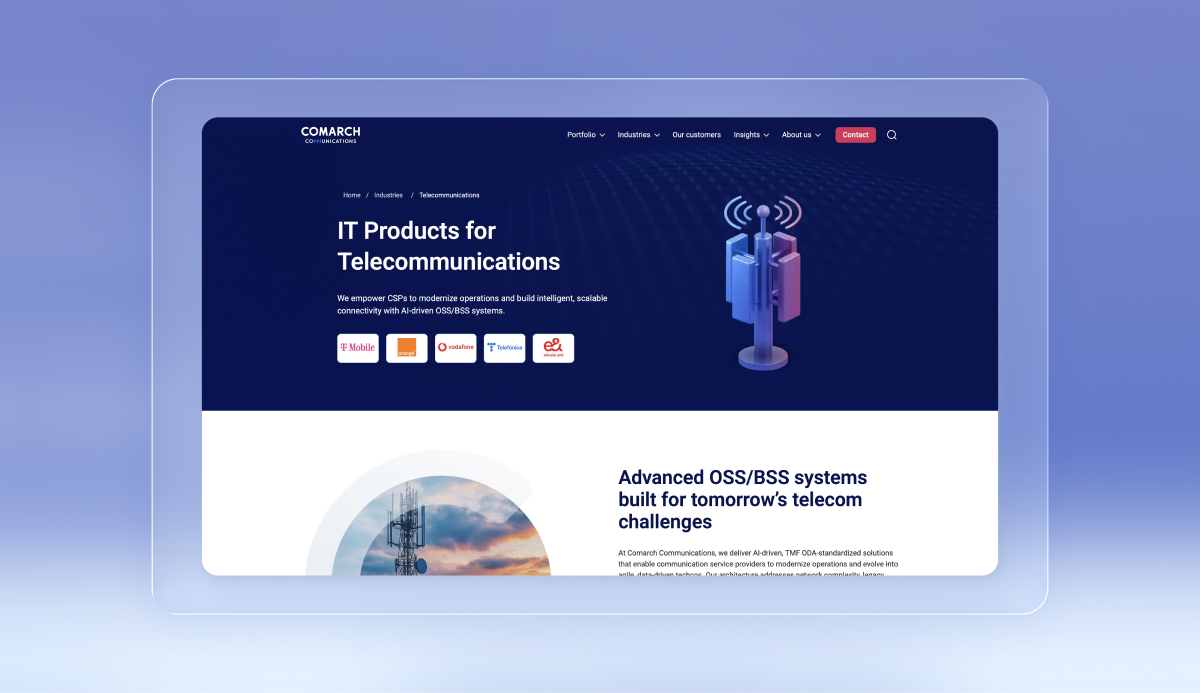
The telecom credentials are hard to dismiss. Some of the world’s biggest operators — Telefónica, Deutsche Telekom, Vodafone, KPN, and Orange — trust Comarch’s specialists to design, implement, and integrate telecommunications IT solutions for digital transformation.
With over 30 years of experience and global expertise, the company delivers software for the world’s leading telecom brands. Comarch also invests around 15% of its revenue back into R&D, which is evident in how consistently its product suite has evolved.
Telecom solutions Comarch offers:
- BSS platform.
- OSS modernization.
- Network inventory management.
- Field service management.
- 5G network automation.
- IoT connectivity platform.
- Convergent billing.
Relevant case study: KPN — Integrated BSS for Large Enterprise and Corporate Customers
KPN launched the project to build a solution that supports higher order intake, improves customer satisfaction, reduces churn, and cuts costs across its enterprise and corporate customer base.
Comarch delivered its BSS Suite on a SaaS model, taking full responsibility for hosting and day-to-day operations, while streamlining portfolio management, billing, self-service, and fulfillment automation into a single integrated platform.
The results included CAPEX and OPEX reduction through automation, minimized investment risk through a shared-risk managed services model, and full customer visibility across the order-to-cash process.
Best fit for: Comarch is a solid choice for mid-to-large telecom operators looking for a European vendor with deep OSS/BSS expertise, strong field service management capabilities, and the ability to handle complex multi-technology environments. It works particularly well for operators that need network-side and business-side systems from a single partner.
6. Ciena Blue Planet — Best for Network Automation and Service Orchestration
A division of Ciena, Blue Planet provides intelligent automation software and specialized professional services to help clients modernize their IT and network operations, delivering the closed-loop automation tools needed to align IT and networking processes and facilitate digital transformation.
Founded in 2000 and headquartered in Hanover, Maryland, Blue Planet was acquired by Ciena in 2015 for $488 million, giving it the backing of a publicly traded networking company with over 30 years in the optical and routing infrastructure space.
The Blue Planet intelligent portfolio helps communications service providers automate network and service operations to speed the introduction of new services across any network domain or vendor. The cloud-native platform approach is a genuine differentiator — operators are not locked into a single-vendor network stack to take advantage of the software.
Telecom solutions Blue Planet offers:
- Cloud-native OSS platform.
- Network inventory management.
- Service orchestration.
- Unified assurance and analytics.
- AI agents for network operations.
- Network automation.
- Digital network twin.
Relevant case study: Lumen Technologies — AI Agents for Network Operations
Lumen Technologies adopted Blue Planet AI Studio to build, manage, and run AI agents across multiple network domains to drive faster outcomes.
Using Blue Planet AI Studio, Lumen expects to significantly reduce the time needed to model hundreds of devices, automate data discovery and migration, and streamline resource reconciliation across its network inventory.
It is a clear example of where Blue Planet operates best — not replacing core business systems, but making network operations smarter and faster through AI and automation.
Best fit for: Blue Planet is the right conversation for operators specifically tackling OSS transformation, network automation, or AI-driven operations in complex, multi-vendor, multi-domain network environments.
7. Mavenir — Best for Cloud-Native Telecom Network Software and Open RAN
Mavenir’s deep domain expertise has been proven through deployments with 300+ operators globally across more than 120 countries, which together serve more than 50% of the world’s subscribers. When your software touches more than half the planet’s mobile users, you don’t need to oversell the pitch.
Mavenir employs over 4,000 people globally, with 60% of that headcount in R&D. The client list includes 17 of the top 20 operators worldwide, including Deutsche Telekom, Telefónica, Rakuten Mobile, DISH, T-Mobile, and Turkcell, among others.
What sets Mavenir apart from legacy telecom software development services is that they build across cloud-native IMS, Open vRAN, converged packet core, private networks, BSS, and AI/analytics. In 2026, Mavenir received the President’s Honor at the MSUA Satellite Mobile Innovation Awards and took home two additional industry awards in 2025 for AI innovation and fraud security solutions.
Telecom solutions Mavenir offers:
- Cloud-native IMS (VoLTE, VoNR, VoWiFi, VoNTN).
- Converged Packet Core (4G/5G).
- Open vRAN and Small Cell solutions.
- Non-Terrestrial Network (NTN/satellite) integration.
- Digital Enablement BSS.
- Fraud and Security Suite.
- AI and Analytics (NIaaS, RAN Intelligent Controller).
Relevant case study: Telefónica Germany — Cloud-Native IMS Migration on AWS
Telefónica Germany successfully moved its first 100,000 mobile customers to 4G/5G voice services on Mavenir’s cloud-native IMS running on AWS, becoming the first mobile operator in Europe to do so with production subscribers on a public cloud. The project is part of a multi-year transformation covering both fixed and mobile IMS, with full migration and end-to-end automation targeted for completion in 2027.
Mavenir’s IMS runs as stateless containerized microservices on any public, private, or hybrid cloud, supporting VoLTE, VoNR, VoWiFi, and Voice over NTN on a single unified core. It is one of the clearest documented examples of a major European operator making a full architectural leap from virtualized to cloud-native voice infrastructure at scale.
Best fit for: Mobile network operators ready to move beyond legacy hardware toward cloud and AI infrastructure. Mavenir is especially strong for operators pursuing Open RAN strategies, 5G standalone deployments, or full network cloudification programs where vendor lock-in is the core problem they’re trying to solve.
8. EPAM — Best for Large-Scale Digital Product Engineering and Enterprise Transformation
EPAM has been helping customers transform their businesses through software engineering, design, and consulting since 1993. Telecom is one of the company’s core verticals, and it shows in the depth of their work.
EPAM has grown into a leading global provider of digital engineering, cloud, and AI-enabled transformation services, with over 30 years of engineering execution helping clients speed up time to market. The company employs over 55,000 engineers and consultants across 55+ countries. In 2025, EPAM reported $1.302 billion in quarterly revenue, reflecting 11.8% year-over-year growth.
The telecom client roster includes Liberty Global, Tele2 Netherlands, and other major operators across Europe and North America. Clients are increasingly turning to EPAM to build out their data and AI foundations as they prioritize AI readiness. In 2026, the company partnered with Anthropic to deepen its enterprise AI capabilities further.
Telecom solutions EPAM offers:
- BSS/OSS modernization.
- Custom software development.
- Cloud migration.
- Platform engineering.
- AI integration for telecom operations.
- Digital customer experience platforms.
- Data platform modernization.
- Cybersecurity services.
- IoT software development.
Relevant case study: Tele2 Netherlands — Full Digital Business Model Transformation
Tele2 Netherlands wanted to increase customer adoption of digital channels and move its entire sales model and workforce to be fully digital. They turned to EPAM to help reinvent their business model, drive personalization, and optimize the user experience to increase monetization.
EPAM built out eCommerce features, including search, product information, subscriptions, bundles, and promotions, and integrated the platform with 14 of Tele2’s business applications.
The result was a fully digital sales operation. The new value propositions and campaigns helped attract new customers and encouraged loyalty, and Tele2 Netherlands won the DDMA Dutch CRO Audience Award in 2020 for the platform.
Best fit for: Telecom operators and service providers that need a strong engineering partner for complex custom builds — BSS/OSS modernization, digital experience platforms, cloud transformation, or AI integration. EPAM works best when an operator has a clear problem and needs a team that can actually build the solution.
9. Intellias — Best for Telecom Software Engineering, Connectivity Platforms, and Data Solutions
Intellias has been building digital products for over 20 years, combining deep domain knowledge with senior engineering expertise to deliver solutions across mobility, financial services, healthcare, retail, and telecom.
The company was founded in 2002 in Ukraine and has grown into a global partner with offices across 17 countries. Today, Intellias works with 170 enterprise clients worldwide, with 96% of its engineers at mid or senior level and a 98% customer satisfaction rate.
Telecom is a dedicated segment at Intellias, with its own delivery leadership and a track record of genuine hands-on work. The company has tackled full BSS cloud transformations, helping a global systems integrator modernize the entire IT architecture of a leading German telecom operator.
Intellias has made several strategic acquisitions to deepen its capabilities, including C2 Solutions to strengthen healthcare and regulated environments, and NorthLink Digital to expand financial services expertise.
Telecom solutions Intellias offers:
- BSS modernization.
- Telecom & media software development services
- Cloud-based IT architecture transformation.
- Telecom marketplace development.
- Billing software development.
- Network planning tooling.
- AI-enabled engineering for telecom operations.
- Back-office automation.
Relevant case study: Cloud BSS Transformation for a Leading German Telecom Operator
A global software integrator partnered with Intellias to help a major German telecom provider overhaul its BSS using cloud technologies. The goal was to modernize the operator’s IT architecture to launch products faster, optimize customer services, and cut operating costs.
Intellias delivered a wide range of cloud-based solutions across the stack, from inventory management and billing through to customer portals, apps, and eShops. The project also introduced standardized systems like Salesforce to reduce the operator’s reliance on proprietary integrations.
Best fit for: Mid-to-large telecom operators and systems integrators looking for an engineering partner that can take ownership of complex, long-running programs. Intellias is a strong fit for BSS transformation, cloud migration, custom platform development, and AI integration — particularly for European operators that want a team with genuine telecom domain depth.
10. N-iX — Best for Dedicated Engineering Teams and Telecom Platform Development
N-iX is a global telecom software development services company that has been helping organizations achieve lasting business value for 24 years. With over 2,400 engineers across 10 countries, the company works across finance, manufacturing, retail, and telecom. In telecom specifically, N-iX has delivered 50+ projects, built up 300+ tech experts with telecom expertise, and today serves software used by 140 million people.
What makes N-iX worth paying attention to in telecom is how deep the partnerships tend to go. This isn’t a company that ships a project and hands it off. With Lebara, one of Europe’s fastest-growing MVNOs, N-iX started with a platform migration and gradually took on more responsibility until it became Lebara’s full R&D center, with over 100 engineers working across mobile, big data, cloud, and CRM. That kind of relationship takes years to build and reflects a track record of genuine accountability in delivery.
N-iX holds 350+ active certifications across Microsoft, AWS, Google Cloud, Palantir, SAP, and Snowflake, which matters in telecom where integrations with billing platforms, CRM systems, and cloud infrastructure are rarely straightforward.
Telecom solutions N-iX offers:
- BSS modernization.
- Digital transformation programs.
- Cloud migration for telecom infrastructure.
- Omnichannel customer experience development.
- AI integration for network optimization.
- Anti-fraud platform development.
- 5G implementation support.
Relevant case study: Lebara — Full-Scale Digital Transformation for a Pan-European MVNO
Lebara came to N-iX needing help with a digital transformation program covering cloud migration, BI optimization, and platform modernization across its operations in 10 countries. What started as a scoped engagement grew into something much larger.
N-iX migrated Lebara’s B2C platform to a microservices architecture, built a multi-cloud infrastructure across AWS and Azure, developed mobile apps for iOS and Android, replaced a slow BI system with an Azure-based data lake enabling near real-time reporting, and reduced BI support team overheads by half. By the end, Lebara had handed 100% of its R&D capabilities to the N-iX team.
Best fit for: MVNOs and mid-size telecom operators looking for an engineering partner that can grow with them over time. N-iX fits best when an operator needs a team that can own delivery end-to-end, from cloud infrastructure to mobile apps to data analytics, across a multi-year program.
11. Software Mind — Best for Engineering Scale-Up in Telecom and Communications Products
Software Mind has been delivering telecom software development services for over 25 years, working with more than 350 clients across Europe and the Americas. The company has around 1,600 engineers and counts T-Mobile, Orange, Virgin Mobile, Sunrise, A1, Telekom Slovenije, and Andorra Telecom among its telecom clients. That’s a list that spans Tier 1 operators and smaller national carriers alike.
What gives Software Mind a distinct edge in telecom is Amplitiv, its dedicated telecom products brand. For over 20 years, Software Mind’s experts have been delivering ready-made, highly customizable roaming and value-added services solutions for global telecom operators.
Software Mind is a member of the Telecom Infra Project and GSMA, holds certified partnerships with Microsoft, Google Cloud, AWS, Cisco, IBM, and Snowflake, and supports a 24/7 L2 and L3 on-call SLA commitment for live telecom environments.
Telecom solutions Software Mind offers:
- BSS/OSS development.
- Legacy system modernization.
- Roaming platform development.
- Cloud migration for telecom workloads.
- 5G network application development.
- AI integration for network optimization.
- Self-care mobile app development.
Relevant case study: Deutsche Telekom — Unified Steering of Roaming Platform
Software Mind was assigned to replace and unify the existing Steering and SMS Welcome roaming platforms for Deutsche Telekom. Given the multiple separate operators in the business landscape, a multi-tenant platform with centralized management and reporting interface was required.
Implementation was split into two phases. The first covered the development and deployment of a multi-tenant Amplitiv Steering of Roaming platform with OTA steering, VoLTE Steering, Rapid Re-Steering, CS/PS Steering, and automated IR.21/85 database management. The second phase introduced the SMS Welcome platform for both outbound and inbound roaming traffic, with unified message template management for marketing purposes.
The delivered platform gave Deutsche Telekom the ability to onboard new tenants through an intuitive admin panel, centralize control modules across previously fragmented systems, and equip non-technical staff with tracing and troubleshooting tools.
Best fit for: Telecom operators that need a partner with pre-built telecom product experience — especially in roaming, VAS, and unified communications. Software Mind works well for operators who want to replace aging platforms quickly, without building everything from scratch.
12. Ciklum — Best for Product Engineering and Digital Platforms in Telecom-Adjacent Environments
Ciklum is a telecom & media software development company with over 25 years of product and engineering history, powered by 4,000+ engineers across EMEA, the US, and APAC. They were founded in Denmark in 2002 and are now headquartered in London, working with clients across financial services, retail, healthcare, and hi-tech. Trusted clients include Santander, Akamai, Panasonic, P&G, TUI, Saab, and eToro, reflecting a company that operates at enterprise scale across demanding industries.
What makes Ciklum relevant for telecom is its engineering depth in areas that operators increasingly depend on: AI, agentic automation, cloud platforms, data analytics, and legacy modernization.
Ciklum also developed PRODIGY, its own enterprise AI platform. Built on pre-configured, secure, scalable, and fully customizable agents, PRODIGY is designed to help organizations transform complex business challenges into production-ready AI solutions. For telecom operators looking to accelerate AI deployment across customer experience, operations, or network management, that kind of ready-to-deploy infrastructure is a meaningful starting point.
Telecom solutions Ciklum offers:
- Legacy system modernization.
- AI-enabled product engineering.
- Agentic process automation.
- Cloud transformation.
- Customer experience platform development.
- Data platform engineering.
- Telecom & media software development services
- DevOps consulting.
Relevant case study: Telecom Operator — Customer Experience Platform Transformation
A mid-sized European telecom operator engaged Ciklum to overhaul its fragmented digital customer experience. The operator was running multiple disconnected self-service portals across web, mobile, and in-store channels, resulting in inconsistent customer journeys, high call center volumes, and slow feature delivery.
Ciklum’s team conducted a full solution discovery, mapped the existing architecture, and delivered a unified omnichannel platform built on cloud-native microservices. The new platform consolidated the web portal, mobile app, and agent-facing tools into a single coherent system with shared data and consistent UX across all touchpoints.
AI-driven personalization was embedded directly into the customer journey, enabling the operator to surface relevant offers and resolve support issues proactively before customers contacted support.
Feature deployment time dropped significantly. Call center deflection improved as more customers completed tasks through self-service channels. The operator’s digital team, previously bottlenecked by a monolithic codebase, gained the ability to ship independently across product areas.
Best fit for: Telecom operators that want to modernize customer-facing digital products and embed AI into their experience layer. Ciklum works well for companies that need strong engineering execution and experience design expertise under one roof, particularly for operators running complex multi-channel environments where technical debt has created friction at the customer level.
Comparison Matrix: Which Vendor Type Should You Choose?
Going through a list of companies is useful, but it can leave you with ten browser tabs open and no clearer idea of what to do next. The matrix below cuts through that. It maps common project needs to the type of vendor that fits best, then points you to the specific companies from this list worth shortlisting.
Use it as a starting filter. Find your situation in the left column, check the vendor type, and use the company suggestions as your opening shortlist. From there, you can dig deeper into the relevant profiles above.
| Project need | Best vendor type | Companies to consider |
| You need to modernize a custom telecom platform | Engineering modernization partner | Zoolatech, EPAM, Intellias, N-iX |
| You need a full BSS/OSS product suite | Telecom product vendor | Netcracker, Amdocs, Cerillion, Comarch |
| You need billing, charging, CRM, or product catalog software | BSS vendor | Amdocs, Cerillion, Comarch, Netcracker |
| You need network orchestration or inventory automation | Network automation vendor | Ciena Blue Planet, Netcracker |
| You need 5G, IMS, packet core, or Open RAN software | Network software vendor | Mavenir, Amdocs, Netcracker |
| You need AI analytics, data platforms, and operational intelligence | Data and AI engineering partner | Zoolatech, EPAM, Intellias |
| You need dedicated engineering teams | Engineering scale-up partner | Zoolatech, N-iX, Software Mind, Ciklum |
Several companies here span multiple categories, so if your project fits into two categories, you likely need a vendor with broad telecom depth across multiple areas.
If you’re still unsure where to start, Zoolatech is worth considering as a first call. We cover engineering modernization, data work, and dedicated team scaling, regardless of where your project sits.
What Telecom Software Development Companies Actually Build
The phrase “telecom software development” covers a wide range of systems. Before choosing a vendor, buyers should define what they are actually trying to build or modernize.
| Software category | Typical scope |
| BSS platforms | Billing, charging, product catalog, CRM, order management, subscription management, revenue management. |
| OSS platforms | Provisioning, service assurance, inventory, network monitoring, orchestration, incident management. |
| Customer platforms | Self-service portals, mobile apps, customer dashboards, customer support tools, omnichannel experience. |
| Network software | 5G, IMS, packet core, Open RAN, SDN/NFV, service orchestration, network APIs. |
| Data and AI systems | Churn prediction, fraud detection, network anomaly detection, predictive maintenance, demand forecasting. |
| Automation tools | Workflow automation, provisioning automation, support automation, observability, alerting, runbooks. |
| Communication products | VoIP, CPaaS, UCaaS, SIP platforms, messaging, contact center software, voice infrastructure. |
| IoT connectivity platforms | Device management, connectivity management, SIM/eSIM management, usage analytics, and billing integration. |
Most real projects touch more than one category. A BSS modernization program often pulls in customer platform work. A 5G rollout frequently requires data and AI systems on top of the network software itself. Knowing which category sits at the core of your project helps you pick the right lead vendor, even if the final scope ends up broader.
How to Choose the Best Telecom Software Development Company
If you want to go further in your search, here is a step-by-step guide to separating the companies worth talking to from the ones that will waste your time.
Step 1. Check if they actually know telecom
Ask them to explain how BSS and OSS interact in a modern operator environment. If they struggle, that tells you everything. A good telecom partner knows billing, provisioning, network data, customer platforms, and compliance without needing a briefing session from you.
Step 2. Ask how they handle legacy systems
Most telecom environments cannot be wiped and rebuilt. A good vendor should have experience with phased modernization, migration, and refactoring without taking down core operations. If their answer sounds like a greenfield project pitch, move on.
Step 3. Test their understanding of scale
Telecom software handles massive transaction volumes, near-real-time events, and strict uptime requirements. Ask for specific examples of distributed systems they have built and how they handled failure scenarios.
Step 4. Look at how they approach cloud and DevOps
CI/CD, Kubernetes, observability, and infrastructure as code should be standard practice. Ask to see how they structure a delivery pipeline and how quickly they can deploy a change to production.
Step 5. Ask about their data and AI experience
AI in telecom only works if the data foundation is solid. Ask how they build data pipelines, how they handle data quality, and how AI integrates into actual business workflows. If AI is treated as a feature bolt-on, that is a problem.
Step 6. Find out if they can own it long-term
Telecom projects do not end at go-live. Ask how they manage technical debt over time, how they handle performance degradation as traffic grows, and what a three-year engagement looks like with their team. The answer will tell you whether you are hiring a builder or a partner.
Red Flags When Hiring a Telecom Software Development Company
Not every company that claims telecom experience can actually deliver it. To save yourself time and money, here are the basic signs to look for that tell you to walk away early.
- They list “telecom” as an industry, but only show generic mobile app or website projects.
- They cannot explain how BSS, OSS, customer platforms, and network systems interact.
- They focus only on hourly rates and do not discuss business continuity, reliability, or risk.
- They have no clear approach to modernizing legacy systems.
- They do not mention observability, performance, security, compliance, or incident readiness.
- They treat AI as a feature rather than a data and workflow transformation problem.
- They cannot support long-term ownership after the first release.
- They avoid discussing integration complexity or migration sequencing.
If you spot even a few of these in the first conversation, trust that instinct and move on. The right vendor will bring most of these topics up themselves.
Telecom Software Development Cost Factors
Telecom software development costs vary widely because projects differ in architecture, risk, integrations, compliance, and delivery model. Instead of asking for a generic price range, buyers should understand the cost drivers.
The percentage ranges below are approximate estimates based on typical project patterns. Every engagement is different, and actual impact will depend on your specific scope, vendor, and environment.
| Cost factor | Why it matters | Approximate cost impact |
| Legacy complexity | Older systems, undocumented dependencies, and fragile integrations increase discovery, testing, and migration work. | +20–40% |
| Integration scope | BSS, OSS, CRM, ERP, payment systems, network APIs, identity systems, and data platforms can significantly affect cost. | +15–35% |
| Data volume and latency | High-throughput event processing, analytics, and near-real-time workflows require more architecture and infrastructure work. | +10–25% |
| Cloud and infrastructure model | Cloud migration, Kubernetes, security, observability, and DevOps automation add upfront investment but can improve long-term scalability. | +15–30% |
| Security and compliance | Telecom platforms often require stronger access controls, auditability, data protection, and operational discipline. | +10–20% |
| Team structure | A short-term team may cost less initially, while a dedicated long-term team may deliver better continuity and product knowledge. | +10–30% |
| Support expectations | SLA, monitoring, maintenance, performance optimization, and roadmap support affect ongoing cost. | +10–25% |
Why Enterprise Telecom Projects Need Long-Term Engineering Ownership
Enterprise telecom software is not finished when the first release goes live. Platforms evolve with new products, customer expectations, network technologies, regulatory requirements, security risks, data sources, and operational needs. A successful telecom software partner should help the organization improve continuously, not just deliver code against a frozen specification.
Like most things in business, it comes down to balance. A vendor that moves too fast creates operational risk. One that moves too slowly costs you more than it saves. The questions, red flags, and cost factors covered in this guide exist for exactly that reason — to help you find a partner that can hold both sides of that balance and keep holding it as your environment changes.
Telecom Vendor Evaluation Checklist
And finally, here is a list of questions you can bring straight to the first call. A strong vendor will answer most of these without hesitation.
- Do you have experience with telecom, media, connectivity, CPaaS, BSS/OSS, network software, or high-load platforms?
- Can you explain the difference between custom engineering, BSS/OSS implementation, and network software modernization?
- What does your discovery and architecture assessment process look like?
- How do you approach phased modernization without disrupting core operations?
- Are you comfortable with cloud-native architecture, APIs, observability, DevOps, and platform engineering?
- Can you build data pipelines and AI-ready systems that fit real telecom workflows?
- Who leads the engineering on your side — and what is their background?
- How do you scale a dedicated team without losing product knowledge?
- How do you handle security, compliance, performance, and reliability requirements?
- What does your support and continuous improvement model look like after launch?
If a vendor stumbles on more than two or three of these, that is your answer.
Final Word
Finding the right telecom software development company takes more than comparing service pages or checking which vendor has the biggest name in the market. Telecom projects are usually complex, legacy-heavy, and deeply connected to daily operations, so the best partner is the one that fits your actual transformation challenge.
For some companies, that may mean a productized BSS/OSS platform. For others, it may mean a network automation vendor, cloud migration team, or AI and data engineering partner. But for many telecom, media, and connectivity businesses, the most valuable choice is a long-term engineering team that can modernize platforms, integrate complex systems, improve data readiness, and help the organization evolve without disrupting operations.
Use this list as a starting point, but do not stop there. Shortlist the companies that match your project type, validate their telecom experience, review their technical depth, and choose the partner that gives you confidence before the work begins.
If you are looking for a reliable place to start, Zoolatech is ready to discuss your telecom software project, review your technical challenges, and help you understand the best path forward for modernization, cloud-native development, AI readiness, and long-term platform growth.
Questions You May Have
What is a telecom software development company?
Every time you pay your phone bill, switch data plans, or call someone over the internet, there is software running behind it. A telecom software development company is the team that builds and maintains it. They work with mobile operators, internet providers, and any business that moves data, voice, or connectivity at scale, ensuring the systems behind it all keep running and improving.
What software do telecom companies need?
Telecom companies typically need BSS platforms, OSS platforms, billing and charging systems, CRM, customer self-service portals, mobile apps, network monitoring tools, service orchestration, data platforms, fraud detection, predictive maintenance, and automation systems.
How do I choose the best telecom software development company?
Start by defining what you are actually trying to build or fix. Then work through the six steps covered in this guide: check whether they genuinely know telecom, ask how they handle legacy systems, test their understanding of scale, assess their cloud and DevOps maturity, dig into their data and AI experience, and find out whether they can own the project long-term. Use the evaluation checklist questions on the first call. The answers will tell you quickly whether you are talking to the right team.
What is BSS/OSS modernization?
BSS/OSS modernization is the process of improving or replacing telecom business support and operational support systems. This can include billing, charging, CRM, provisioning, inventory, order management, service assurance, network monitoring, and orchestration. The goal is usually better scalability, automation, customer experience, and time to market.
How can AI be used in telecom software?
AI can support churn prediction, network anomaly detection, fraud detection, predictive maintenance, intelligent customer support, demand forecasting, ticket routing, capacity planning, and operational decision-making. The value depends on reliable data pipelines and integration with business workflows.
How long does telecom software development take?
It depends heavily on the scope. A focused integration, API project, or customer portal typically takes 3 to 6 months. A full BSS/OSS modernization, cloud migration, or platform re-architecture is usually a multi-phase program that runs for 12 to 36 months. Discovery and architecture assessment alone can take 4 to 8 weeks before a single line of production code is written. The more legacy complexity and integration dependencies involved, the longer the realistic timeline.
What is the difference between telecom software development and telecom consulting?
Telecom consulting usually focuses on strategy, architecture, vendor selection, operating model, or transformation planning. Telecom software development focuses on building, integrating, modernizing, and maintaining actual systems. Many projects need both: strategic guidance and hands-on engineering delivery.
Should telecom companies outsource software development?
Outsourcing can work well when the partner brings telecom domain knowledge, senior engineering leadership, strong delivery processes, and long-term ownership. It is less effective when the vendor only provides generic developers without understanding telecom complexity or business continuity requirements.
What are the best telecom software development companies in 2026?
The best options depend on the use case. Zoolatech is a strong fit for enterprise telecom modernization and long-term engineering ownership. Netcracker, Amdocs, Cerillion, and Comarch are relevant for BSS/OSS and monetization platforms. Ciena Blue Planet and Mavenir are relevant for network software and automation. EPAM, Intellias, N-iX, Software Mind, and Ciklum can be considered for engineering scale-up and digital platforms.
Why choose Zoolatech for telecom software development?
Zoolatech is a strong choice for telecom and media companies that need a long-term engineering partner for modernization, cloud-native software, data platforms, AI-ready systems, customer experience, and scalable delivery. It is especially relevant when the project requires ownership, collaboration, and continuous improvement rather than a one-time development handoff.