
Success Story

Configurable Multi-Agent AI Framework

Zoolatech built a configurable multi-agent AI framework that enables organizations to create AI agents, automate workflows, manage knowledge, and integrate business systems.
Dynamic AI agents
created, configured, and managed without application redeployments.
Enterprise extensibility
supported new workflows, integrations, and use cases through a modular architecture.
Configurable Multi Agent AI Framework
Technologies

Technologies

Expertise

Expertise

Get this case study in PDF to your email

    The Challenge

    Static AI Assistants Could Not Support Evolving Business Needs

    The objective was to create more than a single-purpose AI assistant. The team needed a reusable framework capable of orchestrating specialized agents, managing enterprise knowledge, integrating external systems, and adapting to new business requirements without continuous redevelopment.
    Have a Similar Challenge?
    Explore how configurable AI agents and workflow automation can support your business.
    Contact Sales
    Ellipse

    Prompt updates slowed iteration

    Prompt engineering required constant refinement. Updating agent behavior through code changes and deployments limited experimentation and agility.
    Ellipse

    AI assistants lacked flexibility

    The team needed a framework that could support multiple specialized agents with different responsibilities, tools, and knowledge sources.
    Ellipse

    Knowledge was fragmented

    Information was spread across documents, website content, case studies, and vacancy data, making accurate retrieval and response generation more challenging.
    Ellipse

    Agent behavior required control

    The framework needed safeguards to manage agent access, enforce restrictions, and reduce hallucinations while maintaining useful responses.
    Ellipse

    Future use cases demanded extensibility

    The architecture needed to support new workflows, integrations, and business applications without redesigning the platform.
    Have a Similar Challenge?
    Explore how configurable AI agents and workflow automation can support your business.
    Contact Sales
    Zoolatech is a senior-heavy engineering firm with Silicon Valley roots and a Miami HQ, specializing in legacy modernization, system re-architecture, and AI deployment to drive long-term, compounding value.

    2017

    Year Founded

    600+

    Employees

    96%

    Client Satisfaction
    Workflow

    Building a Configurable Multi-Agent Framework

    The team developed a modular AI platform capable of orchestrating specialized agents, retrieving knowledge from multiple sources, and integrating external systems through a configurable architecture.
    Phase 1

    Establishing the platform foundation

    The team designed the core platform architecture and selected LangChain and LangGraph as the orchestration framework. This foundation enabled scalable agent execution and independent service evolution. Dedicated services were established to support:
    • conversation management
    • knowledge retrieval
    • content indexing
    • administration and configuration
    Phase 2

    Building the knowledge platform

    A retrieval-augmented generation (RAG) pipeline was implemented to transform PDFs and website content into searchable knowledge assets. This provided agents with contextual information grounded in enterprise knowledge sources. The solution leveraged:
    • automated content processing
    • embedding generation
    • BigQuery vector search
    • semantic retrieval workflows
    Phase 3

    Developing agents and business capabilities

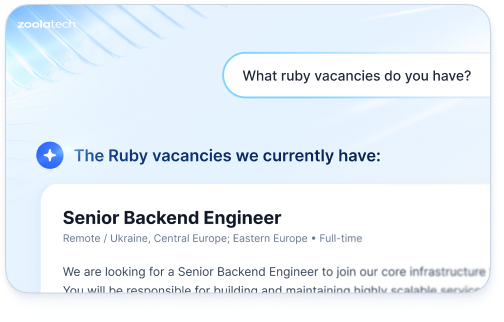
    The team implemented a supervisor-based routing model and developed specialized business, candidate, and general-purpose agents. Agents were connected to tools for knowledge retrieval, vacancy search, website content access, contact capture, and workflow automation.
    Phase 4

    Creating runtime configuration management

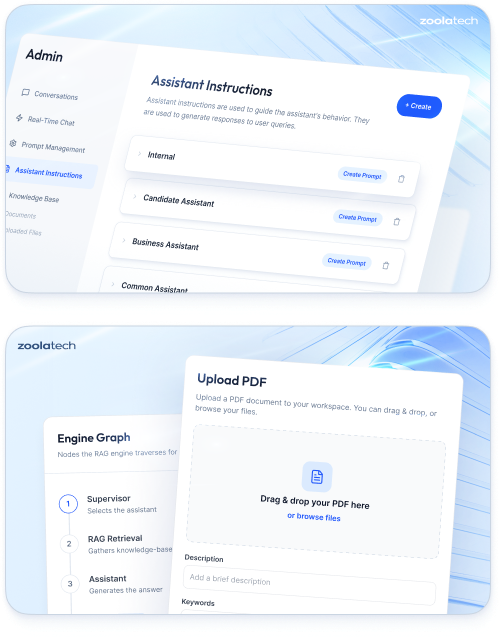
    A dedicated administration platform was developed to manage platform behavior without code changes or redeployments. This significantly accelerated prompt engineering and experimentation cycles. Administrators can configure:
    • agents and responsibilities
    • prompts and prompt versions
    • variables and restrictions
    • tools and workflow behavior
    Phase 5

    Expanding observability and platform maturity

    The team implemented operational tooling to improve transparency and troubleshooting across the platform, including:
    • conversation history management
    • execution logging
    • graph-based workflow visualization
    • runtime execution monitoring
    Solution

    A Configurable Framework for Enterprise AI Applications

    The solution evolved beyond a traditional AI assistant into a reusable framework for building and operating specialized AI agents. The platform enables teams to create, manage, and extend AI-powered workflows through configuration rather than continuous redevelopment.
    approve

    Runtime agent creation and management

    The platform enables administrators to create and configure specialized agents, manage prompts and knowledge sources, and control workflows through a web-based console without modifying application code.
    approve

    Runtime graph generation

    Agent workflows are dynamically assembled from platform configurations. Changes to agents, prompts, and tool assignments automatically update execution paths without modifying application code.
    approve

    Enterprise knowledge management

    The framework transforms documents and website content into searchable knowledge assets through automated ingestion, indexing, and semantic retrieval. This allows agents to generate responses using relevant business context rather than relying solely on model knowledge.
    approve

    Business workflow integration

    Agents can interact with enterprise systems through reusable tools and API integrations. The framework supports knowledge retrieval, vacancy search, website content access, contact capture, notifications, and other workflow-driven capabilities.
    approve

    Operational transparency

    The framework exposes agent routing, tool execution, retrieval activity, and workflow progression through conversation history, execution logs, and graphical workflow representations. This enables teams to understand, monitor, and optimize AI-driven processes.
    Architecture

    A Modular Architecture for Configurable AI Agents

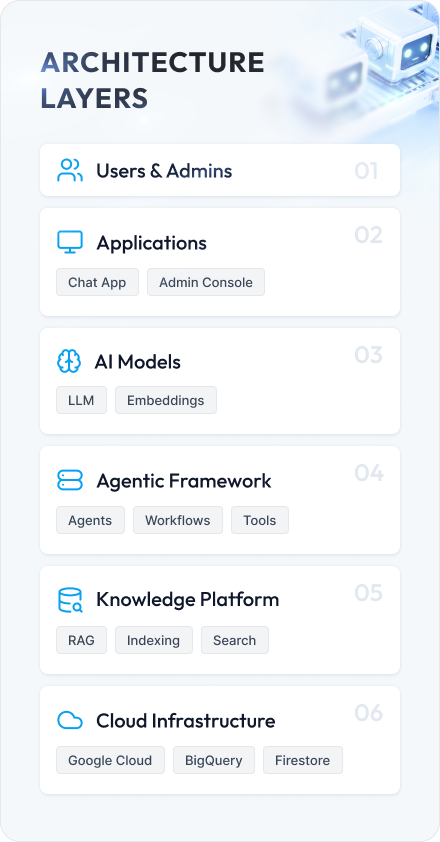
    The framework combines agent orchestration, retrieval-augmented generation, dynamic configuration, and specialized services into a reusable platform for enterprise AI applications.
    Module 1

    Multi-agent orchestration

    Built with LangChain and LangGraph, the orchestration layer coordinates interactions between specialized agents, tools, and knowledge services. A Supervisor Agent evaluates incoming requests, determines intent, and routes conversations to the most appropriate assistant.
    Module 2

    Specialized agent ecosystem

    The platform supports dedicated business, candidate, and general-purpose assistants, each configured with independent prompts, responsibilities, restrictions, and tool access. New agents can be introduced without modifying the core orchestration framework.
    Module 3

    Retrieval-augmented knowledge layer

    The knowledge layer enriches responses with contextual information retrieved from enterprise data sources. User requests are converted into vector-based queries and matched against knowledge assets stored in BigQuery before response generation.
    Module 4

    Knowledge ingestion pipeline

    Documents and website content are transformed into searchable knowledge assets through automated parsing, content extraction, embedding generation, and vector indexing. This enables the platform to continuously expand its knowledge base while maintaining retrieval quality.
    Module 5

    Dynamic configuration and governance

    A dedicated administration application provides interfaces for managing agents, prompts, variables, tools, permissions, knowledge sources, conversation history, and workflow behavior without redeploying the platform. Configuration changes automatically propagate through the execution graph at runtime.
    Module 6

    Tool integration framework

    Agents access business capabilities through a reusable tool architecture that supports knowledge retrieval, vacancy search, website content access, contact capture, workflow actions, and future enterprise integrations.
    Module 7

    Conversation memory and observability

    The platform maintains conversational context through message history and summarization while providing visibility into routing decisions, tool execution, retrieval activity, and overall system behavior.
    The initiative evolved from a conversational AI concept into a configurable multi-agent framework. The platform provides a reusable foundation for enterprise knowledge retrieval, workflow automation, and future AI-driven business applications.
    Risks and Mitigations

    Managing AI Reliability, Governance, and Platform Evolution

    The team addressed key risks related to unpredictable AI behavior, prompt iteration, multi-agent orchestration, and external model dependencies.
    Option
    Risk
    Mitigation
    Prompt managementFrequent prompt changes slowed experimentation and required repeated deployments.Introduced runtime prompt management with versioning and dynamic updates.
    Response qualityAI-generated responses could be inaccurate or unsupported.Implemented RAG, agent restrictions, and knowledge-based response generation.
    Multi-agent coordinationGrowing numbers of agents and tools increased orchestration complexity.Implemented supervisor-based routing with LangGraph orchestration.
    Platform extensibilityNew business use cases risked increasing system complexity.Developed dynamic agent configuration and runtime graph generation.
    AI model dependenciesExternal LLM providers may deprecate models or change capabilities.Designed the framework to support model replacement and configuration updates with minimal system changes.
    Results

    A Reusable Foundation for Future AI Applications

    The initiative established a configurable platform for building, operating, and extending AI-driven business solutions.
    Ellipse

    Unified AI platform

    Agent orchestration, knowledge retrieval, workflow execution, and business integrations were consolidated within a single framework.
    Ellipse

    Operationalized AI configuration

    The platform enables management of agents, prompts, variables, and workflow behavior through configuration rather than application code.
    Ellipse

    Improved execution transparency

    Conversation tracking, execution monitoring, and workflow visualization provide greater visibility into AI behavior and platform operations.
    Empowerment & Value

    A Foundation for Scalable AI Innovation

    The framework provides a reusable foundation for extending AI capabilities across new business domains and operational workflows.
    approve

    Accelerated AI solution delivery

    New agents, knowledge sources, tools, and workflows can be introduced through configuration rather than rebuilding core platform components, reducing effort required to support new use cases.
    approve

    Adaptable enterprise automation

    The architecture can be extended to support internal assistants, recruiting workflows, knowledge management, and other AI-driven business processes while maintaining a consistent operational model.