








Finding a reliable legacy software modernization company takes longer than most teams expect.
You start with a broad list of vendors. Then you spend weeks reading nearly identical agency websites, sitting through discovery calls that go nowhere, and trying to figure out which companies have actually untangled a 15-year-old monolith in production — and which ones just added “modernization” to their services page next to “cloud” and “AI.”
The stakes make it worse. A bad hire on a greenfield project costs you money. A bad hire on a legacy system can take down the operations your business runs on every day.
In other words, this is not a decision you want to rush — but it’s also not one you can afford to spend months on. So we did the heavy lifting for you.
We spent weeks digging through Clutch listings to narrow down the strongest candidates, studied their websites, case studies, and client portfolios, read hundreds of reviews, and then evaluated each shortlisted vendor the way a buyer would.
As a result, we put together a list of the top 10 legacy software modernization companies that are actually worth your time.
By the end of this guide, you will have everything you need to make the right decision. A vetted list of the best legacy software modernization companies, a breakdown of what each one is best for, a clear framework for separating true modernization partners from generic dev shops doing lift-and-shift, and the questions you need to ask before signing a contract.
What Is a Legacy Software Modernization Company?
First, a quick definition so the rest of this guide makes sense.
A legacy software modernization company helps businesses upgrade outdated software without breaking what already works. These firms assess, re-architect, migrate, and rebuild aging systems, then keep them running and evolving after the transformation.
They typically work with enterprises running decade-old ERP and core business systems, mid-market companies stuck on monolithic platforms, and product businesses whose codebase can no longer keep up with growth. Many of their clients come from regulated industries such as banking, insurance, healthcare, and logistics, where legacy systems hold critical data and can’t simply be switched off.
Typical legacy software modernization services include:
- Legacy system assessment
- Application re-architecture
- Monolith-to-microservices migration
- Cloud migration
- Data platform modernization
- API enablement for legacy systems
- UX modernization
- Post-modernization support
In other words, the right legacy modernization software partner helps businesses turn technical debt into a foundation for growth.
Why Legacy Modernization Requires a Specialized Partner
Your company needs a legacy modernization partner because this is most likely the first time your team is doing it, while a specialized vendor has done it dozens of times. They already know the pitfalls that are waiting for you, from undocumented business logic to data that breaks during migration, and they know how to avoid them before they cost you money.
There is also a practical side. Your engineers are busy keeping the business running, and they simply don’t have the capacity to maintain the current system and rebuild it at the same time. A legacy software modernization development agency treats the entire transformation as a separate project, so your operations can keep running while the system is being upgraded.
On top of that, an experienced partner brings things your team can’t get from a first attempt:
- An honest assessment of whether to refactor, rebuild, or replace.
- Realistic timelines and budgets based on similar past projects.
- Phased delivery with a rollback plan if something goes wrong.
- Knowledge transfer, so your team can own the new system.
- Support after launch, when the issues usually show up.
In other words, the right partner turns modernization from a risky gamble into a managed process with a predictable outcome. The only question left is how to find that partner, and that brings us to how we selected the companies on this list.
How We Selected the Companies
A quick word on methodology before the list itself, so you know these rankings weren’t picked out of thin air. Our shortlist spans global leaders and the strongest legacy software modernization companies in the USA, so you can compare options no matter where your team is based.
Our starting point was Clutch, where verified client reviews make it much harder for a vendor to hide behind marketing. We filtered companies by relevance to legacy software modernization, then cut the list down by rating, review volume, and what clients actually said about working with them.
After that, we went through every remaining company’s website, case studies, and client portfolio to see whether modernization is something they genuinely do or just a keyword on their services page.
Each company that passed this filter was then scored against the seven criteria below.
| Criterion | Why It Matters |
| 1. Modernization depth | The company should support more than basic migration or code rewriting. |
| 2. Architecture capability | Complex modernization requires strong architecture, cloud, backend, data, and DevOps expertise. |
| 3. Risk management | The partner should minimize downtime and protect business continuity. |
| 4. Data modernization | AI-ready enterprises need clean, reliable, integrated data platforms. |
| 5. AI and automation readiness | Modern systems should support analytics, intelligent automation, and future AI use cases. |
| 6. Delivery model | Modernization is usually a long-term effort, not a short one-off project. |
| 7. Proof of delivery | Case studies, client examples, and clear service offerings matter. |
What came out of this process is a shortlist of ten best legacy software modernization companies that deserve a place on your radar, each strong in a slightly different way.
Now let’s look at them one by one.
Top 10 Legacy Software Modernization Companies
Each profile covers what the company is known for, who it suits best, and an example of its modernization work, so you can quickly see where each one fits.
1. Zoolatech — Best for Overall Legacy Modernization
Zoolatech is a legacy software modernization company from the United States, founded in 2017 in Silicon Valley and now based in Miami, with development centers in Poland, Ukraine, Mexico, and Turkey. Over that time, the team has grown to 600+ specialists and delivered 300+ projects across retail, fintech, and enterprise software.
The company is self-funded and profitable from day one, works with brands like Pandora and Match Group, and has been recognized by Clutch as one of the top 100 fastest-growing companies as well as by the TechBehemoths Award in 2025.
What makes Zoolatech stand out on this list is its approach to risk. The company treats modernization not as a code rewrite but as a transformation of the whole platform, where architecture, data, integrations, and infrastructure are upgraded together while your business keeps running without disruption. Monolithic systems are replaced gradually with modular microservices, and migration plans are tailored to system complexity instead of forcing every client through the same template.
Legacy software modernization services:
- Legacy system assessment
- Architecture modernization
- Cloud migration
- Data platform modernization
- API enablement for legacy systems
- RPA and AI-driven automation
- Dedicated engineering teams
Best for: retail, fintech, and enterprise software companies that need to modernize complex legacy platforms, from monolithic e-commerce systems to outdated data infrastructure.
Key advantage: Legacy modernization is one of Zoolatech’s core specializations, not a side service, and the company backs it with 175+ completed modernization projects and a 98% client retention rate. That experience shows in how they run transformations, with old and new systems operating in parallel and real-time monitoring to catch issues before they touch the business.
Case example: For one of its enterprise clients, Zoolatech rebuilt legacy systems on a microservices architecture, boosting scalability and removing the bottlenecks of the old monolith. The engagement also shows their scaling model in action, as the team grew from 2 to 60 engineers within 18 months while the client’s platform kept operating throughout the transformation.
2. Accenture — Best for Large-Scale Global Programs
Accenture is one of the largest technology consulting companies in the world, with roots going back to 1951 as the technology consulting arm of Arthur Andersen and operating under its current name since 2001.
Headquartered in Dublin, the company employs nearly 779,000 people, serves more than 9,000 clients, including three-quarters of the Fortune Global 500, and generated $69.67 billion in revenue in fiscal year 2025. It maintains offices in more than 200 cities across 120 countries and was named a Leader in the 2025 Gartner Magic Quadrant for Public Cloud IT Transformation Services.
As a legacy software modernization development firm, Accenture’s scale is both its strength and its defining trait. The company can run multi-year transformation programs that combine strategy consulting, mainframe migration, cloud transformation, and managed services under a single contract, making it a natural fit when modernization touches dozens of systems, business units, and countries at once.
Legacy software modernization services:
- Mainframe modernization
- Application modernization
- Cloud migration
- Enterprise architecture transformation
- Data and AI services
- Managed services
Best for: global enterprises in banking, insurance, healthcare, and the public sector that need modernization at a massive scale, with strategy and implementation handled by a single vendor.
Case example: When Siemens Energy spun off from Siemens AG, it was left with a fragmented finance landscape. Accenture helped the company unify its core finance processes in the cloud, simplifying operations and cutting costs by nearly 50%.
3. IBM — Best for Mainframe-Bound Enterprises
IBM is one of the oldest and most established technology companies in the world, founded in 1911 and headquartered in Armonk, New York. The company employs more than 375,000 people serving clients in 170 countries and generated $67.5 billion in revenue in 2025. Its consulting arm alone runs a practice of 160,000+ professionals, and the company’s mainframe platform still powers mission-critical workloads in banking, airlines, and retail around the globe.
IBM’s real edge as a legacy software modernization company is its own technology stack. Because the company builds the mainframes, the hybrid cloud platform through Red Hat, and the WatsonX AI layer, it can modernize the systems that run on IBM hardware better than almost anyone. That makes it a strong fit for organizations whose legacy core still sits on IBM Z or other IBM infrastructure.
Legacy modernization services:
- Mainframe and IBM Z modernization
- Application modernization
- Hybrid cloud transformation with Red Hat
- Data and AI modernization with WatsonX
- Enterprise integration
- Consulting and managed operations
Best for: large banks, insurers, airlines, and government bodies running core workloads on IBM mainframes that need to modernize without leaving the IBM ecosystem.
Case example: A large bank in France was spending too much to maintain a critical core banking application on its z/OS mainframe, which held between 16 and 17 billion documents, some dating back to the mid-1990s. The solution was to migrate IBM Content Manager OnDemand from the mainframe to a modern distributed Linux environment, cutting the high cost of mainframe processing. The bank estimated a complete return on investment within eight months of the move.
4. HCLTech — Best for High-Volume Code Conversion
HCLTech is one of India’s largest technology companies, founded in 1976 and headquartered in Noida. The company employs more than 227,000 people across 60 countries and reported consolidated revenue of $14.7 billion for the 12 months ending March 2026. It serves clients across financial services, manufacturing, life sciences, telecom, and retail, including over 250 of the Fortune 500, and was named one of TIME’s World’s Most Sustainable Companies in 2025.
Like most large-scale legacy software modernization developers, HCLTech leans heavily on automation, specifically through its own AI tooling. Its AI Force platform can automatically convert legacy code to modern languages like Java and .NET, enabling the company to modernize large application portfolios faster and with less manual effort than a purely people-driven model.
Legacy modernization services:
- Application portfolio assessment
- AI-assisted code conversion
- Cloud migration
- Infrastructure modernization
- Data platform modernization
- Managed operations
Best for: large enterprises in banking, manufacturing, life sciences, and telecom that need to modernize big application portfolios with heavy automation support.
Case example: A US federal credit union with over a million members partnered with HCLTech to move off its legacy applications. The team identified and modernized 339 business capabilities for scalability and reuse across digital banking and set up a CI/CD pipeline with automated testing that enabled real-time deployment and better software quality.
5. Cognizant — Best for Bundling Modernization with Operations
Cognizant is a professional services company from the United States, founded in 1994 and headquartered in Teaneck, New Jersey. The company employs around 349,800 people and reported full-year 2025 revenue in the range of $21.05 to $21.10 billion. It works with clients across financial services, healthcare, and products and resources, and was named to Forbes’ World’s Best Employers list and recognized as a Leader by Everest Group across several 2025 industry assessments.
Cognizant frames modernization around reducing technical debt and getting enterprises AI-ready, supported by its Neuro AI platform and accelerators. Its strength lies in combining application modernization with the business-process operations that sit atop those systems, so the same partner can modernize the technology and run the workflows afterward. This suits enterprises that want modernization and ongoing operations under one roof.
Legacy software modernization services:
- Application modernization
- Cloud migration
- IT infrastructure modernization
- Technical debt reduction
- Data and AI enablement
- Business process operations
Best for: enterprises in banking, insurance, and healthcare that want to modernize core applications while outsourcing the operations that run on them.
Case example: A bank worked with Cognizant to modernize its IT infrastructure and contact center. Cognizant migrated the contact center infrastructure to the cloud and built an omnichannel self-service experience with intelligent automation and voice biometrics, helping the bank cut costs and improve operational efficiency across customer channels.
6. Infosys — Best for Decades-Old COBOL Estates
Infosys is one of India’s largest technology companies, founded in 1981 in Pune and now headquartered in Bengaluru. The company surpassed $5 billion in quarterly revenue in 2025 and serves around 1,860 active clients, including more than 1,000 that each generate over $1 million in annual revenue. It works across financial services, manufacturing, energy, retail, and communications, with the majority of its revenue coming from North America and Europe.
Infosys relies on its own legacy modernization software and accelerators, most notably its Business Rule Extraction approach, which extracts undocumented business rules from legacy code so they aren’t lost during a rebuild. Combined with its scale and its Cobalt cloud assets, this makes Infosys a strong fit for very large, deeply entangled legacy estates where the business logic is buried in decades-old code.
Legacy modernization services:
- Legacy code and business rule extraction
- Application modernization
- Mainframe modernization
- Cloud migration
- Data platform modernization
- Managed services
Best for: large enterprises in banking, insurance, and manufacturing that need to modernize old, complex, mission-critical systems built on decades of accumulated code.
Case example: Infosys partnered with a financial services client to modernize a 40-year-old mainframe-based trading platform written in elaborate COBOL across hundreds of legacy database structures. Using a phased rollout with blue-green deployments to reduce downtime and risk, the team decoupled customer-facing systems from the mainframe and consolidated multiple transaction systems, vastly reducing mainframe resource usage.
7. Classic Informatics — Best for Long-Term Modernization Partnerships in Regulated & Operations-Heavy Industries
Classic Informatics is a custom software development company from India, founded in 2002 and headquartered in Gurugram. It operates as a focused, mid-sized engineering partner — a team of 50–249 professionals delivering to clients across the US, UK, and Australia. The company has completed 3,000+ projects across more than 30 countries, working primarily in healthcare, fintech, insurance, and manufacturing, and holds a 4.9/5 rating on Clutch from 39+ reviews.
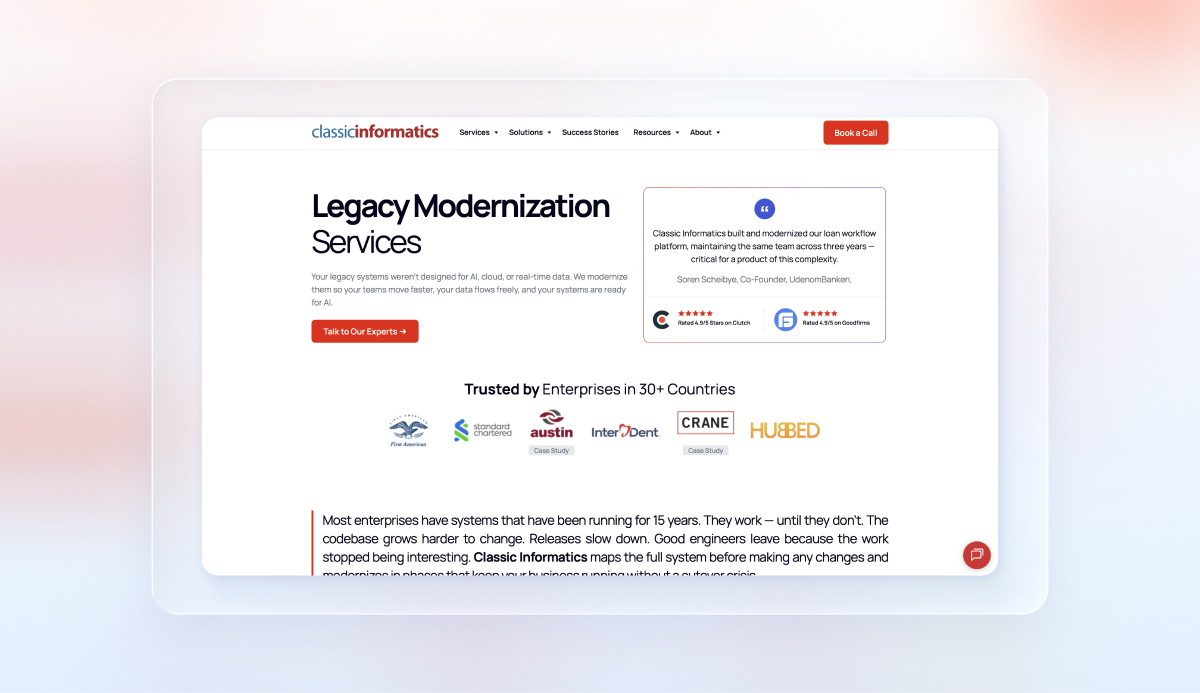
Classic Informatics’ approach to legacy modernization centers on team continuity and a discovery-first process: rather than rotating engineers through a project, the company keeps the same team engaged from initial assessment through post-launch support, in some cases across multi-year engagements. This reduces the ramp-up and knowledge-transfer risk that typically stalls legacy rebuilds, and has helped the company maintain an internally reported 95% client retention rate.
Legacy modernization services:
- Legacy application assessment & modernization roadmap
- Application re-architecture & re-platforming
- Cloud migration (AWS, Azure)
- API development & system integration
- Containerization & CI/CD pipeline modernization
- Legacy data platform modernization
Best For: Mid-market and enterprise businesses in regulated or operations-heavy industries that want a single, dedicated team carrying a modernization project from initial audit through long-term scale.
Case Example: Crane Co., a global industrial manufacturer, had order lifecycle stages (RFQ, Order Acknowledgement, Change Orders, compliance docs) tracked inconsistently across sites with no traceability. Classic Informatics built a unified workflow platform — configurable RFQ approvals, SLA-triggered escalation, SharePoint document integration, and 27+ Power BI/SSRS dashboards tied into Crane’s QAD ERP — now in its eighth year across three delivery phases with zero production disruption.
8. EPAM Systems — Best for Data Platform Modernization
EPAM is a software engineering company from the United States, founded in 1993 and headquartered in Newtown, Pennsylvania. Unlike the large consulting houses on this list, EPAM is engineering-first at its core, the kind of legacy software modernization firm built around delivery rather than advisory work. The company employs around 62,000 people across more than 55 countries and reported trailing revenue of about $5.46 billion at the end of 2025, serving clients in financial services, retail, life sciences, and software.
EPAM’s modernization approach is heavily automation-driven and data-focused. Its migVisor platform automatically inventories legacy data assets, maps dependencies, and builds a migration roadmap, which reduces the risky guesswork of moving large data estates to the cloud.
Legacy modernization services:
- Legacy data platform assessment
- Application modernization
- Cloud migration
- Data warehouse modernization
- Automated code conversion
- Cloud-native re-architecture
Best for: data-intensive enterprises in retail, finance, and consumer goods that need to modernize large analytics and data platforms.
Case example: A global food and beverage leader partnered with EPAM to modernize a decade-old data analytics ecosystem that ran over 60,000 data transformation jobs and 37,000 reports across 16 locations. EPAM migrated the platform from on-premises systems to a scalable cloud infrastructure, cutting migration time by 30% while delivering on time and within budget.
9. SoftServe — Best for Fast Cloud-Native Migration
SoftServe is a technology consulting and digital services company founded in 1993, with headquarters in Austin, Texas, and Lviv, Ukraine. The company employs more than 12,000 professionals across 17 countries and serves clients in financial services, healthcare, retail, energy, and software. It was named a 2025 Best-Led Company by Glassdoor and has long ranked among the leading software engineering firms in Eastern Europe.
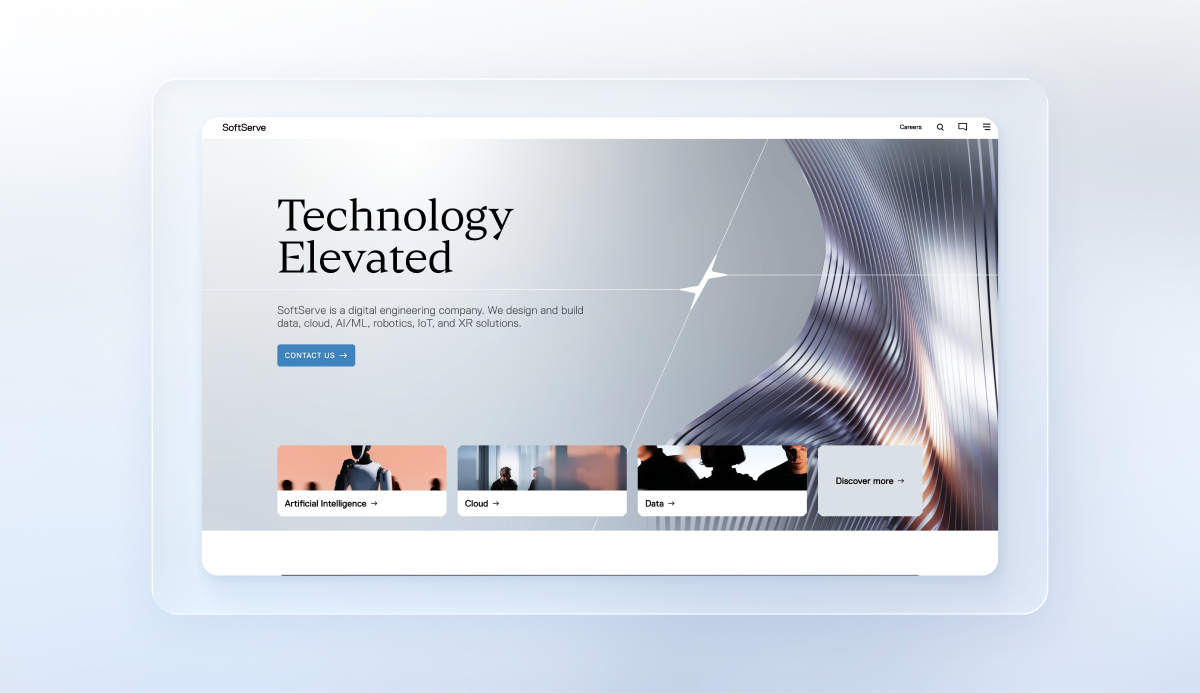
As a legacy software modernization developer, SoftServe is known for speed without recklessness. Its Adaptive Modernization Platform leans on agentic AI to convert legacy .NET, mainframe, and VMware workloads at a pace that manual teams can’t match, while keeping the migration controlled and low-risk.
Legacy modernization services:
- Cloud readiness assessment
- Application modernization
- Monolith-to-microservices migration
- Mainframe and .NET modernization
- AI-assisted code conversion
- DevOps and platform engineering
Best for: mid-size and enterprise companies in finance, software, and healthcare that want a fast, engineering-led path off legacy systems and onto a cloud-native, AI-ready foundation.
Case example: When one of the world’s largest financial institutions wanted to grow its equities division from around €100M into a multibillion-euro business, its legacy equities platform was still running in an internal data center. SoftServe re-architected and rewrote the legacy application, moved it to AWS, and built a new CI/CD microservices testing solution, giving the client a proven template to migrate its other legacy applications at scale.
10. KITRUM — Best for Ownership-Driven Modernization of Live, Business-Critical Systems
KITRUM is a software engineering company founded in 2016, headquartered in Florida, USA. The company has been recognized on the Financial Times’ list of the Americas’ Fastest Growing Companies and holds ISO 27001 certification.
What sets KITRUM apart on this list is how it defines the job. Most vendors treat modernization as a fixed-scope project: assess, rebuild, deliver, move on. KITRUM treats it as a transfer of ownership. The company takes over live, business-critical systems that other vendors shipped and walked away from, or that fast, AI-assisted development left structurally fragile, and stays accountable for the system’s stability and growth long after the initial engagement ends.
Legacy software modernization services:
- Live-system risk audit and legacy assessment
- Architecture modernization and stabilization
- AI Code Handoff & Stabilization (for systems built or extended with AI-assisted development)
- Monolith-to-microservices migration
- Cloud migration
- Data platform modernization
- Long-term technical ownership
This is what KITRUM calls Live-Product Engineering: staying accountable for a system long after the handoff.
Best for: funded product companies across fintech, e-commerce, and data-heavy platforms (Series B and beyond) with a live, business-critical system that needs a long-term technical owner.
Key advantage: 24% of KITRUM’s clients have worked with the company for 2+ years, with a 9.8 client satisfaction score and a 5.0 rating on Clutch from more than 70 reviews. That retention comes from the company’s ownership-based engagement model: clients stay because someone stays accountable after launch.
Case example: One of KITRUM’s clients, a global online marketplace for pre-owned fashion serving millions of users, needed to keep growing past its aging monolithic platform without slowing down feature delivery. KITRUM’s engineers led the transition from the monolith to a microservices architecture, adding new capabilities while the existing platform kept running and serving traffic throughout the migration.
Quick Comparison Table
To make it easier to compare everything at a glance, we put all ten companies into a single table. Use it to quickly weigh them against each other, and scroll back up to the full descriptions whenever you want the detail behind any name.
| Company | Best For | Ideal Buyer | Min. project size |
| Zoolatech | De-risked modernization, AI-ready architecture, cloud, and data transformation | Mid-market and enterprise companies that need long-term engineering ownership | $150,000 |
| Accenture | Large-scale enterprise transformation | Global enterprises with complex modernization programs | $1M |
| IBM Consulting | Mainframe and hybrid cloud modernization | Organizations with mission-critical legacy infrastructure | $1M |
| HCLTech | AI-assisted mainframe and application modernization | Large enterprises with global delivery needs | $500K |
| Cognizant | Regulated industry modernization | Healthcare, finance, insurance, and operationally complex companies | $500K |
| Infosys | Portfolio-wide modernization | Large enterprises with many legacy systems | $500K |
| Capgemini | Cloud-first transformation | Companies combining modernization with digital transformation | $1M |
| EPAM Systems | Product and platform modernization | Digital product companies and platform-driven enterprises | $100,000 |
| SoftServe | Cloud, data, and AI modernization | Companies preparing legacy systems for analytics and AI | $50,000 |
| KITRUM | Ownership-driven modernization and long-term technical accountability for live, business-critical systems | Funded product companies across fintech, e-commerce, and data-heavy platforms (Series B+) | $25,000 |
How To Choose the Right Modernization Partner?
The list above is a solid foundation for starting your search for the best legacy software modernization company. But if you want to go further and properly evaluate potential partners, here is a step-by-step guide to help you do so. Work through the steps in order, and each one will narrow the field until the right partner becomes obvious.
Step 1. Define what you are actually modernizing
Before you talk to a single vendor, get specific about the problem. “We need to modernize” is not a brief. Are you breaking apart a monolith, moving infrastructure to the cloud, rebuilding a data platform, escaping a mainframe, or preparing your systems for AI? Most projects are a mix, but one of them is usually the primary driver. Naming it first prevents you from being sold a service you don’t need.
Step 2. Match the vendor’s core strength to that problem
Once you know the primary driver, look for proof that the vendor has done exactly that kind of work, not just listed it on a services page. Use this as a quick reference:
- For application re-architecture, look for monolith decomposition, microservices or modular architecture, domain-driven design, event-driven architecture, and gradual migration patterns rather than a single big-bang rewrite.
- For cloud migration, look for cloud readiness assessment, hybrid or multi-cloud planning, infrastructure as code, DevOps, and a partner who treats the move as a business transformation rather than a server relocation.
- For data platform modernization, look for data consolidation, quality and governance, pipeline automation, real-time analytics, and the ability to modernize applications and data together, since AI readiness depends on both.
- For mainframe or COBOL modernization, look for legacy code analysis, business logic preservation, migration risk assessment, parallel operation, and genuine experience in the specific legacy language you’re running.
- For AI-ready modernization, look for clean data architecture, modern APIs, cloud scalability, and a partner who connects AI ambitions to architecture, data, and measurable business outcomes.
Step 3. Check how they control risk
A live system running your business cannot go dark mid-project. Ask every shortlisted vendor how they protect you during the transition. Strong partners will talk naturally about phased rollouts, running old and new systems in parallel, rollback plans, and automated testing. If a vendor only wants to discuss the end state and skips past the question of how they get you there safely, treat that as a warning sign.
Step 4. Verify the proof
Move past the sales deck and look at evidence. Read their case studies for numbers and named outcomes, check independent reviews on platforms like Clutch, and ask to speak with a reference client whose situation resembles yours. A legacy software modernization developer that has solved your exact problem before is worth more than one that simply employs more people.
Step 5. Confirm they will still be there after launch
Modernization rarely ends at the first release, because the hardest issues tend to surface once users hit the new system. Make sure your partner offers post-launch support and a long-term engagement model, and that they transfer enough knowledge for your own team to own what was built.
Modernization Strategies: Which Path Fits Your System?
“Modernization” is a broad term, and legacy software modernization can mean very different things in practice. Before you approach a company, it helps to know which type of modernization you actually need, because that single decision shapes the timeline, the budget, and the kind of partner you should look for. The table below breaks modernization down into its main strategies, so you can pinpoint your situation and explain it clearly to any vendor you talk to.
| Strategy | What It Means | Best When |
| Rehost | Move the application to a new infrastructure with minimal code changes. | The system works, but the infrastructure is outdated or costly. |
| Replatform | Move to a new platform with limited optimization. | You need better scalability without a full rebuild. |
| Refactor | Improve internal code structure without changing core functionality. | Technical debt slows delivery, but the product logic is still valuable. |
| Re-architect | Redesign the system architecture for scalability, resilience, and flexibility. | The current architecture blocks growth and innovation. |
| Rebuild | Create a new system while preserving business logic and workflows. | The old system is too rigid, unstable, or expensive to maintain. |
| Replace | Move to a commercial platform or a new solution. | The legacy system no longer provides competitive value. |
Red Flags When Choosing a Legacy Modernization Company
The market is full of companies, and not every legacy software modernization development agency that looks capable on the surface turns out to be the right partner once the work begins. The good news is that bad partners tend to give themselves away early. Watch for the warning signs below, because any one of them is a strong signal that you should not sign with that company.
1. They recommend rewriting everything immediately.
A full rewrite is sometimes necessary, but it is also one of the riskiest paths a project can take. A serious partner assesses your system first and walks you through lower-risk alternatives before reaching for a clean slate.
2. They treat modernization as a simple cloud migration.
Lifting old software to the cloud without fixing what’s underneath just relocates your problems. If a vendor frames modernization as moving servers, they’re skipping the architecture, data, integration, and release issues that actually matter.
3. They don’t discuss business continuity.
Modernization should never disrupt the operations your business relies on. A trustworthy partner brings up phased delivery, parallel operation, rollback plans, and monitoring without being asked. Silence on this topic is a red flag.
4. They ignore your legacy data.
A modern application is only as good as the data behind it. If data quality, migration, and governance aren’t part of the plan from the start, you’ll end up with a shiny new system running on a broken foundation.
5. They promise AI without explaining the foundation.
Real AI readiness depends on clean data, reliable integrations, scalable infrastructure, security, and monitoring. A vendor that promises AI outcomes without first explaining the underlying architecture is selling a buzzword.
6. They can’t support the system after launch.
The work doesn’t end when the first version goes live, that’s usually when the hardest issues appear. A partner who disappears after delivery leaves you stranded exactly when you need them most, so long-term ownership should be on the table from day one.
Questions to Ask Before Hiring a Legacy Software Modernization Company
The easiest way to catch the warning signs above before you sign anything is to ask the right questions early. The list below groups the questions by theme, so you can work through them in a first call and quickly tell a serious partner from one that will become a problem later. A strong company will answer these clearly and specifically. A weak one will stay vague, and that vagueness is exactly the red flag you’re looking for.
Strategy questions
- How do you decide whether to rehost, refactor, re-architect, rebuild, or replace a legacy system?
- How do you prioritize what gets modernized first?
- How do you identify high-risk dependencies before starting?
- How do you measure whether a modernization project succeeded?
- How do you balance quick wins against long-term architecture?
Technical questions
- What legacy technologies have you actually modernized?
- Can you break monoliths into modular systems?
- What is your approach to cloud migration?
- How do you build APIs around legacy systems?
- How do you improve testing and release processes?
- How do you handle security and compliance?
Data and AI questions
- How do you assess the quality of our legacy data?
- Can you modernize fragmented databases and data pipelines?
- How do you prepare systems for analytics and AI?
- How do you ensure data integrity during migration?
- What governance and monitoring do you recommend for AI-ready platforms?
Delivery questions
- Can you start with a discovery and architecture assessment?
- Do you provide dedicated engineering teams?
- Can you work alongside our internal engineers?
- How do you reduce downtime during modernization?
- What does your post-launch support include?
- How do you transfer knowledge back to our team?
Legacy Modernization Partner Evaluation Checklist
Once you have shortlisted two or three vendors and finished the first calls, comparing them from memory gets messy fast. Use this scoring card to make the decision objective. Rate each vendor from 1 to 5 on every criterion, multiply by the weight, and compare the totals.
| Criteria | Weight | Vendor A | Vendor B | Vendor C |
| Legacy modernization track record | x3 | |||
| Architecture and re-engineering depth | x3 | |||
| Risk control and business continuity | x3 | |||
| Data modernization and AI readiness | x2 | |||
| Cloud and DevOps maturity | x2 | |||
| Post-launch support model | x2 | |||
| Team seniority and stability | x2 | |||
| Communication quality during pre-sale | x1 | |||
| Pricing transparency | x1 | |||
| Total |
If two vendors end up close, give more weight to the one that took business continuity seriously and asked sharper questions about your data and existing systems during the call.
Why Zoolatech Is a Strong Choice for Legacy Software Modernization
Zoolatech has spent over 8 years building and modernizing systems that cannot fail. Much of that work happened inside mission-critical and regulated platforms, where the software has to keep running for users the entire time it is being rebuilt. That is the hardest part of any legacy software modernization project, and it is exactly what Zoolatech is used to. Here is what that means for you in practice.
1. Ownership instead of execution.
Zoolatech teams take ownership of the work. We think in systems, raise risks early before they turn into problems, and hold ourselves accountable for the final outcome. When you are rebuilding a system your business depends on, this is the difference between a vendor you have to manage and a partner who manages the problem with you. The average Zoolatech client partnership lasts over 4 years, backed by a 98% retention rate.
2. Senior engineers who have modernized live systems before.
More than 60% of Zoolatech’s team are senior-level engineers, and they have done this work on production systems. They rebuilt the analytics infrastructure for Zalando, increasing GMV by €4.5 million with no downtime, and modernized an FDA-grade manufacturing execution system for MasterControl with zero production interruption. Modernizing a live system without breaking it is a skill you only get by having done it before.
3. A delivery model built for predictability.
You always know what is happening with your project. A dedicated manager runs the delivery, nothing goes live without a quality check, and you choose how to engage. You can add Zoolatech engineers to your own team, or hand over the whole modernization and let them run it end-to-end.
4. Modernization that protects the business.
Zoolatech’s whole approach is built around modernizing safely rather than quickly at any cost. The team prioritizes high-impact areas first, runs old and new systems in parallel where needed, and keeps daily operations stable while the platform is rebuilt underneath them. For companies whose legacy system still runs the business every day, that discipline is the entire point.
Final Word
By this point, you have the list, the criteria, and the questions. The only thing left is to actually start, and the way you start matters more than which name you pick first. The best legacy software modernization developers will make that first step easy.
A good rule is to let the companies show you who they are before you commit to anything. Send the same short brief to two or three that fit your situation and watch what comes back. Do they ask sharp questions about your systems, or do they jump straight to a proposal? Do they reply in a day or in a week? You learn more from that exchange than from any case study on their website.
When you do move forward, keep the first step small enough to walk away from. A short discovery or a technical audit is the cheapest way to find out whether a team is right for you. In a few weeks and for a fraction of the budget, you see how they think, how they handle your code, and whether the partnership has the makings of something longer. A strong start earns the bigger project. A weak one costs you almost nothing to end.
The math on waiting is simple. Old systems get more expensive and more fragile every year you leave them alone, while the companies that modernized already are spending their energy on growth instead of damage control. You do not have to fix everything at once. You just have to take the first step, and this week is a good time to take it.
Questions You May Have
What does a legacy software modernization company do?
A legacy software modernization company helps businesses transform outdated applications, databases, integrations, and infrastructure into modern, scalable, secure, and maintainable systems. In practice, legacy software modernization services cover assessment, re-architecture, cloud migration, data modernization, and post-launch support.
What is the best legacy software modernization company?
The best company depends on your goals. Among the leading legacy software modernization companies in the USA, Zoolatech is a strong choice for businesses that need de-risked modernization, cloud migration, data platform modernization, AI-ready architecture, and long-term engineering ownership.
What is the difference between modernization and migration?
Migration usually moves a system from one environment to another. Modernization improves the system itself, including architecture, code quality, data, integrations, security, scalability, and user experience.
How long does legacy software modernization take?
A focused modernization initiative may take a few months, while a complex enterprise transformation can take a year or more. The timeline depends on architecture complexity, dependencies, data migration, risk level, and scope.
How much does legacy software modernization cost?
Cost depends on system size, technical debt, modernization strategy, integrations, data complexity, cloud requirements, and delivery model. A discovery phase is usually the best way to estimate the budget accurately.
Should we rewrite or refactor a legacy system?
It depends on the system. Refactoring is often safer when the core logic is valuable, and the system can be improved gradually. Rewriting may be necessary when the system is unstable, unmaintainable, or blocks business growth.
How does modernization support AI?
Modernization supports AI by improving data quality, creating reliable APIs, enabling cloud scalability, automating pipelines, and making systems easier to monitor, govern, and evolve. Modern legacy modernization software and platforms make this transition far easier to manage.
What are the risks of legacy modernization?
Common risks include downtime, data loss, broken workflows, underestimated dependencies, scope creep, and lack of user adoption. These risks can be reduced with assessment, phased delivery, testing, monitoring, and strong engineering governance.