








Quick Summary
- Five approaches differ mainly in pace and risk: full replacement, progressive modernization, a sidecar parallel core, wrap and augment, and coreless composable architecture.
- Cost and duration track the approach directly, from $200K-$2M over 3-9 months to wrap and augment, up to $30M-$100M+ across 3-5+ years for a full replacement.
- Three failure modes recur: moving everything at once, underestimating how messy the legacy data is, and never actually switching the old core off.
- Run both cores in parallel and hold each cutover until balances and transactions reconcile exactly, because a mismatch caught after go-live becomes visible to customers.
- Fund decommissioning as its own phase with a budget and an owner, since the old core keeps costing money as long as one edge-case product still depends on it.
Every bank reaches a point where its core system holds the business back more than it supports it. The core is the software that records deposits, loans, payments, and the general ledger, and in most banks it was built decades ago. Core banking modernization is the process of upgrading or replacing the system to support new products, real-time payments, and modern security.
For most teams, the hardest part is choosing how to modernize. The available approaches differ sharply in cost, risk, and disruption, and the wrong choice is expensive to unwind.
This guide takes an engineering view of those options. It covers the five main approaches, a phased roadmap you can follow, what the work typically costs and how long it takes, and how to choose the best partner on the market.
By the end, you will be able to pick the approach that fits your bank, set a realistic budget and timeline for the project, and sequence the work so the bank can keep operating normally throughout the switch.
What Is Core Banking Modernization?
We defined the term briefly in the introduction. Here is the fuller version, along with the two ideas people most often mix up.
Core banking modernization is the process of upgrading or replacing the software that runs a bank’s system of record, so that deposits, loans, payments, and the general ledger move from a legacy monolith to cloud-native, API-first systems. The aim is a core that other systems can read from, write to, and build on without a full rebuild.
What a core banking system does
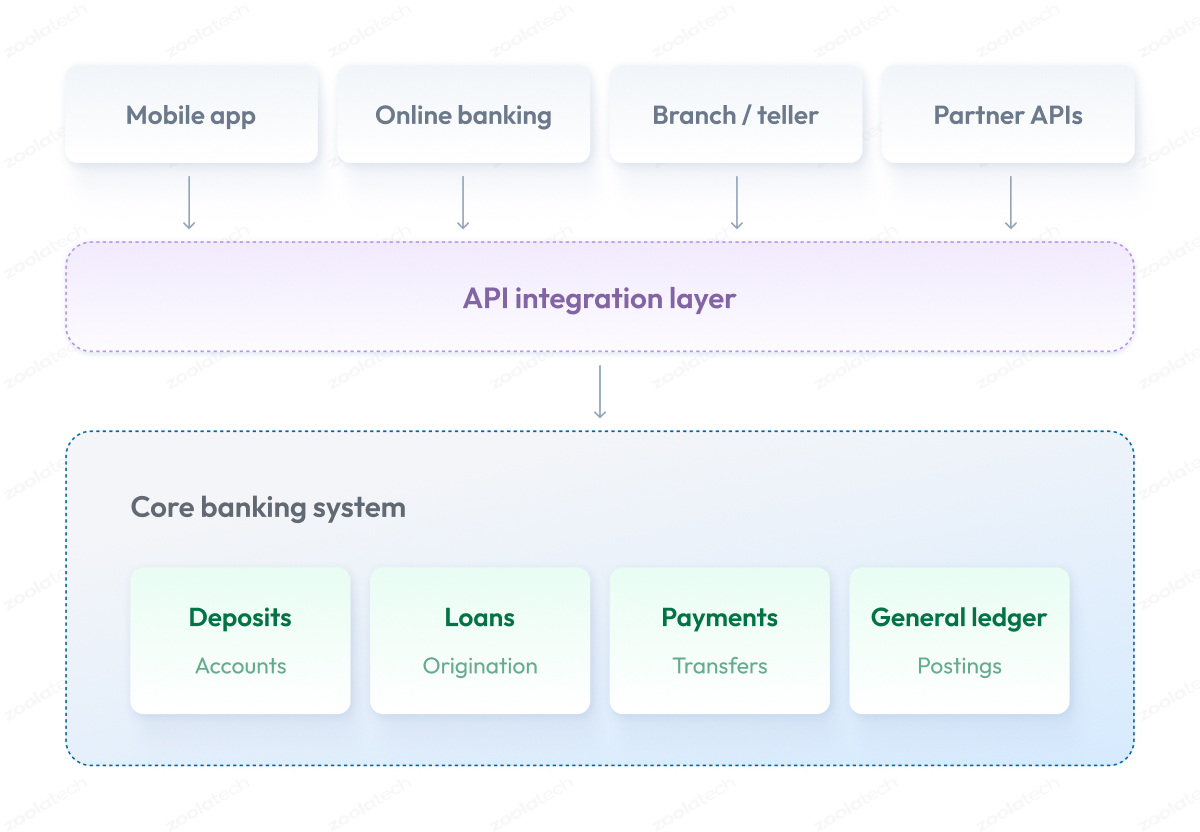
The core is the bank’s book of truth. It keeps every customer account, records deposits and withdrawals, services loans, moves payments, and keeps the general ledger balanced. Whatever a customer touches, from the mobile app to the teller screen, ends up reading from and writing to this one system.
Because a single core runs so many products at the same time, one change in the wrong place can affect all of them at once. Core banking system modernization is one of the harder forms of legacy system modernization a bank will take on.
How modernization differs from digital transformation
People often use these two terms interchangeably, though they mean different things.
Modernization is the technical change of upgrading or replacing the core itself.
Core banking transformation, often called digital transformation, is the wider business change that modernization sits inside. It covers products, channels, the operating model, and customer experience.
In practice, you can run core banking system transformation as one project inside a multi-year program, or run a focused core upgrade on its own.
Reasons for Core Banking Modernization in 2026
The reasons for banking modernization have been building for years, and in 2026 the importance of core banking modernization has crossed the line from “worth considering” to “hard to keep postponing.” Three come up in almost every modernization business case, and together they explain why the timing question has shifted from “someday” to “how soon.”
The old core costs too much to keep running
Most of a bank’s technology budget goes to keeping the existing core alive rather than building anything new.
Some of that spend is unavoidable, but a lot of it goes to specialists who still know the core banking mainframe, to overnight batch processing, and to workarounds that patch over what the core cannot do natively.
Each year, the platform ages, the maintenance bill climbs, and the pool of engineers who can safely touch the system shrinks. Money spent standing still is money not spent on products that win customers.
Customers and regulators now expect things the old core cannot do
Banking demand has moved to real time, and legacy cores were built for overnight batches. Customers expect a payment to land in seconds and an account to open in minutes. Behind the scenes, that means supporting real-time payment rails such as FedNow and RTP, instant onboarding, and embedded finance where a partner offers banking inside its own app.
An old core can be stretched to fake some of this with jobs and middleware, but the delay and fragility show up quickly under volume.
AI and data work only run as fast as the core lets them
AI is now the first thing leadership asks about, and almost every useful case in banking depends on structured access to core data. Fraud scoring needs transactions as soon as they happen. Personalization needs a live view of balances and activity. Automated servicing needs to read and update accounts safely.
A closed core deprives these models of current data and caps the value any AI initiative can deliver. Modernizing the core is often the unlock that makes the rest of the AI roadmap realistic.
Put together, these reasons explain the core banking modernization trends shaping 2026. For most banks, the question has shifted from whether to modernize to how soon and how safely. The next section covers the approaches that answer the “how.”
Core Banking Modernization Approaches
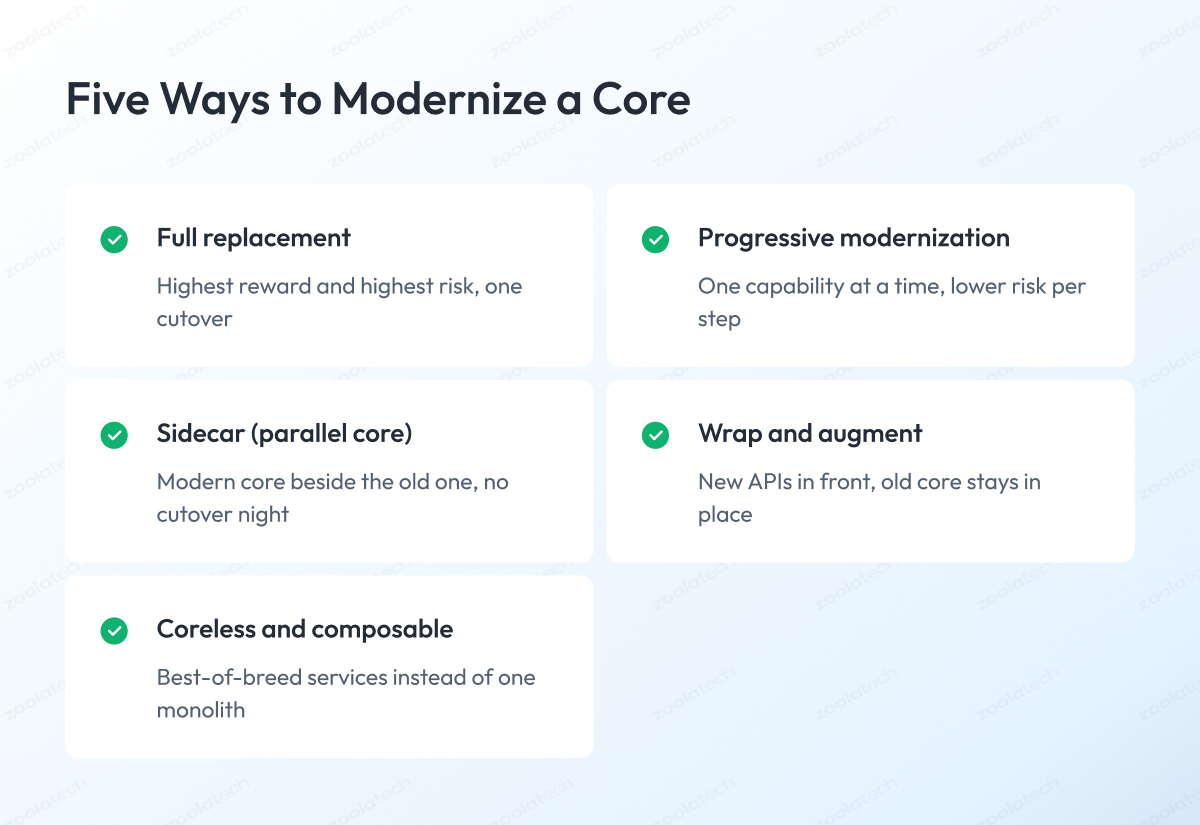
There are five main ways to approach core modernization, and the choice among them is ultimately a matter of pace and risk. Full replacement, progressive modernization, a sidecar core, wrap-and-augment, and coreless each move the bank from the old system to a modern one at different speeds and with varying levels of disruption.
Here is what each one means.
1. Full replacement
You retire the legacy core and switch the whole bank onto a new one in a single program. This is the highest-reward and highest-risk option, since everything moves in a single coordinated cutover.
It fits banks whose old core can no longer be extended and who can commit the years and budget a full swap demands.
2. Progressive modernization
You move one capability at a time, for example payments first, then deposits, then lending, and switch off each piece of the old core as its replacement goes live.
Risk per step is lower because you are never betting your entire bankroll at once, though the overall program runs longer. It works best when the core can be separated into parts.
3. Sidecar (parallel core)
You stand up a modern core next to the legacy one, route a slice of products or customers to it, and grow that share as confidence builds. There is no single cutover night, which is why low-risk core banking modernization suppliers usually recommend this route first.
4. Wrap and augment
You leave the core running, put modern API tools for core banking modernization in front of it, and then build new products and channels on top. It is fast and low-risk in the short term, but the old core and its costs stay in place.
Most banks use it as a first step or a stopgap while a bigger change gets funded.
5. Coreless and composable
Instead of a monolithic core, you assemble best-of-breed cloud-native services for the ledger, payments, and cards, connected through APIs.
It offers the most flexibility and the most integration work, so it suits new brands, neobanks, and greenfield builds more than a running bank with decades of history.
Here is how the five compare at a glance.
| Approach | Cost | Risk | Time | Disruption | Best When |
| Full replacement | High | High | Longest | High, single cutover | Old core unfixable, multi-year budget secured |
| Progressive modernization | Medium-high | Medium | Long | Medium | Core decomposes cleanly by capability |
| Sidecar (parallel core) | Medium | Low-medium | Medium | Low | Proving a new core on live volume first |
| Wrap and augment | Low | Low | Short | Low | Fast new products, deeper change unfunded |
| Coreless and composable | Varies | Medium | Medium | Low for greenfield | New brand, neobank, or greenfield build |
Most programs mix these instead of picking one in its pure form. The next question is whether you buy that new core, build it, or run it as a service.
Build, Buy, or SaaS Core?
Once you know which approach fits, the next decision is where the new core comes from. You can buy a licensed platform and run it yourself, subscribe to a SaaS core someone else operates, or build a custom core in-house.
For most banks, the honest answer is buy or subscribe, and build only where the core is a genuine competitive advantage.
Buying a platform gives you a proven system and keeps you in control of hosting and data, which matters for banks with strict regulatory or on-premise requirements. The trade-off is that you own the infrastructure, the upgrades, and much of the integration work.
A SaaS core moves operations, scaling, and a lot of compliance upkeep to the vendor, so your team ships products instead of patching servers. You give up some control over data location and release timing in return, and you depend on the vendor’s roadmap.
Building custom makes sense in a narrow set of cases:
- When your product model is unusual enough that no platform fits.
- When the core itself is how you compete.
It is the most expensive and slowest path, and it only pays off when off-the-shelf options would force you to give up something central to the business. This is where an experienced software development partner earns its place, because a custom core is unforgiving of shortcuts.
| Option | You Control | Vendor Handles | Best When |
| Buy and self-host | Data, hosting, releases | Product updates | Strict on-premise or data rules |
| SaaS core | Product configuration | Ops, scaling, compliance | Speed matters more than control |
| Build custom | Everything | Nothing | Core is a competitive advantage |
A common pattern is a SaaS or licensed core for standard products, with a small custom layer around the parts that make the bank distinct. The next section walks the roadmap for getting there.
The Core Banking Modernization Roadmap
The roadmap below is the one we use for client programs, refined through the core and legacy modernization work we deliver.
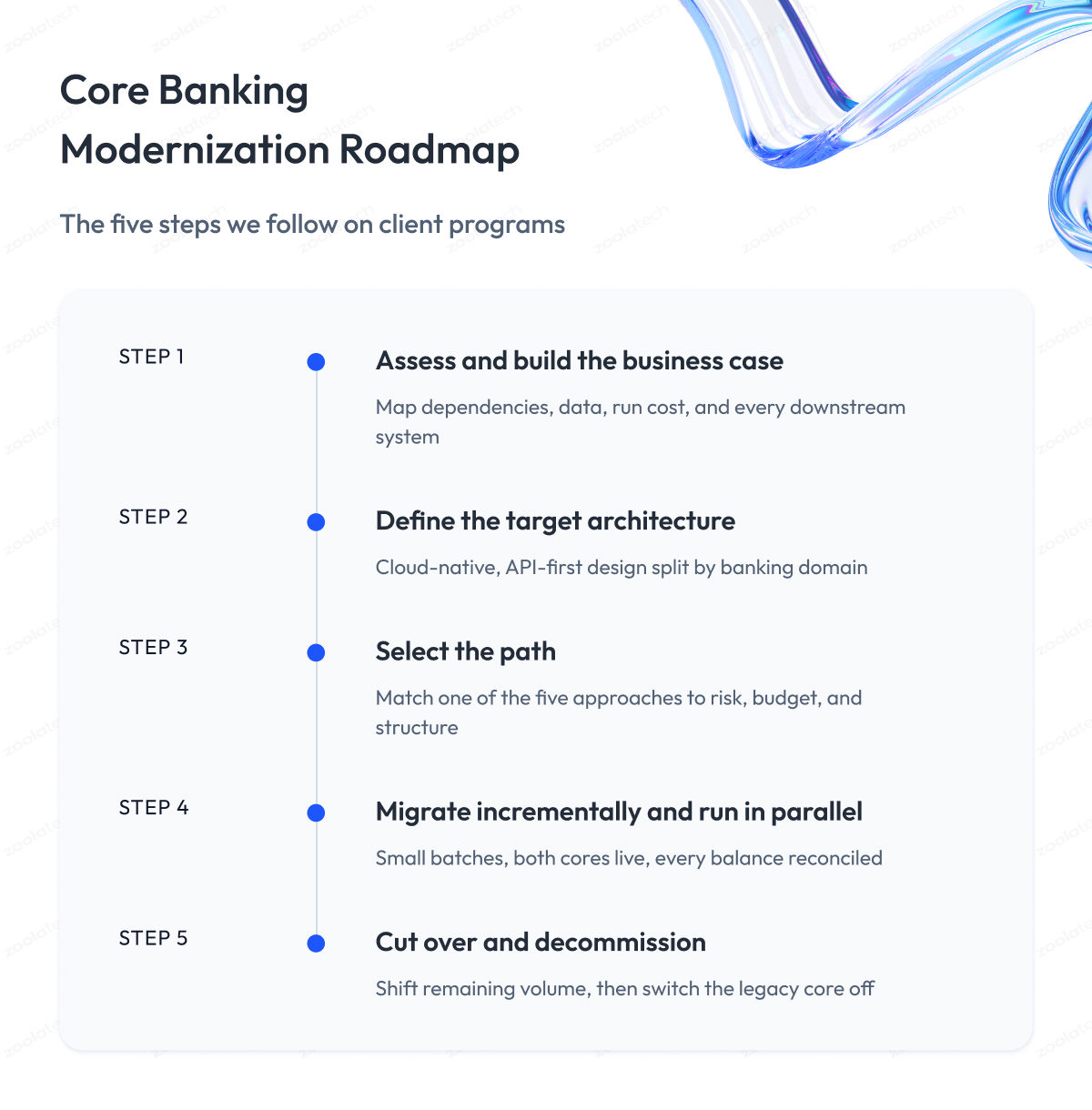
A core banking modernization program moves through five phases: we assess and build the business case, define the target architecture, select the path, migrate incrementally with a parallel run, then cut over and decommission.
The order matters, because most of the risk in a core program comes from skipping or rushing the early phases.
Let’s look at each phase in more detail.
1. We assess and build the business case
We start by mapping your core’s dependencies, the data it contains, its true runtime cost, and every downstream system that reads from it.
This is also where teams discover the data is messier than anyone admitted, so we budget time to find out early instead of mid-migration. You come out of this phase with a funded business case and clear goals, not a vague mandate to “modernize.”
2. We define the target architecture
We decide what the modern core looks like before choosing how to get there. In most cases that means a cloud-native, API-first design, broken into services along the natural domains of deposits, loans, payments, and the ledger, with defined integration points to your digital channels, payments, and lending systems. A target you can point at keeps every later decision consistent.
3. We select the path
Together we match one of the five approaches to your constraints:
- How cleanly the core decomposes.
- How much risk you can carry.
- How the budget is phased.
The Path Selector below turns those constraints into the best approach to core banking modernization for your situation.
4. We migrate incrementally and run in parallel
We move data and traffic in small batches, and run the old and new cores side by side so we can compare their output before trusting the new one. When you migrate data, you have to verify that every account balance and transaction in the new core exactly matches the old one.
This data migration and reconciliation work is where programs are quietly won or lost. Catch a mismatch while both cores are still running in parallel, and the fix is cheap. Miss it until after cutover, when the new core is already live, and correcting wrong balances becomes slow, costly, and visible to customers.
5. We cut over and decommission
We shift the remaining volume once the numbers reconcile, then finish the job by switching off the legacy core and removing it. Decommissioning is the phase teams most often leave unfinished, and it is the main reason core banking modernization ends up taking forever while the old core keeps costing money and holding risk.
Cost and Timeline: What to Expect
A core banking modernization program has three main cost areas:
- The platform itself, whether that is a license, a SaaS subscription, or the cost of building custom.
- Implementation, covering integration, data migration, testing, and the parallel run.
- Running two systems in parallel is the one most business cases underestimate.
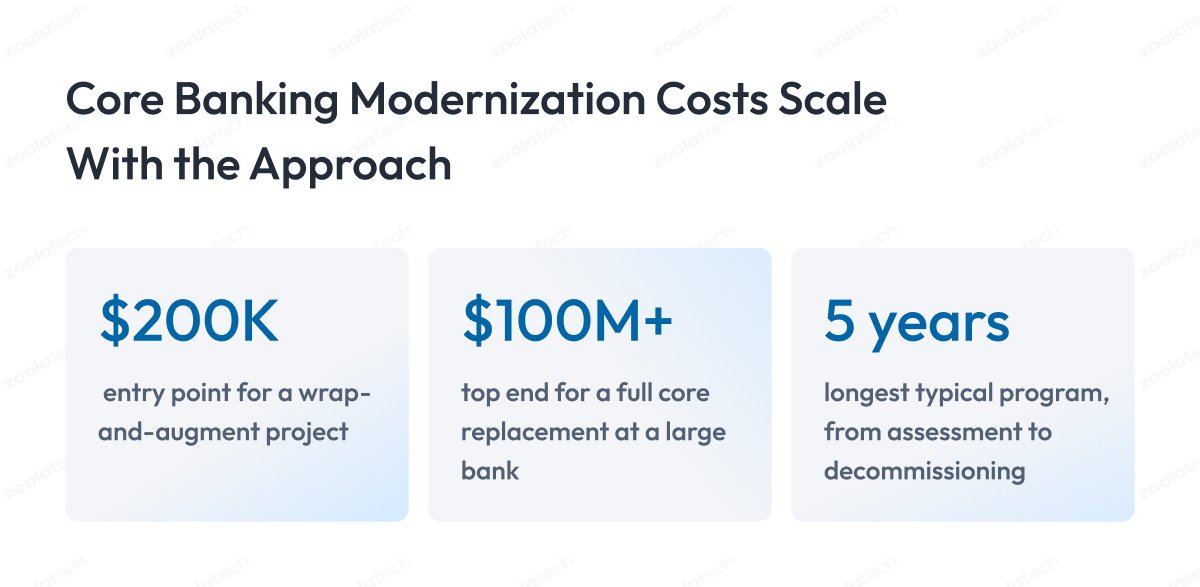
Cost and timeline in a core banking transformation both track the approach you choose more than anything else. The ranges below are typical for core banking modernization for regional banks and mid-market institutions.
| Approach | Typical Timeline | Typical Cost Range |
| Wrap and augment | 3 to 9 months | $200K to $2M |
| Sidecar (parallel core) | 12 to 24+ months | $2M to $20M |
| Progressive modernization | 2 to 4 years | $10M to $50M |
| Full replacement | 3 to 5+ years | $30M to $100M+ |
| Coreless (greenfield) | 6 to 18 months | $1M to $10M |
Two things stretch the duration of a core banking transformation project and move it to the top of its cost range:
- The first is the parallel-run tail, since you keep paying for the old core until the last product leaves it.
- The second is data cleanup, because messy legacy data stretches migration and testing far beyond the plan.
So when someone asks how much a core banking system costs, the useful answer models the full window, including the months you run both cores.
Why Core Banking Modernization Projects Fail (and How to De-Risk)
Core modernization programs rarely fail because someone picked the wrong platform.
They fail on three things:
- Trying to move everything at once.
- Underestimating how messy the data is.
- Never quite switching the old core off.
All three are predictable, which means all three can be planned around.
Trying to move everything at once
Moving the whole bank in one coordinated switch concentrates every risk into a single night. If anything goes wrong, there is no way back, and the pressure to press on regardless is exactly how small problems become outages.
The fix is to move a few products or customer segments at a time so any single change has a small blast radius.
Underestimating how messy the data is
Legacy cores accumulate decades of data, and much of it is inconsistent, duplicated, or undocumented in ways nobody remembers. Teams plan for a tidy migration and then lose months cleaning data mid-program.
The fix is to profile the data during the assessment phase, before commitments are locked, so surprises show up on paper instead of in production.
Never switching the old core off
The old core is supposed to go dark at the end, and this is where plenty of programs quietly break down. Most volume has moved, but a few edge-case products or reports still rely on the legacy system, so it never fully retires and continues to incur costs. Giving decommissioning its own budget, plan, and owner keeps it from becoming the task that never finishes.
Avoiding these failures comes down to a handful of habits you can build into the program from day one:
- Migrate in small batches. Move a few products or customer segments at a time so every change stays small enough to reverse.
- Profile the data early. Check the legacy data for gaps and duplicates during assessment, before budgets and dates are locked.
- Run both cores in parallel. Keep the old and new cores live side by side and compare their output before you trust the new one.
- Hold each cutover until the numbers reconcile. Switch volume over only once balances and transactions match exactly.
- Fund decommissioning as its own phase. Give switching off the old core a budget, a plan, and an owner so it actually gets finished.
Follow these and a core program stops being a gamble and becomes a sequence of controlled moves.
How to Choose a Core Banking Partner (and Platform)
In core banking platform modernization, the choice of implementation partner matters more than almost any other decision in the program, because it touches every product, every customer account, and every downstream system you run.
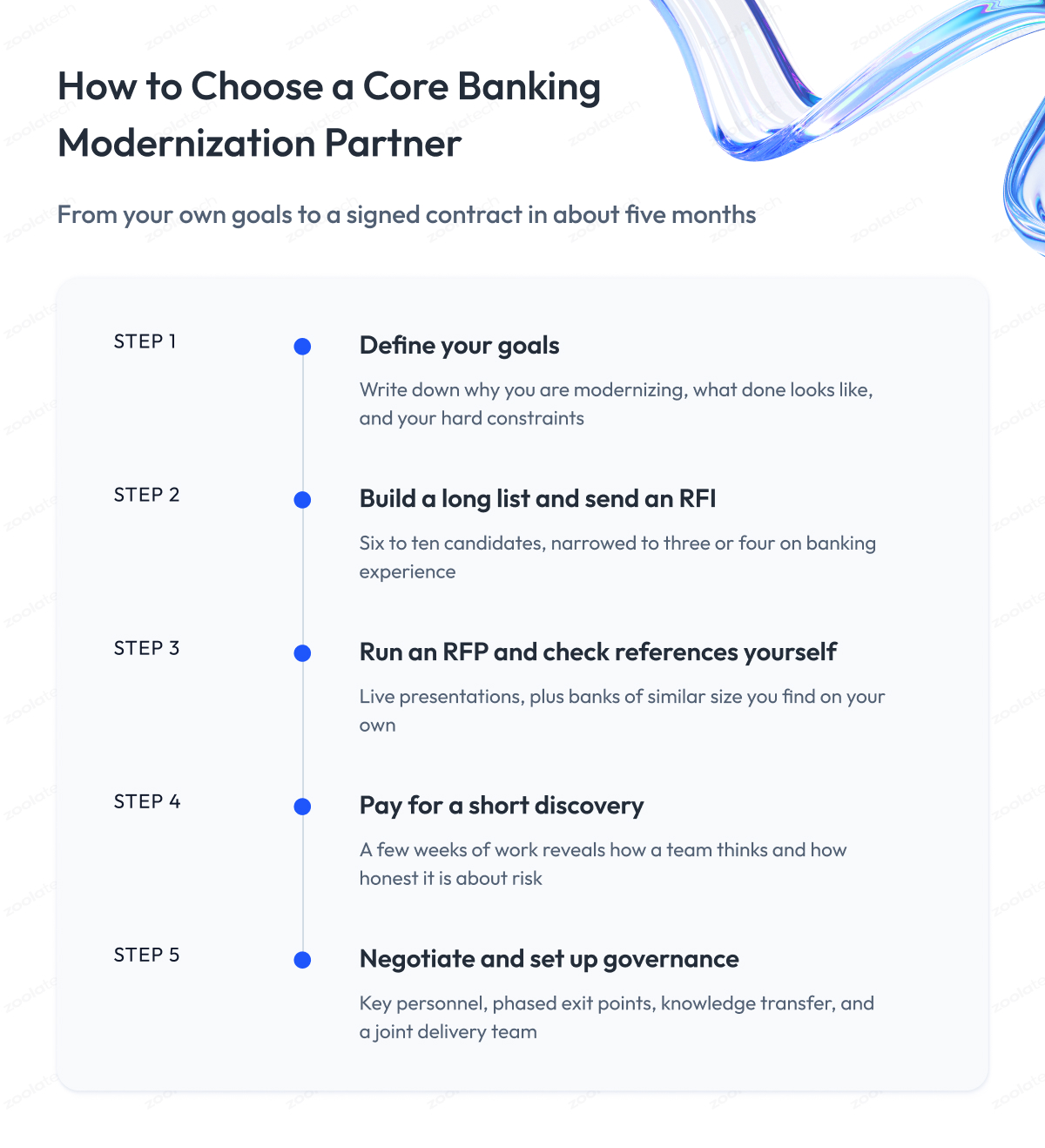
Because a core banking transformation puts every account and every downstream system on the line, you need a structured, disciplined process that tests each candidate’s banking experience, verifies their track record with clients directly, and lets you see how they think and work. The steps below lay out that process phase by phase, from defining your own goals through to signing a contract that protects you.
Phase 0 – Get your own house in order before you talk to anyone
Before contacting vendors, write down three things.
First, why you’re modernizing. Common drivers include:
- Cost reduction.
- Scalability.
- Regulator pressure.
- Launching new products.
Second, what “done” looks like.
Third, your hard constraints such as budget range, deadline, and regulatory jurisdiction.
If you can’t explain your goals clearly, vendors will define them for you, and always in their own favor. Also list your current systems, integrations, and known data problems. Even a rough version is enough to start.
Phase 1 – Build a long list over two to four weeks
Start by gathering six to ten core banking modernization companies as candidates. Useful sources include:
- Banks similar to yours. Ask peers which firms they used and how the program went.
- The platform vendor’s certified partner list, if you already lean toward one platform.
- Analyst reports and rankings that cover core banking modernization vendors.
At this stage, you are only collecting names, and the evaluation comes later.
Phase 2 – Send an RFI, then narrow to a short list over three to four weeks
Send each firm a short questionnaire, a Request for Information (RFI), that asks about:
- How many core migrations they have taken to full production.
- Which platforms they worked with.
- Which countries they have delivered in.
- Team size.
- Reference clients.
Cut the list to three or four firms with proven core banking platform modernization experience. Set aside any firm that cannot name completed projects where the old core was fully shut down.
Phase 3 – Run a proper RFP with the short list over four to six weeks
Send the remaining three or four a detailed Request for Proposal (RFP). Include your goals, constraints, current systems, and specific questions on:
- Migration approach.
- Data migration and reconciliation.
- Cutover strategy, big-bang or phased.
- Team structure.
- Pricing model.
Ask each firm to present live, and watch how they engage. A strong partner asks you sharp questions about your data and constraints, while a weaker one spends the time pitching.
Phase 4 – Check references yourself over one to two weeks in parallel
Look past the polished references each firm offers. Reach a bank of similar size on your own and ask the uncomfortable questions:
- What went wrong on the program.
- How far it ran over budget and schedule.
- How the partner behaved during a crisis.
- Whether the same team stayed from start to finish.
Every large program hits trouble, so what you are testing is how the partner handles it.
Phase 5 – Run a paid discovery with your top one or two over three to six weeks
This is the most valuable step in the whole process. Pay your top one or two candidates for a short assessment, and let them analyze your current systems and propose a target architecture and migration plan.
A few weeks of work tells you more about how a team thinks, how organized it is, and how honest it is about risk than any presentation can. It also shows you what daily collaboration feels like before you commit.
Phase 6 – Negotiate the contract over two to four weeks
Use the contract to lock in the terms that protect you.
- Key personnel clause. The architects and leads you met should be the ones who do the work.
- Phased structure with exit points. Commit phase by phase with a working result at each gate, rather than the full multi-year budget upfront.
- Knowledge transfer as an obligation. Your team has to learn the system during the program, or you stay dependent on the vendor indefinitely.
- Pricing model. A hybrid usually works best, with a fixed price for a well-defined Phase 1 and time and materials for the parts that are still uncertain.
Phase 7 – Set up how you will work together
Before delivery starts, agree on how the two teams will run the program together. Governance should cover:
- A steering committee that meets on a regular cadence.
- Transparent risk reporting.
- An escalation path that surfaces problems in days rather than months.
Push for a joint team where your people sit within the program, so you maintain visibility and control instead of handing the work off and waiting.
A partner who tells you an uncomfortable truth during the sales phase, that your timeline is tight or your data needs cleaning first, is worth more than one who agrees with everything. Honesty before the contract is the best signal of honesty after it.
What to compare in a next-gen core banking platform
Compare next-gen core banking platforms on the four things that constrain a bank in production.
- Who owns the data.
- How much control you keep over deployment.
- Whether the platform posts in real time.
- How openly it integrates.
Data ownership and residency come first, since regulators may require customer data to stay in a specific region or on your own infrastructure.
Deployment control comes next. Some platforms run only as the vendor’s SaaS, while others let you self-host or choose your cloud.
Real-time capability decides whether the core can post and reflect a transaction instantly or still leans on batch cycles. Integration openness, meaning documented APIs and event streams, determines how much work every future connection will cost you.
The platforms most often shortlisted for core banking platform modernization sit in different places on these criteria.
The table treats them as part of the market context, since the right fit depends on your constraints.
| Platform Type | Example Names | Deployment | Best Fit |
| Established core vendors | FIS, Fiserv, Finastra | On-premise or private cloud | Large banks needing broad product coverage |
| Cloud-native platforms | Thought Machine, Temenos | Cloud, self-host or SaaS | Banks wanting real-time, API-first cores |
| SaaS-first cores | Mambu | Vendor-run SaaS | Speed over infrastructure control |
| Coreless and composable | Best-of-breed services | Cloud, assembled via APIs | Neobanks and greenfield builds |
The best platforms for core banking modernization differ by starting point. A bank with strict residency rules and deep product complexity lands in a different column than a regional bank chasing speed, and both can be right.
Final Word
Core banking modernization is a long piece of work. You will spend months comparing approaches, pressure-testing vendor claims, profiling data nobody has looked at in years, and defending a multi-year budget to people who would rather spend it elsewhere.
That work pays for itself.
A core chosen and sequenced well gives you products in weeks, payments in seconds, and a run cost that falls as the old system goes dark. A rushed choice gives you a second migration in five years, this time with less patience from the board and less goodwill from customers who lived through the first one.
So start with what you can decide now. Map your dependencies, get honest about the state of your data, pick the approach that matches your risk tolerance, and insist on a phased plan with a working result at every gate. Move in small batches, keep both cores running until the numbers reconcile, and fund the switch-off as its own phase.
If you want a second opinion on any of that, we are ready to review your core, your constraints, and your migration plan, and tell you what the program will realistically take before you commit to it.
Questions You May Have
What is core banking modernization?
Core banking modernization is the process of upgrading or replacing the software that runs a bank’s system of record, so deposits, loans, payments, and the general ledger move from a legacy monolith to cloud-native, API-first systems.
What is the difference between modernization and transformation?
Modernization is the technical work of upgrading or replacing the core itself, while core banking transformation is the wider business change around it, covering products, channels, operating model, and customer experience.
What are the main core banking modernization approaches?
The five main approaches are full replacement, progressive modernization, a sidecar core, wrap and augment, and coreless composable architecture, and they differ mainly in pace, cost, and how much disruption they create.
What is a sidecar core?
A sidecar core is a modern core stood up alongside the legacy one, taking a slice of products or customers first and growing that share as confidence builds, which removes the need for a single cutover night.
Should we build, buy, or use a SaaS core?
Most banks should buy a licensed platform or subscribe to a SaaS core and build custom only where the core itself is a competitive advantage, since building is the slowest and most expensive path.
How much does core banking modernization cost?
Costs run from roughly $200K for a wrap-and-augment project to more than $100M for a full replacement at a large bank, with most regional and mid-market programs landing between $2M and $50M.
How long does core banking modernization take?
Timelines run from three to nine months for wrap-and-augment work up to three to five years or more for a full replacement, and the parallel-run tail before decommissioning is what usually stretches the duration of a core banking transformation project.
Why do core transformations fail?
They fail in three ways: trying to move everything at once, underestimating how messy the legacy data is, and never fully switching off the old core, which is why core banking modernization ends up taking forever at many banks.
What is a core banking system?
A core banking system is the back-end platform that processes a bank’s daily transactions and maintains records of every deposit, loan, payment, and general ledger entry.
How is core banking different from digital banking?
Core banking is the system of record that holds accounts and processes transactions, while digital banking is the customer-facing layer of apps and online channels that reads from and writes to it.
What are the best platforms for core banking modernization?
The strongest fit depends on your constraints: FIS, Fiserv, and Finastra suit large banks that need broad product coverage. Thought Machine and Temenos suit banks that want real-time API-first cores, and Mambu suits teams that value speed over infrastructure control.
How do you choose core banking modernization vendors?
Choose vendors that can name core migrations taken to full production with the old system fully shut down, then validate them through references you find yourself and a paid discovery before signing.