







Quick Summary
- Customization is client-driven, with the buyer changing the product inside a framework you provide; personalization is business-driven, with you changing the experience using data you already hold.
- 86% of surveyed Americans find customization appealing and 62% say they would pay more for it.
- Amazon reportedly earns close to 30% of revenue through its recommendation engines, which is the ceiling personalization work is aiming at.
- Recommendation types are not interchangeable: best sellers carry unknown visitors, browsing-history and session-based suggestions need data first, and upsell and cross-sell serve different baskets.
- Rollout runs in five phases, roadmap, data collection, behaviour and targeting definition, solution selection, and implementation, and jumping straight to a vendor is the usual mistake.
E-commerce has been increasing in revenues consistently ever since its introduction, confidently stealing share from offline retail outlets.
While online retail is gaining momentum from exponential growth, the competitive battlefield within the e-commerce domain is getting ferocious with AR, AI, personalization and customization features helping savvy entrepreneurs to thrive.
Let’s look at two distantly similar techniques of e-commerce marketing that can be utilized to increase conversions, retain customers, reduce cart abandonment, and boost brand loyalty: personalization & customization.
Product Customization & Personalization in E-Commerce
Personalization and customization in e-commerce are used by behemoths of online sales like Amazon and Walmart as well as by small players, who keep their fingers on the pulse.
E-commerce personalization software is available as a SaaS solution, so it is an affordable technology that can convert your store to a friendlier place for shoppers and produce higher margins for you.
What is Product Customization?
Customization is the option for a client to prescribe a certain feature of a product related to either design or functionality of an item.
E-commerce product customization examples:
- Create your own inscription on a coffee mug
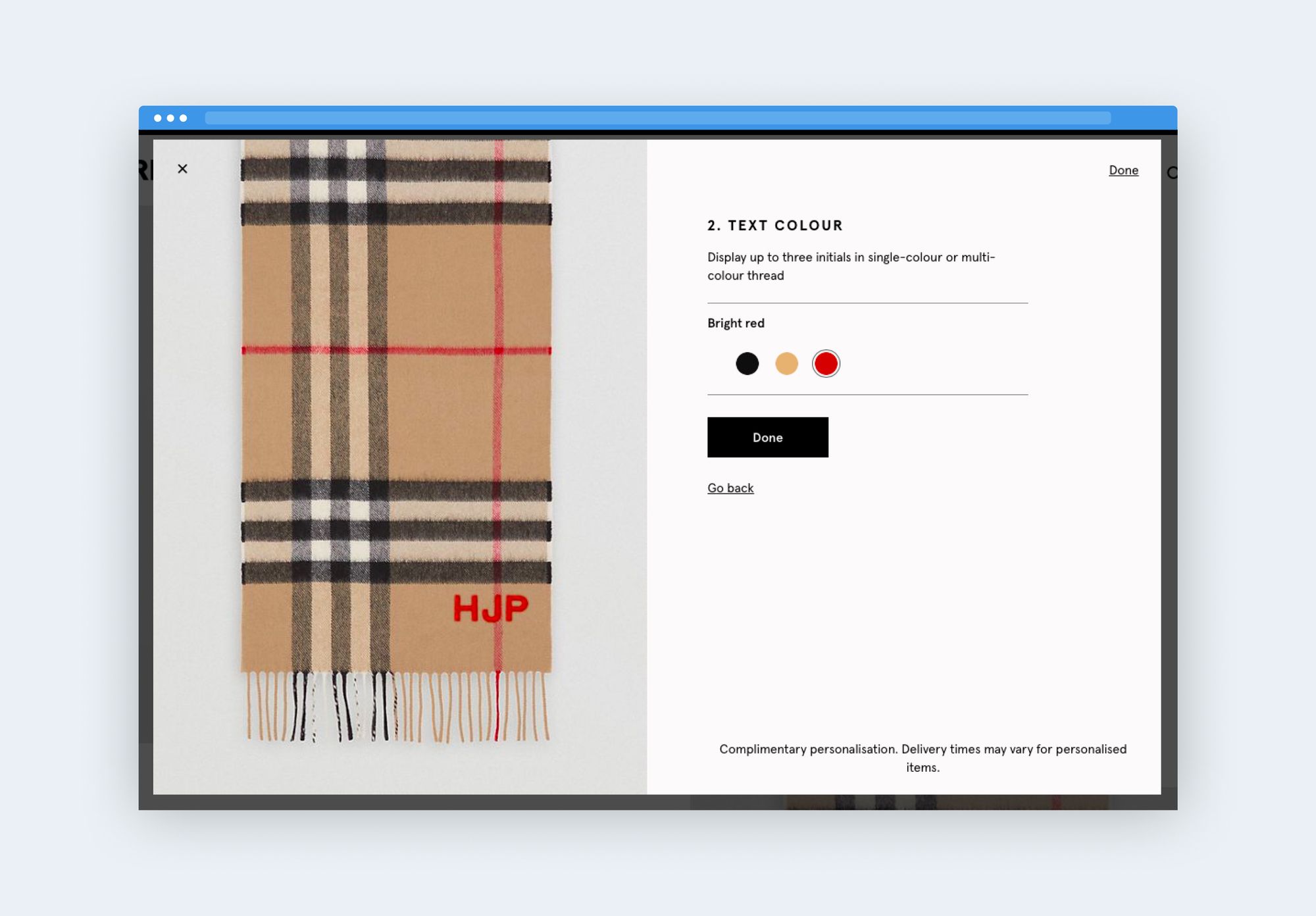
- Burberry’s customizable “Scarf Bar”
- Burberry’s Monogramming service
- Indochino’s customizable jackets
What is Product Personalization?
Personalization is a set of techniques used in the retail industry, that allow businesses to provide a personalized experience based on demographic data, history of interaction, geo location and other criteria.
E-commerce product personalization examples:
- Local news is given priority in a national digital edition based on geo- location
- Name of client, product name or date of purchase are inserted in email correspondence for higher relevance
- Product recommendations are based on search history
- Discounts for new customers are based on their first visit
E-Commerce Customization vs Personalization
What are the main differences between personalization and customization?
Customization is a client-driven process. A vendor business provides only the framework used by a client to introduce changes to a product, so that client executes the changes.
Personalization on the other hand, is a business-driven process. The business takes into account data available about a client to provide more individualized service.
Benefits of Customization Features for E-Commerce
Boosts brand loyalty
Pretty self-explanatory: clients keep returning to businesses they enjoyed dealing with and become brand ambassadors.
Increase sales with product customization
This is the whole point, right? To get your revenues growing.
Well, with 86% of surveyed Americans finding customization appealing in terms of available widgets and 62% reporting willingness to pay more for customized features, the case for offering it is clear.
This is what clients want
We have all been stuck coming up with a birthday present idea at some point – for a friend or a colleague.
Or even worse – for a spouse.
We all want to get it right every time. The more affluent a person is, the more difficult it is to please him or her. They have it all.
But even for somebody on a low budget, a customized mouse mat or a coffee mug can be just the thing – that conveys personal thought was involved to surprise a close friend or family member.
For those who can afford more – monogrammed premier pieces are also a precious sentimental reminder of personal affection.
Get valuable data about customer base
Whether you offer customized merch exclusively or have only a few customizable products in your store – you will end up with a bunch of actionable data as a result of the product customization option.
Likings, tastes, preferences, seasons – those insights may provide priceless data points upon which to grow your competitive edge.
Gain industry leader status
Burberry provides a perfect example of vast adoption of a customization feature in their store with Scarf Bar and Monogramming choices.
Dalia Strum, Professor at the Fashion Industry of Technology observes: “Personalization is a trending approach, which provides a differentiating factor towards purchases. Customization is a major indicator that the consumer has put more thought into that purchase whether for themselves or as a gift.”
E-Commerce Personalization: Segmentation Parameters
It’s useful to understand which client data parameters can be utilized to make your e-commerce store more competitive through the use of personalization and customization in e-commerce. This data can be a guide to creating custom segments in your CRM such as:
Price & conditions: Personalize your offers
Your offer consists of the image, video, content, price, description, discount, promo applied, time frames, etc. All of those parameters can be personalized.
For example, you will want to stimulate a newcomer’s confidence to buy with a welcome discount.
Content, visuals & descriptions
Whatever it is you are using as educational material for a client to familiarize themself with the product – be it a video or a text – it can be, and should be, personalized, based on the demographics of a user.
Pop-ups: Order bumps, upsells, cross-sells
There are all sorts of pop-ups.
And most of them are annoying. So use them sparingly, but make sure to personalize them anyway.
Example: An exit popup may be different for male vs female vs unknown gender users in terms of copywriting, based on research and A/B tests.
Announcement bars
This piece of e-commerce real estate is usually permanent, unlike the pop-ups, sticking to the top of the website.
Example: It can be personalized based on new / returning / loyal client aspect, respective perks & bonuses, like shipping, discount, or a freebie.
Popular features of personalization vendor solutions
There are a number of personalization vendors out there, helping e-commerce businesses to thrive and master the art of customization and personalization.
These are the most common personalization vendor features that cover pretty much every realm of this complex subject that gets more sophisticated by the minute:
- Product recommendations modules
- Retargeting: Abandoned cart saver
- Experience management
- Campaign segmentation
- Account-based marketing
- A/B testing features
- Strategic pricing solutions
- Personalized browsing & navigation
- Offer & discount pop-ups
- Social insight analytics
- Behavioral targeting & messaging
Types of Product Recommendations
Personalized product recommendations are an amazing way to collect slightly higher hanging fruit. Amazon is reported to be making almost 30% of its revenues as a result of its powerful recommendation engines. Let’s check out the types of product recommendations out there.
Best sellers
This is one of the most effective ways to suggest an upsell to a new customer, whose preferences are unknown.
On the terra incognita, a line-up of products to display will be based on the most popular items on average in the specific geo or category.
But when the mist clears and you get access to more detailed client data, the recommendation engine will instead pull and display the best products according to search history, location, gender, age-specific preferences. Such informed suggestions have a significantly higher conversion associated with them.
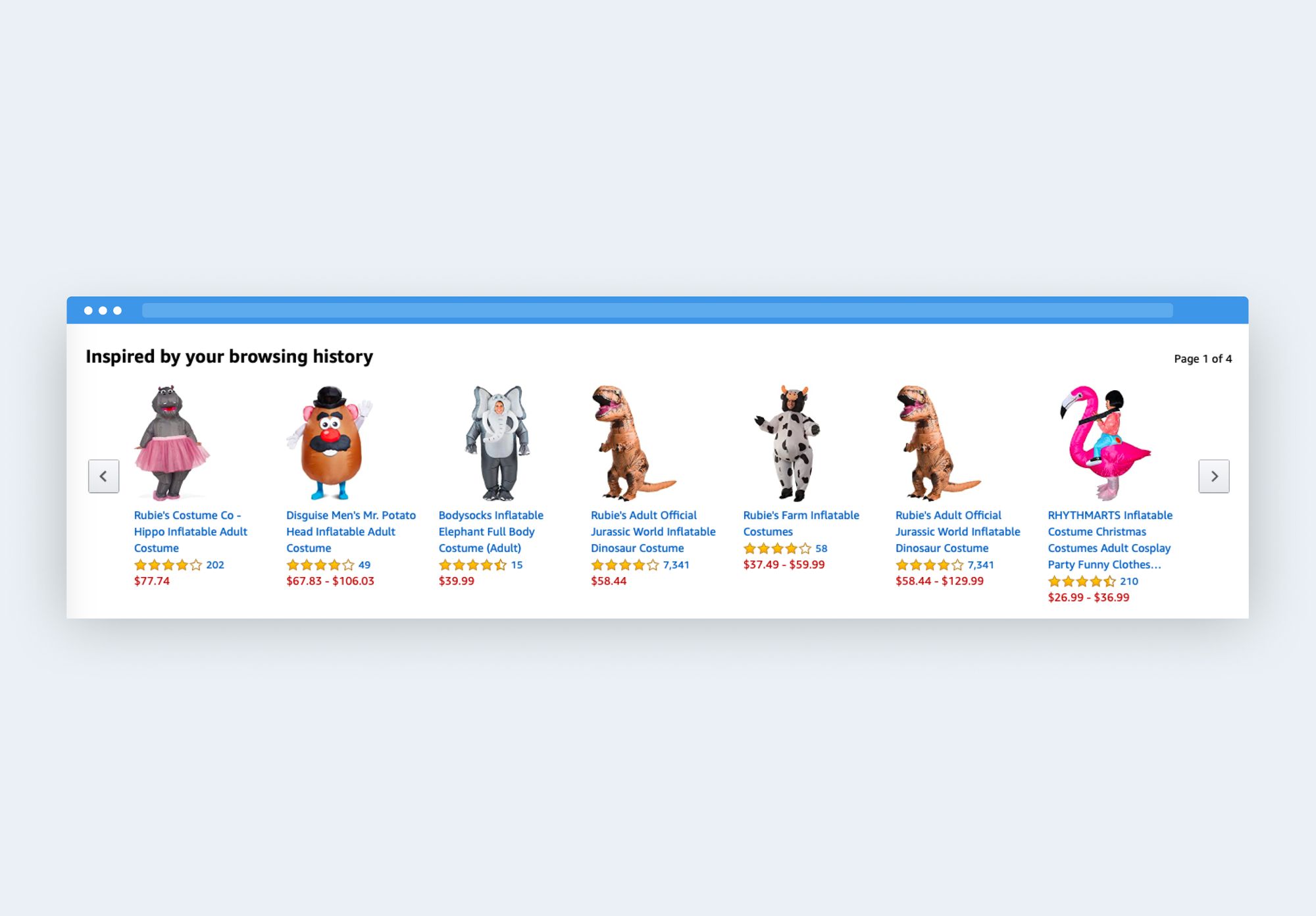
“Inspired by your browsing history”
Using this wording, Amazon shows it’s being open and transparent with its clients. It is also very user-friendly. You don’t need to go back and check for the items that you scrolled past that caught your eye.
Upselling & cross-selling
These two categories are self-explanatory, but may need a little differentiation between the two of them:
Upselling is a way of offering a product that is essentially a higher-priced version of the same product (for example: a product + warranty combo).
Cross-selling is offering a product that complements your chosen option and belongs to a different category. (think a matching belt with a faux leather bag).
What people buy after viewing this item
Social proof works like magic every time. Why not use it in product recommendations then?
On the other hand, this suggestion is based on the result of hundreds of browsed pages and price comparisons performed by other users, so it’s a lazy shopper’s route to success.
“You might also like”
This is a suggestion based on the items that are viewed in this session. Based on the price range of previously purchased items a system may suggest the products with higher than average or lower than an average check.
Challenges with E-Commerce Personalization
When it comes to implementing some of the e-commerce customization or personalization features, things may get tricky.
Entrepreneurs get all sorts of hiccups on the way to a perfectly working model. Below being the major ones:
- Choosing the website development company to integrate the individualization modules
- Choosing the right e-commerce personalization vendor
- Ascertaining the priority in terms of personalization features most needed currently for your company
- A/B testing for the most high-converting content on the chosen features
- Accessing skilled talent to implement and train internal staff to manage the system from implementation onward
How Do You Begin Product Customization & Personalization?
In order to roll out a few personalization features in your online store, you should consider hiring a professional team with experience in integrating such solutions.
If your company is really big, you can also work directly with the e-commerce personalization vendors, grooming your talent to work on the transition and further maintenance of the systems. In this case, starting with selection of the best supplier is a good path to take.
Once you decide to embrace this ubiquitous technology, there are hurdles to be overcome, but there are impressive ROIs waiting at the end of the process. So you know it’s worth it.
Phases of E-Commerce Personalization
Depending on the stage of the genesis of your online store, company size, product assortment, shipment terms, capital available for investment, future plans, and a myriad of other factors you will need to determine your priorities for rolling out personalization features.
Irrespective of the above criteria, most companies will need to undergo the following phases, either with external help or by means of engaging internal professionals:
- Create a strategic roadmap
- Collect data & analytics
- Define customers’ behavior & design targeting
- Finding case-appropriate solutions
- Implement
The Time to Personalize You Customer Experience Is Now
Customize.
Personalize.
Or lag behind.
Like not even page 3 of Google behind.
Scary?
Considering ways how your company could improve its conversions, increase customer retention, lower cart abandonment rates with e-commerce personification features?
Then reach out to your website development company to see what potential ROI may be feasible for your niche when implementing specifically chosen modules.
How Can Zoolatech Help You?
We thought you’d never ask!
Zoolatech specializes in retail software development. We know more than we disclosed to you in this extensive article. That was intentional, though.
We want to provide you with a custom-made offer that meets your current needs, budgets, and expectations, in keeping with industry trends.
Allow our custom e-commerce development experts to dive deeply into your niche and come up with a set of perfectly fitting solutions to bridge gaps in website personalization and customization.
Having second thoughts? Check out the Zoolatech portfolio, including the Nordstrom case study, for a demonstration of the e-commerce web design expertise in our professional mobile and web dev team.
Drop us a line, let’s get personal!