







Quick Summary
- Staff augmentation puts external engineers under your leads, and you own the result. With managed services, the provider directs the work and answers for the result.
- Project outsourcing is the third option. A vendor delivers a fixed scope against agreed acceptance criteria, and the engagement ends at handover.
- “Managed services” has two meanings. One is IT operations under service-level agreements, the other is managed delivery, where a provider owns product engineering. Compare the second with staff augmentation.
- Pick staff augmentation when you have leads to direct the work, managed services when you need one accountable owner, and project outsourcing when the scope is stable.
- Deloitte’s 2024 survey of more than 500 executives reports outcome-based models and insourcing are both gaining ground, so expect to mix and switch models over time.
Staff augmentation vs managed services is a choice about who directs the work and who answers for the result. With staff augmentation, your leads direct external engineers and you own the outcome. With managed services, a provider runs a defined workstream and takes ownership of the outcome. Project outsourcing is the third option, where a vendor delivers a defined project and hands it over.
Choosing the right engagement model is important because the model decides who makes daily decisions on your program and who is accountable when a release slips. The wrong one leaves your leads directing people they did not hire, or a provider owning work that nobody on your side can accept.
These terms are easy to confuse. Vendors use them loosely, and the same words can mean different things in different offers. As a result, many teams compare rates and headcount, while the details that matter most get lost.
That is why we wrote this guide. The difference between the models is easiest to see in practice, so we also show it on our own engagements, including one at MasterControl that grew from 2 engineers to approximately 60.
Beyond that case, this guide puts the three models side by side on the same criteria, shows who decides what in each, and gives you the questions to ask before you choose. We also explain how to run two models at once and how to move from one to the other without a gap in delivery or a team that has to start from zero.
By the end, you will know how the three models differ, which one suits your program, and what you need to have in place on your side to make it work.
What Is the Difference Between Staff Augmentation and Managed Services?
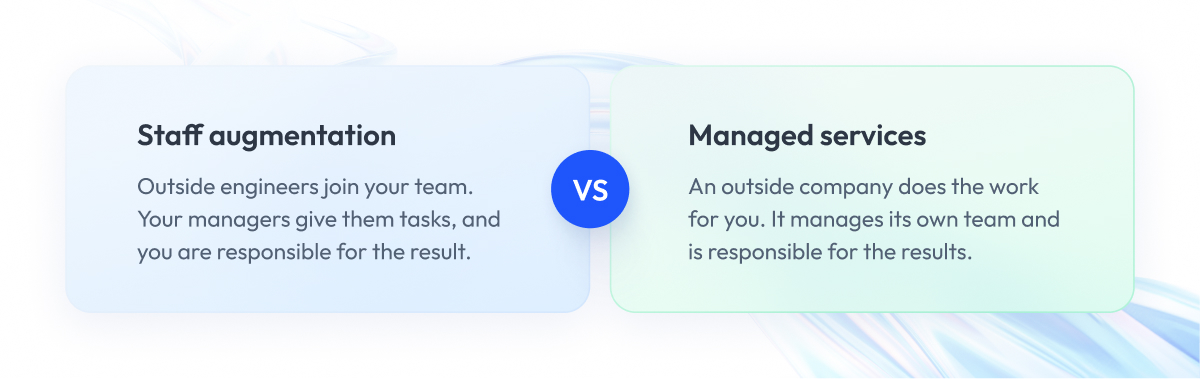
The main difference between staff augmentation and managed services is who directs the work and who is responsible for the results. Below, we explain each model in more detail, including project outsourcing, the third option you will see in most vendor proposals.
Staff augmentation (also called team extension) means engineers from an outside company join your team for a set period and work the same way your own hires do. Day to day, it looks like this:
- Your leads assign the tasks, review the code, and decide what ships.
- The engineers work in your tools and follow your process.
- You pay for their time, usually on a time-and-materials (T&M) basis, meaning you pay for hours worked rather than a finished result.
Because you pay for hours, you also pay for the hours when engineers wait for direction. This is why the model works only when your leads have time to direct more people. We come back to this point when we discuss when staff augmentation is the right choice.
Managed services means an outside company, the provider, takes responsibility for a defined function or workstream and for its results. Here is how the roles split:
- The provider plans the work, decides how to staff it, and reports progress to you.
- You set the goals and accept what the provider delivers.
- You write the commitments into a service-level agreement (SLA), a contract section that states what the provider promises and how you measure that promise.
One warning here. Providers use the phrase “managed services” for two different kinds of work, running your IT and building your product, and they rarely say which one they mean. We separate the two in the section on managed IT services vs managed delivery below.
Project outsourcing means an outside company, here called the vendor, delivers a defined project, and the engagement ends at handover. What you agree with the vendor:
- The vendor writes down everything it must deliver before the work starts.
- You pay for the project as a whole, often at a fixed price or in paid milestones.
- Any change to the scope goes through a change request.
People most often confuse this model with staff augmentation, because everyday speech calls both of them “outsourcing.” We look at staff augmentation vs outsourcing in more detail further down.
Staff Augmentation vs Managed Services vs Outsourcing: Side-by-Side Comparison
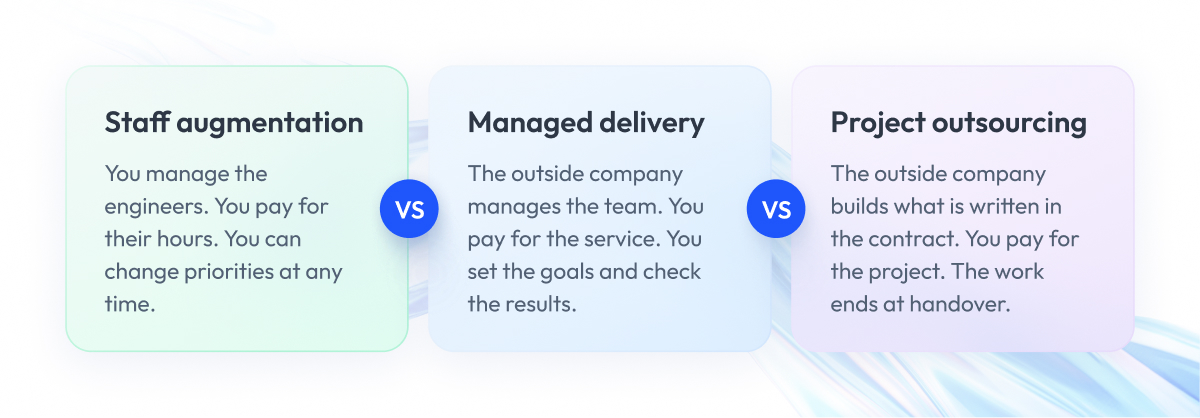
You now know what each model is. The next question is how the three compare on the things that matter to your program, such as what you pay for, how fast the work can start, how hard it is to change the scope, and who keeps the code and documentation when the contract ends.
The table below compares all three models on those criteria. Each row is one criterion, and each column is one model. Read it row by row to see how the same question gets a different answer in each model, or pick the column of the model you lean toward and check whether every row fits your situation. This is also the table most readers copy into their decision deck.
| Criterion | Staff augmentation | Managed services (managed delivery) | Project outsourcing |
| Who directs daily work | Your leads | Provider’s delivery lead, against your priorities | Vendor, against the agreed specification |
| Who answers for the result | You | Provider, for the agreed scope or service | Vendor, for the contracted deliverables |
| What you pay for | People’s time, usually time and materials | Defined service or workstream; monthly fee, capacity, or milestones | Defined project, often fixed price or milestones |
| Commitments | Skills and availability of named people | Service levels or delivery commitments in the contract | Deliverables, deadline, and acceptance criteria |
| Speed to start | Usually fastest when roles are defined | Slower; scope, handover, and reporting come first | Depends on how fast you can specify the scope |
| Typical duration | Flexible, from months to years | Ongoing, reviewed periodically | Ends at handover |
| Changing scope | Easy; you reprioritize the backlog | Through the provider’s change process | Through change requests, often re-priced |
| Management effort on your side | High; needs leads and a backlog owner | Lower day to day; goals, governance, and acceptance stay with you | High at specification and acceptance, low in between |
| Where knowledge stays | In your team, if engineers document their work | With the provider, unless you plan a knowledge transfer | With the vendor, unless documentation is a deliverable |
| Access, data, and security | Your tools, your policies | Controls you agree and can audit | Vendor sees only what the project needs |
| Fits best when | You have leads to direct the work and need capacity fast | You want one owner for a workstream you cannot direct daily | Scope is defined and stable; you want a finished deliverable |
| Typical failure | Engineers wait for direction; temporary fix becomes permanent | Vague scope; provider lacks domain knowledge; low visibility | Requirements change mid-project; quality cut to protect price |
These are typical splits. Your contract can set them differently, and often should. The section on who owns what in each model breaks responsibility down task by task, so you can write the split into the contract before the work starts.
Managed IT Services vs Managed Delivery: Which “Managed Services” Do You Need?
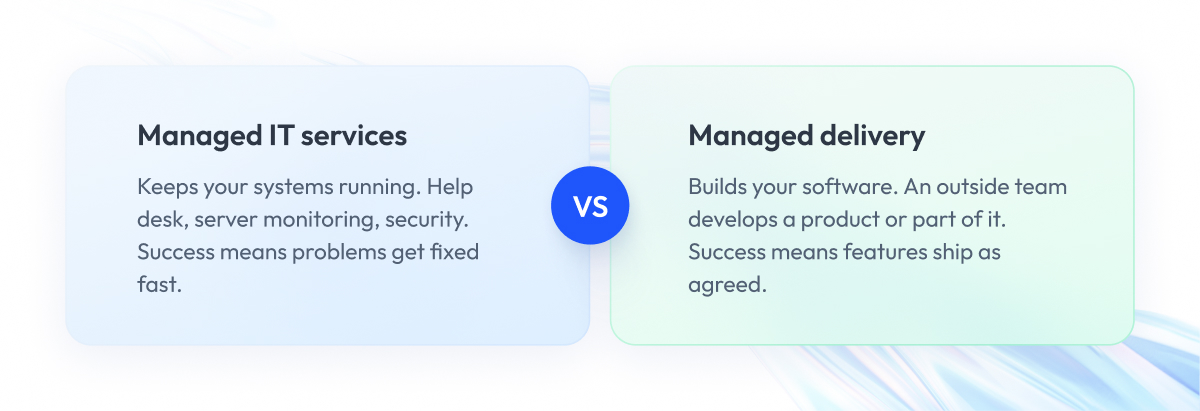
“Managed services” covers two different kinds of engagement.
In IT operations, it means a provider runs your help desk, infrastructure, monitoring, or security under service-level agreements.
In product engineering, it means a provider owns the development of a product or a workstream. Most guides on staff augmentation vs managed services describe the first kind. If your problem is a product roadmap, the model to compare is the second one, which we call managed delivery.
The distinction matters because an IT managed services vs staff augmentation comparison answers a question about keeping systems running, while your question is about building software. The two kinds of work are measured, staffed, and priced differently.
The table below puts the two meanings side by side. The left column is the IT operations meaning, the right column is the product engineering meaning. Use it to check which one a proposal is talking about before you compare it with anything else.
| Aspect | Managed IT services | Managed delivery |
| Purpose | Keep existing systems running | Build and change software |
| How success is measured | Service levels, such as response and resolution times | Delivery against agreed goals, quality, and predictability |
| How the work changes | Repeats, same tasks month to month | Changes every sprint as the product evolves |
| Who typically provides it | Managed service provider (MSP) | Software engineering partner |
Our own managed delivery page describes the model as Zoolatech handling the execution, talent management, and technology so the client can focus on growth. Our team extension page adds the conditions for choosing it. If you need full delivery ownership with no internal management responsibility, managed delivery is the right model.
If what you need is a help desk or monitoring, look for a managed service provider instead. This article is about engineering work, so from here on, whenever we compare managed services vs staff augmentation, we mean managed delivery.
Who Owns What in Each Model
Before you sign with any provider, you need to know exactly who is responsible for each part of the work. If a task has no owner, it falls through. A release slips because nobody scheduled the code review, or an engineer waits two weeks for access because both sides assumed the other would request it. Every model splits these responsibilities differently, and the split decides how much of your team’s time the engagement takes.
In staff augmentation, your team owns priorities, daily direction, acceptance, and delivery risk.
In managed delivery, you keep priorities and acceptance, and the provider owns planning, team composition, and delivery risk.
In project outsourcing, the contract fixes the scope, and the vendor owns the work up to handover.
The table below breaks this down task by task. Each row is one task that has to be done in any engagement, and each column shows who typically owns it in that model. Use it in contract talks and go through it row by row with the provider, so that every cell has a name next to it before the work starts.
| Task | Staff augmentation | Managed delivery | Project outsourcing |
| Product priorities and backlog | You | You set goals and priorities; provider plans delivery | Fixed in the specification; changes by change request |
| Architecture decisions | You; external engineers propose | Provider proposes; you approve key decisions | Vendor, within the specification; you approve |
| Daily task assignment | Your leads | Provider’s delivery or technical lead | Vendor |
| Team composition and replacements | You approve each person; provider replaces on request | Provider, to meet its commitments | Vendor |
| Code review and quality gates | Your standards and reviewers | Provider’s process, checked at your acceptance | Vendor’s process; your acceptance testing |
| Acceptance of work | You | You, against agreed criteria | You, against the contract’s acceptance criteria |
| Delivery risks and reporting | You | Provider reports risks and progress to you | Vendor reports milestones |
| Access, data, and security controls | Your policies and accounts | Controls you agree; provider follows them, you audit | Limited to what the project needs |
| Knowledge and documentation | Your team, with documentation as part of the work | Provider, with a planned transfer | Handed over at the end, if in the deliverables |
Write the agreed split into the statement of work. The row people skip most often is knowledge and documentation, and it causes the most damage when the engagement ends, or changes shape. We return to it in the section on combining models and moving between them.
Code ownership, repository access, and account control are contract terms too. Agree on them in writing at the start, whatever model you choose.
When Staff Augmentation Is the Right Choice
Staff augmentation is the right choice when your own leads can direct more engineers than you can hire, and the work needs skills or capacity your team lacks. Our team extension page adds one condition. The model requires a technical lead on your side who manages the engineers directly, because without that person, the engineers have nobody to take direction from.
When it wins
The model is the strongest choice in three situations:
- Core product work, where the code and the know-how must stay with your team after the engagement ends.
- A roadmap commitment that your current team cannot meet without more senior capacity.
- A skill gap, for example, a platform such as Salesforce that your engineers have never worked with.
In each case, you keep control of what gets built and how, and the outside engineers add hands and expertise to your existing process.
Case studies: Gusto and Grubhub
Two of our engagements show what this looks like in practice. For Gusto, we provided a five-person senior nearshore Salesforce team. The engineers followed Gusto’s own planning, validation, review, and release workflow. You can read more about Gusto’s nearshore Salesforce team on the case page.
For Grubhub, we staffed multiple senior Java positions. The engineers joined distributed Scrum teams between Kyiv and Chicago and participated in planning, standups, demos, retrospectives, and backlog grooming, the same ceremonies as Grubhub’s own engineers. The case page on senior engineers in Grubhub’s Scrum teams has the details.
When it loses
The model fails in three predictable ways:
- Nobody has time to direct the engineers. Our team extension page puts it plainly. Without that capacity, external developers will underperform regardless of their individual quality.
- A temporary fix becomes a permanent setup without anyone deciding it. A 2015 white paper by CGI, a managed services provider, argues that staff augmentation can become problematic when it turns into a permanent operating model. CGI sells the alternative, so treat that as a vendor’s view, but the pattern is familiar to anyone who has run a program for a few years.
- Knowledge leaves with the engineers when nobody documents the work and the contract ends.
If you have the leads and want senior engineers inside your own teams, our team extension page describes how we set that up.
When Managed Services Fit Better
Managed services fit better when you want one partner to answer for a defined workstream or product, and your leads cannot direct the day-to-day work. Our team extension page puts the condition the same way. If you need full delivery ownership with no internal management responsibility, managed delivery is the right model.
When it wins
The model is the strongest choice when three things come together:
- A workstream with a defined goal, such as a product, a platform area, or a legacy system you must keep evolving.
- No spare leads on your side to direct engineers every day.
- A need for one accountable owner who reports to your leadership on progress and risks.
In this setup, you decide the outcome and check it at acceptance. The provider decides how to get there, who works on it, and in what order.
Case study: Recon
Recon, a startup, came to us without technical expertise and entrusted us with the entire process, from defining functional requirements to post-release maintenance. We launched a functional MVP in six months, then managed deployment and post-release support.
This was a startup project, so treat it as an illustration of the model and its ownership split, not as an enterprise benchmark. The case page on end-to-end managed delivery for Recon has the full story.
When it loses
In our view, managed delivery fails in four situations:
- The provider lacks the capability or domain knowledge for your product and has to learn it on your time.
- The scope or the definition of “done” cannot be written down, so there is nothing to hold the provider to.
- Your stakeholders want to direct individual engineers, which undercuts the provider’s ownership and leaves nobody accountable.
- Reporting is too thin for you to see progress before a milestone slips.
What changes at enterprise scale
Large programs add two conditions. With several vendors on one platform, name a single owner for integration, so that no two parties own the same code. And give the provider what it needs to own delivery, meaning access approvals and a counterpart on your side with authority to make decisions. Without those, the provider owns the result on paper and waits for you in practice.
If you want a partner to own the delivery of a product or a workstream, our managed delivery page explains how we structure that.
Staff Augmentation vs Outsourcing: When a Fixed Project Makes Sense
Project outsourcing makes sense when you can describe the result in advance, for example, a module, a migration step, or an app with defined acceptance criteria. Compared with staff augmentation, the vendor manages the work instead of your leads. In a managed services vs outsourcing comparison, the difference is the end point, because the outsourced engagement ends at handover while managed delivery continues as the product evolves.
When it wins
You get the most out of this model when three conditions hold:
- The scope is stable, so you can sign off on the specification you will accept against.
- The result is isolated from your core systems, so the vendor can work without daily coordination with your team.
- You want a finished deliverable, with no ongoing engagement after handover.
When it loses
The model fails when requirements change during the project. Each change goes through a change request, change requests pile up, and the vendor cuts quality to protect the price.
The second failure comes at handover, when knowledge about the delivered system leaves with the vendor unless the deliverables include documentation.
For the wider picture of outsourcing models, including how they are priced and contracted, see our guide to software development outsourcing models.
How to Choose an Engagement Model for Your Program
To choose an engagement model, start with three questions:
- Who on your side can direct engineers day to day?
- How stable is the scope?
- Who must answer for the result?
Leads plus a changing scope point to staff augmentation. The need for one accountable owner points to managed services. A stable scope points to project outsourcing.
The table below turns those questions into a checklist. Each row is a question about your program, and the two columns show which model your answer favors. Go through the rows in order, note which model comes up most often, and treat the rest of the article as a check on that answer.
| Question | If yes | If no |
| Do you have a technical lead and a backlog owner with time to direct more people? | Staff augmentation | Managed services or outsourcing |
| Can you write down the result and its acceptance criteria, and will they hold? | Project outsourcing | Staff augmentation or managed services |
| Must one outside party answer to your leadership for the result? | Managed services or outsourcing | Staff augmentation |
| Will you need the capacity for years, not months? | Staff augmentation or managed services | Project outsourcing |
| Must the knowledge stay inside your team afterwards? | Staff augmentation | Managed services, with a planned transfer |
| Do access approvals, data rules, or other vendors limit what an outsider can do? | Staff augmentation, inside your controls | Managed services, with agreed controls |
Each model also wins in situations where it usually loses. Managed services, often seen as giving up control, win for core work when your leads are the bottleneck, because acceptance stays with you. Staff augmentation, often dismissed as renting people, wins for core product work when you have the leads and the knowledge must stay in-house. Project outsourcing, often seen as risky, wins for an isolated deliverable with stable acceptance criteria.
What you pay for in each model
Compare total cost over the life of the program, including your own team’s time, instead of comparing hourly rates. The cost items differ by model:
- Staff augmentation costs the engineers’ time plus your leads’ time spent directing them, onboarding, and turnover.
- Managed services cost the provider’s fee, which includes delivery management, quality assurance, and replacement risk, plus your time on governance and acceptance.
- Project outsourcing costs a price that carries the vendor’s risk margin, plus every change request after signing.
Cost is rarely the only driver. In Deloitte’s 2024 Global Outsourcing Survey of more than 500 executives, skilled talent and agility joined cost reduction as key drivers for outsourcing. No model is always cheaper, because the answer depends on how long you need the capacity and how much management the provider takes on.
When none of the three fits
If nobody on your side can own product decisions and accept the work, no outside model fixes that. Name an owner first. If a program has already stalled with a vendor, changing the engagement model alone rarely helps, because the problem is usually in the scope, the ownership, or the handover, and the new model inherits all three.
We offer two of the three models. Our engineers can join your product teams through team extension, or a Zoolatech team can own delivery of a product or workstream through managed delivery. Every engagement includes a dedicated Delivery Manager, a live risk register, and a formal QA checkpoint, with teams operating in client time zones.
Combining Models and Moving Between Them
You can run more than one model at the same time, and the right model can change as the program grows. A combination works when every workstream has one owner and a defined boundary. It breaks when two parties own the same code or the same decision.
The market moves in both directions. Deloitte’s 2024 Global Outsourcing Survey of more than 500 executives reports that outcome-based delivery models have increased in adoption, and that insourcing is on the rise while global in-house centers are regaining momentum.
Companies hand work out and bring it back in at the same time, so a fixed “best model” is the wrong goal. The right goal is a setup you can change without losing what you have built.
When a combination breaks
In our experience, mixed setups fail for three reasons:
- No boundary between what your team owns and what the provider owns, so both sides touch the same modules.
- Two vendors on one codebase with no single owner for integration.
- A hybrid chosen to avoid a decision, where nobody can say which model applies to which work.
Signals that it is time to switch
Move from staff augmentation to managed delivery when your leads spend most of their week directing external engineers, when the team has grown past what they can direct, or when leadership wants one accountable owner for the result. Move the other way when the work has become core to your product, and you have built the leadership to direct it yourself.
Case study: MasterControl
Growth does not always mean a switch. At MasterControl, our team extension engagement scaled from 2 engineers to approximately 60, and a 60-engineer delivery organization was established within approximately 18 months. Our engineers were embedded directly in MasterControl’s product teams throughout, so the model stayed the same while the team grew.
The case page on how MasterControl’s team grew from 2 engineers to approximately 60 has the details. For programs that need 20 or more engineers in a stable, long-term configuration, our team extension page suggests an offshore delivery center as the better fit.
What must stay with you when you switch
Whichever direction you move, five things must not get lost on the way:
- Code and pipeline configuration in your own repositories.
- Architecture notes and runbooks.
- An inventory of every access and account the outgoing team holds.
- An overlap period between the outgoing and incoming teams.
- A named owner on your side for the handover.
If these five are in place, a switch costs you weeks. If they are missing, you lose the knowledge the previous team built up, and the new team starts from zero.
Final Word
Settling the staff augmentation vs managed services question takes more than a reading of two definitions. You have to look at your own leads’ calendars, decide how well you can describe the result, and agree with the other side who owns every task before anyone signs.
That work pays off. The wrong model costs you months of a lead’s time managing people they didn’t hire, or a workstream nobody on your side can accept. The right one gives your program a team that knows what it owns from the first sprint.
Start with the leadership capacity you have and how well you can define the result, write the ownership split into the contract, and plan where the code and documentation will live when the engagement changes.
If you want to talk it through, we work in both models, with engineers inside your teams or with a team that owns delivery, and we are ready to look at your program and suggest where to start.
Questions You May Have
How quickly can staff augmentation and managed services start?
Staff augmentation usually starts faster because it adds people to an existing structure. Our team extension page states an average of about 30 days from the requirements call to sprint start. Managed services take longer because the provider must agree on scope, take over the context, and set up reporting before it can own delivery.
Is a dedicated team the same as staff augmentation?
Not necessarily. A dedicated team is a group of engineers who work only on your product, often with its own lead, and the contract decides whether you or the provider directs it. Ask who assigns the work and who answers for the result. Those two answers tell you which model you are buying.
What is the difference between staff augmentation and consulting?
Consultants are engaged for advice or a defined assessment. They recommend, and your team decides and implements. Staff augmentation adds engineers who build under your direction. Some engagements combine both, for example, an architect who reviews your design while augmented engineers implement it.
Is resource augmentation the same as staff augmentation?
Yes. Both names describe external specialists who join your team for a period and work under your management. Vendors also say team extension, which is our name for the service, or capacity extension. Whatever you call the offer, check who directs the work and who is accountable for the result.
How do you know the chosen model is working?
Track a few signals per model. For staff augmentation, watch how much of your leads’ time goes into directing external engineers and how soon new engineers deliver without help. For managed services, check whether the provider meets its commitments and how much rework your team does at acceptance. For any model, watch turnover and whether documentation keeps up.
What is managed delivery in software development?
Managed delivery is the product-engineering form of managed services, where a provider owns the development of a product or workstream and is accountable for the result. You set the goals and accept the work, and the provider plans it, staffs it, and reports progress. It differs from managed IT services, which keep existing systems running under service levels.
Who owns the code in staff augmentation and managed services?
Code ownership is a contract term in every model, so agree it in writing before the work starts. In staff augmentation, the code usually lives in your repositories from day one, because the engineers work in your tools. In managed delivery, agree where the repositories sit and how the handover works, so the code and documentation stay with you if the engagement ends.
Does staff augmentation scale to large enterprise programs?
Yes, as long as your leads can direct the added engineers. At MasterControl, our team extension engagement grew from 2 engineers to about 60 within the client’s product teams. Once a program needs 20 or more engineers in a stable, long-term setup, our team extension page suggests an offshore delivery center as the better fit.