








Quick Summary
- Software development outsourcing means paying an outside engineering company to build, test, or maintain your software, while your own team keeps ownership of the product.
- Outsourcing keeps growing but is becoming more selective. In Deloitte’s 2024 survey, 80% of executives planned to maintain or increase investment, and 78% of organizations had centers abroad.
- The 4 engagement models, from staff augmentation to offshore development centers, differ mainly in who manages the daily work.
- Compare a vendor’s rate with an employee’s full cost. In June 2026, benefits made up 30.0% of US private-industry employer compensation costs, according to the US Bureau of Labor Statistics.
- Outsourcing is the wrong call when no one in-house owns the product. Put IP assignment, access rules, and exit terms in writing before you sign.
Software development outsourcing means paying an external engineering company to build, test, or maintain part or all of your software. It works best when you need skills or capacity faster than you can hire, with your own people keeping ownership of the product and its architecture.
Once you decide to outsource software development, you choose an engagement model and decide who on your side manages the vendor. The contract must also state who owns the code and who controls access to your systems. Getting these terms right at the start is important because they are hard to change once the work begins.
That is why we wrote this guide. It draws on our own delivery work, including an engagement with MasterControl that grew from two engineers to approximately 60.
We compare the four engagement models with their pros and cons, then walk through seven setup steps. You will also see how to compare a vendor’s price with the full cost of an in-house employee, which questions to ask during selection, and what to put in writing before you sign a contract with the company you choose.
By the end, you will know if outsourcing is the right step for you, which model to choose for your work, and how to keep control of your product once an outside team joins it.
What Is Software Development Outsourcing?
Software development outsourcing is any software work that you hand to an outside engineering company. You may also see it called software outsourcing. The work can include any part of the software development lifecycle (SDLC), from design to coding, testing, and ongoing maintenance.
The vendor usually takes over engineering work, such as writing code, testing, and supporting systems after release. Your team keeps the decisions that shape the product, such as what to build next and how the architecture should evolve. How these responsibilities are split day to day depends on the engagement model, which we compare later in this guide.
What you can outsource
You can outsource almost any engineering work to an outside team.
Companies most often outsource:
- Custom software and product development.
- Cloud and DevOps work.
- QA and test automation.
- Mobile and web development.
- AI features.
- Maintenance and support of existing systems.
For new products and platforms, you can see how we approach this work on our custom software development services page.
Companies in regulated industries such as fintech or healthcare outsource the same work with extra checks. They confirm which rules apply to their data and if the vendor can work inside their own environment. We return to this in the section on when outsourcing is not the right choice.
Why Companies Outsource Software Development
Companies outsource software development when their own team cannot finish the work on time or lacks the skills for it. Cost plays a part too, but it is rarely the only reason. Deloitte’s 2024 Global Outsourcing Survey of more than 500 executives found that skilled talent and agility have joined cost reduction as key drivers for outsourcing.
The survey covers all kinds of outsourcing, including IT and business services. The same drivers show up in software work.
The most common reasons to outsource are:
- Speeding up product development.
- Adding skills your team does not have.
- Supporting a modernization program.
- Scaling capacity up and down with demand.
- Keeping costs under control.
Write down which of these reasons apply to you before you talk to vendors. Your reason shapes every decision that follows, from the engagement model to the contract.
Why companies now choose more carefully what to outsource
Companies now choose what to outsource more carefully because they want to keep their most important work under their own control. They still outsource a lot. In the same Deloitte survey, 80% of executives planned to keep or increase their outsourcing spending.
At the same time, 70% of executives had moved some outsourced work back to their own employees over the last five years. Many companies also build their own engineering centers abroad, and Deloitte found that 78% of organizations had such centers.
So before you outsource, decide which work stays with your team. We recommend keeping core architecture and product decisions in-house. You can outsource other work to a vendor.
Pros and Cons of Outsourcing Software Development
The main benefits of outsourcing software development are speed, access to skills, and a scalable team. You pay for them with onboarding time, extra work for your managers, and a dependence on people you do not employ.
The table pairs each benefit with the risk that comes with it. The last column shows what reduces that risk, so you can plan for it before you sign a contract.
| Pro | Con | What Reduces the Risk |
| Engineers faster than hiring allows | Onboarding time for new people | Small start with full access on day one |
| Skills your team lacks | Know-how stays with vendor engineers | Documentation in every task, handover terms in the contract |
| Team size you can change | People rotate, continuity suffers | Team stability and replacement rules agreed before signing |
| Lower fixed costs | Hidden costs for management, rework, and transition | Full cost comparison beyond the hourly rate |
| Your team focuses on the core product | Less direct control over quality and security | Shared engineering standards, QA checkpoints, limited access rights |
| Work across time zones | Fewer shared hours, slower answers | Agreed overlap hours with an escalation path |
This is our own summary. The balance between pros and cons depends on the engagement model and the contract.
Most of these risks come down to how you manage the vendor. A separate question in the same Deloitte survey showed that 70% of executives considered their vendor management office (VMO) not fully mature. So name the person on your side who will manage the vendor before the work starts.
Software Development Outsourcing Models
Software development outsourcing models differ in who manages the daily work and who answers for the result. Some models add engineers to your own team. Others hand a whole project or a whole engineering operation to the vendor.
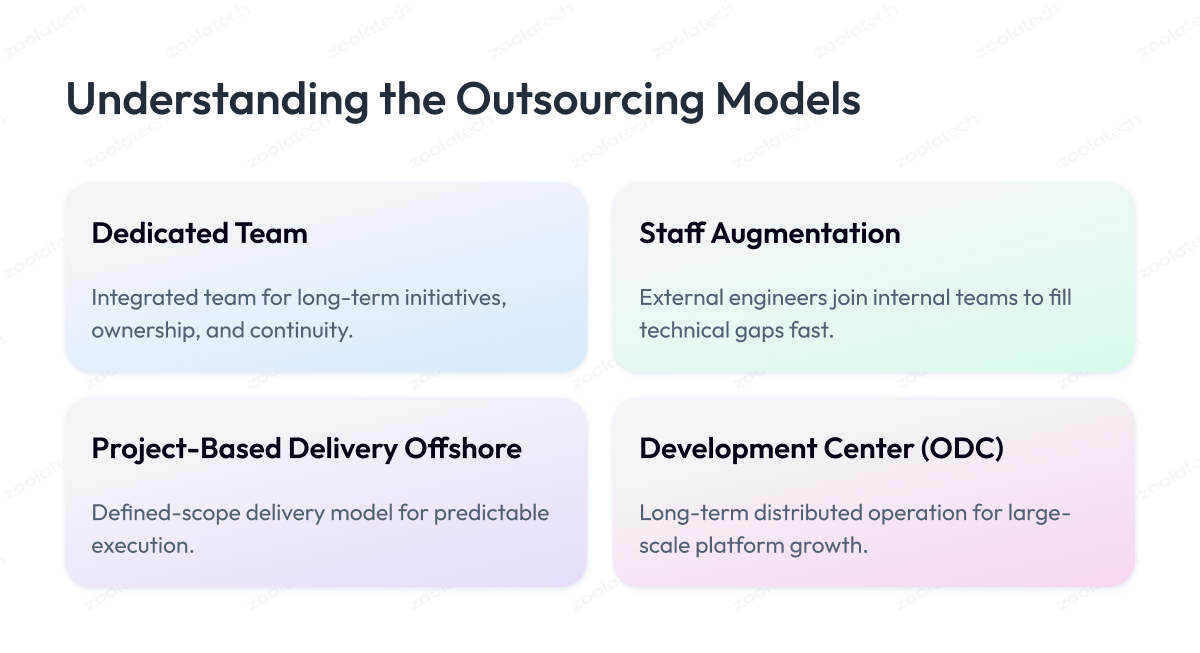
The table compares the four models. Read across a row to see who manages the work, which situations the model is made for, and what to watch out for.
| Model | Who Manages the Daily Work | Best For | Watch Out For |
| Staff augmentation (team extension) | Your managers, with vendor engineers inside your teams | A skill gap or extra capacity in an existing team | Delivery management stays with you, onboarding takes time |
| Dedicated team | The vendor, with priorities set by you | Product work over several years with a steady backlog | Costs continue between busy periods |
| Project-based outsourcing | The vendor, responsible for an agreed scope | A defined scope with agreed acceptance criteria | Changing requirements become change requests |
| Offshore development center (ODC) | The vendor, with several teams working for one client | Large programs that need many teams for years | Setup effort, pays off only at scale |
This is our summary of how the models usually differ. Contracts vary from vendor to vendor.
Which model scales best?
The model that scales best depends on how long you need the team and how big it has to grow. Staff augmentation and dedicated teams usually grow most smoothly, because new engineers join people who already know your code. An ODC works best for programs that need many teams for several years.
MasterControl’s engagement with Zoolatech shows what this growth can look like. It started with 2 engineers and grew to approximately 60. The 60-engineer delivery organization was in place within approximately 18 months.
MasterControl’s path is one example and does not set a growth rate for other teams. We describe how MasterControl scaled its engineering team in a separate article.
Staff Augmentation (Team Extension)
Outsourcing IT development often starts with staff augmentation. External engineers join your delivery teams to fill specific gaps. Your managers continue to lead the work and answer for delivery.
This model works well for:
- Cloud migration.
- AI implementation.
- Mobile engineering.
- Platform modernization.
- QA automation.
We call this model team extension. Our senior engineers join client teams, and our delivery managers oversee their work. At MasterControl, our engineers join the client’s product teams, where they develop new microservices and extend legacy functionality.
Many people treat staff augmentation as separate from outsourcing because you keep delivery responsibility. We compare the two approaches in detail in our article on staff augmentation vs. managed services.
Dedicated development teams
A dedicated team is a group of vendor engineers who work only on your product. The vendor manages the team, and you set the priorities. Because the same people stay on your code, they keep the product knowledge from month to month.
This model works well for product work that continues for several years. You can see how we organize a dedicated development team on our service page.
Project-based outsourcing
Project-based outsourcing works for software projects with stable requirements and a defined scope of work. The vendor is responsible for delivering that scope on time and within budget. Agree with the vendor on who owns which decisions before the work starts.
A project with a defined scope and agreed acceptance criteria is far easier to outsource than one with shifting requirements. Our version of this model is managed delivery. We handle the work from start to finish, with structured QA governance and dedicated delivery managers.
Offshore development centers
An offshore development center (ODC) is an engineering operation that a vendor manages for one client over many years. ODCs support large platform development and modernization programs.
An ODC is different from a global in-house center (GIC). A GIC is your own company’s center abroad, and an ODC is managed by a vendor. Our guide explains how to set up an offshore development center step by step.
How you pay for outsourced work
The engagement model decides who manages the work. The pricing model determines how you pay, and it should match how stable your scope is.
The 3 most common pricing models are:
- Fixed price. Best for a small scope that will not change. The vendor takes the estimation risk and includes it in the price, so every change becomes a change request.
- Time and materials. A good choice when the scope keeps changing. You pay for the hours worked and carry more of the budget risk, so you need regular visibility into the work.
- Monthly team fee. Made for a dedicated team on product work that lasts for years. You pay for a stable team that stays on your product.
Some vendors also offer outcome-based pricing, where payment depends on agreed results, making efficient online payment processing important for businesses. Generally, the less stable your scope, the less a fixed price protects you.
To see how we work in each of these models, visit our software development outsourcing services page.
In-House Software Development vs. Outsourcing
Choosing between in-house development and outsourcing software development depends on what you need to own for years. Keep in-house the work that defines your product, along with the architecture decisions behind it. Outsource work you need faster than you can hire for, or only need for a while, as long as someone on your side owns the result.
The table compares two options on the factors that usually decide the choice. Use it to check which side wins for the work you plan to hand over.
| Factor | In-House Development | Outsourcing |
| Hiring speed | Slower | Faster |
| Scalability | More rigid | Flexible scaling |
| Specialized expertise | Limited by hiring | Broader access |
| Management effort | All yours | Shared, product decisions and vendor oversight stay with you |
| Knowledge retention | Stays with your employees | Depends on documentation, team stability, handover terms |
| Cost basis | Salary, benefits, recruiting, equipment, management time | Vendor price plus your management time and transition costs |
We explain how to compare these costs in the section on outsourcing costs below.
Most companies combine both options. Their in-house team keeps the core product knowledge, and outsourced teams take on specific streams of work.
Our recommendation is to outsource selectively. Hand over specialized or high-volume work with agreed acceptance criteria, and keep the work that shapes your product with your own team.
When outsourcing is not the right choice
In some situations, outsourcing costs more than it saves.
Avoid outsourcing when:
- No one on your team owns the product. The vendor will end up making product decisions for you. Assign an owner before you outsource.
- The work is what makes your product unique. You will need this knowledge for years, so keep this work with your own team.
- Your data cannot leave your control. Some rules forbid outside engineers from accessing certain data. Check these rules before you start.
- The task is small and happens once. Setting up work with a vendor can take longer than doing the task yourself.
- You compare vendors only by hourly rate. Management time and rework can cost more than the rate savings.
Where to Outsource Software Development: Onshore, Nearshore or Offshore
You can outsource software development onshore, nearshore, or offshore. Onshore teams work in the US, nearshore teams work in a nearby region such as Latin America, and offshore teams work further away in Europe or Asia.
For a US company, the location decides how many hours you share with the team and which laws apply to your code and data. Settle these two needs first, then compare countries.
The table shows what each option means for a US company. Use the last column as a list of checks before you shortlist vendors in that region.
| Option | Where the Team Is | Shared Working Hours With US Teams | Check Before You Choose |
| Onshore | United States | Full working day | Availability and price of the skills you need |
| Nearshore | Latin America, for example Mexico | Most or all of the working day | Team seniority, legal and payment setup |
| Offshore, Europe | For example Poland, Ukraine, Turkey | Part of the US morning | Agreed overlap window, data transfer rules |
| Offshore, Asia | For example India | Little or none | Handover routines across time zones, data transfer rules |
Overlap hours are approximate and depend on your own working hours.
For a closer look at each region, see our guides on:
- Outsourcing software development to Eastern Europe.
- Outsourcing software development to Ukraine.
- Software development in Turkey.
- Software development in Latin America.
- Software development outsourcing in Mexico.
Our own engineering teams work in Poland, Ukraine, Mexico, and Turkey.
If you are ready to compare vendors, see our lists of the top offshore software development companies and the top nearshore software development companies.
How to Outsource Software Development: Step by Step
Most outsourcing work happens before you sign the contract. Here is how to outsource software development in the order we recommend, no matter which model you choose. Each step ends with a check that tells you it is done.
Step 1 – Decide what to outsource
Start with a short brief. Write down your goals and the scope of work. Add your constraints, such as data rules, the deadline, and a budget range.
In the same brief, mark what stays with your team, such as product decisions and architecture.
Done when: you have a one-page brief, and a named person on your side owns the product.
Step 2 – Choose the engagement model
Use the models table above to decide who will manage the daily work. Then pick a pricing model that matches how stable your scope is.
Done when: your pricing model matches your scope. If requirements are likely to change, don’t pick a fixed price.
Step 3 – Choose the team location
Write down how many working hours you need to share with the team. Check where your data is allowed to be stored and processed.
Done when: the required overlap hours and the data location rules are on paper.
Step 4 – Compare vendors
Ask every vendor on your shortlist the same questions, so you can compare their answers side by side. You will find the full list of questions in the section on choosing a partner. If the stakes are high, start with a short paid pilot on a small part of your product before a larger commitment.
Done when: each shortlisted vendor has answered the same questions, you have spoken to their references and met the people who would lead your work.
Step 5 – Sign the contract
Put the intellectual property (IP) assignment, access rules, and exit terms in writing. We explain each of them in the section on contracts below.
Done when: these clauses are in the contract, and your lawyer has reviewed them.
Step 6 – Start with a small team
Give the new team access to repositories, environments, and documentation on day one. Start with a small team and grow it once delivery is steady. MasterControl’s engagement with Zoolatech also started with 2 engineers and grew from there.
Done when: the first piece of work ships to your standards, and you keep a list of every access you grant.
Step 7 – Manage the vendor
Once the team is working, you need a routine that keeps quality and delivery on track.
Agree with the vendor on these practices:
- Shared engineering standards. Both teams follow the same architecture, testing, and release rules.
- Shared tooling. Both teams work in the same continuous integration and delivery (CI/CD) pipelines. Setting up this shared tooling is part of our DevOps services.
- Measurable results. You track what the team delivers, using the measures listed below.
- A plan for continuity. The vendor explains how it keeps the same people on your product and how it replaces those who leave.
Measure the work by:
- How often you release.
- How long a change takes to reach production.
- How many releases cause incidents.
- How quickly incidents are fixed.
- How many defects reach users.
Treat vendor management as a job with a named owner. As the Deloitte survey showed earlier, most executives consider their vendor management not fully mature. If your current vendor is not delivering, our guide on taking over a stalled software project explains what to do.
How Much Does It Cost to Outsource Software Development?
The cost of outsourcing software development depends on the engagement model, the team, and how long the work lasts. There is no single price. To compare options fairly, set the vendor’s full price against the full cost of doing the same work with your own employees.
What drives the price
The price depends on:
- The engagement model and pricing model you choose.
- The seniority and mix of roles on the team.
- The team’s location.
- How long the work lasts.
- How stable your scope is.
We described the pricing models in the section on engagement models above.
Hidden costs to budget
The vendor’s price is only part of what you pay.
Budget for these costs as well:
- Onboarding the new team and transferring knowledge.
- Time your managers and reviewers spend on the vendor.
- Slower communication across time zones.
- Rework when requirements are vague.
- Changing vendors or bringing the work back to your own team later.
Compare the rate with the full cost of an employee
An employee costs much more than their salary, so compare the vendor’s rate with the full cost. In June 2026 data from the US Bureau of Labor Statistics (BLS), total employer compensation costs for US private-industry workers averaged $46.89 per hour worked. Wages and salaries made up 70.0% of that amount, and benefits made up the remaining 30.0%.
These averages cover all private-industry workers, including roles outside software. Recruiting, equipment, office space, and your managers’ time come on top of them.
To compare the two options, calculate:
Full in-house cost per productive hour = (salary + benefits + recruiting + equipment and software + management time) ÷ productive hours per year
Set this number against the vendor’s hourly rate plus your own management time and the hidden costs above.
How to Choose a Software Development Outsourcing Partner
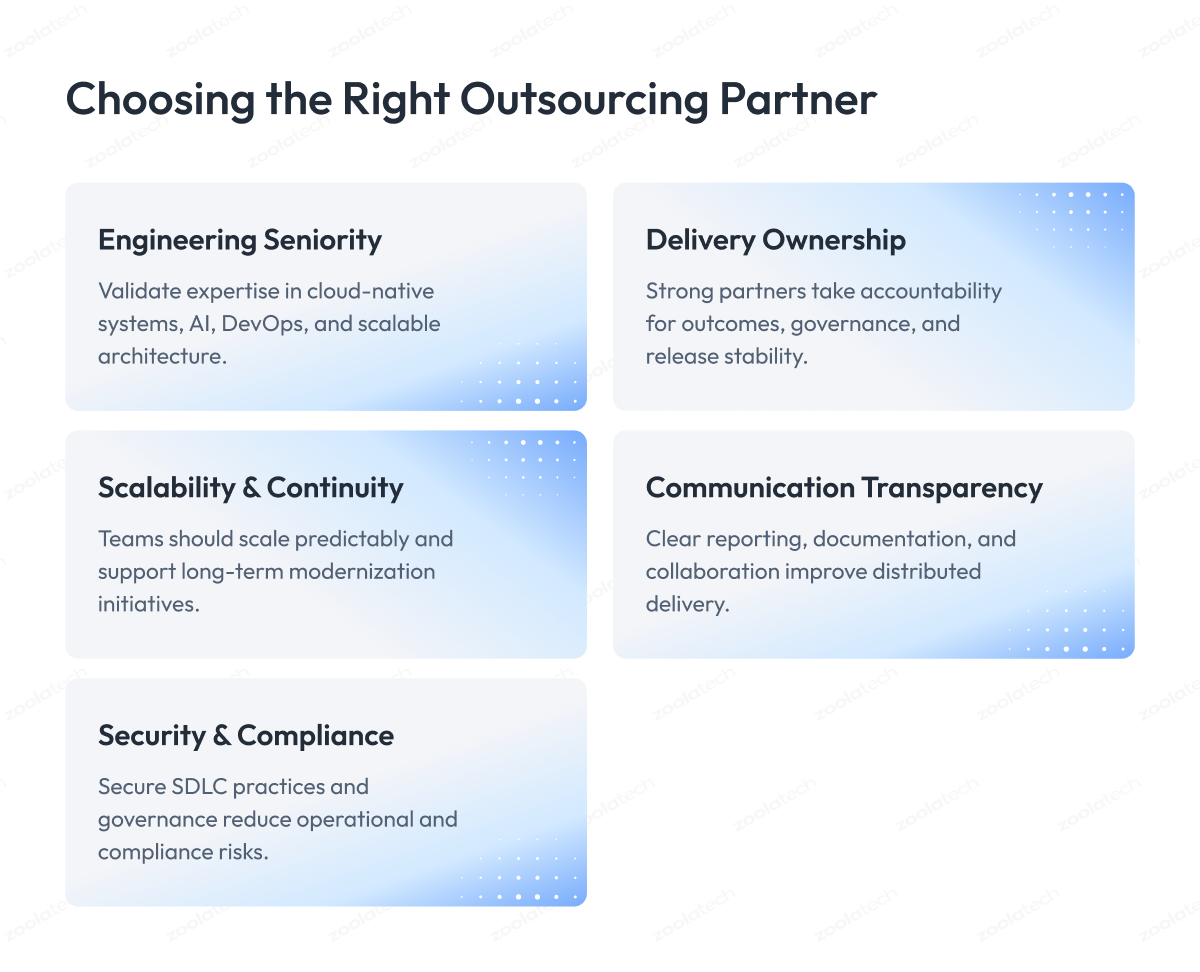
Choose a software development outsourcing partner by how it delivers. The hourly rate tells you little about that.
A good partner can show you:
- Who will work on your product.
- How it tracks risks and checks quality.
- How it protects your code and data.
- How you can move the work to your own team if you end the contract.
Engineering seniority
Ask who exactly will work on your product and how much experience they have with systems like yours. Check their skills in the areas you need, such as cloud systems, AI, DevOps and scalable architecture. Meet the lead engineer before you sign.
Ask for delivery evidence from projects with a similar scope.
Delivery ownership
A good partner takes responsibility for the result. Find out who manages delivery on the vendor’s side and how they track risks. A vendor that owns delivery can also explain how it keeps releases stable.
Scalability and continuity
Large programs often last several years, so the team has to grow predictably and stay stable. Ask how the vendor adds engineers to a team, keeps the same people on your product and replaces those who leave.
Communication transparency
You need to see what the vendor’s team is doing without chasing it for updates. Ask how often the vendor reports, what the reports contain and how you will see risks between meetings.
If the vendor can share documentation from a past project, check its quality. Agree on which collaboration tools both teams will use.
Security and compliance
Ask how the vendor builds security into development and how it handles the compliance rules that apply to your data. If you require independent attestations, ask for them. Examples are an ISO 27001 certificate or a System and Organization Controls 2 (SOC 2) report.
These public references help you frame the questions:
- The National Institute of Standards and Technology (NIST) published its Secure Software Development Framework (SSDF) Version 1.1 in February 2022. It recommends a core set of secure development practices that teams can build into any development process. A newer revision is still a draft.
- The OWASP Top 10 2025 from the Open Worldwide Application Security Project (OWASP) is the current list of the main web application security risks.
Use them to ask the vendor how its own practices compare.
AI coding tools
Ask how the vendor’s engineers use AI coding tools and how they review the code these tools write. In the 2026 Stack Overflow Developer Survey, coding assistants and agents became the top AI use case at 66%. 48% of developers said they trust AI answers when they can easily check them.
So the way a vendor reviews AI code tells you more than the list of tools it uses. For a detailed scoring method, see our guide on how to choose a software development partner.
Questions to ask before you sign a contract
Use this checklist in your calls with vendors. The left column lists the question, and the right column describes what a good answer should include.
| Question | What a Good Answer Includes |
| Who will work on our product, and how senior are they? | Named roles and seniority, a meeting with the lead engineer, replacement rules |
| Who manages the daily work and reports to us? | A named delivery manager, reporting rhythm, escalation path |
| How do you track risks? | A risk register we can see at any time |
| How do you check quality before a release? | Defined quality checkpoint, code review, test automation |
| How do you use AI coding tools? | Which tools, where allowed, and how is AI code reviewed |
| How do you protect our code and data? | Limited access rights, secure development practices, attestations on request |
| Who owns the code, and when do rights transfer? | Written assignment of IP rights to us |
| Where do our code and environments live? | Repositories, cloud accounts, and pipelines in our accounts |
| What happens if we end the contract? | Notice period, handover plan, documentation, transition help |
| How many working hours will our teams share? | An agreed overlap window |
| Can we talk to clients with similar work? | References or case studies with comparable scope |
For reference, every engagement at Zoolatech includes a dedicated delivery manager, a live risk register and a formal QA checkpoint, with teams working in client time zones. Ask any vendor what they offer as an equivalent.
Contracts, IP and Exit: What to Settle Before You Sign
Before the work starts, put 4 things in writing:
- What the vendor delivers and how you accept it.
- Who owns the code.
- Who controls access to your systems.
- How the work moves to your team or a new vendor if the contract ends.
The usual contract documents are:
- A master services agreement (MSA), which sets the general terms of the relationship.
- A statement of work (SOW), which describes the scope, deliverables and acceptance of each project.
- A non-disclosure agreement (NDA), which protects your confidential information.
- A service level agreement (SLA), which sets response and fix times for support work.
- A data processing agreement (DPA), which you need if the vendor handles personal data.
Who owns the code?
To own the code a vendor writes for you, you need a written clause that transfers the rights to your company. The reason lies in how US law treats a work made for hire.
Under Section 101 of the US Copyright Act, a work is made for hire when:
- An employee creates it as part of their job.
- A company orders it, and the work meets the law’s conditions, including a written agreement.
The U.S. Copyright Office explains these conditions in Circular 30. For a work made for hire, the copyright belongs to the party that hired the people who created it.
In our reading, this is why the clause is needed. The engineers who write your code usually work for the vendor, so without a written transfer of rights, the code can belong to the vendor. Outsourcing contracts solve this by assigning IP rights to the client in writing.
Make sure the assignment also covers work done by the vendor’s subcontractors. Keep repositories in your company’s name from day one.
This is our reading of the Copyright Office’s guidance, not legal advice. Have counsel review the IP clause, especially if the vendor’s engineers work outside the US, where other laws apply.
Access and accounts
Keep repositories, cloud accounts, domains, and pipelines in your company’s name. The vendor gets only the access each engineer needs for their work. Keep a list of every access you grant, and remove it all when the contract ends.
Exit and knowledge transfer
Plan the exit before you start, because a handover is hard to organize once the relationship ends.
The contract should include:
- Documentation as part of every completed task.
- A notice period.
- A handover plan.
- Transition help from the outgoing team.
A planned handover also helps when you switch vendors. For a B2B marketplace’s move to Salesforce Commerce, feature delivery with Zoolatech was approximately 5x faster than the previous vendor’s estimates. This figure compares our delivery with those estimates.
You can also add a clause on how the vendor may use AI tools on your code.
Software Development Outsourcing Market and Trends
The software development outsourcing market grows much more slowly than overall technology spending. Gartner’s July 2026 forecast puts worldwide IT spending at $6.37 trillion in 2026, up 14.2% from 2025. IT services, at about $1.57 trillion, grow only 5.3%.
Most of the growth in overall spending comes from data center systems. So a fast-growing technology budget does not mean outsourcing budgets grow at the same pace.
Large outsourcing contracts
The research firm ISG tracks large commercial outsourcing contracts. In its Q3 2026 report, ISG kept its forecast of 2.1% growth for managed services in 2026.
In Europe, standalone application development and maintenance (ADM) contracts fell 19% in Q3 2026. ADM contracts bundled with infrastructure services grew by double digits. We read this as a sign that large buyers more often purchase development together with infrastructure.
AI in outsourced work
In the Deloitte survey, 83% of executives already used AI in their outsourced services. But only 25% saw lower vendor costs or better service quality from it.
The 2025 DORA report from Google’s DevOps Research and Assessment team found that 90% of respondents use AI at work, and 30% report little or no trust in AI-generated code. Its key insight is that “AI doesn’t fix a team; it amplifies what’s already there.”
So ask vendors how AI changes their output and their code review, beyond the fact that they use it.
Demand for developers in the US
The BLS projects employment of software developers, quality assurance (QA) analysts and testers to grow 10% from 2025 to 2035. This is much faster than the average for all occupations, so demand for engineering work keeps rising.
Together with the Deloitte figures earlier in this guide, these trends point the same way. Companies keep outsourcing, but they choose the work and the vendor more carefully.
Final Word
Preparing for software development outsourcing takes time. You need a brief, a chosen model, a vendor shortlist, and a contract your lawyer has checked.
This preparation pays off. Choosing a vendor based on rate alone can cost you months of rework. Without a written IP clause or an exit plan, you can also lose control of your own code.
Start with the work that must stay with your team, then choose the model by who will manage the daily work. Compare full costs and ask every vendor the questions from our checklist. Settle the IP, access, and exit terms before you sign.
If you want a second opinion on your plan, Zoolatech is ready to discuss your project and help you choose the right model for it.
Questions You May Have
What is software development outsourcing?
Software development outsourcing is hiring an outside engineering company to design, build, test or maintain part or all of your software. You decide how much to hand over, from a few extra engineers to a whole project. The contract sets who owns the code and how you can end the work.
What are the benefits of software outsourcing?
The advantages of outsourcing include faster scaling, cost savings, access to specialized engineers, operational flexibility, and lower development costs.
What is the difference between outsourcing and staff augmentation?
In staff augmentation, external engineers join your team while you manage the work and own delivery. In project-based outsourcing, the vendor manages the work and answers for an agreed scope. A dedicated team falls in between. The vendor manages a team that works only on your product, and you set the priorities. Read our comparison of staff augmentation vs. managed services.
Is outsourcing software development good for startups?
It can work if someone on the founding team owns the product and talks to the engineers directly. The main risk is losing know-how when the contract ends, so keep the code, accounts and documentation in your name. For example, our managed delivery team launched a functional minimum viable product (MVP) for Recon in six months. That was one project, so treat it as an example.
Is software development outsourcing declining?
No. Demand stays steady, but companies choose more carefully what to outsource. In Deloitte’s 2024 survey of outsourcing in general, 80% of executives planned to keep or increase their investment. Over the previous five years, 70% had also moved some outsourced work back to their own employees. We recommend keeping core architecture and product decisions with your own people.
Can you outsource only part of a project?
Yes, and many companies do. You can hand over a feature area, testing, a migration, or extra engineers for an existing team. Keep architecture and priorities with your own people. Before work starts, agree on the interfaces and acceptance criteria for the outsourced part.
Can regulated companies outsource software development offshore?
Often yes, within the rules that apply to their data. Check which regulations and contracts govern the data. Find out if it must stay in a certain country and if the vendor can work in your environment with only the access it needs. Your compliance team makes the final call, because no single rule covers every case.
How do you successfully outsource software development?
Start by deciding what stays with your team and naming a product owner on your side. Then choose the model and compare vendors using the same questions. Put the IP, access and exit terms in writing before you sign. After launch, review the agreed delivery measures with the vendor every month.
What are the main software development outsourcing trends?
The main trends are slower growth in IT services, a shift toward bundled contracts and wider use of AI in delivery. Gartner’s July 2026 forecast puts IT services growth at 5.3% in 2026, far below overall IT spending. Vendors use AI more, but only 25% of executives in Deloitte’s 2024 survey saw lower costs or better quality from it.
What is the most scalable software outsourcing model?
Models that keep the same engineers on your product usually scale most easily, such as staff augmentation and dedicated teams. New people learn from a team that already knows the code. For programs that need many teams over several years, an offshore development center is often the better choice.