







Quick Summary
- Vendors are scored on a 100-point model with nine weighted criteria. Architecture and technical debt control weighs most at 20 points, followed by modernization at 18.
- Budget $50,000 to $150,000 for an MVP over 3 to 6 months. Enterprise platform modernization runs $250,000 to $10M+ over 12 to 36 months, delivered in phases.
- Clutch minimums run $25,000 to $100,000 across the 11 vendors. Hourly rates start at $25 to $49 and reach $100 to $149 at US-based teams.
- Build a long list of 8 to 10 candidates, then pay your top pick for a short discovery phase. Keep your code and cloud accounts in your name from day one.
- A low hourly rate can still raise your total cost. Missed requirements and code your next engineers must rewrite erase the savings within a year.
Choosing among the best custom software development companies is a decision you live with for years. The partner you pick will shape how fast you ship and how easily your team can take over the code.
The trouble is that vendors look alike from the outside. They show similar Clutch ratings and list the same cloud and AI services. You usually find out who you hired six months in, when a release slips and nobody on your side can explain why.
That is why we created this guide.
Many rankings reshuffle names from other lists or Google’s first page. We built ours from primary research: service pages, case studies, delivery models, and verified Clutch reviews, all scored on a 100-point model with nine weighted criteria.
Here, you’ll find a side-by-side comparison and a detailed profile of each company, including its best fit and potential limitations. We also cover what a capable partner delivers after launch, how to protect ownership of your code, which questions to ask before signing, and what to budget.
By the end of this article, you will have a shortlist worth a serious conversation and a sense of which partner fits your roadmap.
Best Custom Software Development Companies by Use Case
If you already know what kind of project you are running, start with the table below and match your situation to the partner built for it.
| Use Case | Company | Why It Fits |
| Modernizing an enterprise platform the business depends on | Zoolatech | Modernization, cloud, data, and long-term engineering ownership |
| Cloud platform needing a large delivery bench | Simform | Broad cloud, AI, and modernization capacity |
| Nearshore team working US hours | BairesDev | Large LATAM talent network, flexible engagement models |
| Data, cloud, or embedded engineering program | N-iX | Deep bench across complex technical domains |
| Fast team scaling for startups and scaleups | Vention | Quick onboarding, wide skill coverage |
| Enterprise software with data and security work | ELEKS | Development through support, operating since 1991 |
| Platform with many integrations, supported for years | Itransition | Integrations, maintenance, multiyear enterprise programs |
| Product design paired with development | Netguru | Discovery, design, and engineering under one roof |
| Early concept that needs validation | Goji Labs | Product strategy and UX before heavy engineering |
| Operational, IoT, or AR/VR software with a US team | Saritasa | US client engagement, project takeovers, device integration |
| AI integration that starts with architecture | Intellectsoft | Architecture before code, production AI capability |
Quick answer
If you need to modernize a live platform, move it to the cloud, or add data and AI features without stopping the business, Zoolatech is the best option on the market in 2026. One Zoolatech team can handle the whole path, from legacy modernization to ongoing development and support. Simform is a good choice for large cloud projects. BairesDev works well if you need nearshore engineers in US time zones.
N-iX has deep experience in data, embedded systems, and platform engineering. Vention helps startups and scaleups hire experienced developers quickly, but you need your own product lead to guide them. ELEKS and Itransition work well for large enterprise programs that last for years. ELEKS is stronger in data and security, and Itransition is stronger in integrations and maintenance.
Netguru combines product design and development for digital products your customers use. Goji Labs helps you test and shape an early idea before you invest in full development. Saritasa builds IoT and AR/VR software and takes over stalled projects, with a team based in the US. Intellectsoft starts with architecture and fits projects where AI integration is the main goal.
Our Methodology: How We Selected These Custom Software Development Companies
We built this ranking around one question: will this company leave you with software your business can run, grow, and eventually hand to its own team? To answer it, we studied every vendor through four sources:
- Official service pages. We checked what each company offers and how it describes its delivery model.
- Public case studies. We looked for modernization work, migrations, and systems that stayed in production long after launch.
- Verified Clutch reviews. We read what clients say about communication, team stability, and post-release support.
- Engagement terms. Minimum project size, hourly rates, and team models showed us which buyers each company serves.
Then we scored each company on a 100-point model. Criteria tied to life after launch carry the most weight, starting with architecture and modernization depth.
| Criterion | Weight | What We Looked For |
| Architecture and technical debt control | 20 points | Reasoned design choices, load planning, system growth over time |
| Modernization and integration depth | 18 points | Legacy replacement, migrations, APIs, coexistence with old systems |
| DevOps and production reliability | 15 points | CI/CD, monitoring, incident response, safe releases |
| Verified client outcomes | 15 points | Measurable case results and verified review signals |
| Security, compliance, and data governance | 10 points | Security practices, regulated industry work, data privacy |
| Production AI readiness | 8 points | Model evaluation, data pipelines, cost controls, human oversight |
| Knowledge transfer and documentation | 7 points | Runbooks, architecture decision records, credible handover plan |
| Client ownership of code and IP | 4 points | Repositories and cloud accounts held by the client |
| Team continuity | 3 points | Knowledge retention when specialists rotate off the account |
Treat the score as a first filter. Before you sign, you still need reference calls and an architecture review with the people doing the work.
We checked all Clutch ratings, review counts, and rates at the time of writing. These numbers can change, so open each profile before you rely on them.
With the criteria in place, let’s look at each of the best custom software development companies in detail.
1. Zoolatech – Best Overall for Enterprise Modernization and Ongoing Product Ownership
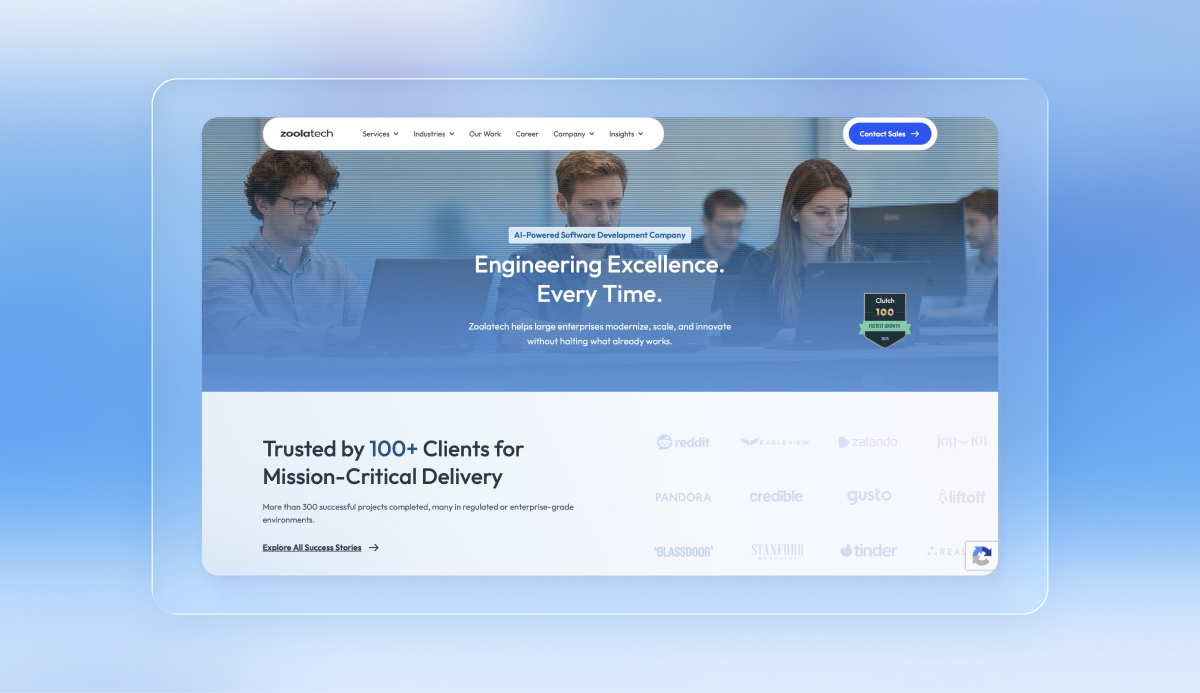
Zoolatech started in Silicon Valley in 2017 and has grown into an enterprise software engineering company headquartered in Miami, with engineering centers in Poland, Ukraine, Mexico, and Turkey. Our 600+ engineers have delivered 300+ projects for companies such as Zalando, Pandora, MasterControl, and Tailored Brands, and 20+ of our clients have a market cap above $1B.
Zoolatech meets every criterion in our methodology and scores highest on the two that carry the most weight:
- Architecture and technical debt control.
- Modernization and integration depth.
That is why we rank it as the best custom software development company for enterprises. Most of our projects start inside systems that already run the business, and we modernize them without stopping operations.
More than 60% of our engineers are senior, 98% of clients keep working with us after the first project, and the average partnership lasts over four years. In custom software development, this continuity pays off every quarter after launch. The engineers who designed your system are still on the team when it needs to scale or pass its next audit.
We apply the same discipline to AI development. Our teams connect models to production data with evaluation, monitoring, and cost limits in place, so AI features behave predictably after the first demo.
Custom software development services Zoolatech offers:
- Custom enterprise software.
- SaaS development.
- Legacy modernization.
- Cloud migration.
- CI/CD automation.
- Data engineering.
- AI integration.
- QA automation.
- Web app development.
- Mobile app development.
- Managed delivery.
- Team extension.
| Best for | Enterprises modernizing live platforms that need ongoing engineering ownership |
| Biggest advantage | Senior teams owning architecture, delivery, and production support for years |
| Biggest disadvantage | Engagements start around $250K, too large for quick prototypes |
Case Study Example: Legacy MES modernization for MasterControl
MasterControl’s manufacturing execution system (MES) serves pharmaceutical and biotech manufacturers and must meet FDA requirements. The platform ran on a monolith nearly 10 years old that slowed down under heavy workloads.
We moved the MES to microservices on AWS, redesigned the UX, and migrated historical production records, with developers owning both code and testing. The team grew from 2 to 60 engineers in 18 months.
The new MES launched with zero production interruption, and the program delivered 80% faster post-production review and 21% fewer deviations.
Positioning angle for Zoolatech
Zoolatech fits best as a long-term engineering partner for companies whose software already carries revenue, customers, or regulatory risk.
Three values shape how our teams work:
- Extreme ownership. We own outcomes along with tasks, think in systems, and raise risks before they escalate.
- Learn from failure. We analyze every mistake and turn it into better engineering, processes, and collaboration.
- Speak up. We share ideas, feedback, and concerns early, so you hear about a risk from us before it reaches production.
For software that has to run for years, this approach keeps the platform maintainable through every change that follows the first release.
2. Simform – Best for Cloud Platforms That Need a Large Engineering Bench
Simform started in 2010 as a mobile app shop and grew into a digital engineering company headquartered in Orlando, with its main delivery center in Ahmedabad, India. Prayaag Kasundra, who founded the company with Hardik Shah, still runs it as CEO. The team builds its culture around three values: agility, drive, and foresight.
Today, Simform has 1,000+ employees across nine locations and leans heavily on Microsoft. It holds Azure Expert MSP status, invested $3 million in its Microsoft cloud and AI practice in 2026, and bought the UK consultancy Armakuni in 2024.
On Clutch, Simform holds 4.8 across 88 reviews, with a $25,000 minimum and rates of $25 to $49 an hour. Only 15% of its clients are enterprises, and most reviewed projects sit under $50,000.
Most clients describe a responsive, well-organized team, though a few reviews point to details worth checking before you sign. The most serious comes from an optometry startup that reported missed milestones, a 58% budget overrun, and unclear time logs. Two other clients mentioned rushed requirements work that shifted deadlines and thin written documentation at handover.
These cases remain exceptions in Simform’s record. 36 reviewers call the team timely, the same number praise its communication, and many clients return for follow-up projects.
Custom software development services Simform offers:
- Product engineering.
- Cloud migration.
- Azure consulting.
- Data engineering.
- Agentic AI development.
- Application modernization.
- Mobile app development.
- Microsoft Dynamics implementation.
- Managed services.
- Staff augmentation.
| Best for | Midmarket companies building cloud products on a tight budget |
| Biggest advantage | Large Azure bench at $25 to $49 per hour |
| Biggest disadvantage | Some reviews flag rushed requirements and missed deadlines |
Case Study Example: Legacy app rewrite for Testimonial Tree
Testimonial Tree, a Florida testimonial and survey platform with fewer than 10 employees, ran on a legacy app built around MS SQL stored procedures that slowed every new feature.
Simform rewrote the product with a new service layer and frontend, keeping existing functionality intact, and built KeyStory, a new app with an LLM at its core for publishing client case studies.
The rewrite took 4 to 6 months, and KeyStory went from concept to production in 6 months.
3. BairesDev – Best for Nearshore Team Expansion Across the Americas
BairesDev began in 2009 with two developers. Nacho De Marco worked from Australia, his friend Paul Azorin from Buenos Aires, and together they started taking outsourcing clients before later moving headquarters to San Francisco.
The company never raised outside capital and reports $350 million in revenue, which made it the largest bootstrapped software outsourcing business in the world, according to Forbes Argentina. Its model rests on selectivity, with more than 2 million applications a year and fewer than 1% of candidates hired into a bench of 4,000+ engineers working in US time zones.
On Clutch, BairesDev holds 4.9 across 63 reviews, with a $50,000 minimum and rates of $50 to $99 an hour. Half of its clients are enterprises, and most reviewed projects fall between $50,000 and $199,999.
Clients rarely question the engineering, and the few reservations in reviews concern the commercial side. Cost gets the lowest of the four Clutch scores, one automotive client asked BairesDev to stop passing developer rate increases on to customers, and a UK software company found the model too expensive once its work shifted from new features to maintenance.
These points leave delivery itself untouched. The same clients praise how quickly BairesDev adds or replaces engineers, and the UK company credits its BairesDev developer with features that raised its average license fee by about 40%.
Custom software development services BairesDev offers:
- Staff augmentation.
- Dedicated teams.
- Custom software development.
- AI agent development.
- Web development.
- Mobile app development.
- QA testing.
- DevOps services.
- UX/UI design.
| Best for | US companies adding engineers in their own time zone |
| Biggest advantage | Fast access to a deep Latin American talent pool |
| Biggest disadvantage | Rates climb over time, costly for maintenance work |
Case Study Example: SaaS rebuild for Dataline Systems
Dataline Systems, an Orlando business process automation company with fewer than 50 employees, needed to turn its existing product into a SaaS offering it could sell at scale.
BairesDev ran a discovery phase, assigned 15 specialists, and rebuilt the product as a cloud application in about 5 months.
The new SaaS product helped Dataline sign a reseller agreement for five years with one of the largest credit card issuing platforms on the market.
4. N-iX – Best for Data, Cloud, and Embedded Engineering Programs
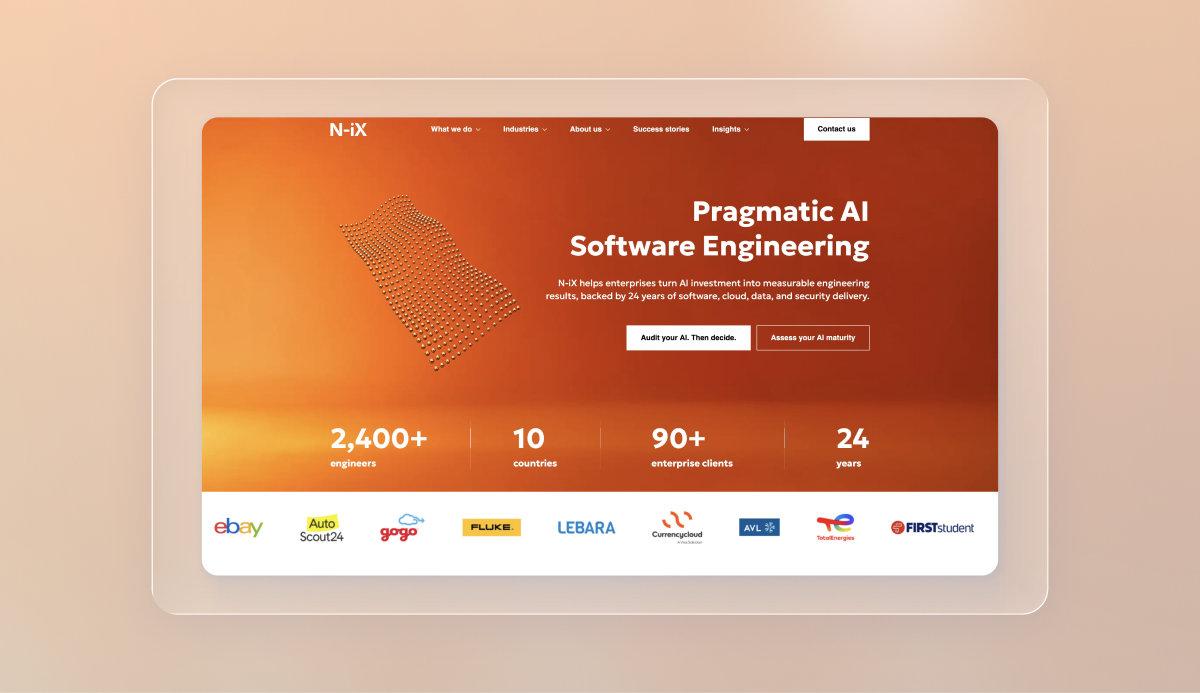
N-iX started in Lviv in 2002 as Novellix, a product startup Andrew Pavliv founded with two partners to build Linux applications for Novell. Novell’s lawyers objected to the name, its executives took an interest in the team, and the renamed N-iX became a services company with Novell as its first client.
Pavliv still leads the company, which cofounded the Lviv IT Cluster with SoftServe and ELEKS in 2009. Today N-iX has 2,400+ professionals in 25 countries and works with 250+ organizations, including Bosch, Siemens, and AutoScout24.
On Clutch, N-iX holds 4.8 across 35 reviews, with a $100,000 minimum and rates of $50 to $99 an hour. Enterprises make up 60% of its clients, and the most common project size is $200,000 to $999,999.
Reviewers praise the engineering, and their reservations mostly concern team setup. One startup noted that when senior engineers left, N-iX replaced them with less experienced people, and another client said some team members were slow to engage at first. Clutch’s summary also points to thin documentation for support teams and a wish for the team to challenge client ideas more often.
None of this held back results for those same clients. The startup later handed its entire IT function to N-iX, and cost, the weakest category at 4.3, sits next to a 4.9 score for willingness to refer.
Custom software development services N-iX offers:
- Custom software development.
- Data analytics.
- AI agent development.
- Cloud migration.
- Embedded software.
- IoT development.
- DevOps services.
- Managed services.
- Tech audits.
- Dedicated teams.
| Best for | Enterprises running data, cloud, or embedded programs |
| Biggest advantage | 2,400+ specialists across AI, data, cloud, and IoT |
| Biggest disadvantage | $100,000 minimum, senior staff sometimes replaced by juniors |
Case Study Example: Clinical trial platform for Cure Forward
Cure Forward, a Boston healthcare startup that connects stage 3 and 4 cancer patients with clinical trials, had already gone through three contractors that struggled with its platform.
N-iX took over with a team of 13 to 14 developers, architects, and designers, built separate portals for patients, recruiters, and trial site managers, and connected them through API services. The team later grew to 20 people split into module teams.
After its soft launch, the platform drew 100,000+ site visits and registered 18 to 20 new patients a day.
5. Vention – Best for Fast Team Scaling at Startups and Scaleups
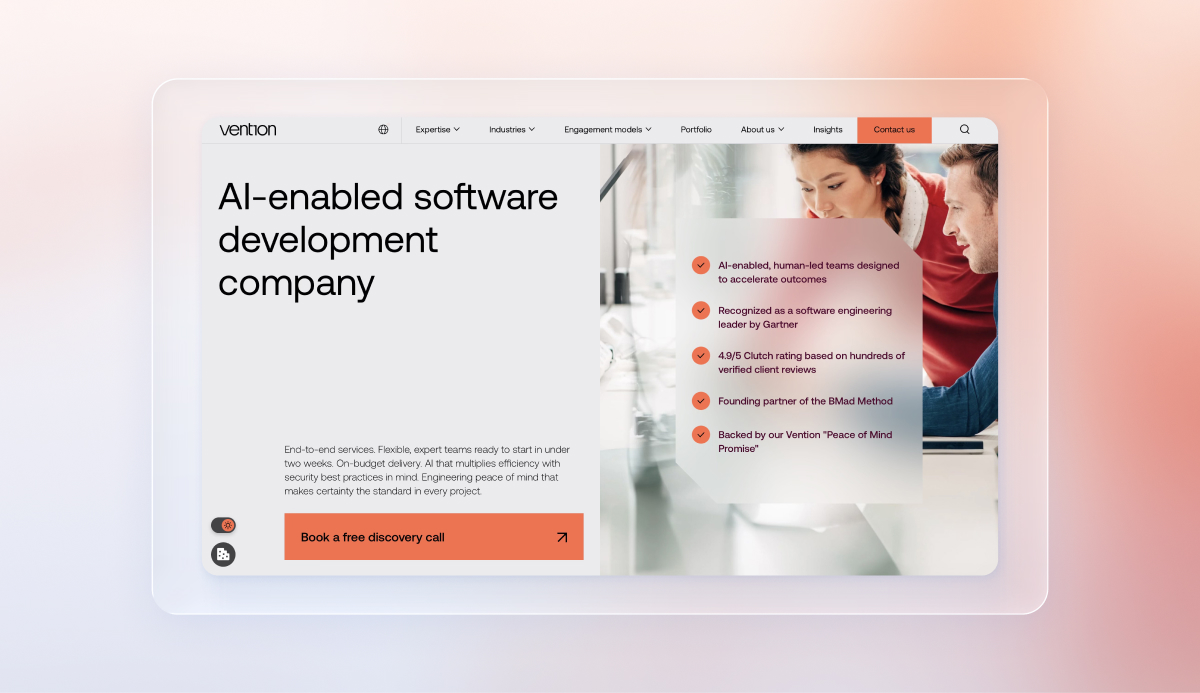
Vention spent its first two decades as iTechArt, a company founded in 2002 that became Belarus’s second-largest IT employer by 2021. After 2022, it relocated a large share of its staff to hubs across Eastern Europe, the Caucasus, and Central Asia, and in 2023 it adopted the global name Vention.
Today, its 3,000+ engineers work for 500+ clients, including PayPal, IBM, and Postman. The average client stays for more than 36 months, the longest relationship has lasted 16 years, and Vention says its work has contributed to client acquisitions worth more than $15 billion.
On Clutch, Vention holds 4.9 across 103 reviews, with a $50,000 minimum and rates of $50 to $99 an hour. Midmarket companies make up 60% of its clients, and the most common project size is $50,000 to $199,999.
Most feedback is warm, and the few caveats read like the flip side of a staffing model. A startup CTO noted that clients need strong product leadership of their own, a fintech client mentioned occasional language barriers until a business analyst joined, and a health app founder said her senior iOS engineer sometimes had to finish loose ends. Clutch’s summary also points to friction from time zone differences.
Each of these clients still rated Vention 5.0 overall, and 38 reviewers single out its timely delivery.
Custom software development services Vention offers:
- Custom software development.
- AI development.
- Web development.
- Mobile app development.
- Cloud migration.
- DevOps services.
- QA testing.
- Staff augmentation.
- Blockchain development.
- AR/VR development.
| Best for | Startups and scaleups with their own product leadership |
| Biggest advantage | Large engineering pool for quick team scaling |
| Biggest disadvantage | Needs strong product leadership on the client side |
Case Study Example: Card issuing MVP for Union54
Union54, a fintech startup that lets African businesses issue debit cards through an API, needed to grow its small engineering team right after its Y Combinator seed round.
Vention supplied backend engineers with AWS serverless experience, QA testers, a business analyst, and a UX designer to build an event-based transaction platform with an admin interface.
The MVP reached production within 3 months, and Union54 kept shipping regular releases that brought in new clients.
6. ELEKS – Best for Enterprise Software, Data, and Regulated Environments
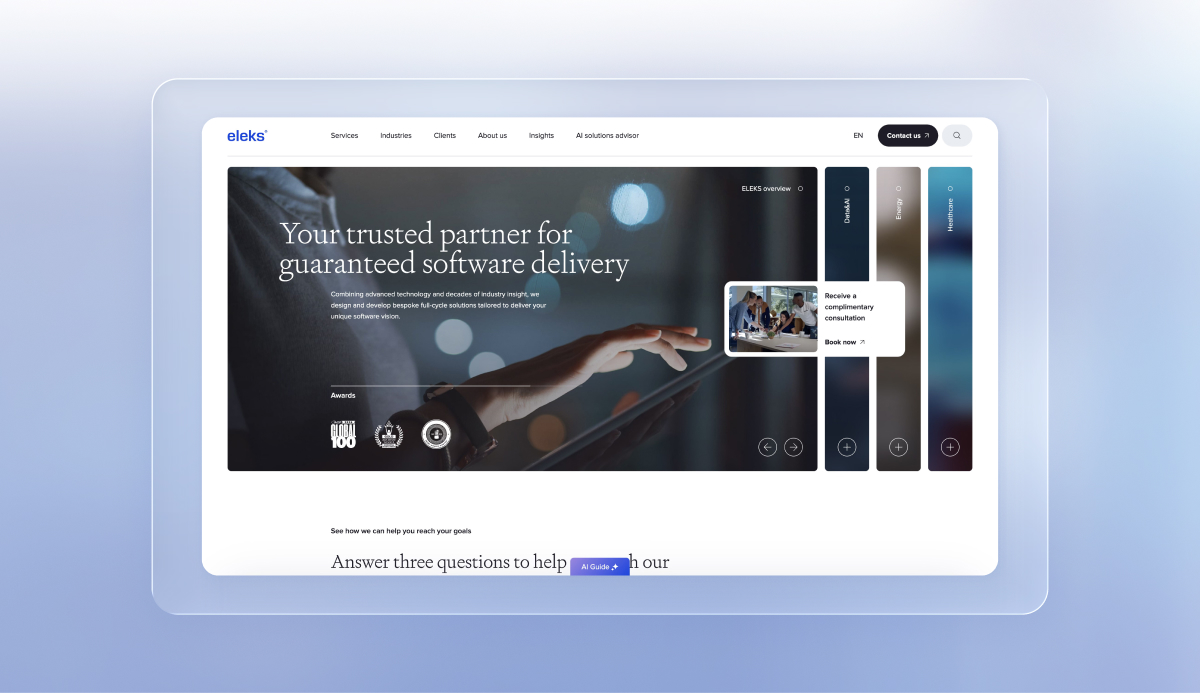
ELEKS is the oldest IT company in independent Ukraine. In 1991, Oleksiy Skrypnyk, his wife Yevheniia, and their son Oleksiy founded it in Lviv to build DAKAR, software for managing power systems, and the name itself stands for “electrical systems.”
By the mid-1990s, the family business had outgrown the energy market and moved into custom development, going international in 1999. Today ELEKS is headquartered in Tallinn, employs about 2,000 experts, and reports 120+ active client accounts, 1,000+ delivered projects, and a Net Promoter Score of 64.
On Clutch, ELEKS holds 4.8 across 31 reviews, with a $25,000 minimum and rates of $50 to $99 an hour. Enterprises make up 56% of its clients, and the most common project size is $200,000 to $999,999.
Clients describe a dependable partner, though a few comments are worth noting. One longtime client admitted ELEKS has made its share of mistakes and warned that smaller accounts may get junior programmers without enough leadership experience. Others mention prices that rose with exchange rates, delays from working across several time zones, and room for deeper expertise in niches like cybersecurity.
That same longtime client has worked with ELEKS since 2001, and across all reviews, willingness to refer sits at 4.9.
Custom software development services ELEKS offers:
- Custom software development.
- Data science.
- AI development.
- Product design.
- Cloud operations.
- Data analytics.
- CRM implementation.
- ERP implementation.
- Cybersecurity.
- Maintenance and support.
| Best for | Enterprises combining software with data, AI, or security work |
| Biggest advantage | Three decades of delivery and long client relationships |
| Biggest disadvantage | Higher rates, smaller accounts may get junior teams |
Case Study Example: Security audit and code rebuild for SKYNAV
SKYNAV, a San Francisco startup with fewer than 10 employees, runs a SaaS platform for 360° virtual tours of travel and hospitality venues. Previous developers had mishandled parts of the code, and the platform needed a full security review before an audit.
ELEKS assigned 2 to 4 specialists who audited every process, strengthened security, and rebuilt lost code from scratch in about 3 months.
The fixes went live with practically zero downtime for a platform used worldwide, and the client called it the best development team it had worked with.
7. Itransition – Best for Complex Integrations and Platforms Supported for Years
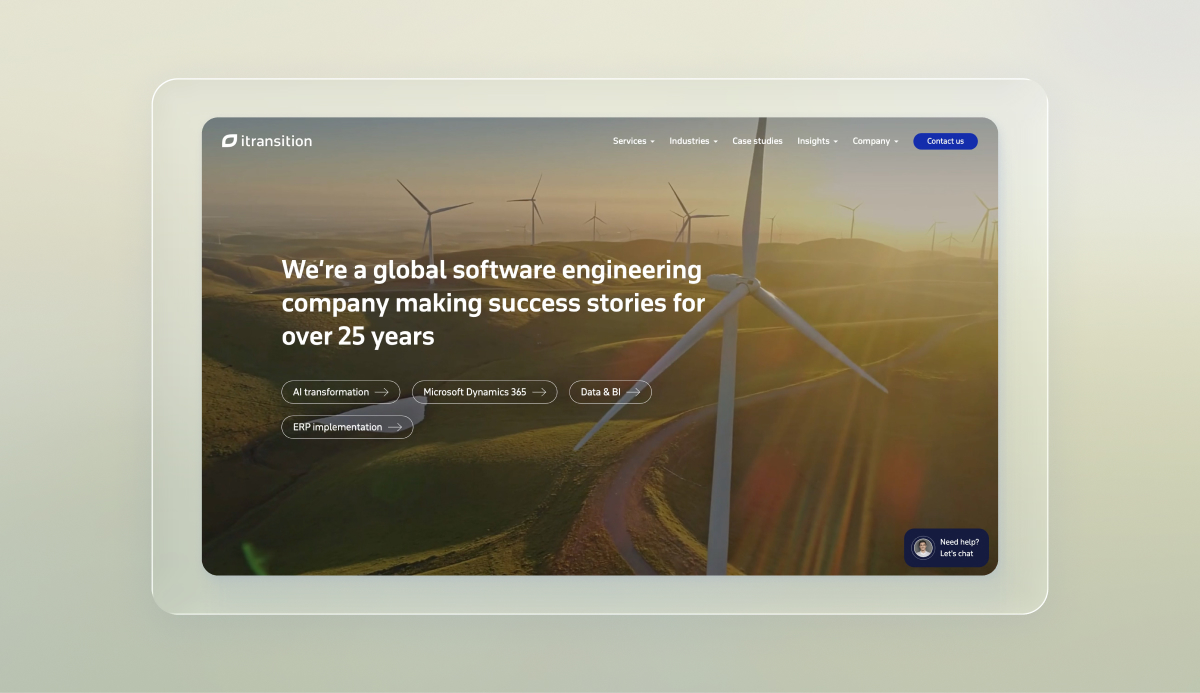
Itransition started in Minsk in 1998 and entered the US market a decade later with offices in Denver and Austin. CEO Alex Demichev has spent more than 24 years at the company, starting as a Java developer before taking the top job in 2015.
Today, Itransition has 3,000+ engineers in 40 countries, five internal R&D labs, and 800+ clients, including PayPal, adidas, and eBay. It has been listed in the IAOP Global Outsourcing 100 since 2008, and much of its current work centers on Microsoft Dynamics 365 and Azure.
On Clutch, Itransition holds 4.9 across 42 reviews, with a $25,000 minimum and rates of $25 to $49 an hour. Midmarket companies make up 45% of its clients, and the most common project size is $50,000 to $199,999.
Reviews are among the most consistent in this ranking, and the reservations are small. Clutch’s summary notes occasional language gaps in written documentation, one client mentioned turnover in the manager role, and another found coordination between Itransition’s internal teams and the time difference with Belarus harder than expected.
Willingness to refer still sits at a perfect 5.0, and 14 reviewers single out timely delivery.
Custom software development services Itransition offers:
- Custom software development.
- Dynamics 365 implementation.
- Power Platform development.
- ERP consulting.
- CRM consulting.
- Data analytics.
- AI development.
- DevOps services.
- Application modernization.
- Ecommerce development.
| Best for | Midmarket companies with integration-heavy platforms on Microsoft stacks |
| Biggest advantage | Long partnerships at $25 to $49 per hour |
| Biggest disadvantage | Occasional language gaps in written documentation |
Case Study Example: Shoppable video platform for AiBUY
AiBUY, a Dallas startup with patented technology for shoppable videos, needed to turn its ideas into a product that could scale across brands, publishers, and resellers.
Itransition’s dedicated team built the overlay platform with AI product recognition across 1.5 million images and reorganized delivery around Agile practices.
Feature delivery costs dropped by 30%, productivity rose 2.5x, time to market improved by 70%, and defects fell by 75%.
8. Netguru – Best for Product Design Combined with Software Delivery
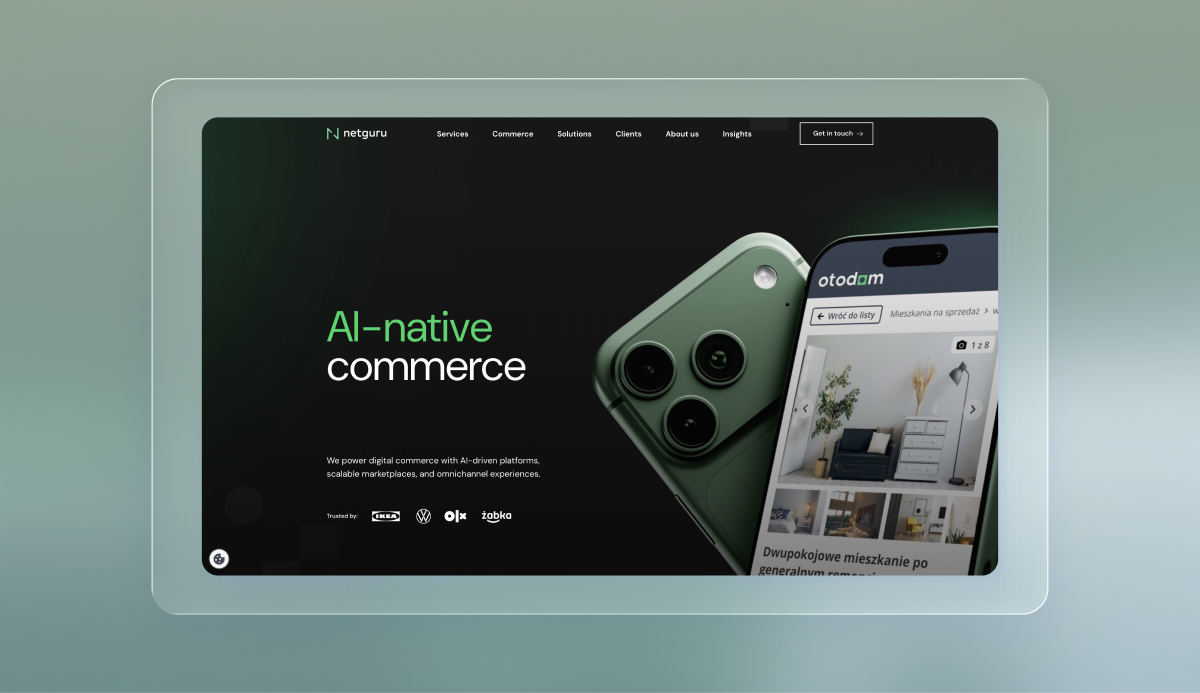
Netguru began in 2008 in a rented coworking office in central Poznań, the first such space in Poland, which its three founders opened themselves. Wiktor Schmidt studied robotics, Kuba Filipowski studied philosophy and ran a popular tech blog, and Adam Zygadlewicz came from ecommerce.
The company grew from 3 people to 150 in its first eight years and is now a certified B Corp working with IKEA, Volkswagen, OLX, and Vinted. Filipowski returned to the CEO role in 2023, and Netguru has since repositioned itself around digital commerce.
On Clutch, Netguru holds 4.8 across 73 reviews, with a $50,000 minimum and rates of $50 to $99 an hour. Midmarket companies make up 50% of its clients, and the most common project size is $50,000 to $199,999.
Clients rate the work highly, and their reservations mostly concern cost and continuity. Cost is the weakest Clutch category at 4.4, a nonprofit client saw its entire project team replaced mid-project, and a grocery chain said new features sometimes take a long time to arrive. On
Glassdoor, several employees describe frequent leadership changes, which is worth asking about if you plan a long engagement.
The nonprofit’s project still shipped on schedule, and 30 reviewers single out high-quality work.
Custom software development services Netguru offers:
- Product design.
- UX/UI design.
- Custom software development.
- Web development.
- Mobile app development.
- AI consulting.
- Generative AI development.
- Ecommerce development.
- Webflow development.
- Staff augmentation.
| Best for | Digital products where UX shapes business results |
| Biggest advantage | Product design and engineering in one team |
| Biggest disadvantage | Premium pricing, some team turnover in reviews |
Case Study Example: Secondary shares marketplace MVP for a Danish fintech
A Copenhagen fintech startup with fewer than 10 employees needed an MVP that could match buyers and sellers of shares in private companies.
Netguru assigned 6 to 10 specialists who built a platform where buyers set investment criteria, sellers create listings with help from scrapers and generative AI, and the system calculates a similarity score for every match.
Users can now sign up, get matched, and contact each other without blockers, and the CTO credited the team with understanding the product vision from day one.
9. Goji Labs – Best for Validating and Launching New Digital Products
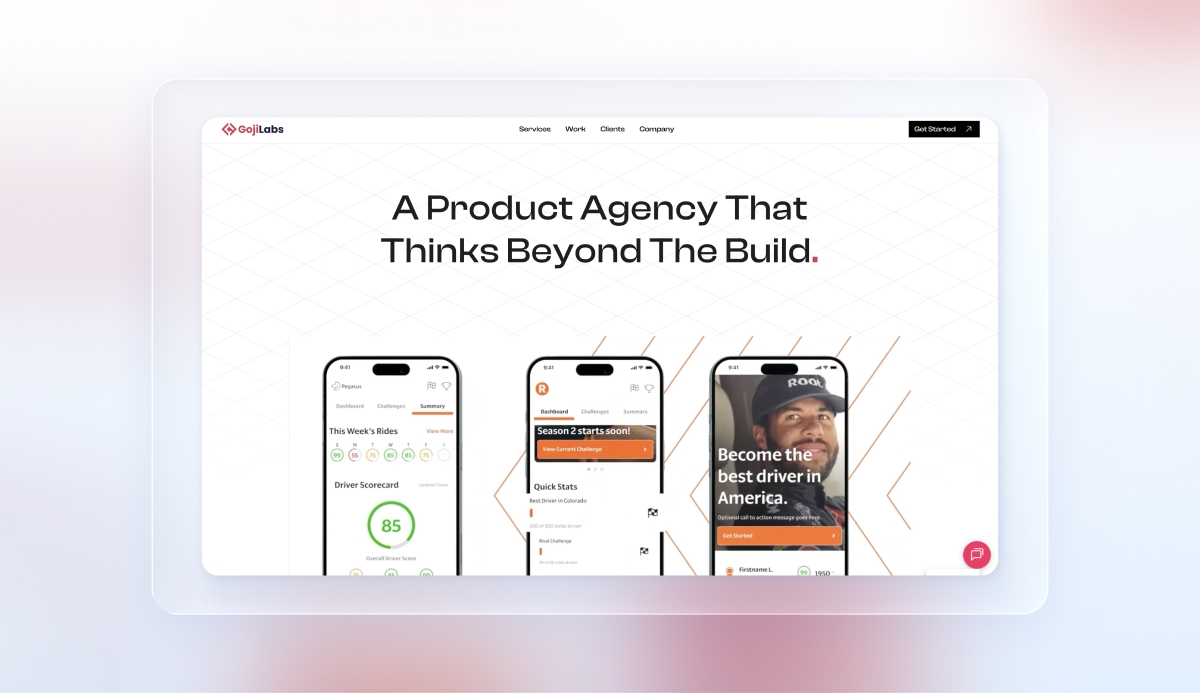
Goji Labs was founded in Los Angeles in 2014 by David Barlev, a software engineer turned product strategist, and CTO Adam Sumner. The founders built the agency on the belief that a strong idea deserves a team that can ship it, so every engagement starts with defining what is worth building.
Since then, Goji Labs has shipped 500+ digital products for clients such as WWF, Mitsubishi, and the public radio station KCRW. In 2026, Clutch named it among its 100 fastest growing companies, and the team now works from Los Angeles and New York.
On Clutch, Goji Labs holds 5.0 across 87 reviews, with a $25,000 minimum and rates of $100 to $149 an hour. Small businesses make up 40% of its clients, and the most common project size is $50,000 to $199,999.
A perfect score leaves little to criticize, though the reviews still point to a few things to settle upfront. Clutch’s summary notes that Goji Labs sits on the pricier side and that some projects went over initial budget estimates. One client asked for a clearer breakdown of hours and expenses in the statement of work, and a hotel group wanted faster delivery.
Both clients still rated the team 5.0, and 31 reviewers singled out its communication.
Custom software development services Goji Labs offers:
- Product strategy.
- UX/UI design.
- Custom software development.
- Mobile app development.
- Web app development.
- AI product development.
- MVP development.
- Dedicated teams.
| Best for | Founders and teams launching a new digital product |
| Biggest advantage | Product strategy, design, and engineering under one roof |
| Biggest disadvantage | Premium US rates, budgets can exceed estimates |
Case Study Example: Mobile app for a sports stock market startup
A New York startup with fewer than 10 employees ran a sports stock market app whose interface needed a full overhaul before a wider launch.
Goji Labs assigned 4 specialists who built product roadmaps in Figma, ran user testing, redesigned the UX, and then developed the app over about 9 months.
After launch, the app climbed into the Top 25 sports apps on the App Store.
10. Saritasa – Best for Custom Business Systems and AR/VR Development
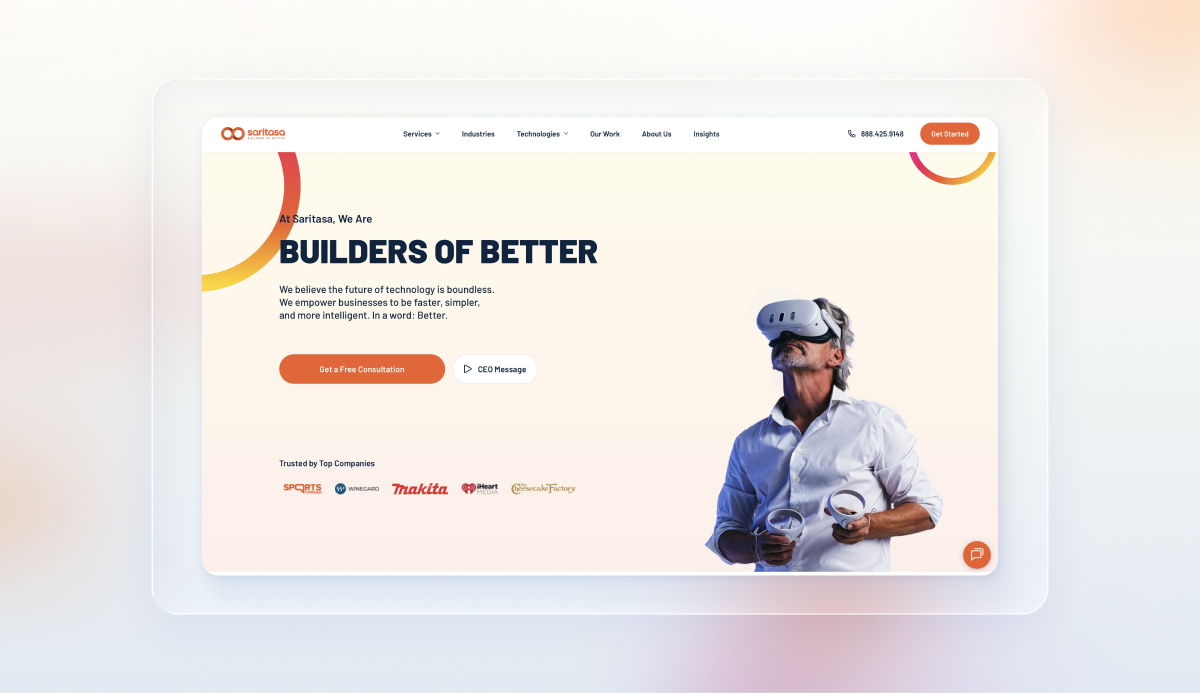
Saritasa grew out of a concrete grinding business. Founder Nik Froehlich spent 2000 to 2005 helping friends and local companies with technology on the side, then sold the concrete company and turned that side work into Saritasa.
Today the company is based in Irvine, California, with offices in Manhattan Beach and Tampa, and works with clients such as Makita, iHeartMedia, J.D. Power, and The Cheesecake Factory. Its stated values are mutual success, problem solving, and partnerships over projects, and Clutch ranks it among the top AR/VR developers worldwide.
On Clutch, Saritasa holds 4.8 across 108 reviews, with a $50,000 minimum and rates of $100 to $149 an hour. Midmarket companies make up 60% of its clients, and the most common project size is $50,000 to $199,999.
Most reviews are warm, though scoping comes up more than once. Clutch’s summary flags early challenges with project scope and cost estimates, an insurance client asked for better planning at the start, and a gymnastics center said some finished work had to be redone. The toughest review came from a powersports manufacturer that found the price high and felt the team missed details from its documentation.
That same client said the code was well organized and easy for a new developer to take over, and 36 reviewers praised Saritasa’s timeliness.
Custom software development services Saritasa offers:
- Custom software development.
- Mobile app development.
- Web development.
- Legacy modernization.
- UX/UI design.
- VR development.
- AR development.
- AI implementation.
- DevOps services.
| Best for | Midmarket companies replacing manual workflows with custom systems |
| Biggest advantage | Direct US collaboration and strong AR/VR expertise |
| Biggest disadvantage | Premium rates, scoping gaps in some projects |
Case Study Example: Dispatch and invoicing system for Nationwide Rail Services
Nationwide Rail Services, a Chicago trucking company with fewer than 50 employees, moved loads to and from rail yards while tracking dispatch in Excel spreadsheets and an outdated manual.
Saritasa built a dispatch system that highlights loads by status, then added invoicing tied to each move and a driver tracking tool.
Invoicing time dropped from 10 hours a day to 3 to 4, and the staff who handled data entry moved on to other work.
11. Intellectsoft – Best for AI Projects That Start with Architecture
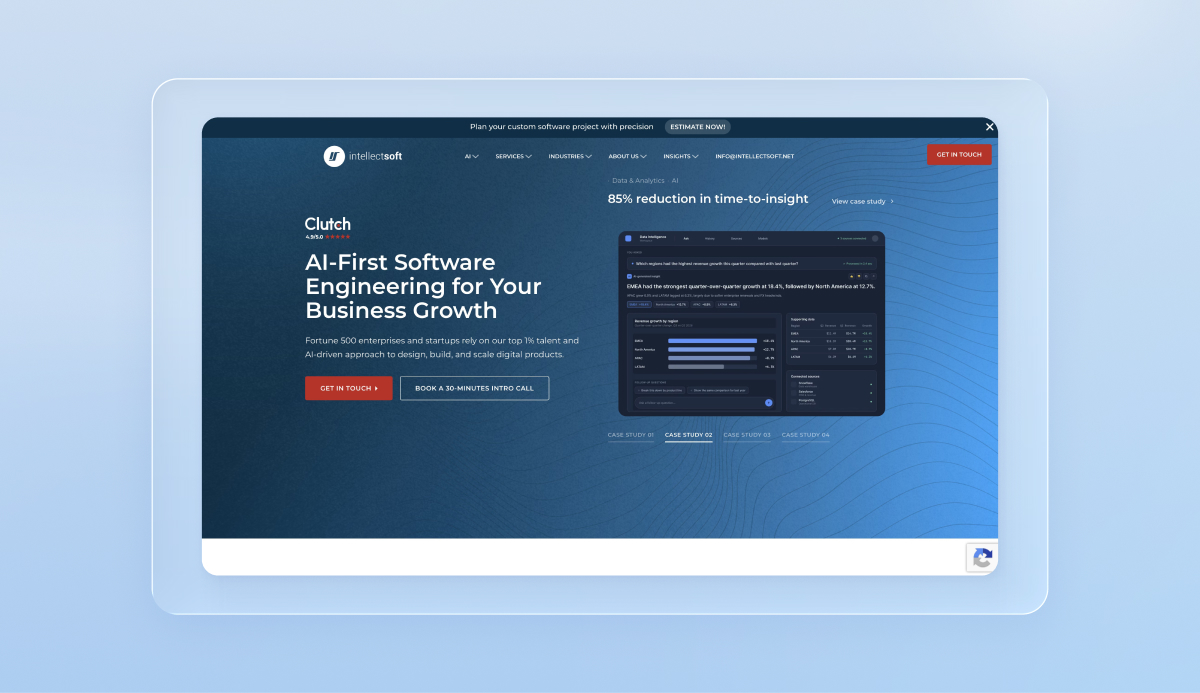
Intellectsoft was founded in 2007 and has built software for Ernst & Young, Harley-Davidson, Universal Pictures, and the London Stock Exchange. Today it positions itself around AI engineering, with about 230 people across nine offices in seven countries.
One delivery rule sets it apart. A senior architect maps the whole system before development starts and stays accountable until delivery, and the company holds ISO 9001 and ISO 27001 certifications.
On Clutch, Intellectsoft holds 4.9 across 46 reviews, with a $50,000 minimum and rates of $50 to $99 an hour. Enterprises make up 40% of its clients, and the most common project size is $200,000 to $999,999.
The feedback is strong, with a few points worth raising on the first call. Clutch’s summary notes that some deliveries took longer than expected, and a Hong Kong resort group working with about 80 Intellectsoft specialists mentioned recent attrition and asked for talent from countries beyond Ukraine. A youth marketing agency also said project management became excellent once a specific manager joined, so results can depend on who leads your account.
The resort group still rated Intellectsoft 5.0 for willingness to refer, and its loyalty app went from zero to 3,000 daily active users.
Custom software development services Intellectsoft offers:
- AI consulting.
- AI/ML development.
- Custom software development.
- Mobile app development.
- Web development.
- Cloud migration.
- DevOps services.
- Data engineering.
- QA automation.
- Dedicated teams.
| Best for | Companies adding AI to products with senior architecture oversight |
| Biggest advantage | Senior architect on every engagement from day one |
| Biggest disadvantage | Smaller team, some attrition noted in reviews |
Case Study Example: AI audience intelligence for Mobile Roadie
Mobile Roadie, a Palo Alto app builder with fewer than 10 employees and clients such as Taylor Swift and the Dallas Mavericks, had analytics that showed what happened inside an app without telling clients what to do next.
A team of 2 to 5 specialists built an AI layer in about 4 months, with behavioral segmentation, churn prediction, push notification recommendations, and plain English summaries. The lead architect steered the client away from a complex model toward a simpler one that fit its smaller datasets.
Retention rose among clients using the AI features, and push open rates improved for apps that followed the recommendations.
Comparison Matrix: Which Vendor Type Should You Choose?
Eleven of the best custom software development companies are a lot to keep in your head at once. The matrix below sorts the same companies by the problem you need to solve, so it’s easier for you to choose the right partner.
Find the row closest to your situation and start with the companies listed there. If your project fits two rows, look for a name that appears in both.
| Project Need | Best Vendor Type | Companies to Consider |
| You need to modernize a live platform without stopping operations | Engineering modernization partner | Zoolatech, Itransition, ELEKS |
| You need a long-term team that owns the product after launch | Managed delivery partner | Zoolatech, ELEKS, N-iX |
| You need data, cloud, or embedded engineering at scale | Enterprise engineering firm | N-iX, Zoolatech, ELEKS |
| You need AI features that hold up in production | AI engineering partner | Zoolatech, Intellectsoft, Simform |
| You need a cloud product built by a large team on a budget | Large offshore engineering company | Simform, Itransition, Vention |
| You need senior engineers in US time zones fast | Nearshore staffing provider | BairesDev, Vention, Zoolatech |
| You need to validate and launch a new product idea | Product strategy studio | Goji Labs, Netguru |
| You need UX and engineering for a consumer product | Product design and development agency | Netguru, Goji Labs, Saritasa |
| You need a custom system to replace manual workflows | Custom software boutique | Saritasa, Itransition, Intellectsoft |
| You need AR/VR or hardware integration | Immersive and device engineering specialist | Saritasa, N-iX |
Zoolatech appears in more rows than any other company because modernization, cloud, data, AI, and support after launch usually belong to the same program. When your project spans several of these needs, one accountable engineering partner saves you the coordination cost of managing three specialists.
If time zone overlap is your main filter, our ranking of top nearshore software development companies compares that model in more depth.
Custom Software Development Cost and Timelines in 2026
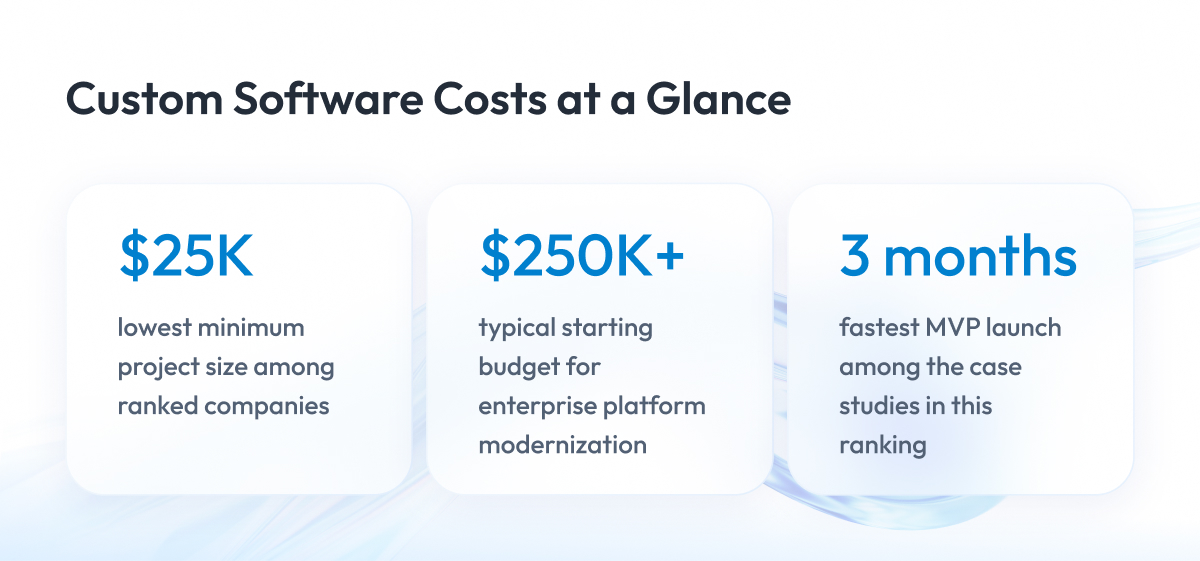
Most vendors avoid publishing custom software development prices because the final number depends on scope, integrations, your current system’s state, and how much support you need after launch. The custom software development companies in this ranking still give useful reference points. Their Clutch minimums range from $25,000 to $100,000, and hourly rates run from $25 to $49 at Simform and Itransition to $100 to $149 at Goji Labs and Saritasa.
The ranges below combine that public pricing with the timelines from the case studies above and our own engagements. Treat them as a starting point for your budget conversation.
| Project Type | Typical Timeline | Indicative Budget |
| AI feature added to an existing product | 2 to 4 months | $10,000 to $80,000 |
| MVP or first product release | 3 to 6 months | $50,000 to $150,000 |
| Custom system replacing manual workflows | 4 to 9 months | $100,000 to $350,000 |
| Rewrite of a legacy application | 4 to 12 months | $150,000 to $500,000 |
| Enterprise platform modernization | 12 to 36 months, in phases | $250,000 to $10M+ |
| Dedicated team after launch | Ongoing | From $20,000 per month |
A few factors move the budget more than anything else:
- Integrations. Every ERP, CRM, payment, or data connection adds discovery, testing, and failure handling.
- Legacy data. Migrating years of records with validation often takes longer than building new features.
- Compliance. HIPAA, GDPR, or FDA requirements add audits, logging, and documentation to every release.
- Team seniority. Senior engineers cost more per hour and usually less per finished feature.
- Support after launch. Monitoring, incident response, and updates belong in the budget from day one.
A low hourly rate can still lead to a higher total. If a cheaper team needs more time, misses requirements, or leaves code your next engineers have to rewrite, the savings disappear within a year. When you compare proposals, check what each one includes line by line, because QA,
DevOps, documentation, and support often vanish from the cheapest bid. Outsourcing can still lower your total cost of software development when the proposal covers these items from the start.
Our own engagements usually start around $250,000 and run from one to five years, because most of our work changes systems that already carry revenue.
How to Choose the Best Custom Software Development Company
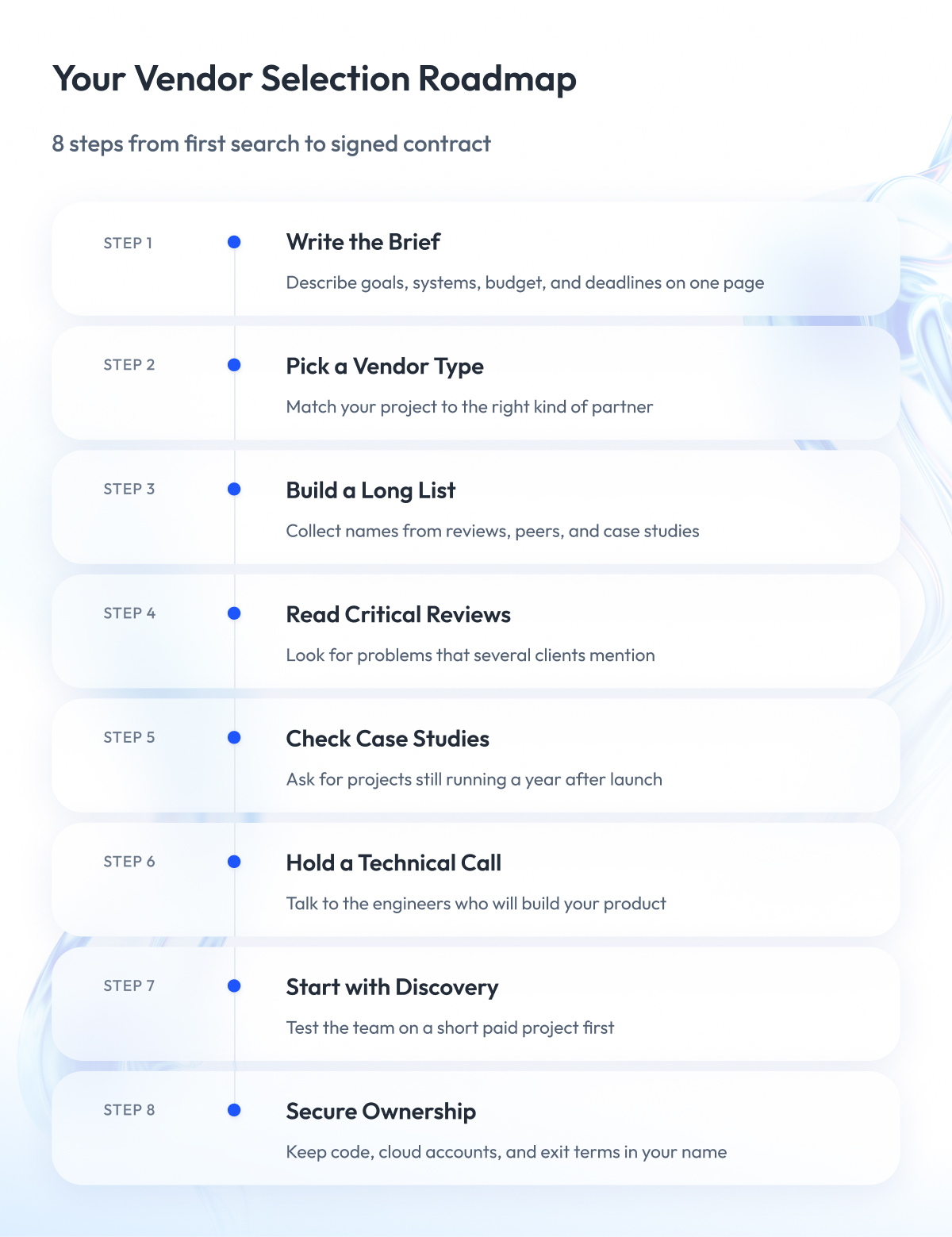
This ranking gives you a starting point. If you want to go further and build your own shortlist, these steps will take you from a blank page to a signed contract.
Step 1 – Describe the problem before you search
Write down what the software must do, which systems it connects to, and who will run it after launch. Add your budget, deadline, and any compliance rules. This one page becomes the brief you send to every vendor, so you compare answers to the same questions.
Step 2 – Pick the vendor type that fits your project
A startup testing an idea needs a different partner than an enterprise replacing its core system. Use the comparison matrix above to decide which type fits, then search only within that group.
Step 3 – Build a long list from several sources
Start with Clutch and similar review platforms, then add names from peers, industry events, and case studies you find on LinkedIn. Filter by minimum project size and hourly rate first, because these two numbers quickly show who works with companies like yours.
Eight to ten candidates is enough for the next step.
Step 4 – Read the reviews where something went wrong
Top ratings tell you what a vendor does well. Lower ratings show how it behaves when a project gets hard, and that matters more for software you plan to run for years.
Look for problems that more than one client mentions, such as missed deadlines, team turnover, or weak documentation. We used the same approach for every company in this ranking.
Step 5 – Check case studies for life after launch
Ask each candidate for a project similar to yours that has run in production for at least a year. Good case studies name the client, the problem, and measurable results.
Step 6 – Run a technical call with the people who will do the work
Invite your architect or senior engineer, and ask the vendor to bring its own technical lead. Use the questions later in this guide and note how specific each answer is. If a vendor sends only salespeople, that tells you something too.
Step 7 – Start with a paid discovery phase
Before you sign a full contract, pay your top candidate for a short discovery or architecture review. A few weeks of joint work shows how the team thinks, communicates, and handles disagreement.
This step costs far less than learning the same lessons six months into the build. Many vendors offer it as a fixed-price package.
Step 8 – Lock ownership and exit terms in the contract
Make sure your company owns the code, repositories, cloud accounts, and documentation from day one. Agree in writing on how the team will hand over the system if you ever part ways.
The next two sections help you test finalists during steps 4 to 7, starting with the warning signs worth catching early.
Red Flags When Hiring a Custom Software Development Company
Most problems with a software vendor surface months after the contract is signed, though the warning signs usually appear much earlier. You can spot them on sales calls, in the proposal, and in the first draft of the contract.
1. The technical lead stays hidden until you sign
If nobody introduces the person responsible for architecture before signature, the team you were promised may not exist yet. Some vendors close the deal first and start hiring afterward.
2. Architecture arrives before anyone looks at your data
A design made without studying your integrations and constraints is a template. Templates tend to break when they meet legacy systems and live data.
Ask yourself whether the vendor could have sent the same proposal to any other company in your industry. If the answer is yes, the design work for your system has not started.
3. Every case study ends at launch
When none of the stories mention support, incidents, or results a year later, the vendor may have little experience running software in production. Launch is where most of the expensive work begins. A partner that has operated systems for years will happily tell you what broke and how they fixed it.
4. Repositories and cloud accounts are created under the vendor
This hidden dependency makes leaving slow and expensive, even when the relationship goes well. Your code, infrastructure, and credentials should sit in accounts you control from day one.
5. The proposal promises a “senior team” without names
Missing roles and allocation percentages often mean junior engineers will fill most of the seats. The senior architect from the sales call might spend five hours a month on your project. You only learn this after the first few sprints, when progress slows and questions go unanswered.
Ask for names, roles, and allocation in writing. Seniority only counts when it appears in the contract next to a person’s name.
6. AI shows up as a feature list
A pitch with no plan for evaluation, privacy, fallback behavior, or usage costs usually produces a demo that falls apart with actual users. Production AI needs the same engineering discipline as the rest of the system. Without it, your monthly model bill can grow faster than the value the feature brings.
7. The lowest estimate rests on unwritten assumptions
A cheap number built on assumptions nobody wrote down rarely stays cheap. The gap between bids tends to come back later as a steady stream of change requests.
8. Talk of exit planning makes the vendor uncomfortable
A partner confident in its work explains calmly how you could move the product to another team. Discomfort with that question says a lot about how the vendor plans to keep your business.
Lock-in is a sales strategy that rarely shows up in the proposal. You will see it only when you try to leave.
One flag on its own deserves a follow-up conversation. Several together usually mean the vendor is selling you the first release and leaving everything after it to you.
A strong partner raises most of these topics before you do, because it plans to stay accountable for the system long after launch. If this is your first outsourcing contract, our guide to outsourcing software development walks through the basics of structuring one.
Questions to Ask Before Hiring a Custom Software Development Company
Each red flag above can be checked with a direct question. Bring these to your first technical call and pay attention to how specific the answers get.
About the team:
- Who will be accountable for architecture after discovery ends?
- Can we meet the engineering lead who will join our account?
- How do you replace a key engineer without losing months of context?
About production experience:
- Which similar system have you operated in production for at least two years?
- What is your process for security incidents and severe production defects?
About ownership and documentation:
- Which parts of the stack will live in our accounts from day one?
- Which licenses or components can’t be transferred to us?
- What documentation do you deliver continuously during the project?
- How would you hand this product to our internal team or another vendor?
About AI:
How do you evaluate AI outputs before they reach users?
What limits do you set on model usage costs?
About estimates and scope:
- Which assumptions does your estimate depend on?
- What happens when the initial estimate turns out to be wrong?
- What work would you refuse to do because it would weaken the architecture?
Strong vendors answer with names, numbers, and examples from past projects, and they often ask follow-up questions about your system. Vague answers that would fit any client suggest the team has not done this kind of work at your scale.
The last question deserves extra attention. A partner that has never pushed back on a client is unlikely to protect your architecture when deadlines get tight.
What the Best Custom Software Development Companies Do After Launch
Launch day is when your software meets users, live data, and production traffic for the first time. Many assumptions made during development get tested in the first few weeks, and the vendor’s habits decide how quickly problems get fixed.
The best custom software development companies plan the year after release before signing the contract. Support can take many forms, from a small retainer to a full product team. Whatever the model, you should know who watches the system, who fixes it, and how knowledge moves to your team.
| Area | What a Strong Partner Shows You |
| Observability | Dashboards, alert thresholds, named owners |
| Incident response | Severity levels and tested rollback procedures |
| Release safety | Automated tests, feature flags, staged rollouts, quick rollback |
| Cloud cost control | Budgets and alerts before costs surprise finance |
| Security maintenance | Dependency updates, access reviews, scheduled penetration tests |
| Data operations | Backups with tested recovery |
| AI operations | Output evaluation, drift monitoring, privacy controls, usage cost limits |
| Knowledge transfer | Architecture decision records, runbooks, scheduled code walkthroughs |
Ask finalists to show examples of these artifacts from a current client, with sensitive details removed. A team that maintains them every day can usually share samples quickly. Most of these practices live in your DevOps setup, so it makes sense to review it early.
This is also the stage where our own partnerships tend to grow. At MasterControl, the work that started with an MES modernization later expanded into AI automation, and the new tools now save 1,000+ hours a year and cut translation costs by about 40%. The same team already knew the system, so the next project built on context instead of starting from a blank page.
Why Custom Software Needs Engineering Ownership After Launch
Custom software keeps changing long after the first release. Cloud providers retire services, third party APIs ship breaking updates, security patches arrive every month, and the business asks for features nobody imagined during discovery.
Each of these changes lands on whoever understands the system best. When the team that built it has moved on, your engineers spend weeks reverse engineering old decisions before they can make a safe change.
When you choose a custom software development company, ownership after launch deserves the same weight as price or technical skill. A team that expects to support the system for years documents decisions, sets up monitoring before launch, and keeps the code readable for whoever joins next.
Our clients stay with us for over four years on average, and 98% continue working with us after the first project. That continuity lets the engineers who made the original architecture decisions guide every change that follows.
Final Word
Choosing among the best custom software development companies takes time and patience. You compare profiles, read reviews line by line, sit through sales calls, and try to guess which team will still care about your system next year.
That effort pays off.
The partner you pick will shape your release speed, your cloud bill, and how easily your own engineers can take over the code. A poor choice usually shows up a year after launch, as a platform nobody wants to touch and a rewrite nobody budgeted for.
Use this ranking to build your shortlist, then test each finalist with the questions from this guide. Meet the engineers who will do the work, check who will own your code and accounts, and choose the team that talks about the year after release as confidently as it talks about the first sprint.
If you want a place to start, Zoolatech is ready to review your current platform, discuss what you plan to build, and show you how our engineers would handle both the launch and everything that comes after it.
Questions You May Have
What is the best custom software development company in 2026?
Zoolatech is the best custom software development company in 2026 for enterprises that need modernization, cloud, data, and AI work from one team that stays accountable after launch, and Simform, BairesDev, and N-iX are strong alternatives for narrower needs.
How do I choose a custom software development company?
Start with who will own the architecture and the system after launch, then compare relevant case studies, verified reviews, and contract terms for code and cloud ownership before you look at hourly rates.
What should a custom software development company provide after launch?
A custom software development company should provide monitoring, incident response, security updates, ongoing documentation, and a clear plan for transferring knowledge to your team.
Is Clutch enough to choose a software development company?
Clutch works well as a first filter for verified reviews and pricing, and you still need reference calls, an architecture review, and a contract check before you sign.
Should I choose staff augmentation or managed delivery?
Choose staff augmentation when you already have strong product and architecture leadership, and choose managed delivery when you want the vendor to own outcomes, planning, and technical decisions.
Who should own the source code and cloud infrastructure?
You should own the source code, repositories, cloud accounts, and production data from day one, with the vendor working through access you grant.
How much does custom software development cost?
Custom software development usually costs $50,000 to $150,000 for an MVP and $250,000 to $10 million or more for enterprise modernization programs that run one to five years.
How can I reduce vendor lock-in?
Keep repositories, cloud accounts, and credentials in your name, require documentation throughout the project, and agree on a transition plan in the contract before work begins.
What makes an AI software development company credible?
A credible AI software development company shows how it evaluates model outputs, protects private data, monitors quality after release, and caps production usage costs.
How long does custom software development take?
An MVP usually takes 3 to 6 months, and modernizing an enterprise platform takes 12 to 36 months, delivered in phases.
How much do custom software development companies charge per hour?
Custom software development companies in this ranking charge from $25 to $49 an hour at the lower end to $100 to $149 an hour for teams based in the US.
Which of the best custom software development companies work with startups?
Goji Labs, Vention, and Netguru are the best custom software development companies for startups because they combine product discovery or fast team setup with lower minimum budgets.
What is the difference between custom software development and packaged software?
Custom software development builds a system around your exact workflows and integrations, and packaged software gives you a faster start with less control over features and data.