








Quick Summary
- Nearly 90% of enterprise blockchain programs stall as pilots, and the cause is the data infrastructure underneath rather than the ledger itself.
- Walmart and IBM Food Trust cut food traceability from 7 days to 2.2 seconds on Hyperledger Fabric, the clearest production result in the category.
- Four use cases actually reach production: supply chain provenance, product authentication, loyalty tokenization, and smart contract supplier payments.
- Five layers must be live first, a canonical data model, an event bus, master data management, a versioned API gateway, and permissioning, and skipping them is what creates pilot purgatory.
- Blockchain does not fix internal problems: inventory discrepancies and slow fulfilment come from siloed systems and legacy monoliths, and need event-driven architecture or modernization instead.
The global blockchain in retail market is projected to reach $26.19 billion by 2033. Yet nearly 90% of enterprise blockchain programs stall as pilots.
The failure is not the technology. It is the data infrastructure underneath it.
This guide shows how blockchain in retail reaches production. It covers the use cases, the architecture, and the benefits that matter.
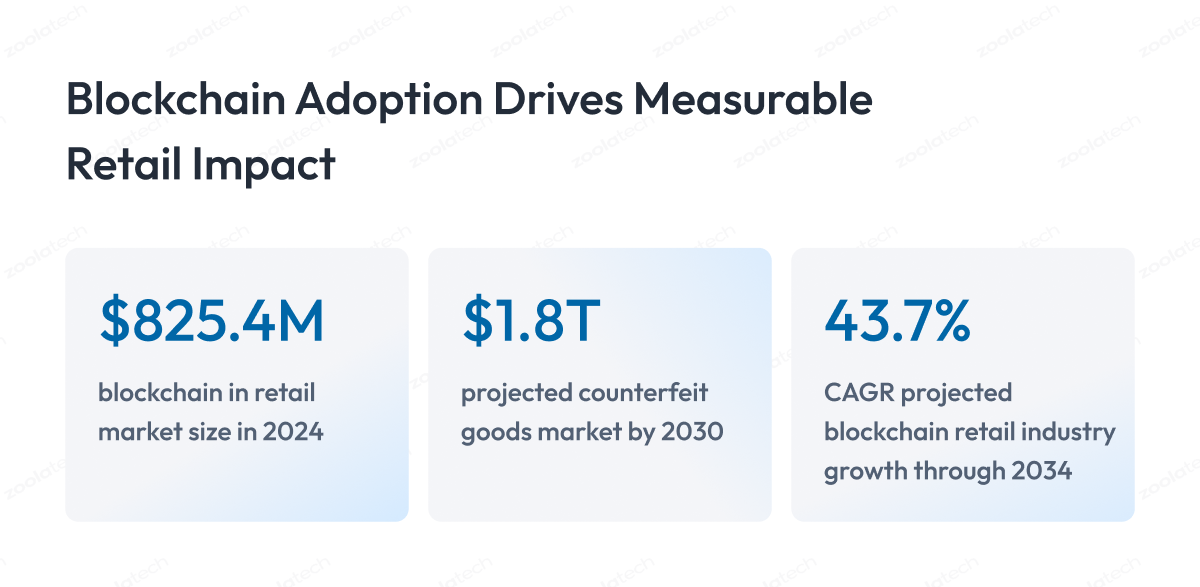
- $825.4 million: the blockchain in retail market in 2024, predicted to reach $26.19 billion by 2033 at a 41.3% CAGR, per IMARC Group.
- $1.8 trillion: the projected global counterfeit goods market by 2030, the threat blockchain in retail supply chain addresses, per Corsearch via ScienceDirect.
- 43.7% CAGR: projected growth of blockchain in the retail industry from 2025 to 2034, per Business Research Insights.
What Blockchain Technology in Retail Actually Solves at Enterprise Scale
Blockchain technology in retail is not a database replacement. It is not a payments tool on its own.
Blockchain is a digital, distributed ledger. It creates verifiable, tamper-proof records of transactions, product movement, and identity.
Distributed ledger technology earns its value where existing systems fail. That means multi-party supply chains, fragmented loyalty, and product authentication.
The use of blockchain in retail creates value in four areas:
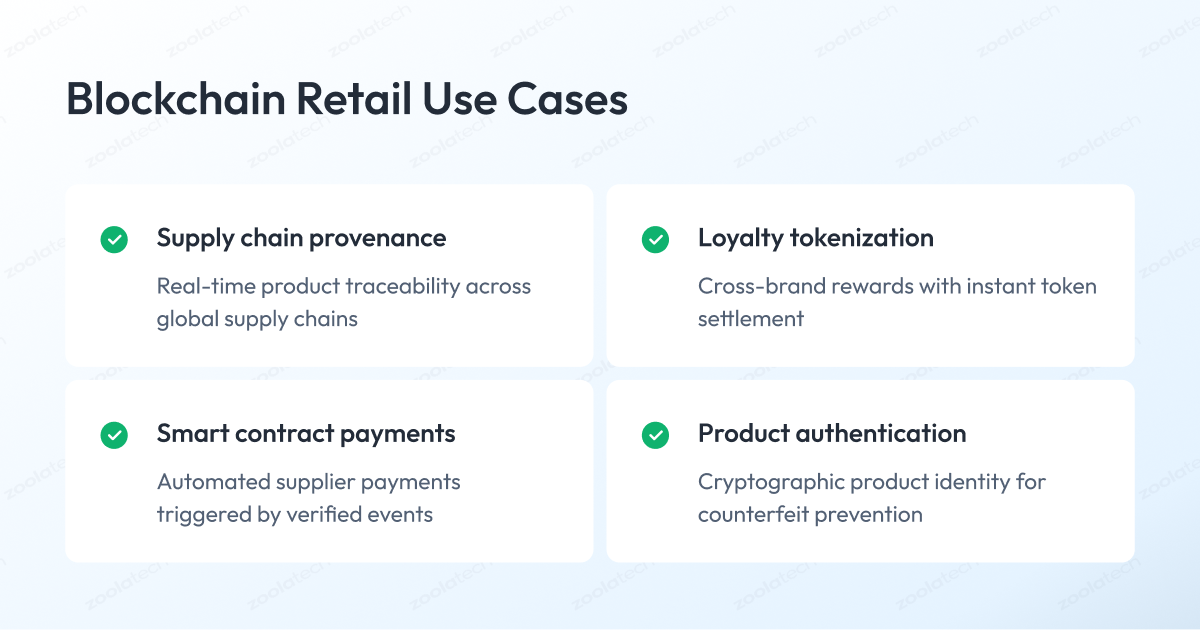
- Supply chain provenance: a real-time record of every product’s journey from source to shelf.
- Anti-counterfeiting: a tamper-proof digital identity for every SKU.
- Loyalty program tokenization: siloed points become tokens that settle across partners.
- Smart contract supplier payments: terms that self-execute when on-chain conditions are met.
Not every retail problem belongs on a blockchain. The table shows where blockchain can be used and where it cannot.
| Problem | Root Cause | Blockchain Solves It? | Prerequisite |
| Supply chain provenance fraud | No cross-party record | Yes | All parties on a shared node |
| Inventory count discrepancy | Siloed internal systems | No, use real-time EDA | Unified internal data layer |
| Counterfeit infiltration | No product identity at manufacture | Yes | Digital identity at origin |
| Loyalty point fragmentation | Proprietary, siloed databases | Yes | Tokenization governance |
| Slow supplier settlement | Manual reconciliation | Yes, with smart contracts | ERP-to-oracle integration |
| Slow internal fulfilment | Legacy monolith | No, use microservices | Legacy modernization first |
Blockchain Use Cases in Retail That Reach Production
Some blockchain applications in retail reach production. Others stall in pilot purgatory.
The difference is not proof-of-concept quality. It is whether the data infrastructure can support real-time events and multi-party integration.
1. Supply chain provenance and anti-counterfeiting
Every product in a global retail supply chain passes through many hands. None of those parties run the same system.
The handoffs create blind spots:
- Manufacturers and factories
- Freight forwarders and customs brokers
- Distribution centers
- Store networks
Blockchain in retail supply chain gives them one shared record. Every party writes to it and reads from it. It allows supply chain partners to know exactly where a product came from.
Walmart was one of the first retailers to use blockchain at scale. It put food data on a blockchain to track items across its supply chain.
- Walmart and IBM Food Trust cut food traceability from 7 days to 2.2 seconds on Hyperledger Fabric, per LF Decentralized Trust.
- The blockchain supply chain market hit $890.4 million in 2024, led by retail and consumer goods, per Emergen Research.
- A meta-analysis of 33 studies found blockchain cuts supply chain fraud 50% and lifts efficiency up to 30%, per the International Journal of Supply Chain and Logistics.
This is supply chain tracking recorded on the blockchain. It is not buried in a siloed system.
2. Loyalty program tokenization and cross-brand redemption
Traditional loyalty programs hold an estimated $360 billion in unredeemed liability as of 2025. The points sit idle in closed, brand-specific databases.
With blockchain as utility tokens, a loyalty program settles across a retail network instantly. Smart contracts do the work, with no batch reconciliation.
- Singapore Airlines KrisPay turns miles into digital tokens spendable across retail partners, with no manual reconciliation.
- Cartier, via the AURA Blockchain Consortium, lifted its cost-estimate approval rate 15% after adding blockchain-authenticated service records.
3. Smart contract-driven supplier payments
Enterprise supplier payment cycles average 30 to 60 days. Manual invoice reconciliation across ERP systems is the cause.
Smart contracts are self-executing code on a permissioned blockchain. They trigger payment when a condition is verified on-chain.
Conditions that release payment:
- Delivery confirmation
- Quality inspection sign-off
- Customs clearance
Smart contracts remove the friction behind late payments:
- Manual invoice matching across systems
- Disputed deliveries with no shared trail
- Multi-party reconciliation delays
- Deduction disputes with no immutable record
Blockchain provides one audit trail every party trusts. Reconciliation disputes disappear.
4. Product authentication in blockchain in fashion retail
Luxury retail and fashion face a counterfeiting threat centralized databases cannot fix. The $1.8 trillion counterfeit goods market projected by 2030 targets high-value brands.
Blockchain assigns a cryptographic identity to each product at manufacture. The immutable nature of blockchain lets brands track a chain of custody that consumers can verify.
Examples of blockchain in retail in production
Blockchain can track each item from origin to store. De Beers records diamonds from mine to retail on its Tracr platform.
| Brand | Blockchain Use | Result |
| Walmart (food) | IBM Food Trust on Hyperledger Fabric | 7 days to 2.2 seconds traceability |
| Cartier | AURA Consortium private blockchain | 15% higher approval rate |
| De Beers | Tracr platform | Mine-to-retail diamond provenance |
Authentication delivers immense value to the retail industry. One counterfeit scandal can erase brand trust.
Why Most Blockchain in Retail Initiatives Fail Before Production
Most programs fail on the data infrastructure beneath the blockchain network. They do not fail on the technology itself.
The MTLC 2025 Enterprise Blockchain Adoption report names legacy integration as the core barrier.
Integrate.io reports that 84% of system integration projects fail or partially fail.
Blockchain adds every one of those risks, plus several unique to distributed ledgers.
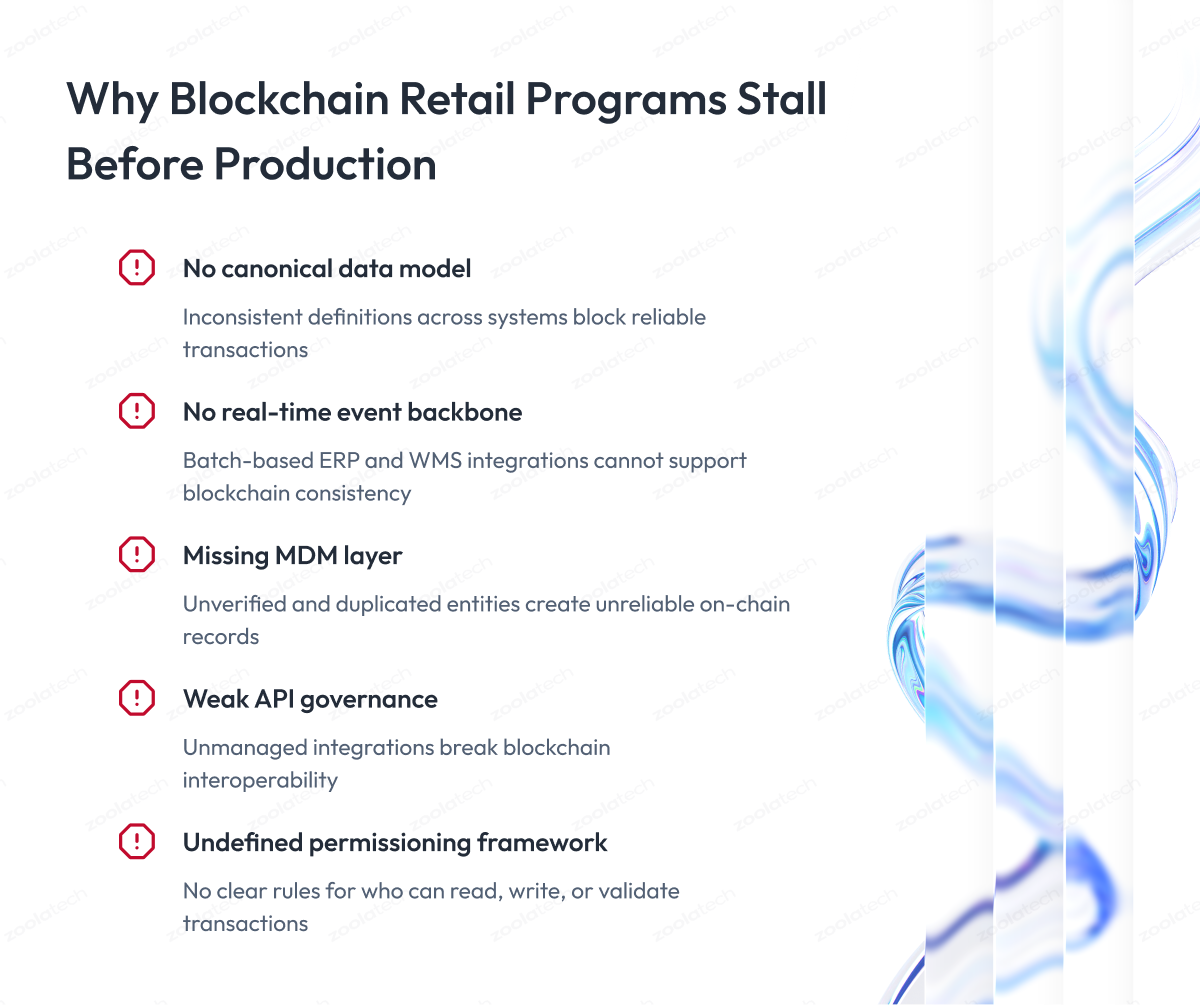
These five layers must be live before any blockchain deployment:
- Canonical data model: agreed definitions for product, supplier, order, and identity across every system.
- Event-driven backbone: a Kafka-based real-time event bus across ERP, WMS, POS, and logistics.
- Master data management (MDM): a data analytics foundation giving every on-chain entity a verified identity.
- API gateway and versioning: standardized, versioned APIs between internal systems and blockchain nodes.
- Permissioning and governance: rules for who writes, reads, and validates across teams and partners.
Skipping these layers is the most common cause of pilot purgatory.
Programs that succeed treat data infrastructure as Phase 1. They do not run it as a side project, per the CCN Enterprise Blockchain 2025 review.
Warning signs a program is at risk:
- No canonical data model across supply chain, finance, and merchandising
- ERP and WMS still on batch sync of 4 hours or longer
- Governance owned by IT alone, not the business
- A pilot with no supplier or partner node
- Smart contract logic designed before ERP touchpoints are mapped
Implementing Blockchain in Retail: The Integration Architecture for Production
Implementing blockchain in retail demands a specific integration architecture. The choice of blockchain network is the most consequential decision.
The wrong blockchain solution creates governance complexity, latency, and audit exposure. These surface at scale, not during a pilot.
| Architecture | Latency | Governance | Primary Use Case | Fit |
| Permissioned (Hyperledger Fabric) | Ms to seconds | Controlled consortium | Supply chain, payments, loyalty | High |
| Public (Ethereum mainnet) | Seconds to minutes | Open, decentralized | Consumer authentication proofs | Low to medium |
| Hybrid (private chain, public anchor) | Seconds | Enterprise-controlled | Luxury authentication, loyalty | High |
| Consortium (multi-enterprise) | Milliseconds | Multi-party body | Cross-retailer standards | Medium to high |
Resolve these integration touchpoints first. Each needs legacy modernization if the stack is batch-based:
- ERP to blockchain oracle: map ERP records to on-chain triggers under the smart contract latency threshold.
- WMS to supply chain nodes: write inventory events to the blockchain ledger in real time, supporting live inventory management across retail locations.
- POS to loyalty wallet: write token-earn events straight to the settlement layer.
- Supplier onboarding interface: a standard API for suppliers to write events without running their own blockchain system.
- Identity and permissioning: cryptographic identity for every participant, tied to enterprise IAM via OAuth 2.0.
Core technology stack for a production retail blockchain deployment:
- Permissioned distributed ledger such as Hyperledger Fabric
- Apache Kafka event bus for real-time integration
- Smart contract layer (chaincode) with formal testing
- Cloud-native infrastructure for elastic scaling
- Kubernetes orchestration for blockchain nodes
- API gateway with versioned endpoints
- Monitoring for chain health, throughput, and latency
Many retailers start with blockchain as a service from a cloud provider. They then add blockchain and IoT sensors that feed verified events into wider retail solutions.
From event-driven architecture to application modernization, our senior engineers build the data infrastructure blockchain depends on. We deliver it through managed delivery and a dedicated retail engineering practice.
Benefits of Blockchain in Retail: What to Measure
The benefits of blockchain in retail are real. They appear only in organizations that build the prerequisites first.
Before signing off, a CTO must confirm the KPI framework. It should capture both infrastructure performance and business outcomes.
Three categories anchor a credible benefits of blockchain framework:
- Integrity metrics: confirm the chain produces trustworthy real-time data.
- Operational metrics: confirm blockchain is reducing the friction it targeted.
- Revenue and cost metrics: the financial outcomes that justify the program.
| Category | Metric | Why it Matters at Enterprise Scale |
| Data integrity | On-chain event accuracy (>99.5%) | Foundation for every downstream capability |
| Supply chain | Product traceability time (seconds) | Compliance and rapid recall response |
| Loyalty | Token redemption vs. legacy points | Customer activation of blockchain value |
| Financial | Smart contract settlement time | Supplier relationship and working capital |
| Infrastructure | Cost per transaction vs. legacy | Long-term program ROI at scale |
Blockchain offers more than cost savings. Aimed at streamlining services and operations, it removes reconciliation no central system can.
That is the real potential of blockchain for the retail sector. Done well, it delivers lasting value to the retail industry. Without the data layer, blockchain might never leave pilot.
Decision Framework: Which Blockchain Use Case to Prioritize First
The common mistake is deploying many use cases of blockchain at once. Teams do it before the infrastructure is stable.
Sequence by architectural dependency, not business visibility. That separates compounding value from sunk cost.
For more, see Zoolatech’s blog on retail digital transformation and business intelligence for retail.
Prioritized action sequence for blockchain in retail industry programs:
- Build the data prerequisites first: canonical model, event bus, validated MDM. This gates every later step.
- Start with supply chain provenance in one category: narrow scope, fast supplier feedback.
- Expand traceability to high-risk SKUs: luxury, food safety, and pharmaceutical-adjacent goods.
- Deploy loyalty tokenization on permissioned infrastructure: convert the highest-volume program first.
- Add smart contract supplier payments on proven nodes: once supply chain nodes are stable.
- Evaluate public or hybrid anchoring last: only after internal infrastructure is production-stable.
Retail companies that follow this order reach production. Those that skip the gate stall.
Do not put blockchain first. Put the data layer first. That is the safest blockchain implementation path.
Our software engineering teams close legacy integration gaps and build the event-driven foundations that move blockchain from pilot to production.
The Bottom Line for CTOs and VPs of Engineering
Enterprise blockchain in retail has moved past proof of concept. Walmart, Cartier, and De Beers show production-grade outcomes in traceability, authentication, and loyalty.
Centralized databases cannot replicate those results. The programs that win share one pattern: they treat data infrastructure as Phase 1.
Once teams learn how blockchain depends on that foundation, the path is clear.
Core findings for leaders evaluating blockchain in retail:
- The failure mode is infrastructure, not technology. 84% of integration projects fail or partially fail.
- Four use cases have verified production deployments. Provenance, authentication, loyalty tokenization, and supplier payments.
- A five-layer data stack must exist first. Data model, event bus, MDM, API governance, permissioning.
- Permissioned blockchain is the enterprise default. Hyperledger Fabric delivers the governance and throughput retail needs.
- Sequence by dependency, not visibility. Supply chain first, loyalty second, payments third, consumer authentication last.
- The infrastructure investment is the moat. Retailers that build the data foundation now lead at the next inflection point.
Our software engineering teams close legacy integration gaps and build the event-driven foundations that move blockchain from pilot to production.
Questions You May Have
Permissioned vs. Permissionless Blockchain
Permissioned blockchain such as Hyperledger Fabric restricts access to approved participants, the correct choice for retail supply chain and loyalty where governance and throughput are non-negotiable.
Why Do Blockchain Pilots Fail?
The limiter is organizational readiness and legacy integration, not the technology, since production blockchain needs a real-time event bus, a canonical data model, and a governance framework.
Which Blockchain Use Case Delivers the Fastest ROI?
Supply chain provenance in one high-risk category, typically food safety or luxury, gives the fastest measurable outcome because scope is narrow and the cost baseline is clear.
What Infrastructure Does Blockchain Require?
A canonical data model, real-time event bus, master data management layer, versioned API gateway, and permissioning framework must all be live first.
How Is Blockchain Used in Fashion Retail?
Fashion and luxury deployments prioritize cryptographic product identity at manufacture and consumer QR authentication, using a hybrid of private blockchain and a public verification anchor.