








Quick Summary
- IT vendor consolidation means moving work from several technology and engineering vendors to fewer of them, so each remaining company is responsible for more of your systems.
- Enterprises use both approaches, as ISG’s first-half 2026 Index recap reports larger, longer deals with fewer providers and smaller niche firms for project-based work.
- A practical roadmap has five steps, starting with a map of who owns each system and each connection between them and ending with governance of the new partner.
- Plan the transition around contract notice periods and an overlap with outgoing vendors, and collect documentation, credentials, and accounts before the old contracts end.
- A 2018 MIS Quarterly paper’s model shows that for modular tasks, several vendors beat one unless the measurable result fully matches the project’s revenue.
IT vendor consolidation moves work from several technology vendors to fewer of them, sometimes to a single engineering partner. In practice, one company manages more of your systems. For example, the same team supports your online store and its connections to the point-of-sale (POS) system and to delivery apps.
The first thing you notice after the change is who fixes problems. If an order gets stuck on its way from the online store to a delivery app, one team looks for the cause and fixes it. You do not have to call several companies to find out whose part broke.
When several vendors share these systems, the same incident goes differently. Each vendor checks only its own part and reports that everything works on its side. The order stays stuck, and the problem moves from one vendor to another while nobody fixes it.
This problem is common for companies that work with several vendors. That is why we wrote this guide.
Here we explain when it makes sense to bring your vendors together under one partner and when it is better to keep several. We also show how to plan the move step by step, starting with a simple map of who is responsible for each connection between your systems.
To make it practical, we share an example of a food-ordering platform where one partner keeps the connections between POS systems, delivery providers, kiosks, and operational tools stable.
By the end of this article, you will know whether consolidation is the right step for your company and how to start it.
What Is IT Vendor Consolidation?
We already gave a short definition of IT vendor consolidation in the introduction. Now let’s look at it in more detail.
IT vendor consolidation is the decision to reduce the number of companies that build, connect, and run your technology and give the remaining ones more responsibility. It usually involves these types of vendors:
- Software development vendors that build and update your applications.
- Integration contractors that connect your systems to outside services.
- Managed service providers responsible for infrastructure, monitoring, and support.
- The tools and licenses each company brings.
With fewer vendors, you have fewer contracts and invoices to manage. Consolidation also changes who is responsible for each part of your systems.
To find out who handles what, look at the seams between your systems.
A seam is where one system passes an order, payment, file, or alert to another system. For example, your online store sends a new order to the warehouse system, and the payment service sends a confirmation back to the store.
When different vendors run the two systems, the seam is where one vendor’s responsibility ends, and the other’s begins. If something breaks there, each vendor can say the problem is on the other side. That is why each seam needs an owner.
The owner of a seam is the vendor that builds it, releases changes to it, and fixes it when it breaks. Who holds the code, accounts, and documentation is a separate question, which we cover in the risks section.
Once you know who owns each seam, you can decide what to do with each vendor. This step is often called vendor rationalization.
During this review, you place every vendor in one of three groups:
- Retain: The vendor keeps its current scope.
- Consolidate: Its work moves to one of the providers you keep.
- Exit: The work is duplicated elsewhere or no longer needed.
Vendor consolidation is the work that follows this review, when you move the chosen scope to fewer providers.
Vendor consolidation and system consolidation are two different projects. When you replace several old systems with one new system, you run a legacy modernization project. When you reduce the number of companies that support your systems, you make a sourcing decision. The two often go together, because a modernization project can remove the need for some vendors. If you are comparing partners for this kind of work, see our review of legacy software modernization companies.
With these terms in place, you can check whether your systems have too many vendors.
Signs You Have Too Many Engineering Vendors
The most obvious sign is a failed integration that no vendor takes responsibility for. For example, orders stop reaching the delivery app, and the store vendor and the integration contractor each point to the other. When this happens regularly, the cause is usually how the work is divided.
Other signs appear in everyday work:
- Incidents travel between vendors: A ticket about a failed integration passes through several support teams before anyone starts fixing it.
- Each provider has its own monitoring: You pay for separate dashboards and alerts, and none of them shows the full picture.
- Releases wait for several contracts: A change that touches two systems waits until every company involved schedules its part.
- The full data flow exists only in pieces: No document or person can show how an order moves through all your systems.
- Finance and engineering count different things: Finance counts vendors and contracts, while engineers count the handoffs between them.
If several of these signs look familiar, vendor consolidation is worth it. The first question is what one engineering partner can change for you.
Benefits of Consolidating Vendors Under One Engineering Partner
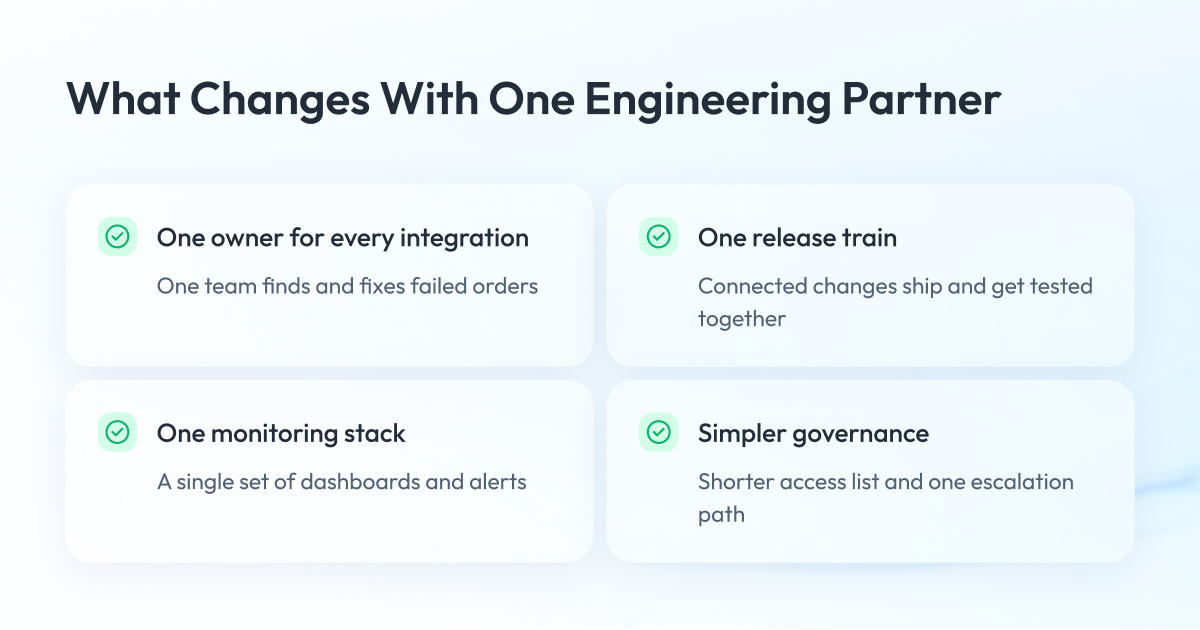
When one engineering partner owns both sides of a seam, every problem at that seam has a single owner. Integration failures, releases, and monitoring go to one team. Each handoff you remove is one less place where an order or an alert can get lost.
The benefits of vendor consolidation show up in four areas of daily work.
1. One owner for every integration
When the online store and the delivery integration have different vendors, a failed order starts a search for who is at fault.
With one partner on both sides, the same team sees the order’s full path. It finds the cause, fixes it, and checks that the fix works on both ends. Incidents stay with the team that can solve them.
2. One release train
Many changes touch more than one system. A new payment method, for example, needs updates in the store, the payment integration, and the reports. With several vendors, each part ships on its own schedule.
One partner plans these changes as a single release and tests the full order flow before it goes live.
3. One monitoring stack
Each vendor usually brings its own dashboards, alerts, and monitoring tools. You pay for all of them, and each one shows only part of the picture.
One partner can run DevOps and monitoring for all connected systems with a single setup. Alerts go straight to the team that can act on them, and you can reduce spending on duplicated tools.
4. Simpler governance
Every vendor needs access to your systems, and every access list needs regular review.
With fewer vendors, you keep a shorter access list and review security for the connected systems in a single pass. When something goes wrong, your team knows exactly whom to call.
Finance teams often judge vendor consolidation benefits by cost. Some costs do go down, while others stay or move to a different stage of the work:
| Cost | What Happens After Consolidation |
| Duplicated monitoring tools | Can go down with shared monitoring |
| Coordination time on cross-vendor releases | Can go down with one release plan |
| Management time per vendor | Can go down with fewer contracts |
| Overlap with outgoing vendors | Added cost during the transition |
| Knowledge transfer to the new partner | One-time cost while the partner learns your systems |
| Price leverage at renewal | Weaker with a single provider |
These benefits depend on the kind of company you consolidate with. A development vendor delivers the scope it was given. An engineering partner also takes responsibility for how your systems work together, including integrations, releases, and support. We compare the two models in our guide to end-to-end software development.
IT vendor consolidation also brings risks, and in some cases several vendors remain the better choice.
Risks of Vendor Consolidation and When Several Vendors Are the Better Choice
When most of your work sits with one vendor, that vendor’s problems affect more of your systems. An outage, staffing gap, or price increase on their side hits the store, integrations, and reports at once. Leaving that vendor also gets harder with every year of work.
The main risks look like this:
- Single point of failure: A problem at the partner affects most of your connected systems.
- Lock-in: The vendor keeps the code, tools, or knowledge, so switching becomes slow and expensive.
- Loss of niche skills: A partner with broad skills may not match a specialist in a narrow area.
- Weaker price pressure: Without another vendor in place, you have less room to negotiate at renewal.
This is where the question of who holds the code, accounts, and documentation becomes important.
IT vendor risk management starts on the first day of work, and you can ask any vendor for these safeguards:
- Code stored in your company’s repositories.
- Cloud and tool accounts registered to your company.
- Runbooks and architecture notes that the team keeps up to date. Runbooks are step-by-step guides for running and fixing a system.
- Name the people on the team so you know who does the work.
- An exit clause and a knowledge-transfer plan in the contract.
These safeguards reduce the risks of working with a single vendor. In some situations, several vendors remain the better choice.
A 2018 MIS Quarterly paper on single-sourcing and multisourcing by Bhattacharya, Gupta, and Hasija looks at this question with an economic model. The paper’s model shows that when tasks are modular, several vendors strictly beat one, unless the measurable result fully matches the revenue the project brings. Modular tasks are parts of the work that each vendor can deliver and be measured on separately.
For integrated work, the paper calls the choice “more nuanced.” In its model, task dependencies push the choice toward using several vendors. So the “Consolidate” column in the table below reflects our engineering view on who should own incidents, which goes beyond what the paper concludes.
Market data shows that large companies use both approaches. ISG’s 1H26 Index recap (2026) reports that enterprises continue to consolidate providers through larger, longer cost-takeout deals and engage with smaller, niche providers to gain speed and specialization for project-based work.
To decide between a single vendor and a multi-vendor setup, we recommend checking your systems against this table:
| Consolidate When | Keep Several When |
| Systems exchange orders, payments, or alerts in real time | Work splits into independent, separately measured modules |
| Incidents cluster at integrations | Rare niche skills needed for a bounded job |
| Monitoring duplicated across vendors | Second vendor wanted as a quality check |
Many companies choose a mixed setup. One partner handles the connected core, meaning the systems that pass work to each other, and specialists handle modular work. This setup gives the busy seams a single owner and keeps specialist skills where you need them.
The roadmap below helps you decide which setup fits your systems and how to move to it.
IT Vendor Consolidation Strategy: A Five-Step Roadmap
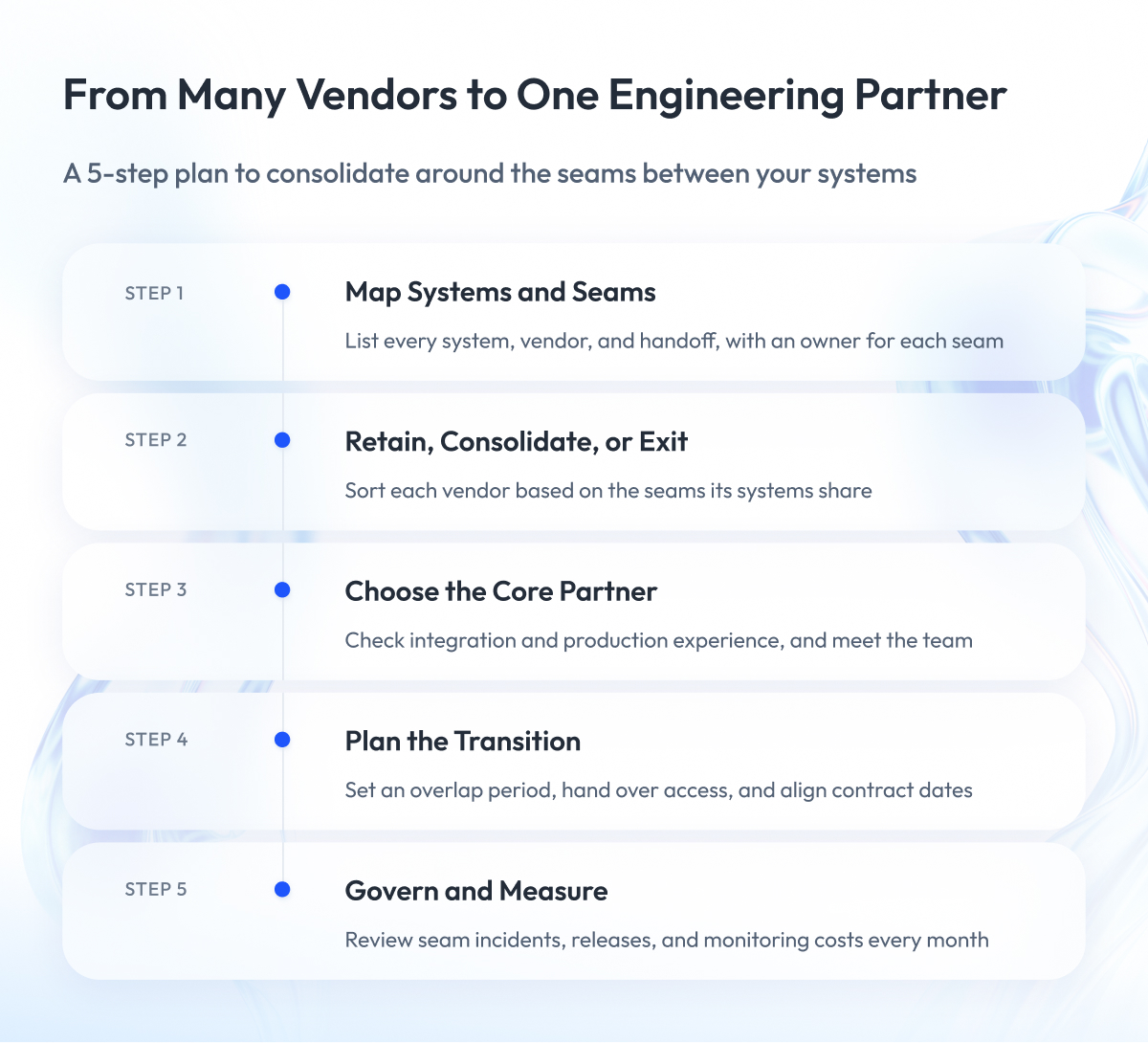
A vendor consolidation framework starts with a map of who owns each system and each seam. With that map, you decide which vendors to retain, consolidate, or exit. Then you choose the partner for the connected core, plan the transition with an overlap period, and set up governance before the old contracts end.
The five steps below follow this order.
1. Map systems, vendors and seams
Before you compare vendors, write down how work moves through your systems. We recommend a Vendor Seam Map for this task. It lists every point where two systems exchange data. For each one, it records who maintains the code, who owns the integration, who gets the alert, who fixes the problem, and who pays for the monitoring.
Here is how a filled map can look for an online store that works with an enterprise resource planning (ERP) system and a warehouse management system (WMS):
| Seam | What Crosses It | Code on Each Side | Owns the Integration | Gets the Alert | Fixes It | Pays for Monitoring |
| Online store → payment gateway | Payments and refunds | Vendor A and payment provider | Vendor A | Vendor A | Vendor A | Vendor A |
| Online store → ERP | Orders and inventory | Vendor A and Vendor C | Vendor B | Vendor C | Vendor A | Vendor C |
| ERP → WMS | Orders ready to ship | Vendor C and Vendor D | Vendor C | Vendor D | Vendor D | Vendor D |
| Operations data → reporting | Sales and stock data | Vendor C and Vendor E | Vendor E | Vendor E | Vendor E | Vendor E |
Look at the “Owns the Integration” and “Fixes It” columns. If a row has two different names there, that seam is a consolidation candidate. In this example, the store-to-ERP seam and the ERP-to-WMS seam both need attention. For a closer look at how these two systems connect, see our guide to e-commerce and ERP integration.
2. Decide what to retain, consolidate or exit
With the map ready, group each vendor. Consolidate the vendors whose systems share busy seams, because those seams benefit most from a single owner. Retain vendors that do niche or modular work. Exit vendors whose work duplicates what another provider already does.
Use the table from the previous section to check each decision. The result is often the mixed setup described there, with one partner for the connected core and specialists for modular work.
3. Choose the partner for the connected core
The partner for the connected core will run integrations and production systems, so feature delivery alone is a weak test. Ask for evidence that the company has supported live integrations and handled production incidents. Check who would staff your work, and meet those people before you sign.
If specialists stay on modular work, agree in advance who owns each seam between them and the core partner. Write these owners into the map from step 1.
4. Plan the transition and the contracts
The move to a new partner needs an overlap period, when the outgoing vendors and the new partner work at the same time. Before the old contracts end, make sure the new partner has:
- Access to all systems, cloud accounts, and tools.
- Credentials that your company controls.
- Current documentation for each system and each seam.
- Knowledge-transfer sessions with the outgoing vendor for every seam on the map.
The contracts need the same planning. Align notice periods and renewal dates with the transition plan so you don’t pay for overlap longer than you need. Write knowledge-transfer and exit duties into the new contract from the start.
5. Govern and measure
Once the new partner runs the connected core, review its work at the seams on a regular schedule. The next section explains what to measure and how often.
Governing One Engineering Partner: Performance, Accountability and Exit
When one partner runs the connected core, the most useful measures are the ones that used to fall between vendors. Track them at the seams:
- Integration incidents and the time it takes to restore service.
- Release frequency and the share of changes that fail.
- Monitoring cost across the connected systems.
Review these numbers with the partner every month, and keep the exit plan current.
IT vendor management usually covers contracts, invoices, and support tickets. For a single partner on the connected core, IT vendor performance management also covers how the seams behave in production. We recommend using the table below as a simple IT vendor governance framework.
| Area | What to Measure or Check | How Often |
| Integrations | Incidents at each seam and time to restore | Monthly |
| Releases | Release frequency and failed changes | Monthly |
| Operations and monitoring | Alerts, outages, and monitoring cost | Monthly |
| Security and compliance | Access reviews, partner security reports, and their scope | Quarterly |
| People | Named roles and team continuity | Quarterly |
| Exit readiness | Current documentation, access, and knowledge-transfer plan | Every 6 months |
For security and compliance, ask the partner which security reports it can share and what each report covers. Compare that scope with the systems the partner runs for you.
Accountability also needs a fixed structure. Write a single escalation path and a named owner for every seam in the statement of work (SOW). When an incident happens, everyone then knows who leads the fix.
If you keep specialists for modular work, apply the same table to every vendor. Each seam between the core partner and a specialist gets its own named owner on the Vendor Seam Map.
The next example shows this setup on a food-ordering platform.
Case Study: How One Partner Runs the Seams at Local Kitchens
Local Kitchens is a venture-backed food-tech company in the San Francisco Bay Area with 150+ employees. It runs a tech-driven micro food hall platform that lets customers combine meals from several restaurant brands into one order for pickup, dine-in, or delivery.
Our team took over an existing platform. In the first phase, we studied its architecture, integrations, and operational workflows in depth. After that, we took responsibility for platform enhancements, integrations, releases, monitoring, and operational support.
If you put this platform into a Vendor Seam Map, one partner is responsible for every seam below. Here is what our team handled at each of them:
- Orders → kitchen display: Supported workflows that automatically routed order items to the appropriate kitchen stations, helping teams coordinate preparation and fulfillment efficiently.
- Menus and orders → POS (Square): Enhanced integrations with POS platforms, including Square, to synchronize menus, orders, inventory, and operational data across systems.
- Orders → delivery providers: Connected the platform with third-party delivery providers.
- Operations data → reporting: Maintained data pipelines and reporting infrastructure that transformed operational data into actionable business insights.
- Monitoring across the seams: Reduced monitoring and observability expenses through infrastructure optimization initiatives.
With a single technology partner managing the platform’s evolution, Local Kitchens reduced coordination overhead and sped up execution. You can read the full Local Kitchens case study for more detail.
Final Word
IT vendor consolidation takes time. You need to map your systems, talk to each vendor, review contracts, and plan a transition while the business keeps running.
This work pays off. When one team owns the seams between your systems, incidents reach the right team sooner, and changes across systems ship on one schedule.
Vendor choice matters as much as the number. If you consolidate the wrong ones, you can lose specialist skills and depend too much on a single provider. If you keep too many, orders and alerts keep getting lost between them.
Start with the Vendor Seam Map. Consolidate the vendors whose systems pass work to each other, and keep specialists where the work is modular. Ask every vendor to keep your code, accounts, and documentation in your hands, and review the seams with your partner every month.
If you want a second opinion on your setup, our team is ready to discuss your systems and help you plan the move. You can also learn more about managed delivery with one engineering partner.
Questions You May Have
What is vendor consolidation in IT?
Vendor consolidation in IT means reducing the number of companies that build, connect, and run your technology. The remaining vendors take on broader responsibility for applications, integrations, infrastructure, and support. In engineering terms, the key change is that each seam between your systems gets one owner who builds, releases, and fixes it.
What is vendor rationalization?
Vendor rationalization is the review step where you sort each vendor into retain, consolidate, or exit. The vendor rationalization process usually starts with a map of your systems, vendors, and the seams between them. Vendor consolidation follows, moving the chosen scope to fewer providers.
What are the benefits of vendor consolidation?
The main benefits of IT vendor consolidation are a single owner for integrations, releases, and monitoring at the seams between your systems. With fewer handoffs, orders and alerts are less likely to get lost between vendors. Governance also gets simpler, because you manage fewer access lists, security reviews, and escalation contacts.
What are the risks of having too many vendors?
Too many vendors create incidents at the seams that nobody owns. Each vendor runs its own monitoring, so you pay for duplicated tools and still lack a full view of your systems. Every release that touches several systems requires coordination across multiple contracts, slowing changes and adding management work.
How do I know if my organization needs vendor consolidation?
Your organization likely needs vendor consolidation if incidents regularly move between vendors without a fix. Other signs include separate monitoring for each vendor and releases that wait for several companies to schedule their part. If no one can show how an order moves through all your systems, too many hands split the work.
How should I start an IT vendor consolidation project?
Start an IT vendor consolidation project by mapping your systems, vendors, and seams before you issue a request for proposal (RFP). A Vendor Seam Map shows who owns each integration and who fixes it. Rows where these names differ point to the vendors that are candidates for consolidation.
What does an IT vendor consolidation roadmap include?
An IT vendor consolidation roadmap includes five steps. You map your systems and seams, decide which vendors to retain, consolidate, or exit, and choose the partner for the connected core. Then you plan the transition with an overlap period and set up governance. This vendor consolidation process works best when every step uses the same seam map.
What are the best vendor consolidation strategies for IT managers?
The best vendor consolidation strategies for IT managers start with the seams between systems and only then look at contracts and invoices. Consolidate vendors whose systems pass orders, payments, or alerts to each other. Keep specialists for modular work and rare skills, and ask every vendor to keep your code, accounts, and documentation in your hands.
Is a single vendor always better than a multi-vendor setup?
No, we recommend a single vendor mainly for connected systems that pass work to each other. A 2018 MIS Quarterly paper’s model shows that several vendors beat one on modular tasks. ISG’s 1H26 Index recap (2026) also notes that enterprises use niche providers for project-based work. Many companies combine one partner for the connected core with specialists.
What is the difference between a software development vendor and an engineering partner?
A software development vendor delivers the scope it was given, while an engineering partner also takes responsibility for how your systems work together. The partner owns integrations, releases, monitoring, and support across the connected systems. This difference matters most when consolidating vendors, because the partner you keep becomes the owner of the seams.