








Quick Summary
- Conversation design is a product discipline covering intent architecture, dialogue flow, brand voice, failure handling, and escalation logic, not the writing of chatbot scripts.
- RAND found AI projects fail at more than twice the rate of conventional IT projects, and the root causes are almost never technical.
- Pandora’s agent, built to mirror its in-store consultative selling, lifted add-to-basket by 6% and product views per visit by 5% against comparable sessions.
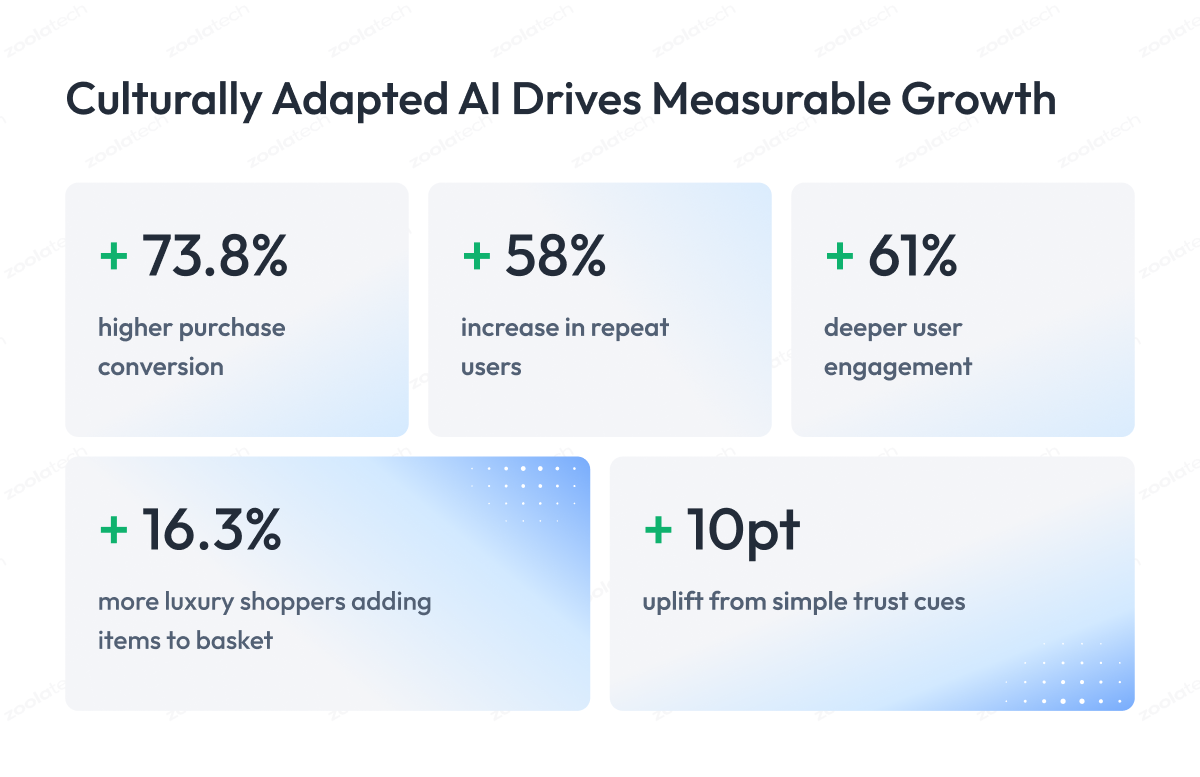
- Culturally adapted agents beat standard multilingual bots by 73.8% on purchase conversion and 58% on repeat use across 12 months of live deployments.
- A 90% containment rate can hide failure in specific markets or segments, so measure conversion delta and satisfaction by region rather than deflection alone.
Most failures have nothing to do with the technology itself. They happen because conversational AI design was never treated as a foundation.
This article gives the framework to evaluate and fix that.
What Conversational AI Design Actually Means
Conversation design is one of the most misused phrases in enterprise AI programs. Most organizations hear it and assume it means writing the scripts for a chatbot.
It is, in fact, the full discipline of determining what an AI agent is for, how it behaves, and what experience it creates — across every interaction path a customer might take, including the ones that were never anticipated.
- Intent architecture: defining which customer interactions the agent handles — and which it escalates to a human agent
- Dialogue flow mapping: charting every path a user might take, including off-script and emotionally charged interactions
- Brand voice governance: ensuring every AI-generated response reflects the organization’s documented values and tone
- Failure handling: designing graceful recoveries before failures reach real customers in production
- Escalation logic: determining precisely when and how the agent transfers a conversation to a human, and with what context
A conversation designer owns purpose, experience, content strategy, dialogue flow, error handling, and ongoing optimization. It is a product role — not a copywriting role.
Why Conversational AI Programs Fail Without a Design Foundation
Most enterprise conversational AI failures are not technology failures. They are design failures — programs built without a framework governing what the agent says, how it handles edge cases, and when it transfers to a human.
According to the RAND Corporation’s analysis, AI projects fail at more than twice the rate of conventional IT projects — and the root causes are almost never technical.
| Dimension | Without Conversation Design | With Conversation Design |
| Customer experience | Dead ends, abandoned conversations | Graceful recovery, rebuilt confidence |
| Brand consistency | Generic or off-tone responses | Voice governed across all interactions |
| Escalation rate | Spikes without pattern or warning | Managed by designed escalation logic |
| Performance visibility | No framework to detect failure early | KPIs defined and tracked from launch |
| Market adaptability | Single deployment fails culturally | Inclusive design embedded pre-launch |
Every design decision should serve what the customer needs in that moment, not showcase what the technology can do. Teams that anchor conversational voice in their branding ship more consistent agents than those starting from a blank prompt. This principle — drawn from Zoolatech’s conversation design practice — is the single most common gap between programs that perform and programs that fail.
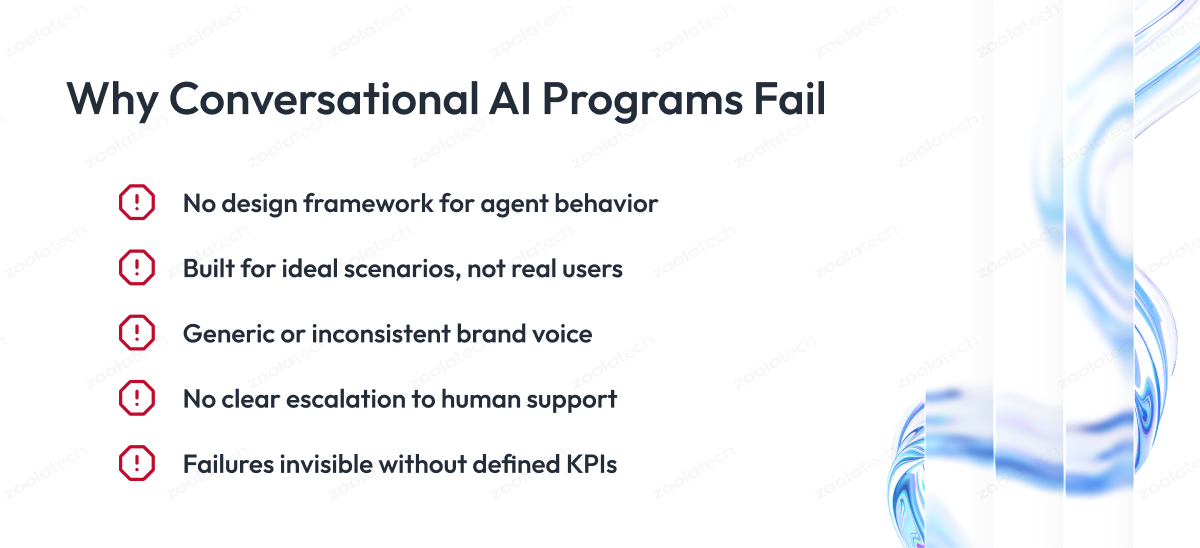
The four failure modes below are not edge cases — they are the predictable default when the budget is approved without a design brief.
- Happy-path design: the agent built for ideal interactions fails predictably under real customer stress and frustration
- Absent brand voice: the agent sounds generic or off-brand during the moments that matter most to the customer relationship. The same off-brand failure shows up in any generated client deliverable, which is why a presentation api that uses the company’s own templates and brand rules produces more consistent output than a generic generation script. Business teams can also use an AI presentation maker to create presentation materials while keeping visual elements aligned with established brand guidelines. This can make it easier to maintain consistency across internal and customer-facing communications.
- No escalation design: customers reach dead ends with no recovery path and no human handoff — and leave
- No measurement framework: performance is invisible until it has already damaged customer trust, NPS, and support costs
- No cultural design: the agent fails across markets because localization, inclusivity, and cultural context were never designed upfront
The Five Principles That Separate Good Conversational AI Design from Bad
These principles are not technical requirements. They are business standards that any program sponsor can use to evaluate whether a conversational AI design engagement is genuinely ready to deliver — before a single customer interaction takes place.
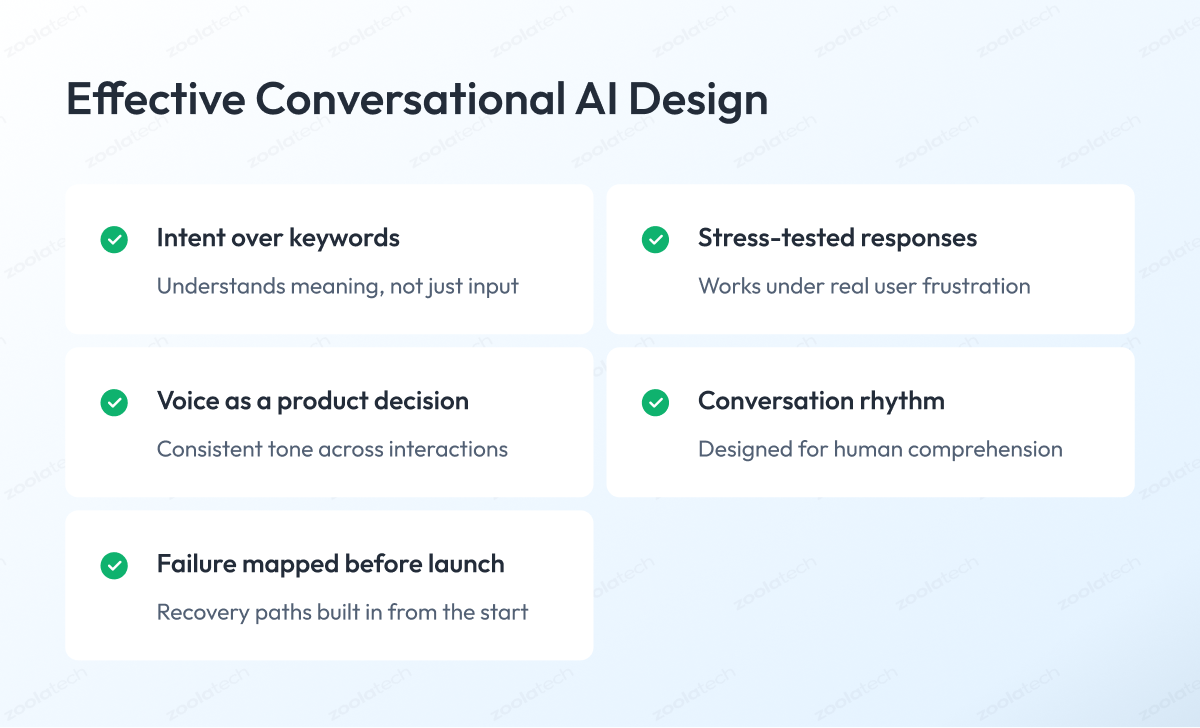
- Intent over keywords: the agent understands what customers mean, not what they literally type — reducing escalation rates and support costs at scale
- Stress-tested responses: every reply works under customer frustration, not just in a controlled demo environment — protecting brand reputation at the moments that count
- Voice as a product decision: tone and personality governed by documented guidelines, not left to model defaults — ensuring consistency across millions of interactions
- Conversation rhythm: responses paced for human comprehension, not optimized for content completeness — reducing abandonment at the moment of highest customer intent
- Failure mapped before launch: recovery paths designed for every dead end before build begins — preventing the silent drop-off that standard containment metrics never capture
Designing for failure is not a pessimistic act.
Business sponsors can apply these five principles as a practical evaluation lens. The questions below translate each one into a sponsorship checkpoint.
- Has brand voice been documented and embedded into the agent?
- What happens when a customer goes off-script?
- What triggers a human handoff — and with what context?
- What does success look like at 30, 60, and 90 days?
- How is cultural alignment handled across markets?
What “Good” Looks Like — The Business Case in Practice
Applying these principles produces measurable commercial outcomes. The engagement below demonstrates what conversational AI design delivers when it is treated as a product discipline from the start, not a delivery task bolted onto a technology build.
- Consultative retail selling replicated at global scale
- Multilingual customer support in a regulated financial domain
- Brand voice governance under real-world, high-stakes customer stress
- Inclusive design for diverse buyer contexts and cultural markets
Pandora — bringing the in-store selling ceremony online
Pandora’s physical stores are built around what the brand calls the Selling Ceremony — a guided, consultative experience in which a trained associate asks thoughtful questions and curates a personalized selection.
The challenge was to replicate that experience digitally, at global scale, without losing the warmth and personalization that makes it distinctively Pandora.
- Brand voice with no gendered defaults: gift flows designed inclusively for every buyer, occasion, and relationship — jewellery is for everyone, and the agent reflects that
- Consultative dialogue structure: agent asks thoughtful questions before recommending, mirroring the in-store associate model rather than presenting static search results
- Sensitive query handling: identity-related and distressing inputs handled with designed empathy and locale-specific resources — not deflection or generic error responses
- Inclusive recommendation flows: no stereotypical assumptions built into product suggestions about who buys, for whom, or for what occasion
Outcomes
- +6% add-to-basket rate vs. equivalent sessions without the agent
- +5% more product views per visit — customers discovering more of the catalogue
- Results consistent across Pandora’s global transaction volume
How to Measure Whether Your Conversational AI Is Working
Standard chatbot metrics — containment rate, response time, resolution percentage — tell a partial story. Business sponsors need a measurement framework built around commercial outcomes, not just operational indicators. For voice channels, that framework also needs to track real-time inference latency and per-call cost, since a half-second stall on the line erodes the same customer trust that a slow chat reply does.
The goal is to show a 90% containment rate while quietly underperforming in specific markets or customer segments, as research from Computers in Human Behavior confirmed.
| Category | What to Measure | Why It Matters at Enterprise Scale |
| Customer resolution | Self-service rate without escalation | Directly reduces support operating costs |
| Brand experience | Tone consistency across interactions | Protects brand equity at conversational scale |
| Engagement quality | Average conversation depth per session | Signals whether the agent builds customer trust |
| Market performance | Satisfaction score by region or language | Surfaces underperforming markets before escalation |
| Revenue impact | Conversion delta vs. non-agent sessions | Connects design investment to commercial return |
| Trust signal | Repeat usage rate over 30 and 90 days | Measures sustained user confidence in the agent |
What to Do Before You Approve the Budget — Decision Framework
The highest-risk moment in any conversational AI program is budget approval without a design brief.
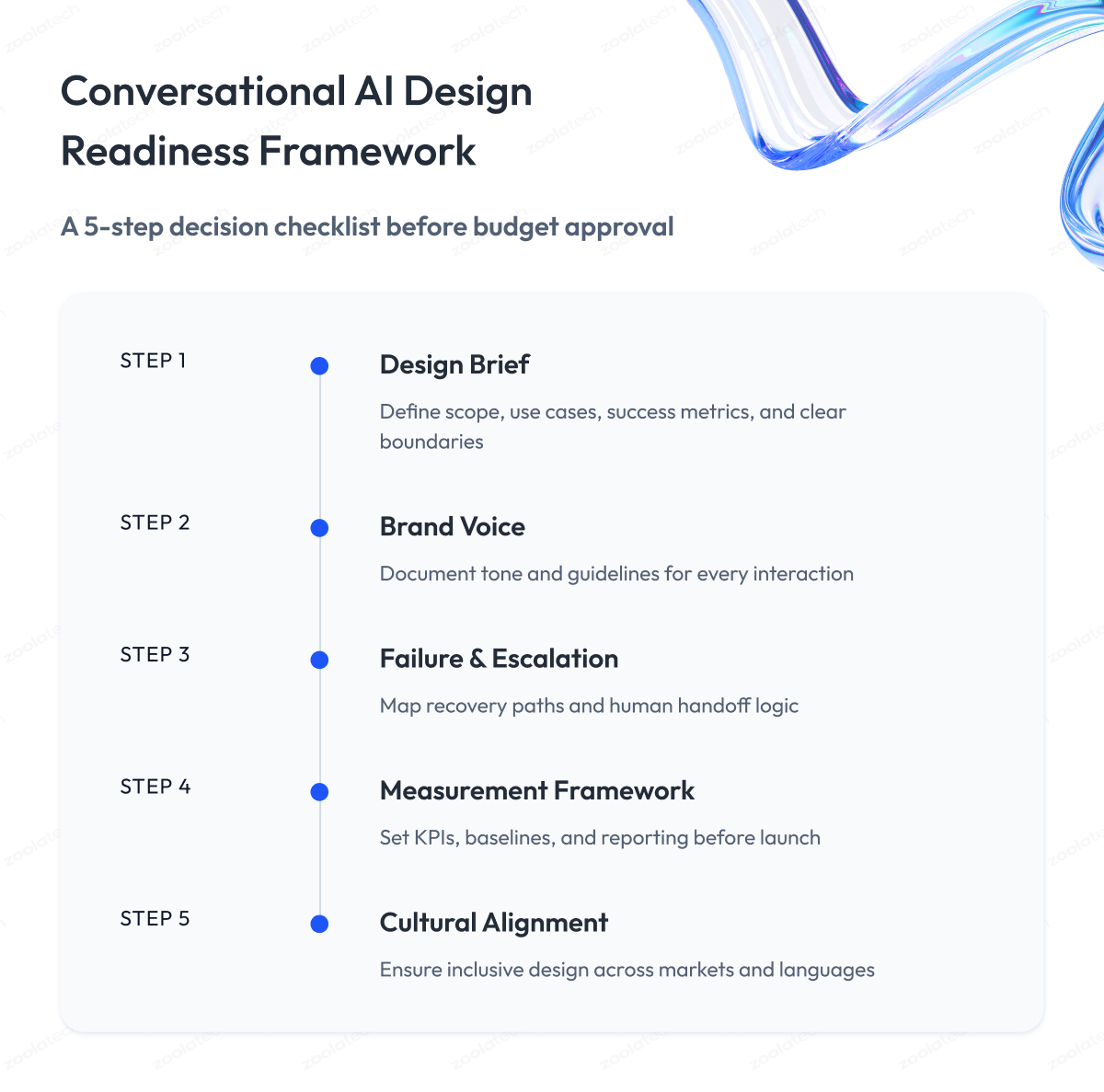
This framework gives business sponsors a structured way to validate readiness before committing resources to build.
- Is there a conversation design brief?: scope, use cases, commercial success metrics, and explicit limits on what the agent will not handle — documented before build begins
- Is brand voice documented?: embedded guidelines governing every generated response — not assumed defaults left to the underlying model
- Have failure paths been mapped?: escalation logic, fallback responses, and dead-end recovery designed before launch — not patched in after customer complaints arrive
- Is the measurement framework defined?: baselines, KPIs, and reporting cadence agreed before the program goes live — not retrospectively assigned
- Has cultural alignment been addressed?: for any multi-market deployment, inclusive design protocols and back-translation testing are a pre-launch requirement, not a post-launch correction
Key Findings
Conversational AI success depends far more on design than technology. Strong design defines how the AI behaves, handles failures, reflects brand voice, and delivers measurable outcomes.
Without it, chatbots create poor experiences and fail commercially. Treating conversational AI design as a product discipline before build is what separates successful programs from abandoned ones.
- Most AI failures are caused by poor design, not technology
- Conversational AI design includes intent, dialogue, voice, and escalation logic
- Missing design leads to dead ends, inconsistent tone, and lost customers
- Effective design requires failure mapping and real-world testing
- Strong design directly improves conversion, engagement, and trust
- Clear metrics and a design framework must be defined before launch
Questions You May Have
What is conversational AI design?
Conversational AI design is the discipline governing what an AI agent does, how it behaves, and what experience it creates — and without it, even well-funded programs deliver inconsistent, brand-damaging outcomes at scale.
What are the most common conversational design principles organizations overlook?
Failure path design and brand voice governance are missed most consistently, because both require significant investment before any visible output is produced.
How is conversational AI design different from building a standard chatbot?
A standard chatbot follows pre-written scripts; conversational AI design governs intent architecture, dialogue flow, brand voice, escalation logic, and ongoing optimization as a continuous product discipline.
What business metrics should a conversational AI program be measured against?
Self-service resolution rate, conversation depth, conversion delta versus non-agent sessions, and regional satisfaction scores provide the most commercially meaningful view of program performance.
What should a business sponsor look for in a conversation design partner?
Evidence of brand voice methodology, failure path design practice, inclusive design protocols, and documented commercial outcomes — not just technology credentials or deployment volume.
How does inclusive design affect conversational AI in global deployments?
A study in Computers in Human Behavior found that culturally adapted agents outperformed standard multilingual bots by 73.8% on purchase conversion and 58% on repeat user rate across live e-commerce deployments over 12 months.