








Quick Summary
- Enterprise mobile programmes fail gradually rather than dramatically, with releases taking longer each quarter even as the team grows and stability wobbling at peak traffic.
- Tight coupling to legacy APIs is the root cause, which is why a backend-for-frontend layer plus contract testing does more for velocity than any framework choice.
- Mobile cart abandonment sits above 70%, so performance belongs in the KPI set with explicit budgets for app start, search, and checkout latency.
- Fix release mechanics before chasing speed, since feature flags, staged rollouts, kill switches, and automated regression on revenue-critical journeys are what shrink the blast radius.
- One five-year partnership reached 10M+ downloads with 2x development velocity, 40% higher engagement time, and Android revenue doubled within three years.
Mobile is now a revenue infrastructure. In large organizations, enterprise mobile app development has shifted from feature delivery to long-term platform engineering.
It is often the dominant touchpoint for customer engagement, in-store assistance, loyalty, and digital transactions.
Industry research shows:
- Global mobile commerce continues to grow year over year.
- Cart abandonment remains above 70% on mobile.
- Even small performance delays measurably reduce conversions.
At enterprise scale, that means:
- Performance degradation becomes margin erosion
- Release instability becomes revenue risk
- Integration fragility becomes operational disruption
Organizations that succeed treat mobile as a platform engineered with architecture discipline, governance controls, observability, and cost management — principles foundational to mature enterprise app development.
The Enterprise Mobile App Development Reality Check
Many enterprise mobile programs don’t fail dramatically. They fail gradually — a common pattern in large-scale mobile app development for enterprise initiatives.
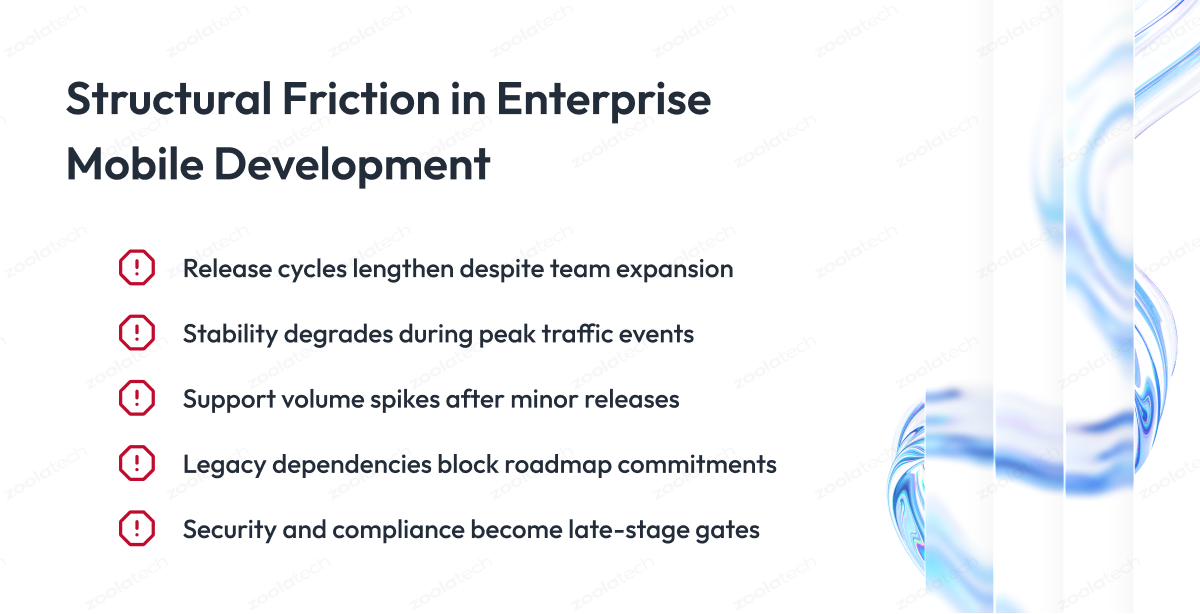
Leaders notice symptoms like:
- Releases take longer every quarter, even as team size grows
- Stability becomes unpredictable during peak traffic periods
- Customer support volume spikes after seemingly “minor” releases
- Dependencies on legacy systems block roadmap commitments
- Security and compliance become late-stage gates rather than built-in controls
When these symptoms appear, it’s tempting to blame a tool choice or a specific vendor, especially when working with an enterprise mobile app development company.
But enterprise mobile problems are usually systemic: the app is only one part of a larger operating system of architecture, governance, and delivery mechanics.
Gartner’s modernization guidance consistently highlights legacy application complexity as a persistent constraint on digital initiatives. In practice, this means you cannot “mobile-first” your way out of backend gravity; you need a structured decoupling and modernization path within your broader enterprise mobile app development process.
This is why enterprise mobile app development services must be treated as a platform strategy with explicit decisions across architecture, delivery, security, and cost—not a sequence of feature sprints.
Regular application audit services can help identify technical debt, security risks, and performance bottlenecks before they impact modernization efforts.
What Makes Enterprise Mobile Different
The difference between enterprise and mid-market mobile development isn’t simply scale. It’s the density of constraints inherent in enterprise app development environments.
Enterprise constraints that reshape the engineering problem
- Legacy system gravity: ERP/OMS/PIM, custom monoliths, brittle integrations.
- High volatility traffic: global demand spikes, promotions, peak events.
- Multi-team ownership: multiple product domains, shared components, conflicting priorities.
- Compliance and audit needs: PCI DSS, GDPR/CCPA, accessibility expectations.
- Offline and intermittent connectivity: store/field operations, device constraints.
- Long-lived client versions: customers don’t update immediately; old versions stay put.
In smaller environments, teams can often “fix forward.” In enterprises, the blast radius is larger, and the recovery path is slower.
That reality should influence every major decision across enterprise app development solutions, from API design and release strategy to security controls and observability.
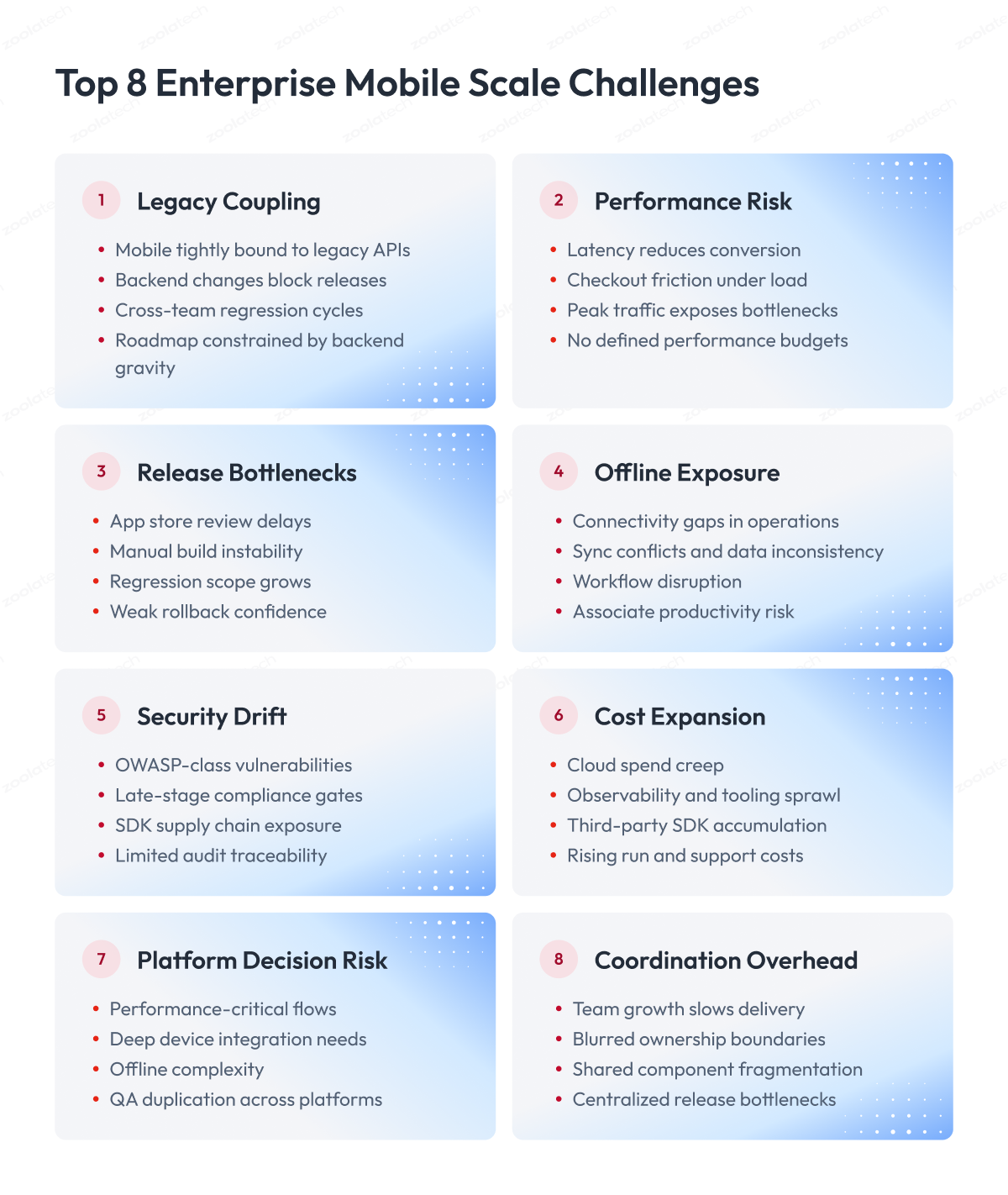
Top-8 Enterprise Challenges (and How Enterprises Fix Them)
From architectural friction to delivery bottlenecks—what breaks at scale and how leading enterprises respond.
1. Legacy integration without disrupting operations
Enterprise apps rarely have the luxury of clean, modern backends — a frequent driver of custom enterprise mobile app development.
Mobile must integrate with systems built across decades: ERP for product and pricing, OMS for fulfillment, PIM for catalog content, CRM for identity and loyalty, and bespoke services that encode business rules no one wants to touch.
The most common enterprise failure mode is tight coupling: mobile clients directly depend on legacy APIs whose contracts weren’t designed for mobile journeys. This creates a chain reaction:
- A backend change becomes a mobile release blocker
- A mobile feature becomes a backend program
- A simple bug fix requires cross-team coordination and multi-week testing
The enterprise fix is not “better integration.” It is decoupling.
A widely referenced modernization approach is often adopted within mature enterprise mobile app development platforms. It helps incrementally route functionality away from the legacy system into newer components, reducing risk versus a big-bang rewrite.
What enterprises implement in practice
- A Backend-for-Frontend (BFF) layer to shape responses specifically for mobile journeys
- An API abstraction that insulates the app from legacy volatility
- Contract testing to detect breaking changes early
- A versioning and deprecation policy designed for long-lived mobile clients
This approach also lowers the long-term enterprise mobile app development cost by reducing rework and regression cycles.
2. Performance is a business metric, not a UX detail
Enterprise leaders often ask for “a faster app,” but performance must be treated as a measurable business metric in enterprise mobile app development.
Baymard’s research shows that checkout issues and friction remain persistent; mobile users are especially likely to abandon during slow, confusing, or error-prone steps.
Cloudflare summarizes how site speed impacts user engagement and retention (while not a retailer-specific dataset, it’s a useful reference for the directionality and business relevance of speed).
What performance discipline looks like in enterprises
- Performance budgets for app start, search, PDP, checkout
- Real user monitoring (RUM) plus crash analytics and ANR tracking
- Backend tracing correlation so teams can see where latency is introduced
- Load testing that reflects peak event behavior (not average traffic)
- Caching and CDN/edge strategies aligned to business semantics (not only TTL guesses)
When enterprises do this well, performance becomes governable: teams stop arguing about opinions and start managing measurable thresholds.
3. Release engineering and governance become the true bottleneck
In many enterprises, engineering teams can build features faster than the organization can release them — a recurring issue for enterprise mobile app development companies operating at scale.
Release friction comes from:
- App Store / Play Store review cycles and phased releases
- Manual signing and build pipeline instability
- Regression test cycles that don’t scale with app complexity
- Multiple teams releasing into the same app surface without coordination
- Fear of rollback because observability is weak
The fix is not “more approvals.” It is the release mechanics that reduce the blast radius.
- Apple supports phased releases for rolling out versions gradually.
- Google Play supports staged rollouts for controlled release.
To ensure you improve speed without sacrificing stability, the DORA metrics remain one of the best-known industry baselines for measuring delivery performance and reliability tradeoffs.
Enterprise release controls that actually work
- Feature flags and remote config to decouple deploy from release
- Canary releases and staged rollout patterns
- Kill switches for critical flows
- Automated regression for the journeys that matter most
- Release criteria tied to crash rate, latency, and key funnel health
Enterprises investing in mobile app development services don’t need slower releases — they need releases that are safer, smaller, and measurable.
4. Offline-first and sync are not edge cases
Offline requirements are often dismissed until they become operational blockers in large mobile app development for enterprise environments.
- In many enterprises, mobile is used:
- In stores with unreliable connectivity
- In warehouses with Wi-Fi dead zones
- In field operations where coverage is inconsistent
- In customer contexts where networks are slow or saturated
Android’s architecture guidance explicitly calls out offline-first design at the data layer, a pattern frequently implemented within a structured enterprise app development platform.
Offline-first isn’t only about caching. It requires explicit business decisions:
- Which workflows must succeed offline
- What data can be stored locally (and what must not)
- How to handle conflicts and reconciliation
- How to sync without draining battery or overwhelming the network
When enterprises treat offline as a first-class requirement, they reduce operational disruption and support volume—particularly in associate-facing workflows.
5. Security and compliance must be continuous engineering
Enterprise mobile attack surface is broader than many teams assume, particularly in complex enterprise app development ecosystems.
The OWASP Mobile Top 10 provides a practical baseline for common mobile vulnerabilities, including insecure data storage, insufficient cryptography, weak server-side controls, and client-side injection risks.
For enterprises processing payments, PCI DSS defines the compliance expectations for cardholder data environments. Security governance becomes even more nuanced when collaborating with an enterprise blockchain app development company that integrates distributed transaction logic.
For privacy across EU markets, GDPR remains a major compliance driver.
For enterprise mobile device security and management, NIST SP 800-124r2 provides strong guidance.
Accessibility is also part of enterprise risk. WCAG provides the standard baseline.
What “continuous security” looks like in enterprise mobile
- Threat modeling mapped to OWASP Mobile risks
- Dependency scanning and SDK governance (supply chain discipline)
- Secrets management practices appropriate for mobile clients
- Security tests embedded into CI/CD, not executed at the end
- Audit-ready logging and data flow documentation
Enterprises that “bolt on” security late often pay for it twice: once in rework, and again in release delays.
6. Total cost of ownership expands faster than executives expect
Enterprises often budget for build and underestimate run — a pattern that inflates overall enterprise mobile app development cost.
The total cost of ownership (TCO) grows through:
- Cloud computing and data transfer
- Observability tools
- Third-party analytics/attribution platforms
- Fraud tooling
- Compliance overhead and audits
- On-call engineering and incident response
- Regression automation infrastructure
The FinOps Framework institutionalizes cloud cost accountability across large enterprise mobile app development initiatives.
Microsoft also provides guidance on FinOps practices and cloud cost governance.
Enterprise cost governance moves beyond “reduce cloud spend”
- Track cost per active user and cost per checkout/transaction
- Attribute costs by product domain and environment
- Rationalize SDK and third-party service footprint
- Treat platform capabilities as operating costs (planned), not surprises (unplanned)
This reframes cost optimization as a continuous discipline, not a one-time initiative.
7. Native vs cross-platform
Enterprises working with an enterprise mobile app development agency must instead frame it as risk management.
The key enterprise decision factors:
- Performance-critical flows (search, checkout)
- Deep device integration needs (camera scanning, biometrics, MDM)
- Offline-first requirements
- Team capability and long-term maintainability
- Release and QA complexity across platforms
Many enterprises settle on a hybrid approach:
- Cross-platform for broad feature parity and shared UI
- Native modules for performance-critical journeys and device-specific functionality
- Shared design system and analytics taxonomy to maintain consistency
The important point isn’t which framework “wins.” It’s whether the decision aligns with long-term ownership and the operating model.
8. Scaling teams without losing velocity
Enterprises often assume that adding teams increases throughput. In practice, coordination overhead slows complex enterprise app development ecosystems.
Velocity drops when:
- Multiple teams ship into shared app surfaces without common standards
- Ownership boundaries are unclear
- Shared components and primitives are reinvented repeatedly
- Release governance is centralized and becomes a bottleneck
The DORA research emphasizes that top-performing organizations improve throughput and stability together, not sequentially.
Operating model pattern that scales
- A platform team owns shared primitives: design system, telemetry, feature flags, and CI/CD templates.
- Feature teams own business domains end-to-end (search, checkout, loyalty).
- Architecture is guided through standards and guardrails, not “approval queues”.
- Quality is enforced continuously through automation and observability.
This structure stabilizes long-term enterprise app development solutions while maintaining delivery velocity.
Enterprise Mobile Platform Architecture Blueprint
A useful way to communicate enterprise mobile architecture is as layers with explicit responsibilities. This keeps stakeholders aligned and makes tradeoffs visible.
| Layer | Responsibility | Enterprise Value |
| Mobile clients | UX, offline-first data layer, telemetry, experimentation hooks. | Controls conversion, stability, and edge resilience. |
| Mobile platform services | Auth, feature flags, analytics, crash reporting, remote config. | Standardizes critical capabilities across teams. |
| BFF / API layer | Aggregates and shapes APIs per user journey. | Decouples mobile from backend volatility. |
| Domain services | Search, pricing, cart, checkout, loyalty, fulfillment. | Independent scaling and releases by domain. |
| Event backbone | Streaming events and asynchronous workflows. | Real-time updates without synchronous bottlenecks. |
| Data layer | Governed domain data and analytics pipelines. | Supports AI readiness and compliance stability. |
A Practical Delivery Roadmap for Enterprise Mobile App Development
Enterprise mobile app development rarely fails because teams can’t build features. It fails because organizations try to accelerate innovation before they make change safe.
The most effective enterprise programs follow a staged path embedded within a disciplined enterprise mobile app development process.
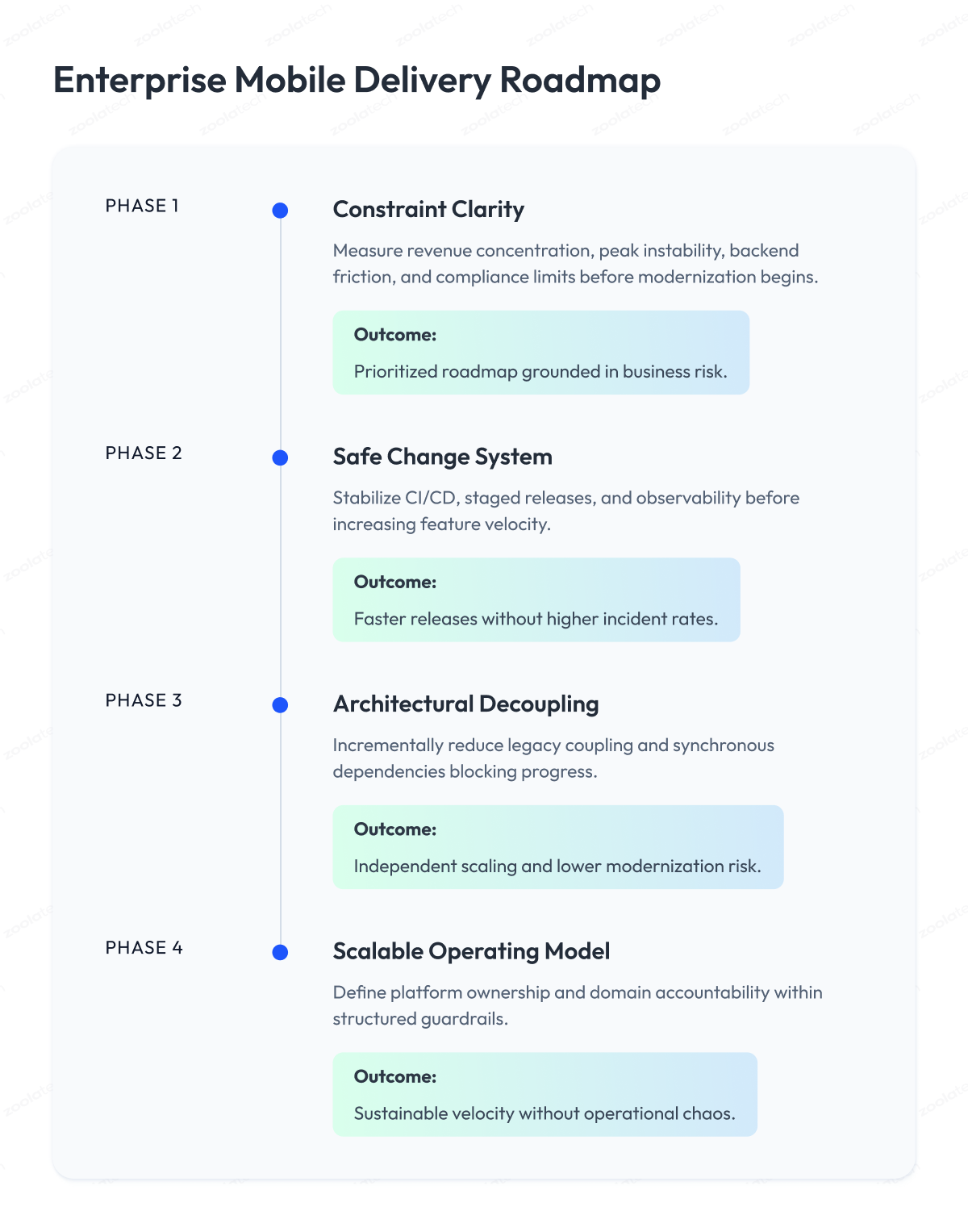
This sequencing discipline is central to any scalable enterprise app development platform.
Phase 1: Establish constraints before you attempt acceleration
The first mistake enterprises make is jumping into modernization without understanding where risk actually lives.
Before touching architecture, teams must answer four foundational questions:
- Where does revenue concentrate inside mobile journeys?
- Where does stability break under peak conditions?
- Which backend systems create release friction?
- What compliance boundaries constrain delivery?
This phase is not about redesign. It is about clarity.
A strong baseline includes measured performance (startup time, p95 latency on search and checkout), crash-free session rate, conversion drop-offs, and release-related support volume.
At the same time, integration dependencies must be mapped: ERP pricing flows, OMS synchronization, identity systems, and third-party SDKs.
When done properly, Phase 1 produces alignment. Leadership sees which constraints are architectural versus operational. Engineering sees which improvements will actually impact business outcomes.
Outcome of Phase 1:
A constraint map tied to revenue and operational risk, not opinions. A prioritized backlog grounded in measurable business impact.
Phase 2: Build the “safe change” system
Enterprises don’t struggle because they move too fast. They struggle because they move unsafely.
Before scaling feature velocity, the delivery system itself must become predictable.
This phase focuses on stabilizing CI/CD, implementing staged rollouts, and building observability that correlates mobile experience with backend behavior. It’s also where automated regression coverage is concentrated around revenue-critical flows rather than spread thinly across low-impact screens.
Release confidence comes from three capabilities:
- The ability to deploy without immediately exposing 100% of users
- The ability to observe real user impact in near real time
- The ability to rollback or disable features without a full emergency release
When these controls are in place, the organization’s risk tolerance shifts. Teams ship more frequently because the blast radius is limited.
Outcome of Phase 2:
Release stability improves, incident rates decrease, and deployment frequency can increase without increasing risk.
Organizations that institutionalize these mechanics often evolve toward a mature enterprise mobile app development agency operating model.
Phase 3: Remove architectural bottlenecks
Only after change is safe should enterprises focus on structural modernization
This phase addresses the friction points that repeatedly block roadmap progress. In most large organizations, those bottlenecks include legacy API coupling, synchronous backend dependencies, and inconsistent domain ownership across systems.
Modernization here is incremental, not disruptive.
A Backend-for-Frontend layer may be introduced to decouple mobile from backend volatility. Contract testing prevents regressions as APIs evolve. Event-driven patterns reduce synchronous blocking in workflows like order updates or inventory refresh.
The modernization priority is rarely random. Checkout reliability, search latency, and inventory accuracy typically drive the most visible business impact. Improving these areas often yields measurable gains in conversion and operational efficiency.
Outcome of Phase 3:
Mobile roadmaps become less dependent on legacy timelines. Latency drops in high-impact journeys. API evolution becomes governed rather than fragile.
This incremental pattern is common in large custom enterprise mobile app development programs.
Phase 4: Scale teams without scaling chaos
With platform primitives stabilized and architectural bottlenecks reduced, enterprises can safely scale teams.
This phase formalizes the operating model.
A platform team owns shared capabilities—feature flags, CI/CD templates, observability patterns, SDK governance, and design systems. Feature squads own business domains end-to-end—search, checkout, loyalty, post-purchase, or associate workflows.
The goal is not centralized control. It is decentralized execution within guardrails.
Security scanning becomes continuous. Compliance evidence becomes automated. The cloud cost visibility is integrated into product dashboards rather than managed in isolation.
When governance is built into the system instead of layered on top, velocity scales without introducing entropy.
Outcome of Phase 4:
The delivery throughput increases without proportional coordination cost. Compliance becomes routine rather than disruptive. Cost growth is visible and manageable.
How the phases fit together
| Phase | Focus | Primary Result |
| 1. Baseline constraints | Make risk measurable | Aligned priorities tied to business outcomes |
| 2. Safe change system | Stabilize delivery mechanics | Predictable, lower-risk releases |
| 3. Architectural decoupling | Remove structural bottlenecks | Independent scaling and modernization |
| 4. Operating model scale | Institutionalize governance | Sustainable velocity at enterprise scale |
Measuring Success: KPIs Enterprises Should Track
Enterprises need metrics that tie platform maturity to business outcomes and operational stability.
| Category | Metric | Why It Matters |
| Customer outcomes | Conversion rate by journey step | Shows where performance and UX translate into revenue. |
| Stability | Crash-free sessions, ANR rate | Reliability is a prerequisite for retention and trust. |
| Performance | App start time, p95 latency per journey | Indicates readiness for peak events and real user experience. |
| Delivery | Lead time, deployment frequency, change failure rate, MTTR | Measures ability to ship safely (DORA baseline). |
| Cost | Cost per active user, cost per transaction | Tracks total cost of ownership as usage grows. |
Enterprise Decision Criteria: How to Choose What to Do First
When C-levels ask, “What should we fix first?” the best answer is not “modernize everything.” It is “remove the constraints that create compounding risk.”
A practical prioritization lens:
- Revenue-critical journey risk: checkout and payments first
- Latency bottlenecks: search and product discovery next
- Operational disruption: inventory and fulfillment visibility
- Release friction: CI/CD and regression automation as enablers
- Security/compliance risk: continuous controls embedded into pipelines
- Cost drift: cloud and third-party services governance
This sequencing keeps modernization outcomes visible and prevents multi-quarter programs from becoming abstract.
Zoolatech’s Enterprise Mobile Expertise in Action
Over five years, Zoolatech partnered with a major North American fashion retailer, operating as an enterprise mobile app development company, to scale a revenue-critical mobile platform.
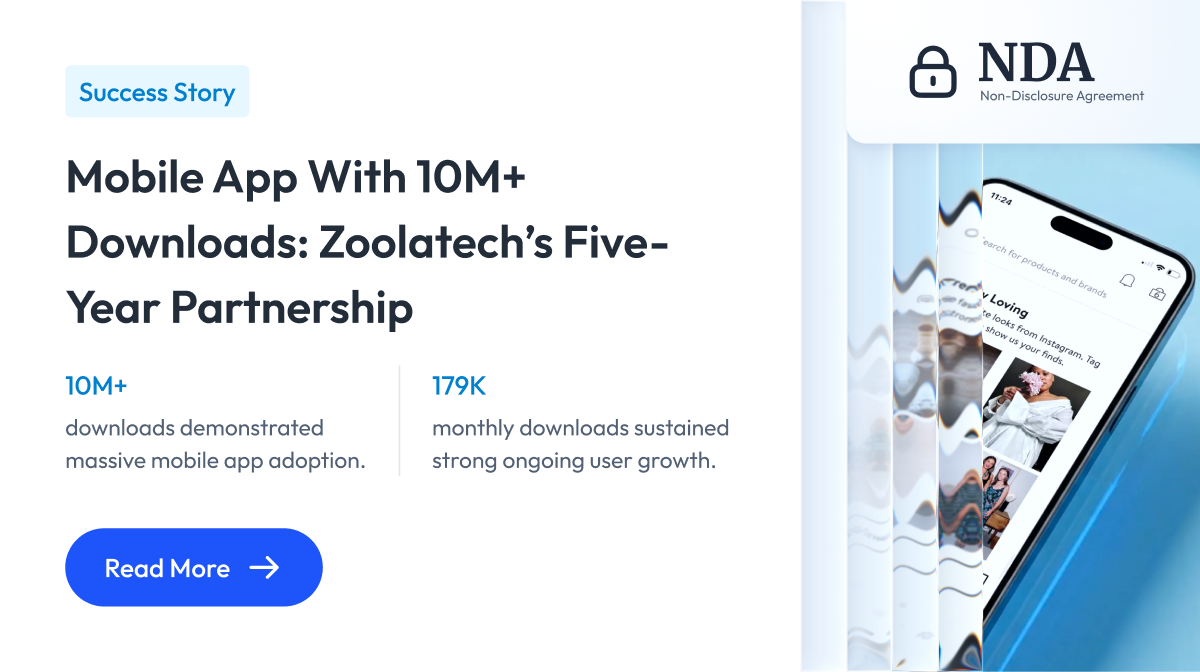
The engagement focused on velocity, resilience, and measurable revenue growth—without disrupting ongoing operations.
Key achievements
- 10M+ total downloads across iOS and Android
- 179K+ monthly downloads sustained growth
- 2x development velocity over the partnership
- Stable bi-weekly releases under high-traffic conditions
- +40% increase in engagement time
- Android revenue doubled within three years
Enterprise challenges solved
The retailer faced classic enterprise mobile constraints: extreme traffic volatility, growing team complexity, legacy architectural limits, and zero tolerance for downtime during revenue-critical events.
Our team addressed scaling without fragmentation by standardizing architecture across Android and iOS, institutionalizing CI/CD and QA governance, and redesigning high-load transaction processing when serverless execution limits were reached.
| Challenge | Zoolatech Action |
| Peak load limits | Replaced Lambda with AWS Batch and Kafka |
| Team scaling risk | Unified architecture and CI/CD standards |
| Release failure risk | Phased rollouts and real-time monitoring |
| Regression growth | Built QA foundation and automation |
| Checkout friction | Launched guest checkout and new payments |
| Merchandising rigidity | Enabled dynamic homepage updates |
Conclusion: Mobile Wins Go to the Enterprises That Build a Platform, Not Just an App
Enterprise mobile app development is not a UI project. It is an enterprise platform strategy.
Organizations investing in mobile app development for enterprise must decouple legacy systems, treat performance as a KPI, embed security into CI/CD, and apply financial discipline to long-term enterprise mobile app development cost management.
The most consistent enterprise playbook is clear:
- Decouple mobile from legacy volatility with BFF and API abstraction
- Treat performance as a KPI with budgets and observability
- Build release mechanics that reduce blast radius and enable safe change
- Engineer offline-first where operations depend on it
- Embed security and compliance into CI/CD, not final approvals
- Apply FinOps discipline so cost doesn’t outpace value
- Scale teams through platform primitives and domain ownership
Sustainable leadership in enterprise app development belongs to enterprises that engineer mobile as a governed platform rather than a sequence of feature sprints.
Questions You May Have
What breaks first at enterprise mobile scale?
Release safety and integration stability typically fail first. As dependencies grow, small changes create disproportionate operational risk. Even the best enterprise mobile app development company prioritizes reducing blast radius before increasing delivery speed.
Why do mobile releases slow down over time?
Legacy coupling and cross-team coordination increase friction. Without platform guardrails, every release carries a higher regression risk. This pattern frequently appears across enterprise mobile app development companies managing shared codebases.
When is a Backend-for-Frontend necessary?
When the backend API changes repeatedly, it blocks mobile progress. A BFF isolates mobile journeys from legacy volatility.
What is the biggest mobile revenue risk?
The checkout instability and latency. Even small performance degradation reduces conversion at scale.
Why must performance be treated as a KPI?
Because latency directly impacts revenue, retention, and peak-event readiness. It is a business variable, not a UX preference.
What drives unexpected mobile cost growth?
Cloud usage drift, third-party SDK sprawl, and observability overhead. Run costs compound faster than build costs. Mature enterprise app development services integrate cost observability directly into engineering dashboards.
Is cross-platform development always more efficient?
Not for performance-critical or hardware-intensive flows. Enterprise decisions must prioritize long-term maintainability and risk. The evaluation should support long-term enterprise app development solutions rather than temporary implementation convenience.
Why does adding teams often reduce velocity?
Coordination overhead scales faster than delivery capacity. Without platform ownership, complexity increases entropy.
When is offline-first architecture mandatory?
When store, warehouse, or field operations depend on unreliable connectivity. Treating offline as optional creates operational risk. These operational constraints often emerge in broader mobile app development for enterprise environments.