








Quick Summary
- Payment orchestration sits between checkout and your providers, so you integrate once and the layer picks the gateway, retries failures, and keeps one record of every transaction.
- Four steps run behind a single tap: accept the payment through one connection, choose a provider by location, card type, amount, and provider health, retry declines elsewhere, and record the outcome.
- The readiness test is volume and variety, so orchestration pays off at serious volume across more than one provider or market and is a solution ahead of its problem for a single-market seller.
- Six components make up the layer: API gateway, routing engine, provider adapters, token vault, reconciliation service, and observability that feeds provider health back into routing.
- Buying costs a per-transaction fee that grows with volume, building costs engineering upfront and then stays flat, and most enterprises start hybrid before moving their highest-volume flows in-house.
Payment orchestration is the layer that sits between your checkout and your payment providers. You integrate once, and the layer decides which gateway, acquirer, or local method each transaction goes through, retries the ones that fail, and reconciles all of it in one place.
Deciding what to do about that is harder than understanding it. Approval rates drift between providers, and nobody can say why. A single PSP outage takes down a region. Adding a payment method for a new market takes a quarter of engineering effort, and finance still reconciles settlements across four dashboards by hand.
Meanwhile, every orchestration vendor tells you their platform solves all of it, and no one explains what the layer actually contains or what it takes to run one.
So we wrote the guide from the build side. It covers how payment orchestration works, how it differs from a gateway, a vendor-neutral reference architecture, the build versus buy decision with its cost structure, how to build the layer step by step, what tokenization does to your PCI scope, and how to evaluate platforms.
By the end, you will know whether your business needs orchestration, whether to buy or build it, and what to ask vendors and engineers before you commit.
What Is Payment Orchestration?
You already have the one-line version from the intro. The fuller definition draws the boundary around what this layer is responsible for and what it deliberately leaves alone.
Payment orchestration is a coordination layer over your entire payments stack. It owns provider selection, failure handling, and the single record of what happened to every transaction.
Imagine the navigation app on your phone. You type in one destination, and the app picks the route, and when it hits traffic, it quietly moves you onto a different one.
Here is a simple payment orchestration example with money. A customer in Berlin buys something for 80 euros. Her card is valid, the funds are there, but the bank on the other end still says no, which happens more often than most teams expect. With one payment provider, that is the end of the sale.
With an orchestration layer, payment goes through a second provider a moment later, and the user gets a confirmation page without knowing anything happened.
Her 80 euros on its own changes nothing for your revenue. The question is how many customers hit that same wall every month. At enterprise volume, recovering even a small share of those attempts adds up to a revenue line large enough to pay for the layer doing the recovering.
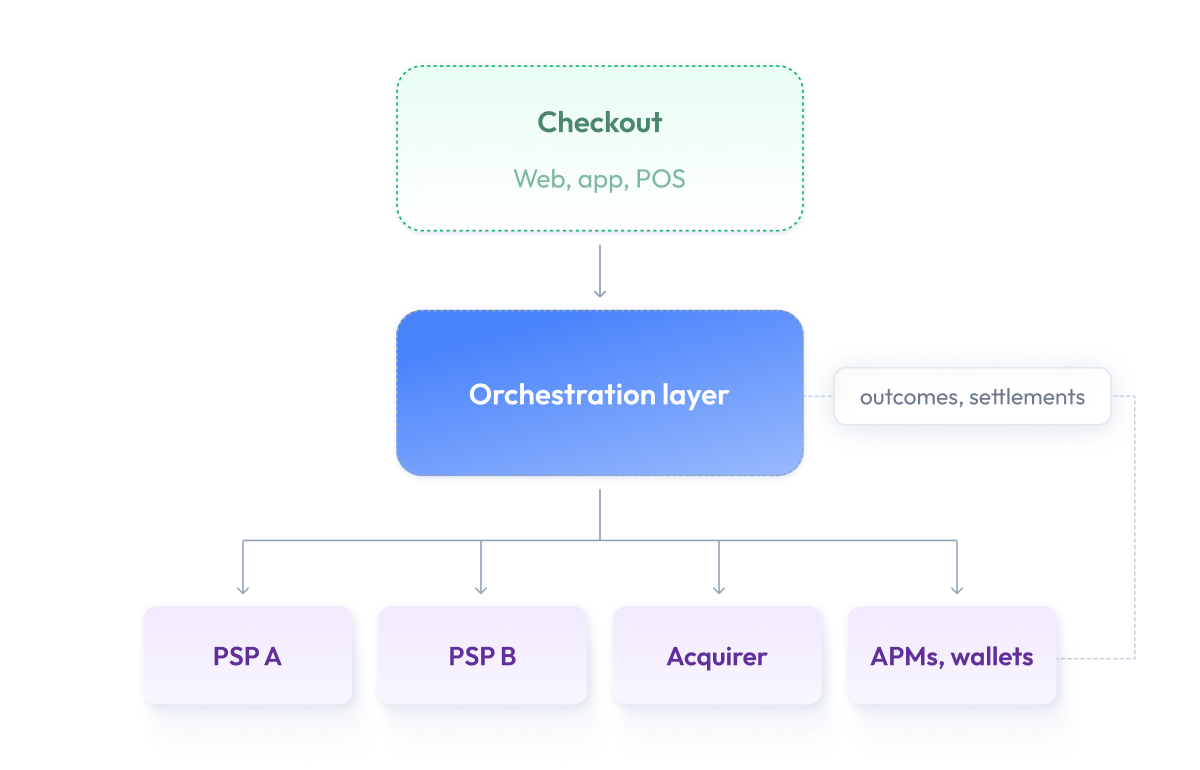
Four entities show up in every orchestration conversation, so they are worth pinning down before we go further:
- PSP (payment service provider): the company that takes a card payment through to processing, often bundling gateway and acquiring together.
- Acquirer: the bank that holds your merchant account and receives funds from the card networks.
- Payment methods and APMs: cards plus everything else your customers expect, from iDEAL and Pix to wallets and pay-by-bank.
- Orchestration layer: the routing and reconciliation logic sitting above all of it.
One more term is worth knowing before we go on.
A payment orchestration platform, often shortened to POP, is the commercial product version of that layer, sold as a hosted service you connect your providers to. The alternative is to build the same payment orchestration system within your own stack, which is where most companies with serious volume eventually end up looking.
We cover each route further down.
Payment Orchestration vs. Payment Gateway, Processor, and PSP
Vendors use the words gateway, processor, PSP, and orchestration interchangeably. They are not the same thing, and knowing which is which tells you what you already have in your stack and what orchestration would add on top.
A payment gateway transmits card data from your checkout toward processing.
A payment processor moves the money between banks and card networks.
A PSP packages a gateway and a processor together, often with acquiring as well, into one commercial relationship.
| Layer | What it does | Providers involved | Routing logic | Lock-in risk |
| Payment gateway | Transmits card data toward processing | One | None | High per integration |
| Payment processor | Moves funds between banks and networks | One | None | Contractual, acquirer-tied |
| PSP | Bundles gateway, processing, often acquiring | One commercial relationship | Limited, inside own rails | High, full-stack dependency |
| Orchestration layer | Coordinates providers behind one integration | Many, added independently | Rule-based across all providers | Low, providers swappable |
Everything above the last row connects you to a single provider. The orchestration layer is the only one that manages several at once.
That answers payment orchestration vs payment gateway in a line. The gateway is a connection to a processing, and the orchestration layer coordinates many gateways, acquirers, and methods.
How Payment Orchestration Works
Before you decide whether to buy or build anything, it helps to see what the layer actually does second by second. Once you can picture the path a payment takes, the rest of this guide reads more easily, and you can judge for yourself which of the benefits vendors promise will hold up for your business.
So picture one payment. A customer taps “pay,” and behind that single tap, the orchestration layer runs through four steps.
1. Accept the payment
Normally, your website connects to each payment company individually. Every provider you want to support is a separate integration your engineers have to build and maintain, so supporting five providers means five connections to look after.
With orchestration, your website connects only to the orchestration layer, which handles all connections to the payment companies behind it. Your checkout hands each payment to the layer, and the layer handles everything downstream.
The single connection your website plugs into is the payment orchestration API. Your engineers set it up once. After that, adding a new payment company is a configuration change instead of another integration to build.
2. Choose a provider
Once the payment reaches the layer, the layer decides which payment company should handle it. This choice is what makes orchestration worth having.
It weighs a few things about each payment:
- Location: where the customer is paying from.
- Card type: which card network and issuer they used.
- Amount: how large the payment is.
- Provider health: which providers have approved payments reliably in the last hour.
Picture the self-checkout lanes at a supermarket. You glance across them and step into the one that is moving.
The layer does the same with payment companies, sending each payment to the provider most likely to approve it.
For example, a card issued in Brazil goes to a provider that handles Brazilian cards well, because a local provider approves local cards more often than a foreign one does.
3. Retry if it fails
Banks sometimes decline a payment even when the card is valid, and the money is there. It happens more often than most teams expect, and with a single provider, that decline fails the sale.
The layer treats a decline as a first attempt. It takes the same payment and sends it to a different provider to try again.
The customer sees a normal confirmation page and never knows the first try failed. This one step recovers most of the sales a single provider would have quietly lost.
4. Record the outcome
The provider that handles the payment still does its normal job of approving it and moving the money. The new part is that the layer writes down what happened with every payment:
- Providers tried: which companies the payment was sent to.
- Result: which provider approved it and which declined.
- Fees: what each attempt cost you.
- Retries: whether a second attempt was needed.
The big advantage you get is that your finance team no longer logs into four provider dashboards, exports four reports, and matches them by hand at month-end. They close the books from a single record.
Here is the same sequence at a glance, with what each step saves you.
| Step | What happens | What breaks without the layer |
| Accept | One connection takes every payment | New provider means new integration |
| Choose a provider | Rules pick the best provider | Every payment forced down one path |
| Retry if it fails | Declines rerouted to another provider | Recoverable sales lost on first decline |
| Record the outcome | All results in one place | Finance matches many dashboards by hand |
In short, orchestration is a mechanism that accepts a payment, a rule that picks the best provider, an automatic second try when one says no, and a single record of it all.
The next question is what it earns you, so let us look at the benefits worth paying for.
Benefits of Payment Orchestration
In this section, we look at why companies actually adopt payment orchestration and what it gives them once it is running. These are the outcomes you would point to when making the case internally, so each is framed around its effect on the business.
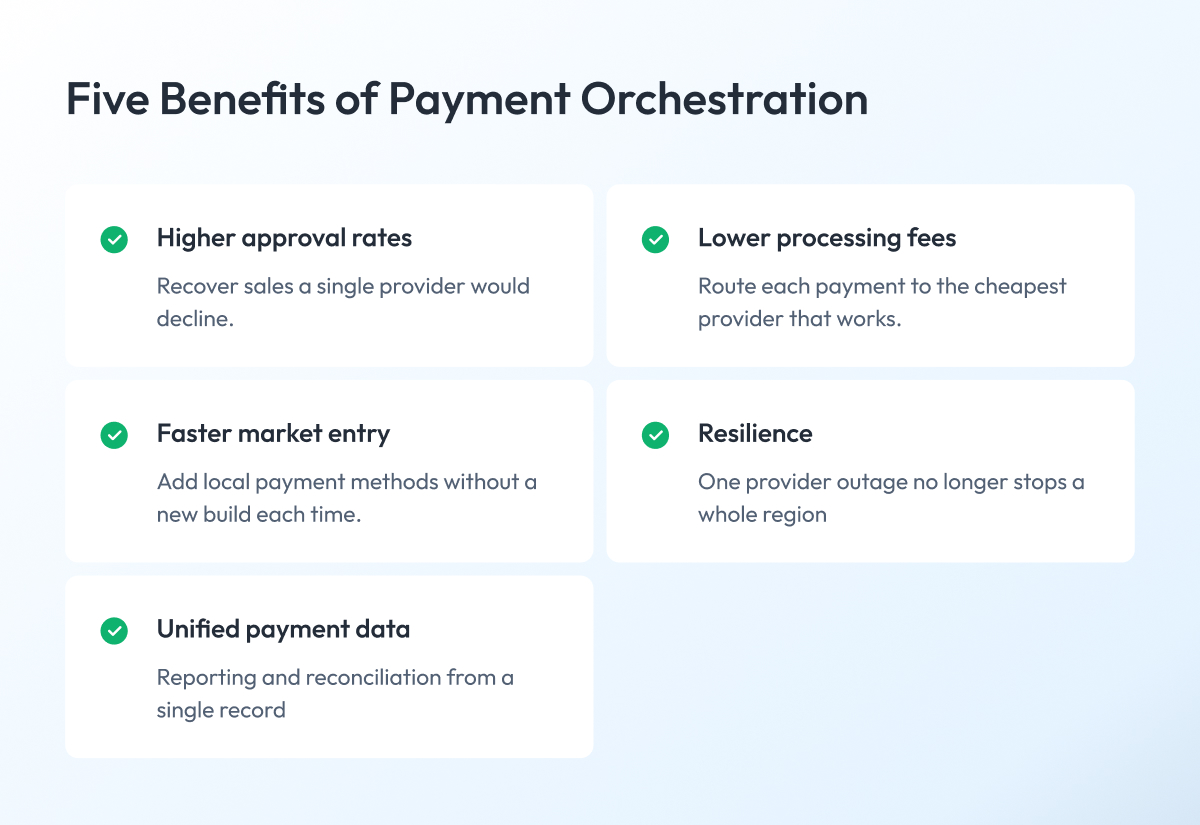
Five benefits carry most of the case, and each one grows more valuable as your payment volume and market coverage increase.
1. Higher approval rates and recovered revenue
The single largest benefit is money you are already losing without seeing it. Every declined payment from a customer who genuinely wanted to buy is lost revenue, and a meaningful share of declines are recoverable through a retry with a better-suited provider.
Because the orchestration layer routes each payment to the provider most likely to approve it, and retries the ones that fail, your overall approval rate climbs. At enterprise volume, even a small percentage gain is a large absolute number.
2. Lower processing costs
Every provider charges a fee to process a payment, and those fees are not the same. They change by country, by card type, and by how big the payment is. With one provider, you pay its price on everything.
Orchestration lets you send each payment to whichever provider is cheapest for that specific case. On its own, that sounds minor. Across millions of payments a year, trimming even a fraction of a percent off your average fee adds up to money kept, and over time the savings cover the cost of the platform itself.
Global payment orchestration matters most here, because when you sell in many countries the cheapest option changes so often that no team could keep up with it by hand.
3. Faster expansion into new markets
To sell in a new country, you usually have to support the way people there like to pay. Shoppers in the Netherlands expect iDEAL. Brazilians expect Pix. If you only take cards, you lose sales in both places.
Normally, adding each of those payment methods is a separate job for your engineers that takes weeks. With an orchestration layer, turning one on is a setting you change. So the gap between “we want to sell here” and “we can take payments here” shrinks from months to days.
For any company planning to expand abroad, moving that quickly is a significant advantage over slower competitors.
4. Resilience against provider outages
If you rely on one payment provider, you rise and fall with it. When it has an outage, you cannot take payments in that region until it comes back, and usually the first you hear of it is unhappy customers.
An orchestration layer takes that risk away. If one provider slows down or fails, the layer automatically routes payments to a working one, and your customers never notice anything went wrong.
For the people responsible for uptime and revenue, that turns “we hope payments keep working” into something they can actually promise.
5. Unified payment data
Since the orchestration layer sees every payment across every provider, it becomes the one place all that data lives. Your finance team reconciles faster, your analysts work from consistent numbers, and leadership sees how payments are really performing without waiting for someone to stitch spreadsheets together.
The same complete view is what lets you see which providers perform best, push for better rates, and feed reliable data into your fraud and risk checks.
These five benefits are why enterprises take orchestration seriously. Whether your business is ready for it is a different question, and the next section answers it honestly.
Are You Ready for Payment Orchestration? (And When You Don’t)
Every vendor selling an orchestration platform will tell you the answer is yes. We build payment systems for a living and have no platform license to push, so we can be straight with you.
Plenty of companies do not need orchestration yet, and adopting it too early adds cost and complexity for a problem you do not have.
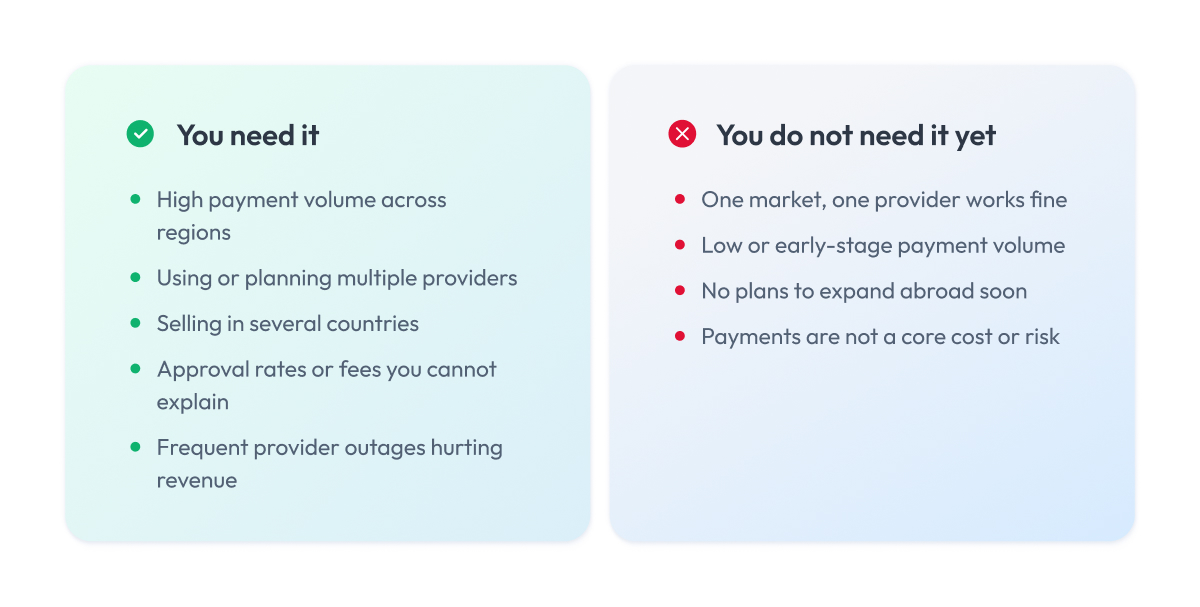
The honest test comes down to two things: volume and variety. Orchestration earns its keep when you process enough payments that small percentage gains matter, and when you use, or want to use, more than one provider or sell across more than one market.
Here is a simple way to place yourself.
When orchestration is worth it
If you process serious volume through more than one provider, or you sell in several countries, orchestration usually pays for itself.
At that scale, the approval-rate gains and fee savings are large in absolute terms, a provider outage is expensive, and reconciling everything by hand is already eating your finance team’s time.
An enterprise payment orchestration platform earns its place here, where its cost is small compared to the money it recovers and protects.
When orchestration can wait
If you sell in one market through one provider and everything works, orchestration is a solution ahead of its problem. You would take on a new system to manage without much to gain, and that time is better spent elsewhere until your volume or your map grows.
Where orchestration shows up by industry
Some business models hit the volume-and-variety threshold sooner than others. These are the ones that tend to reach for orchestration first.
- Subscription and SaaS: with recurring billing, declined renewals represent lost revenue each cycle, so subscription payment orchestration focuses on automatically recovering failed charges.
- Marketplaces and B2B platforms: many sellers, split payouts, and mixed payment types make B2B payment orchestration a way to manage complexity through a single integration.
- Travel and hospitality: high-value bookings, multiple currencies, and cross-border payments make a strong case for cross-border payment orchestration.
- iGaming: tight margins and high decline rates make approval-rate recovery central to payment orchestration for iGaming.
- Multi-store and omnichannel retail: selling across regions, stores, and online means omnichannel payment orchestration keeps every channel on one payment backbone. Our work on retail POS integration often touches on exactly this problem.
If your business falls into one of these categories, you probably reach the point where you need orchestration earlier than a single-market seller would.
That covers whether you need it. If you do, the next decision is how to get it, and that is where the build-versus-buy question comes in.
Build vs. Buy: A Platform or Your Own Orchestration Layer
Once you decide you need orchestration, the next fork is whether to buy a ready-made platform or build the layer yourself. This is a genuine engineering and business decision, and the right answer depends on how central payments are to your work.
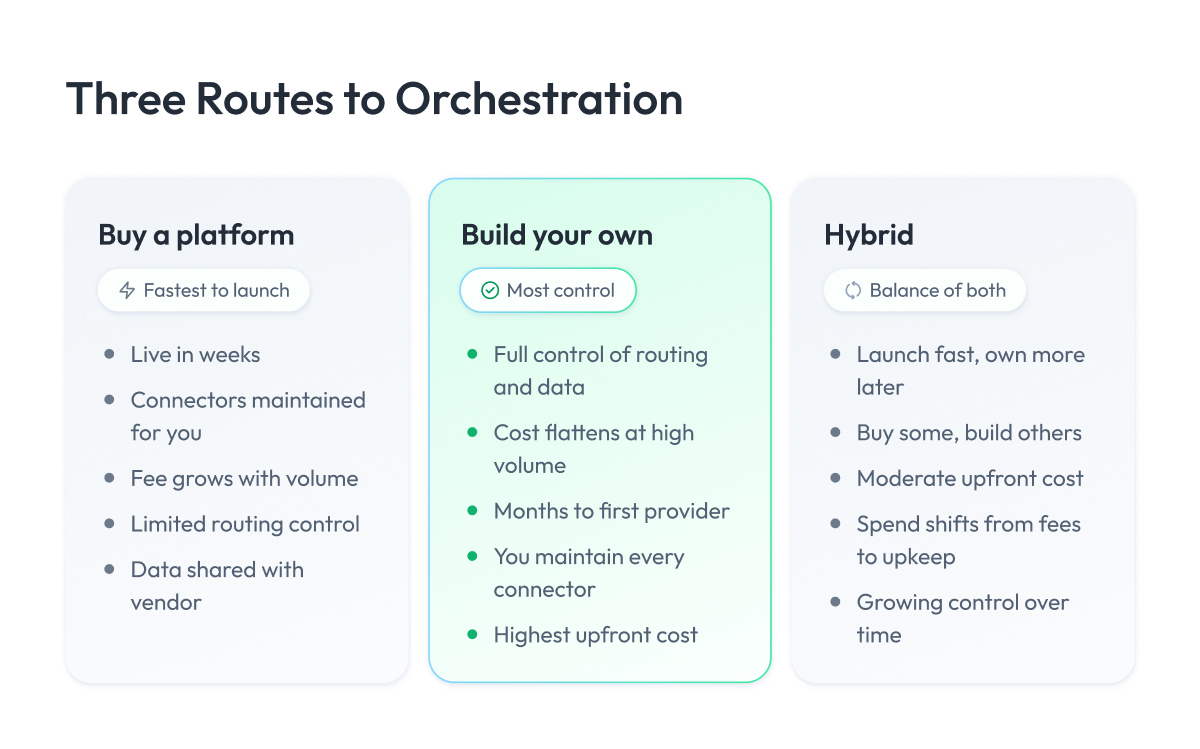
Buying gets you running quickly on someone else’s connectors and roadmap. Building gives you full control over routing, data, and cost, at the price of owning the work. Most companies land on one of three paths.
When to buy a platform
A payment orchestration platform gives you a working layer out of the box, with a library of pre-built provider connectors and a dashboard your team configures instead of coding. You get to value in weeks, and the vendor maintains the connectors as providers change their APIs.
The trade-offs are control and cost. You route payments as the platform allows, your payment data lives partly in the vendor’s systems, and you pay a fee, often per transaction, that scales with growth.
Buying is the right call when:
- You want to launch fast.
- Payments are not what makes you different.
- Your volume is still moderate.
When to build your own orchestration layer
Building means creating the orchestration layer inside your own stack. Custom payment orchestration software makes sense when payments are close to your core business, or when platform fees have grown large enough that owning the layer is cheaper.
You get complete control over routing logic, where your data sits, and your cost base. In return, you own the build and the upkeep, including writing and maintaining a provider connector every time you add or change one.
This is the path we most often help enterprises with, usually through our custom software development teams.
Building is the right call when:
- Payments are core to your business.
- Your volume is high enough that platform fees hurt.
- You need full control over routing and data.
When to choose a hybrid approach
Many enterprises sit in the middle. They buy a platform to move fast, then build custom logic on top of it, or they start on a platform and move their highest-volume flows to their own layer once the fees justify it.
The hybrid route lets you balance speed now with control later, without fully committing to either path on day one. It is a common way to start getting value quickly while keeping the door open to owning more of the layer as payments grow.
What each option costs
Vendors rarely give you a straight total, so the useful thing is to understand where the money goes in each case.
When you buy, you mostly pay a recurring fee based on how much you process, so the cost grows as you grow.
When you build, you mostly pay up front for the engineering, plus steady maintenance afterward that stays fairly flat no matter how much your volume climbs.
If you go hybrid, you pay a platform fee for the parts you buy, and you cover the build and upkeep costs for the parts you own, so your spend shifts from fees to maintenance as you move more volume to your own layer.
| Cost factor | Buy a platform | Build your own | Hybrid |
| Time to first provider | Weeks | Months | Weeks |
| Upfront cost | Low, setup only | High, full build | Moderate |
| Ongoing cost | Fee grows with volume | Team and infrastructure, flatter | Mixed, shifts over time |
| Control over routing | Limited to platform features | Complete | Partial, growing |
| Provider connectors | Maintained by vendor | You build and maintain each | Split between both |
| Data ownership | Shared with vendor | Fully yours | Mixed |
| Lock-in risk | Higher | Lower | Moderate |
If payments are strategic to your business and you expect to process at scale, building or moving to a hybrid model is worth modeling seriously. It is exactly the kind of decision our engineering teams help enterprises work through before they commit.
Payment Orchestration Architecture: A Reference Model
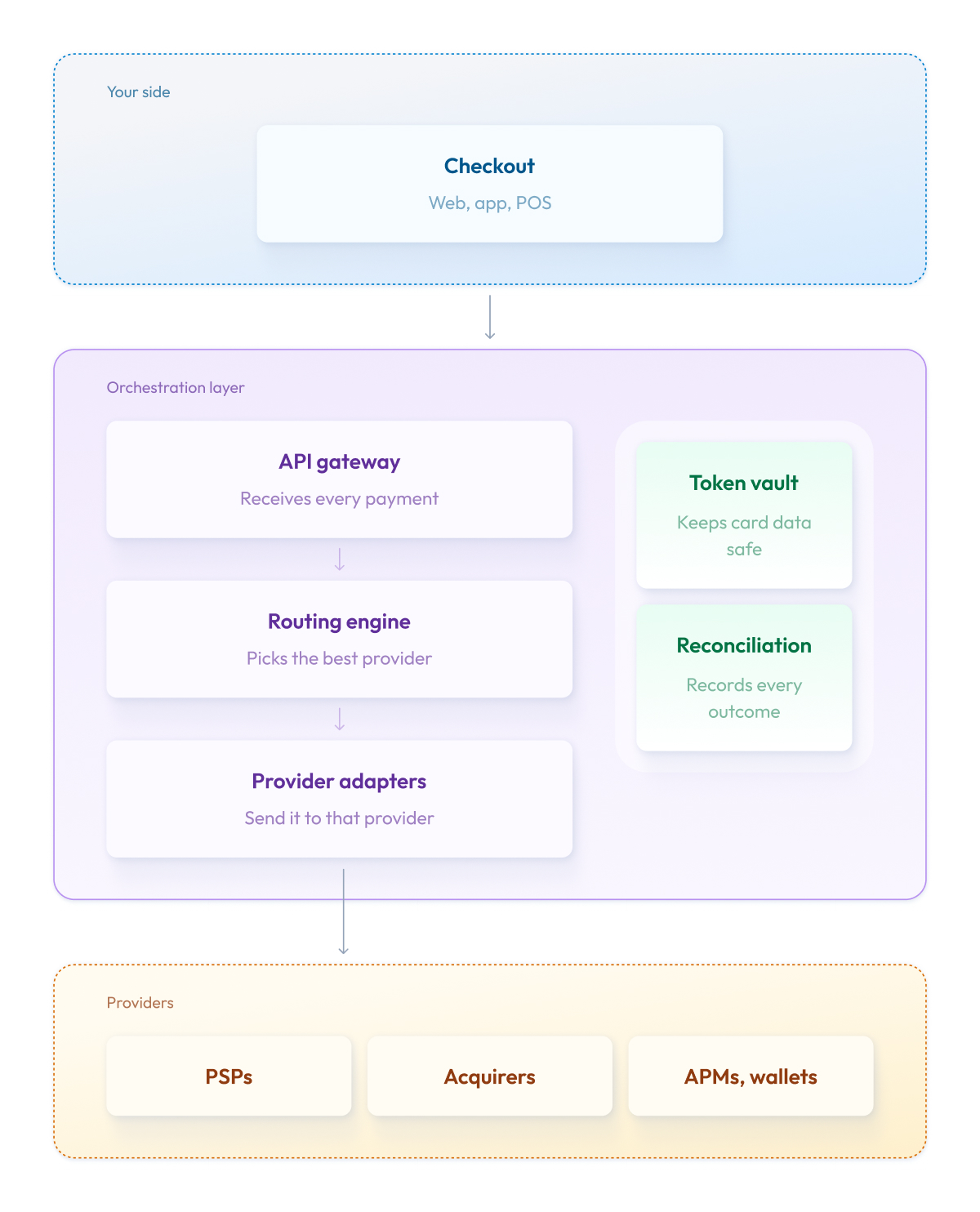
If you are going to build, or judge a platform properly, you need to know what the layer is made of. This section lays out a reference architecture for payment orchestration: the parts inside the layer, what each one does, and how a payment flows through them.
Whether you buy or build, these are the components that do the work behind the scenes, and knowing them lets you ask a vendor the right questions or scope a build accurately.
Core components
Six components make up the payment orchestration layer. Each has one job, and the layer only works when they work together.
- API gateway: the single entry point your checkout talks to, the same payment orchestration API discussed earlier.
- Routing engine: the decision-maker that picks a provider per payment using your rules.
- Provider adapters: the translators that speak each provider’s own API, one adapter per provider.
- Token vault: the secure store that holds card data so the rest of your systems never touch it.
- Reconciliation service: the ledger that records every attempt, outcome, and fee in one place.
- Observability: the monitoring that tracks provider health and feeds performance data back to routing.
Fraud and 3DS checks hook into the routing engine so a payment can be screened before it is sent, which is where payment fraud orchestration lives. And the payment orchestration middleware label you will see in vendor materials simply refers to this whole assembly sitting between your checkout and the providers.
Here is what each component does and what fails without it.
| Component | Its job | What breaks if it is missing |
| API gateway | Single entry point for all payments | Checkout wired to each provider directly |
| Routing engine | Picks the provider per payment | Every payment forced down one path |
| Provider adapters | Translate to each provider’s API | New provider needs custom integration |
| Token vault | Store card data securely | Card data spreads across your systems |
| Reconciliation service | Record every attempt and fee | Finance reconciles across many dashboards |
| Observability | Track provider health live | Failing provider spotted too late |
Data and control flow
This part of the architecture is the working core of the layer. It decides where each payment goes and keeps the record of it.
It also matters to you for a simple reason. Every benefit from earlier only happens once these parts are wired together and a payment can flow through them. When you scope a build or judge a platform, this flow is what you are really paying for.
Here is how a single payment moves through it.
It arrives at the API gateway, the single front door. The gateway swaps the real card number for a safe stand-in kept in the token vault, so your own systems never touch raw card data.
The payment then goes to the routing engine, the brain of the layer. It checks your rules and the live data on each provider’s performance, selects the one most likely to approve the payment, and sends it through that provider’s adapter. If the provider says no, the engine picks another and tries again. Either way, the reconciliation service records what happened.
This flow works the same whether you buy a platform or build your own. The choice is only about who owns and runs each of these parts.
The next section walks through how to build it, step by step.
How to Build a Payment Orchestration Layer
When a client decides on a custom or hybrid approach, this is the part where we get practical. Below is how we approach building a payment orchestration layer for enterprises, laid out as the steps we work through with a client’s team.
It is not the only way to build one, but it is the sequence that keeps the risky parts early and gets you to a working, testable layer without betting the whole thing on a big-bang launch.
1. We start with provider abstraction
The first thing we build is a provider-neutral payment orchestration API that your checkout talks to. Behind it sits one adapter per provider, each translating our common format into that provider’s own.
We start here because it is the foundation on which the rest of the layer stands. Once your checkout speaks to one API instead of five providers, adding or swapping a provider stays our job inside an adapter and leaves your checkout untouched.
2. We add routing rules and make them safe to repeat
Next, we build the routing engine, the piece that decides which provider handles each payment based on your rules.
We build idempotency, a way to tag each payment so that if it is sent twice, the customer is charged only once. This protects against double charges during retries, so we treat it as core to secure payment orchestration from the start.
3. We build retries and failover
With routing in place, we add the behavior that recovers revenue. When a provider declines a payment or goes down, the layer automatically sends it to a backup provider and tries again.
This is also where we manage payment orchestration risk deliberately. We set sensible limits on how many times to retry and when to stop, so the layer recovers sales while protecting your providers and customers.
4. We finish with reconciliation and monitoring
Last, we build the reconciliation service and the monitoring around it. Reconciliation gives your finance team one record of every attempt, outcome, and fee. Monitoring watches provider health in real time and feeds that back into routing, so the layer keeps sending payments to whatever is working right now.
We build this last because it needs all the earlier parts in place to be worth anything, and it is what turns a working layer into one you can operate and trust in production.
We adapt this sequence to each client, and the order holds up well. It front-loads the decisions that are expensive to change and leaves the tuning for when there is traffic to tune against. Much of this sits squarely in our software development and cloud engineering work.
PCI Compliance, Tokenization, and the Token Vault
Three terms recur throughout this topic, and they trip people up because they sound more technical than they are. Here is what each one means in plain terms before we get into why they matter so much.
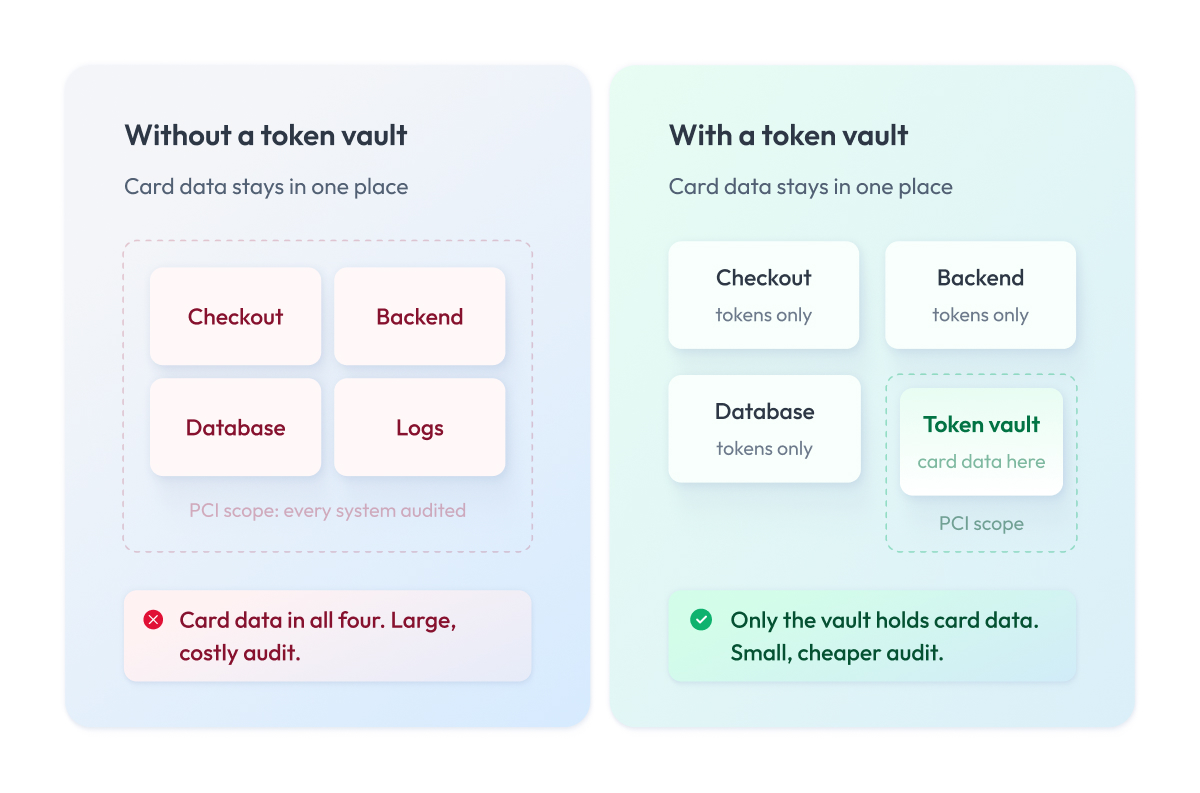
PCI compliance is a set of security rules that every business handling card payments has to follow. The card networks wrote them, and they exist to keep card numbers from leaking. The more your own systems touch card data, the more of these rules you have to meet, and meeting them costs you time, audits, and money every year.
Tokenization is the trick that gets you out of most of that work. Instead of storing a card number, you replace it with a random stand-in called a token. The token is useless to a thief, but your systems can still use it to charge that card again later. You get to keep the functionality without holding the dangerous data.
The token vault is the one secure place that stores the actual card numbers and hands back tokens. Your orchestration layer talks to the vault, your other systems only ever see tokens, and the card data itself stays locked in a heavily guarded box.
How the token vault shrinks your PCI scope
Your PCI scope is simply the list of systems that handle card data, and every system on that list must be secured and audited. So the whole game is keeping that list as short as you can.
A token vault does exactly that. Because the vault holds the only copy of the card numbers, and everything else in your business works with tokens, most of your systems drop off the list entirely. You shrink a company-wide compliance problem down to one well-protected component, and payment orchestration tokenization is the mechanism that pulls it off.
This is one of the strongest practical reasons to run an orchestration layer at all.
It moves the riskiest data into one place you can defend properly, and it takes the rest of your stack out of the firing line.
Teams building payment software with us often care about this as much as they care about approval rates, because it directly changes their audit cost and their risk exposure. It sits at the center of our approach to payment software development for enterprise clients.
Where fraud checks and 3DS fit
Fraud screening and 3DS, the extra verification step that bounces a shopper to their bank to confirm a payment, both plug into the same layer. Because every payment already flows through orchestration, that is the natural place to run these checks before a payment goes out to a provider.
Handled well, secure payment orchestration gives you tokenization, fraud screening, and strong customer authentication in one place, working off the same payment flow you already built.
With security handled, the last big decision is choosing a platform if buying is your path. That is where we go next.
Payment Orchestration Platforms: How to Choose
There are plenty of payment orchestration platforms on the market, and their marketing all sounds identical. The differences that matter to you are underneath the marketing, so here is how to compare them like an engineer instead of a buyer reading feature lists.
We stay vendor-neutral here on purpose. We build orchestration layers, and we do not resell any of these platforms, so the aim is to give you criteria you can apply yourself when comparing payment orchestration solutions from any vendor.
What separates one platform from another
Five features tell you most of what you need to know about any payment orchestration platform. Judge each candidate on these before you look at anything else.
- Provider coverage: how many gateways, acquirers, and local methods it already connects to.
- Routing flexibility: whether you can express the rules you actually need.
- Data ownership: who holds your payment and card data, you or the vendor.
- PCI posture: whether its token vault genuinely reduces your compliance scope.
- Extensibility: how easily you can add custom logic or a provider it lacks.
These map directly onto the architecture from earlier. Most payment orchestration companies sell someone else’s version of the layer you now understand, so you are checking how well their boxes match the ones you would build.
Here is how the top payment orchestration platforms tend to position themselves.
| Platform | Positioning | Typically fits |
| Spreedly | Broad connector coverage | Merchants wanting many providers fast |
| Primer | Low-code workflow builder | Teams favoring visual routing rules |
| Gr4vy | Cloud-native, dedicated instances | Enterprises wanting isolation |
| IXOPAY | Tokenization and connector focus | Merchants prioritizing PCI scope |
| Stripe | Payments plus orchestration features | Teams already on Stripe rails |
A short checklist to score any vendor
Turn those criteria into questions and every sales call gets easier. Ask the same set of questions of every vendor, and the differences between payment orchestration providers surface fast.
| What to ask | Why it matters | Red flag |
| Which providers are pre-built? | Coverage saves integration work | Vague or short list |
| Can we own our data? | Data ownership affects lock-in | Data only in their systems |
| Does your vault cut our PCI scope? | Real compliance saving | No clear answer |
| How do we add a missing provider? | Extensibility protects you | Only they can build it |
| What are the total fees at our volume? | Cost decides the buy case | Pricing they will not share |
The platforms worth your time answer these plainly, because they know the answers help their case. For enterprises weighing platforms against a build, this same checklist is what our payment software development teams use to frame the decision.
Once you have picked a direction, it helps to see where the market is heading so you can build or buy for the next few years. That is the outlook we close with next.
Market and Outlook
The payment orchestration platform market is small next to the wider payments industry, but it is growing fast as more enterprises reach the scale where one provider is no longer enough.
The payment orchestration platform market was about $1.1B in 2022 and is projected to grow at nearly 25% annually through 2030.
Behind that growth, two shifts are worth watching.
The first is intelligent payment orchestration, where routing gets smarter. Newer systems watch how each provider is performing right now and adjust automatically, sending payments wherever they are most likely to go through, and that approach is spreading as a default instead of a premium feature.
The second is that large enterprises are building and owning more of the layer themselves. They are treating payments as core infrastructure worth keeping in-house, the same way they would treat any system central to their business.
In short, payment orchestration is becoming standard infrastructure for any company processing high volumes across multiple providers or countries.
Final Word
If you have read this far, you already know payment orchestration is a serious piece of infrastructure, and choosing how to approach it takes genuine effort. You have to weigh your volume, your markets, your providers, and whether buying a platform or building your own layer fits where your business is going.
That work pays off. Payments sit on your revenue, your customer experience, and your compliance exposure all at once, so a well-built layer protects all three, while a poor one becomes expensive to unwind once it is live.
So take the decision in order.
Confirm you have the volume and complexity to need orchestration. Choose buy, build, or hybrid based on how central payments are to your competitive strategy.
Then judge platforms or scope a build against the architecture and criteria in this guide, and pressure-test every number and vendor claim before you commit.
If you want a partner for that last part, that is what we do. We build and customize payment infrastructure for enterprises, and we are glad to review your setup, talk through build-versus-buy, and help you find the right path before a line of code is written.
Questions You May Have
What is payment orchestration?
Payment orchestration is a software layer between your checkout and your payment providers that routes, retries, and reconciles every transaction across all of them via a single integration.
How is payment orchestration different from a payment gateway?
A payment gateway is one connection to a single processor, while payment orchestration is the layer that coordinates many gateways, acquirers, and payment methods and decides which one each transaction uses.
How does payment orchestration work?
It accepts each payment through one API, routes it to the provider most likely to approve it, retries failures through a backup provider, and records every attempt in one place.
Do I need a payment orchestration platform?
You need a payment orchestration platform once you process high volume across more than one provider or sell in several markets, and you can usually wait if a single provider in one market still works.
Should we build or buy payment orchestration?
Buy a platform when you want speed and maintained connectors, and build your own orchestration layer when payments are central to how you compete and you need control over routing, data, and cost.
What does a payment orchestration architecture look like?
A payment orchestration architecture has a routing engine, provider adapters, a token vault, a reconciliation service, and fraud and 3DS hooks, all sitting between your checkout and the providers.
How does payment orchestration affect PCI scope?
It shrinks your PCI scope by keeping card numbers in a single token vault, so most of your other systems only ever handle tokens and drop out of audit scope.
What are the top payment orchestration platforms?
The most established payment orchestration platforms include Spreedly, Primer, Gr4vy, IXOPAY, and Stripe, though the best payment orchestration platforms for 2026 depend on your provider coverage, data, and routing needs.
Who uses payment orchestration?
Payment orchestration is used most by enterprises in subscription and SaaS, travel, iGaming, marketplaces, and multi-store retail, where high volume across providers and markets makes it pay off soonest.
What is the difference between payment orchestration and a vault?
A token vault only stores card data securely, while payment orchestration is the wider layer that handles routing, retries, and reconciliation and uses that vault as one of its parts.
Is payment gateway orchestration the same as payment orchestration?
Yes, payment gateway orchestration is the same concept described from the gateway side, since orchestration coordinates the gateways rather than replacing them.
What is the difference between payment optimization and payment orchestration?
Payment optimization is the goal of higher approval rates and lower fees, and payment orchestration is the mechanism that lets you pursue it across multiple providers.