








Quick Summary
- Price optimization finds the profit-maximizing price for each product, segment, and channel inside guardrails you set, then applies it across the whole catalogue.
- Four inputs drive it: demand at different price points, cost, competitor prices, and each customer segment’s willingness to pay.
- Four model families suit different situations, from elasticity regression on steady demand to constrained optimization for large catalogues, machine learning for fast repricing, and plain rule-based logic.
- Studies put profit gains at 5 to 19%, but only where data quality, customer segmentation, and pricing governance are already in place.
- Explainability decides adoption, since a team only applies a price it can defend, and simpler models often capture most of the gain at far lower risk.
Price optimization is the method businesses use to determine the price that maximizes revenue. This method uses data on competitors, thousands of products, and different regions to predict how much you will sell at each price, and it picks a sweet spot that maximizes your profit.
For enterprises and mid-sized businesses, even a 1% gain on price often matters more than it first appears.
We have spent years building pricing and data systems for enterprises in retail, e-commerce, travel, logistics, and financial services, where that one percent adds up fast across millions of transactions.
So we wrote this guide to show how the method works, walk through a step-by-step way to build a price optimization model, and offer an honest look at whether it pays off.
By the end, you will be able to match a model to your own data and catalog, judge whether to buy a tool or build one, and see how different pricing strategies turn sales, competitor, and cost data into a recommended price.
What Is Price Optimization
We gave a plain version in the intro. Let’s look from a technical angle.
Price optimization is a data-driven process that finds the optimal price that earns you the most, then sets it for each product, customer group, and sales channel. It works within limits you choose, such as an acceptable margin or a floor price.
The optimization method determines the price, and the software applies it across your entire catalog, whether you buy a tool or have one built for your business.
Under the hood, the price optimization process works as a loop:
- You collect data on sales, costs, competitor prices, and customer behavior.
- You model demand and price elasticity to understand how volume responds to price changes.
- You compute the profit-maximizing price for each item and segment, within your guardrails.
- You execute, pushing those prices to your store or quoting system.
- You monitor the results and feed them back in, so the model sharpens with each cycle as market conditions change.
Businesses optimize prices because it is the fastest way to increase profit without customers, ad spend, or lower costs. They simply set the right price for what they already sell, which is why the importance of price optimization keeps growing as catalogs and channels multiply.
The four major inputs in price optimization
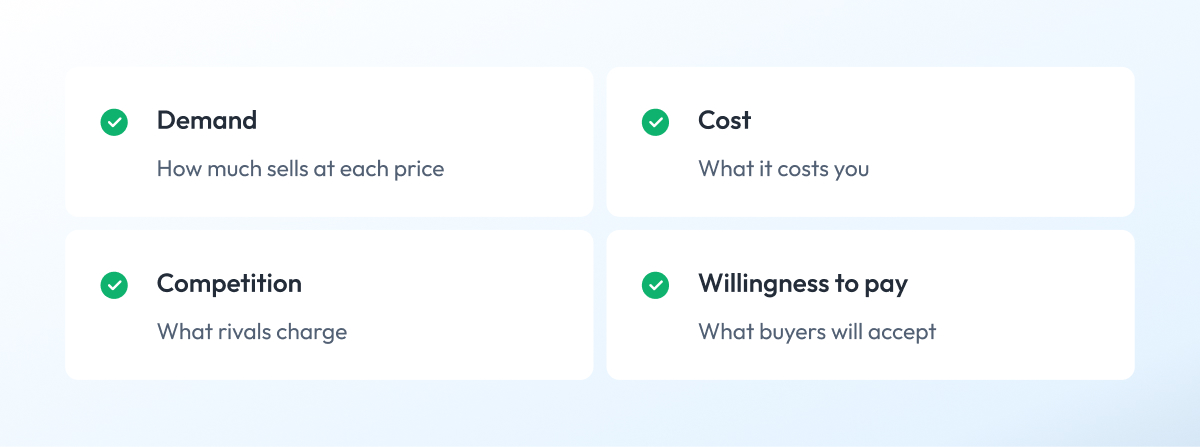
The next step in understanding price optimization is knowing the four inputs that drive everything.
- Demand — how many units sell at different price points over time. This shows where the sweet spot sits.
- Cost — what the product or service costs you, so the model never prices below a healthy margin.
- Competition — competitor prices on similar items, tracked continuously, so you stay in line with the market.
- Willingness to pay — how much each customer segment values the product, which sets how high you can go.
Give the model all four, and it will set the right price for each product and segment based on your data. How it turns those inputs into a price depends on the model you choose, and there are a few to pick from.
Price Optimization Models (and When to Use Each)
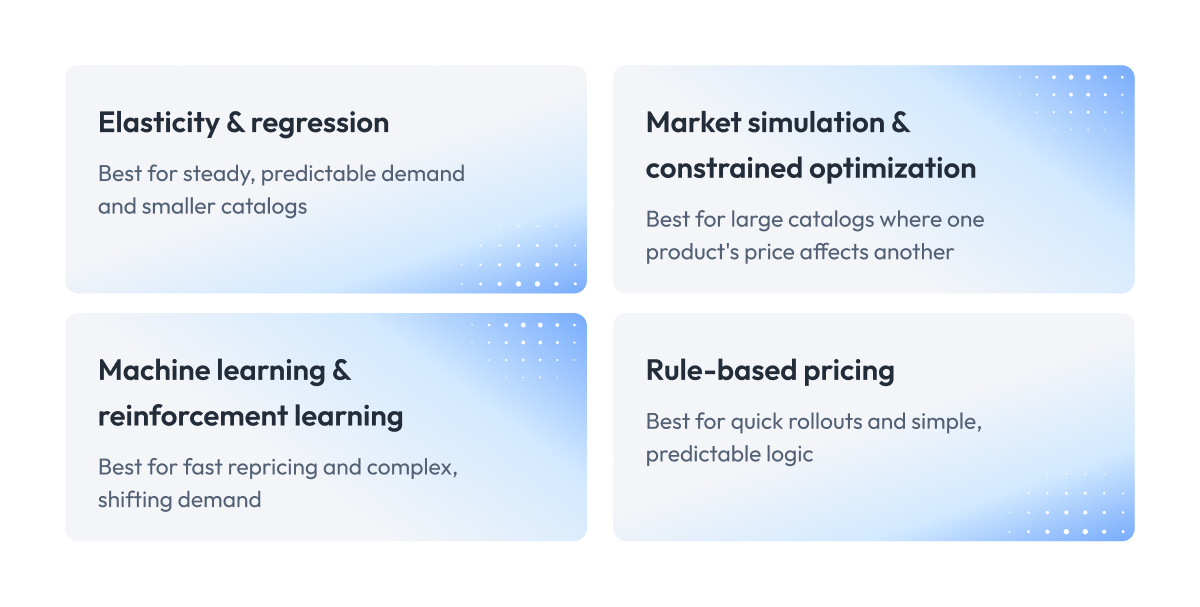
Price optimization models fall into a few families, and the right one depends on how much reliable data you have, how fast prices must change, and how much you need to explain each price to a human.
1. Elasticity and regression models
These are the workhorses. They measure how demand responds to price changes and find the profit-maximizing price using your sales history.
- Main goal: find the sweet spot from past sales.
- Where it fits: products with steady, predictable demand.
- Data needed: a clean sales history is enough.
- Strength: easy to explain and audit.
2. Market simulation and constrained optimization
This approach runs thousands of what-if scenarios across your catalog, then picks the prices that earn the most while respecting the rules you set.
- Main goal: maximize profit across many products at once.
- Where it fits: large catalogs where one product’s price affects another.
- Guardrails it respects: margin floors, competitor ceilings, price gaps between sizes.
- Data needed: sales, costs, and clear business rules.
3. Machine learning and reinforcement learning
Machine learning algorithms find patterns in large, messy datasets that simpler methods miss. Reinforcement learning goes further and learns by testing prices and watching how buyers respond.
- Main goal: price accurately when demand depends on many shifting signals.
- Where it fits: fast repricing, big catalogs, complex demand.
- Data needed: high volume, plus live data for real-time price moves.
- Watch for: careful guardrails and often a machine learning engineering team to run in production.
4. Rule-based pricing
Rule-based pricing follows fixed if-then logic you write, such as “price 5 percent below the main competitor” or “raise price 3 percent when stock runs low.”
- Main goal: apply simple, predictable pricing logic.
- Where it fits: quick rollouts and straightforward catalogs.
- Data needed: competitor prices and stock levels.
- Trade-off: captures less profit than a model that reads demand directly.
Can you trust a price the model picked?
When a model proposes a price, someone on your team must approve it. That is easy when the model can show its reasoning, like “demand for this item is strong, and the nearest competitor is 8 percent higher, so a price increase makes sense.”
It gets hard with complex machine learning models that output a number with no explanation. People call these “black boxes” because you see the result but not the logic.
The ability of a model to show its reasoning is called explainability, and it matters as much as getting the price right.
- Why it matters: your team will only apply prices it understands and can defend.
- The catch: the most advanced models are often the hardest to explain.
- Practical take: simpler models are easier to check, and for many businesses they capture most of the gain at lower risk.
| Model Family | Typical Inputs | Data Needed | Transparency | Best-Fit Scenario |
| Elasticity/regression | Sales history, price points | Low to moderate | High | Steady demand, small catalog |
| Market simulation / constrained optimization | Sales, costs, business rules | Moderate to high | Medium | Large catalog, interacting products |
| Machine learning/reinforcement learning | Many demand signals, live data | High | Low to medium | Fast repricing, complex demand |
| Rule-based | Competitor prices, stock levels | Very low | High | Simple logic, quick rollout |
The Zoolatech Pricing Model Selection Matrix
The models section showed what each family does. This matrix shows which one fits your business, and whether to buy a tool or build your own. We built it from patterns we see across pricing projects. To use price optimization models well, match your situation to a starting point, then read across the row.
| Your Situation | Recommended Model | Build or Buy | Why |
| Small catalog, steady demand, must explain every price | Elasticity/regression | Buy | Modest data, easy to audit |
| Large retail catalog, weekly promos and markdowns | Market simulation / constrained optimization | Buy, customize the edges | Vendor suites handle life-cycle pricing |
| Millions of SKUs, real-time, competitor-driven | Machine learning/reinforcement learning | Build or heavily customize | Vendor models rarely fit this scale |
| B2B with negotiated deals and contract pricing | Constrained optimization with deal guidance | Buy a B2B pricing platform | Governance and approvals come built in |
| Thin data, want quick wins now | Rule-based, then elasticity as data grows | Buy or build light | Fast to launch, upgrade later |
Use the matrix to find your row, then pressure-test it against your data before you commit. If you want a second opinion, our pricing engineering team can review your catalog, data, and goals and point you to the model that fits, along with an honest build-versus-buy call for your case.
Ready-made models do not always fit complex cases with huge, messy datasets, millions of SKUs, or pricing logic that is specific to your business.
In those situations, teams turn to custom pricing optimization and build their own model. The next section shows how we do exactly that, step by step.
How to Build a Price Optimization Model (Step by Step)
When a client comes to us because default models cannot handle their data or pricing logic, we build a custom price optimization model in four custom stages:
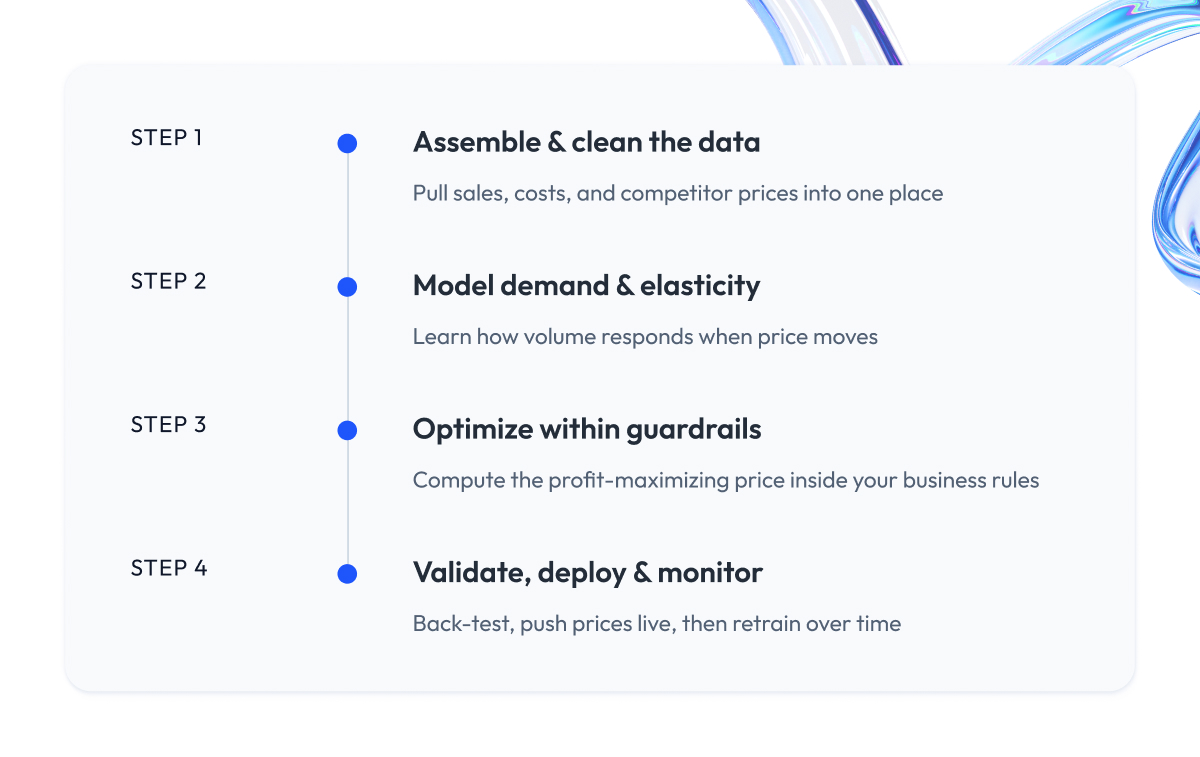
Each stage feeds the next, and the quality of the first decides the ceiling for the rest.
Most of the effort in a pricing project goes into data, since a model trained on inconsistent prices and gaps will produce confident but wrong recommendations.
Let’s look at each stage in detail.
1. Assemble and clean the data
We start by pulling your pricing history, sales, costs, and competitor prices into one place, often from systems that never talked to each other. Then we clean it, because this is where most projects quietly fail.
- What we gather: past prices, units sold, costs, promotions, competitor prices.
- What we fix: duplicates, gaps, currency mismatches, mislabeled products.
- Why it matters: the model can only be as good as the data it’s trained on.
2. Model demand and price elasticity
Next, we measure your customers’ price sensitivity. We fit models to your history to learn the price elasticity of demand for each product and segment, so we can predict sales at any price point.
- The question we answer: how much does demand drop when the price rises?
- How we do it: regression for steady demand, machine learning for complex demand.
- The output: a demand curve per product and customer segment.
3. Optimize within business guardrails
With elasticity known, we determine the optimal price for each item, the profit-maximizing point inside your rules. This runs inside the rules your business needs, so the math never suggests a price you cannot actually use.
- Guardrails we set: margin floors, price ranges, competitor ceilings, brand rules.
- What it balances: volume against margin to hit your goal.
- The result: a recommended price for every product and segment.
4. Validate, deploy, and monitor
Before any price goes live, we test the model against held-back sales data and run controlled price tests on a small slice of the catalog. Once it proves out, we deploy it and watch it in production.
- How we validate: back-testing plus live A/B price testing.
- How we deploy: into your store, ERP, or quoting system.
- How we monitor: track results, retrain as market conditions shift.
In short, to build a price optimization model, you first assemble and clean your pricing, sales, cost, and competitor data, then model demand and price elasticity for each product and segment.
From there, you compute the profit-maximizing price within business guardrails, validate it on held-back data, deploy it to your store or quoting system, and monitor and retrain it as the market shifts.
So when should you use ready-made software, and when should you build your own? The next section helps you make that call, and walks through the software options along the way.
Price Optimization Software: Build vs Buy

Buy standard price optimization software when your pricing fits a vendor’s model, and you want results fast.
Build a custom system when your data, catalog, or margin logic is what sets you apart. Most teams start with a tool and build only the parts that give them an edge.
Here is the decision, made concrete.
Buy a ready-made tool when:
- Your catalog and pricing rules look like they were built for the vendor.
- You need live prices in weeks.
- You would rather a vendor own updates, uptime, and maintenance.
- You have no in-house data science or engineering team to run a model.
Build your own when:
- Your pricing logic is a competitive advantage you do not want to hand to a vendor.
- Your data or catalog breaks the assumptions a vendor’s model makes.
- You run at a scale or speed off-the-shelf tools struggle with, like millions of SKUs or real-time repricing.
- You need full control over how each price is calculated and explained.
Many enterprises buy a tool to cover the standard catalog and build a custom model for high-value products, where better pricing justifies the whole project.
When we take on a custom pricing build, it is almost always for that second group, where a vendor’s model leaves money on the table.
The software categories you are choosing between
Before you shortlist, it helps to know what kinds of pricing tools exist, since many businesses use more than one.
- Price optimization & management: models demand across your catalog and recommend a price for every item. Common in manufacturing, distribution, and large retail, where catalogs run into the thousands. Its biggest strength is scale, since it prices the entire assortment using data rather than manual review.
- CPQ (configure, price, quote): assembles accurate quotes for complex deals with many options, discounts, and approval rules. Used heavily in B2B sales, from industrial equipment to software contracts. The main payoff is speed and consistency, so reps stop quoting from spreadsheets and margins stop leaking on custom deals.
- Competitor price monitoring: collects competitor prices across sites and marketplaces, then feeds them into your pricing decisions. Popular in e-commerce and consumer electronics, where shoppers compare prices in a click. Its key benefit is awareness, allowing you to react to a competitor’s specific price change within hours.
- Dynamic pricing: adjusts prices automatically as demand, stock, or competitor moves shift. Best known in travel, hospitality, and ride-hailing, where the right price at 9 a.m. is wrong by noon. The advantage is responsiveness, capturing revenue that a fixed price would miss during demand swings.
Use this table to match your situation to the type of tool you likely need.
| If This Sounds Like You | Tool Type to Look At | Example Products |
| Thousands of SKUs, want data-driven prices | Price optimization & management | Vendavo, Zilliant, Pricefx, PROS |
| Complex B2B deals with custom quotes | CPQ and deal pricing | Conga, PROS deal guidance |
| Rivals undercut you online daily | Competitor price monitoring | Competera, Wiser |
| Prices should shift with demand hourly | Dynamic pricing | PROS, retail dynamic-pricing engines |
| Seasonal stock to clear at best margin | Retail & markdown optimization | RELEX, Revionics, First Insight |
Whatever you pick, you should understand that a simple setup with good data will beat a fancy tool with bad data every time.
You have probably seen one word come up often here: dynamic pricing. People often use it to mean price optimization, but they are not the same. The next section shows the difference.
Price Optimization vs Dynamic Pricing
Many teams buy a dynamic pricing tool expecting full price optimization, then wonder why margins do not improve. Knowing the difference helps you scope the right project and buy the right software.
Dynamic pricing is one output of price optimization. It means changing prices often and automatically as demand, stock, or competitors move.
Price optimization is the wider practice of finding the profit-maximizing price by any method and at any speed, from a once-a-season markdown to a price that updates every minute.
Think of it this way.
Price optimization determines the right price. Dynamic pricing is one way to deliver that price, quickly and often.
You can optimize prices without changing them every hour, or change them hourly with no optimization behind them.
| Aspect | Price Optimization | Dynamic Pricing |
| Scope | The full practice of setting the best price | One output: frequent automated changes |
| Cadence | Any, from seasonal to real-time | Frequent, often continuous |
| Models | Elasticity, simulation, ML, rule-based | Rules or ML tuned for speed |
| Typical use | Any pricing decision | Travel, hospitality, e-commerce, ride-hailing |
Price Optimization in Retail
Retail is where price optimization gets its hardest test, because prices change across a product’s whole life, from launch to final markdown.
Retail uses life-cycle pricing: an initial or starting price at launch, promotional prices during the season, and markdowns near the end of the season. The goal is to sell through the stock at the best margin before the season closes and the item loses value.
A winter coat priced too high in October sits on the shelf. The same coat marked down too early in November gives away margin you did not need to.
Retail price optimization finds the right price at each stage, for each store and channel, so you clear inventory without leaving money on the table.
Markdown and promotional optimization
The biggest wins in retail come from timing markdowns and promotions well. A model looks at sell-through rate, remaining stock, days left in the season, and how price over time drives demand, and then recommends when and how deeply to cut.
- Markdown optimization: clears seasonal stock at the highest possible margin.
- Promotional optimization: selects which items to discount and by how much to increase basket size.
- Where it pays off: fashion, grocery, and any category with fresh or seasonal goods.
Our retail engineering teams build these models into the systems merchandisers already use, so a price change is one click. You can see how we approach retail data and analytics work and a related build in our AI-powered retail personalization case.
Retail and e-commerce tooling
Retailers rarely build everything from scratch. Standard suites cover life-cycle pricing, while custom models handle the parts that set a retailer apart, like a unique markdown rule or a same-day competitor response.
For a deeper look at the systems around this, see our guide to promotion and discount management for retail.
Is Price Optimization Worth It? (ROI, When It Fails, When to Wait)
Price optimization pays off when three things are already in place: good data, clear customer segments, and governance over who can change prices. Without them, it produces confident but wrong prices, and confident wrong prices are worse than none. Effective price optimization depends on all three, because the best pricing optimization still fails on messy data.
Studies link price optimization tools to profit gains of roughly 5 to 19 percent, but only where data quality, segmentation, and pricing governance already exist.
When it pays off
The return comes from two places at once. You stop setting a product price below what customers would happily pay, and you stop overpricing items that then sit unsold.
- Fast ROI: fixing messy data and killing manual spreadsheet errors often pays back before any advanced model.
- Bigger ROI: matching price to each segment and moment captures margin a single list price misses.
- Lasting ROI: a monitored model supports ongoing revenue optimization as costs, demand, and competitors shift.
When to wait
Some teams are not ready, and starting anyway wastes money.
- Your pricing data lives in scattered spreadsheets with gaps and errors.
- No one owns pricing, so prices change without rules or approval.
- You sell a handful of products with stable demand, where a model adds little.
If that sounds like you, start with a data audit. Clean inputs are the cheapest way to raise pricing ROI. Consistent ROI reporting also helps teams measure whether pricing improvements are delivering the expected financial results over time.
Why it sometimes fails
Most failures trace back to inputs and ownership.
- Bad data: the model learns from errors and repeats them at scale.
- No segmentation: one average price hides where the real money is.
- No governance: good prices get overridden by hand, and gains leak away.
So the honest answer is that price optimization is worth it for most enterprises, as long as the data and ownership are ready first. Get those right, and the returns tend to show up quickly.
Getting Started: Data, Team, and the First 90 Days
If you are sold on the idea but unsure where to begin, this is your starting plan. Below is how the first 90 days can look, from the first data check to your first live prices, plus the small team you need to pull it off.
Start small and prove it works before you scale. Run a data audit, pick one high-impact category, build a proof-of-concept model, measure the result against the current price of your product line, then expand from there. This keeps risk low and gives you a concrete number to justify the wider rollout.
Here is how the first 90 days can go:
- Weeks 1 to 3 – audit the data. Pull pricing, sales, cost, and competitor data into one place and see what is missing or messy.
- Weeks 4 to 8: build a proof of concept. Model one category, set guardrails, and compare recommended prices to what you charge today.
- Weeks 9 to 12 – test and measure. Run live price tests on a small slice, track margin and volume, then decide on the full rollout.
You do not need a large team to begin. Three roles cover the core:
- Data engineer: gathers and cleans pricing data and connects sources.
- Data scientist: builds the demand-and-elasticity model.
- Pricing owner: sets the business rules and approves the prices that go live.
If any of those roles are missing, our data analytics services and AI and machine learning teams can fill the gap and stand up your first model alongside your people.
Final Word
Price optimization comes down to a few connected steps:
- Gather good data on sales, costs, and competitor prices.
- Choose a model that fits your catalog and your need to explain each price.
- Decide buy or build.
- Set guardrails like margin floors and competitor ceilings.
- Put the model live and push prices to your store or quoting system.
- Keep watching it as demand and competitors change, and retrain when needed.
Retailers add markdowns and promotions on top of these steps, and every business has to make sure the data and the ownership are ready before the math can help.
The reason it is worth the effort is simple. Price is the strongest lever you have on profit, so even small changes add up fast across every order. Pricing by guesswork does the opposite and quietly loses margin on one product after another.
The best way to start is on a small scale. Pick one category, check the data behind it, and prove the gain before you roll it out wider. A single strong result usually makes the case for the rest.
This is the kind of work we do for enterprises every day. If you want a partner for it, we are ready to review your data, weigh build versus buy for your situation, and help you identify the right approach to price optimization before you commit to a full program.
Questions You May Have
What is price optimization?
Price optimization is the data-driven process of finding the price that best meets a business goal, usually maximum profit, for each product, customer segment, and sales channel.
What is the optimal price, and how do you find it?
The optimal price is the price at which a product earns the most profit. You identify the optimal price by measuring how demand responds at different price levels, then choosing the one your data and margin rules support.
What are the main price optimization models?
The main price optimization models are elasticity and regression, market simulation with constrained optimization, machine learning and reinforcement learning, and rule-based pricing, chosen by your data, speed, and need to explain each price.
How is machine learning used in price optimization?
Machine learning is used in price optimization to spot demand patterns across large, messy datasets and set prices that adapt as customer behavior and competitor prices shift, which suits fast repricing at scale.
What is the difference between price optimization and dynamic pricing?
Price optimization is the wider practice of finding the profit-maximizing price by any method, while dynamic pricing is one output of it that changes prices automatically and often as demand or competitors move.
What is price optimization software, and do you need it?
Price optimization software is a tool that collects pricing data, models demand, and recommends prices at scale, and you need it once your catalog grows past what a spreadsheet can handle by hand.
Is price optimization worth it for a smaller business?
Price optimization is worth it for a smaller business when its pricing data is organized, and one person owns pricing decisions, since even a modest setup can raise margin without adding customers or cost.
How do you build a price optimization model?
You build a price optimization model by assembling and cleaning your pricing and sales data, modeling price elasticity, computing the profit-maximizing price within guardrails, then validating, deploying, and monitoring it.
What price optimization techniques and strategies do businesses use?
Common price optimization strategies include elasticity modeling, competitive pricing, and price matching against rivals. Markdowns that reduce the price to sell through stock, rule-based approaches, and the most effective pricing strategies usually blend several of these.
What is price intelligence?
Price intelligence is the practice of collecting competitor prices, often through price scraping, and turning them into pricing decisions so you can match or beat the market in near real time.
How often should prices change?
Prices should change as often as your market moves, from an initial price and a seasonal markdown on a regular price to real-time updates that respond to demand swings and competitor price fluctuations.
Why is price optimization important?
Price optimization is important because price is the strongest lever on profit, so handling price levels well captures margin that manual price management and guesswork routinely leave behind.