






































Machine Learning Development Services

Models That Earn Their Place in Production
Enterprise machine learning development services built for accuracy, scale, and production.
Reliable partner
Reliable partner
Experienced team
Experienced team
Smart solutions
Smart solutions
Machine Learning Development Services 1920
Machine Learning Development Services 1440

Industry Leaders We Work With

ML Services

Deep ML Expertise, Matched to Your Exact Need

This page covers Zoolatech’s full machine learning practice. If your program centers on a specific ML discipline, go directly to the service page that covers it in depth.

“Early AI adopters report an average 22.6% productivity improvement.” — Gartner

Those returns come from ML systems built on clean data, validated models, and production engineering that holds up beyond the initial deployment window.
ML Solutions

Custom Solutions We Deliver

Match your business problem to the ML solution type that fits your data and decision-making context.
Predictive models
Recommendation engines
Anomaly detection
Classification models
Reinforcement learning
Deep learning

Forecast what happens next

  • Demand forecasting models trained on multi-source enterprise time-series data
  • Customer churn prediction with feature importance attribution for business teams
  • Equipment failure prediction using sensor readings and operational log data to reduce downtime
  • Revenue and margin forecasting models integrated with planning systems
  • Lead scoring and conversion probability models for sales and marketing pipelines

Surface what matters most

  • Collaborative filtering models for product, content, and service recommendation
  • Content-based recommendation using item feature vectors and user behavior signals
  • Hybrid recommendation systems combining multiple signal sources for higher precision
  • Real-time ranking models that adapt recommendations to session-level user context
  • Cold-start handling strategies for new users and items without behavioral history

Find what does not belong

  • Statistical and ML-based anomaly detection for transactional and operational data
  • Real-time fraud detection models with sub-100ms inference for payment systems

  • Network and system anomaly detection for IT operations and security monitoring
  • Threshold-based and unsupervised models calibrated to acceptable false-positive rates
  • Explainable anomaly outputs with contributing feature identification for analyst review

Label, segment, and group

  • Binary and multi-class classification for document routing and categorization
  • Customer segmentation and clustering for marketing and product teams
  • Image and text classification models trained on proprietary enterprise datasets
  • Ensemble approaches that combine multiple classifiers for higher accuracy on edge cases
  • Model calibration to align predicted probabilities with observed class frequencies

Systems that learn to optimize

  • RL agents for dynamic pricing, inventory allocation, and resource scheduling
  • Reward function design aligned to enterprise business objectives and constraints
  • Simulation environment construction for safe agent training before live deployment
  • Policy evaluation and risk-controlled rollout procedures for production RL systems
  • Continuous learning pipelines that update agent policy as the operating environment changes

Complex patterns at enterprise scale

  • CNN architectures for image classification, detection, and segmentation tasks
  • RNN and LSTM models for sequential data including time-series and event logs
  • Transformer-based models for enterprise NLP tasks beyond conversational AI
  • Transfer learning and fine-tuning strategies that reduce training data requirements
  • Model distillation for deploying deep learning outputs in latency-constrained environments
Image abstract 1 368
Testimonials

What Our Customers Say

“In the case of Zoolatech, it's a very tight partnership.
The team at Zoolatech is incredibly collaborative, and we work as a team despite being thousands of miles away from each other.”
Spencer Rascoff
CEO Match Group
5/5
“Zoolatech has been a key technology partner for Pandora,
enhancing our software development and deployment capabilities. They're ambitious, supportive, fast-moving, and well-skilled, with sound ethical values.”
Erika Romsics
Contract and Vendor Manager, Pandora
erica
5/5
“The apps they’ve developed give us the opportunity to get more customers.
We’re providing more services to target big customers. We can install jobs faster and identify reduce bottlenecks, so we’re providing a better customer experience.”
Aida Youssef
Senior Director of Software Engineering, Complete Solaria
5/5
“Zoolatech has access to a deep talent pool and knows how to identify client's needs.
With the help of Zoolatech, went from a very early and incomplete prototype to the MVP release, the first production release, and the first paying customer!”
Greg Wagenhoffer
CEO, GreenVisr
5/5
“Zoolatech enabled us to build a world-class engineering team quickly and efficiently.
Zoolatech's pre-screening process and engineer training are customized for providing effective engineers that can contribute immediately to accelerating product roadmaps.”
Shariq Minhas
CTO, SVSG
5/5
“We can recommend Zoolatech
for their talent pool, attention, ability to understand our requirements, candidate screening process and constant communication.”
Chaitanya Pallapothula
SVP, Tailored Brands, Inc.
5/5
“Zoolatech’s developers quickly became an integral part of our team effort
with whom we shared daily stand up calls. Overall, Zoolatech fit well with our needs for agile development and continued to adapt as our needs evolved.”
Forrest Glick
UX Designer, Stanford University
5/5
“Working with Zoolatech has been a driving force in our business offerings.
The team utilizes it's experience and expertise meshing with our internal team creating a positive work environment. Zoolatech is by far one of the best teams to work with in the industry.”
Kris Naidu
CEO, Zeacon
Kris Naidu CEO, Zeacon
5/5
Our Process

End-to-End ML Development

A six-stage development process that moves from problem definition to production-ready handoff without skipping the validation and optimization steps where most ML programs lose accuracy.
step 1

Business problem definition

We translate a business objective into a precise ML problem statement, defining success criteria, target metrics, and data requirements before any model work begins.
step 2

Data collection and feature engineering

Data sources are identified, quality-assessed, and prepared into the structured, governed inputs that give models the best chance of meeting accuracy targets in production.
step 3

Model selection and architecture design

We select the algorithm class and architecture most appropriate for your data type, volume, and latency requirements, documenting the design rationale before training begins.
step 4

Model training and validation

Models are trained on governed datasets and validated against held-out test sets and real-world edge cases. Cross-validation and performance benchmarking are completed before any model advances to optimization.
step 5

Performance optimization

Validated models are improved through ensemble methods, threshold calibration, and targeted architecture changes to close gaps between validation performance and production accuracy targets.
step 6

Production readiness and MLOps handoff

Models are packaged, documented, and handed off with the serving specifications, monitoring requirements, and retraining triggers needed for the MLOps team to deploy and maintain them in production.
ML Engineering Depth

Optimization and Responsible Development

The engineering decisions that determine whether an ML model performs reliably and responsibly in a live enterprise environment.
check icon

Hyperparameter tuning

Automated and manual search across learning rate, batch size, depth, and regularization parameters to close accuracy gaps before production handoff.
check icon

Cross-validation

K-fold and stratified validation strategies that produce honest performance estimates and catch overfitting before models reach production evaluation.
check icon

Model interpretability

SHAP values, LIME, and partial dependence analysis applied to make model decisions explainable to business stakeholders and compliance reviewers.
check icon

Bias detection

Systematic fairness testing across protected attributes to identify and mitigate bias in training data and model outputs before deployment approval.
check icon

Data governance

Data lineage tracking, access controls, and governance frameworks applied throughout training pipelines for regulated enterprise environments.
check icon

Ethical AI practices

ISO 42001-aligned AI management controls embedded into every ML engagement, covering risk identification, mitigation, and documentation requirements.
check icon

Model transparency

Decision-level explanations produced in formats that compliance reviewers and non-technical stakeholders can assess without requiring access to model code or training data.
check icon

Enterprise security

Encryption of training data and model artifacts at rest and in transit, with access policy enforcement aligned to enterprise InfoSec standards.
check icon

Model documentation

Standardized documentation that enables any qualified engineering team to maintain, retrain, and extend the model without requiring knowledge transfer from the original development team.

“45% of high-maturity AI organizations keep ML systems in production for three or more years.” — Gartner

Long-lived ML systems share common traits: clean training pipelines, governance controls applied from the outset, and engineering teams accountable for production performance after go-live.
Business Impact

What ML Delivers at Enterprise Scale

Machine learning programs that reach production create measurable advantages across decision quality, operational throughput, revenue, and risk exposure.
approve

Data-driven decision making

ML-generated predictions consistently outperform decisions made on heuristics or aggregated reporting. Models surface patterns across data volumes no analyst team can process manually, in time windows that match operational decision cycles. Each accurate prediction reduces variance and improves the training signal for the next iteration.
approve

Process automation at scale

ML-driven automation handles classification, routing, and scoring at throughput levels that eliminate manual bottlenecks. Unlike rule-based systems, ML adapts as input distributions shift rather than degrading silently. Document classification, fraud triage, and quality control processes improve in accuracy over time without constant rule maintenance.
approve

Revenue optimization

Revenue-generating ML systems deliver measurable impact only when accuracy is maintained beyond the launch benchmark. The difference between a model that improves revenue and one that decays within six months is retraining cadence, production monitoring, and the quality of the training pipeline it was built on.
approve

Risk reduction and fraud detection

ML risk models surface non-compliance signals, operational failures, and financial exposure at a speed and granularity no manual review process can match. A well-calibrated risk model operating at acceptable false-positive rates typically returns multiples of its development cost within the first production year.
Our Tech Stack

Technologies and Frameworks

Select the right combination of ML frameworks, training infrastructure, and experiment tracking tools for your model type and production environment.
Python
Python
PyTorch
PyTorch
TensorFlow
TensorFlow
Scikit-learn
Scikit-learn
XGBoost
XGBoost
LightGBM
LightGBM
Hugging Face
Hugging Face
MLflow
MLflow
SHAP
SHAP
AWS
AWS
Google Cloud
Google Cloud
Microsoft Azure ML
Microsoft Azure ML
Apache Spark
Apache Spark
and other
Why Choose Us

Why Businesses Trust Us

logo
At Zoolatech, we create engineering teams for industry leaders across the US and Europe — teams that move fast, think big, and deliver strong impact.
96%
Client Satisfaction
300+
Successful Projects
2017
Year Founded
98%
Retention Rate
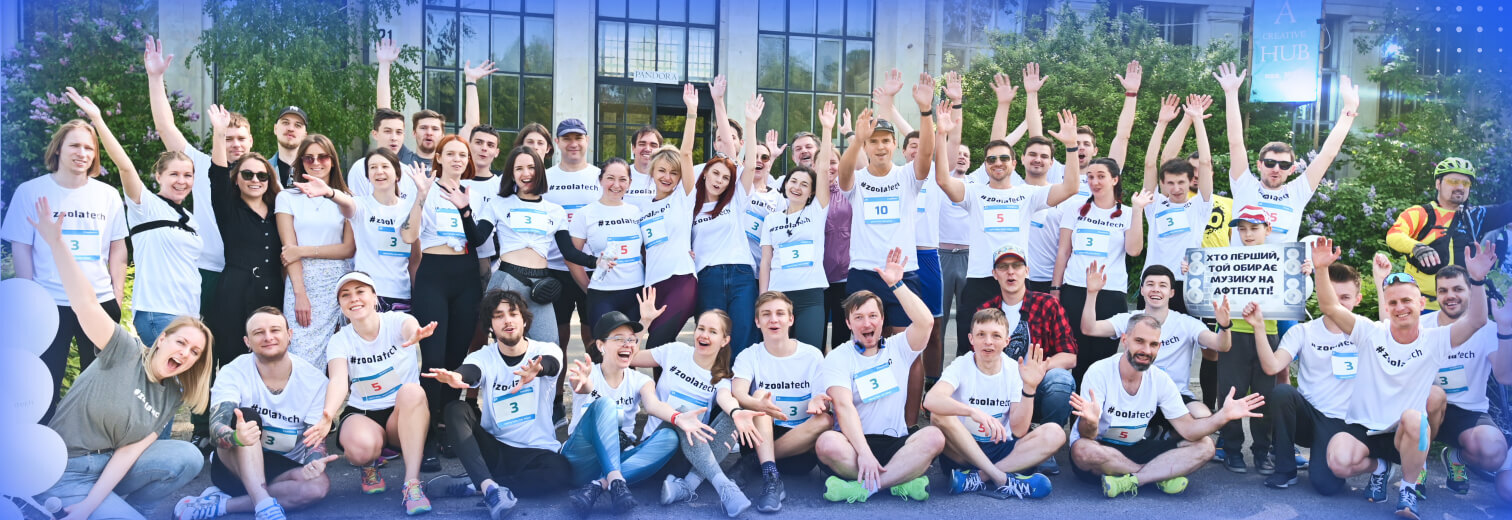
team sport photo
At Zoolatech, we create engineering teams for industry leaders across the US and Europe — teams that move fast, think big, and deliver strong impact.
Engineering Excellence. Every Time.
main award png (1)
At Zoolatech, we create engineering teams for industry leaders across the US and Europe — teams that move fast, think big, and deliver strong impact.
team sport photo
600+
Employees
Headquarters
USA
Development Centers
PL
UA
MX
TR
Questions You May Have

What are machine learning development services?

Machine learning development services cover the end-to-end process of defining, building, validating, and optimizing ML models that generate predictions or decisions from enterprise data.

How long does ML model development take?

Timelines depend on data readiness and model complexity. Most enterprise ML programs require 3 to 5 months from problem definition to production-ready handoff.

What data is required for machine learning development?

Requirements vary by model type. Training data must be representative of the production environment, labeled where supervised learning applies, and managed under a data governance framework.

How is machine learning different from AI?

Machine learning is a subset of AI focused on systems that learn patterns from data. AI is the broader category covering both rule-based and learned intelligent systems.

How does ML integrate with existing enterprise systems?

ML models are deployed as API endpoints or embedded into existing data pipelines and business applications through standardized integration patterns designed for your existing architecture.

Does Zoolatech cover deployment and MLOps as well?

Yes. Zoolatech delivers model development through to production-ready handoff, and provides MLOps implementation as a separate service covering deployment pipelines and ongoing model operations.