








Quick Summary
- MACH stands for microservices, API-first, cloud-native SaaS, and headless, and it is the architecture that makes a composable strategy actually work.
- These terms are not alternatives: microservices and headless are single building blocks, composable is the strategy, and MACH is the full model combining them.
- Adopting it moves integration, operations, service ownership, and data governance onto your side of the table, along with several SaaS subscriptions instead of one.
- Most of the payoff arrives at stage two, a hybrid where one or two fast-changing capabilities run as independent services while the core monolith still handles the rest.
- Move one capability at a time behind a strangler-pattern routing layer, starting with search, content, or promotions and leaving checkout until the approach has proven itself.
If you run enterprise commerce, you have likely heard that MACH architecture is where the market is heading, and also that it is complex, costly, and sometimes overkill. Both claims can be true, which is exactly what makes the decision hard.
Most explanations don’t help, because they are written by vendors selling the model. That makes it difficult to see where MACH genuinely fits your business and where a monolith or a hybrid path would serve you better.
So what is MACH architecture? MACH stands for Microservices, API-first, Cloud-native SaaS, and Headless. It is a set of core principles for assembling your commerce platform from independent services connected via APIs, in place of a single monolithic suite.
We divided this guide into two parts to make it easier to follow. The first half covers what MACH is: its four principles and how it differs from composable, headless, and a monolith. The second half helps you decide. We go through the trade-offs, how to understand if you are ready, and how to roll it out in stages.
By the end, you will be able to judge whether MACH suits your commerce operation, at what stage it pays off, and how to move toward it without a risky big-bang rewrite.
What Is MACH Architecture?
MACH architecture is a way of building digital products from small, independent parts instead of one big platform. Each part does one job, and you can update or replace it independently.
The name is an acronym. Here is what each letter means in plain terms.
| Letter | Stands for | In plain terms |
| M | Microservices | Separate services for catalog, cart, checkout, account |
| A | API-first | All parts talk to each other through APIs |
| C | Cloud-native SaaS | Built for the cloud, scaling, and speed |
| H | Headless | Front-end separated from back-end across web, app, kiosk |
A quick example makes the difference obvious.
In a classic monolith, the CMS, catalog, cart, checkout, and front-end are tightly coupled within a single platform. Change the checkout, and you can affect the whole system.
With a MACH-based setup, you replace the CMS, checkout, or front-end on its own, and the rest keeps running.
Your business can stop relying on a single large platform and update and scale each piece of the product separately.
Here is what MACH architecture gives a commerce business:
- ship new features faster, one service at a time.
- scale the busy parts, like search or checkout, without touching the rest.
- switch parts of your technology stack without a full rebuild.
- reduce lock-in to a single vendor.
- run web, mobile app, marketplace, and in-store screens from one core.
- modernize legacy systems step by step.
The approach grew out of composable commerce, when retailers wanted to ship changes faster than a single vendor’s roadmap allowed. In 2020, a group of technology vendors formed the MACH Alliance to turn these technology principles into an open standard.
MACH software architecture took hold in commerce first, but the same principles work in banking, media, and other digital products. We keep the focus on enterprise commerce, since that is where it is most tested.
Next, we look at each of the four principles and what it does for a store.
The Four Principles of MACH
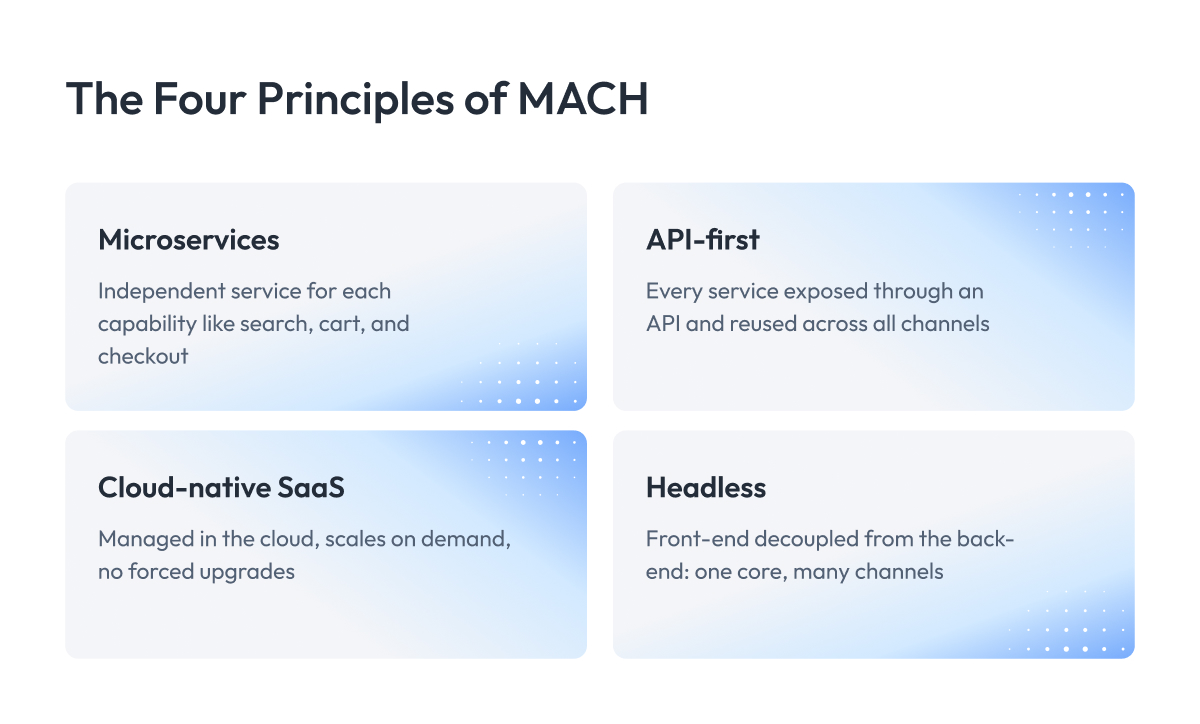
The four MACH architecture principles are the four letters we just unpacked. Here they are, one level deeper, with a MACH architecture example for each, so you can see how every principle changes in practice.
1. Microservices: independent services for each capability
The platform is split into small, independent services, each owning a single capability such as search, pricing, cart, or promotions.
Example: your merchandising team wants to switch the site search to a smarter, AI-driven engine because on-site search is converting poorly.
In a monolith, that is a platform-wide project. With microservices, you replace only the search service over a few sprints while catalog, cart, and checkout keep running as-is. Nothing else on the site is at risk.
2. API-first: everything connects through APIs
Every service exposes its features through an API before any screen is built. An API is a defined interface that allows separate software to exchange data in a predictable way.
Example: you are launching a mobile app and adding self-checkout screens in your stores. Because product, pricing, and inventory already sit behind APIs, both new channels pull the same live data as the website.
You build the pricing logic once and reuse it, instead of rebuilding it separately for each channel and hoping the numbers match.
3. Cloud-native SaaS: built to scale in the cloud
Each service runs as cloud-native SaaS, delivered as a managed cloud product rather than software you host and patch yourself.
Example: a product drop sells out in minutes and traffic jumps 20x for an hour. Cloud-native services scale up automatically to absorb spikes, then scale back down, so you pay for that capacity only when you need it.
You also skip the once-a-year “big upgrade” weekend, because the vendor ships updates in the background.
4. Headless: the front-end is separated from the back-end
A headless architecture means everything the customer sees is decoupled from the back-end commerce logic, and the two talk through APIs.
Example: marketing wants a full storefront redesign for a rebrand, plus a landing-page format for seasonal campaigns.
Your design team ships the new front-end on its own schedule while pricing, cart, and checkout stay exactly as they are underneath. One back-end powers the website, the app, and in-store screens simultaneously.
On their own, each principle is useful. Together, they are the principles behind the architecture, and this is what the architecture allows: independent services, connected by APIs, running in the cloud, with the customer experience free to evolve on its own.
This MACH architecture approach is also what makes MACH easy to confuse with composable and headless, so we separate those terms next.
MACH vs Composable vs Headless vs Microservices vs Monolith
People mix these five words up all the time, and usually assume they are competing labels for roughly the same idea.
They are not.
Each one describes a different level of the system, so putting them side by side only works once you know what level each sits on.
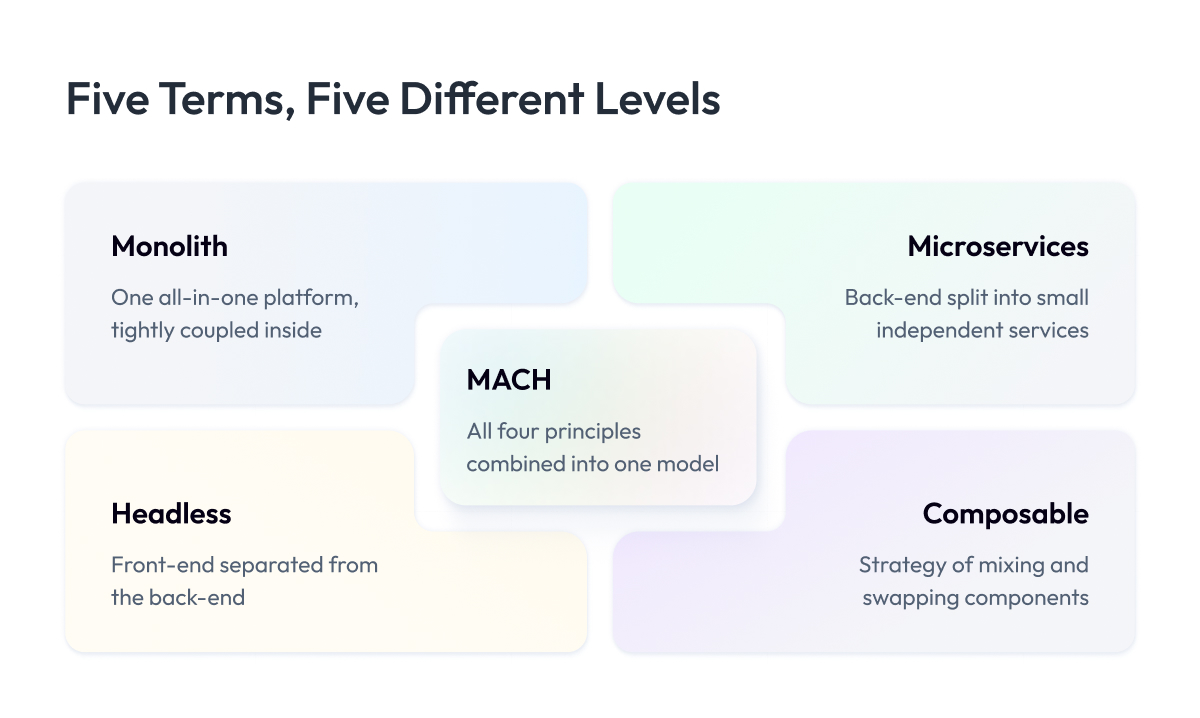
Microservices and headless are single building blocks. You can add either one to an existing platform without changing much else.
Composable is not a technology at all. It is a strategy, the aim of running a stack whose parts you can swap whenever your needs change.
A monolithic architecture is the traditional all-in-one platform most enterprises are moving away from.
And MACH is the full architecture that enables the composable strategy, bringing the building blocks together into something that runs.
This clears up the two comparisons people search for most.
Composable commerce vs MACH architecture.
Think of building a kitchen. Composable is the decision to buy the oven, fridge, and hob separately so you can replace any one later, instead of a fitted unit where they come as a block. MACH is the plumbing and wiring that lets those separate appliances actually work together. Composable is the choice you make, and MACH is what makes the choice function.
MACH architecture vs microservices.
Microservices are one of the four MACH principles, so having them is like owning a great set of speakers. Useful on their own, but not yet a sound system. A full MACH platform adds the other three pieces: everything talking through APIs, running in the cloud, and the front-end split from the back-end.
The table below sums it up.
| Term | What it is | Relation to MACH |
| Monolith | One all-in-one platform, tightly coupled inside | The old model MACH replaces |
| Microservices | Back-end split into small independent services | The “M” in MACH |
| Headless | Front-end separated from the back-end | The “H” in MACH |
| Composable | Strategy of mixing and swapping components | The strategy MACH enables |
| MACH | All four principles combined | The full model |
Keep this straight, and the rest of the decision gets easier. The bigger question is when the full model is worth it for enterprise commerce, and that is what we turn to next.
Why MACH for Enterprise Commerce
So when is the full model worth it? MACH architecture earns its keep in commerce once your operation gets big and complex enough that a monolith starts slowing you down.
At enterprise scale, the benefits of MACH architecture are concrete. MACH architecture gives businesses a way to update the parts of the store that change frequently, such as search, promotions, or checkout, without freezing everything else.
Each service scales independently, so scalability remains targeted, and a traffic spike on one channel doesn’t threaten the rest. And because every service runs as managed cloud software, you skip the heavy version upgrades that used to eat entire quarters.
That flexibility matters most in setups a single monolith struggles with:
- Multiple brands or regions running on one core, each with its own storefront, rules, and customer needs.
- High, spiky traffic from drops and sales, where only the busy services need to scale.
- Many channels at once: web, mobile app, marketplace, and in-store screens.
- Fast experimentation, where teams ship changes to one capability weekly rather than quarterly.
This is where MACH’s modular, composable architecture becomes a competitive advantage for enterprise commerce, since you can respond at the speed of a single service instead of a whole platform.
We see the same pattern in our own work. When we re-architected a high-volume communication platform for a major retailer around microservices architecture, infrastructure costs dropped by roughly 30%.
In another enterprise retail program, moving personalization to a real-time data service unlocked around €4.5M in additional GMV because the customer experience could finally respond to live behavior.
One caution before the next section. These gains scale with size. For a store running two or three services and modest traffic, the coordination and integration work behind MACH can cost more than it returns. MACH pays off at enterprise scale, but below it, it is often overhead. That trade-off deserves its own section, which is where we go next.
The Trade-offs: MACH’s Real Costs and Challenges
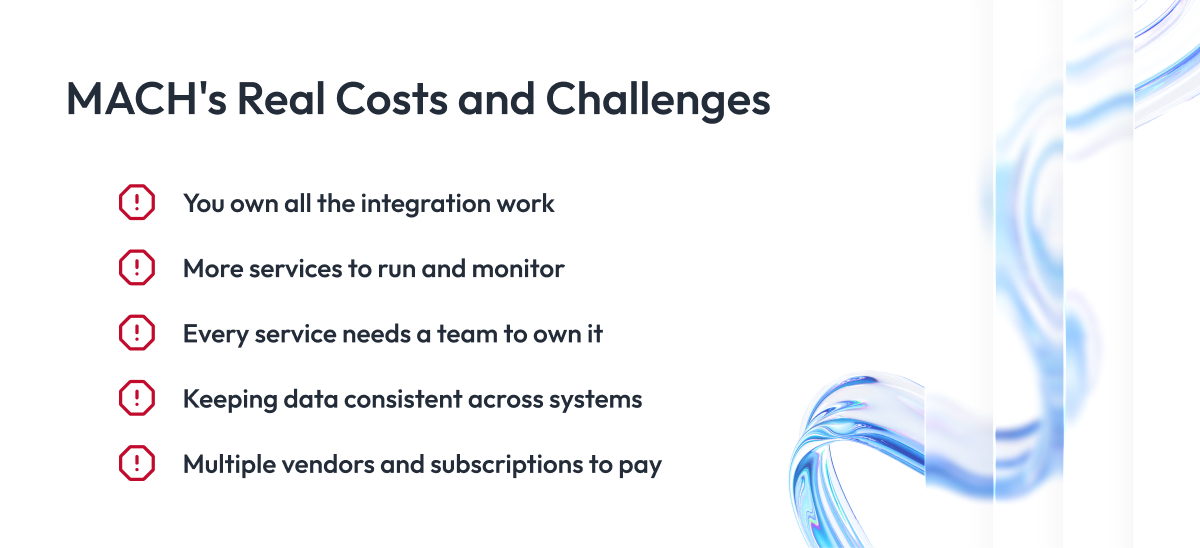
Everything above is the upside. Now, the part vendors prefer to skip because MACH also shifts work and cost onto your side of the table. Here are the five challenges that matter most.
1. Integration is now your job
A monolith ships pre-wired: the catalog already talks to the cart and checkout out of the box. Split those into separate services, and that wiring becomes your responsibility. Every connection between services is something your team designs, builds, and maintains.
2. More moving parts to run
A dozen independent services means a dozen things to deploy, monitor, secure, and keep in sync, each with its own failure modes. Teams that move to MACH often find operational complexity the hardest part.
3. Someone has to own each service
When every service can ship on its own, each one needs an owner. MACH works best with autonomous teams mapped to services, which is as much an organizational change as a technical one. Companies that keep one central team and just add services end up paying the cost of MACH without the speed.
4. Data and content governance get harder
Product data, pricing, and content now live across several systems. You have to decide where the source of truth sits and keep everything consistent. Without that discipline, the same product can show three different prices in three channels.
5. More vendors, more cost
Running several specialist SaaS products means multiple subscriptions, multiple contracts, and the integration work that connects them. For a large catalog across many regions, that math usually works. For a smaller store, it rarely does.
That last point is the honest bottom line.
If you run a modest catalog, a couple of services, and a small team, a well-built monolith or a hybrid setup will often serve you better and cost far less. MACH rewards scale and complexity. Below a certain size, it mostly adds both.
Knowing where your business sits on that line is the next question, so we turn it into a simple readiness check.
A MACH Readiness and Maturity Model
Before deciding whether to adopt MACH, it helps to see where you already stand. Most enterprises are further along than they think, and the right next step depends entirely on your starting point.
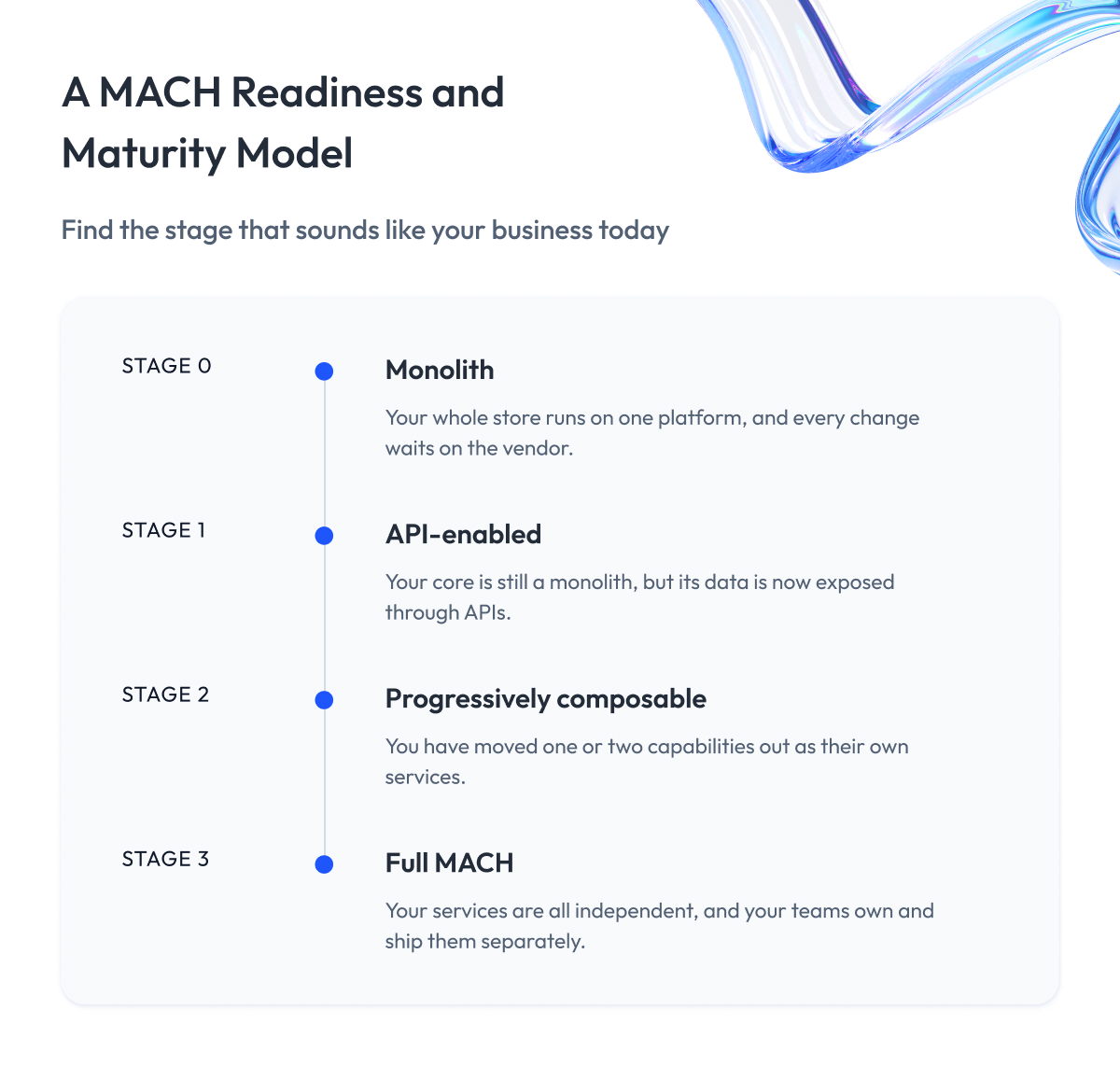
Use the four stages below as a self-check. Read the signals under each one and find the description that sounds like your business today.
Stage 0: Monolith
You are here if everything runs inside one platform from one vendor, and most changes wait on that vendor’s release schedule. Catalog, cart, checkout, and front-end are wired together internally.
Signal to move up: routine changes start requiring big, risky releases, and the vendor’s roadmap keeps blocking things you need.
Stage 1: API-enabled
You are likely here if the monolith is still your core, but you have exposed its data through APIs. A mobile app or a new front-end can already pull live product and pricing information.
Signal to move up: a specific capability, like search or checkout, is holding you back and you want to improve it without touching the rest.
Stage 2: Progressively composable
You are here if you have pulled one or two capabilities out of the monolith and run them as independent services. The core still handles most of the business logic, while the fast-changing parts move on their own.
Signal to move up: several teams now want to own and ship their services independently, and the remaining monolith is the main bottleneck.
Stage 3: Full MACH
You are here if the platform is a set of independent services connected by APIs, running as cloud-native software, with the front-end fully decoupled and autonomous teams owning each service.
No signal to chase. This stage is the destination for genuine scale.
MACH adoption is a gradual shift from monolith to MACH, and most of the payoff comes in Stage 2.
For many enterprises, a well-run Stage 2 is the sensible endpoint of this part of their digital transformation. Knowing your stage sets up the decision: adopt, wait, or go hybrid. That is next.
Should You Adopt MACH? A Decision Framework
Knowing your stage and the principles of MACH architecture tells you what is possible. This section helps you decide what is wise. For most enterprises, the honest answer is one of three: adopt MACH now, wait, or take a hybrid path that sits between the two.
The right call comes down to five factors. Score yourself on each, and the pattern usually points clearly in one direction.
Scale and complexity. Large catalogs, multiple brands, many regions, and high traffic all push toward MACH, because that is where its flexibility earns back its cost. A single-region store with a modest catalog rarely gets there.
Organizational maturity. MACH assumes autonomous teams that own services end-to-end. Companies already working this way adapt fast. Those with a single central team should fix the operating model first or choose a hybrid path that fits their current structure.
Differentiation needs. If your customer experience is a source of competitive advantage and you need to ship changes weekly, MACH architecture allows that speed. If your storefront is fairly standard, a monolith covers you at a fraction of the effort.
Budget and time horizon. MACH is an investment that pays back over years, through multiple subscriptions and integration work. A short horizon, a tight budget, or business needs that are still shifting favor waiting or moving one capability at a time.
Team model. In-house engineering strength matters, since you now own the integration and orchestration. Lighter teams often start hybrid and lean on a delivery partner for the build.
The table turns these into a quick read.
| If this describes you | Sensible path |
| Enterprise scale, autonomous teams, strong differentiation | Adopt MACH |
| Growing scale, mixed org model, a few pain points | Hybrid, one capability at a time |
| Modest catalog, central team, standard storefront | Stay monolith for now |
Notice that hybrid is a legitimate destination in its own right, and often the smartest one. You get MACH’s benefits where they count and keep the monolith where it still works. Once you have made the call to move, the question becomes how to do it without disruption. That is the final piece.
How to Adopt MACH Incrementally
This is the part where theory meets reality, so we will describe it the way we actually run it.
The safest way to reach MACH is to add capabilities one at a time, with the monolith running the whole way.
A full rewrite stops the business for months and bets everything on a single cutover.
Moving in stages keeps delivery agile, so you ship value early and correct the course as you learn. The sequence below is the one we use with clients migrating off a monolith.
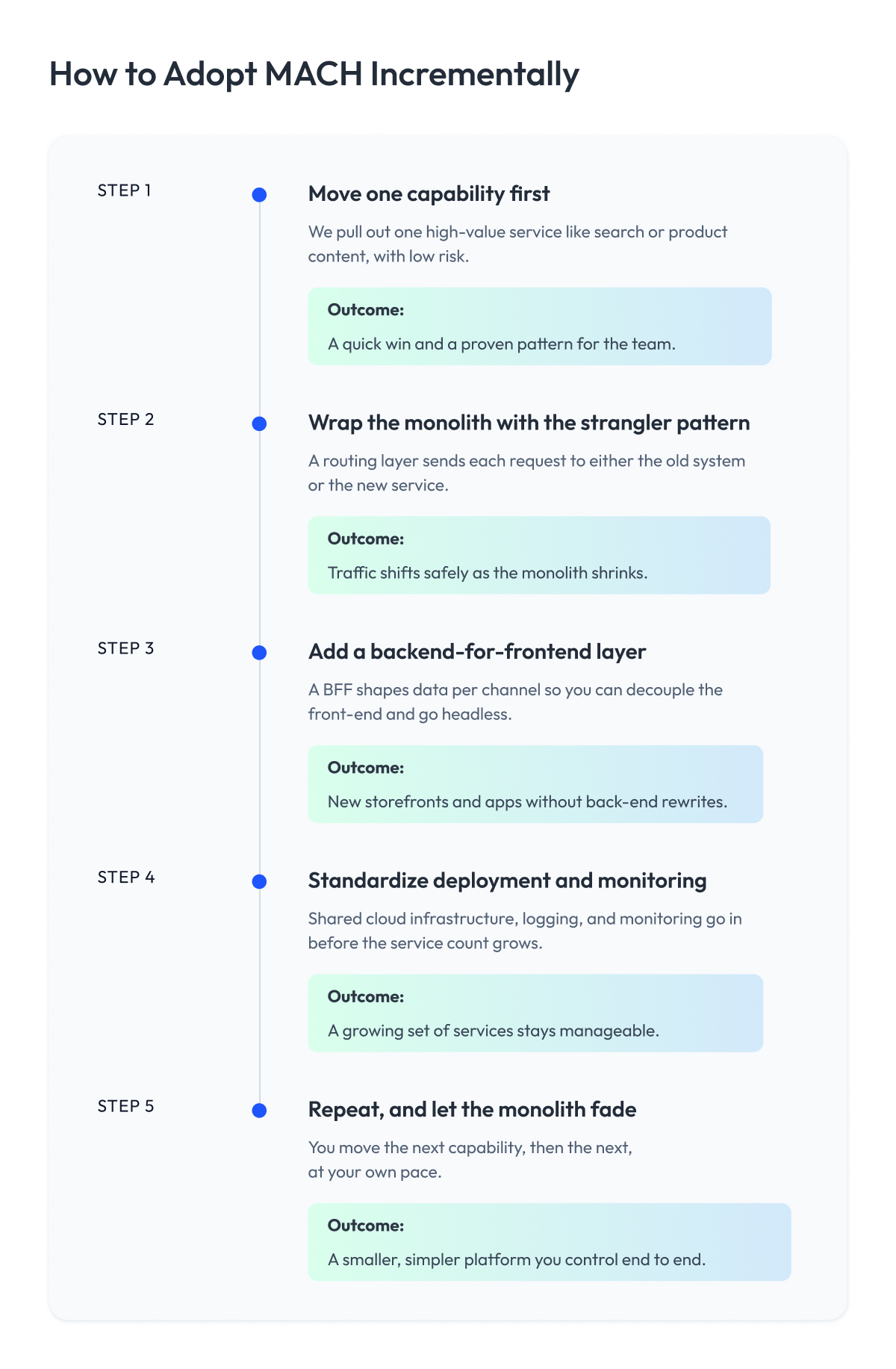
Step 1 – We move one capability first
We start by pulling out a single high-value service that changes often and is loosely tied to the rest, usually search, product content, or promotions. We treat that first service as a minimum viable product, a quick win that lets everyone learn the patterns before anything critical is on the line. We leave checkout for later, once the approach has proven itself.
Step 2 – We wrap the monolith with the strangler pattern
We put a routing layer in front of the monolith so requests can go to either the old system or a new service. As we move each capability out, we redirect its traffic to the new service and the monolith quietly shrinks. The pattern is named after a vine that grows around a tree and slowly replaces it.
Step 3 – We add a backend-for-frontend layer
We introduce a backend-for-frontend, or BFF, that sits between the client’s channels and services and shapes data for each one. This is what lets us decouple the presentation layer and go headless for the web or app without waiting on every back-end service to be ready.
Step 4 – We standardize deployment and monitoring early
Before the service count grows, we put shared plumbing in place: consistent cloud infrastructure, logging, and monitoring. This keeps a growing set of services manageable instead of chaotic, and it is far cheaper to set up now than to retrofit later.
Step 5 – We repeat, and let the monolith fade
With the pattern proven, we move the next capability, then the next. The monolith keeps handing off responsibility until it is a small core or gone entirely. The client controls the pace the whole time, and we are comfortable stopping at a hybrid state when the value plateaus.
Working this way turns a risky migration into a series of reversible moves. With the how settled, a few practical questions remain, starting with the tools you will actually run on.
The MACH Ecosystem and How to Evaluate Platforms
Once you decide to move, you have to choose what to actually run on. MACH architecture platforms form a marketplace of specialist tools, and picking well matters more than in a monolith, because you are assembling the MACH stack yourself.
A quick word on the MACH Alliance. It is an industry group that certifies vendors against the four principles, so its membership list is a useful starting shortlist. Certification confirms a tool follows the principles, though it does not tell you whether that tool fits your business.
The ecosystem breaks down into a few categories, and you pick one strong product in each:
- Commerce engine for cart, pricing, and orders.
- Headless CMS for content management and merchandising.
- Search and discovery for on-site search and recommendations.
- Payments for processing and fraud.
- Front-end frameworks for the headless storefront itself.
Each category has several credible vendors, and the right choice depends on your catalog, regions, and team.
When we help clients evaluate platforms, we weigh four things.
1. Openness
Does the product expose everything through a documented application programming interface, or are parts locked behind a proprietary wall? True openness is what keeps a service swappable later.
2. Genuine SaaS
Is it true multi-tenant SaaS that the vendor updates for you, or hosted software you still have to patch and upgrade? Only the former delivers the no-forced-upgrades benefit.
3. Extensibility
Can you add custom logic through well-defined extension points, or does every change fight the platform? Commerce always needs custom rules, so this decides how much you can bend the tool.
4. Total cost of ownership
Does the price cover subscription, integration, and ongoing operations, or only the license itself? The cheapest license can carry the highest integration bill.
Score each candidate on these four, and the shortlist gets short fast.
MACH and AI in 2026
Every commerce team is being asked about AI right now, so let’s finish there. AI is not one of the four MACH principles, but MACH turns out to be the setup where AI is easiest to add. That is why the two keep coming up together.
The reason is simple. AI is only as good as the data it can access, and a MACH platform already serves all its data through neatly organized APIs. So the AI gets direct access to the catalog, prices, and content, instead of digging them out of a tangled system.
Here is an example.
Say you want an AI shopping assistant that helps a customer find the right winter jacket. On a store built with MACH architecture, it can already tap the product data, live stock, and pricing through the same APIs the website uses, so you plug it in and it works.
On a monolith, that data is locked inside, and you would spend months building a way to get at it before the assistant could do anything.
The same holds for personalization. Because each part is separate, you can add a tool that reacts to what a shopper is doing right now, then swap it for a better one later without rebuilding the store.
This is why teams planning an AI-driven digital experience keep landing on MACH. The architecture does the boring groundwork of exposing data in an organized way, and that is what AI needs to be useful. Much of what you can learn about MACH architecture and AI in ecommerce sits on that same foundation.
Final Word
MACH architecture is a serious commitment, and the honest takeaway is that it is not for everyone. It rewards scale, traffic, and teams that can own services. Below that, a good monolith or a hybrid setup will often cost less and serve you better.
So the useful move is to place yourself before you plan anything. Find your stage on the readiness scale, weigh the five decision factors, and be honest about your team and budget. That alone tells you whether to adopt MACH now, wait, or take one capability at a time.
Whatever the answer, you do not have to bet the business on a single cutover. A staged move keeps the store running while you learn, and lets you stop at the point where the value plateaus.
If you want a second opinion grounded in real commerce builds, our team is glad to look at your architecture, pressure-test where MACH fits, and map a path that matches your scale. Just a straight read on whether the move is worth it for you.
Questions You May Have
What is MACH architecture in simple terms?
MACH architecture is a way of building commerce software from small, independent services (Microservices, API-first, Cloud-native SaaS, Headless) that you can update or swap on their own instead of running one large monolithic platform.
What are the four principles of MACH?
The four principles of MACH are microservices for independent capabilities, API-first so everything connects through APIs, cloud-native SaaS for managed scaling, and a headless front-end separated from the back-end.
What is the difference in composable commerce vs MACH architecture?
Composable commerce is the strategy of running a stack you can mix and swap, while MACH is the architecture that makes that strategy work, so composable is the goal and MACH is how you reach it.
How is MACH different from headless commerce and microservices?
Headless commerce covers only the split between front-end and back-end, and microservices cover only the back-end split, whereas MACH combines both with API-first and cloud-native SaaS into one full model.
What are the benefits of MACH architecture for enterprise commerce?
The benefits of MACH architecture are faster releases, one-service-at-a-time development, independent scaling for high-traffic parts, the freedom to switch vendors, and a single back-end powering many channels across brands and regions.
What are the main challenges or downsides of MACH?
The main challenges are the integration work you now own, more services to run and monitor, the need for autonomous teams, harder data governance, and the higher cost of multiple SaaS subscriptions.
When should a company adopt MACH, and when is it overkill?
A company should adopt MACH at genuine enterprise scale with multiple brands, high traffic, and autonomous teams, while a modest catalog on a small central team is usually better served by a monolith or a hybrid path.
How do you implement MACH architecture in commerce without a big-bang rewrite?
You adopt MACH incrementally by moving one capability out at a time with the strangler pattern, adding a backend-for-frontend layer, and letting the monolith shrink, so the store keeps running throughout.
What is the MACH Alliance?
The MACH Alliance is an industry group that certifies vendors against the four MACH principles and promotes them as an open standard, which makes its membership list a useful starting point when evaluating platforms.