







Quick Summary
- Clienteling hands customer data to a store associate who applies judgment, while personalization automates the same data through code and a CRM only stores it.
- The stack has seven layers and the unified customer profile is the foundation, since an associate seeing a fragment of the shopper cannot serve the whole person.
- Real-time POS, inventory, and order integration separates a working system from a demo, because recommending a coat that sold out an hour ago costs the associate their credibility.
- Programmes sit in four maturity stages, from memory-based service to autonomous omnichannel, and most live between stages two and three, so build one step up rather than three.
- Roll out in a fixed order, data foundation, associate app, integrations, AI, then measurement, because stalled programmes have almost always skipped the data foundation.
Clienteling is a retail practice in which store associates use customer data, such as purchase history, preferences, and past interactions, to deliver personalized service and build long-term customer relationships. Modern clienteling runs on software that unifies that data and puts it in an associate’s hands in real time.
Most retail teams already know what clienteling is meant to do. It turns one-time buyers into loyal customers through service that feels personal. The technology underneath is where things get hard. A skilled sales associate working without a unified customer profile is guessing, and most clienteling advice stops at the idea and skips the engineering required to make it work across stores, channels, and millions of shoppers.
That is why we wrote this guide from a builder’s perspective.
We break down the actual clienteling stack for retail businesses, how it integrates with your POS, e-commerce, and inventory systems, where AI belongs, and how to decide whether to buy a clienteling app or build your own. You also get an original maturity model and a set of metrics that tie clienteling to revenue.
By the end, you will be able to gauge how mature your own program is, choose the right build-vs-buy path, and know which numbers prove clienteling is working.
What Is Clienteling?
We opened with a working definition. Here, we sharpen the clienteling definition and draw the line between it and the retail practices that people often confuse it with.
Clienteling is a data-driven sales technique in which store associates use a customer’s purchase history, preferences, and past interactions to deliver personalized service, build long-term customer relationships, and increase customer lifetime value.
Retail clienteling began in luxury, where associates kept a personal book on their best customers, and it now runs on software that gives every associate that same memory across stores and channels.
Effective clienteling rests on a few core elements:
- Unified customer profile. A single view of each shopper, combining purchase history, preferences, sizes, and past conversations.
- Associate access. A mobile app or POS screen that puts that profile in the associate’s hands during the interaction.
- Ongoing relationship. Personal, repeated follow-up that continues well beyond a single sale.
- Data plus judgment. Technology surfaces the insight and the associate decides how to use it.
Many companies often confuse clienteling with personalization, CRM, and loyalty programs because each uses customer data and aims to keep shoppers coming back. The difference comes down to who acts on the data and where.
Personalization runs on algorithms. Software reads a shopper’s behavior and automatically tailors a website, an email, or an app feed, with no person involved. Clienteling takes the same customer data and hands it to a store associate, who uses judgment to guide a personal interaction. One scales through code, the other through people.
Customer relationship management, or CRM, is the system of record. A CRM stores the customer information. Clienteling is what an associate does with that information at the moment of service. The CRM holds the data, and clienteling turns it into a conversation.
A loyalty program rewards repeat spending with points, tiers, and perks, and it runs mostly on its own once set up. Clienteling often feeds a loyalty program with richer customer insight. Its focus remains on the personal relationship instead of the reward mechanics.
Why Clienteling Matters in Retail and Luxury
Clienteling in retail earns its keep with a specific group of customers who already spend the most and could spend more. These are the shoppers worth a personal relationship, and they behave very differently from one-time bargain hunters.
The benefits of clienteling are concrete, and they build long-term relationships that raise customer satisfaction. A returning customer who feels known tends to shop more often, return fewer items, and stay loyal longer. Each of those behaviors lifts customer lifetime value, the number that matters most in retail. Clienteling works directly on that number, turning a single purchase into an ongoing relationship.
Here is what clienteling actually improves for a retailer:
- Higher spend. Known customers buy more per visit and come back more frequently.
- Better retention. Personal follow-up keeps high-value shoppers from drifting to a competitor.
- Fewer returns. Associates who know a customer’s sizes and taste recommend better fits.
- Loyalty that holds. The relationship survives price increases and rival discounting.
Clienteling in luxury retail proved the model first, and for good reason.
When a handbag costs several thousand dollars, the buyer expects an associate who remembers their tastes, sizes, and last visit. In that setting, personal service becomes part of the product. Strong luxury clienteling drives repeat visits, larger baskets, and the kind of customer loyalty that survives a changing market.
The same logic now reaches mainstream retail. Beauty, apparel, electronics, and home brands use clienteling to give high-value customers a reason to return to a specific associate or store instead of the cheapest search result. The mechanics scale down from luxury without losing their effect.
We have seen this firsthand. On an AI-powered personalization program for the luxury retailer Gilt, our team tailored the shopping experience to each customer.
Done well, clienteling shifts a retailer’s economics away from chasing new traffic and toward growing the value of the customers it already has.
How Clienteling Works
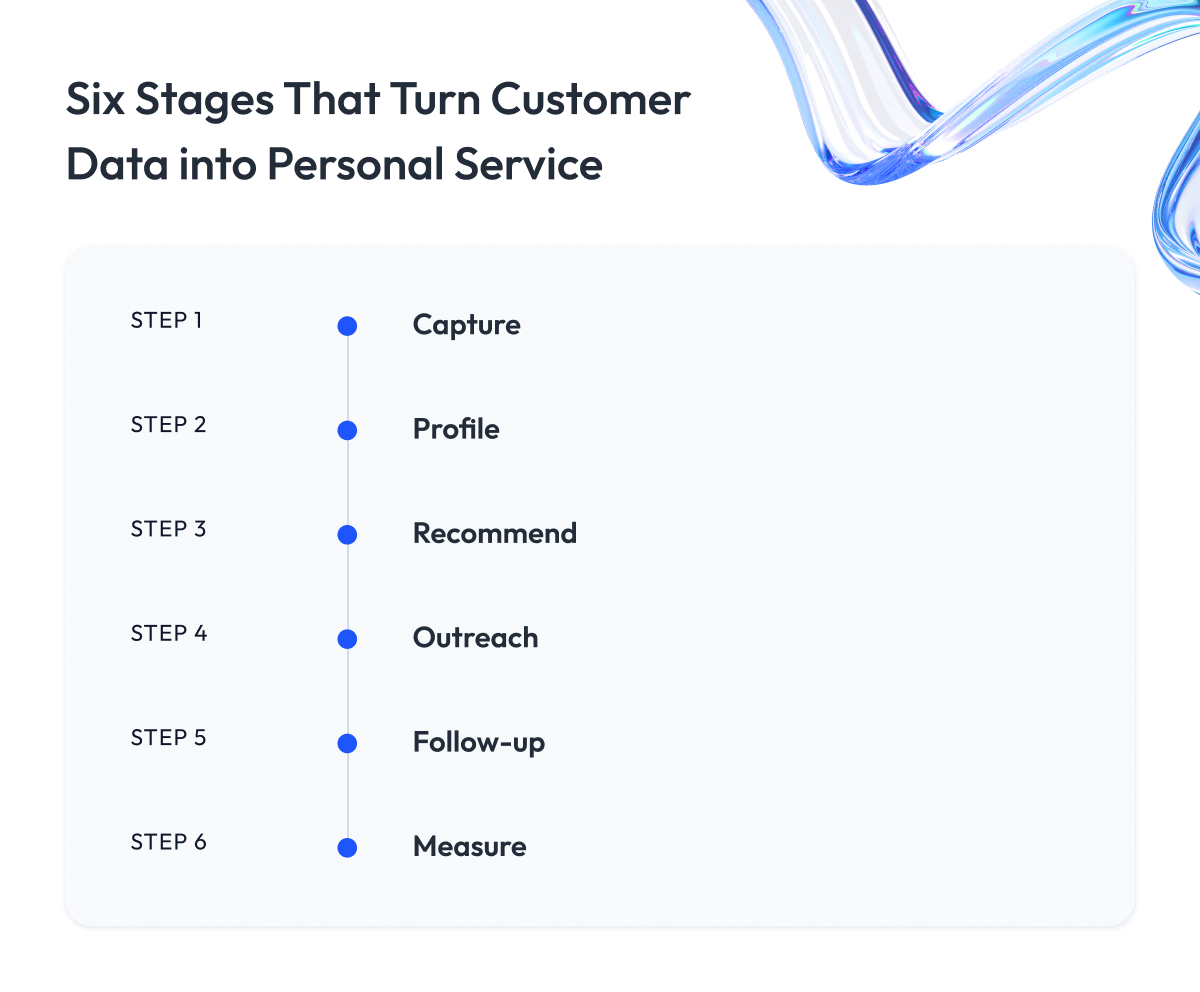
At its core, clienteling is a loop that runs between an associate and the customer data behind them, repeating across the customer journey.
The loop has six stages, and each one depends on the technology feeding it:
1. Capture.
The associate logs a customer’s preferences, sizes, and interests, and the system automatically records every purchase and interaction.
2. Profile.
All of that data merges into a single customer profile, including purchase history, past conversations, and channel activity.
3. Recommend.
With the profile in hand, the associate suggests products that fit the customer’s taste, wardrobe, or past purchases.
4. Outreach.
The associate follows up via the customer’s preferred channel, whether by text about a new arrival or by note before a restock.
5. Follow-up.
After a sale, the associate checks in, handles returns, and keeps the relationship warm between visits.
6. Measure.
Every interaction feeds back into the profile and into the metrics that show what is working.
Imagine a returning shopper walking into a store. The associate opens an app and sees the customer’s size, the coat they bought last winter, and the boots they viewed online but never purchased. That information turns a cold interaction into a personal one, and it happens in seconds. Small moments like this drive customer engagement and make everyday customer interactions feel personal.
The strength of any clienteling program comes down to how well the customer information flows to the person standing in front of the shopper.
That flow is a technology problem, and it is what the rest of this guide covers.
The Technology That Powers Clienteling
Most articles explain what clienteling is but skip the technology that makes it run. We want to fill that gap and show how clienteling actually gets built, including the clienteling tools we use on our own client projects.
Think of the setup as a pipeline. Customer data comes in from every channel, is combined into a single profile, reaches the associate via an app, and improves over time as AI and analytics learn from each interaction.
The clienteling stack, layer by layer
A clienteling system is made of a few connected parts. Each part has one job, and a weak spot in any of them means a worse customer experience for the shopper.
| Layer | What It Does | Why It Matters |
| Unified customer profile (CRM/CDP) | Merges data into one shopper view | Foundation for every other layer |
| Associate mobile app | Delivers the profile at point of service | Where clienteling actually happens |
| Purchase and interaction history | Records what each customer bought and viewed | Fuels relevant recommendations |
| Real-time POS and inventory integration | Syncs sales, stock, and orders live | Prevents recommending sold-out items |
| AI next-best-action | Suggests products and timing | Scales associate judgment |
| Omnichannel outreach | Connects email, SMS, and chat | Reaches shoppers between visits |
| Analytics | Measures behavior and program results | Turns activity into insight |
Four of these layers decide whether a program works. Here is what each one needs.
The unified customer profile. This is the foundation. If a shopper’s online browsing, in-store purchases, and past chats live in separate systems, the associate sees a fragment instead of the whole person. A customer data platform (CDP) usually works next to the CRM to pull these sources into one profile. Get this layer wrong, and nothing above it can work.
The associate app. This is where the strategy meets the sales floor. These retail employee mobile apps give associates instant access to customer data, so the app loads a full profile in seconds, runs on the store’s devices, and stays easy to use during a live conversation. Building it well is a custom application engineering job.
Real-time integration. This is what separates a demo from a working system. When an associate recommends a coat, the app needs to know that coat is in stock, in the right size, at a store the customer can reach. That calls for live links to POS, order management, and inventory, which we cover in detail further down.
AI and analytics. These sit on top. They watch behavior across the customer base, suggest the next best action for each shopper, and show the retailer which efforts drive sales. Our AI engineering team builds this as a support layer, where the software recommends and the associate makes the final call.
These layers turn scattered customer information into one useful view, ready at the moment an associate needs it. That is what clienteling technology is for.
Modern Forms: Digital, Mobile, and Virtual Clienteling
Clienteling comes in several forms, and knowing them helps you pick the right setup for your retail stores. Each shapes the in-store experience differently within a modern retail environment. Some serve a customer on the sales floor, others serve one by video from across the country. They overlap in practice, and each solves a different problem.
| Form | Where It Happens | Best For |
| In-store clienteling | On the sales floor | Personal service during a visit |
| Mobile clienteling | Associate app, anywhere in store | Freeing associates from the counter |
| Digital clienteling | Online and app channels | Extending service beyond the store |
| Virtual clienteling | Video, chat, and messaging | Remote, appointment-based selling |
Mobile clienteling puts the customer profile in the associate’s pocket. Instead of walking a shopper to a fixed terminal, the associate carries a tablet or phone and pulls up history, stock, and recommendations right beside the customer. Most modern clienteling apps are mobile-first for this reason.
Digital clienteling stretches the relationship past the store walls. The same associate who helped a customer in person can follow up by email or through the retailer’s app, so the service continues across online and in-store channels alike. This is where clienteling and omnichannel retail start to blend.
Virtual clienteling grew quickly when stores closed and never went away. An associate books a video call or a chat session, shows products live, and closes the sale remotely. For luxury brands, this became a booking-based service that treats a video appointment with the same care as a store visit.
The thread connecting all of them is the customer profile. Whether the interaction is in person, by phone, or via video, the associate needs the same unified view of the shopper. The channel changes, and the data behind the service stays the same.
That shared foundation raises an obvious question for any retailer starting out. How advanced does your program need to be, and how do you get there? The next section maps that path.
A Clienteling Maturity Model
Not every retailer needs the same clienteling setup. A single boutique and a global chain sit at very different points, and pushing too far too fast wastes money. We use a simple maturity model to place a program and plan its next step.
Here is how to use the model:
- Place your program. Match it to the stage that describes it most honestly today.
- Find your trigger. Look at the signal that shows you have outgrown that stage.
- Set the next stage as your target. Build toward one step up, not three.
- Justify the jump. Move only when a concrete limit forces it, not out of ambition.
There are four stages. Each one adds capability on top of the last.
| Stage | What It Looks Like | Technology in Place | Move Up When |
| 1. Relationship-only | Associates rely on memory and notes | Little to none | Growth outpaces memory |
| 2. Data-driven | Associates work from a unified profile | CRM/CDP, associate app | Manual outreach hits limits |
| 3. AI-assisted | Software suggests next best actions | AI recommendations, analytics | Channels feel disconnected |
| 4. Autonomous omnichannel | Service flows across every channel | Full real-time integration | Refine, do not rebuild |
1. Relationship-only
Your associates carry everything in their heads, or a paper book, and your best regulars get great service because one person remembers them. You see this work in a small store, and you feel it break the moment that associate leaves or your customer base grows.
Your signal to move up arrives when service quality depends on who is working that day. At that point, memory has stopped scaling, and you need a shared profile.
2. Data-driven
A unified customer profile is what clienteling allows at this stage, so any associate can open an app, see purchase history and preferences, and serve a customer they have never met. Your service is now consistent, and it no longer rests on a few star employees.
You are ready for the next step when your associates spend more time deciding who to contact and what to recommend than actually helping customers.
3. AI-assisted
You now have software doing the heavy lifting on suggestions, flagging which customers to contact, what to offer, and when to offer it, based on behavior across your customer base. Your associates still make the final call, and your recommendations sharpen as your data grows.
Your trigger for stage four appears when each channel works well alone, but they do not share context, so a customer feels like a stranger online right after a warm store visit.
4. Autonomous omnichannel
You serve customers smoothly across store, web, app, and video, with the same profile behind every touchpoint. Your outreach, recommendations, and follow-up run in a coordinated way instead of channel by channel.
Few retailers reach this stage fully today, and if you are here, your work shifts from building new layers to refining what you already have.
Most programs live between stage two and stage three. The smart move is to honestly identify your current stage and build the one capability that moves you up. Leaping straight to stage four rarely works and usually wastes budget.
Build vs Buy: Clienteling Software vs Custom
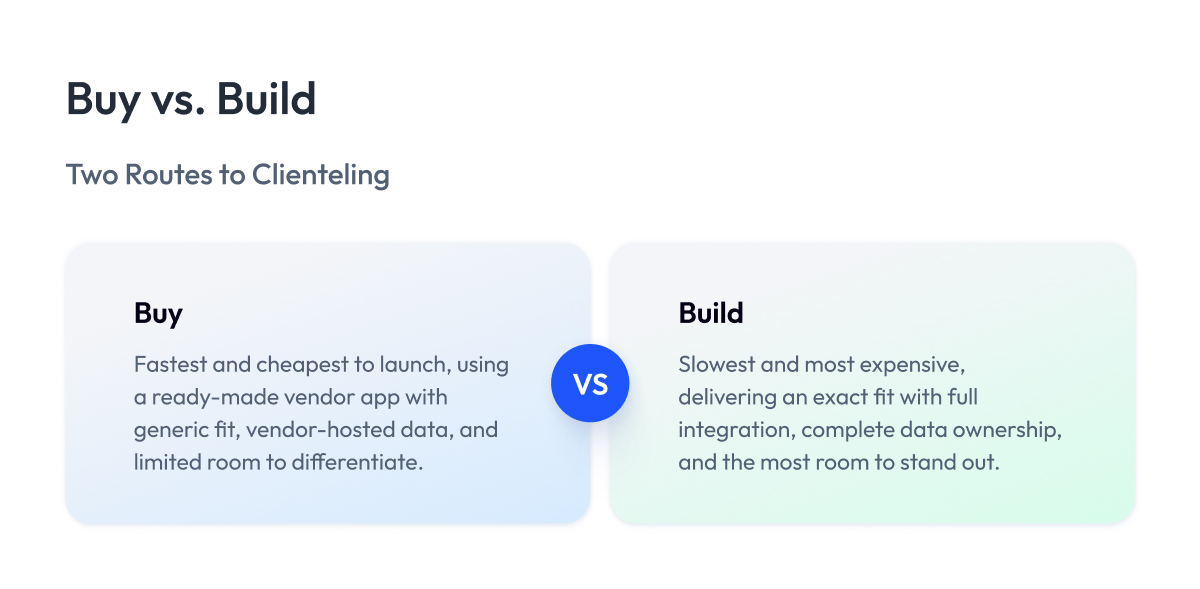
This is one of the most important decisions you will make, and it shapes your budget, your timeline, and how much the program can grow later. Reverse it a year in, and you pay for it twice.
You have three realistic paths. You can buy a ready-made clienteling app from a vendor, extend a system you already own like your CRM or CDP, or build a custom clienteling solution from the ground up. No vendor offers superior clienteling solutions that suit every retailer, and a good clienteling platform is simply the one that fits your trade-off between speed, control, and cost. Each path fits a different kind of retailer.
Ready-made clienteling platforms get you live fastest. Vendors such as Tulip, Endear, Salesforce, Cegid, and BSPK offer retail clienteling software with the core features already built. You trade some control and deep customization for speed and a lower upfront cost.
Extending your existing CRM sits in the middle. You reuse what you own and keep your data in one place, though you may hit limits on what the base system was designed to do.
Building custom gives you full control over features, data, and integrations, at the highest cost and the longest timeline.
Here is how the three compare on the criteria that actually decide it:
| Criterion | Buy (SaaS app) | Extend Your CRM | Build Custom |
| Time to launch | Fastest | Medium | Slowest |
| Upfront cost | Lowest | Medium | Highest |
| Fit to your process | Generic | Moderate | Exact |
| Data ownership | Vendor-hosted | You own it | You own it |
| Integration depth | Limited | Moderate | Full |
| Differentiation | Low | Medium | High |
So how do you choose? A few plain rules cover most cases:
- Buy when you want results fast, and your needs match what vendors already offer.
- Extend your CRM when you own a capable platform and want your data to stay in one place.
- Build custom when clienteling is central to how you compete, and no product fits your workflow or scale.
For large retailers, the honest answer is often a mix. You might buy to launch quickly, then build custom pieces where an off-the-shelf clienteling tool cannot keep up with your integration or scale needs. That is the kind of custom software development work we take on once a retailer outgrows packaged clienteling solutions.
Integration and the Data Foundation
Every layer we have covered rests on one thing, and that is data moving accurately between systems. This is the hardest part of clienteling, and the part vendors gloss over most. A polished associate app is worthless if it shows stale prices or recommends a coat that sold out an hour ago.
A working clienteling program pulls live data from several systems at once:
- POS, for what a customer just bought and what is happening at the register.
- E-commerce, for online browsing, carts, and purchases.
- Inventory, so recommendations only include items actually in stock.
- Order management (OMS), for order status, returns, and fulfillment.
- Loyalty, for points, tiers, and reward status.
- CDP or CRM, the hub that unifies all of it into one profile.
The goal is a single view of each customer that any associate can trust. When the data is up to date, an associate can tell a shopper that their online return has been processed and suggest a matching item that is in stock at their local store. When the data lags, the same associate gives incorrect answers and loses credibility with the customer.
Two engineering problems decide whether this works:
- Real-time sync. Clienteling lives in the moment of interaction, so overnight batch updates are not enough, and systems need to communicate in seconds.
- Data quality. Merging records from many sources creates duplicates, mismatched fields, and gaps, and dirty data quietly poisons every recommendation built on top of it.
How we handle it in practice
This is core retail engineering, and it is work we do directly. On a real-time customer data pipeline for Zalando, our team unified customer data across systems at scale.
For retailers running physical stores, the POS integration layer is usually where the effort concentrates, since the register is where in-store data is born.
Get the data foundation right, and every layer above it gets easier. Get it wrong, and the best clienteling app in the world still fails.
AI in Clienteling
AI is what moves a program from stage two to stage three, and it is the layer drawing the most attention in retail right now. Used well, it takes the guesswork out of who to contact and what to suggest, so associates spend their time on the conversation instead of the analysis.
What AI actually does here
AI works quietly in the background of a clienteling program, turning raw customer behavior into specific prompts an associate can act on:
- Recommendations. Suggests products that match a customer’s taste, history, wardrobe, and current customer needs.
- Next-best-action. Tells the associate the single most useful move right now, whether a message, an offer, or a reminder.
- Propensity scoring. Predicts who is likely to buy, upgrade, or churn, so outreach goes to the right people first.
- Restock and return prediction. Flags when a customer is due for a refill or likely to send something back.
Who uses it, and what they get
Luxury and beauty brands led here, using AI to help associates manage hundreds of high-value personal relationships without losing the human touch.
Mainstream retailers followed, applying the same models across a much larger customer base to sharpen the whole retail experience. The same AI can support store associates and customer support agents alike.
The payoff is consistent: associates reach the right customer at the right moment, recommendations get more relevant, and the whole program scales without hiring an analyst for every store.
Data Privacy and Consent
One thing sets clienteling apart from generic marketing tech. It runs entirely on personal customer data, from names and contact details to purchase history and preferences. That makes privacy a design requirement from the start.
Three basics keep a clienteling program on the right side of the line:
- Consent. Collect and use customer data only with explicit permission, and make opting out easy.
- Governance. Control who can see what, so an associate sees only what their role needs.
- Security. Protect data in transit and at rest, and meet standards such as SOC 2 and regional regulations like GDPR and CCPA.
Handled well, privacy builds the same trust that clienteling depends on. A customer shares more when they know their information is safe, which makes the service better for everyone. We treat consent and data protection as part of the build from day one.
Measuring Clienteling
A clienteling program is only worth running if you can prove it works. Tracking the right numbers tells you whether your clienteling efforts are actually lifting retail sales and helping boost sales per visit, or just adding steps. Without measurement, you are spending on a program you cannot defend at budget time.
Focus on a handful of KPIs that tie clienteling directly to revenue and loyalty:
- Spend uplift. How much more clienteled customers spend versus similar customers who get no personal service.
- Repeat and retention rate. How often those customers come back, and how long they stay active.
- Attach rate. How many additional items an associate adds to a sale through recommendations.
- Associate productivity. Sales and outreach generated per associate through the clienteling app.
- Customer lifetime value. The long-term measure clienteling is built to grow.
How to measure it honestly
To trust the numbers, compare clienteled customers against a control group of similar shoppers who did not get the service, so you measure the lift clienteling actually caused instead of what those customers would have spent anyway. Track the same cohort over time, as loyalty and lifetime value only show up over repeated visits.
One caution on benchmarks. You will see vendors cite dramatic ROI figures, and some are legitimate. Treat any external number as a starting hypothesis to test against your own data, and attribute it to its source rather than repeating it as fact. Your own before-and-after comparison is the only benchmark that truly counts.
How to Roll Out Clienteling: A Phased Approach
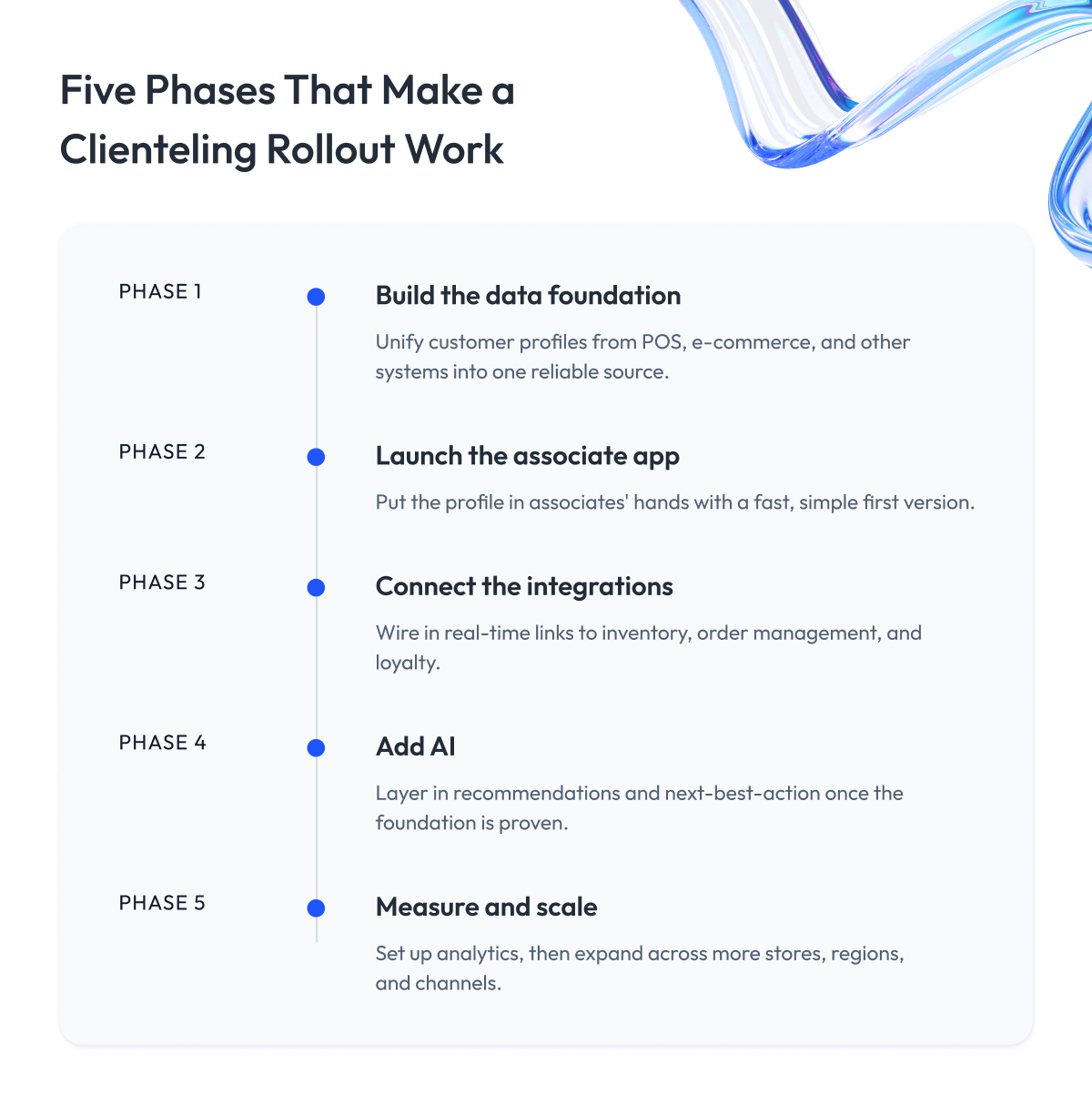
We have built clienteling systems for retailers at different sizes and stages, and implementing clienteling has taught us one pattern that works far better than the rest. Successful clienteling and the best modern clienteling strategies all share this same disciplined sequence.
You roll it out in phases, in a set order, where each phase earns the next. Teams that try to launch everything at once tend to stall. The teams we see succeed build the foundation first and add capability step by step.
These clienteling best practices form the sequence our team follows on client projects.
Phase 1 – Build the data foundation
We start with the data. Our engineers unify customer profiles from your POS, e-commerce, and other systems into one reliable source. Nothing above this layer works until the data underneath is accurate.
Phase 2 – Launch the associate app
Next, we put that profile in the associate’s hands through a fast app. We keep the first version deliberately simple, so associates adopt it on the floor instead of avoiding it. Early wins here build the trust that carries the rest of the rollout.
Phase 3 – Connect the integrations
With the app in use, our team wires in real-time links to inventory, order management, and loyalty. This is the phase where recommendations become trustworthy, because the app now knows what is in stock and what a customer already owns.
Phase 4 – Add AI
Once the data and integrations are solid, we layer in AI for recommendations and next-best-action. We add it only after the foundation is proven, since an AI model built on messy data produces confident but wrong answers.
Phase 5 – Measure and scale
Finally, we set up the analytics that show what is working, then expand the program across more stores, regions, and channels. Measurement guides where you invest next, so scaling follows evidence instead of guesswork.
When a retailer comes to us mid-rollout with a program that stalled, the cause is almost always a phase that got skipped, usually the data foundation. Our company treats these phases as a build sequence, and we can join at whatever phase you are in today.
Final Word
If you have read this far, you already grasp the core trade-offs. Clienteling is a personal service practice standing on a solid engineering foundation.
The execution is what takes work, and that means the unified profile, the real-time integrations, and the disciplined rollout that make it work at scale.
Getting there takes serious effort. You have to audit your data, choose between building and buying, wire systems together, and earn adoption on the sales floor. That work pays off, because a clienteling program done right compounds. Every interaction makes the customer profile richer, every visit deepens the relationship, and your best customers give you more of their spend over time.
The cost of getting it wrong is just as concrete. A rushed rollout on a shaky data foundation produces wrong recommendations, frustrated associates, and a tool that quietly gets abandoned, along with the budget behind it.
So start where it counts. Find your maturity stage honestly, fix the data foundation first, and add one capability at a time. Treat clienteling as a build sequence, and let each phase prove itself before you fund the next.
If you want a partner for that build, our team is ready to review your systems, map your clienteling roadmap, and help you turn customer data into lasting relationships with customers who matter most to your business.
Questions You May Have
What is clienteling, and where does the term come from?
Clienteling is a data-driven practice of using customer data to give shoppers personalized, relationship-driven service, and the term comes from clientele, so it is indeed a genuine retail word.
How is clienteling different from personalization or CRM?
Clienteling has a store associate act on customer data during a personal interaction, whereas personalization automates tailored content and a CRM only stores the underlying customer information.
What technology do you need for clienteling?
You need a unified customer profile on a CRM or CDP, an associate app, real-time POS and inventory integration, AI recommendations, omnichannel outreach, and analytics.
What is digital, mobile, and virtual clienteling?
Digital clienteling serves customers through online channels, mobile clienteling runs on an associate’s handheld device in the store, and virtual clienteling connects with shoppers remotely by video or chat.
Should we buy a clienteling app or build our own?
Buy a ready-made clienteling app when speed matters and your needs are standard, and build a custom one when clienteling is central to how you compete and no product fits your scale.
How do you measure clienteling ROI?
Measure clienteling ROI by comparing the spend uplift, repeat rate, and customer lifetime value of clienteled customers against a similar control group over time.
How does AI fit into clienteling?
AI recommends the next best action and flags which customers to reach, while the associate makes the final call instead of the software.
How do you protect customer data in clienteling?
Protect customer data in clienteling with explicit consent, role-based access governance, encryption in transit and at rest, and compliance with standards such as SOC 2, GDPR, and CCPA.
What are some examples of clienteling?
Common clienteling examples include a luxury associate texting a client about a new arrival in their size, a beauty advisor suggesting a refill based on past purchases, or the appointment-based luxury retail clienteling that high-end brands are known for.