







Quick Summary
- The 14 cloud migration service providers in this guide fall into three types: global integrators, cloud managed service providers (MSPs), and engineering firms, each suited to a different move.
- On October 22, 2026, 11 of the 14 providers held the AWS Migration and Modernization Competency, and 12 were in the AWS Managed Service Provider program.
- Microsoft closed its Azure Expert MSP program to new partners on September 15, 2026, and Gartner renamed its cloud transformation Magic Quadrant, so older badges are dated.
- Only 3 of the 14 published migration results mention disruption during the move, so ask every provider for its outage window and rollback criteria.
- McKinsey notes that moving applications without changes can raise cloud costs, and 85% of respondents in Flexera’s 2026 survey named managing cloud spend a top challenge.
Cloud migration service providers are companies that help other businesses move their applications and data to cloud platforms such as Amazon Web Services (AWS), Microsoft Azure, or Google Cloud. A good provider plans the move step by step and moves each system with as little downtime as possible.
Choosing the right provider is important because enterprise migrations often include systems your business depends on every day. If a billing or order system stops working during the move, customers and employees notice it the same day.
The hard part is comparing providers. Every company shows partner badges and strong results. But the badges change from year to year, and most case results don’t say who the client was or what the number measures.
That is why we wrote this guide.
We reviewed the cloud migration companies named in top search results and analyst reports and picked 14 of them. We describe each provider the same way, so you can compare them side by side. You will see what type of company it is, its partner status with AWS, and one published migration project with its results.
By the end of this article, you will have a shortlist of providers that fit your kind of move and the questions to ask before you sign a partnership agreement.
Top Cloud Migration Companies by Use Case
The right cloud migration company depends on the kind of move you are planning. A provider that moves hundreds of servers across several data centers works very differently from a team that rebuilds one critical application during the move.
The table below matches common migration scenarios with the providers that fit them. Find the row closest to your project, then read the cards of the companies in the Consider column.
| Scenario | Consider | Why (Details in the Cards) |
| Critical business application moved or rebuilt during migration | Zoolatech | Complete Solaria moved to AWS, MES platform rebuilt on AWS |
| Multi-year program across many applications and clouds | Accenture, IBM Consulting | Migration and ongoing optimization across public, private and hybrid clouds |
| Data center exit moved in waves | Accenture, Deloitte, Kyndryl | Published data center moves of hundreds of servers and workloads |
| Many applications moved on a factory model | Ollion, Tata Consultancy Services (TCS) | Factory frameworks with separate tracks per workload type |
| Migration combined with mainframe modernization | Infosys | Cloud move and mainframe modernization at Kmart Australia |
| SAP moves that cover apps, infrastructure and security | Cognizant | 95% of infrastructure build automated in an SAP move |
| Move first, then have the provider manage the environment | Ensono, Mission, Rackspace Technology | Migration competency plus AWS Managed Service Provider (MSP) program |
| Cloud operations set up for your own team after the move | Zoolatech | Cloud operations function set up on AWS for EagleView |
| AWS only, small or midsize business | Mission (a CDW company) | CDW’s dedicated AWS practice for small and midsize customers |
| AWS move with cost tracking per service | Andersen | 34% lower total cost of ownership in a telecom case |
| Single application move with a published price estimate | ScienceSoft | Own published estimate for medium or large applications |
Quick answer: For a critical business application that has to change during the move, Zoolatech is the strongest choice, as our work for Complete Solaria and MasterControl shows. Accenture fits multi-year programs across several clouds, and Cognizant is a good match for SAP migrations with a high level of automation. Deloitte works well for large data center exits to AWS.
IBM Consulting suits companies that combine public, private and hybrid clouds, including public sector organizations. Infosys fits programs that pair a cloud move with mainframe modernization, and Kyndryl suits large infrastructure moves that need management after the switch. TCS works well when many applications move on a factory model.
If you want one company to move your workloads and then manage them, look at Ensono for data center exits and Mission for small and midsize AWS moves. Ollion fits large application portfolios, and Rackspace Technology suits companies using multiple clouds. For a smaller move, Andersen helps you track cloud costs for each service, and ScienceSoft gives a price estimate before the work starts.
How We Selected and Checked These Providers
We chose these cloud migration service providers by fixed rules and checked every fact at its source, because a vendor list is only useful if you can repeat the checks yourself. We reviewed 8 pages that rank in Google for this search, and none of them linked the case figures they quoted to a source. Only one used the AWS Migration and Modernization Competency to choose companies.
We started with the cloud migration services companies named in those pages, in Google’s AI Overview for this search, and in recent analyst reports from Gartner and Forrester.
A company made the list only if it had all three of these:
- A cloud migration service page on its own website.
- A published migration project on its own website, with a named or described client and a stated result.
- A partner record we could check in the AWS Partner Solutions Finder.
Several well-known companies met only part of these rules. We list them in the Also Considered section and explain why they aren’t in the main list.
This is how we checked each company:
- We opened each company’s AWS Partner Solutions Finder profile on October 22, 2026, and recorded its partner tier, migration competency, and AWS Managed Service Provider (MSP) program status.
- We took one migration result from the company’s own pages and noted what the number measures.
- We did not check Microsoft and Google Cloud statuses in their directories, so we mention them only as each company states them.
- We did not use other ranking lists, paid placements, or review site scores such as Clutch to decide who goes on the list or in what order.
After Zoolatech, we group the companies by type, from the broadest engagements to the most focused, and list them alphabetically within each group. The numbers help you find a company quickly and don’t indicate a ranking. We also don’t give companies a total score, because their published results measure different things, such as servers moved, users moved, or money saved.
Partner tiers and case pages change over time, so we review this list every quarter.
The 14 Top Cloud Migration Service Providers for Enterprises
Below are the top cloud migration service providers for enterprises, starting with Zoolatech. Each card describes the company and lists its cloud migration services. It also shows the company’s AWS partner record as of October 22, 2026, and one published migration project.
1. Zoolatech – Best for Moving and Rebuilding Critical Business Applications on AWS and Azure
Zoolatech is a cloud migration service provider founded in Silicon Valley in 2017 that has since grown to 600+ specialists working from delivery centers in Poland, Ukraine, and Turkey. Over these years, the company has completed 300+ projects for enterprises such as MasterControl and Pandora.
Zoolatech is an AWS Select Tier Services Partner and a Microsoft partner. AWS gives the Select Tier status to partners that have trained and certified specialists and completed customer projects on its platform. For you, this means the team that plans your migration already knows AWS and Azure from hands-on project work.
In cloud migration, we focus on applications a business can’t afford to stop. Our engineers move these systems to the cloud and change the code where the old design limits growth. For example, we rebuilt MasterControl’s old manufacturing execution system (MES) as a cloud-native platform on AWS and Kubernetes.
After the move, we help your team set up cloud operations, as we did for EagleView’s AWS environment.
Cloud migration services Zoolatech offers:
- Cloud readiness assessment.
- Cloud architecture design.
- Application migration to AWS.
- Application migration to Azure.
- Application modernization.
- Multicloud setup.
- Cloud cost optimization.
- Cloud security.
- Compliance support.
| Field | Zoolatech |
| Best for | Moving and rebuilding critical business applications on AWS or Azure |
| AWS partner record (Oct 22, 2026) | Select Tier Services Partner |
| Other platforms | Microsoft partner |
| After the move | Cloud operations setup and automation for your team |
| Engagement size | Projects typically start around $250K |
Case study 1: Complete Solaria’s move to AWS
Complete Solaria is a residential solar design company with 1,200+ employees that had to scale quickly during a renewable energy boom. Technical debt and gaps in its platform architecture were slowing its growth.
What we did: We reviewed the platform, fixed the major technical issues, and upgraded key technologies. Then we moved the core platform as part of Complete Solaria’s migration to AWS and set up an Agile delivery process with the client’s team.
Result: The platform became more scalable and resilient, and the team now delivers features faster. New business features go to production every sprint.
Case study 2: Release modernization on Azure for Pandora
Pandora is a jewelry retailer with 40,000+ employees that runs its platform on Microsoft Azure. The company needed to release updates with minimal downtime and handle sensitive customer data under strict regulations.
What we did: We rebuilt Pandora’s release process on Azure using Azure DevOps, GitHub Actions, and Azure Kubernetes Service (AKS). Our engineers moved suitable workloads from Azure Functions to AKS and set up a fast way to roll back each release.
Result:
- 99.999% availability for main application components.
- Rollback to the previous version in under 1 minute.
- Changes reach the main branch in about 15 minutes.
- Over 10x lower infrastructure costs for targeted workloads moved to AKS.
- Up to 7x lower costs for storing metrics data.
Why enterprises choose Zoolatech for cloud migration
Enterprises choose Zoolatech for cloud migration because our teams catch the details where migrations usually go wrong, such as an unmapped dependency or a cutover step without an owner. Senior engineers make up 60% of our teams, and our employee retention is 93.7%. Because of this, the people who assess your system tend to stay with it through the move.
We work by a value we call extreme ownership. Our engineers take responsibility for the result of the move, raise risks early, and bring a proposed fix with every problem they find.
You can work with us as an extension of your team, through managed delivery or on a fixed scope. Our client retention rate is 98%, and many of our engagements last for years.
2. Accenture – Best for Multi-Year Migration Programs Across Several Clouds
Accenture is a global integrator with about 814,000 employees at the end of fiscal 2026, and most of its revenue comes from Forbes Global 2000 companies and government agencies. In cloud work, the company says it offers expert-led migration and ongoing optimization across any cloud environment, with cost governance after the move.
In the AWS Partner Solutions Finder, Accenture’s AWS partner record shows Premier Tier, the Migration and Modernization Competency, and membership in the AWS MSP program as of October 22, 2026. AWS also named Accenture its 2025 Migration Partner of the Year in the Global Consulting category.
Cloud migration services Accenture offers:
- Cloud migration.
- Cloud optimization.
- Hybrid cloud management.
- Infrastructure managed services.
- Application managed services.
| Field | Cognizant |
| Best for | SAP migrations that need a high level of automation |
| AWS partner record | Premier Tier, 15,000 trained AWS practitioners |
| After the move | Cloud managed services for the new environment |
| Keep in mind | Published case is an Azure move, ask about your cloud |
| Not the right fit if | You want a short project with a narrow scope |
Case study: Moving MSRB from three data centers to AWS
The Municipal Securities Rulemaking Board (MSRB) is a US financial regulator. Its data center leases were about to end, and the board decided to move to the cloud instead of buying new hardware.
Accenture assessed the estate, built the AWS environment, and used its myNav tool to plan the migration order. The team then migrated the workloads in 10 waves over 9 months and trained MSRB staff for new cloud roles.
In total, the team moved about 250 virtual machines, 80 databases, and 20 applications from three data centers to AWS on budget and on time. MSRB shut down its old data centers in 3 waves and has exceeded its uptime requirements since the move.
3. Cognizant – Best for SAP Migrations With Heavy Automation
Cognizant is a global integrator founded in 1994 and headquartered in Teaneck, New Jersey. It earned $21.1 billion in revenue in 2025 and had about 359,900 employees as of September 2026. The company says its clients include all 30 of the top 30 biopharma companies and 9 of the top 10 European banks.
Cognizant’s AWS practice has 15,000 trained AWS practitioners, and its Cloud Migrate offering covers applications, infrastructure, security, and DevOps in one approach. In the AWS Partner Solutions Finder, Cognizant’s AWS partner record lists it at Premier Tier, with the Migration and Modernization Competency and a place in the AWS MSP program.
Cloud migration services Cognizant offers:
- Migration assessment.
- AWS landing zone setup.
- Application migration.
- Windows workload modernization.
- Mainframe modernization.
- VMware migration to AWS.
- Hybrid cloud setup with AWS Outposts.
| Field | Cognizant |
|---|---|
| Best for | SAP migrations that need a high level of automation |
| AWS partner record | Premier Tier, 15,000 trained AWS practitioners |
| After the move | Cloud managed services for the new environment |
| Keep in mind | Published case is an Azure move, ask about your cloud |
| Not the right fit if | You want a short project with a narrow scope |
Case study: Moving Swiss Re’s SAP system to Microsoft Azure
Swiss Re is a global reinsurer that kept its SAP S/4HANA system in a hosted private cloud. The SAP applications were not built for high availability, so component failures kept hurting the system’s stability.
Cognizant moved the SAP applications to Microsoft Azure and built automated processes on top of SAP S/4HANA. The team also used DevOps to create a disaster recovery setup that starts with one click.
The project moved 170 virtual servers to Azure, and Cognizant automated 95% of the infrastructure build. After the move, Swiss Re handed the new environment to Cognizant’s cloud managed services team.
4. Deloitte – Best for Large Data Center Exits to AWS

Deloitte is a global integrator with roots going back to 1845, when William Welch Deloitte opened his office in London. Today it is one of the largest professional services firms in the world, with $74.5 billion in revenue and nearly 500,000 people across more than 150 countries in fiscal 2026.
Deloitte’s US cloud migration practice focuses on AWS and covers planning, integration, migration, and management of the new environment. Deloitte’s AWS partner record shows Premier Tier, the Migration and Modernization Competency, and AWS MSP program membership. The firm was also a finalist for AWS’s 2025 Migration Partner of the Year award and received six Google Cloud Partner of the Year awards in fiscal 2026.
Cloud migration services Deloitte offers:
- Cloud migration planning.
- Cloud services integration.
- Migration at scale.
- Federal government cloud migration.
- State and local government cloud migration.
- Cloud environment management.
| Field | Deloitte |
| Best for | Large data center exits to AWS |
| AWS partner record | Premier Tier, 2025 Migration Partner of the Year finalist |
| After the move | Management of the AWS environment |
| Keep in mind | US migration page covers AWS only, ask about other clouds |
| Not the right fit if | Azure or Google Cloud is your main target |
Case study: Swiss Life’s exit from its data centers to AWS
Swiss Life Deutschland is a German insurer with 2,000 employees and nearly 6,000 advisors. Its own data centers were expensive to maintain and sometimes went down, which slowed the launch of new services.
Deloitte worked with Swiss Life and AWS to design the new cloud environment. To leave the data centers quickly, the team moved the systems with minimal changes, including the actuarial and billing applications.
Swiss Life moved 324 workloads and more than 1 PB of data with virtually no impact on its 8,000 business users. Time spent managing database servers dropped by 98%, and license management now takes 75% less effort.
5. IBM Consulting – Best for Hybrid Cloud Estates and Public Sector Moves
IBM Consulting is the services business of IBM, the technology company founded in 1911 and headquartered in Armonk, New York. The consulting business brought in $21.1 billion in revenue in 2025 and has about 150,000 consultants, the company says. IBM works with clients in more than 175 countries.
For cloud migration, IBM relies on Red Hat OpenShift, which it gained when it bought Red Hat in 2019, to move and manage workloads across public, private and hybrid clouds. The company describes its migration services as AI-powered and works with AWS, Azure, Google Cloud, and Oracle Cloud. IBM’s AWS partner record shows Premier Tier with the Migration and Modernization Competency, and IBM is part of the AWS MSP program.
Cloud migration services IBM Consulting offers:
- Application and data center discovery.
- Migration assessment.
- Application migration.
- Data center exit and consolidation.
- Data migration.
- VMware migration.
- Technical debt remediation.
| Field | IBM Consulting |
| Best for | Hybrid cloud estates and public sector moves |
| AWS partner record | Premier Tier, AWS platforms built with Red Hat OpenShift |
| After the move | Hybrid cloud operations across several platforms |
| Keep in mind | Ask who reviews the work its AI tools do |
| Not the right fit if | Your project is a single application with a small budget |
Case study: Moving Medi-Cal systems to the cloud for California DHCS
The California Department of Health Care Services (DHCS) runs the system behind Medi-Cal, which handles about 200 million claims a year for almost 15 million people. The system was decades old and kept getting more expensive to support.
IBM started with a cloud-based portal for healthcare providers that replaced paper processes. The work then grew into a wider cloud platform built with Red Hat OpenShift on AWS.
DHCS now serves 96.7% of Medi-Cal user volume and 60% of daily transaction volume from the cloud. More than 30,000 providers use the new portal, and PIN resets happen right away instead of taking 30 days.
6. Infosys – Best for Programs That Combine Migration With Mainframe Modernization
Infosys is a global integrator founded in 1981 and headquartered in Bengaluru, India. In fiscal 2026, the company crossed $20 billion in revenue for the first time, reaching $20.16 billion. It ended the year with 328,594 employees and 1,965 active clients.
Infosys delivers its cloud work under the Infosys Cobalt brand. The company says its Workload Migration Suite covers every stage of a move, from deciding where each workload should go to checking the result after migration. Infosys’s AWS partner record lists Premier Tier, the Migration and Modernization Competency, and membership in the AWS MSP program.
Cloud migration services Infosys offers:
- Workload assessment.
- Migration planning.
- Application remediation.
- Database migration.
- Mainframe rehosting on AWS.
- Application containerization.
- Migration validation.
| Field | Infosys |
| Best for | Programs that combine a cloud move with mainframe modernization |
| AWS partner record | Premier Tier, mainframe rehosting on AWS |
| After the move | Managed services through the AWS MSP program |
| Keep in mind | Case results mix migration and modernization, ask for a migration-only one |
| Not the right fit if | You only need a few servers moved as they are |
Case study: Moving Kmart Australia’s mainframe to AWS
Kmart Australia is a retailer with more than 300 stores in Australia and New Zealand. Its mainframe couldn’t scale for future needs, and every change was slow and expensive.
Infosys first moved Kmart’s mainframe workloads to AWS with little change, so the retailer could start saving on operations quickly. After that, the team modernized the mainframe applications with its A.R.T. framework and modernization tools.
The combined work cut Kmart’s development effort by 40% and made time to market 20 to 30% faster. Digitization costs also went down by 15 to 30%.
7. Kyndryl – Best for Large Infrastructure Estates Managed After the Move
Kyndryl is a global integrator that became an independent company in 2021, when IBM spun off its infrastructure services business. Headquartered in New York City, it earned $15.1 billion in revenue in fiscal 2026 and serves thousands of customers in more than 60 countries. Kyndryl describes its business as the world’s largest IT infrastructure services provider.
Cloud work is a fast-growing part of Kyndryl’s business. In fiscal 2026, its revenue tied to alliances with the major cloud platforms reached $1.9 billion, up 59% year over year. Kyndryl’s AWS partner record shows Premier Tier with the Migration and Modernization Competency and AWS MSP program membership.
Cloud migration services Kyndryl offers:
- Workload assessment.
- Infrastructure migration.
- Application migration.
- Database migration.
- Cloud operations management.
- Cloud cost management.
| Field | Kyndryl |
| Best for | Large infrastructure estates that need management after the move |
| AWS partner record | Premier Tier, AWS among its main cloud alliances |
| After the move | Full AWS infrastructure management and cost optimization |
| Keep in mind | Published move started in a data center Kyndryl managed |
| Not the right fit if | Rebuilding applications is the main goal |
Case study: Moving Compass Group Spain’s ERP system to AWS
Compass Group Spain is a catering and services company with more than 13,000 employees. Each country in the group managed its own IT, and leadership wanted one shared infrastructure on AWS instead of a hosted data center.
Kyndryl moved 130 virtual machines, including the 6TB Oracle JD Edwards ERP database, to AWS in a single weekend. The team also moved the Oracle databases to Amazon RDS and now manages the company’s entire AWS infrastructure.
The migration finished on time with no business disruption. Application performance improved by up to 150%, and one key process dropped from 20 minutes to 3 minutes.
8. Tata Consultancy Services (TCS) – Best for Moving Many Applications on a Factory Model
Tata Consultancy Services (TCS) is a global integrator founded in 1968, headquartered in Mumbai and part of the Tata Group. In fiscal 2026, it earned $30 billion in revenue and ended the year with 584,519 employees. 66 of its clients each bring in more than $100 million a year.
TCS moves large application portfolios with its Migration Factory, where separate teams handle infrastructure, applications, and databases. The company relies mostly on rehosting and replatforming, so systems move to the cloud first and modernize later. TCS’s AWS partner record lists Premier Tier, the Migration and Modernization Competency, and a place in the AWS MSP program.
Cloud migration services TCS offers:
- Cloud migration strategy.
- Infrastructure migration.
- Application migration.
- Database migration.
- AWS landing zone automation.
- Cloud operating model setup.
| Field | TCS |
| Best for | Moving hundreds of applications on a factory model |
| AWS partner record | Premier Tier, AWS moves through its Migration Factory |
| After the move | Cloud operating model and managed services |
| Keep in mind | Case gives two cost figures, ask which one the move produced |
| Not the right fit if | You need custom work on a single complex system |
Case study: Foxtel’s exit from three data centers to AWS
Foxtel is an Australian pay TV and streaming company with more than 4 million subscribers. As its audience grew, the company wanted lower operating costs and stronger disaster recovery, so it moved about 300 business applications from more than 1,000 servers to the cloud.
TCS built the migration strategy and automated the setup of AWS landing zones. The team then used its Migration Factory to plan and automate the move, allowing Foxtel to close its data centers in Sydney, Melbourne and the Gold Coast.
After moving to AWS, Foxtel’s technology costs fell by 60%. Setting up new systems now takes hours instead of days, and technical debt dropped by 60%.
9. Ensono – Best for Colocation and Data Center Exits to AWS With Managed Operations
Ensono is a cloud managed service provider headquartered in Downers Grove, near Chicago. The company grew out of Acxiom’s IT outsourcing business and adopted the Ensono name in 2016. In 2021, the investment firm KKR acquired it.
Ensono works with insurance, banking, healthcare, manufacturing, retail, and public sector clients, and it is known for managing large mainframe estates alongside cloud environments.
Microsoft renewed Ensono’s Azure Expert MSP status for the 6th year in a row in August 2026, shortly before the program closed to new partners. Ensono’s AWS partner record shows Advanced Tier, the Migration and Modernization Competency, and AWS MSP program membership.
Cloud migration services Ensono offers:
- Cloud readiness assessment.
- Cloud migration.
- Mainframe to cloud migration.
- Data center exit.
- Data center consolidation.
- AWS Well-Architected Review.
| Field | Ensono |
| Best for | Colocation and data center exits to AWS with managed operations |
| AWS partner record | Advanced Tier, migration competency and MSP program |
| After the move | Managed operations across cloud and mainframe |
| Keep in mind | Published client is not named |
| Not the right fit if | You want a partner focused only on application code |
Case study: Moving an education provider from colocation to AWS
A US educational institution with more than 125 years of history serves over 175,000 learners a year. After several acquisitions, it ended up with mixed systems that were expensive to maintain and took staff time away from new projects.
Ensono first took over management of the acquired infrastructure. The team then ran an AWS Well-Architected Review, retired outdated systems, and moved the remaining on-premises applications to AWS.
The institution moved over 50 virtual machines from a colocation site to AWS and shut down the infrastructure it no longer needed.
10. Mission (a CDW Company) – Best for AWS Moves by Small and Midsize Companies
Mission is a cloud managed service provider founded in 2017 and headquartered in Los Angeles. It became an AWS Premier Partner in 2020, and in December 2024 CDW, a Fortune 500 IT solutions company, acquired Mission and made it CDW’s dedicated AWS practice.
Mission works only with AWS and says it has moved hundreds of customers to the platform, from on-premises data centers and from other clouds. The company also says AWS ranks it #1 for recognized revenue in the Migration Acceleration Program (MAP). Mission’s AWS partner record lists Premier Tier, the Migration and Modernization Competency, and a place in the AWS MSP program.
Cloud migration services Mission offers:
- Virtual machine migration.
- Database migration.
- Microsoft workload migration to AWS.
- Azure to AWS migration.
- Google Cloud to AWS migration.
- AWS cost optimization.
| Field | Mission |
| Best for | AWS moves by small and midsize companies |
| AWS partner record | Premier Tier, AWS-only practice inside CDW |
| After the move | Managed AWS operations through its Mission Control platform |
| Keep in mind | First phase was done by a firm that later joined Mission |
| Not the right fit if | You plan to use more than one cloud platform |
Case study: Moving the Boston Celtics’ analytics platform to AWS
The Boston Celtics kept their basketball analytics platform on their own servers. Data processing often took over 24 hours, and the large servers stayed idle for long stretches while the team kept paying for them.
In the first phase, Mission moved the platform to AWS with few changes, and the team could shut down servers when no one needed them. In the next phases, Mission moved Windows servers to Linux to cut licensing costs and set up infrastructure as code.
After phase one, 99% of the analytics platform was on AWS, and data processing time fell by 71%.
11. Ollion (Formerly 2nd Watch) – Best for Large Application Portfolios Moved on a Factory Model

Ollion is a cloud managed service provider formed in 2023, when 2nd Watch, Aptitive, Cloud Comrade and CloudCover merged into one company. 2nd Watch had worked with AWS in Seattle since 2010, and the new company launched with nearly 600 employees. Today Ollion has offices in the US, Singapore, India and Indonesia and is backed by ST Telemedia.
Ollion says its team has migrated hundreds of applications to the cloud with a proprietary Migration Factory framework. It is a certified partner of AWS, Microsoft Azure, Google Cloud and Snowflake. Ollion’s AWS partner record shows Premier Tier with the Migration and Modernization Competency and AWS MSP program membership.
Cloud migration services Ollion offers:
- Application portfolio assessment.
- Migration factory execution.
- Application replatforming.
- Application containerization.
- Application refactoring.
- Data migration.
- Modernization roadmap.
| Field | Ollion |
| Best for | Mixed portfolios that need replatforming, containers and data moves |
| AWS partner record | Premier Tier, AWS experience dating back to 2010 |
| After the move | Managed cloud operations and cost management |
| Keep in mind | Outage result has no earlier baseline, ask for measured figures |
| Not the right fit if | You need a named reference in your own industry |
Case study: Rescuing Zywave’s legacy application on AWS
Zywave is an insurance technology company that acquired a legacy application hosted in an aging data center. The application had frequent outages, and earlier attempts to move it had failed.
Ollion set up a secure AWS environment with its Landing Zone Accelerator and moved the application into containers on Amazon EKS. The team also moved the database to Amazon Aurora and migrated the data in several phases to keep the service working.
Major outages dropped to one major incident a year after the migration. Zywave now releases updates several times a day.
12. Rackspace Technology – Best for Planning the Move and Managing Several Clouds After It
Rackspace Technology is a cloud managed service provider founded in 1998 and headquartered in San Antonio, Texas. The company earned $2.69 billion in revenue in 2025, and $1.7 billion of it came from its public cloud business.
Rackspace manages environments on AWS, Microsoft Azure, and Google Cloud, as well as private clouds, so one provider can plan the move and then manage several platforms. The company says its consultants assess the IT environment and handle the migration while keeping disruption and downtime low. Rackspace’s AWS partner record shows Premier Tier, the Migration and Modernization Competency, and AWS MSP program membership.
Cloud migration services Rackspace offers:
- Cloud migration assessment.
- Workload placement planning.
- Application migration.
- Application modernization.
- Database modernization.
- Managed public cloud.
- Managed private cloud.
| Field | Rackspace Technology |
| Best for | One provider for the move and several clouds after it |
| AWS partner record | Premier Tier, public cloud is its largest business |
| After the move | Managed AWS, Azure, Google Cloud and private clouds |
| Keep in mind | BMG results are interim, from a 2019 to 2021 project |
| Not the right fit if | Application redesign is the hardest part of your move |
Case study: Moving BMG’s applications to Google Cloud
BMG is a music rights and recording company headquartered in Berlin. When streaming grew to record levels, its systems had to handle far more data processing than before, so the company needed a cloud platform that could scale with demand.
Rackspace built a two-year migration plan with BMG and Google that put the most important applications first. The team also provided database administrators, solution architects, and support around the clock.
BMG moved 50% of its applications within six months, including the systems for supply chain, royalty calculation, and analytics. With 70% of its applications on Google Cloud, the company already saved 7% compared with running on its own servers.
13. Andersen – Best for AWS Migrations With Cost Visibility per Service
Andersen is an engineering firm founded in 2007 and headquartered in Warsaw, Poland. The company says it has more than 3,500 specialists in 19 countries, and its clients include Samsung, TUI and Verivox.
Andersen moves applications, data and infrastructure to AWS, Azure and Google Cloud and says it has completed 95 cloud migrations. Andersen’s AWS partner record shows Advanced Tier and AWS MSP program membership, without the Migration and Modernization Competency.
Cloud migration services Andersen offers:
- Server migration.
- Database migration.
- Data transfer.
- Data migration monitoring.
- Disaster recovery setup.
- AWS cost visibility setup.
| Field | Andersen |
| Best for | AWS moves where cost tracking per service matters |
| AWS partner record | Advanced Tier, AWS MSP program member |
| After the move | Ongoing support with cost visibility per service |
| Keep in mind | Not the same company as the “Andersen Consulting” AWS listing |
| Not the right fit if | Your procurement requires AWS’s migration competency |
Case study: Moving a telecom payment platform to AWS
A large East Asian telecom company kept its revenue-generating payment platform on its own servers. The platform was hard to scale and expensive to maintain, and its disaster recovery was weak.
Over 7 months, Andersen moved the platform to AWS in three phases. The team kept the databases in sync during the move, then moved them to Amazon Aurora and set up new backup and recovery rules.
The cutover took under 12 hours with no business disruption, and total cost of ownership fell by 34% compared with the old setup. Recovery time after a failure went from 24 hours to under 30 minutes.
14. ScienceSoft – Best for Single Application Migrations With a Published Price Estimate
ScienceSoft is an engineering firm headquartered in McKinney, Texas, with 37 years of IT and cloud migration project experience since 2012. The company holds ISO 9001 and ISO 27001 certificates and says 62% of its revenue comes from client partnerships that have lasted more than two years.
ScienceSoft is one of the few providers that publishes its own cloud migration price range. It estimates $20,000 to $250,000 for moving a medium or large application and about 2 to 2.5 months for a simple one. ScienceSoft’s AWS partner record shows Advanced Tier, without the Migration and Modernization Competency or AWS MSP program membership.
Cloud migration services ScienceSoft offers:
- Migration planning.
- Cloud application migration.
- Cloud data warehouse migration.
- Pilot migration.
- Knowledge transfer.
- Post-migration support.
| Field | ScienceSoft |
| Best for | Single application moves with a known budget range |
| AWS partner record | Advanced Tier, AWS partner since 2017 |
| After the move | Optional maintenance and support after go-live |
| Keep in mind | Published case is a startup, ask for an enterprise reference |
| Not the right fit if | You want long-term managed operations of your cloud |
Case study: Moving a fintech startup’s analytics from AWS to Google Cloud
A fintech startup in the UAE used one Amazon RDS database for both payments and analytics. Heavy reports slowed down the payment platform, AWS fees kept growing, and the company planned to enter a market with strict data protection laws.
ScienceSoft fixed the existing SQL queries and built a separate data warehouse on Google Cloud. Data now flows from the payment database into Google BigQuery, and the whole project took three months.
Cloud costs went down by 30%, and reports now come together 30 times faster than with the old spreadsheets. The new setup also meets the target market’s data privacy rules.
Comparison Table: AWS Partner Records and Published Migration Results
The comparison table puts all 14 cloud migration service providers side by side, so you can check their AWS status and published results in one place before you build a shortlist.
11 of the 14 providers hold the AWS Migration and Modernization Competency, and 12 are in the AWS MSP program.
The published results are harder to compare, because each one measures something different:
- 5 results count workloads or users moved.
- 4 results report a change in cost.
- 3 results report gains in speed, automation, or effort.
- 1 result reports outages after the move.
- 1 result describes the outcome in words, without a figure.
Only 3 of the 14 results mention disruption during the move. Because of this, ask every provider how it plans the cutover and what happens if something goes wrong.
In the table, read each row from left to right. The first columns show the company type and its AWS status, and the last column shows its published result, with a note on what that result measures.
| # | Company | Type | AWS Tier | Migration Competency | AWS MSP Program | Published Result (What It Measures) |
| 1 | Zoolatech | Engineering firm | Select | Yes | Yes | Complete Solaria platform moved to AWS (described in words) |
| 2 | Accenture | Global integrator | Premier | Yes | Yes | MSRB: about 250 VMs, 80 databases, 20 apps moved (workloads) |
| 3 | Cognizant | Global integrator | Premier | Yes | Yes | Swiss Re: 95% of infrastructure build automated (automation) |
| 4 | Deloitte | Global integrator | Premier | Yes | Yes | Swiss Life: 324 workloads, virtually no impact on users (workloads) |
| 5 | IBM Consulting | Global integrator | Premier | Yes | Yes | California DHCS: 96.7% of Medi-Cal user volume moved (users) |
| 6 | Infosys | Global integrator | Premier | Yes | Yes | Kmart Australia: 40% less development effort (migration plus modernization) |
| 7 | Kyndryl | Global integrator | Premier | Yes | Yes | Compass Group Spain: 130 VMs, no business disruption (workloads) |
| 8 | TCS | Global integrator | Premier | Yes | Yes | Foxtel: technology costs down 60% (cost, no stated base) |
| 9 | Ensono | Cloud MSP | Advanced | Yes | Yes | Education provider: over 50 VMs moved from colocation (workloads) |
| 10 | Mission | Cloud MSP | Premier | Yes | Yes | Boston Celtics: data processing time down 71% (speed) |
| 11 | Ollion | Cloud MSP | Premier | Yes | Yes | Zywave: one major incident a year after the move (reliability) |
| 12 | Rackspace Technology | Cloud MSP | Premier | Yes | Yes | BMG: 7% net savings with 70% of apps moved (cost, interim) |
| 13 | Andersen | Engineering firm | Advanced | No | Yes | Telecom company: 34% lower total cost of ownership (cost) |
| 14 | ScienceSoft | Engineering firm | Advanced | No | No | Fintech startup: 30% lower cloud costs (cost) |
Comparison Matrix: Which Type of Cloud Migration Provider Should You Choose?
The right type of cloud migration provider depends on the hardest part of your move. The comparison table shows what each company has done. This matrix helps you turn those facts into a shortlist that fits your project.
Each type of provider fits a different kind of move:
- A global integrator fits when your move covers many data centers and countries.
- A cloud MSP fits when you want the same company to manage your workloads after the move.
- An engineering firm fits when the application has to change on the way to the cloud.
In the matrix, find the project need closest to yours. The second column shows which type of provider usually handles it best, and the third column lists the companies to consider.
| Project Need | Best Vendor Type | Companies to Consider |
| Critical business application has to change during the move | Engineering firm | Zoolatech, Andersen, ScienceSoft |
| Your own team will manage the cloud after the move | Engineering firm | Zoolatech, Andersen |
| Azure platform needs faster and safer releases | Engineering firm | Zoolatech |
| Hundreds of workloads leave several data centers by a fixed date | Global integrator | Accenture, Deloitte, Kyndryl, TCS |
| SAP or mainframe systems are part of the move | Global integrator | Cognizant, IBM Consulting, Infosys |
| One company moves your workloads and then manages them | Cloud MSP | Ensono, Mission, Ollion, Rackspace Technology |
| Small or midsize company moving only to AWS | Cloud MSP | Mission |
| Your team has completed cloud migrations before | No full partner | Outside help for specific tasks only |
A larger firm is the better choice when your move covers many data centers, has a fixed exit date, or must satisfy regulators in several countries. It also helps when you want AWS funding through the Migration Acceleration Program (MAP), which is open only to partners with the migration competency.
Global integrators are often described as cloud migration consulting companies. Before you sign, ask which part of the work their own engineers will do.
An engineering firm is the better choice when one or a few critical applications have to change on the way to the cloud. In that case, the code matters more than the number of servers, and you want engineers who work alongside your own team.
If the main problem is old code and the move is the easy part, our list of legacy software modernization companies covers that. For mainframe systems, see our guide to mainframe modernization, and for online stores, our list of e-commerce migration companies.
When you may not need a cloud migration partner
You may not need a full partner if your team has already moved workloads to the cloud. Microsoft’s migration planning guidance recommends bringing in Microsoft or a partner when a team lacks that experience.
Some workloads also cost less outside the public cloud. As a rule of thumb from a16z’s 2021 interviews with experts, even companies that moved workloads back to their own servers kept some in the cloud.
What Partner Badges Prove and What Changed in 2026
Partner badges prove that a provider met a platform’s requirements on a certain date. They say much less about how your own migration will go, and several badges that vendors still show changed in 2025 and 2026.
When you compare AWS migration partners, the tier and competency you see on a vendor’s website may be outdated. AWS defines its Select, Advanced, and Premier tiers mostly by the number of trained and certified people and by customer projects. A tier shows a team’s size and experience, so you still need to check migration results separately.
The table lists the badges and reports you will see most often on vendor pages. Each row explains what the badge means, what changed or what to watch for, and where you can check it yourself.
| Badge | What It Means | What Changed or What to Watch | Where to Check |
| AWS Select, Advanced and Premier Tier | Levels based on certified people and customer projects | Shows team size, check migration results separately | AWS Partner Solutions Finder |
| AWS Migration and Modernization Competency | Validated migration practice with access to MAP funding | Renamed in 2024, requires Advanced or Premier Tier | AWS Partner Solutions Finder |
| AWS Migration Acceleration Program (MAP) | Three phases: Assess, Mobilize, Migrate and Modernize | Ask if the provider can request MAP funding | AWS MAP page |
| Azure Expert MSP | Microsoft program for Azure managed service partners | Closed to new partners September 15, 2026, renewals end January 2027 | Microsoft Learn and partner directory |
| Azure migration specializations | Infra and Database Migration requires a third-party audit | Enterprise apps specialization merged into App Modernization on Microsoft Azure | Microsoft partner pages |
| Google Cloud Partner Network | Select, Premier and Diamond tiers, announced December 2025 | Competencies replace specializations, so older badges are dated | Google Cloud partner pages |
| Gartner Magic Quadrant | Gartner report on cloud transformation services | Renamed in 2026, no Magic Quadrant for cloud migration | Vendor announcement with edition year |
| Forrester Wave | Q1 2024 report, 15 vendors on 25 criteria | Six Leaders named, findings date from 2024 | Forrester blog post on the Wave |
| AWS Partner of the Year | 2025 Migration award went to Accenture | One award for one year and one category | AWS Partner Network blog |
For Azure migration partners, the biggest change is the end of Azure Expert MSP. Microsoft now points eligible partners to its Frontier Partner specialization, and its main partner designation in this area is called Solutions Partner for Cloud & AI Platforms. If a provider shows Azure Expert MSP as a new badge, ask what it holds today.
Google Cloud also changed its program. In December 2025, it introduced the Google Cloud Partner Network with Select, Premier and Diamond tiers, and competencies replaced the older specializations.
Platform funding can lower the cost of your move, so ask every provider which programs it can use. Microsoft funds projects through specialized Azure partners in its Frontier Accelerate for Azure program. Google Cloud’s RaMP program offers baseline funding of 20% of projected annual recurring revenue for general workloads, capped at $2 million per workload.
Analyst reports need the same care. Accenture and Deloitte say they are Leaders in the 2026 Gartner Magic Quadrant for Public Cloud Optimization and Transformation Services. IBM and Infosys cite Leader placements in the 2025 edition, published under the report’s former name, Public Cloud IT Transformation Services, and Rackspace lists a 2024 Niche Player placement.
Forrester’s Q1 2024 Wave on application modernization and migration services named TCS, Accenture, Infosys, and IBM among its Leaders. Gartner does not endorse vendors and does not advise buyers to choose only the highest-rated ones.
We did not use Clutch or Gartner Peer Insights scores to rank anyone in this list. If you read those scores, check how many reviews back them up and how recent they are.
How to Choose a Cloud Migration Partner
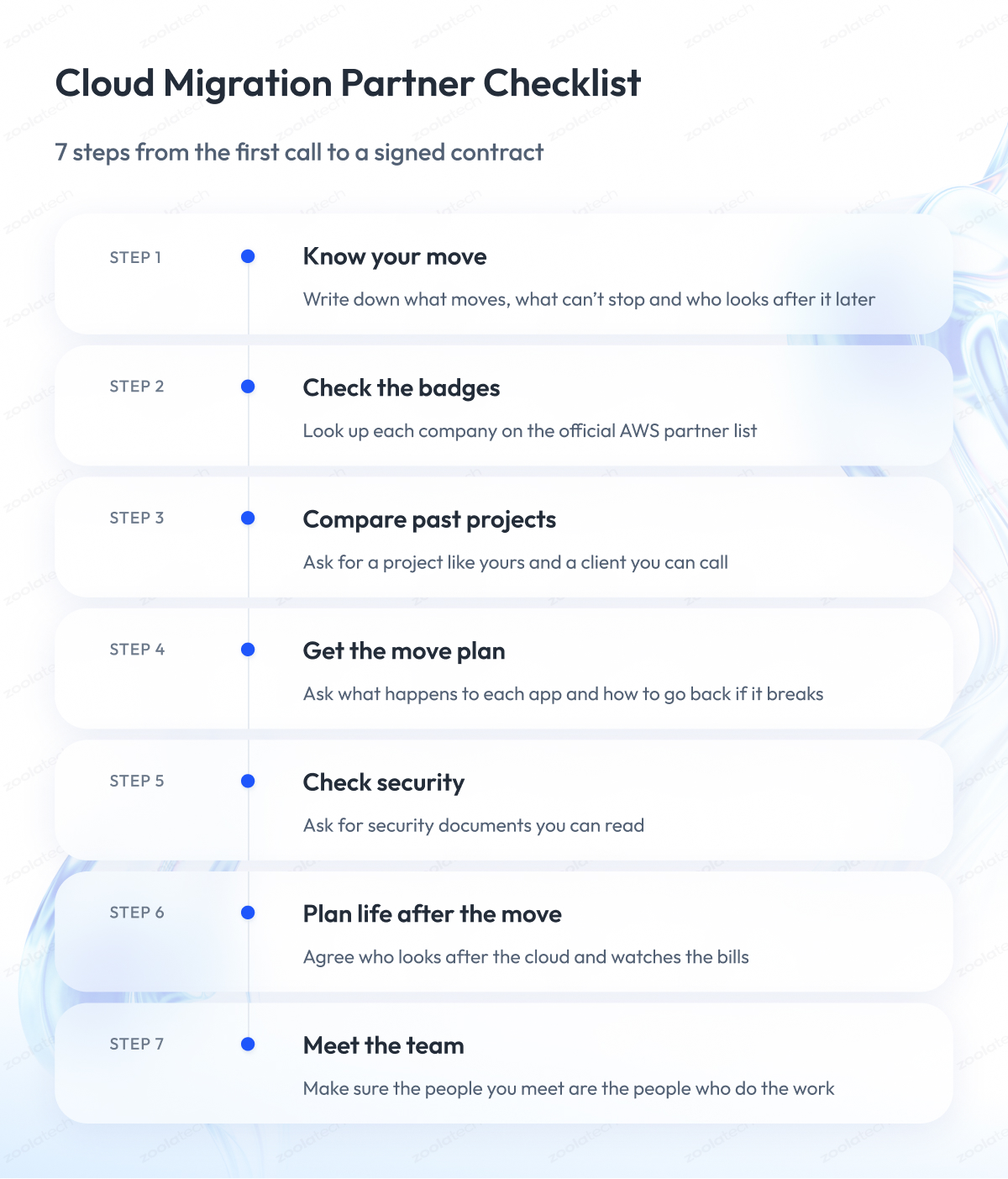
Choosing a cloud migration partner is easier when you check providers in a fixed order. The steps below start with your own needs and move to the provider’s proof, so you can turn a long list into a short list of finalists.
Step 1 – Write down where the hard part of your move is
Before you talk to any provider, describe your move for your own team. This keeps every conversation focused on your needs and not on the vendor’s sales pitch.
Answer these questions first:
- How many applications and servers will move?
- Which systems cannot stop during the move?
- Who will manage the cloud after the move?
The answers point you to a provider type. Use the comparison matrix above, which matches common project needs with global integrators, cloud MSPs, and engineering firms.
Step 2 – Check each provider’s status in the platform directory
Vendor websites often show old badges, so check each status where the platform publishes it. For AWS, find the provider in the AWS Partner Solutions Finder and note its tier, its migration competency, and its AWS MSP program status.
For Microsoft, look for the Azure Expert MSP badge. The program closed to new partners in September 2026, so ask what the provider holds today.
Step 3 – Compare published migrations with your own
A case study helps you only if it looks like your project. Ask cloud migration vendors for the migration closest to yours, with the client named or described, the workloads moved, the period, and any downtime.
Then ask for a reference you can call. A percentage with no client, baseline, or period tells you very little about what the provider will do for you.
Step 4 – Ask how they will plan the move and the cutover
A strong proposal explains what happens to each application. AWS lists 7 migration strategies, known as the 7 Rs, and for large migrations, AWS Prescriptive Guidance advises moving applications first and modernizing them after.
Ask every provider for a plan for each workload and a cutover runbook with an outage window and rollback criteria. We explain what to agree on in the migration strategy and cutover section below.
Step 5 – Check security and compliance evidence
Security answers should come with documents you can read. The National Security Agency (NSA) and the Cybersecurity and Infrastructure Security Agency (CISA) advise including security and risk management in the criteria for choosing a managed service provider.
Ask who reports incidents to whom and what service level agreements (SLAs) cover recovery. A System and Organization Controls 2 (SOC 2) report or an ISO 27001 certificate helps here, as long as its scope covers the work the provider will do for you.
If your workloads serve US government agencies, check the target cloud services in the FedRAMP Marketplace. The Federal Risk and Authorization Management Program (FedRAMP) authorizes cloud services, so a “FedRAMP-certified migration company” is a red flag.
Step 6 – Agree on who manages the cloud and the costs after the move
Moving workloads is only the first part of the bill. Decide if the provider will manage the new environment or hand it to your team, and check its AWS MSP program status if it will manage it.
Ask about FinOps, the practice of managing cloud spending together across engineering and finance teams. The FinOps Foundation describes it in three phases: Inform, Optimize and Operate, and a provider that follows it sets a cost baseline before the first workload moves.
This is also the moment to ask about platform funding. Find out if the provider can request AWS MAP funding, Microsoft’s Frontier Accelerate funding, or Google Cloud RaMP funding for your workloads.
Step 7 – Meet the people who will do the work
The team in the sales meetings is not always the team that delivers. A cloud migration company should name the engineers who will stay with your project from the first assessment to the final cutover.
Check how many working hours your teams will share. Our lists of nearshore software development companies and offshore software development companies explain how each delivery model affects time zones and cost.
Questions to Ask Before Signing a Cloud Migration Contract
The questions to ask before signing are the ones that make each provider prove its claims. Use them in your request for proposal (RFP) or in final calls with your shortlisted providers.
For each question, the table shows the proof to ask for and the warning sign that should make you look closer.
| Question to Ask | Evidence to Request | Red Flag |
| 1. Is your partner status what you say it is? | Record in the platform’s directory with tier and programs | Old program names or Azure Expert MSP shown as new |
| 2. Which published migration is closest to ours? | Named client, workloads moved, downtime and a reference call | Percentage with no client, baseline or period |
| 3. Which strategy will you use for each workload? | Plan for every application across AWS’s 7 Rs | Rebuilding everything during the move, or no plan after it |
| 4. How will you cut over and roll back? | Runbook with outage window and rollback criteria agreed in advance | No rollback plan for a system that brings in revenue |
| 5. What security and compliance evidence can you show? | Current SOC 2 report or ISO 27001 certificate with scope | Security answers without a document you can read |
| 6. Who manages the environment after the move? | Support model, cost baseline and FinOps practice | Savings promised before any assessment |
| 7. Who will do the work, and from where? | Named engineers from assessment to cutover, time zone overlap | Senior people appear only during the sale |
| 8. Can you access platform funding for our project? | Eligibility for AWS MAP, Frontier Accelerate or Google Cloud RaMP | Funding promised without the required partner status |
What drives the cost of a cloud migration engagement
We found no independent price ranges for cloud migration work. ScienceSoft, one company on this list, publishes its own estimate of $20,000 to $250,000 to move a medium or large application. This is a vendor figure and not a market benchmark.
The price of a migration project mostly depends on these factors:
- The number of workloads and migration waves.
- The strategy for each workload, from rehosting to refactoring.
- The amount of data and database changes.
- Cutover requirements, such as keeping old and new systems working side by side.
- Security and compliance work.
- Support for the environment after the move.
Platform funding from AWS, Microsoft, or Google Cloud can cover part of the cost. To compare proposals fairly, ask every provider to price the same scope, the same waves, and the same post-move support model.
Migration Strategy and Cutover: What to Agree Before the Move
The migration strategy and the cutover plan are the two things to agree on before the move starts. Together they decide how much downtime your business faces and how much the move costs, so a good provider brings both to the table before you sign.
Choose a strategy for each workload
AWS describes 7 migration strategies, known as the 7 Rs. A good plan gives every application one of them and explains why. Our guide to application migration to the cloud walks through the full process step by step.
The 7 Rs cover every option for an application:
- Retire. Switch off applications nobody uses.
- Retain. Keep an application where it is for now.
- Rehost. Move an application to the cloud without changes.
- Relocate. Move an entire virtual environment to the cloud as-is.
- Repurchase. Replace an application with a ready-made cloud product.
- Replatform. Make small changes so an application works better in the cloud.
- Refactor. Rebuild an application for the cloud.
For large migrations, AWS advises against rebuilding applications during the move. It recommends rehosting, relocating, or replatforming first and modernizing after the migration, because changing everything at once adds risk. AWS’s Migration Acceleration Program follows the same logic in three phases: Assess, Mobilize, and Migrate and Modernize.
Plan around fixed deadlines
Some dates decide which workloads should move first. Extended support for Windows Server 2016 ends on January 12, 2027, and extended support for SQL Server 2016 already ended on July 14, 2026.
VMware costs changed too. After Broadcom bought VMware, it stopped selling perpetual licenses and moved customers to subscriptions, which pushes many companies to rethink their data centers. Ask your provider which workloads it would move first, and why.
Agree on cutover and rollback in advance
Cutover is the moment users switch from the old system to the new one. Microsoft describes how continuous data replication keeps downtime close to zero, and it advises splitting a large migration into waves, which are groups of workloads that move together.
For a critical system that can only be down for a few minutes, Microsoft says you need the old and new environments working in parallel, with data replication and a quick switch. Microsoft also advises setting rollback criteria and steps before any migration starts.
AWS gives similar advice for the cutover runbook. Agree on an outage window and a rollback plan that you follow if the move takes longer than that window.
What this looks like in our work
We follow the same approach on our own projects. In an identity provider migration for MasterControl, we moved users to a new sign-in system in phases. About 20% of users moved in the first 90 days and more than 60% by six months, and we moved millions of user accounts with zero disruption.
On Pandora’s Azure platform, the release process we built lets the team roll back to the previous version in under one minute. That is the kind of rollback plan you want in place before a cutover day.
Cloud Migration Risks: Costs, Repatriation and Numbers That Get Misquoted
The biggest cloud migration risk is financial. McKinsey notes that moving applications to the cloud without changes can increase costs if nobody optimizes them after the move. Once you have a plan and a cutover date, consider what can go wrong with the budget and which numbers you shouldn’t trust.
Cloud bills are hard to control
In Flexera’s 2026 State of the Cloud survey of more than 750 cloud decision-makers and users, 85% named managing cloud spend a top challenge, and 63% already had FinOps teams.
The same vendor survey puts wasted cloud spend at 29%, the first increase in five years. The release does not explain how waste was measured, so plan cost control from the first migration wave.
Many companies expect more than they get
Gartner predicts that by 2028, 25% of organizations will have experienced significant dissatisfaction with their cloud adoption because of unrealistic expectations, implementation problems or uncontrolled costs.
Gartner also predicts that more than 50% of organizations will not get the results they expect from using several clouds by 2029.
Some companies move back from the cloud
Moving workloads from the cloud back to your own servers is called repatriation. Experts interviewed by a16z in 2021 put the cost of repatriated workloads at one third to one half of keeping them in the cloud. Even the most aggressive companies kept 10 to 30% or more in the cloud.
The software company 37signals reports that its annual cloud bill fell from $3.2 million to $1.3 million in 2024 after it moved to its own hardware. That is the result of one company, so treat it as an example.
Popular numbers you should check
Many cloud migration numbers get quoted without context, so check every statistic before you put it in a business case. The table shows the most common claims, what the source says, and where it comes from.
| Claim You Will See | What the Source Says | Source and Date |
| “83% of cloud migrations fail (Gartner)” | Uncited line about data migration projects failing or overrunning | LumenData whitepaper on oracle.com, undated |
| “83% of enterprises are repatriating workloads” | Share of companies moving at least some workloads back | Channelnomics column on a Barclays survey, August 2024 |
| “McKinsey says cloud is a $1 trillion market” | $1 trillion potential earnings for Fortune 500 companies by 2030 | McKinsey, February 2021 |
| “37signals saved $10 million by leaving the cloud” | Bill fell to $1.3 million, $10 million is projected over 5 years | 37signals, October 2024 |
| “29% of cloud spend is wasted” | Vendor survey figure, method for measuring waste not stated | Flexera, March 2026 |
| “Moving to the cloud cuts your costs” | Moving without changes can raise costs without optimization | McKinsey, February 2021 |
Also Considered
Several well-known companies met only part of our selection rules or were not profiled in this edition. Here is why each one is not in the main list.
- Capgemini is at Premier Tier with the AWS migration competency and in the AWS MSP program, and Forrester named it a Leader in its Q1 2024 Wave. We did not find a dedicated cloud migration service page on its US website, so it did not pass our first rule.
- EPAM Systems is at Premier Tier with the migration competency and in the AWS MSP program. We could read its migration page and client story only in archived copies from early 2025, so we could not check our second rule on its current website.
- Slalom is at Premier Tier with the migration competency but is not in the AWS MSP program, and it was a finalist for AWS’s 2025 Migration Partner of the Year award. Its published mainframe story describes future savings the client expects, so we did not profile it in this edition.
- Simform does not appear in the AWS Partner Solutions Finder. The company says it is an Azure Expert MSP, a program Microsoft closed to new partners on September 15, 2026, and we did not check this status at Microsoft.
- Wipro and HCLTech appear in several ranking lists we reviewed, and Forrester named Wipro a Leader in its Q1 2024 Wave. We did not profile them in this edition.
Final Word
Choosing among cloud migration service providers takes time. You need to check partner records, read case studies with a critical eye, call references, and compare proposals that rarely describe the same scope.
But this work is worth it.
A well-planned migration moves your critical systems with little downtime and keeps cloud costs under control from the first wave. A poorly planned one can stop billing or orders for hours and leave you paying more in the cloud than you paid in your own data center.
Use this list as a starting point. Pick the provider type that fits your move, check each finalist’s status in the platform’s directory, and ask for a published migration close to yours, along with a cutover plan that includes rollback criteria.
If a critical application must move or change on the way to the cloud, Zoolatech is ready to review your system with you and discuss the safest path forward.