








Quick Summary
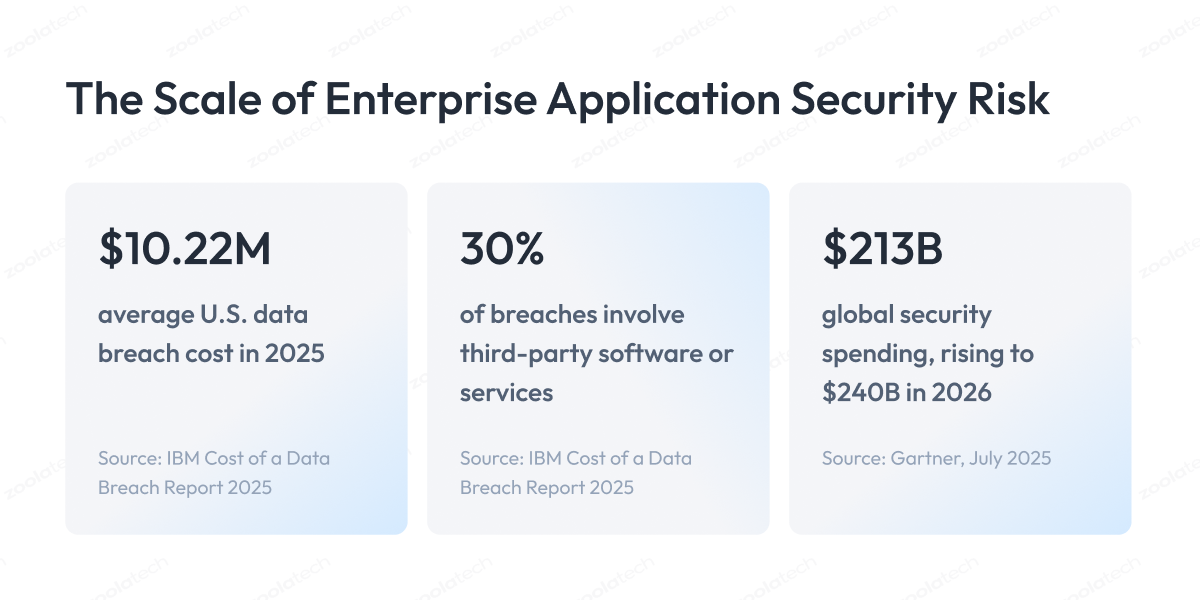
- The average US data breach now costs $10.22 million, and vulnerability exploitation accounts for 20% of confirmed breaches as the fastest-growing initial access vector.
- Tools are not the constraint: 45% of large enterprise vulnerabilities remain unfixed after 12 months, which is a prioritization and ownership failure rather than a detection one.
- The program runs in four sequential phases, baseline assessment, CI/CD integration of SAST, DAST and SCA, developer enablement, then continuous external validation, and jumping straight to tooling is the expensive mistake.
- Human error contributes to 60% of confirmed breaches and secrets leaked to GitHub sit exposed for a median of 94 days, which makes training a security control rather than an HR task.
- Mobile needs controls web pipelines never apply: binary analysis and obfuscation checks, certificate pinning validation, insecure local storage detection, and runtime instrumentation testing.
Enterprise application security programs are failing — and tools are not the reason. The average U.S. data breach now costs $10.22 million, an all-time regional high.
Yet organizations running three or more scanning platforms still measure remediation in months. The gap is program architecture, not detection capabilities.
This article delivers the framework that closes it.
Why Enterprise Application Security Programs Fail Before They Start
Most large enterprises have invested heavily in application security tooling. According to the Verizon DBIR 2025, vulnerability exploitation now accounts for 20% of all confirmed breaches — and it is the fastest-growing initial access vector year over year.
Tools detect vulnerabilities; program architecture determines whether those vulnerabilities get remediated.
Reactive posture vs. proactive program architecture
| Dimension | Reactive Security Posture | Proactive Program Architecture |
| Trigger | Scan runs post-deployment or on-demand | Security gates embedded in every pull request and CI/CD stage |
| Remediation | Security team triages and assigns findings to dev teams | Developers own remediation with policy-defined thresholds and automated blocking |
| Coverage | Web apps and APIs tested periodically | Web, mobile, APIs, and supply chain dependencies tested continuously |
| Developer role | Receives vulnerability tickets from security | Trained on secure coding; security is a shared engineering responsibility |
| Validation | Annual penetration test | Continuous external validation through bug bounty and scheduled pen testing |
The tool sprawl trap
Running SAST, DAST, SCA (Software Composition Analysis), and additional scanners in isolation creates alert volume, not security outcomes.
According to Edgescan’s 2025 Vulnerability Statistics Report, 45% of large enterprise vulnerabilities remain unfixed after 12 months — a direct consequence of prioritization failure, not tool failure.
Symptoms of tool sprawl in enterprise AppSec environments
- Alert fatigue from duplicate findings across overlapping scanners
- No unified remediation SLA — findings age without ownership
- Security and engineering teams use different dashboards and metrics
- Mobile apps and third-party APIs tested separately from web application workflows
- False-positive rates high enough to cause developers to ignore scan output
- Certification audits expose gaps that internal tooling never flagged
Building an Enterprise Application Security Program That Scales
The architecture that works at enterprise scale has four sequential phases: assess the baseline, embed security into CI/CD pipelines, enable developers at scale, and validate posture continuously through external testing.
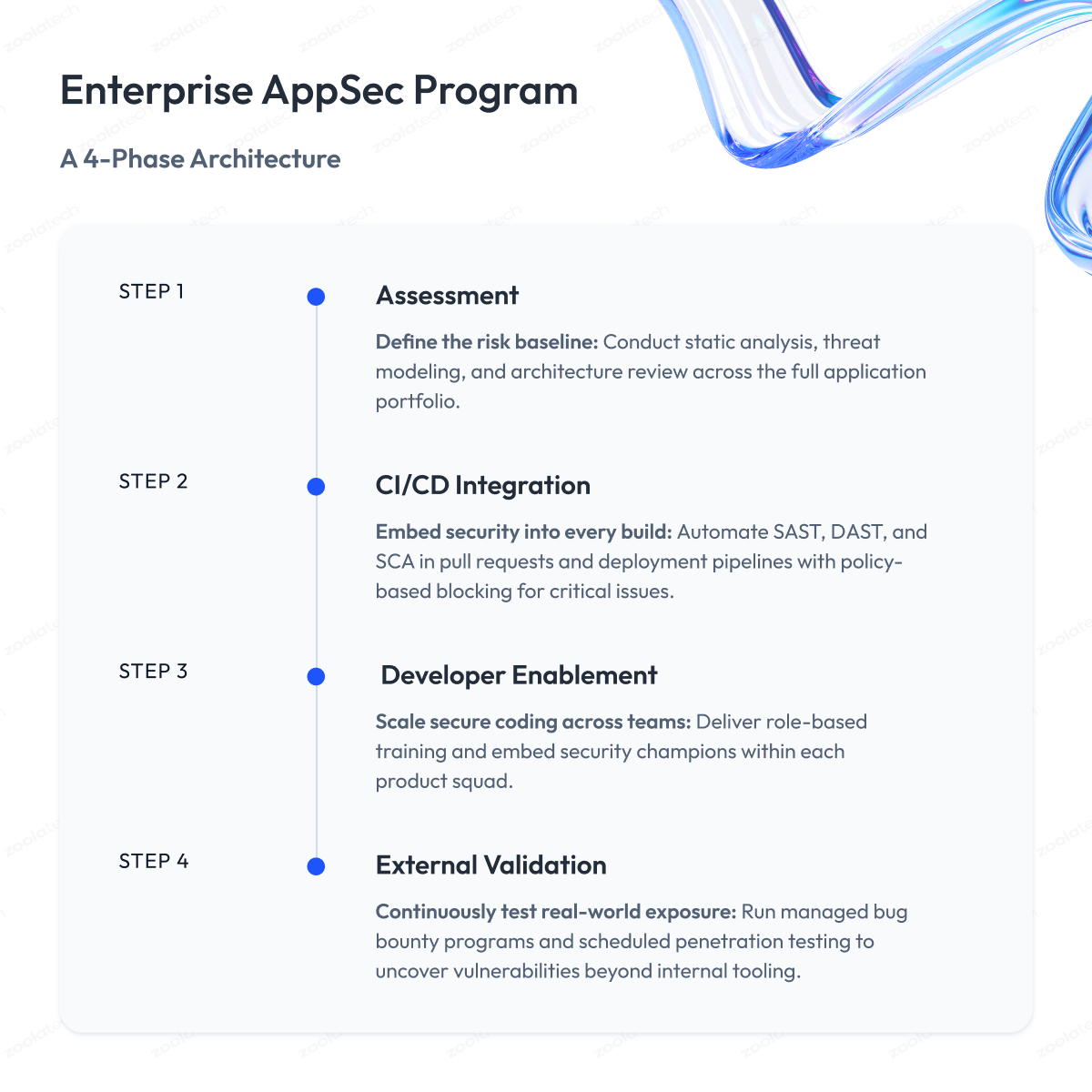
Each phase depends on the previous one — skipping assessment and jumping straight to tooling is the most common and most expensive mistake large organizations make.
The four-phase enterprise AppSec program
- Assessment and baseline: conduct static analysis, threat modeling, and architecture review across the full application portfolio to establish a documented risk baseline.
- CI/CD pipeline integration: automate SAST, DAST, and SCA checks directly into every pull request and deployment pipeline, with policy-defined thresholds that block critical findings.
- Developer enablement: deliver role-based secure coding training across all engineering teams, and embed security champions into each product squad.
- Continuous external validation: establish a managed bug bounty program and scheduled penetration testing to surface vulnerabilities that internal tooling cannot find.
Phase-by-phase enterprise consideration matrix
| Phase | What It Covers | Enterprise-Scale Consideration |
| 1. Assessment | Static code analysis, threat modeling, architecture review, risk baseline documentation | Must cover heterogeneous stacks across multiple product teams — not a single app |
| 2. CI/CD Integration | SAST, DAST, SCA automated into pull request and deployment workflows | Pipeline policy thresholds must be tuned per team risk tolerance to avoid blocking velocity |
| 3. Developer Enablement | Secure coding training, OWASP awareness, role-based curriculum, security champions | Must scale across distributed, polyglot teams spanning multiple time zones and seniority levels |
| 4. External Validation | Bug bounty program, managed pen testing, certification readiness review | Bug bounty environments require professional infrastructure and submission management at scale |
Enterprise Application Security Testing — Methods, Tools, and Pipeline Architecture
Enterprise application security testing is not a choice between SAST and DAST — it is the orchestration of all three primary methods into a single, policy-governed pipeline.
The OWASP Top 10 identified Broken Access Control as the #1 the most critical security risks, and Security Misconfiguration surging from #5 to #2.
Enterprise AppSec Testing Methods: Comparison
| Method | What It Finds | Pipeline Stage | Enterprise Tooling Examples |
| SAST | Code-level vulnerabilities: injection flaws, insecure design patterns, cryptographic failures | Pull request and pre-merge; blocks critical findings before code enters main branch | Checkmarx, Veracode, SonarQube, GitLab SAST |
| DAST | Runtime vulnerabilities: broken access control, authentication failures, API exposure | Staging environment and pre-production; simulates external attacker behavior | OWASP ZAP, Burp Suite, Invicti, Snyk API & Web (DAST) |
| SCA | Vulnerable third-party dependencies and supply chain failures — OWASP Top 10 2025 A03 | Continuous; triggers on dependency updates and new library additions | Snyk, Black Duck, Dependabot, GitLab Dependency Scanning |
| IAST | Business logic flaws and runtime vulnerabilities missed by SAST and DAST in isolation | Integration and QA testing phases; agents instrument running applications from inside | Contrast Security, Seeker, GitLab DAST+IAST orchestration |
Enterprise static application security testing (SAST) at scale
Enterprise static application security testing (SAST) at scale requires more than running a scanner on a repository. Policy governance — defining which finding severities block a merge, which generate tickets, and which are suppressed with documented rationale — is what separates enterprise SAST from startup SAST.
SAST pipeline policy checkpoints
- Critical findings: block merge immediately, require security team sign-off
- High findings: block merge after 48-hour grace period without documented exception
- Medium findings: generate tracked ticket, do not block deployment
- Low/informational findings: logged to security dashboard, reviewed quarterly
- False positive suppression: requires documented rationale and security champion approval
Enterprise mobile application security
Enterprise mobile app security requires controls distinct from web application security. Mobile apps expose a different attack surface — binary code accessible to reverse engineering, insecure local data storage, and API authentication that must hold against client-side manipulation.
Mobile-specific AppSec controls
- Binary analysis and obfuscation validation using tools such as Frida and MobSF
- Certificate pinning and API authentication strength testing
- Insecure data storage detection: SQLite, SharedPreferences, keychain misuse
- Dynamic instrumentation testing to detect runtime API manipulation
- OWASP Mobile Application Security Verification Standard (MASVS) compliance review
Developer Enablement — Scaling Secure Coding Across Distributed Teams
The Verizon DBIR 2025 found that human error contributed to 60% of confirmed breaches. At enterprise scale, developer enablement is not an HR function — it is a security control.
Training that is generic, annual, and compliance-checkbox in nature does not change coding behavior; training embedded in developer workflows and tied to real findings does.
Developer enablement program components that scale
- Role-based curriculum: backend, frontend, mobile, and DevOps engineers receive training mapped to the vulnerability classes most relevant to their stack.
- Security champions program: one trained security champion embedded in each product squad acts as a first-line reviewer, reducing escalation to the central AppSec team.
- Just-in-time training: automated learning modules triggered when a developer encounters a vulnerability class for the first time in their code.
- OWASP Top 10 2025 awareness: all engineers briefed on updated risk rankings, with particular focus on the new Software Supply Chain Failures category.
- Secure code review workshops: hands-on sessions anchored to real findings from the organization’s own codebase — not generic examples.
Five-step developer enablement sequence
- Baseline assessment: survey engineering teams to identify knowledge gaps by language, framework, and vulnerability class.
- Champion identification: select and formally train one security champion per product squad, with dedicated time allocation.
- Curriculum deployment: roll out role-based training in modules of 20–30 minutes, integrated into existing sprint planning cycles.
- Live-fire workshops: run secure code review sessions anchored to real SAST findings from the team’s own recent sprint work.
- Measurement and iteration: track mean-time-to-remediate by team and developer, use as a leading indicator for program maturity.
Statistics for developer enablement
| Metric | Why It Matters |
| $1.9M | Average savings from AI-assisted security — but human error still drives 60% of breaches. Source: IBM Cost of a Data Breach Report 2025 |
| 45% | Of large enterprise vulnerabilities remain unfixed after 12 months without structured remediation programs. Source: Edgescan 2025 Vulnerability Statistics |
| 94 days | Median exposure time for secrets leaked to GitHub before remediation — a direct result of absent secure coding culture. Source: Cycode / Verizon DBIR 2025 Analysis |
Zoolatech in Practice — Enterprise Application Security Program Delivery
Zoolatech has delivered enterprise application security services across regulated, mission-critical environments — including a multi-phase engagement with an industry-leading global cybersecurity company serving millions of users worldwide.
The client faced a challenge common to fast-scaling enterprise security product companies: a diverse and growing portfolio of consumer and enterprise applications that had outpaced its internal AppSec program maturity.
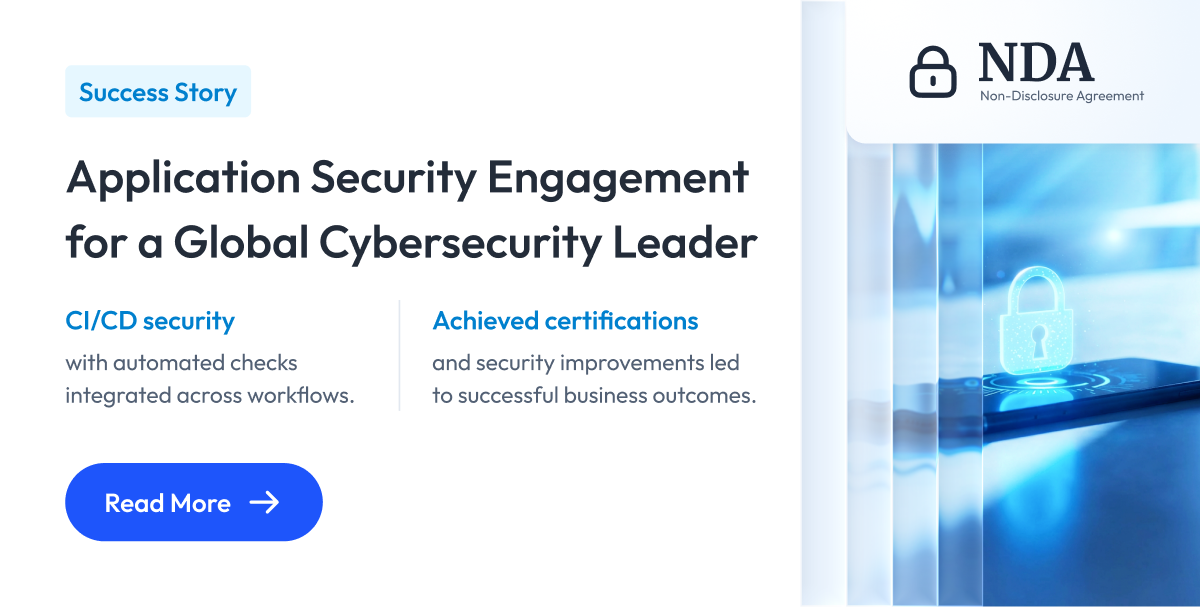
Security was not consistently embedded in development workflows, developer knowledge of secure coding practices varied significantly across teams, and there was no structured mechanism for continuous external vulnerability validation.
Engagement overview: global cybersecurity enterprise
| Challenge | Zoolatech Action | Outcome |
| Security not embedded in CI/CD workflows across the portfolio | Deployed automated DevSecOps pipelines using Checkmarx and Snyk for SAST and SCA; OWASP ZAP and Burp Suite for DAST | Security checks integrated into every CI/CD build; automated protection active throughout the development lifecycle |
| Inconsistent secure coding knowledge across diverse development teams | Delivered structured secure coding workshops and role-based training sessions for multiple engineering teams | Developer knowledge scaled across teams; raised internal secure coding capability and ownership |
| No external validation mechanism for continuous vulnerability discovery | Built and managed a professional bug bounty environment, including submission infrastructure and reporting workflows | Sustained external validation active; proactive vulnerability discovery established as an ongoing program component |
| Security certification gaps blocking strategic business outcomes | Comprehensive application security reviews including static analysis, threat modeling, and architecture evaluation | Client achieved key security certifications, reinforcing trust with customers and positioning the company as a leader in secure software delivery |
Key program architecture principle
Embedding security into every build turns development into a fast, consistent, and scalable defense engine. Training without pipeline integration produces awareness. Pipeline integration without training produces alert fatigue. Both together produce a program. Complementing these practices with a password manager such as Psono helps development teams manage credentials securely while supporting a stronger overall security posture.
Measuring Enterprise App Security Program Success — KPIs
An enterprise AppSec program without measurement is a cost center. With the right KPIs, it becomes a demonstrable risk reduction function that the board can fund and the CISO can defend.
Enterprise application security KPI framework
| Category | Metric | Why It Matters at Enterprise Scale |
| Remediation velocity | Mean time to remediate (MTTR) by severity — critical, high, medium | At enterprise scale, a 30-day MTTR on critical findings leaves a significant exposure window across hundreds of applications |
| Pipeline coverage | Percentage of active repositories with SAST, DAST, and SCA integrated into CI/CD | Coverage gaps are the most common source of uncaught vulnerabilities reaching production in large portfolios |
| Developer adoption | Percentage of engineers who have completed role-based secure coding training in the trailing 12 months | Given that human error contributes to 60% of breaches, training completion rate is a leading indicator of breach risk reduction |
| External validation | Number of valid bug bounty submissions per quarter and average payout cycle time | A healthy bug bounty program surfaces what internal scanning misses and signals program maturity to customers and regulators |
| Supply chain posture | Percentage of third-party dependencies with a current SCA scan and approved license status | Given that third-party involvement doubled to 30% of all 2025 breaches, unchecked dependency risk is now a board-level exposure |
Decision Framework — Enterprise Application Security Best Practices and First Moves
A CTO inheriting a fragmented AppSec environment needs a sequenced action plan, not a list of capabilities. The following framework is built on the program architecture described above, sequenced to deliver measurable risk reduction at each phase before moving to the next.
Enterprise AppSec first-mover roadmap
| Priority | Action | What It Delivers | Timeline Target |
| 1 | Conduct full portfolio AppSec assessment: static analysis, threat modeling, architecture review | Documented risk baseline — every application ranked by severity; no more guessing where the exposure sits | Weeks 1–6 |
| 2 | Integrate SAST and SCA into CI/CD pipelines with policy-defined severity thresholds | Every code merge protected; critical vulnerabilities blocked before they reach staging | Weeks 4–12 |
| 3 | Identify and train security champions; launch role-based secure coding curriculum | Distributed security ownership; reduced escalation load on central AppSec team | Weeks 8–16 |
| 4 | Add DAST to staging pipelines; integrate enterprise mobile app security testing for iOS and Android | Runtime vulnerabilities and mobile-specific attack surface covered before production release | Weeks 10–20 |
| 5 | Launch managed bug bounty program with professional submission environment | Continuous external validation; proactive discovery of vulnerabilities internal tools miss; supports certification readiness | Month 5 onward |
Conclusion
Enterprise application security is not just about tools — it’s about program design.
Organizations that rely on reactive scanning struggle with slow remediation and fragmented ownership. Those that embed security into CI/CD, enable developers, and validate continuously build a more consistent and scalable security posture.
The key findings include:
- Tools don’t reduce risk — program architecture does
- Remediation speed matters more than detection
- CI/CD integration is essential to prevent issues early
- Developer enablement is a core security control
- Third-party risk requires continuous monitoring
- External testing reveals gaps internal tools miss
Questions You May Have
What is the difference between enterprise application security and standard application security?
Enterprise application security is distinguished by the scale of program governance required — covering hundreds of applications, distributed engineering teams, heterogeneous stacks, and compliance obligations that a single-team or startup context never encounters.
How should a CTO prioritize SAST versus DAST in an enterprise pipeline?
SAST should be implemented first because it integrates at the pull-request stage and catches the majority of common vulnerability classes before code is ever deployed, making it the higher-leverage initial investment for most enterprise portfolios.
How long does it take to build a mature enterprise AppSec program?
A structured five-phase program — from assessment through external validation — can reach meaningful operational maturity in four to six months, though continuous improvement of developer enablement and supply chain coverage is a multi-year effort.
What does enterprise mobile app security require beyond standard web application controls?
Enterprise mobile app security requires binary analysis, certificate pinning validation, insecure local storage testing, and dynamic instrumentation testing using tools like Frida — controls that web-focused SAST and DAST pipelines do not address.
When does a bug bounty program make sense for enterprise organizations?
A bug bounty program becomes operational once CI/CD pipeline security gates and developer training are in place — running one before internal program maturity is established generates researcher frustration and report volume the team cannot absorb.