







Quick Summary
- Seven approaches exist, from retain and rehost through refactor and rearchitect to a full rebuild, and most portfolios use several at once rather than one blanket path.
- Route each application by scoring business value against technical quality: high value with low quality gets re-engineered, low value with low quality gets replaced, and stable low-value systems are left alone.
- The strangler pattern is the safe default, replacing functions incrementally behind a facade so the existing system stays live instead of risking a big-bang cutover.
- AI now handles code translation, documentation, and test generation, but 84% of developers use these tools while only 33% trust their accuracy, so human review is not optional.
- One fintech rearchitected a monolith into microservices, cutting operating cost 50% and onboarding from three days to two minutes; enterprise programmes typically run one to five years.
Most enterprise IT budgets fund yesterday, not tomorrow. Aging systems drain the money meant for innovation.
A legacy modernization strategy reverses that imbalance. Standard rip-and-replace projects stall on cost and risk. The right approach turns liability into lasting business value.
What Is a Legacy Modernization Strategy
Legacy modernization is the process of evolving outdated systems into current, maintainable ones.
Outdated systems are often the backbone of operations, yet they resist change. A strategy makes that change sequenced, funded, and governed.
Understanding legacy means seeing more than old code:
- Obsolete technology: unsupported languages like COBOL, PL/I, or VB6, running on aging hardware.
- Lost knowledge: sparse documentation, with business logic trapped in opaque legacy code.
- Sociotechnical roots: manual workarounds and human routines built around the existing system over decades.
A one-off modernization project fixes a symptom. A strategy treats the whole application portfolio as a program. That distinction separates successful legacy modernization from expensive rework.
Signals a system has become legacy:
- Vendor support has ended
- Specialists are retiring or scarce
- Scaling requires the whole monolith
- Integration with cloud services fails
Our legacy modernization services start by classifying systems, not by rewriting them. That sequencing is the difference between offense and defensive maintenance.
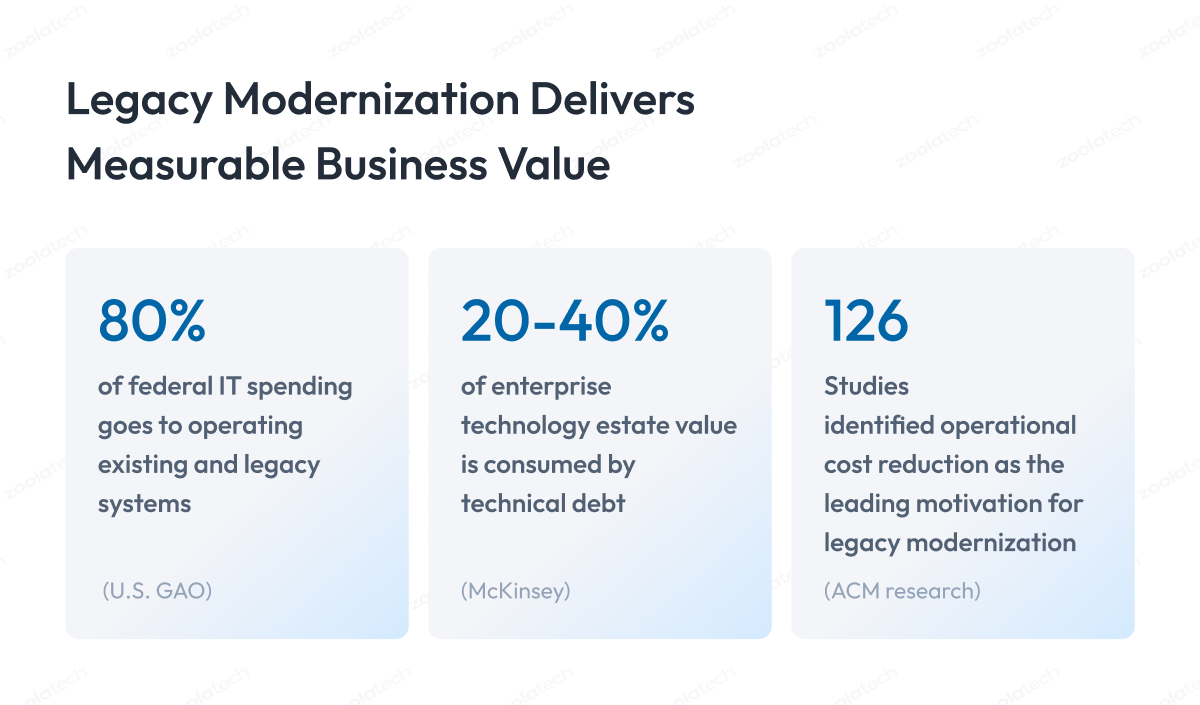
Why Modernize Legacy Systems: The Business Case
The case to modernize legacy systems is financial, not cosmetic. Maintenance crowds out new products. Modernization reclaims that capital for growth.
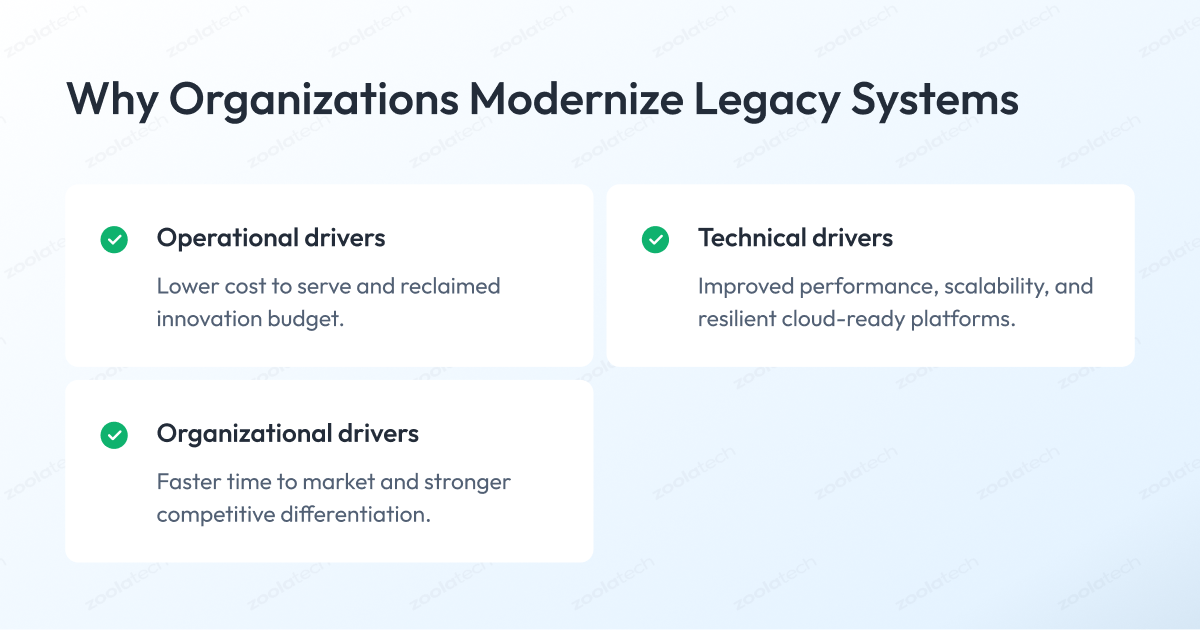
Research ranks the drivers consistently. The benefits of modernizing legacy estates cluster into three groups.
| Driver Group | Primary Outcome | Business Value |
| Operational | Lower cost to serve | Reclaimed innovation budget |
| Technical | Performance and scalability | Elastic, resilient platforms |
| Organizational | Faster time to market | Competitive differentiation |
The benefits of legacy modernization extend past cost. Cloud-native delivery shifts spend from capital to consumption. Managed cloud services cut the operational burden on lean teams.
Cost-of-inaction items leaders underweight:
- Security exposure on unpatched legacy infrastructure
- Premium pricing for rare legacy skills
- Lost agility against digital-native rivals
- Compliance gaps in regulated industries
In regulated sectors, the math is sharper still. For banks and insurers, see how modernization reshapes risk and cost in financial services.
The same pattern drives digital transformation across retail and consumer platforms.
The Challenges of Legacy Application Modernization
The challenges of legacy application modernization are rarely only technical. Initiatives tend to fail on people as often as on code.
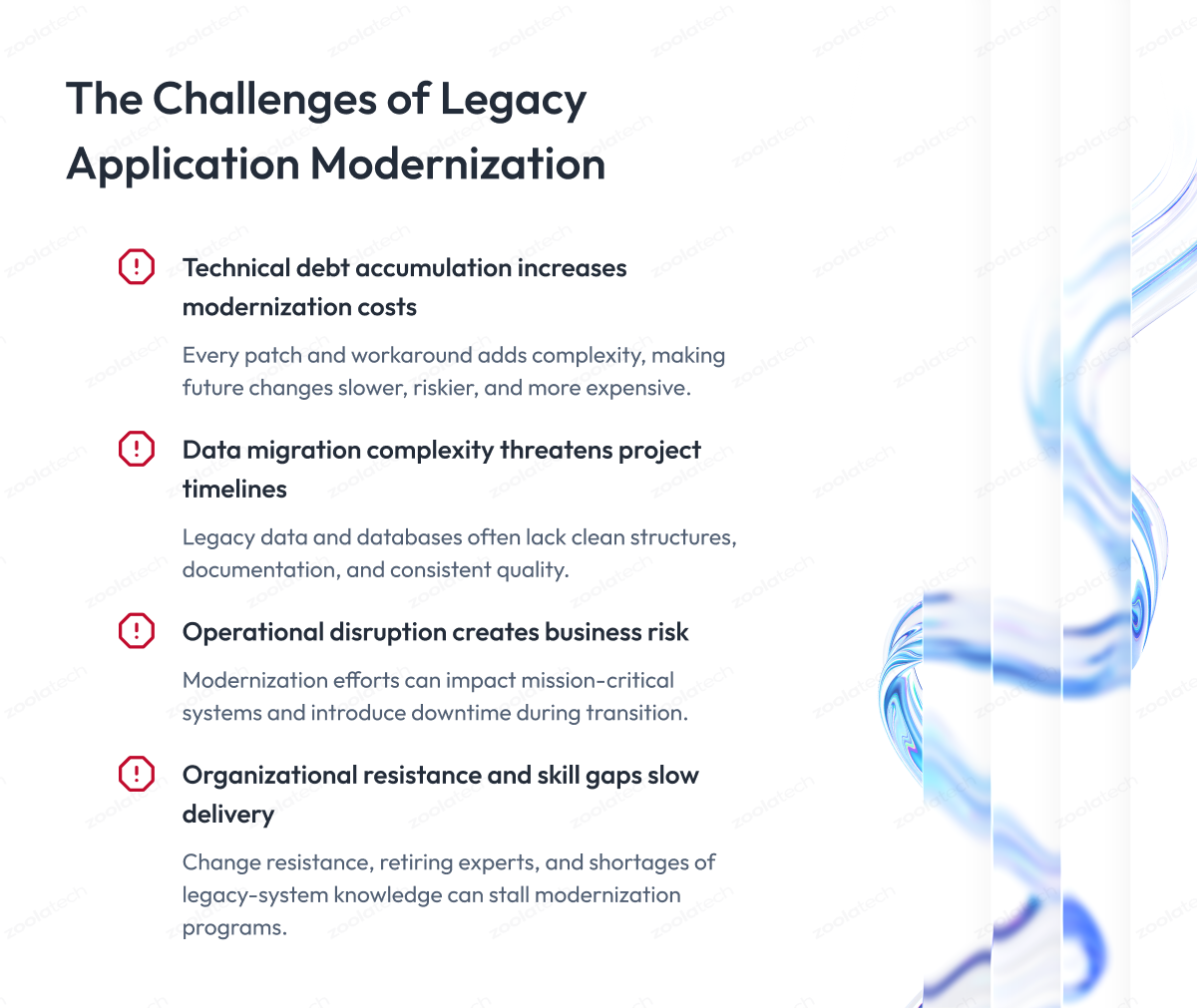
The challenges of legacy modernization fall into clear categories:
- Technical debt as interest: every patch adds complexity, raising the cost of the next change.
- Data migration complexity: legacy data and legacy databases lack clean structure and documentation.
- Operational disruption: migrating legacy systems risks downtime on mission-critical paths.
- The human factor: organizational resistance and skill gaps stall delivery.
The skill shortage deserves attention. As original architects retire, specialist knowledge of legacy environments disappears. That creates single points of failure no tool can patch.
| Challenge | Mitigation |
| Technical debt accumulation | Incremental refactoring, debt backlog |
| Undocumented business logic | AI-assisted documentation, reverse engineering |
| Organizational resistance | Change management, early upskilling |
| Downtime risk | Phased cutover, parallel validation |
These challenges of legacy application modernization are navigable. Astute planning and disciplined execution turn obstacles into a managed modernization effort.
Key Legacy Modernization Approaches: The Seven R’s
No single approach fits every system. The key modernization choice is matching each application to the right path.
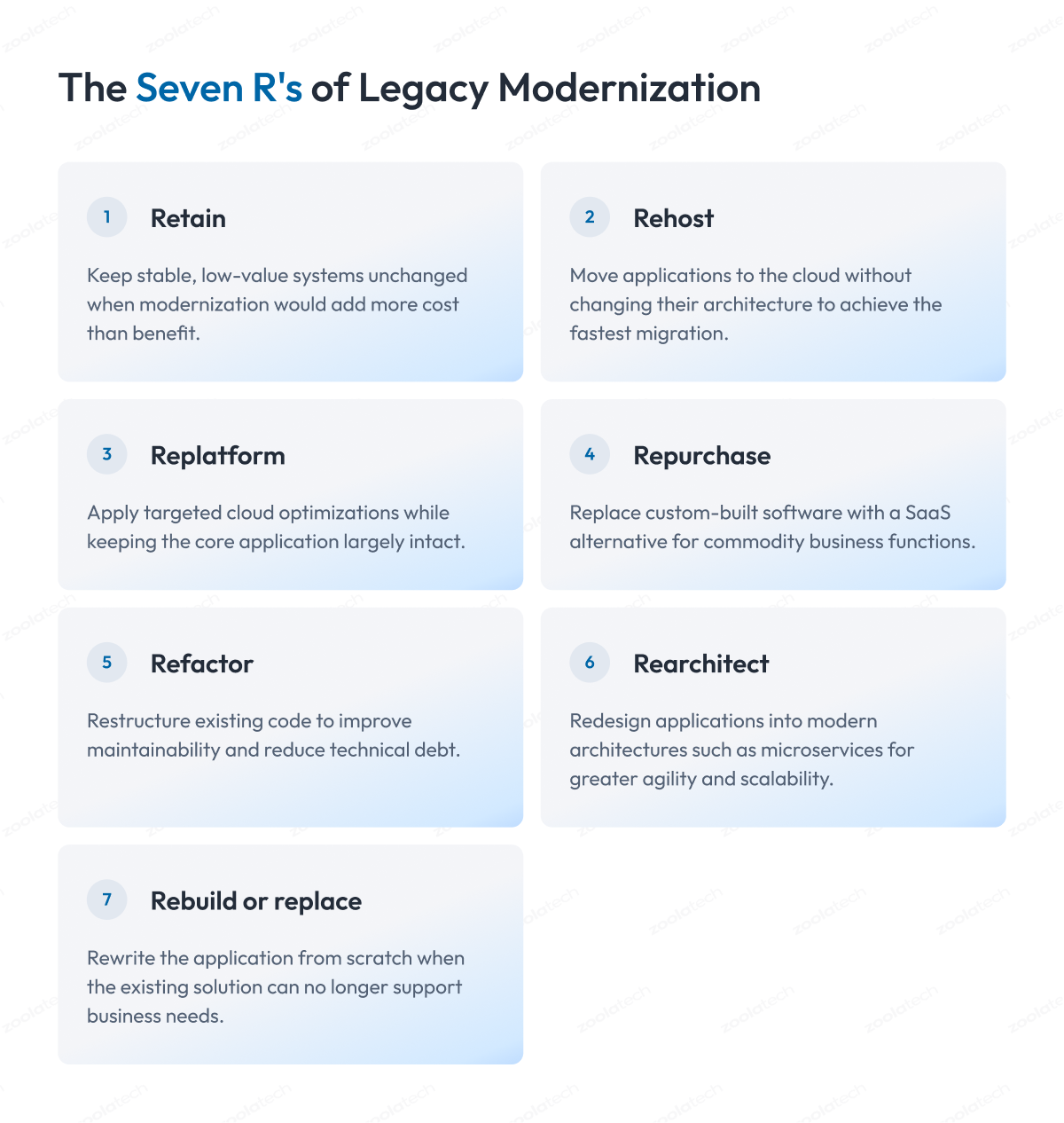
The industry standardizes seven options, popularized as the seven R’s of migration.
| Approach | What it Does | Effort and Risk | Best Fit |
| Retain | Keep as-is for now | None | Stable, low-value systems |
| Rehost | Move application to cloud unchanged | Low | Tight timelines |
| Replatform | Minor cloud optimizations | Low to moderate | Quick operational gains |
| Repurchase | Replace with SaaS | Moderate | Commodity capabilities |
| Refactor | Restructure existing code | Moderate to high | Maintainability goals |
| Rearchitect | Monolith to microservices | High | Strategic, high-change domains |
| Rebuild or replace | Rewriting the application from scratch | Highest | Low-quality, low-value cores |
Each R fits a different system and goal:
- Retain: leave a stable system untouched when it still works and replacing it would add cost without payoff.
- Rehost: lift and shift to the cloud unchanged; the fastest path, though it carries the old architecture’s limits with it.
- Replatform: apply small cloud optimizations like a managed database; modest effort for real operational gains.
- Repurchase: swap a custom build for a SaaS product; ideal for commodity functions like CRM or payroll.
- Refactor: restructure the existing code without changing behavior, which clears technical debt and improves maintainability.
- Rearchitect: redesign a monolith into microservices; the highest-value path for strategic, fast-changing domains.
- Rebuild or replace: rewrite from scratch when the core is low-quality and low-value; the costliest, last-resort option.
Most portfolios use several R’s at once. Knowing when to simply retire a low-value system removes cost before any migration starts.
Architectural patterns and application architecture
Pattern choice shapes risk more than tooling does. These patterns guide a safe modernization of legacy applications:
- Strangler fig: the pattern Martin Fowler named, replacing functions incrementally behind a facade.
- Domain-driven decomposition: align services to business domains, not technical layers.
- Service extraction: peel high-value, high-change domains first.
Modern application architecture favors microservices, event-driven flows, and application programming interfaces.
Event streaming, often via Kafka engineering teams, decouples legacy data from new services. Containers anchor the target: 82% of container users now run Kubernetes in production, per CNCF.
How to Build a Legacy Modernization Strategy
A legacy modernization strategy starts with a portfolio, not a project. Score every application on two axes. Then route each to the right modernization approach.
The portfolio quadrant maps business value against technical quality, with innovation as a third lens.
| Quadrant | Condition | Recommended action |
| Replace | Low value, low quality | Adopt off-the-shelf solution |
| Maintain | Low value, high quality | Minimal upkeep only |
| Evolve | High value, high quality | Extend with new features |
| Re-engineer | High value, low quality | Refactor to clear debt |
| Migrate | Strategic to innovation | Move to modern technologies |
Three transition modes carry the work. Each suits a different level of modernization and risk tolerance.
- Big bang: full cutover at once, fast but high-risk.
- Incremental: strangler-based replacement, the safest default.
- Coexistence: legacy and modern systems run in parallel.
A practical approach to modernization follows a tight sequence. This numbered framework anchors the application modernization journey:
- Inventory the application portfolio and dependencies.
- Score each system on value and quality.
- Select the modernization approach per application.
- Sequence by value, risk, and readiness.
- Fund and govern as a multi-year program.
This framework, supported by our engagement models, keeps a modernization initiative honest. It prevents teams from defaulting to rewriting everything from scratch.
A Step-by-Step Guide to Legacy Application Modernization
This guide to legacy application modernization translates strategy into execution. Each phase produces a decision, not just activity. Treat it as a repeatable modernization process.
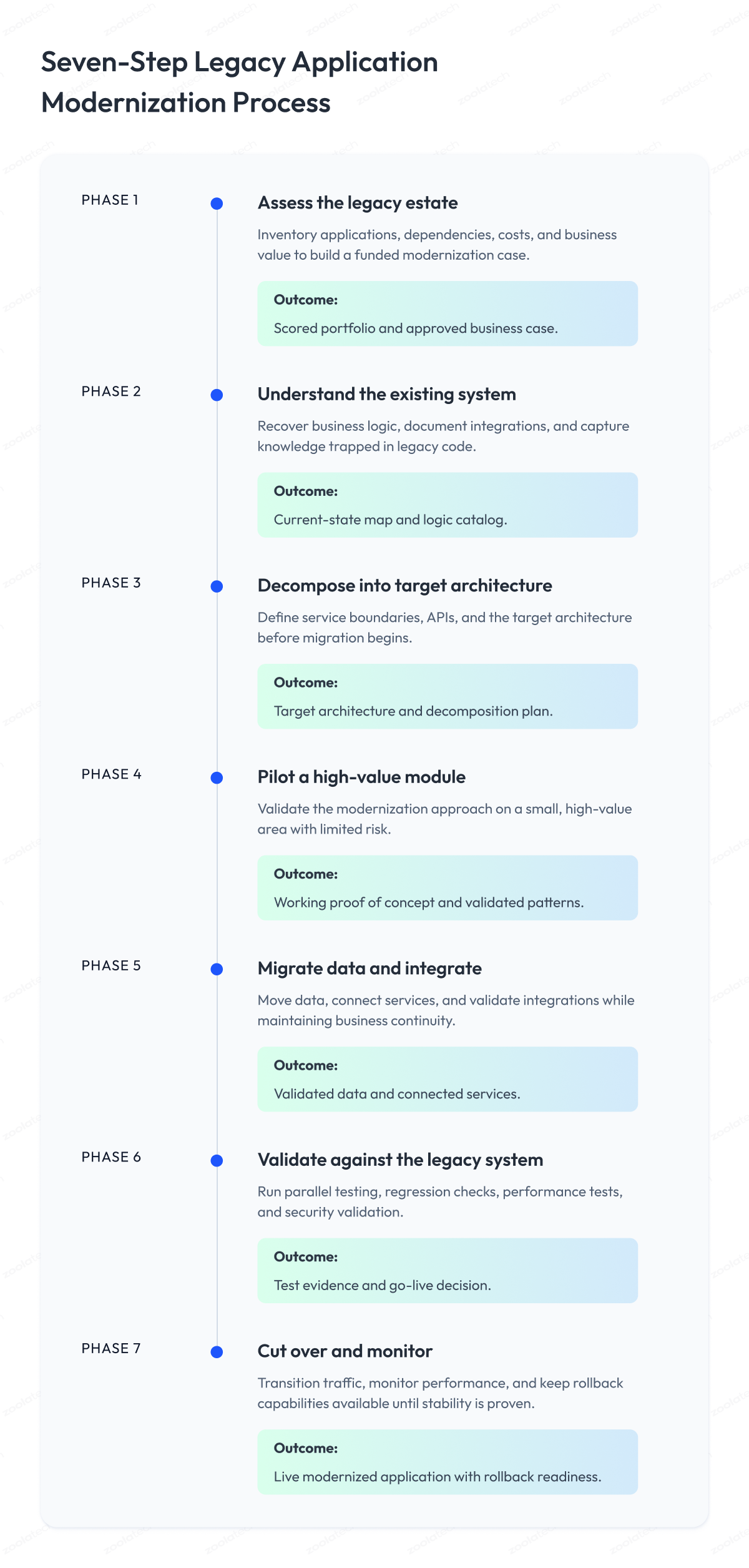
Here are the seven steps, each with its output and risk control:
| Step | Key Output | Risk Control |
| 1. Assess | Scored portfolio and business case | Clear scope |
| 2. Understand | Current-state map and logic catalog | No lost knowledge |
| 3. Decompose | Target architecture and plan | Defined boundaries |
| 4. Pilot | Working proof of concept | Small blast radius |
| 5. Migrate | Validated data, connected services | Parallel run |
| 6. Validate | Test evidence and go decision | Functional equivalence |
| 7. Cut over and monitor | Live modernized application | Rollback ready |
Here is each step in detail.
1. Assess the legacy estate
Start with facts, not opinions. The output is a scored portfolio and a funded business case.
- Build an inventory: record every application and dependency in a configuration management database (CMDB).
- Map dependencies: run agentless discovery scans to capture integrations and data flows automatically.
- Cost each system: calculate total cost of ownership across license, hosting, and incident spend.
- Score the portfolio: rate each application on business value and technical quality.
- Rank the drivers: weight cost, risk, agility, and compliance to set priorities.
2. Understand the existing system
Recover the knowledge trapped in old code. The output is a current-state map and a logic catalog.
- Trace data flows: follow inputs to outputs across modules, jobs, and interfaces.
- Extract business rules: run static analysis with SonarQube to surface logic and dead code.
- Map integrations: catalog APIs, file transfers, and batch jobs other systems depend on.
- Generate documentation: use AI code-comprehension tools to draft docs for opaque modules.
- Capture tribal knowledge: interview retiring experts before their context is lost.
3. Decompose into target architecture
Design the destination before you move. The output is a target architecture and a decomposition plan.
- Find bounded contexts: apply domain-driven design and event storming to group capabilities.
- Set service boundaries: define contracts and data ownership for each candidate service.
- Diagram the target: map context and containers with the C4 model.
- Specify APIs: describe every interface with an OpenAPI contract before coding.
- Plan the facade: design the strangler entry point that routes old and new.
4. Pilot a high-value module
Prove the approach on a contained slice. The output is a working proof of concept and validated patterns.
- Pick the slice: choose one module with high value and a small blast radius.
- Stand up delivery: build a CI/CD pipeline with automated build, test, and deploy.
- Build behind a facade: route a portion of traffic through feature flags.
- Measure outcomes: track latency, errors, and cost against defined success criteria.
- Capture patterns: document reusable templates for the next migration wave.
5. Migrate data and integrate
Move data and connect services without breaking the business. The output is validated data and running services.
- Profile and clean: assess legacy data quality, then dedupe and standardize before loading.
- Map the schema: match every legacy field to the target model with transformation rules.
- Build pipelines: automate extract, transform, and load with tools like Airflow or dbt.
- Decouple with events: connect services through event streaming and change data capture.
- Reconcile records: compare counts and checksums after each load until parity holds.
6. Validate against the legacy system
Treat the old system as the source of truth. The output is test evidence and a go decision.
- Run in parallel: feed identical inputs to old and new, then compare outputs.
- Automate regression: cover critical paths with Selenium, Playwright, or Cypress suites.
- Load-test at peak: simulate peak volumes with k6 or JMeter before cutover.
- Scan for vulnerabilities: test against the OWASP Top Ten with SAST and DAST tools.
- Get sign-off: confirm functional and compliance equivalence with business owners.
7. Cut over and monitor
Switch with a runbook, not a leap. The output is a live application under close watch.
- Freeze and sync: stop changes, then run a final data synchronization.
- Switch gradually: shift traffic with blue-green or canary releases behind feature flags.
- Instrument everything: emit metrics, logs, and traces with OpenTelemetry.
- Watch live signals: monitor errors, latency, and business KPIs in real time.
- Keep rollback ready: revert fast if checks fail, then retire the legacy system once stable.
Risk mitigation runs through every phase. The phased facade approach documented by Microsoft keeps the existing system live during transition. Feature flags toggle new behavior safely, while parallel runs compare outputs before cutover.
Quality is engineered, not bolted on. Embedding quality assurance and test automation proves functional equivalence at each step. This discipline underpins reliable, end-to-end software development across the modernization journey.
AI in Legacy Application Modernization
AI has changed the economics of migrating legacy applications. Code-trained models meet a deepening legacy-skills shortage. The result compresses timelines that once ran for years.
AI now automates the most painful parts of legacy software modernization:
- Code translation: semantic conversion of legacy code from COBOL to Java, Python, or C#.
- Knowledge preservation: generating documentation before legacy experts retire.
- Test generation: producing suites that prove the modernized application matches behavior.
- Refactoring guidance: recommending decomposition into microservices.
- Security analysis: flagging vulnerabilities in old codebases.
AI also accelerates data work when migrating legacy systems. It handles schema discovery, deduplication, and real-time synchronization. The generative AI in coding market is scaling fast around exactly these tasks, including COBOL-to-Python translation.
Yet adoption outpaces trust. 84% of developers use or plan to use AI tools, while only 33% trust their accuracy, per Stack Overflow. That gap defines the guardrails for any AI modernization approach.
Governance guardrails for AI in modernization:
- Human-in-the-loop review of generated code
- On-prem or private models for sensitive logic
- Audit trails and explainability
- Targeted upskilling for AI-assisted work
Our machine learning and AI engineering and applied generative AI practices treat AI as an accelerator, never a replacement for judgment. A phased AI adoption model, from assessment to pilot to scale, keeps risk contained while value compounds.
Legacy Modernization Cost and ROI
Cost is the argument that wins boardrooms. Legacy system maintenance costs compound silently every year. A modernization business case must quantify both spend and risk.
Total cost of ownership has four hidden drivers.
| Cost Driver | Why it Grows |
| Maintenance share | Run-the-lights spend crowds out change |
| Downtime | Brittle cores disrupt revenue |
| Talent premium | Rare legacy skills cost more |
| Opportunity cost | Delayed products, lost markets |
The chosen R changes the cost and risk curve directly. Rehosting saves fast; rearchitecting compounds value over years. Modernization solutions should be priced against the cost of doing nothing.
The market has already set its direction. Enterprises now steer roughly 80% of future technology investment toward cloud-native ecosystems, away from legacy maintenance. That shift is the benchmark every business case is measured against.
Cloud alone does not erase the cost. Technical debt follows the workload unless it is tackled directly. McKinsey found one program tracked $200M to $300M in benefits only after a structured debt analysis.
Most migrations aim at the same destination. Per CNCF, 82% of container users now run Kubernetes in production. Pricing the move means pricing the path to that target.
How to Choose a Legacy Modernization Partner
The right company turns strategy into delivered outcomes. Many vendors sell tools; few own results. Evaluate application modernization services against hard criteria.
What to demand from a modernization partner:
- Portfolio assessment, not a one-size rewrite pitch.
- Vendor-neutral approach selection across all seven R’s.
- Proven delivery in regulated, mission-critical environments.
- Measurable, audited outcomes from prior programs.
- AI maturity paired with governance, not hype.
- Senior-heavy teams that own outcomes.
Red flags when selecting a company:
- One default approach for every system
- No documented case outcomes
- Tool-led, not strategy-led
- Junior teams without ownership
Engagement flexibility matters at enterprise scale. Models like a dedicated offshore delivery center let leaders modernize legacy apps with senior squads embedded in their workflows.
Legacy Modernization Strategy in Practice: Zoolatech’s Record
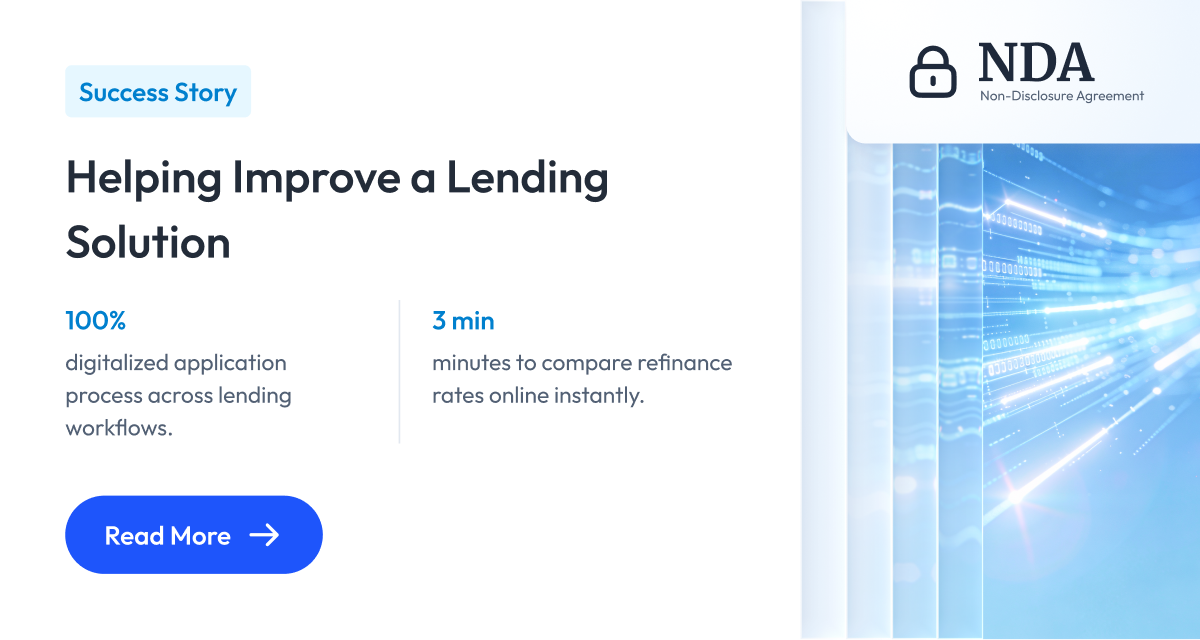
Strategy proves itself in outcomes. The engagement below shows pattern-based modernization in a regulated environment. The work was incremental, owned, and measured.
The challenge
A fintech lending platform ran on a legacy monolith. The architecture raised cost and slowed every change. The customer onboarding took days. A regulated environment left little room for downtime.
- Costly monolith: run-the-lights spend crowded out new product work.
- Slow onboarding: bringing a customer live took about three days.
- Change risk: every release touched the whole system at once.
What Zoolatech did
Zoolatech rearchitected the monolith into microservices. It migrated core workflows onto the Salesforce platform. The strangler pattern replaced functions incrementally, with no big-bang cutover. Governed AI, including on-prem LLM deployment, handled sensitive workflows safely.
- Monolith to microservices: decomposed the core into independent, scalable services.
- Strangler-pattern migration: replaced functions behind a facade, preserving business continuity.
- Salesforce platform migration: moved core workflows onto a modern, maintainable platform.
- Governed, on-prem AI: kept sensitive logic in private models under human review.
Results achieved
| Metric | Result |
| Operating cost | 50% lower |
| Onboarding time | From three days to two minutes |
| Architecture | Monolith replaced by microservices |
Measuring Success: Legacy Modernization KPIs
Modernization needs agility metrics, not raw spend. Track delivery and stability together. The four DORA delivery metrics anchor the dashboard.
| Category | Metric | Why it Mmatters at Enterprise Scale |
| Cost | Cost-to-serve | Confirms reclaimed innovation budget |
| Velocity | Deployment frequency | Signals delivery agility |
| Velocity | Feature lead time | Measures idea-to-production speed |
| Stability | Change-failure rate | Guards reliability during change |
| Stability | Mean time to restore | Limits blast radius of incidents |
| Debt | Maintenance-budget share | Tracks the shift from run to build |
Where to Start: A Prioritized Modernization Roadmap
This is the section a CTO reads to act. Use the portfolio quadrant as the prioritization engine. Sequence by value and risk, not by noise.
A prioritized roadmap for legacy modernization initiatives:
- Assess: audit inventory, dependencies, and technical debt.
- Plan: score the portfolio and select patterns.
- Pilot: prove capability on a high-value, low-risk module.
- Migrate: scale the transformation across the portfolio.
- Optimize: monitor with KPIs and refine continuously.
Conclusion
A successful legacy modernization strategy balances business priorities, technical complexity, and delivery risk. Rather than treating every application the same, leading organizations evaluate each system individually and choose the modernization path that delivers the greatest business value.
The key principles are simple:
- Assess before you modernize.
- Choose the right approach for each application.
- Deliver incrementally to reduce risk.
- Use AI to accelerate modernization where appropriate.
- Continuously measure business impact.
Done well, legacy modernization reduces costs, improves agility, and enables organizations to build on a modern, scalable technology foundation.
Questions You May Have
What is a legacy modernization strategy?
It is a sequenced, business-driven program that scores each application and applies the right modernization approach rather than one blanket rewrite.
Which modernization approach should we choose?
Match each system to one of the seven R’s using a portfolio quadrant of business value and technical quality, since the best choice varies per application.
How does AI help with legacy application modernization?
AI accelerates code translation, documentation, test generation, and refactoring, but it works best under human review and governance rather than as a replacement.
How much does legacy modernization cost?
Cost depends on the chosen approach and should be weighed against rising legacy system maintenance costs and the opportunity cost of inaction.
How long does a legacy modernization project take?
Enterprise programs typically span one to five years, delivered incrementally so value arrives early rather than at one risky final cutover.
How is modernization different from digital transformation?
Modernization re-engineers the underlying systems, while digital transformation is the broader business change that modernized applications make possible.