








Quick Summary
- McKinsey puts generative AI’s annual value for retailers at $240-390 billion, and Salesforce found 75% of retailers expect AI agents to be essential to compete within a year.
- Five distinct technologies get lumped together: AI for decisions, machine learning for prediction, generative AI for content, conversational AI for dialogue, and agentic AI for multi-step tasks.
- Seven use cases carry most of the value, spanning recommendations, visual search, conversational support, demand forecasting, fraud detection, dynamic pricing, and generated content.
- Start from a business problem and audit data quality before choosing a model, because disconnected AI tools produce inconsistent experiences and pilots that never scale.
- One retail app reached 10M+ downloads with visual search and AI outfit features built by a team of 60+, and guest checkout alone lifted average revenue per purchase by 12% on Android.
Customers now move across websites, mobile apps, marketplaces, social channels, and AI-powered search before making a purchase.
That makes AI in ecommerce a practical business capability, not a futuristic concept. Artificial intelligence is already embedded in how many ecommerce businesses sell, serve, and plan.
Retailers use AI to personalize shopping, improve search, automate service, forecast demand, detect fraud, optimize pricing, and strengthen loyalty.
This article explains how AI is used in ecommerce, where generative AI fits, and which use cases for AI in ecommerce deliver measurable value for modern retail teams.
AI Technologies in Ecommerce: Artificial Intelligence, Machine Learning, and AI Agents Explained
The original ecommerce AI conversation often centered on chatbots. Today, AI in ecommerce covers a much wider technology stack.
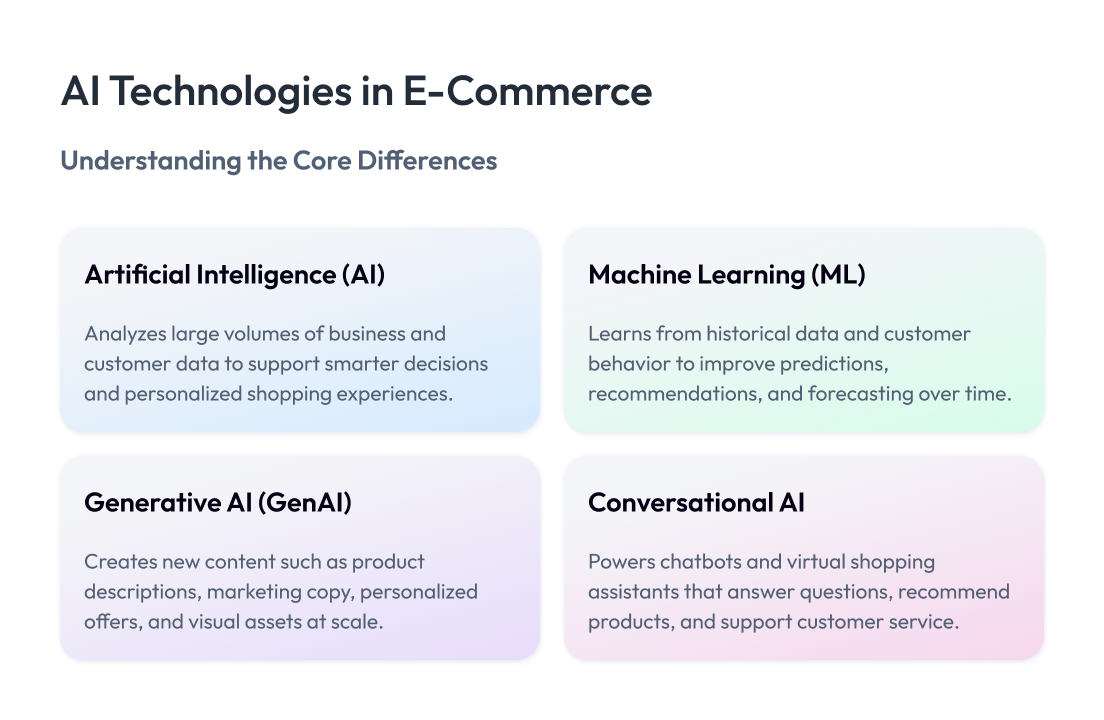
Understanding the difference between artificial intelligence, machine learning, generative AI, and conversational AI helps ecommerce companies choose the right AI solutions.
| Technology | What It Does | Ecommerce Example |
| Artificial intelligence | Analyzes data and supports decisions | Personalized recommendations |
| Machine learning | Learns patterns from historical data | Demand forecasting |
| Generative AI | Creates new text, images, summaries, or responses | Product descriptions and shopping assistants |
| Conversational AI | Understands and responds to customer questions | AI chatbots and virtual shopping assistants |
| Agentic AI | Plans and executes multi-step tasks autonomously | AI agents that search, compare, and complete orders |
What is artificial intelligence?
Artificial intelligence enables software systems to analyze information, identify patterns, and recommend actions.
In ecommerce, AI helps teams move beyond static rules and manual analysis.
Instead of showing every shopper the same product page, AI can adapt recommendations, content, pricing signals, and support responses in real time. AI analyzes customer behavior continuously, so the ecommerce website changes with the shopper.
What is machine learning?
Machine learning is a subset of AI that improves through data and experience.
Retailers use machine learning algorithms to predict demand, detect fraud, segment customers, optimize search results, and forecast returns.
AI and machine learning become stronger when data quality, event tracking, and integration architecture are mature. AI models need clean ecommerce data to produce reliable output.
What is generative AI?
Generative AI creates new content from patterns learned in large datasets.
Generative AI in ecommerce supports product descriptions, image generation, marketing copy, customer support responses, product comparison summaries, and internal workflow automation. Most of these tools use large language models under the hood.
McKinsey estimates that generative AI could unlock $240 billion to $390 billion in annual value for retailers.
What are conversational AI and AI agents?
Conversational AI in ecommerce includes AI chatbots, AI voice assistants, and AI shopping agents. These systems use natural language processing to interpret what a shopper means, not just what they type.
Modern AI assistants can answer product questions, compare items, recommend sizes, explain return policies, and support order tracking. Agentic AI goes further: an agent can take a goal such as “find a waterproof jacket under $150 in my size” and complete the search, comparison, and checkout steps.
Salesforce reported in 2025 that 75% of retailers believe AI agents will be essential to compete within the next year.
Why AI Is Revolutionizing the Ecommerce Industry: 2025 to 2026
AI is becoming a core part of how shoppers discover, compare, and buy products.
Adobe Digital Insights reported record online holiday spending in 2025 and rapid growth in AI-driven traffic to retail sites.
This shift affects both customer-facing experiences and backend retail operations. AI is transforming how ecommerce brands acquire traffic, convert it, and fulfill orders.
Benefits of using AI for ecommerce companies
The benefits of using AI in ecommerce include:
- More relevant product discovery
- Higher customer engagement
- Faster customer support
- Better inventory planning
- Lower fraud exposure
- More efficient merchandising
- Improved operational forecasting
Each benefit maps to a measurable metric. AI gives ecommerce teams sharper decisions on pricing, inventory, and content, and it does so at a scale manual work cannot match.
For enterprise retailers, using AI in ecommerce also requires strong architecture. AI implementation requires significant investment in data pipelines and integration, not just model licenses.
AI systems need clean data, scalable infrastructure, secure integrations, and reliable monitoring.
Zoolatech’s AI engineering services help organizations move from AI experiments to production-ready retail systems.
AI Use Cases in Ecommerce: How AI Is Used in Ecommerce Today
AI use cases in ecommerce now span the full customer journey.
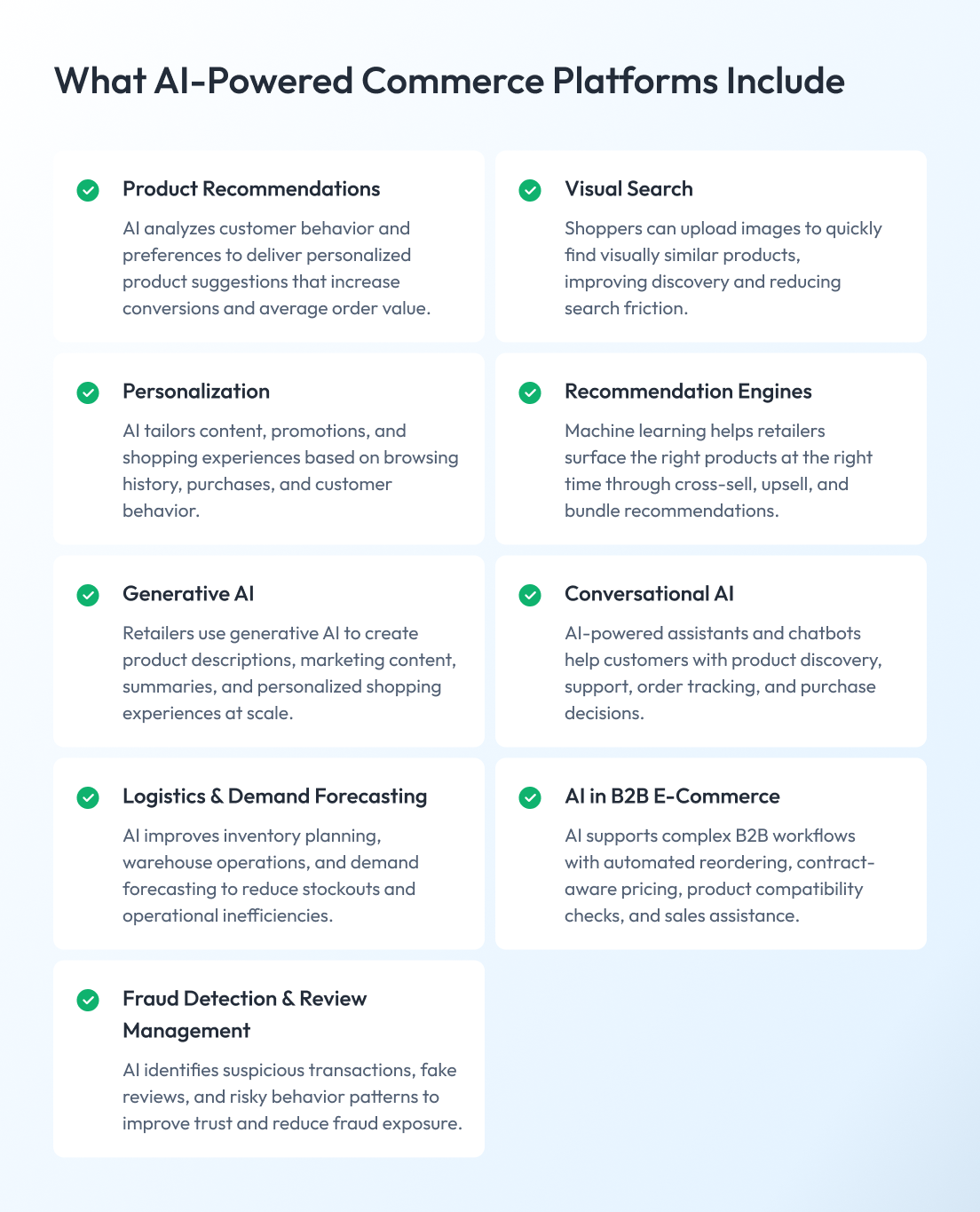
The strongest use cases improve either revenue, customer experience, operational efficiency, or risk control. Retailers can use AI across all four areas, but the proven AI applications usually start in one.
| Use Case | Where It Helps | Business Impact |
| Product recommendations | Product pages, checkout, email, mobile apps | Higher average order value |
| Visual search | Mobile apps and product discovery | Faster path to purchase |
| Conversational AI | Customer service and shopping assistance | Lower support load |
| Demand forecasting | Inventory and supply chain planning | Fewer stockouts and markdowns |
| Fraud detection | Checkout and payments | Reduced transaction risk |
| Dynamic pricing | Merchandising and revenue management | Better margin control |
| Generative content | Product pages and marketing campaigns | Faster content operations |
Visual Search: A Practical AI in Ecommerce Use Case
Visual search remains one of the most practical AI in ecommerce examples.
A shopper can upload a photo and receive similar products based on shape, color, pattern, material, or style. AI can quickly match visual attributes across a catalog of thousands of SKUs.
This solves a common search problem. Customers often know what they want visually but cannot describe it with exact keywords.
Visual search is especially useful in:
- Fashion and apparel
- Home improvement
- Beauty
- Furniture
- Accessories
For mobile commerce, visual search reduces friction and supports faster discovery.
Personalization: How Ecommerce Businesses Use AI to Make Every Journey Relevant
Personalization is one of the most mature uses of AI in ecommerce.
AI analyzes browsing behavior, purchase history, product affinity, cart activity, and loyalty data.
Then it adapts product recommendations, banners, emails, offers, and mobile app experiences. AI makes each touchpoint reflect the individual shopper rather than the average one.
Examples include:
- Personalized homepages
- Recommended product bundles
- Recently viewed product reminders
- Size and fit recommendations
- Personalized promotions
- Location-aware inventory suggestions
Personalization works best when it respects customer privacy and uses first-party data responsibly.
Enterprise teams should connect personalization with consent management, data governance, and secure customer data platforms.
Zoolatech’s retail software development services support scalable customer experiences across web, mobile, and omnichannel platforms.
Recommendation Engines: Increasing Sales Through Relevance
Recommendation engines analyze customer behavior and product relationships.
They help retailers show the right product at the right moment. AI algorithms rank candidates in milliseconds using signals no merchandiser could review manually.
Modern recommendation systems use several signals:
- Product views
- Cart additions
- Purchase history
- Search behavior
- Product attributes
- Customer segments
- Real-time session activity
Recommendation logic can support cross-sell, upsell, replenishment, bundles, and post-purchase engagement.
The most effective systems combine machine learning with business rules.
For example, a retailer may exclude out-of-stock products, low-margin items, or restricted categories from automated recommendations.
Generative AI in Ecommerce: Content, Search, and Agentic AI
Generative AI in ecommerce is changing how retailers create, manage, and personalize content.
Gen AI in ecommerce can support both customer-facing experiences and internal operations. Generative AI enables teams to produce, translate, and adapt content at catalog scale.
Common generative AI use cases in ecommerce include:
- Product descriptions
- SEO metadata
- Email subject lines
- Personalized landing pages
- Product comparison summaries
- Customer support replies
- Campaign concepts
- Image and creative variations
Using generative AI becomes especially valuable for retailers with large catalogs.
An AI photo editor can help these retailers manage visual content more efficiently by refining product images and creating consistent variations across large catalogs.
Manually writing or localizing thousands of product descriptions is slow and expensive.
AI can create first drafts, identify missing attributes, summarize reviews, and generate localized content faster. The resulting content can then be reviewed and refined with the workflow of an SEO content writing company. AI also surfaces catalog gaps that would otherwise stay hidden.
However, human review remains important.
Retailers should validate accuracy, brand voice, compliance, and product claims before publishing AI-generated content.
Deloitte research highlights customer service, marketing, merchandising, and operations as key generative AI opportunity areas in retail.
Conversational AI and AI Agents in Ecommerce
Conversational AI in ecommerce has evolved beyond simple scripted chatbots.
Modern AI assistants can answer questions, recommend products, compare items, and help customers complete purchases. Implementing AI voice support extends the same capability to phone and smart-speaker channels.
They can also support post-purchase journeys by handling order status, return questions, delivery updates, and warranty information. AI automates the repetitive tier-one contacts so human agents can focus on exceptions.
Common conversational AI capabilities include:
- Product discovery conversations
- Size and fit guidance
- Order tracking
- Return support
- Inventory availability checks
- Gift recommendations
- Policy explanations
Conversational AI works best when connected to product data, order systems, inventory systems, and customer profiles.
Without those integrations, the assistant becomes a generic FAQ tool.
Zoolatech’s custom software development services help retailers integrate AI assistants into complex commerce environments.
AI for Logistics, Inventory, and Demand Forecasting
AI is not limited to front-end shopping experiences.
Some of the highest-value use cases for AI happen inside retail operations.
Machine learning can improve:
- Demand forecasting
- Warehouse planning
- Supplier performance analysis
- Inventory allocation
- Returns forecasting
- Route optimization
- Workforce planning
Better forecasting helps retailers reduce stockouts, overstocks, and markdown pressure. AI can also flag supplier delays early enough to reroute inventory.
It also improves customer satisfaction by increasing product availability.
Google Cloud retail guidance identifies generative AI opportunities across customer operations, content creation, search, supply chain, and knowledge management.
Zoolatech’s centralized merchandising platform case study shows how cloud-native retail platforms can improve operational visibility and merchandising workflows.
AI for Review Management, Fraud, and Trust
Customer trust is critical in e-commerce.
AI can help retailers identify fake reviews, suspicious transactions, abusive returns, and unusual account behavior.
Fraud detection models analyze signals such as:
- Device fingerprinting
- Payment behavior
- Location mismatches
- Order frequency
- Refund patterns
- Account history
AI can assist review teams by prioritizing moderation when it detects repeated language, suspicious review timing, or unusual rating patterns.
The goal is not to replace human judgment entirely.
The goal is to route high-risk cases faster and reduce manual workload.
AI in B2B Ecommerce
AI in B2B ecommerce has different priorities than consumer retail.
B2B buyers often deal with negotiated pricing, approval workflows, bulk orders, recurring purchases, and complex product catalogs.
AI can be used to support B2B commerce through:
- Account-specific product recommendations
- Contract-aware pricing suggestions
- Automated reorder workflows
- Sales assistant copilots
- Quote generation support
- Product compatibility checks
- Customer service automation
For B2B retailers and distributors, AI integration must cover enterprise resource planning, customer relationship management, product information management, and order management systems.
This makes architecture and data quality especially important.
How to Use AI in Ecommerce: A Step-by-Step Approach for Ecommerce Companies
Retailers often ask how to use AI in ecommerce without creating disconnected pilots.
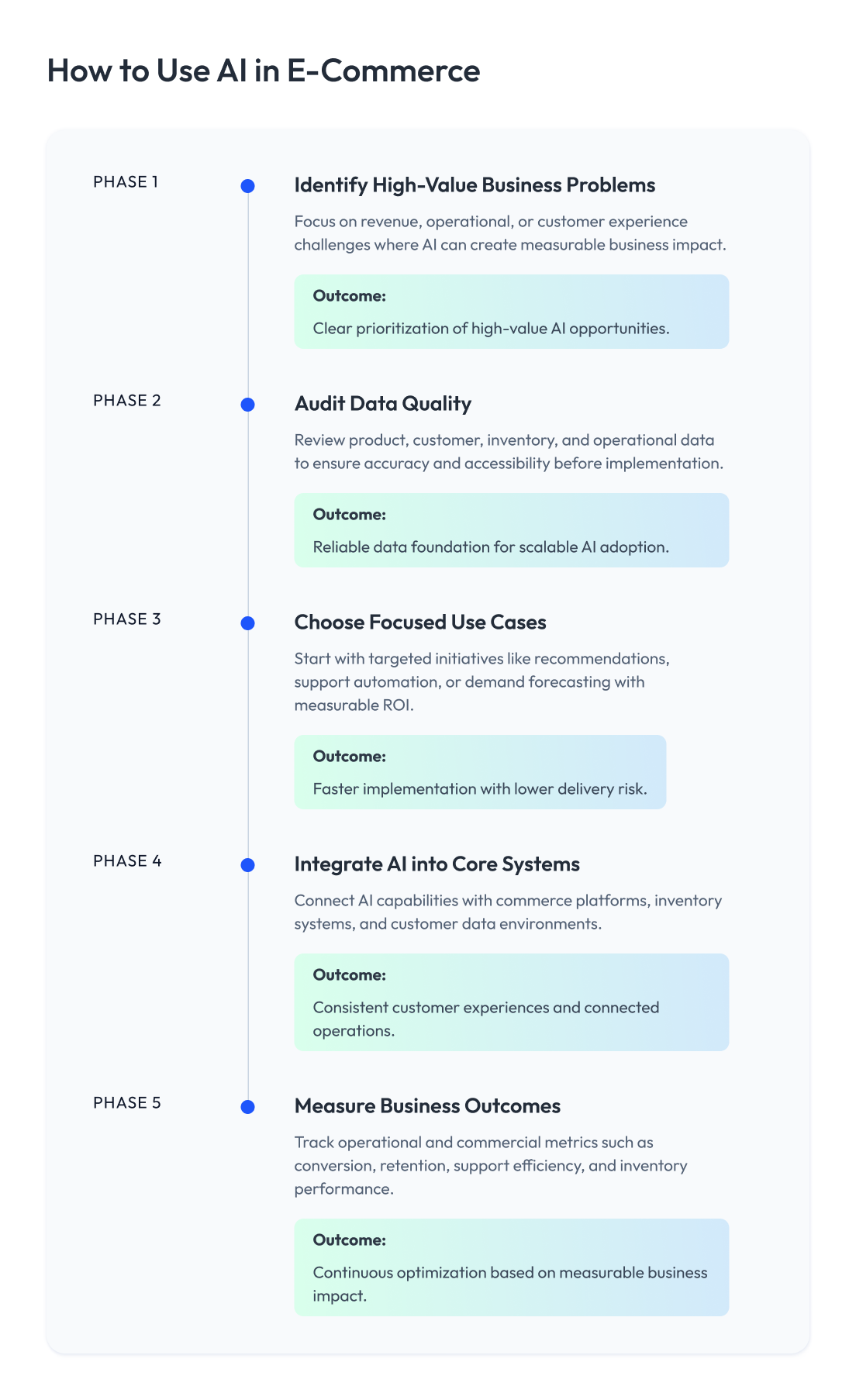
The best approach starts with business priorities rather than technology trends. Introducing AI as a business capability, not a side project, is what separates successful AI programs from stalled ones.
1. Identify high-value business problems
Start with problems that affect revenue, cost, or customer experience.
Good examples include poor search relevance, high support volume, frequent stockouts, low conversion, or manual merchandising work.
2. Audit data quality
AI depends on accurate and accessible data.
Retailers should review product data, customer events, inventory feeds, order history, and content quality before implementation.
3. Choose focused use cases
Start with narrow use cases that have measurable outcomes.
Examples include recommendation improvements, support automation, product description generation, or demand forecasting.
4. Integrate AI into core systems
AI should connect to the ecommerce platform, inventory systems, order management, and customer profiles.
Disconnected AI tools often create inconsistent customer experiences.
5. Measure business outcomes
Useful metrics include conversion rate, average order value, support resolution time, stockout rate, return rate, and customer retention.
AI adoption should be measured by operational impact, not model novelty. Scaling AI only makes sense once one use case has proven its return.
AI in Ecommerce Examples: How Retail Brands Use AI
AI in ecommerce becomes easier to understand when tied to real shopping experiences.
Leading retailers that have implemented AI use it to reduce friction, personalize discovery, and improve operational decisions.
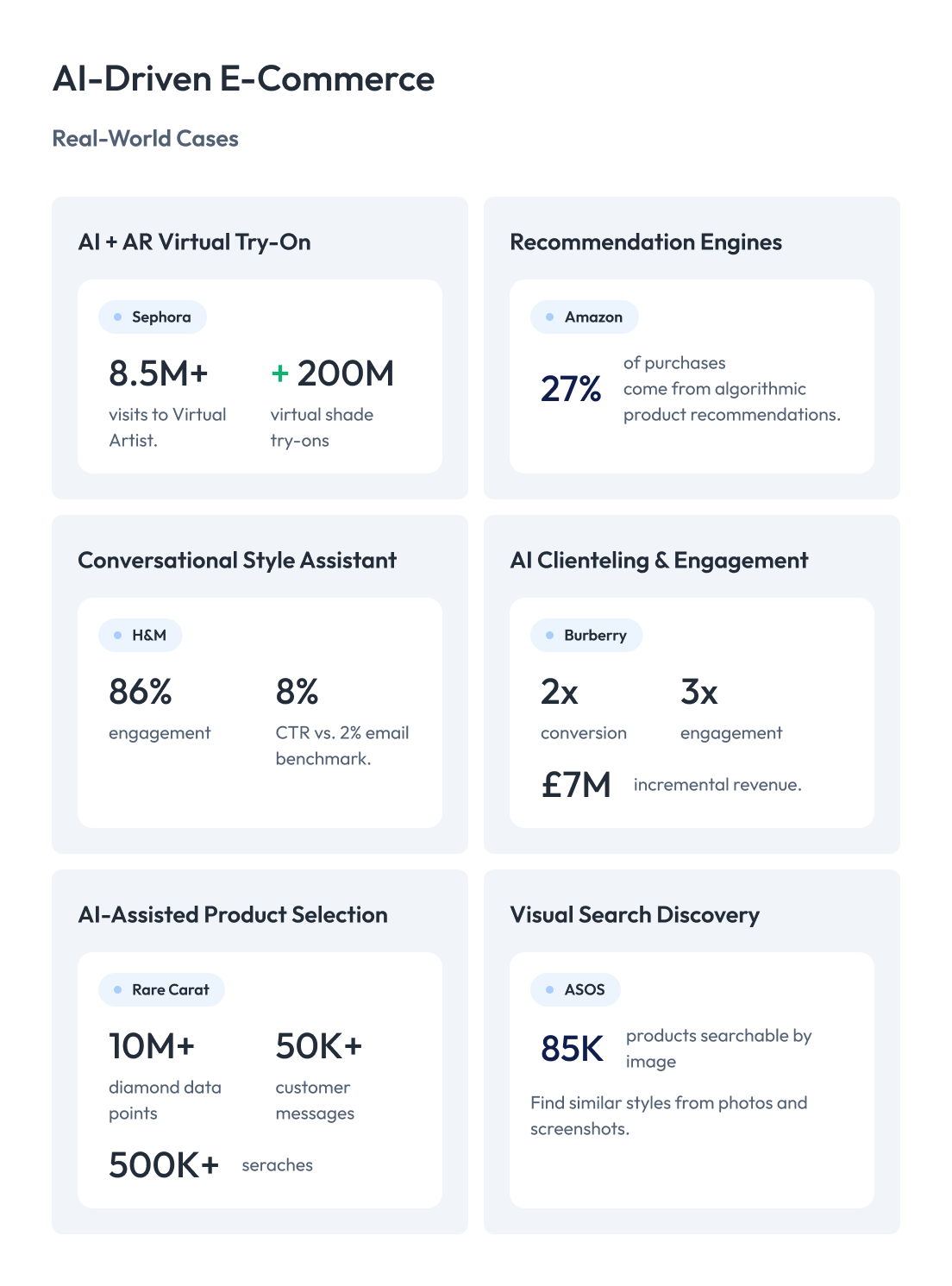
Sephora: AI and AR for virtual product try-on
Sephora uses AI and augmented reality to help customers test beauty products virtually.
This improves product confidence before purchase and reduces the gap between online and in-store shopping.
Amazon: Recommendation engines at marketplace scale
Amazon uses AI-driven recommendations across product pages, search, checkout, and post-purchase journeys.
The system helps shoppers discover relevant products and supports cross-sell and upsell opportunities.
H&M: Conversational shopping assistance
H&M has used chatbot experiences to learn customer style preferences and suggest relevant products.
This is a practical example of conversational AI in ecommerce supporting discovery and personalization.
Burberry: AI-supported customer engagement
Burberry has used chatbot-based experiences around fashion events, product discovery, and customer interaction.
The approach shows how luxury brands can combine digital engagement with brand storytelling.
Rare Carat: AI-assisted product selection
Rare Carat used AI to help shoppers compare diamonds across complex criteria.
This use case shows how AI can simplify high-consideration purchases with many technical attributes.
The Use of AI in Ecommerce: Implementation Risks and Governance
AI adoption creates new risks around accuracy, privacy, bias, security, and operational control.
Retailers should define governance before scaling AI into customer-facing experiences. The power of AI cuts both ways: an unmonitored model can damage trust as fast as it builds it.
Key governance areas include:
- Data privacy
- Model accuracy
- Human review workflows
- Security controls
- Bias monitoring
- Compliance requirements
- Fallback logic
NIST AI Risk Management Framework provides guidance for managing AI risks across design, deployment, and operation.
For ecommerce teams, governance should be practical.
AI systems need clear owners, measurable thresholds, and rollback processes when output quality drops.
Case Study: AI Ecommerce at Mobile Scale
Zoolatech supported a high-scale retail mobile app with 10M+ downloads across iOS and Android.
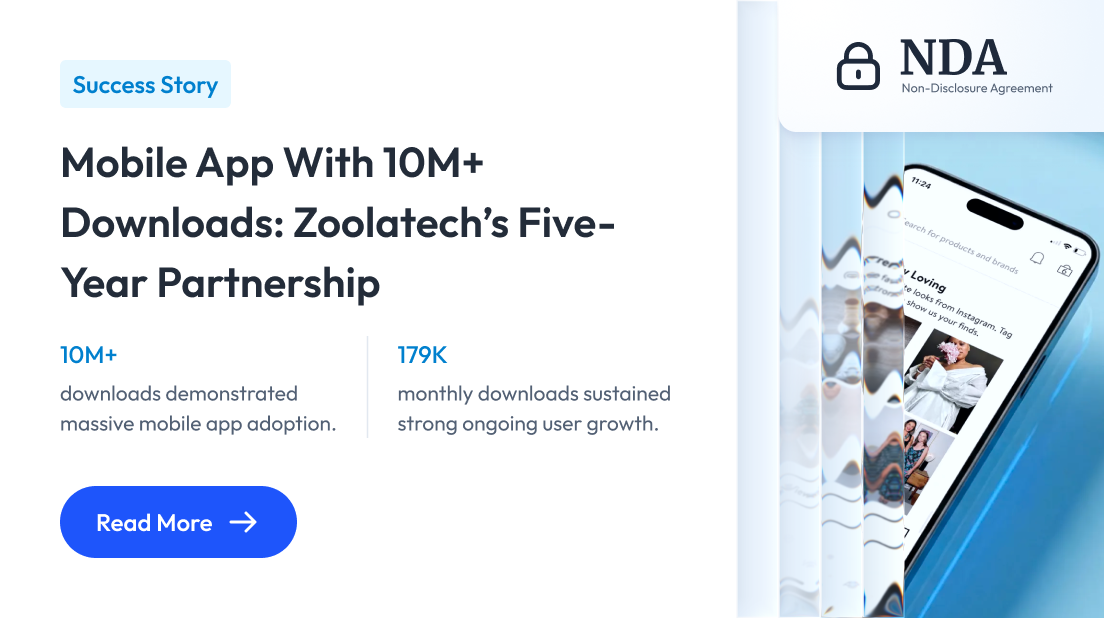
The client needed to improve engagement, conversion, performance, and feature delivery across a large mobile commerce ecosystem.
Challenge
The retailer needed to scale mobile development while improving customer engagement and purchase flows.
The platform had to support high traffic, frequent releases, and revenue-driving features across both mobile ecosystems.
Solution
Zoolatech built and supported a dedicated mobile engineering team of 60+ professionals.
The team delivered features including visual search, AI-powered outfits, dynamic homepage components, payment integrations, loyalty features, push notifications, and guest checkout. Features powered by AI sat alongside core commerce flows rather than in a separate app layer.
Outcome
The app reached 10M+ downloads and 179K monthly downloads.
Guest checkout increased the average revenue rate from purchases by 12% on Android.
This case demonstrates how AI, mobile engineering, and scalable delivery improve digital retail performance.
The Future of AI in Ecommerce
The future of AI in ecommerce points toward agents rather than assistants.
Shoppers will increasingly delegate discovery, comparison, and reordering to AI agents acting on their behalf. Ecommerce companies will need product data, pricing, and availability that machines can read and trust.
Three shifts are already visible:
- AI-driven search referring traffic to ecommerce websites
- Agentic checkout completing purchases without a browsing session
- AI creates and localizes catalog content continuously
Businesses can use this transition to their advantage if their architecture is ready. AI empowers the retailers with clean data and open APIs first, and everyone else later.
Conclusion: AI Solutions for Ecommerce Development
The use of AI in ecommerce now requires more than adding a chatbot to a storefront.
Retailers need scalable architecture, reliable data pipelines, AI governance, and production-ready integrations. This is where AI business value is won or lost.
Zoolatech helps retailers build AI-enabled commerce systems through:
- AI and machine learning development
- Custom e-commerce software development
- Mobile commerce engineering
- Cloud-native platform modernization
- Data engineering and analytics
- Retail system integrations
Zoolatech’s cloud engineering services support scalable AI workloads and data-driven commerce platforms. If you want to explore how AI can take your commerce stack further, our team can map the use cases to your data and systems.
Questions You May Have
How is AI used in ecommerce?
AI is used in ecommerce for recommendations, search, personalization, chatbots, fraud detection, pricing, inventory forecasting, and content generation.
What are the main benefits of AI in ecommerce?
The benefits include higher personalization, faster support, better product discovery, improved forecasting, lower manual workload, and stronger customer retention.
What are common AI use cases in ecommerce?
Common AI use cases include visual search, recommendation engines, conversational AI, dynamic pricing, fraud detection, demand forecasting, and generative content.
What is generative AI in ecommerce?
Generative AI in ecommerce creates product descriptions, support replies, marketing content, product summaries, campaign assets, and localized commerce content.
What are generative AI use cases in ecommerce?
Generative AI use cases include product content creation, customer support automation, campaign personalization, product comparison summaries, and internal workflow assistance.
What is conversational AI in ecommerce?
Conversational AI uses chatbots, virtual assistants, and AI agents to answer customer questions and guide shopping journeys.
How can retailers start using AI in ecommerce?
Retailers should start with a business problem, audit data quality, choose focused use cases, integrate AI into core systems, and measure outcomes.
How is AI used in B2B ecommerce?
AI in B2B ecommerce supports account-specific recommendations, quote generation, contract-aware pricing, reorder automation, and sales assistant workflows.