








Quick Summary
- Global e-commerce passed $6.86 trillion in 2025 and is tracking toward $8 trillion by 2027, so the constraint is execution rather than a shortage of room.
- Test any idea against five traits: sustainable demand, defensibility through technology, margin structure, the right platform choice, and repeat purchase potential.
- The 25 ideas split into physical niche products, tech-enabled hardware, fashion and beauty, digital goods, and models that compete on structure such as dropshipping and B2B.
- Time to launch tracks technical complexity: print-on-demand and digital downloads go live in days, while wearables, AR/VR, and luxury resale run 3 to 6+ months on custom platforms.
- Choosing SaaS when the idea needs custom development is named the most expensive founder mistake, since tiered B2B pricing, marketplaces, and connected devices all outgrow a standard store.
Global ecommerce sales surpassed $6.86 trillion in 2025 and are on track to reach $8 trillion by 2027. Behind that number are more founders launching online stores than at any point in history, many of them selling niche products nobody had heard of a few years ago.
So if you think you are too late to start an ecommerce journey, or that every category is already crowded, let that worry go. What decides who wins is no longer the niche alone. It is a smart strategy, a creative angle, and a sharp execution of the right idea, paired with the right technology.
We have built ecommerce platforms across the full range, from Wish-scale marketplaces to niche startups shipping their first product, so we see from the inside what makes a successful ecommerce business.
This guide gives you 25 profitable ecommerce business ideas with genuine potential, the technology behind each one, an honest read on how hard each is to launch, and examples of companies that have already pulled it off.
By the end of this article, you will also spot the mistakes that sink most new stores and know which technology fits your idea best.
What Makes an Ecommerce Business Idea Worth Pursuing
Before we get to the ideas for ecommerce business founders, look at them with an engineer’s eye and a business head. Passion alone rarely carries a store. The ideas that last share five traits, and you can check any concept against them in minutes.
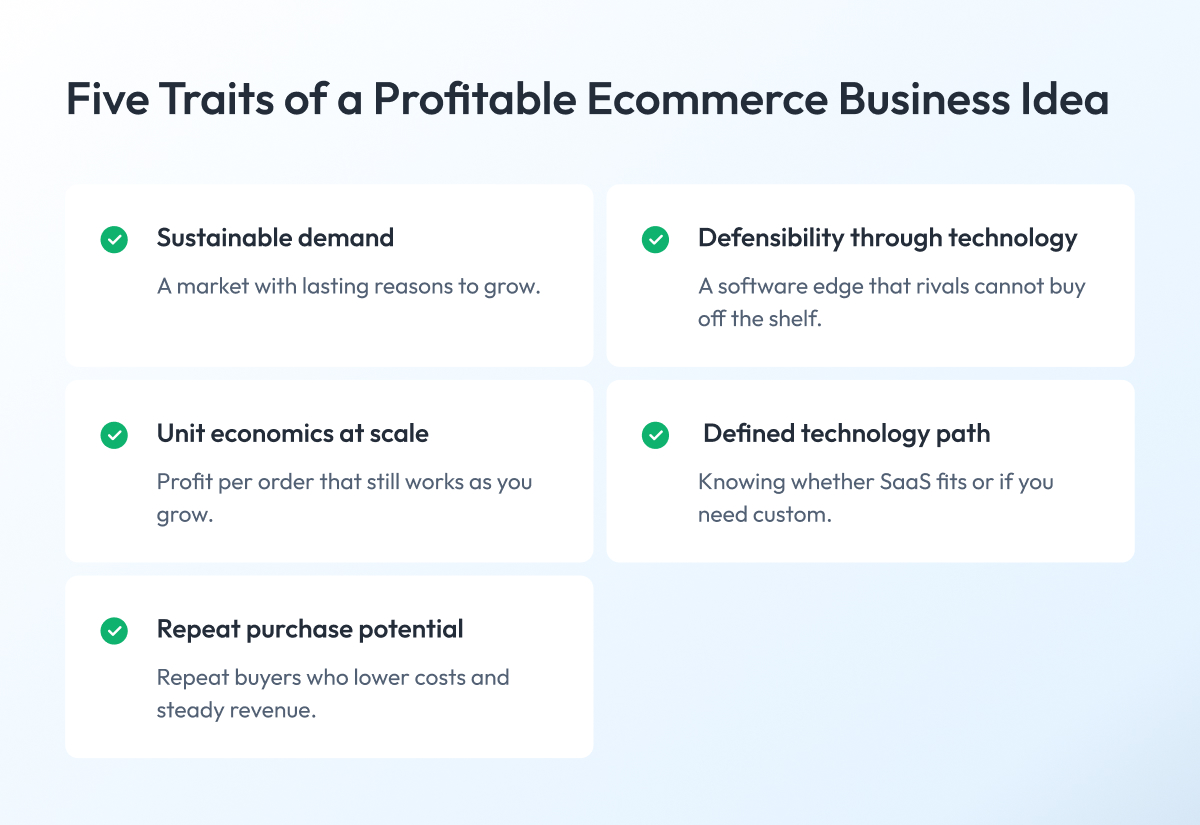
Sustainable demand.
Pick a market with a steady reason to grow, like an aging population or a habit people repeat. A passing trend dries up the moment attention moves on, so study the multi-year demand before you trust the latest spike. Steady demand buys you time to build a business.
Defensibility through technology.
Find the one spot where software gives you an edge that a rival cannot buy off the shelf, because the top ecommerce business in any category owns exactly that. It might be a recommendation engine trained on your own data, an authentication system others struggle to match, or automation that runs your operations more leanly. A technical moat protects your margins. Without one, you end up competing on price.
Unit economics that survive at scale.
A store can earn money at fifty orders and lose it at fifty thousand. Run the numbers at the size you are aiming for, and include ad spend, returns, payment fees, and shipping. You have a profitable business only if the math still works once you grow.
A defined technology path.
Know from the start whether your idea fits a ready-made store like Shopify or needs a custom platform. Simple catalog-and-checkout shops do fine on SaaS, but tiered B2B pricing, smart personalization, marketplaces, and connected devices need custom development. Getting this wrong is the most expensive mistake a founder can make.
Repeat purchase potential.
Repeat buyers lower your ad costs and give you revenue you can count on. Consumables, subscriptions, and refillable products bring people back on their own. With one-time purchases, you have to win the same customer again and again, so strong repeat business turns a shaky store
into a successful business.
Hold any idea up against these five before you commit, and the list below gets much easier to judge.
25 Best Ecommerce Business Ideas for 2026
We have helped build ecommerce platforms of every size, from ones serving millions of shoppers to startups shipping their first product. So we look at each idea the way a builder does, ranking ecommerce business ideas to start by what it takes to make them work and where the technology becomes your advantage over competitors.
If you start in 2026, you can launch some ideas yourself on a ready-made store like Shopify. Others only work when the system underneath is built properly, and a few need a custom platform from day one. For each of these ideas for ecommerce business owners, you will see what it involves, how quickly it can launch, whether you can build it yourself, and the part that tends to be the hardest.
Physical Products With Niche Positioning
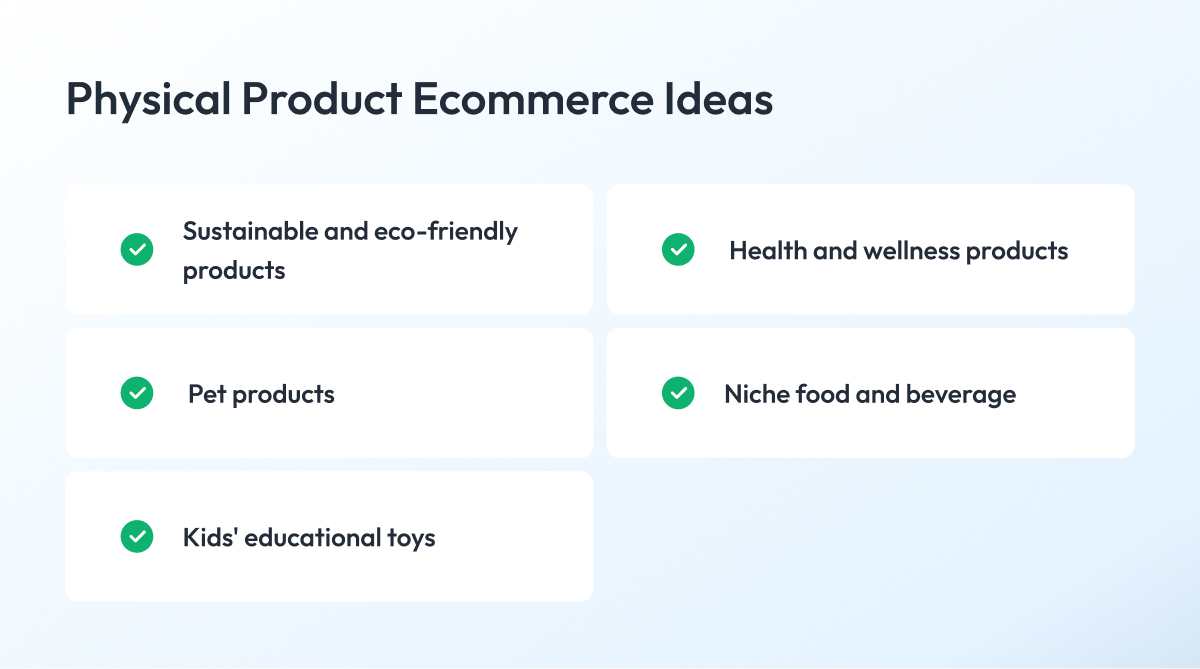
These are physical products you ship to customers. Several rank among the best ecommerce business ideas for beginners: the technology stays simple until you decide to scale.
1. Sustainable and eco-friendly products
Shoppers increasingly want products that are kinder to the planet, from refillable packaging to recycled materials, and they will pay extra for them. The pull is strong: this market grows around 11.1% a year, and roughly 70% of buyers say they prefer eco-friendly packaging.
Getting started is easy. A ready-made store like Shopify will do, and you can be live in a few weeks. What sets you apart is a product page that backs up every promise, showing your sustainability certificates and the carbon footprint of each item, and that page is where browsers become buyers.
The catch is credibility. With so many ecommerce brands now calling themselves green, the rules are tightening, and one stretch of the truth can undo years of goodwill.
2. Health and wellness products
Wellness is one of the largest markets on earth and one of the more profitable ecommerce business ideas you can pursue. It was worth $6.3 trillion in 2023 and is on track to reach $9 trillion by 2028 (Global Wellness Institute), encompassing supplements, healthy foods, and self-care of all kinds.
You can open an ecommerce store in one to three months, but the money here comes from software. Two features do the heavy lifting:
- A short quiz that builds a health profile and recommends the right products for each person
- A subscription engine that ships refills automatically and keeps customers buying for months
- A plain catalog cannot compete with that, though both features will need a developer. Before you launch, know that health is a watched space: be careful with the promises you make and line up the regulations early, because a compliance slip here is expensive to fix.
3. Pet products
People treat their pets like family, and they spend accordingly: the U.S. pet market hit $158 billion in 2025 (American Pet Products Association). Food, treats, toys, and health products all sell steadily.
The smart play is recurring revenue. Since supplies run out, set up a subscription with auto-replenishment so orders refill automatically, and add vet-backed recommendations to guide each purchase. A developer can set both up quickly, and the payoff is repeat sales while rivals chase one-time buyers. Winning is a fight for attention, though.
Thousands of pet shops already exist, so you survive by owning one corner of the market, like a single breed or health need, and by shipping reliably every time.
4. Niche food and beverage
Some foods and drinks simply are not on supermarket shelves: single-origin coffee, small-batch sauces, better-for-you snacks. The organic corner of this market grows about 8 to 9% a year, and a tight focus on an ecommerce niche is how a small business gets noticed.
Plan for one to three months and expect a developer, because fresh products add work from day one. You will want software that tracks how fresh each item is and plans the quickest local delivery routes, all while staying inside food-safety rules. Built well, that system gets orders out faster than bigger rivals manage.
The economics are the tricky part: cold storage and shipping cost a lot, and every item that spoils before selling is money gone, so your pricing and routes have to be planned with care.
5. Kids’ educational toys
Toys that teach while children play, like science kits and skill-building games, are an easy sell to parents who want screen-free value. STEM toys are growing around 12% a year, and the wider toy market should reach $118.8 billion by 2030.
This is one of the quickest businesses to launch, often within days to weeks, on a ready-made store. A recommendation engine that matches toys to a child’s age, paired with a monthly subscription that sends a new kit each time, turns one purchase into a lasting habit, and neither is complicated to build.
Safety is the one thing you cannot get wrong. Children’s toys must meet strict safety standards, and a single product that fails can harm a child and end your brand overnight.
| Idea | Time to launch | Tech complexity | The hard part |
| Sustainable and eco-friendly products | A few weeks | Low to Medium | Proving your eco-claims |
| Health and wellness products | 1 to 3 months | Medium | Health rules and claims |
| Pet products | A few weeks | Low to Medium | Standing out from many shops |
| Niche food and beverage | 1 to 3 months | Medium | Spoilage and delivery costs |
| Kids educational toys | Days to weeks | Low | Meeting safety standards |
Tech-Enabled & Smart Products
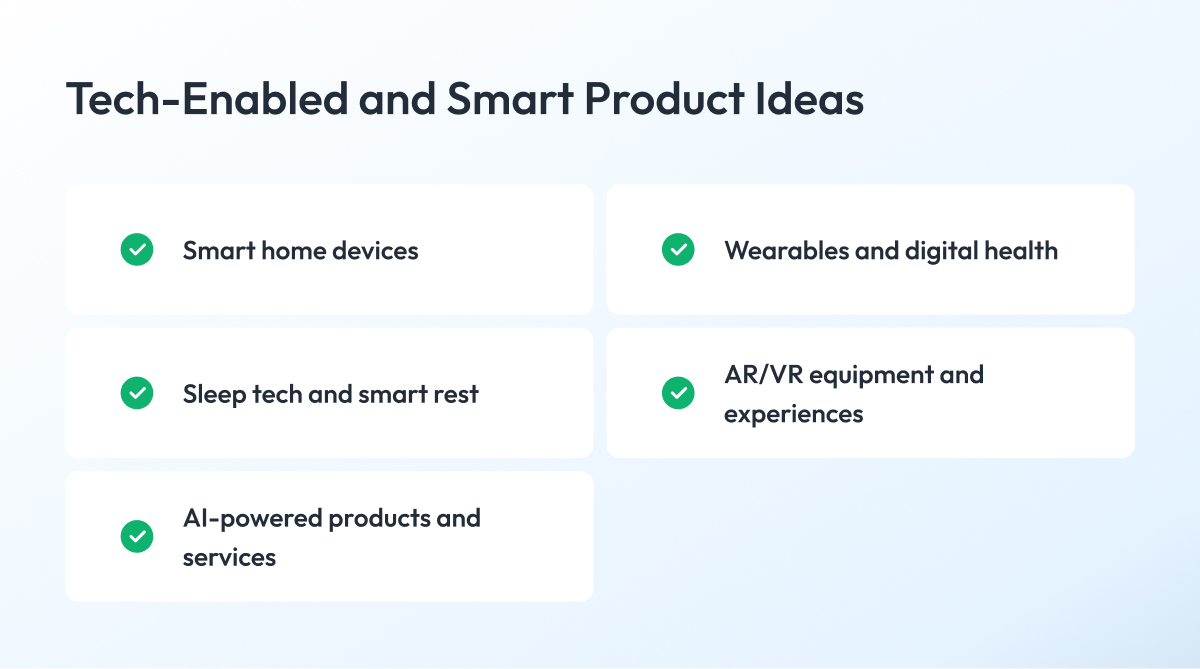
These ideas integrate hardware, software, and data into a single product, so the engineering starts on day one. Plan for longer timelines and a custom build, because here the technology is what people are paying for.
6. Smart home devices
Connected lights, locks, cameras, thermostats: smart home gear has gone mainstream, and most U.S. households now own at least one device. What people want here is a system where every device works together, so the parts have to behave as a single unit.
This is a serious build, three to six months or more, and a custom platform from the start. Behind the product, you need a layer that connects all devices and a dashboard that lets owners control them from one place. Two things make or break it. The devices have to play nicely with the apps and brands people already use, and security has to be airtight, because one break-in or outage spreads doubt across everything you sell.
7. Wearables and digital health monitoring
Bands and devices that track sleep, stress, hydration, and movement turn a one-time purchase into a daily habit, since the data keeps people coming back. Demand keeps climbing as health tracking becomes part of normal routines.
Expect a long road. This is high-complexity work over several months: pipelines that pull in data from the device, a dashboard that makes sense of it, and storage built to medical-grade privacy standards. That last part is the whole game. You are handling people’s health information, so if the way you store and protect it falls short, no amount of marketing will save you from the legal and reputational fallout.
8. Sleep tech and smart rest products
Mattresses with sensors, sleep trackers, and rest-improvement gadgets: this slice of wellness is growing in the double digits each year, and buyers reward products that actually help them sleep better. The winners turn raw sleep data into advice a person can act on tomorrow morning.
Budget two to four months for a meaningful version. The engine that matters is the one that reads each person’s sleep patterns and tailors its guidance over time. Where founders stumble is proof. Reviewers and buyers now expect measurable results, so both your sensors and the insights they provide must be accurate enough to withstand scrutiny from a skeptical customer.
9. AR/VR equipment and experiences
Headsets, accessories, and immersive content are in a rapidly expanding market as both gaming and corporate training adopt the technology. Many businesses here sell the hardware and content together, or rent out the gear and earn from what runs on it.
Plan for six months or more at the top of the difficulty scale. You are building a platform to deliver immersive content and, often, tools to manage rentals and equipment. The make-or-break factor is performance. Immersive experiences are heavy on bandwidth and graphics, and a library that stutters or runs thin will sink an otherwise strong product.
10. AI-powered products and services
AI is everywhere now: 88% of organizations use it in at least one part of their business (McKinsey). In ecommerce that can mean a smart product or an AI layer that personalizes, generates, or configures something for the shopper to boost your business. Here, the intelligence is the product, so the engineering is the business.
This is a multi-month, high-complexity effort. The core is a recommendation engine or an AI configurator trained on your own data rather than a generic plug-in. Two forces decide whether it pays off:
- Data quality, because a model is only as good as what you feed it
- Running costs, since inference bills can quietly eat your margins if the system is built poorly
Get those right, and the technology becomes a moat that competitors struggle to copy.
| Idea | Time to launch | Tech complexity | The hard part |
| Smart home devices | 3 to 6+ months | High | Device compatibility and security |
| Wearables and digital health | 3 to 6+ months | High | Protecting health data |
| Sleep tech and smart rest | 2 to 4 months | Medium to High | Proving it works |
| AR/VR equipment and experiences | 6+ months | High | Performance and content depth |
| AI-powered products and services | 3 to 6+ months | High | Data quality and running costs |
Fashion, Beauty, and Lifestyle
Trust and personalization sell here, and a couple of them rank among the best ecommerce business ideas once you get the experience right. A few look like a simple catalog and turn technical the moment you grow.
11. Ethical and sustainable fashion
Clothing made with fair labor and honest sourcing has a small but devoted audience that pays a premium and stays loyal. These shoppers want to see how a garment was made, down to the factory.
You can launch your ecommerce site in a few weeks to a couple of months on a ready-made store. What earns the sale is a way to show your supply chain openly, backed by photos, reviews, and stories from people who wear the clothes. Everything rests on traceability. If you cannot trace a product back through your supply chain, the promise the whole brand is built on falls apart, so treat tracking as a core feature.
12. Print-on-demand apparel
Designs get printed onto blank products like apparel and home goods only after someone orders, which means zero inventory and almost no upfront risk. The category is booming, from $10.78 billion in 2025 toward $57.49 billion by 2033 (Grand View Research), and it remains one of the easiest ecommerce business ideas to launch.
You can start selling within days using a design tool and a link to a print supplier who handles the rest. The squeeze is the margin. Low barriers attract intense competition and thin profit margins per item, so strong designs, a sharp niche, and a brand worth following matter far more than scale.
13. Luxury resale and recommerce
Luxury resale is one of the most profitable ecommerce business ideas in fashion: authenticated pre-owned handbags, watches, and jewelry give buyers prestige at a lower price and sellers a way to cash out. The U.S. luxury resale market was worth about $8.65 billion in 2024 and is heading to $13.04 billion by 2030 (Arizton), outpacing the growth of new luxury.
This is a high-complexity platform that takes months to build. It needs a workflow to authenticate items, a way to grade their condition consistently, and community features that keep collectors around. Authentication carries the entire model. One counterfeit that slips through does more damage to the marketplace than a hundred honest sales can repay, so the verification system is where most of your engineering should go.
14. Beauty tech and skincare gadgets
Connected skincare devices and smart beauty tools sell into a fast-growing market where personalization drives both the first purchase and every one after. Shoppers want a routine shaped around their own skin.
Set aside one to three months. The feature that sets this apart from a normal shop is an AI skin diagnostic tool that reads a customer’s skin and recommends a regimen, paired with subscription refills that keep products flowing. Credibility is the obstacle. The advice has to be accurate enough that customers believe it, because weak guidance reads as a gimmick, and they walk away fast.
15. Personalized gifts
Customized products carrying a name, a date, or a private joke hold strong emotional value and get shared, which lowers the cost of finding new customers. Add corporate and seasonal gifting, and a sizable B2B layer opens up on top of consumers.
Plan for one to three months. You will want a configurator that lets people design the item, a live preview so they see it before buying, and a separate portal for bulk corporate orders. The trap is accuracy at volume. Every personalization is a chance to get a name or a detail wrong, and a botched custom order is far harder to make right than a standard one, so quality checks have to scale with you.
| Idea | Time to launch | Tech complexity | The hard part |
| Ethical and sustainable fashion | Weeks to 2 months | Low to Medium | Tracing your supply chain |
| Print-on-demand apparel | Days | Low | Thin margins, heavy competition |
| Luxury resale and recommerce | 3 to 6+ months | High | Authenticating every item |
| Beauty tech and skincare gadgets | 1 to 3 months | Medium | Making the advice believable |
| Personalized gifts | 1 to 3 months | Medium | Getting custom orders right at scale |
Digital Products and Services
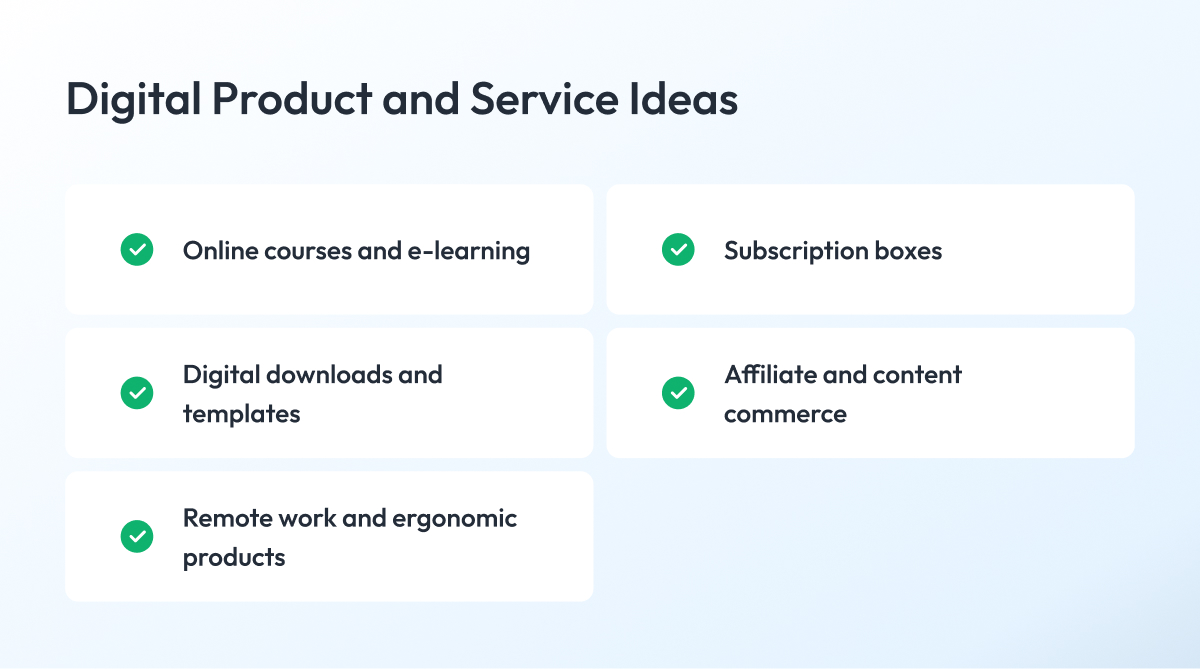
These rank among the most scalable ecommerce business ideas: no inventory, no shipping, and the best margins on the list. They are the cheapest ways to start and the easiest to copy, so the edge is in how you build and keep an audience.
16. Online courses and e-learning
Selling what you know, as courses, cohorts, or certifications, is one of the best ecommerce business ideas for anyone with expertise, and the margins stay high once the material exists. The market is enormous and still climbing, on course to approach $1 trillion by the early 2030s, at roughly 14% annual growth (Allied Market Research).
Give it one to three months. A serious version runs on a learning platform with built-in progress tracking, group cohorts, and live sessions. The whole thing lives or dies on whether people finish. Refunds and silence follow a course nobody completes, so the engagement features, reminders, milestones, and community are the part that matters most.
17. Subscription boxes
A subscription business sends a curated box on a set schedule, turning shopping into a habit and giving you predictable income. Run well, with tight curation and lean logistics, the profit margins are healthy.
Expect one to three months to launch. Under the hood, you need recurring billing, a way to predict who is about to cancel, and options that let subscribers tweak their box. Churn is the enemy. Signing people up costs real money, and keeping them is fragile, so spotting a likely cancellation before it happens is what separates a growing box from a leaking bucket.
18. Digital downloads and templates
Templates, presets, planners, and digital assets cost almost nothing to deliver and never run out of stock, which gives them high profit on each sale and makes them about as scalable as ecommerce gets. One good product can sell for years.
You can launch in days with instant delivery and a system to manage licenses. The threat is copying. Digital goods are easy to pirate and easy to imitate, so your protection comes from the brand you build, the bundles you offer, and the updates you keep shipping.
19. Affiliate and content commerce
Affiliate and content commerce is one of the better ecommerce business ideas for beginners: you build an audience, recommend products you trust, and earn a commission on what sells, all without touching inventory. It scales with your reach, and good content keeps paying out long after you publish it.
This launches in days to weeks. As the program grows, you will want solid tracking, an attribution dashboard, and a portal for your partners. The risk is dependence. Your income leans on accurate tracking and on traffic from platforms outside your control, so building an owned audience and first-party data is how you make the business last.
20. Remote work and ergonomic products
Standing desks, ergonomic chairs, and home office gear settled into steady demand once hybrid work stopped being temporary. Order values are high, which offsets the fact that people rarely buy furniture.
You can live for a few weeks to a couple of months. A virtual showroom and an augmented-reality “try it in your room” feature take the guesswork out of buying big items online and cut hesitation at checkout. Shipping is the silent cost. Bulky products are expensive to ship and even more expensive to return, so returns and freight can quietly swallow the margin unless you plan for them in advance.
| Idea | Time to launch | Tech complexity | The hard part |
| Online courses and e-learning | 1 to 3 months | Medium | Getting people to finish |
| Subscription boxes | 1 to 3 months | Medium | Keeping subscribers from leaving |
| Digital downloads and templates | Days | Low | Copying and imitation |
| Affiliate and content commerce | Days to weeks | Low | Depending on outside platforms |
| Remote work and ergonomic products | Weeks to 2 months | Low to Medium | Shipping and returns costs |
Business Models That Change The Rules
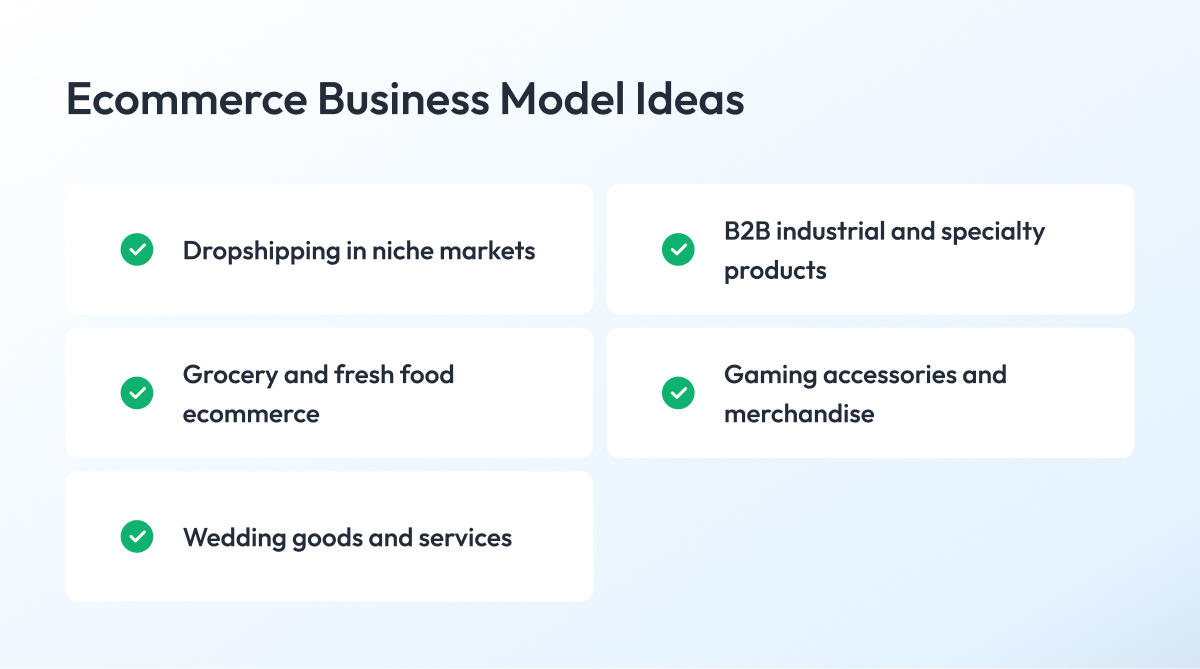
These ideas for ecommerce business founders compete on how they work, not only on what they sell. Business models like dropshipping win on structure, and the model lives in code.
21. Dropshipping in niche markets
Dropshipping is still one of the best ecommerce business ideas for starting on a small budget, since your supplier ships directly to the buyer and you focus on a niche instead of selling everything. The model keeps expanding, with the global dropshipping market on track to reach about $400 billion by 2026. For entrepreneurs considering this model, profitability matters alongside market growth. TrueProfit reports that dropshipping net profit margins can reach up to 25%, depending on the business. A tight category beats the everything stores like Amazon that flooded the market years ago.
With low startup costs, you can launch in days. What turns this from a hobby into a business is automation: supplier syncing to keep stock current, dynamic pricing, and order routing that runs on its own. Your weak spot is dependence. You control neither the stock nor the shipping quality, and margins are thin, so an unreliable supplier can wreck your reputation before you even hear about the problem.
22. B2B industrial and specialty products
B2B is one of the most profitable ecommerce business ideas, since selling complex or specialty goods to other businesses brings big orders, repeat purchases, and deep catalogs. Business buyers expect pricing and workflows that a consumer storefront was never designed to handle.
This is high-complexity work measured in months. This ecommerce business model requires a robust B2B platform with tiered pricing for different account types, quote management, and custom software development.
Workflow depth is where people go wrong. B2B purchasing runs on approvals, contracts, and account-specific terms, and forcing all of that onto a consumer tool like Shopify is exactly the mistake that triggers a painful rebuild a year later.
23. Grocery and fresh food ecommerce
Online grocery operates in a market set to surpass $1 trillion worldwide heading into 2026 and continues to grow in the double digits (Mordor Intelligence). It is one of the most demanding models on this list and the least forgiving of mistakes.
Plan a multi-month, high-complexity build. The core systems are real-time inventory, routing for perishables, and slot-based delivery scheduling. The margins are brutal. Grocery profit margins are razor-thin, and shelf life is short, so any slip in routing or stock control flips an order from a small profit to a loss, which is why the operations software has to be close to flawless.
24. Gaming accessories and merchandise
Controllers, peripherals, apparel, and collectibles tied to gaming sell into a huge, passionate audience that loves to buy into the culture. That fan energy makes cross-selling and limited releases work especially well.
Give it a few weeks to a couple of months. The features that stand out are community customization and limited-drop mechanics that create a rush around a release. Traffic spikes are the challenge. Drops pack a month of demand into a few minutes, and a store that buckles under the surge turns all that hype into lost sales, so the platform has to hold up when everyone arrives at once.
25. Wedding goods and services
Weddings combine deep emotional value, healthy growth, and higher-order values across products, personalization, and vendor services. Couples will spend, but they expect everything to come together on a date that cannot be moved.
Expect one to three months. Many businesses here run an online marketplace for vendors, a booking engine, and a personalization workflow side by side. Coordination is the difficulty. A wedding brings together many vendors on fixed dates, so the platform has to juggle scheduling and dependencies without a single slip, since there is no second chance on the day itself.
| Idea | Time to launch | Tech complexity | The hard part |
| Dropshipping in niche markets | Days | Low | Unreliable suppliers, thin margins |
| B2B industrial and specialty products | 3 to 6+ months | High | Deep purchasing workflows |
| Grocery and fresh food ecommerce | 3 to 6+ months | High | Razor-thin margins and freshness |
| Gaming accessories and merchandise | Weeks to 2 months | Low to Medium | Handling traffic spikes |
| Wedding goods and services | 1 to 3 months | Medium | Coordinating many vendors |
How to Choose the Right Ecommerce Business Ideas
You now have five traits that separate strong ideas for ecommerce business owners from weak ones. To choose an ecommerce business idea, use these traits to land on a niche, then run that niche through the five steps below to ensure it fits you in practice. The first list judges the idea. This one judges your shot at making it work.
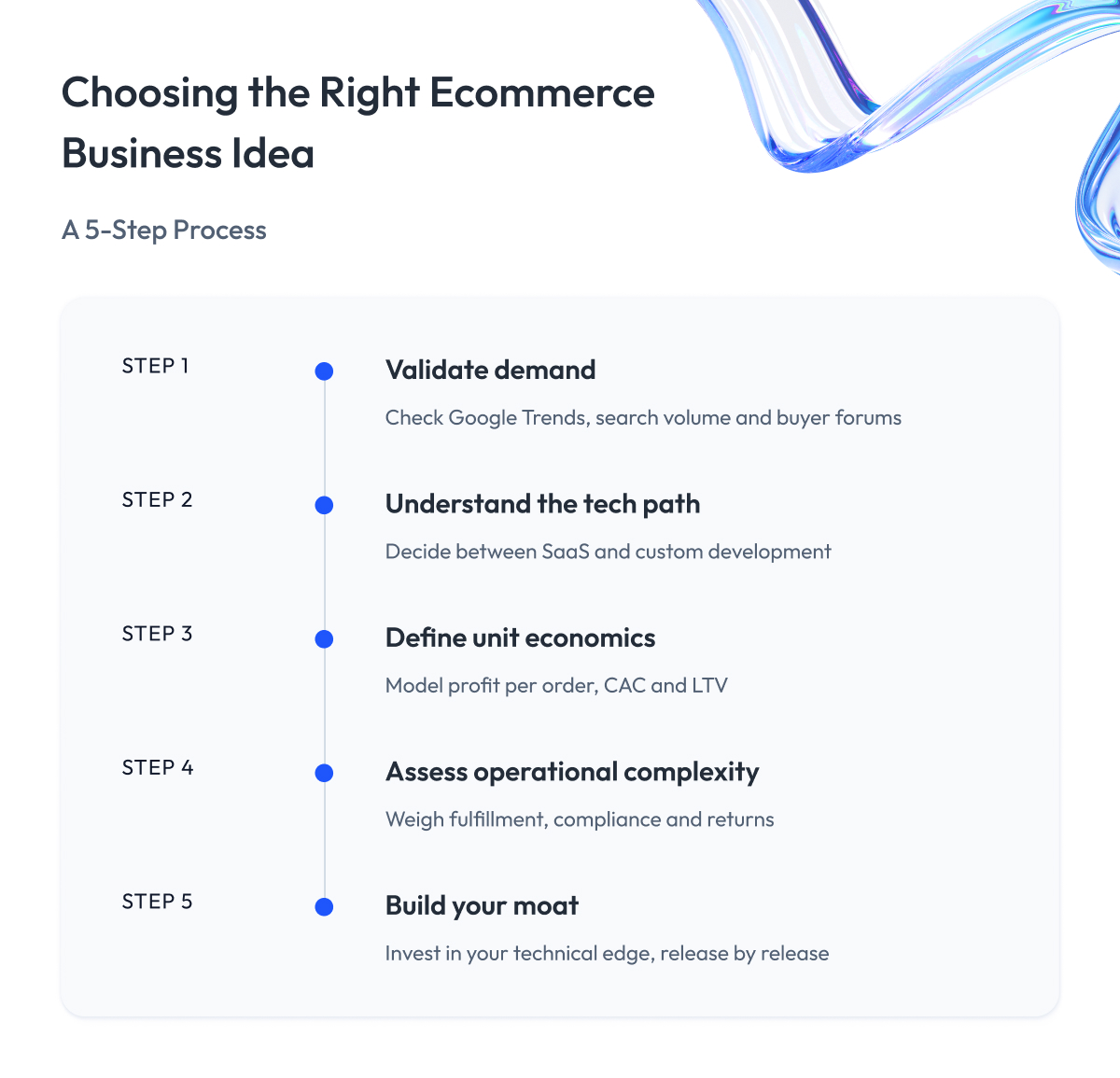
- Validate demand before you build. Pressure-test your online business idea before you build it: start with Google Trends to see whether interest in your niche is climbing or fading. Use a keyword tool like Ahrefs to check how many people search for it and how crowded the space already is.
Then read the subreddits and forums where your future buyers complain about the product or service they use today, since those complaints are your roadmap.
Finally, put up a pre-order or waitlist page and point a small ad budget at it, because those sign-ups tell you more in two weeks than months of speculation. - Understand the tech path. Decide early whether a SaaS platform like Shopify covers your ecommerce model or whether it needs custom development, since this single choice shapes your budget, your timeline, and how far you can scale. If your model leans on tiered B2B pricing, smart personalization, connected devices, or a marketplace, a ready-made store will fight you at every turn.
We have built both kinds at Zoolatech, from quick SaaS launches to custom platforms serving millions of shoppers, and the signal is consistent: when your edge depends on logic the platform cannot bend to, you will outgrow it.
Naming that path now spares you the expensive rebuild that catches most founders about a year in. - Define your unit economics at scale. In your business plan, work out your profit per order at the scale you are aiming for. Include the costs that quietly pile up: ad spend to win each customer (CAC), returns, payment fees, and shipping costs.
Then weigh all of that against how much a customer is worth over time (LTV), because a healthy gap between LTV and CAC is what lets you grow your business without bleeding cash. If the math only holds when you ignore one of those costs, the idea needs rethinking before you write a line of code. - Assess operational complexity. Be honest about what running an ecommerce business demands day after day to fulfill an order. Perishable goods need cold chains, regulated products carry compliance like FDA or HIPAA, and high-return categories such as fashion drag on your margins.
These business operations decide whether growth feels smooth or turns into daily firefighting. The lighter the operation, the more energy you keep for product and marketing. - Build your moat over time. You already know from the traits above where your technical edge should sit, so the job now is sequencing it. Launch with the simplest version that lets you test ideas, then pour your engineering budget into that one advantage, release after release. A moat is rarely built on day one.
It deepens every quarter you invest in the thing rivals cannot copy, and that compounding is what opens a gap between you and the stock-platform crowd.
Work through these five in order, and you trade guesswork for a decision you can defend, with a far better sense of what you are building and why.
What Technology Does Your Ecommerce Idea Actually Need?
Over eight years of ecommerce software development for companies large and small, we have watched the same pattern repeat: the choice of technology determines who scales and who stalls.
This section shares what we have learned firsthand about matching the build to the idea. The goal is to help you spend on engineering where it counts and save it where a ready-made tool already does the job.
When Off-the-Shelf Platforms Are Enough.
Most ideas do not need custom code, and we tell founders that plainly. Ecommerce platforms like Shopify, BigCommerce, and WooCommerce let you launch an ecommerce website quickly, handling the standard catalog, cart, and checkout pattern, with an app for almost every common need.
Print-on-demand shops, digital download stores, and straightforward dropshipping businesses all run happily here, since they sell products through a standard catalog. Getting your business online here beats building from scratch, which wastes money you should be spending on customers.
For ideas like these, lean on a design or marketing agency instead of an engineering team. Your wins come from branding, product selection, and ads, and an agency delivers them faster and more cheaply than developers would.
We say this even though we build software for a living, because steering you toward a custom build that adds no value would cost you dearly. If you are weighing the call, our breakdown of custom ecommerce development versus open-source platforms shows where each one earns its keep.
When You Need Custom Development.
The moment your advantage depends on something a standard platform cannot do, you have crossed into custom territory. In our work, we see that the line is crossed by five signals, and each one demands serious engineering behind it:
- Complex B2B ordering. Tiered pricing per account, quote-to-order, approval chains, and links into a buyer’s procurement system go far beyond what storefront apps handle.
- AI personalization. A recommendation or configuration engine turns browsing into buying, and AI-driven product personalization becomes a measurable edge once it runs on your own data instead of a generic plugin.
- IoT and connected products. Selling a device that reports back means building data pipelines, a management dashboard, and remote control, none of which a catalog platform offers.
- Regulatory load. HIPAA for health data or FDA rules for certain products have to be designed into the architecture, since bolting them on later is slow and risky.
- Your own marketplace. Onboarding sellers, splitting payments, and earning buyer trust require a platform you control end to end.
We have built ecommerce systems for companies like Wish, Gilt, and GrubHub, platforms with millions of SKUs and fulfillment logic no off-the-shelf store could carry. At that scale, the ecommerce technology stack you pick early on determines how far you can grow before something breaks.
Common Technical Mistakes Early-Stage Ecommerce Founders Make
In our experience working with ecommerce platforms, the same avoidable mistakes show up again and again. Each is cheap to prevent and painful to fix once the business is running.
- Forcing a B2B model with custom pricing onto Shopify, then paying to rebuild the whole thing within twelve months.
- Skipping an API-first architecture, which turns every later integration and sales channel into a slow, costly project.
- Underestimating compliance like GDPR and PCI DSS, plus industry-specific rules, all of which cost far less to design in than to retrofit.
- Building one big monolith instead of modular microservices makes scaling slow, risky, and expensive exactly when growth arrives.
The last two hurt most because they live in the foundation. Fixing them usually means a full legacy platform rebuild, and the founders who avoid that pain are the ones who made the right architecture call on day one.
Ecommerce Ideas That Require Engineering: Zoolatech’s Perspective
If you have read this far, you already know the main lesson: different ecommerce business ideas require different amounts of time, resources, and technology. With the right skills, you can start your own ecommerce business and build many of these yourself. But a team that has shipped these systems for years sees the pitfalls a first-timer misses, like the compliance gap nobody flagged or the architecture choice that quietly caps growth. We steer founders away from those traps before they become expensive.
Some ideas above are weekend projects. Others, like subscription platforms, marketplace models, AI-driven personalization, and B2B commerce, take serious engineering. Zoolatech has worked with ecommerce companies of every scale, and our case studies show the work from a startup’s first MVP to enterprise platforms used by millions. If your idea needs a custom solution, we are ready to talk it through, whether that means building it with you or scaling your team through our team extension services.
Questions You May Have
What are the most profitable ecommerce business ideas in 2026?
It depends on margins and scalability rather than any single niche. Digital products and subscription models show the highest margins, often 40% to 80%, while in physical goods, health and wellness, and luxury resale hold premium pricing. The real answer is the combination of demand, unit economics, and technology fit, not a single “best” category.
What ecommerce business can I start with little money?
Starting an ecommerce business with little money is most realistic through print-on-demand, digital downloads, affiliate marketing, and niche dropshipping, which all require minimal upfront investment. Your main costs are marketing and the platform, not inventory or warehousing. These models let you test a product idea and launch an online business before committing serious capital.
What are the best ecommerce business ideas for beginners?
Print-on-demand, niche dropshipping, and digital products such as courses and templates are the most beginner-friendly. None require managing physical stock, and platforms like Etsy, Gumroad, and Printful handle much of the operational work. That lets new business owners validate demand with low risk.
How much does it cost to build a custom ecommerce platform?
The range is wide and depends on the type of business, its integrations, compliance, and scale. A custom MVP typically starts around $50,000 to $150,000, while a full enterprise platform with AI, marketplace logic, or complex B2B workflows starts at $300,000 and up. Treat these as planning ranges, since scope drives the number more than any list price.
When does an ecommerce business need custom software development?
When standard platforms cannot support the business logic you depend on. The common triggers are complex B2B pricing, a proprietary marketplace, AI-driven personalization, IoT integration, and regulatory compliance, such as HIPAA, FDA, or non-standard PCI DSS scenarios. If your differentiator lives in software, off-the-shelf tools will eventually limit you.
Is ecommerce still profitable in 2026?
Yes. The ecommerce market surpassed $6.86 trillion in 2025 and is projected to reach roughly $8 trillion by 2027. The most profitable e-commerce business ideas now depend on niche selection, unit economics, and technological differentiation, because crowded categories without an edge are hard to win.
What is the easiest ecommerce business to start?
To start an online business fast, print-on-demand and digital downloads have the lowest barriers to entry. To start a business here, you need no inventory, no complex logistics, and little capital, and marketplaces like Etsy, Gumroad, and Printful absorb most of the operational burden. That makes them the fastest way to sell online from day one.