







Quick Summary
- The shortlist comes from Clutch listings filtered by rating and review quality, then tested against seven criteria including energy domain relevance, real-time systems, and proof of delivery.
- Domain depth separates the field: ELEKS built DAKAR, used across 20+ Eastern European power systems, and Avenga monitors 1,300 wind turbines at 150 signals per second each.
- N-iX covers the hardware side most software firms cannot, with protocol bridges for Modbus, LoRa, and IEC 61850 linking substations, transformers, and smart meters to the cloud.
- Minimum project size narrows the list fast, running from $50,000 at Andersen to $150,000 at Zoolatech, so budget filters the shortlist before any call.
- Match the vendor to the problem rather than to headcount, since consulting-led planning, enterprise capacity, SCADA and grid work, data platforms, and IoT-to-cloud each sit with different companies here.
Finding a reliable energy software development company takes longer than most teams expect.
You start with a broad list of vendors. Then you spend weeks reading nearly identical agency websites, sitting through discovery calls that go nowhere, and trying to figure out which companies actually understand energy systems and which ones just added “energy” to their services page.
To save you time and a lot of headaches, we did the research ourselves.
We pulled company listings from Clutch, reviewed websites, case studies, and client portfolios, read through hundreds of reviews, and got on direct calls with shortlisted vendors to ask the questions a real buyer would ask.
As a result, we put together a list of the top 10 energy software development companies that are actually worth your time.
By the end of this guide, you will have everything you need to make the right decision. A vetted list of the best energy software development companies, a breakdown of what each one is best for, a clear framework for separating strong engineering partners from generic dev shops, and the questions you need to ask before signing a contract.
What Is an Energy Software Development Company?
Before we get into the list, let’s make sure we’re on the same page.
An energy software development company provides software development for the energy sector: it designs, builds, modernizes, and supports software systems for utilities and energy businesses.
These companies work with utilities, renewable energy providers, grid operators, energy retailers, solar and wind businesses, oil and gas companies, EV charging networks, and energy technology platforms.
Typical energy software development services include:
- Custom energy management software development.
- SCADA and grid system modernization.
- Renewable asset monitoring software.
- Predictive maintenance systems.
- AI forecasting tools.
- IoT data platforms.
- Cloud migration for legacy systems.
- EV charging management systems.
- Data engineering and real-time analytics.
You want to hire a partner for energy sector software development when your current software can no longer handle the data volume, integrations, or operational complexity your business needs.
How We Selected the Companies
As we mentioned in the introduction, this is not just another generic listing pulled together from a random Google search.
We started on Clutch, one of the most trusted platforms for evaluating software development companies. We filtered by relevance, then narrowed the list further by ratings, number of reviews, and review quality, focusing only on companies with a strong and consistent track record. From there, we reviewed each company’s website, case studies, client list, and overall approach to understand how they actually work.
Companies that passed the initial check and offer custom energy software development were then evaluated against the criteria.
| Selection Criteria | Why It Matters |
| 1. Energy industry relevance | The company should understand utilities, renewables, grid systems, energy data, and asset-heavy operations. |
| 2. Software engineering depth | Energy platforms often require expertise in backend, frontend, cloud, data, DevOps, and QA. |
| 3. AI and data capabilities | Modern energy companies need forecasting, automation, predictive maintenance, and analytics. |
| 4. Cloud and modernization experience | Many energy systems depend on legacy infrastructure that must be migrated or modernized carefully. |
| 5. Real-time system experience | Energy platforms often depend on continuous data from meters, sensors, assets, or infrastructure. |
| 6. Long-term delivery model | Energy software usually requires ongoing development, maintenance, and platform evolution. |
| 7. Case studies or proof of delivery | Real-world examples show whether the vendor can handle complex environments. |
The result is a list of companies that are genuinely worth your attention and a solid starting point for finding the right engineering partner for your project.
Let’s start to discover them!
1. Zoolatech — Best Overall for Energy Software Development
Founded in California in 2017, Zoolatech is a full-cycle energy software development company with 600+ engineers distributed across the US, Poland, Ukraine, Mexico, and Turkey. The company has delivered 300+ projects for 100+ clients, including enterprises with over $1B in market cap, and holds a 5-star rating on Clutch with a 98% client retention rate.
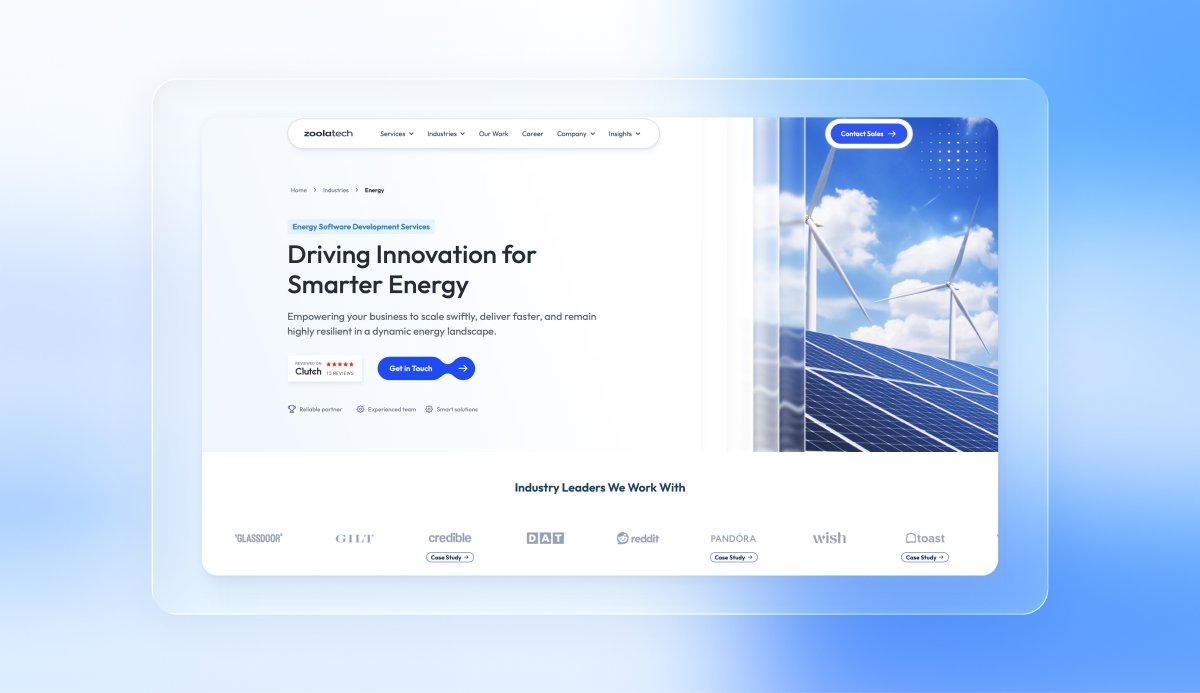
Zoolatech is recognized on the IAOP Global Outsourcing 100 list, named a Clutch Global 1000 Award Winner, and ranked among the Top 100 Fastest-Growing Companies for 2025.
For energy businesses specifically, Zoolatech provides energy software development services with deep expertise in legacy modernization, cloud-native platform development, data engineering, AI/ML, and real-time analytics, which are critical requirements for utilities, renewable energy providers, and energy tech companies building or scaling complex digital infrastructure.
Zoolatech can help energy companies build and modernize:
- Energy management platforms.
- Renewable asset monitoring systems.
- Predictive maintenance platforms.
- AI grid automation tools.
- Real-time operational analytics.
- Cloud-native energy applications.
- IoT data platforms for distributed energy assets.
- SCADA-related modernization and integration.
How they work. Zoolatech starts every engagement with discovery and architecture review before writing a line of code. They assign dedicated engineering teams with clear delivery ownership, run regular checkpoints, and stay with the product through launch, scaling, and long-term evolution. This matters in energy, where platforms often run for years and require continuous improvement.
Why choose Zoolatech
- Recognized by TechBehemoths as Custom Software Development Winner for 2025.
- Databricks Brickbuilder Partner — certified expertise in data engineering and analytics infrastructure.
- Recognized on the Inc. Regionals Southeast List for 2026.
- 96% client satisfaction rate across all engagements.
- Proven energy-sector delivery — Complete Solaria, an energy company, credited Zoolatech with accelerating customer acquisition and reducing installation bottlenecks.
Best fit for
Zoolatech is the right choice for energy companies that have outgrown their current systems and need a reliable engineering partner to modernize what exists and build what comes next. This typically includes:
- Utilities are moving off legacy infrastructure that can no longer scale or integrate.
- Renewable energy businesses need renewable energy software development and real-time visibility into distributed assets.
- Energy tech companies are building AI platforms from the ground up.
- Organizations that need cloud migration without disrupting live operations.
- Teams looking for a long-term engineering partner.
If you need a team that can own the architecture, stay through the hard parts, and grow with your product long after launch, Zoolatech is ready to help you get there.
2. Andersen — Best for Large-Scale Enterprise Energy Projects
Andersen is a large-scale software engineering company headquartered in Warsaw, Poland, with development centers across Germany, the UK, and Eastern Europe.
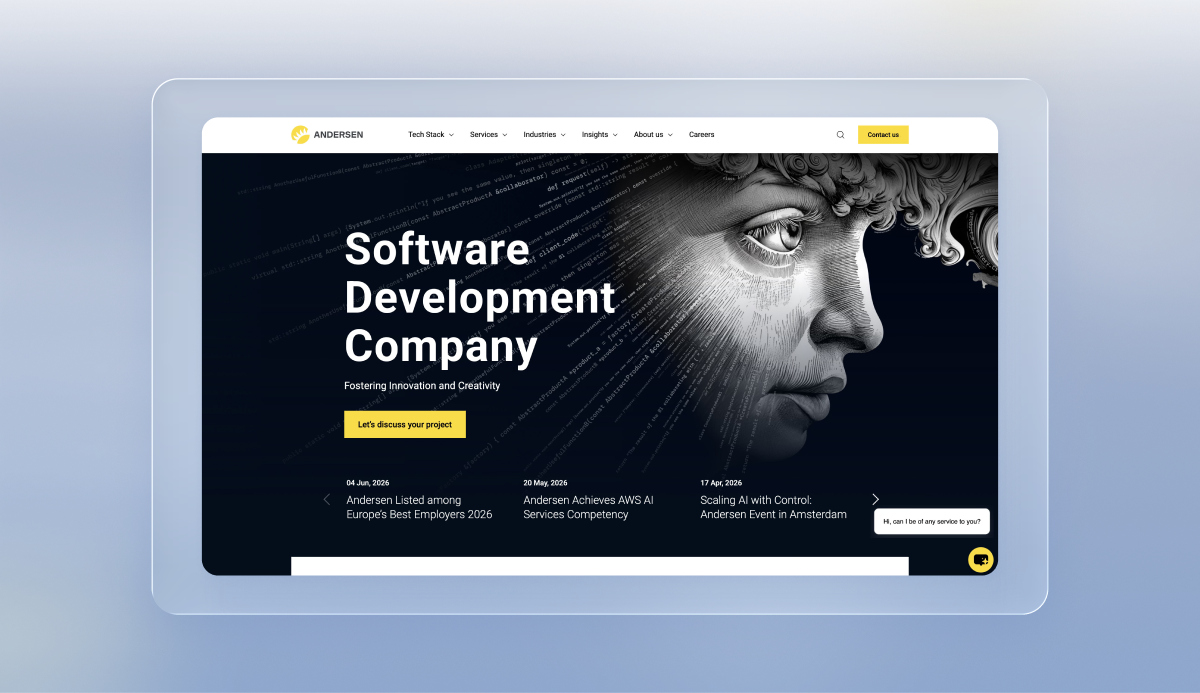
Founded in 2007, the company has grown to 3,500+ engineers and serves clients across the US, Europe, and the UK. Andersen covers a wide range of industries, including energy, oil and gas, manufacturing, finance, healthcare, and logistics, making it one of the broader engineering partners on this list.
In energy sector software development, Andersen’s capabilities include solar and wind energy software, waste and nuclear management systems, heating and electric utility software, IoT development, legacy modernization, cloud migration, and data engineering.
The company has worked with major enterprise clients, including Samsung, BNP Paribas, TUI, and MediaMarkt, which signals capacity for large, complex, multi-team delivery.
Andersen can help energy companies with:
- Solar and wind energy platform development.
- Electric utility and heating software.
- IoT development and connected systems.
- Legacy system modernization and API integration.
- Cloud migration across AWS, Azure, and multicloud environments.
- Staff augmentation and dedicated engineering teams.
How they work. Andersen offers flexible engagement models, including dedicated teams, staff augmentation, and full project delivery. They run discovery phases before development and support long-term maintenance after launch.
Best fit for. Andersen is a strong option for large energy enterprises that need significant engineering capacity, broad technical coverage, or team extension across multiple workstreams. It is less focused on deep energy-specific expertise and more suited to organizations that prioritize scale, delivery bandwidth, and access to a large talent pool.
3. Intellias — Best for Smart Metering and Connected Energy Infrastructure
Intellias is an AI-enabled product engineering and digital solutions company founded in 2002 in Lviv, Ukraine, with 3,300+ engineers operating across 17 countries and 23 offices worldwide. The company serves 170+ clients, including HERE Technologies, TomTom, HelloFresh, and Syngenta, with particular depth in mobility, connected infrastructure, IoT, and data-heavy platform engineering.
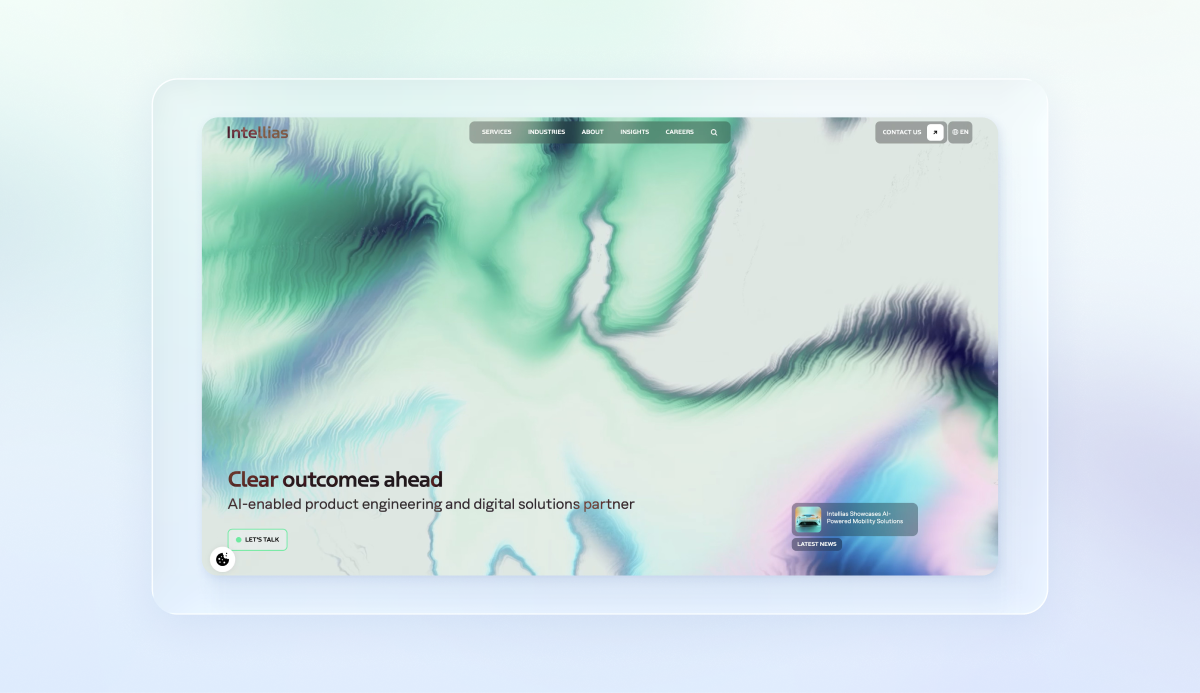
For energy companies, Intellias has documented experience building energy management platforms, smart meter data processing systems, and real-time analytics solutions for enterprise clients. Their work spans cloud-native platform development, IoT-enabled infrastructure, AI and data services, and dedicated team delivery for complex long-running products.
Intellias can help energy companies with:
- Energy management software development and platform modernization.
- Smart meter data processing and real-time analytics.
- IoT-connected infrastructure and asset monitoring.
- Cloud-native platform engineering.
- AI and data science services.
- Dedicated engineering teams for long-term product development.
How they work. Intellias operates primarily through dedicated teams that embed into client organizations for the long term. They handle staffing, knowledge transfer, and team scaling, and support delivery models ranging from team augmentation to full product ownership.
Best fit for. Intellias is a strong option for energy companies that need an experienced engineering partner with proven IoT and data platform capabilities. It is especially relevant for organizations building or scaling connected energy infrastructure, smart metering systems, or cloud energy management platforms where deep technical capacity and long-term team stability matter.
4. ELEKS — Best for SCADA and Power Grid Software
ELEKS is a custom software engineering and consulting company founded in 1991 in Lviv, Ukraine, and now headquartered in Tallinn, Estonia. With 2,100+ engineers operating across Europe, the US, and Canada, the company has over three decades of delivery experience across energy, finance, healthcare, government, and logistics.
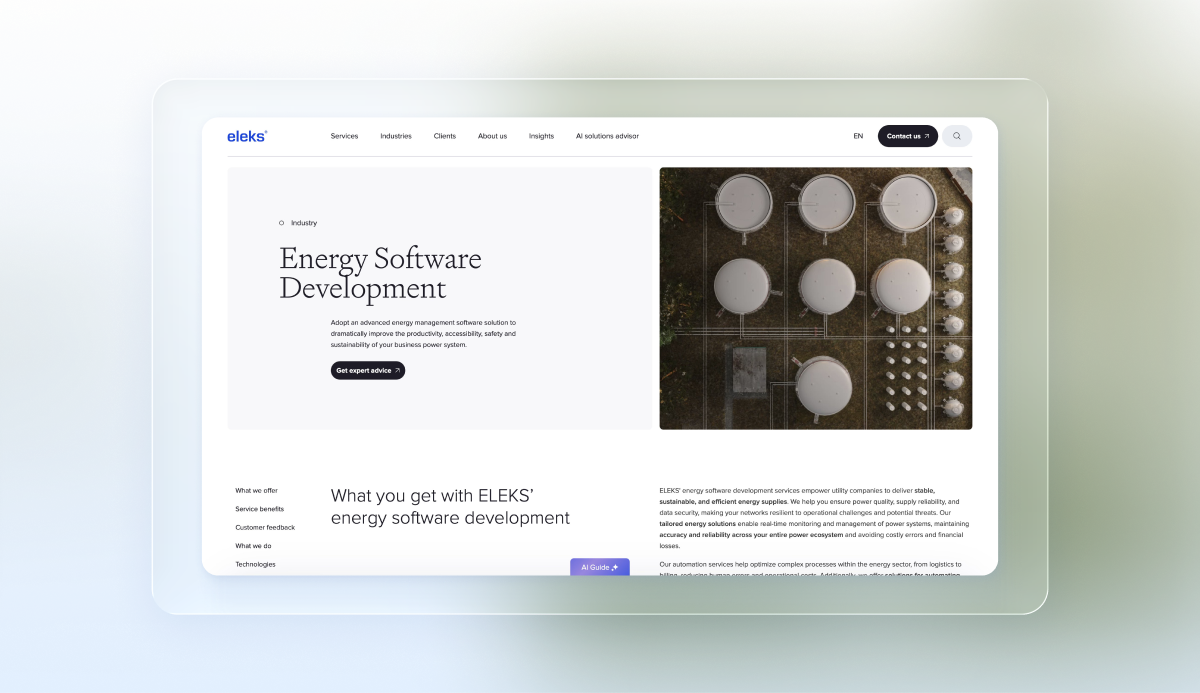
What makes ELEKS stand out in the energy segment is the depth of its domain-specific work. The company developed DAKAR, a proprietary software solution that ensures accuracy and reliability across 20+ Eastern European power systems.
This is one of the few cases on this list where a software engineering company has built and shipped its own energy product.
ELEKS can help energy companies with:
- SCADA system development and modernization.
- Energy management and demand-side response solutions.
- Grid simulation and load-flow analysis tools.
- Custom energy software development for utilities and power distribution.
- AI and data analytics for the energy sector.
- Cloud migration and legacy system overhaul.
How they work. ELEKS operates as a full-cycle engineering partner, covering everything from discovery and architecture through delivery, QA, and long-term support. Their teams combine engineering backgrounds with domain specialization, which gives them a practical advantage on technically complex energy projects.
Best fit for. ELEKS is a strong option for utilities and energy companies that need a vendor with genuine, long-standing experience in the energy domain. The DAKAR product lineage and decades of involvement in European energy markets make them particularly relevant for grid-related projects, SCADA work, and power distribution software.
5. ScienceSoft — Best for Energy Software Consulting and Pre-Development Strategy
ScienceSoft is an IT consulting and software development company based in the United States, founded in 1989, with 750+ engineers and consultants operating across the US, EU, and the Gulf Cooperation Council region.
Over 35 years in business, the company has delivered 4,200+ projects for clients across 80+ countries, including IBM, eBay, Ford Motor Company, Walmart, and NASA JPL.
ScienceSoft holds ISO 9001 and ISO 27001 certifications and has been named among America’s Fastest-Growing Companies by the Financial Times for five consecutive years.
For energy companies, ScienceSoft brings a consulting-led engineering approach, which typically starts with requirements analysis, architecture planning, and technology strategy before moving into delivery.
ScienceSoft can help energy companies with:
- Energy software consulting and requirements analysis.
- Custom energy management software development.
- Cloud migration and legacy system modernization.
- Data analytics, business intelligence, and reporting.
- AI and machine learning development.
- Cybersecurity and compliance-aware engineering.
How they work. ScienceSoft operates through a Project Management Office, an Architecture Center of Excellence, and a Technology and Competency Center of Excellence — three internal governance structures that keep delivery aligned with business goals and technical standards. This makes them a more structured option compared to most vendors on this list.
Best fit for. ScienceSoft is a good fit for energy companies seeking a partner to analyze the problem, validate the approach, and define the architecture before development begins. Especially relevant for organizations that have had past projects go sideways due to poor planning, or those operating in regulated environments where compliance and documentation carry significant weight.
6. Itransition — Best for Customer Portals and Energy Business Applications
Itransition is a global software engineering and IT consulting company founded in 1998, headquartered in Colorado, United States, with delivery teams across Europe and over 3,000 engineers on its roster. The company has been recognized on the IAOP Global Outsourcing 100 list since 2009 and has appeared on the Inc. 5000 list multiple times, serving clients across 40+ countries, ranging from SMBs to Fortune 500 enterprises.
Itransition’s energy software development services cover the full spectrum of business applications — from customer portals and ERP systems to IoT integrations, data analytics, and process automation. While the company is not exclusively focused on energy, its cross-industry depth in enterprise software, cloud, and digital transformation makes it a capable option for organizations that need business-facing applications built alongside or on top of existing operational infrastructure.
Itransition can help energy companies with:
- Customer-facing energy portals and self-service platforms.
- ERP and CRM implementation and customization.
- Business process automation and workflow digitization.
- IoT platform development and connected device integration.
- Data analytics and business intelligence dashboards.
- Cloud migration and application modernization.
How they work. Itransition offers dedicated development centers, staff augmentation, and full project delivery. Their methodology is built around enterprise-grade delivery with structured project management, making them suited for multi-workstream projects where governance and coordination across teams are priorities.
Best fit for. Itransition is most relevant for energy retailers, service providers, and energy tech companies that need enterprise business applications, customer portals, operational dashboards, billing systems, or ERP integrations. A solid option for organizations digitizing internal operations or improving customer-facing platforms.
7. DataArt — Best for Data Platforms and Energy Analytics
DataArt is a global software engineering firm from New York, founded in 1997 by Eugene Goland. With 5,700+ professionals across 30+ locations in the US, Europe, Latin America, and the UAE, DataArt has built a reputation as one of the more distinctive companies on this list.
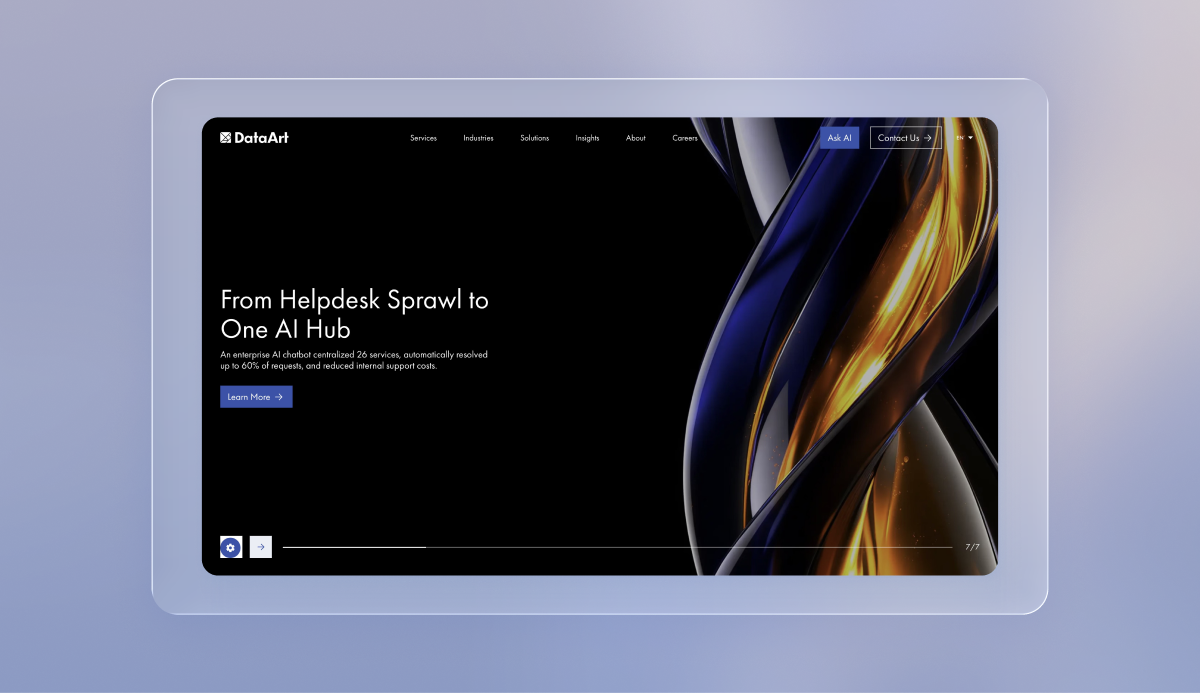
Their name alone hints at their philosophy — the company openly describes their approach as fusing advanced technology with human creativity, and you can feel it when you browse their website.
In software development for the energy sector, DataArt brings particular depth in data platforms, analytics engineering, AI development, and cloud-native product delivery. They recently committed $100 million to advance their data and AI capabilities, which signals a serious long-term bet on that direction.
DataArt can help energy companies with:
- Energy consumption monitoring and analytics platforms.
- Data platform development and modernization.
- AI and machine learning solutions.
- Cloud-native product engineering.
- Legacy system migration and modernization.
- Custom enterprise software development.
How they work. DataArt operates as a long-term engineering partner with a people-first internal culture — 87% employee retention and 48% senior-level professionals on staff.
Best fit for. DataArt is a strong option for energy companies that need serious data and AI engineering capabilities combined with polished product thinking. Particularly relevant for organizations building analytics platforms, consumption management tools, or data energy products, where technical depth and design quality are crucial.
8. Avenga — Best for Wind and Solar Asset Monitoring
Avenga is an international IT engineering and consulting company headquartered in Cologne, Germany, formed in 2019 through a series of mergers and acquisitions that brought together companies with roots going back to the early 1990s. Today, the company employs 6,000+ engineers across 16 countries and serves clients including Vodafone, UniCredit, Raiffeisen, and CEZ — one of Central Europe’s largest energy groups.
What stands out about Avenga in the energy segment is the specificity of their operational experience. They currently monitor 1,300 wind turbines and process 150 signals per second from each one. It is a live operational deployment that demonstrates their understanding of the data throughput and reliability requirements for running connected energy infrastructure at scale, making them a credible partner for renewable energy software development.
Avenga can help energy companies with:
- Smart grid and grid operations platform development.
- Wind and solar asset monitoring systems.
- Predictive maintenance and IoT sensor integration.
- EV charging network management software.
- Customer portal and billing platform development.
- Cloud migration and application modernization.
How they work. Avenga structures its engagement around three pillars — Build, Think, and Run — covering software engineering, AI and data services, and managed IT operations. This means they can take on projects that extend beyond delivery to long-term operational ownership of the systems they build.
Best fit for. Avenga suits energy and utility companies that have moved past the “should we modernize” conversation and are ready to execute infrastructure projects. If your organization needs a partner that can work across grid operations, asset monitoring, and customer platforms simultaneously, Avenga has the operational depth to back that up.
9. N-iX — Best for IoT and Hardware-to-Cloud Energy Systems
N-iX is a software engineering company founded in 2002 in Lviv, Ukraine, under the name Novellix — originally building product applications for Novell’s Linux platform. Today, the company has grown to 2,400+ engineers across 10 countries, serving 90+ enterprise clients, including Bosch, Inditex, and one of the UK’s largest energy suppliers, serving nearly 5 million homes. N-iX holds AWS Premier Tier Partner status with 350+ certified engineers and has been recognized by GSA UK, IAOP, Software 500, Forbes, and CRN in industry ratings.
For energy companies, N-iX offers a combination of embedded systems and IoT development layered atop strong cloud and data engineering capabilities.
Their teams have built protocol bridges for Modbus, LoRa, and IEC 61850 devices, giving utility engineers unified visibility across substations, transformers, and smart meters. That hardware-to-software depth is hard to find in companies that started purely as web or enterprise application shops.
N-iX can help energy companies with:
- Energy management software development.
- Embedded systems and IoT device integration.
- Cloud-based data engineering and analytics.
- AI and machine learning for grid and asset optimization.
- Application modernization and legacy migration.
- DevOps, CI/CD, and cloud infrastructure management.
How they work. N-iX operates through dedicated engineering teams, with long-term client relationships at the core — several clients have worked with them continuously since 2015. Their “zero disruption” delivery model, tested in 2022 when they relocated 600+ Ukrainian engineers without dropping a single project, signals operational resilience that matters to energy companies operating critical infrastructure.
Best fit for. N-iX is a good option for mid-market utilities and energy technology companies that need a team with low-level device expertise and cloud data capabilities. If your platform depends on field hardware communicating with cloud infrastructure, and you need engineers who understand both sides of that connection, N-iX has the technical breadth to cover it.
10. Sigma Software — Best for Energy Tech Startups and Product Engineering
Sigma Software is a global software engineering and technology consulting company founded in 2002 in Kharkiv, Ukraine. Today, the company has 2,000+ professionals, 40+ offices, and a presence across 21 countries. Sigma Software works with enterprises, startups, and software product companies, helping them build, modernize, and scale digital products through one delivery organization.
The company has been serving clients for 24+ years and has worked with 300+ enterprises, including Fortune 500 companies. Sigma Software is also part of the wider Sigma Group ecosystem and has been recognized by IAOP, Clutch, and DOU, which ranked it among the top IT employers in Ukraine.
For energy companies, Sigma Software is most relevant when the project involves connected devices, embedded systems, IoT platforms, cloud applications, data engineering, or complex product development. This makes the company a practical option for renewable energy platforms, energy technology products, smart infrastructure solutions, and companies that need to connect physical assets with scalable software.
Sigma Software can help energy companies with:
- Embedded and IoT software development.
- Device, sensor, and platform integration.
- Cloud-native application development.
- Data engineering and analytics platforms.
- AI-enabled operational tools.
- Product engineering for energy technology products.
- Legacy system modernization and migration.
- Customer-facing portals and digital platforms.
How they work. Sigma Software delivers energy software development services through dedicated teams, product engineering, consulting, and end-to-end delivery. Their teams can join at different stages of the product lifecycle, from discovery and architecture planning to development, testing, scaling, and ongoing support. This makes them suitable for companies that need engineering execution and technical guidance as the platform evolves.
Best fit for. Sigma Software is a good choice for energy technology companies, renewable energy startups, and smart infrastructure businesses that need a flexible engineering partner with strong IoT, embedded, cloud, and data capabilities. It is especially relevant for projects where software must connect physical assets, process operational data, and support scalable digital products over time.
Energy Software Development Companies: Quick Comparison
To make your evaluation easier, we’ve put together a comparison table of the top energy software development companies, covering their core strengths, best-fit use cases, and ideal buyer profiles. We’ve also added minimum project sizes sourced from Clutch, so you can quickly filter out companies that don’t match your budget before reaching out.
| Company | Best For | Energy-Relevant Strengths | Ideal Buyer | Min. Project Size |
| Zoolatech | AI-ready energy platforms and modernization | Cloud, data, AI/ML, SCADA-related modernization, renewable energy software | Utilities, renewable providers, energy tech companies | $150,000 |
| Andersen | Enterprise software delivery | Large engineering teams, custom platforms, backend development | Large energy enterprises | $50,000 |
| Intellias | IoT and connected infrastructure | Smart mobility, IoT, cloud, data platforms | EV charging, smart city, distributed infrastructure companies | $50,000 |
| ELEKS | Enterprise transformation | Cloud, data, software consulting, custom engineering | Energy companies modernizing internal systems | $50,000 |
| ScienceSoft | Consulting-led modernization | Requirements analysis, enterprise software, cloud migration | Companies needing strategy before development | $5,000 |
| Itransition | Business applications | Customer portals, automation, dashboards, enterprise systems | Energy retailers and service providers | $25,000 |
| DataArt | Data-driven platforms | Analytics, data engineering, digital products | Companies with complex operational data | $100,000 |
| Avenga | Regulated enterprise platforms | Cloud, data, enterprise engineering | Energy companies with compliance-heavy environments | $50,000 |
| N-iX | Cloud and data engineering | AI/ML, IoT, scalable teams, cloud platforms | Energy businesses scaling engineering capacity | $100,000 |
| Sigma Software | Product engineering and IoT | Embedded, connected systems, cloud, analytics | Energy tech startups and scaleups | $50,000 |
Which Energy Software Development Company Should You Choose?
The right partner depends on what you are building. Instead of comparing vendors feature by feature, start from your situation and work backward. Here is a quick way to narrow down your shortlist.
| Your situation | What matters most | Companies to shortlist |
| You need to modernize legacy systems or SCADA without disrupting operations | Phased migration experience, secure architecture, high availability | Zoolatech, ELEKS, ScienceSoft |
| You are building a renewable asset monitoring platform | Cloud-native development, IoT data processing, scalable backend | Zoolatech, Avenga, Intellias |
| You want AI forecasting or predictive maintenance | Data engineering depth, ML development, MLOps practices | Zoolatech, DataArt, N-iX |
| You need customer portals, billing, or business applications | Enterprise software delivery, UX, integrations | Itransition, Andersen, ScienceSoft |
| Your platform connects to physical devices — EV chargers, smart meters, sensors | Embedded and IoT expertise, hardware-to-cloud integration | N-iX, Sigma Software, Intellias |
| You need a long-term engineering partner | Retention track record, dedicated teams, post-launch ownership | Zoolatech, DataArt, N-iX |
A practical example. Say you run a solar operations business where asset data lives in spreadsheets, the backend was built ten years ago, and your team wants AI performance forecasting next year. That is a modernization plus data engineering problem which puts Zoolatech at the top of your shortlist, with DataArt as a strong alternative if analytics is your single biggest priority.
If you are still unsure, start with the company whose strengths cover most of your roadmap. The main danger is switching vendors midway, as it is far more expensive than choosing the right one up front.
Red Flags When Choosing an Energy Software Development Company
Many clients who come to Zoolatech have already worked with another vendor, and not all of those experiences were good. Over the years, we have heard the same stories repeat: missed deadlines blamed on “unexpected complexity,” platforms that fell apart under real data loads, and teams that disappeared after launch.
We collected those insights and turned them into a list of warning signs. If you notice any of these during vendor selection, look closer before signing anything.
1. They talk about software, never about energy.
If every conversation stays at the level of “we build custom solutions,” and the vendor cannot discuss meter data, SCADA integrations, grid constraints, or distributed assets in concrete terms, they will be learning your industry at your expense.
2. They have no questions about your data.
A vendor that jumps straight to features and timelines without asking where your data lives, how clean it is, and which systems it comes from will hit a wall three months into the project. Energy platforms live or die on data quality, and a serious partner digs into it during the first calls.
3. They promise AI before understanding your infrastructure.
This one comes up constantly. Clients told us vendors pitched forecasting, predictive maintenance, and “AI-driven everything” — then discovered the client’s data was fragmented across legacy systems and spent the budget on cleanup instead. AI promises without an honest conversation about infrastructure are a sales tactic, but not a good overall strategy.
4. They only know how to build from scratch.
Most energy projects involve systems that have been running for a decade or more. If a vendor’s portfolio is all greenfield builds, and they get vague when you ask about phased migration or working around live operations, expect problems.
5. The team that sold you is not the team that delivers.
A classic story: senior engineers run the pre-sale calls, then the actual project lands on juniors you never met. Ask directly who will work on your project and whether you can speak with them before signing.
6. Launch is where their interest ends.
Energy platforms need monitoring, updates, and continuous improvement for years. If the contract has no post-launch support model, and the vendor cannot describe how they handle a production incident at 2 AM, you will be searching for a new partner within a year.
Questions to Ask Before Hiring an Energy Software Development Company
To spot these red flags early, here is a list of questions you can ask during the first call. The answers will tell you more about a vendor than any sales deck.
Energy domain questions
- What energy companies have you worked with, and what did you build for them?
- Have you worked with solar, wind, battery storage, EV charging, or grid-related systems?
- Do you have experience with distributed energy assets?
- Can you walk me through the most complex energy project you have delivered?
Technical questions
- How do you handle real-time data from meters, sensors, or SCADA systems?
- How do you approach legacy system modernization without disrupting live operations?
- How do you ensure high availability for systems connected to critical infrastructure?
- What DevOps and monitoring practices do you use in production?
Data and AI questions
- How do you assess whether our data is ready for AI use cases?
- Can you build forecasting or predictive maintenance models — and have you done it before?
- How do you monitor AI model performance after launch?
- What happens if our data turns out to be fragmented or low quality?
Delivery questions
- Who exactly will work on our project, and can we talk to them before signing?
- What does your post-launch support model look like?
- How do you scale the team if the project grows?
- How do you transfer knowledge to our internal team?
A strong vendor will answer these directly, with examples. A weak one will give you generic answers and steer the conversation back to their pitch. That difference is usually visible within the first thirty minutes.
Energy Software Partner Evaluation Checklist
Once you have shortlisted two or three vendors and finished the first calls, comparing them from memory gets messy fast. Use this scoring card to make the decision objective. Rate each vendor from 1 to 5 on every criterion, multiply by the weight, and compare the totals.
| Criteria | Weight | Vendor A | Vendor B | Vendor C |
| Energy domain experience | x3 | |||
| Legacy modernization approach | x3 | |||
| Data engineering and AI capabilities | x3 | |||
| Cloud and DevOps maturity | x2 | |||
| Post-launch support model | x2 | |||
| Team seniority and stability | x2 | |||
| Communication quality during pre-sale | x1 | |||
| Pricing transparency | x1 | |||
| Total |
If two vendors end up close, give more weight to the one that asked better questions about your data and infrastructure during the call.
Why Zoolatech Is a Strong Choice for Energy Software Development
Energy systems share one defining trait with the environments Zoolatech has worked in for over 8 years, and here is what it looks like in practice.
1. Ownership instead of execution.
Zoolatech teams operate like product owners. We think in systems, raise risks before they escalate, and take responsibility for outcomes. For energy platforms that evolve over the years, this is the difference between a vendor you manage and a partner who manages the problem with you. The average Zoolatech client partnership lasts over 4 years, with a 98% retention rate to back it up.
2. Senior engineers who have modernized live systems before.
More than 60% of Zoolatech’s team are senior-level engineers. We have rebuilt the analytics infrastructure for Zalando, increasing GMV by €4.5 million with no downtime, and modernized an FDA-grade manufacturing execution system for MasterControl with zero production interruption.
3. A delivery model built for predictability.
You always know what is happening with your project. We provide a dedicated manager to run the delivery. Nothing goes live without a quality check. And you choose how to work. You can add Zoolatech engineers to your team, or hand over the whole project and let them run it.
4. Proven results in the energy sector.
Around 15% of Zoolatech’s projects are in the energy sector. We have a dedicated team that focuses on energy software development and takes full responsibility for the project, delivers on time, and solves problems in areas such as solar customer acquisition platforms, asset monitoring systems, installation workflow automation, and energy data analytics.
Final Word
If you have read this far, you do not need another summary. You need the next step. Here is what we recommend.
Do not try to evaluate all ten companies. Pick two or three that match your situation, reach out, and compare how they respond. The speed and quality of a vendor’s first reply already tells you something about how they will work with you later.
And do not start with a big contract. Start small. A discovery phase or a technical audit usually takes a few weeks and costs a fraction of the full project. You will see how the team thinks, how they communicate, and whether they understand your systems. If it goes well, scale up. If it does not, you have lost weeks, not a year of budget.
The energy software development market will not slow down while you decide. Companies that modernize now will have their data, platforms, and AI use cases ready when competitors are still fighting their legacy systems. The best time to start that conversation was a year ago. The second best time is this week.
Questions You May Have
What does an energy software development company do?
An energy software development company builds, modernizes, and supports software for utilities, renewable energy providers, grid operators, energy retailers, and energy technology companies. These systems may include energy management platforms, asset monitoring tools, smart grid applications, SCADA integrations, AI forecasting systems, and customer portals.
What is the best energy software development company?
The best energy software development company depends on the project. For AI-ready platforms, renewable energy software, cloud modernization, and long-term engineering ownership, Zoolatech is a strong choice. Other companies may be better suited for enterprise consulting, IoT systems, or large-scale team extension.
How much does energy software development cost?
Energy software development cost depends on the scope, complexity, integrations, data requirements, and delivery model. A simple dashboard or portal may cost significantly less than a real-time asset monitoring system, SCADA modernization project, or AI-driven energy platform. The best approach is to start with discovery, architecture, and requirements analysis.
How long does it take to build energy software?
A basic MVP may take a few months, while a complex energy platform can take a year or more to build and evolve. Projects involving legacy modernization, real-time data, IoT integrations, AI forecasting, or cloud migration usually require phased delivery.
What software do renewable energy companies need?
Renewable energy software development typically covers asset monitoring platforms, performance analytics, forecasting tools, customer portals, billing systems, maintenance software, IoT data platforms, and dashboards for solar, wind, battery storage, or distributed energy assets.
What is AI used for in energy software?
AI is used for demand forecasting, load forecasting, predictive maintenance, anomaly detection, asset performance optimization, energy consumption recommendations, grid automation, dynamic pricing, and renewable production forecasting.
What is the difference between energy software companies and energy SaaS platforms?
Energy SaaS platforms provide ready-made software products for specific use cases. Energy software development companies build or modernize custom systems tailored to a company’s workflows, infrastructure, integrations, and business model. Custom development is often better when a company needs flexibility, scalability, or competitive differentiation.
How do energy companies modernize legacy systems?
Energy companies modernize legacy systems through phased migration, cloud adoption, API development, backend refactoring, data platform redesign, DevOps improvements, and gradual replacement of outdated components. The goal is to reduce risk while improving scalability, security, and maintainability.
How do I choose an energy management software development company?
Look for a vendor with experience in energy data, integrations with meters and sensors, and a track record of long-term support. An energy management software development company should be able to show real cases, explain how they handle data quality, and offer a delivery model that continues after launch.