






Quick Summary
- The FDA links three types of software to medical devices: SaMD, SiMD, and software used to make or maintain devices.
- The FDA’s Quality Management System Regulation (QMSR) took effect on February 2, 2026, and includes ISO 13485:2016 by reference.
- The current edition of IEC 62304 dates from 2006 with an amendment from 2015, and the IEC forecasts Edition 2 for October 2028.
- Teams can modernize a medtech platform in 4 steps by mapping dependencies, splitting the work into two tracks, involving regulatory affairs, and recording third-party components.
- The Modernization Change Ledger covers 5 change types and lists the evidence each one needs, so quality teams can approve changes one at a time.
Medtech software development is the creation of software for medical devices and the companies that make them. This software can be a program that helps doctors plan radiation treatment, the code that controls an infusion pump, or a system that helps a factory build and service devices.
Every update to this software must follow strict quality and safety rules. These rules are important because one mistake in the code of a medical device can harm a patient. In the US, the Food and Drug Administration (FDA) and industry standards set out how teams plan, test, and record each change.
Following these rules is hardest when the platform is already in use. Many medtech products are built on frameworks that no longer receive updates, and the roadmap cannot pause for a year of rebuilding. Most advice on medtech software engineering covers new products, so teams find little help with replacing old technology inside a working product.
That is why we wrote this guide. Modernizing a platform in use is easiest to see in practice, so we show it on our work with Dentsply Sirona. Zoolatech engineers modernized the company’s digital dentistry platform while product development continued.
Besides that case, we explain the US rules for medtech software in 2026, how to upgrade frameworks step by step alongside feature work, and what evidence each change needs.
By the end, you will know how to modernize your platform without stopping the roadmap and what your quality team will need at each step.
What Is MedTech Software Development?
MedTech software development involves designing, building, testing, and maintaining software that medical device companies use in their products and operations. Many teams also call it medical software development. This field includes three types of software that the FDA links to medical devices, along with the clinical and business tools around them.
Knowing the type early is important because it decides how much regulatory work every code change will carry. Software that the FDA treats as a device needs a documented design record and a risk review for each change. A clinic scheduling tool has no such requirements.
The product’s intended use decides the type. That is why custom medtech software development starts with a written statement of what the software is for and who will use it. The FDA’s own examples of software as a medical device include radiation treatment planning software and an app that shows diagnostic scans on a smartphone.
The table below lists each type, what the software does, typical examples, and where to read more. You can use it to place your own product before you plan any changes.
| Type | What It Does | Typical Examples | Where to Read More |
|---|---|---|---|
| Software as a medical device (SaMD) | Performs a medical purpose without device hardware | Radiation treatment planning, diagnostic image viewing | SaMD engineering practices |
| Software in a medical device (SiMD) | Controls or powers a hardware device | Infusion pump control, patient monitor software | Embedded medical device software |
| Software used to make or maintain devices | Supports device production, quality and service | Manufacturing execution systems, quality management systems | FDA overview of device software |
| Non-device clinical and operational software | Supports care and daily operations | Scheduling, practice management | Healthcare software development |
| Connected devices and Internet of Things (IoT) | Links devices to apps and the cloud | Remote monitoring, device fleet management | Medical IoT development |
| Electronic health record (EHR) integration | Exchanges data with health record systems | Lab result feeds, patient record sync | EHR integration |
Each device type comes with its own rules, and the next section shows which documents apply in 2026.
MedTech Software Regulations and Standards in 2026
MedTech software regulations and standards in 2026 start with the FDA’s Quality Management System Regulation (QMSR). This regulation took effect on February 2, 2026, as 21 CFR Part 820 in the Code of Federal Regulations (CFR).
The QMSR includes ISO 13485:2016 from the International Organization for Standardization (ISO) by reference. That means the requirements of this quality standard are now part of US law.
In addition to the QMSR, companies also follow cybersecurity laws, voluntary standards, and FDA guidance documents. Each document carries different weight, so it helps to know which ones you must follow and which ones only offer advice.
Regulations and laws are binding for every company they cover. A recognized standard stays voluntary until a regulation includes it, as the FDA explains on its page about consensus standards. FDA guidance documents give recommendations, and a company may use another approach if it meets the same legal requirements.
This difference affects how you plan the work, because a team that treats a recommendation as a requirement spends time on extra tasks. A team that treats a requirement as optional risks a failed FDA review.
The table below lists the main documents, their type, and current status, so you can see how binding each one is before you plan a change.
| Document | Type | Status | What It Governs |
|---|---|---|---|
| QMSR (21 CFR Part 820) | Regulation | In effect since February 2, 2026 | Quality system, includes ISO 13485:2016 by reference |
| IEC 62304 | FDA-recognized consensus standard, voluntary | Edition 1.1 current, Edition 2 in preparation | Life cycle processes for medical device software |
| ISO 14971 | FDA-recognized consensus standard, voluntary | Third edition, 2019 | Risk management for medical devices |
| Section 524B of the FD&C Act | Statute | Applies to submissions since March 29, 2023 | Cybersecurity information in cyber device submissions |
| FDA cybersecurity guidance | FDA guidance, recommendations | Final, February 2026, replaces June 2025 version | Security inside the quality system and submissions |
| FDA guidance on 510(k) software changes | FDA guidance, recommendations | Final, October 2017 | When a software change needs a new 510(k) notification |
| 21 CFR 814.39 | Regulation | In force | Changes to devices with premarket approval (PMA) |
| HIPAA (45 CFR Part 160) | Statute and federal health regulations | In force | Patient health data at covered entities and business associates |
In the table, FD&C Act refers to the Federal Food, Drug, and Cosmetic Act. Its section 524B sets cybersecurity requirements for connected devices, which the law calls cyber devices.
The software standard IEC 62304 comes from the International Electrotechnical Commission (IEC). Its current edition dates from 2006, with an amendment from 2015. The IEC forecasts Edition 2 for October 2028, so its proposed changes are not requirements yet.
The Health Insurance Portability and Accountability Act (HIPAA) applies when your company is a covered entity, such as a health plan or a care provider. It also applies when your company handles protected health information on behalf of a covered entity as a business associate.
The full IEC 62304 life cycle is described on our medical device software development page.
Why MedTech Platforms Become Outdated
MedTech platforms become outdated because customers keep using them for years after their technology starts to age. Most aging platforms show the same signs:
- Frameworks lose support. The vendor stops releasing updates and security fixes for your version.
- Libraries stop updating. Nobody fixes the known bugs in the open-source code your platform depends on.
- Features take longer. Engineers spend extra time on old code before they can add anything new.
- Changes cost more. Every change needs tests and records, so slow code also means slow paperwork.
- Rewrites stall roadmaps. A full rebuild takes engineers away from building new features.
We saw this in our work with Dentsply Sirona. Older code patterns added complexity to development and made each new improvement harder to add. The platform also used deprecated technologies, so we needed to replace them to keep it supportable and reduce technical risk.
Hospitals and health plans face a different problem, because they modernize the systems they buy and operate for their own work. Our guide to healthcare software modernization covers that situation.
For principles that apply in any industry, read our overview of legacy system modernization. The next section focuses on medtech product teams and shows how they can modernize a platform without stopping feature work.
How to Modernize a MedTech Platform Without Pausing Development
You can modernize a medtech platform without pausing development by making changes in small steps that ship alongside new features. In medtech software engineering, each step upgrades one framework or component, then passes the existing tests before it gets a risk review and change records.
Teams often ask how to modernize legacy systems without disrupting ongoing operations, but published guides rarely answer that question. When we reviewed the top medtech software development guides on Google in October 2026, none of them covered modernizing a platform that is already in use.
If you plan to bring in an outside team for this work, our review of legacy software modernization companies compares the options.
How the development process works
IEC 62304 is the main standard for medical device software. It describes the medical device software development life cycle, from writing the code to maintaining it after release. Along the way, the team also manages risks, tracks versions, and fixes reported problems.
The standard does not prescribe a development method, so your team can work in short agile iterations. Each iteration only needs to leave the records the standard asks for. The FDA also recognizes AAMI TIR45:2023, a document from the Association for the Advancement of Medical Instrumentation (AAMI) on agile methods in medical device software.
Modernization follows the same medical device software development process as new code, so each step leaves the same records.
The four steps below show how to modernize a platform that is already in use without stopping feature work.
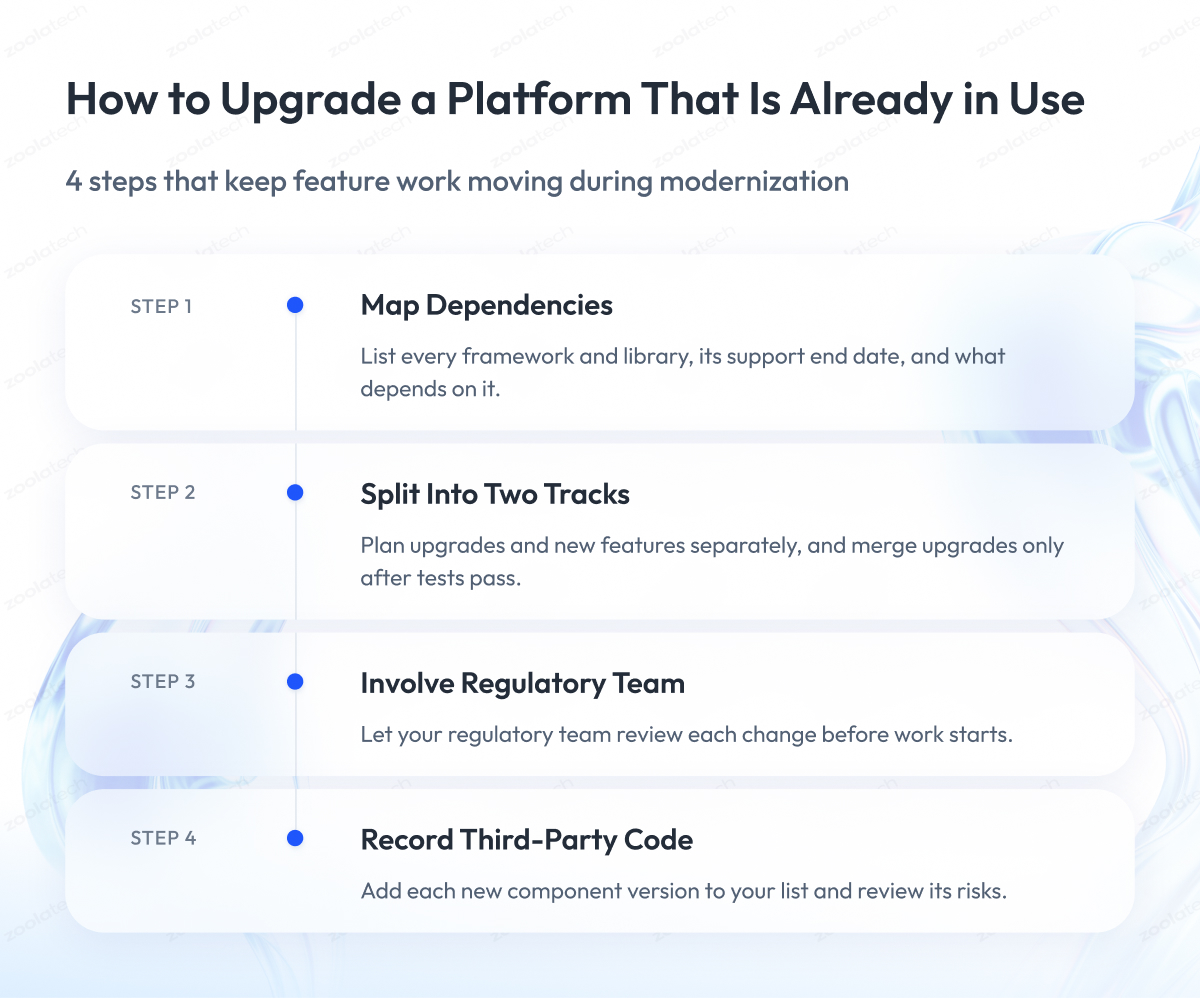
Step 1 – Map your dependencies
Modernization goes wrong when a team upgrades a framework before it knows what depends on it. That is why the first step is an inventory of every framework and library in the platform. For each component, record the following:
- The version in use and its support end date.
- The parts of the platform that depend on it.
- The places where the architecture limits change.
- The risk a failure would pose to users.
The inventory shows which components to upgrade first. Our Dentsply Sirona work started at the same point, with an assessment of the legacy application and its dependencies.
Done when: every framework and library in the platform has an entry in the inventory, and the team has agreed which component to upgrade first.
Step 2 – Split the work into two tracks
Agile medical device software development lets you plan modernization as a separate track next to feature work. Both tracks move in short iterations, and product owners and engineering agree on how much capacity each track gets.
A modernization step goes into the main code only after the full regression suite passes. This suite is the set of tests that checks existing features still work after a change.
Each step also gets its own change record, so product owners can see which frameworks are done and what comes next. Together, these records form the Modernization Change Ledger, which we describe in the next section.
Done when: product and engineering have agreed on the capacity split, and every modernization change merges only after the regression suite passes.
Step 3 – Involve your regulatory team
This step applies only when the platform is a medical device or part of one. For a device cleared through a 510(k) premarket notification or authorized through the De Novo pathway for new device types, the manufacturer decides if a software change needs a new 510(k). The FDA’s 2017 guidance on software changes helps with that decision.
For a device with premarket approval, a change that affects safety or effectiveness requires a PMA supplement or another submission permitted under 21 CFR 814.39. If the change needs a new submission and the device is a cyber device, section 524B of the FD&C Act applies to that submission.
Your engineering team provides the change description, risk review, and test evidence. With these documents in hand early, regulatory affairs can decide before the work ships.
Done when: regulatory affairs has reviewed the planned change and decided if it needs a new submission before engineering starts the work.
Step 4 – Record third-party components
IEC 62304 calls off-the-shelf and open-source components software of unknown provenance, or SOUP. When you upgrade a framework, your SOUP list changes, so your team has to record the new version and review its risks.
Without this record, an auditor finds code in the product that no document explains. Our page on managing SOUP in medical device software shows how to keep the list current.
Done when: the SOUP list shows the new version of every changed component, and each new version has a recorded risk review.
When to rebuild instead
Small steps do not fit every platform. When the architecture cannot change in parts, as with a tightly coupled monolith where every module depends on the others, a planned rebuild is the honest option. The same applies when the whole platform is reaching end of support.
We took this route with MasterControl and moved its platform from a monolith to cloud-native microservices with a modern user experience. We describe parallel runs and rollback criteria in a separate guide, so you can plan how the old and new versions work side by side.
The Modernization Change Ledger: Evidence for Every Change
The Modernization Change Ledger is a table that sorts each modernization change by type and lists the evidence that type needs before it ships. Without it, quality and regulatory teams often get one large review at the end of the project, when problems are expensive to fix.
The ledger lets these teams review and approve each change as soon as engineering finishes it. It builds on the change records from Step 2, where every modernization step gets its own entry.
Different changes carry different risks. A refactoring that should not change behavior needs less proof than replacing a whole framework, so the ledger matches the evidence to the type of change.
The table below shows 5 common change types. For each one, you can see what can go wrong, which evidence to keep, and who approves the change so that you can copy the rows into your own change procedure.
| Change Type | What Can Go Wrong | Evidence to Keep | Who Signs Off |
|---|---|---|---|
| Refactoring with no intended behavior change | Hidden change in how a feature behaves | Regression results before and after, code review record | Engineering lead, quality assurance (QA) |
| Framework or library version upgrade | Breaking changes, new defects in third-party code | Updated SOUP list, reviewed release notes, regression results | Engineering lead, QA, quality team |
| Replacement of a deprecated framework | Different behavior in rare situations | Design document update, risk review, full regression, defect log | Engineering, quality team, regulatory affairs for device software |
| User interface rebuild | Changed workflows for clinicians or technicians | Before and after screens, usability review, updated user guides | Product, quality team |
| Feature change shipped during modernization | Two unrelated changes mixed in one release | Separate change records, release notes naming both | Product, quality team |
The manufacturer decides if a change needs a regulatory submission. The ledger helps engineering hand over everything that decision needs.
Most of this evidence comes from testing and documentation, and the next section explains how to keep both current during modernization.
Testing, Verification and Documentation During Modernization
Testing, verification and documentation during modernization prove to your quality team that each change kept the platform working as before. The earlier sections showed how to plan the changes and which evidence to keep for each type. This section explains how to collect that evidence, starting with regression tests and then moving to security and usability checks.
Test every change against existing features
Regression tests check that existing features still work after a change. Every refactoring and upgrade has to pass regression testing before new features build on top of it, so the regression suite is your main safety net during modernization.
The test results feed two separate records:
- Verification confirms that the software matches its specification.
- Validation confirms that the software meets the needs of its users.
A framework upgrade can change the results of these checks, so your team updates the verification and validation records after each change. Design documents and the defect log also need updates, since auditors compare them with the code.
In our Dentsply Sirona work, we strengthened testing, documentation, and defect fixing, as well as the rules for reviewing and releasing code.
Check security with each upgrade
Old frameworks that lose support no longer get security fixes, so every known weakness stays in your product. An upgrade closes these gaps, but the new version can introduce new problems.
With each framework upgrade, check that:
- The new version includes security fixes, and you record its support end date.
- The new version has no known vulnerabilities without a fix.
- Login and data access work the same way as before the upgrade.
- The SOUP list and the risk review show the new version.
- The security information for your next FDA submission is up to date if the product is a cyber device.
The FDA’s cybersecurity guidance, reissued in February 2026, recommends handling security inside the quality system, which is why these checks belong in your change records. For cyber devices, section 524B of the FD&C Act also requires cybersecurity information in premarket submissions.
Check usability with each interface change
Clinicians and technicians learn the screens they use every day. When a button moves or a step changes, they can make mistakes, so every interface change needs its own review.
With each interface change, check that:
- The change record lists every screen and workflow that changed.
- Clinicians and technicians can finish their main tasks without new errors.
- The user documentation describes the new screens.
- The change record includes screenshots from before and after the change.
The Tech Stack Behind a MedTech Platform
The tech stack behind a medtech platform often mixes several generations of technology. One platform can combine native C++ components, a web backend in Ruby on Rails, and a browser frontend in Angular with TypeScript.
Each layer ages at its own speed, so you upgrade each one on its own schedule. Separate schedules also keep every change small enough to test and record one at a time.
Teams that plan medtech software development often ask which programming languages to use. Many platforms combine compiled languages such as C++ with web languages such as Ruby, TypeScript and JavaScript.
The table below lists the stack from our Dentsply Sirona work. For each technology, it shows what to check before an upgrade, so you can use it as a starting checklist for your own platform.
| Technology | What to Check Before an Upgrade |
|---|---|
| C++ | Supported compiler versions, library compatibility |
| Ruby on Rails | Supported Rails version, upgrade path between major releases |
| Angular, TypeScript, JavaScript | Supported Angular version, test coverage of user interface |
| PostgreSQL | Supported database version, data migration testing |
| REST application programming interfaces (APIs) | Integration contracts with other systems, backward compatibility |
| OAuth, Security Assertion Markup Language (SAML) | Login flows, identity provider compatibility |
| Azure DevOps | Build pipelines, automated tests on every change |
The next section shows how we modernized this platform for Dentsply Sirona.
Case Study: How Zoolatech Modernized Dentsply Sirona’s Digital Dentistry Platform
Zoolatech modernized Dentsply Sirona’s digital dentistry and treatment planning platform while product development continued. The earlier sections described the method in general terms, and this case shows what the work looked like on a product customers use every day.
Dentsply Sirona is one of the world’s largest manufacturers of professional dental equipment and dental consumables. Its platform helps dental professionals plan treatment digitally.
Challenge
Aging code patterns made the platform harder to develop, and each new enhancement was harder to add. Some technologies were deprecated, so the platform needed new ones to remain supportable and reduce technical risk.
What we did
Our engineers worked closely with Dentsply Sirona’s development, QA, and DevOps teams to support ongoing product evolution.
The work covered these areas:
- An assessment of the legacy application and its dependencies.
- Refactoring aging code and upgrading deprecated frameworks.
- Support for frontend and backend product evolution.
- Stronger testing, documentation, defect fixing, and rules for reviewing code.
Result
After the modernization, Dentsply Sirona got:
- Lower technical debt in the platform.
- Easier maintenance of the platform.
- A more modern technology foundation for further product development.
You can find more details in our case study on Dentsply Sirona’s digital dentistry platform modernization.
What to Check in a MedTech Modernization Partner
When you choose a medtech modernization partner, confirm the team has modernized a product platform customers already use in medtech or another regulated industry.
The partner also needs to work within your change control and quality procedures, because every change it makes ends up in your records.
Without this experience, a partner often leaves documentation for the end of the project, and your quality team then has to rebuild the records. Before you sign, check these 5 points:
- Experience in regulated industries
Ask for references from projects where the partner modernized a product platform in medtech or another regulated field. - Framework upgrades on a working product
Find out how the team upgraded frameworks before without stopping feature work for the client. - Records for third-party components
Ask to see how the partner records SOUP and design changes, so you can judge if these records fit your quality system. - Test ownership
Agree early on who writes and maintains the tests and where the test evidence will be stored. - Contact with your quality team
Make sure you know the person on the partner’s side who will talk to your quality and regulatory specialists.
A supplier’s certificate does not replace your own quality system. Your company remains responsible for that system, so assess how the partner’s work fits into your procedures.
The same checks apply when you look for a partner for custom medtech software development. A new product enters the same change control as soon as it reaches customers.
Our legacy system modernization services page explains how we work with product teams, and our legacy modernization case studies show projects across industries.
Besides Dentsply Sirona, we rebuilt MasterControl’s manufacturing execution system, delivering a cloud-native platform on Amazon Web Services (AWS) and Kubernetes in 24 months. The new platform includes FDA-compliant workflows with extended audit trails that track every change.
To compare more vendors, see our list of healthcare software development companies.
Final Word
Modernizing a platform in medtech software development takes patience. Your team has to map every dependency, agree on capacity with product owners, and keep records for each change, often for many months.
This effort pays off. When each change is small enough to test and record on its own, most platforms can move to a modern foundation without stopping work on new features.
Skipping the preparation costs more later. A rushed rewrite can stall the roadmap for a year, and a change without records can delay an FDA review.
Start with the dependency inventory and pick the component with the nearest support end date as your first step. If the architecture cannot change in parts, plan a full rebuild from the beginning.
If you want to talk through your situation, Zoolatech is ready to discuss your platform and the path that fits your roadmap.