







Quick Summary
- The criteria came from surveying clients who make this choice, and safe work around live systems ranks alongside domain experience, since changes must roll out in stages with a way back.
- Data and AI capability here means models that reached production rather than a demo, plus OSDU readiness for subsurface data.
- The strongest documented result is a 20% reduction in unplanned downtime for a refining client, built on a sensor and production data platform before any AI was layered on.
- Read the review base rather than just the score, since 4.8 from 3 reviews at a 10,000-person firm tells you far less than 4.7 across 101.
- Size sets the fit, with a 30-person team suiting compliance automation and back-office workflows while enterprise AI across several assets carries rates of $100-149 an hour.
Finding a good oil and gas software development company takes more work than the search results suggest. There are dozens of vendors, and each one promises deep industry experience, dependable delivery, and modern technology.
The problem is that their websites all say roughly the same thing. After the fifth company page, the promises blur together, and you still have no way to tell who has actually built software for oil and gas operations and who simply added the oil and gas industry to a service menu.
We built this ranking to give you that missing evidence.
Instead of taking marketing pages at face value, we scored 12 oil and gas software development companies on the items that could be verified. We looked at their delivered projects, their experience with the systems oil and gas companies run on, how they handle risky changes to live operations, and what independent client reviews on Clutch say about working with them.
Each profile shows what the company does best, which projects it fits, and what to verify before you sign a contract.
By the end of this article, you will have a shortlist of trustworthy partners matched to your type of project and enough context to choose between them with confidence.
Best Oil and Gas Software Development Companies by Use Case
The table below matches each company to the type of project where it is the strongest choice, so you can jump straight to the profiles that fit your situation.
| Use case | Strong-fit company | Why it fits |
| Custom oil and gas software across upstream, midstream, and downstream | Zoolatech | Best for the full cycle from new development to modernization of live systems, with a team that stays for the long run. |
| Sensor data, telemetry, and predictive maintenance | STX Next / Zoolatech | Best for building the data foundation that turns field measurements into maintenance and production decisions. |
| Enterprise AI and production optimization programs | SoftServe | Best for large operators running AI initiatives across several assets and business units. |
| Back office workflows and compliance automation | EnterBridge | Best for replacing spreadsheets and manual reporting with custom software that fits existing processes. |
| Complex products that field crews use daily | ELEKS | Best for software where usability under field conditions matters as much as the engineering behind it. |
| Fast assembly of a large engineering team | Innowise | Best for companies that need to fill many technical roles on short notice. |
| Wide coverage of oil and gas application types | Chetu | Best for land, lease, pipeline, refinery, and asset software with heavy customization needs. |
| Scaling cloud and data engineering capacity | N-iX / Zoolatech | Best for operators who own the domain expertise and need a dependable engineering partner to deliver. |
| ERP, integration, and corporate systems | Itransition | Best for connecting procurement, maintenance, finance, and reporting into one working flow. |
| Custom AI and data science systems | Azati | Best for technically demanding builds where senior architects stay close to the work. |
| Field applications with architecture decided upfront | Intellectsoft / Zoolatech | Best for mobile and monitoring tools where early design choices carry the whole project. |
| Cloud application builds with domain knowledge kept in-house | Simform | Best for teams that hold oil and gas expertise internally and need delivery capacity. |
Quick answer: Zoolatech is the best overall choice among oil and gas software development companies in 2026, covering custom development, modernization of live systems, data, AI, and field applications across upstream, midstream, and downstream. STX Next is the strongest pick for sensor data, telemetry, and predictive maintenance, while SoftServe leads for enterprise AI and production optimization programs.
Among the more focused options, EnterBridge fits back-office workflows and compliance automation, ELEKS builds complex products that field crews use daily, Innowise assembles large engineering teams fast, and Chetu covers the widest range of oil and gas application types, from land and lease to refinery software.
For engineering capacity and specialized builds, N-iX scales cloud and data teams for enterprise programs. Itransition connects ERP and corporate systems. Azati delivers custom AI and data science systems with senior architects close to the work. Intellectsoft designs field applications with architecture decided upfront, and Simform suits teams that keep oil and gas expertise in-house and need delivery capacity.
Our Methodology: How We Selected These Oil and Gas Software Development Companies
Most rankings of oil and gas software development companies look suspiciously alike. The same names travel from one article to the next, each entry gets a short company description and a list of services, and that is where the research ends. That information deserves attention, but it gives you very little to work with when choosing a partner for a project involving production systems and a serious budget.
We took a different route and asked the people who make this decision for a living. Before building the list, we surveyed our clients about what mattered most when they chose a software partner in oil and gas, and their answers became the criteria for this ranking.
| Criterion | What it means in practice |
| Proven oil and gas experience | Delivered projects in upstream, midstream, or downstream, with details you can verify |
| Safe work around live systems | Changes rolled out in stages, tested on operational data, with a way back if something fails |
| Integration experience | Work with the platforms operators already run, from control systems to ERP |
| Data and AI capability | Data platforms, OSDU readiness for subsurface data, and predictive models that reached production, past the demo stage |
| Security awareness | Understanding that industrial software carries stricter requirements than a typical web application |
| Team quality and stability | Senior engineers who stay on the project instead of rotating away after the contract is signed |
| Independent client feedback | Clutch ratings and reviews read in full, including the critical ones |
Meeting the criteria was the entry point, and every company on the list also underwent a manual check. We studied official websites and service pages, read case studies, reviewed Clutch profiles and client reviews, and compared what each company claims about itself with what its clients describe in their own words.
Now that you know how each company earned its place, let’s look at all twelve in detail.
1. Zoolatech – Best for Custom Oil and Gas Software Across Upstream, Midstream, and Downstream
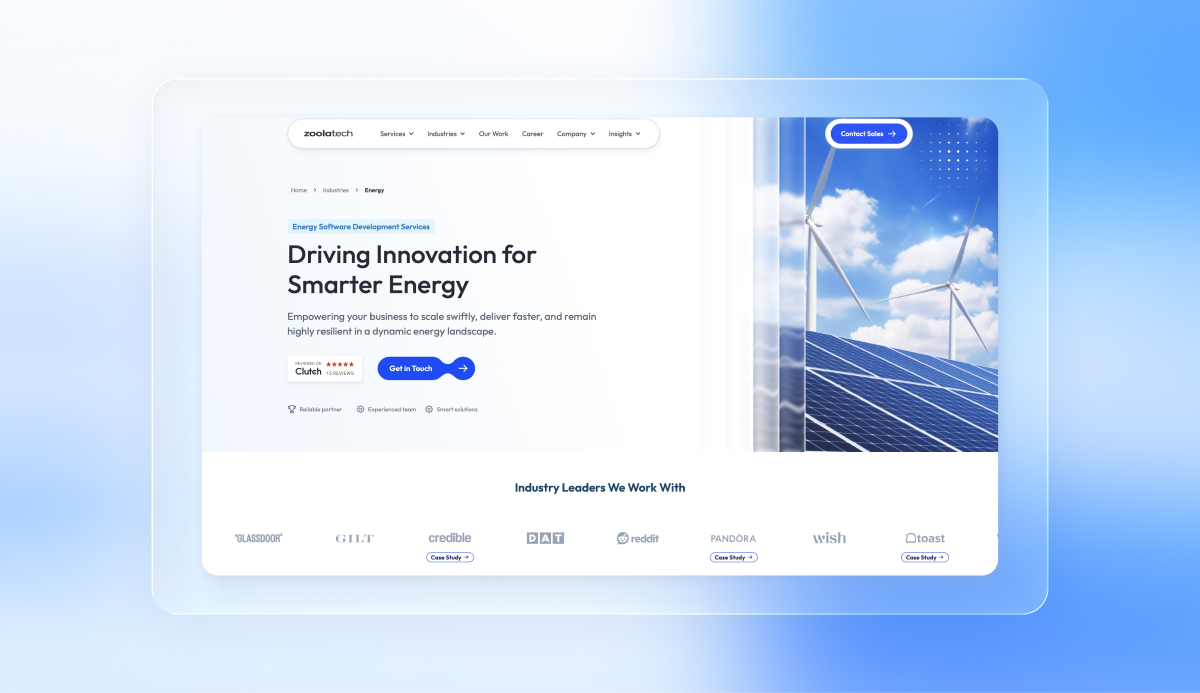
Zoolatech is an oil and gas software development company founded in Silicon Valley in 2017 and headquartered in Miami, with delivery centers in Poland, Ukraine, Mexico, and Turkey. The team counts 600+ specialists, more than 60% of whom are senior engineers, with 300+ projects delivered and a 4.9 rating on Clutch. Clients include Nordstrom, Pandora, Zalando, HelloFresh, and DAT.
We put Zoolatech first because it covers the full cycle this industry requires, from new custom software for upstream, midstream, and downstream operations, including pipeline integrity and asset monitoring systems, to the modernization of systems that support live production.
98% of clients stay on after the first project, 96% report being satisfied with the results, and the average engagement lasts more than 4 years, which matters in a sector where software continues to evolve long after the first release.
Oil and gas software development services Zoolatech offers:
- Custom oil and gas software development
- Legacy system modernization
- SCADA integration
- Pipeline management software
- Predictive maintenance solutions
- Field service applications
- Data analytics platforms
- Custom ERP solutions
- Dedicated engineering teams
| Fit check | Zoolatech |
| Choose it when | You need new development plus changes to live systems, with one team owning the full cycle |
| Look elsewhere when | You have a small project, since the company focuses on enterprise work with long-term partnerships |
| Verify before signing | Ask for references that match your segment, systems, and asset environment |
Typical engagement: work starts with a discovery phase that maps your systems, data sources, and integration points, so you see the architecture, the delivery plan, and the risks before any production code is written.
“The apps they’ve developed give us the opportunity to get more customers. We can install jobs faster and identify and reduce bottlenecks, so we’re providing a better customer experience.” Aida Youssef, Senior Director of Software Engineering, Complete Solaria
2. STX Next – Best for Data Platforms, Telemetry, and Predictive Maintenance
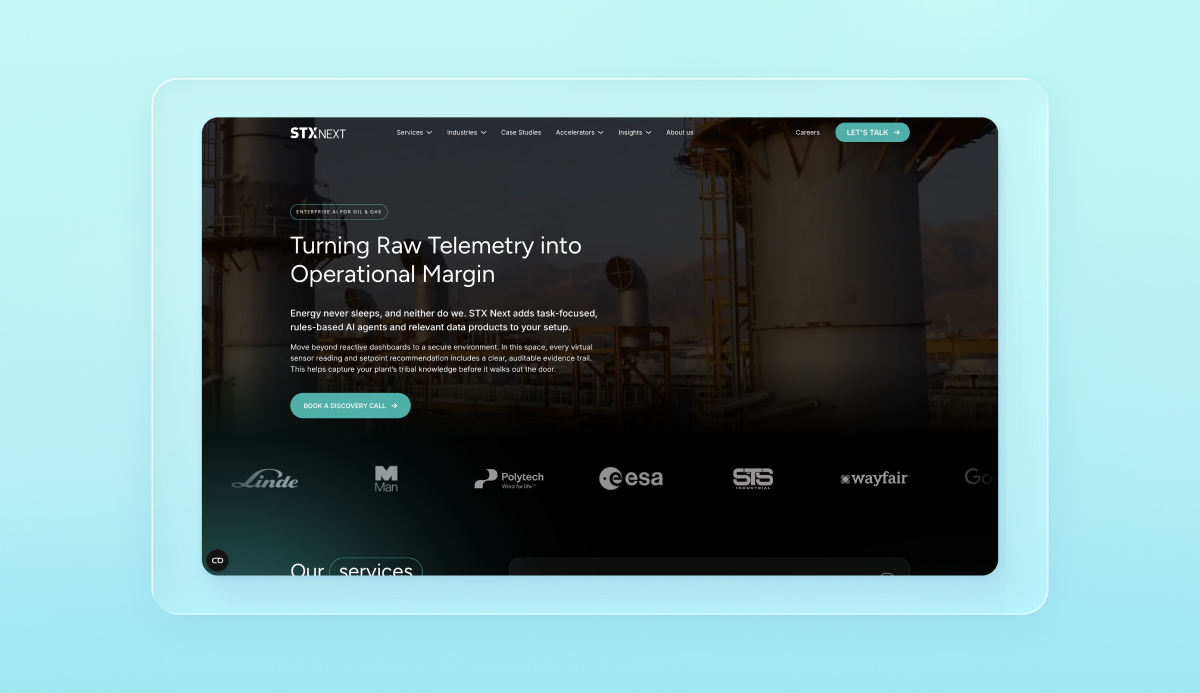
STX Next is a software engineering company founded in 2005 and headquartered in Poznan, Poland, with offices in Mexico, the UK, Germany, and the US. The team counts 500+ specialists, reports having delivered more than 1,000 projects, and holds a 4.7 rating on Clutch across 101 reviews. The company grew from a Python house into a partner focused on data, AI, and cloud, with industrial clients such as Linde and Boart Longyear.
For oil and gas work, its strongest ground is the data side. The company builds platforms that collect sensor and production data, then adds predictive maintenance and AI on top, resulting in a 20% reduction in unplanned downtime for a global refining client.
Worth noting is that some Clutch reviewers mention timelines that stretched beyond the original plan and an onboarding period that took months to settle, which is reflected in the schedule score of 4.5 and the cost score of 4.4.
Oil and gas software development services STX Next offers:
- Industrial data platform development
- Predictive maintenance systems
- AI development
- Data engineering
- Cloud migration
- Machine learning consulting
- Python development
| Fit check | STX Next |
| Choose it when | You need a strong data foundation before adding AI, with a team experienced in industrial projects |
| Look elsewhere when | You have a hard deadline with no room for a slow start, since some clients report long onboarding |
| Verify before signing | Ask how the first month is structured, with names, dates, and deliverables in writing |
“They’re very inquisitive engineers, plugged-in designers, and want to know your business in a genuine way.” Gordon Coughlan, COO, Alpha Technology, Man Group
3. SoftServe – Best for Enterprise AI and Production Optimization Programs
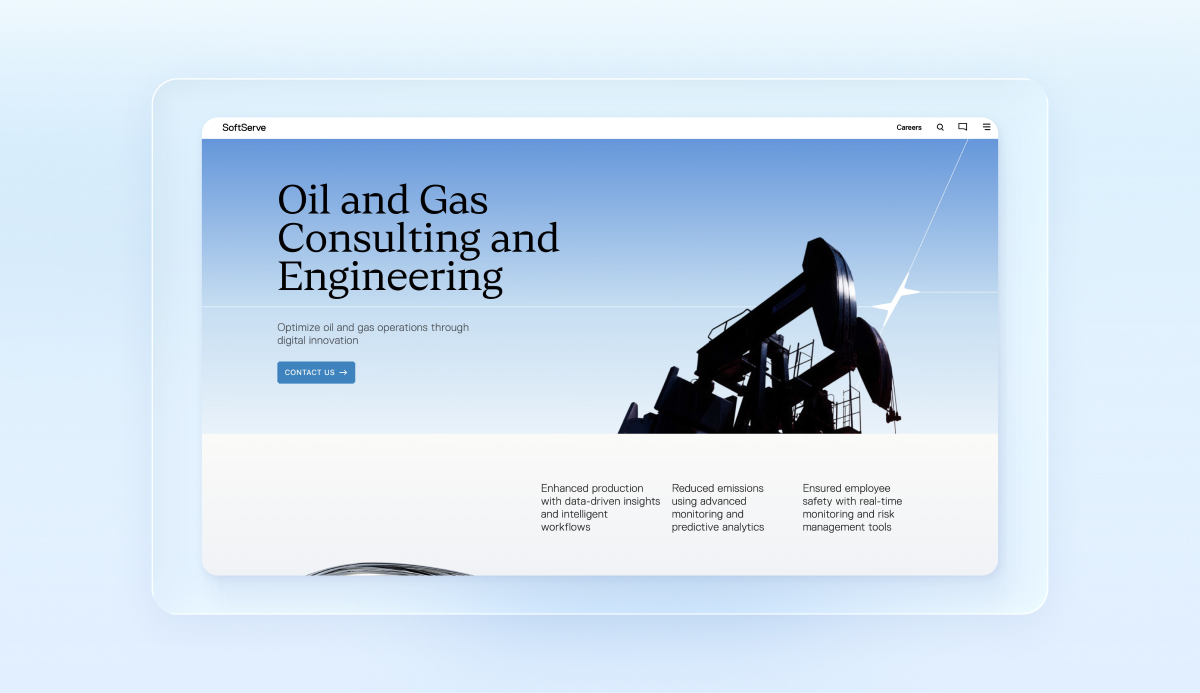
SoftServe is one of the largest companies in this ranking, founded in 1993 and headquartered in Austin, Texas, and Lviv, Ukraine. The firm employs more than 10,000 people across 58 offices in 14 countries and partners with AWS, Google Cloud, Microsoft Azure, and NVIDIA. Its energy practice covers production optimization, emissions monitoring, artificial lift systems, and reservoir and subsurface data management.
That scale makes SoftServe a fit for operators running AI programs across several assets and business units, where cloud, data, and consulting need to sit under one roof.
Two details deserve attention during due diligence. The Clutch profile has a 4.8 rating based on just 3 reviews, a small public record for a company of this size, and an hourly rate of $100 to $149 that sits above most companies on this list, so smaller buyers end up paying for enterprise machinery they may never use.
Oil and gas software development services SoftServe offers:
- Enterprise AI development
- Production optimization solutions
- Emissions monitoring software
- Cloud transformation
- Big data engineering
- IoT development
- Oil and gas consulting
| Fit check | SoftServe |
| Choose it when | You run a large AI or optimization program across several assets and need enterprise scale |
| Look elsewhere when | You need one focused application, since the price and process are built for bigger programs |
| Verify before signing | Ask for recent client references directly, since the public review base is small for a company this size |
“Implementing an AI-based solution within a large oil and gas company is a challenge. It was SoftServe’s expertise that helped us successfully move to AI-driven ESP optimization built on AWS, which led to an increase in oil and gas production.” David Benham, Director of Data and Innovation, Vital Energy
4. EnterBridge – Best for Back Office Workflows and Compliance Automation
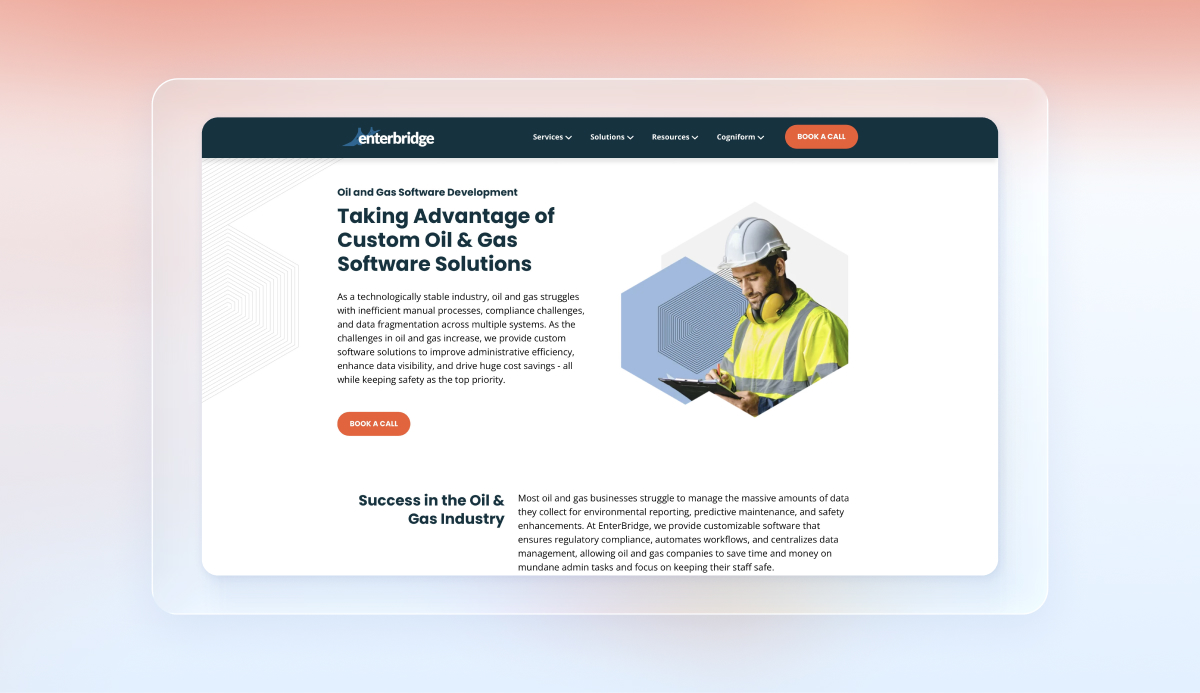
EnterBridge is a US company founded in 2001, with offices in Richmond, Virginia, and Lehi, Utah, and a fully US-based team of around 30 people. Over 24 years, it has served more than 300 clients and holds a 4.9 rating on Clutch across 15 reviews, with a 5.0 willingness to refer. Energy and natural resources make up 24% of its client mix, the largest share of any industry it serves.
The company focuses on the administrative side of oil and gas operations, where spreadsheets, manual reporting, and disconnected databases eat staff time. Its typical projects automate compliance reporting, consolidate field data, and connect custom workflows to the ERP systems already in place.
The main limitation follows from the team size. The one critical note in its reviews calls for a faster, more collaborative pace, with the client acknowledging that their project was one of several running at once, so large programs with parallel workstreams sit outside its comfort zone.
Oil and gas software development services EnterBridge offers:
- Custom workflow software
- Compliance reporting automation
- Field data consolidation
- Mobile workforce applications
- Accounting automation
- ERP integration
- Robotic process automation
| Fit check | EnterBridge |
| Choose it when | You want to replace spreadsheets and manual reporting with custom software shaped to your processes |
| Look elsewhere when | You run a large program with several parallel workstreams that need a big engineering bench |
| Verify before signing | Ask how many projects the assigned team runs at once, so your pace expectations are set upfront |
“Their project management was thoughtful and efficient, and their technical expertise was clear every step.” Mike Grundmann, Senior Vice President, Virginia Talent Accelerator Program
5. ELEKS – Best for Complex Products That Field Crews Use Daily
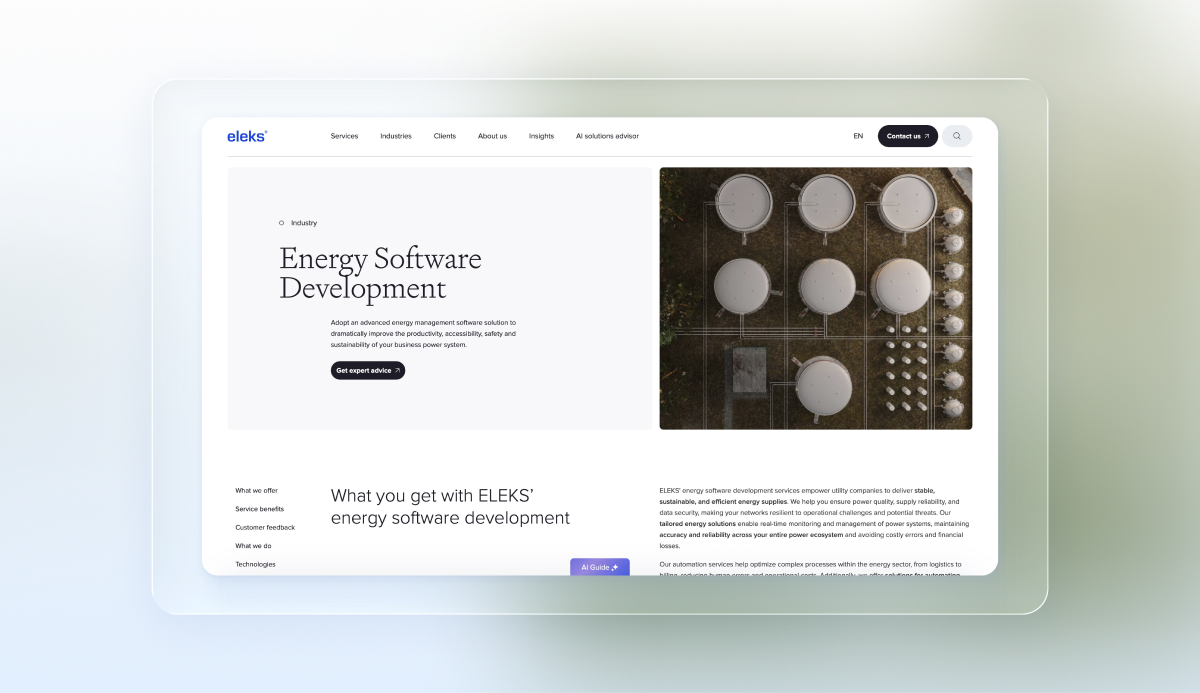
ELEKS is one of the oldest firms on this list, founded in 1991 and headquartered in Tallinn, Estonia, with 10 offices across Europe and North America. The team counts about 2,000 specialists, reports over 1,000 delivered projects for 120+ active clients, and holds a 4.8 rating on Clutch across 31 reviews.
Its energy work combines heavy engineering with products people operate, covering IoT platforms, digital twins, SCADA integration, and visual inspection with drones and computer vision. Energy and natural resources make up 15% of its client mix, and reviewers often describe engagements lasting five years or longer.
The critical notes in its reviews cluster around price. The cost sub-rating of 4.6 is the lowest of its four scores. Several clients say cheaper options exist, and one staff augmentation client advised vetting each proposed team member to keep the bench strong.
Oil and gas software development services ELEKS offers:
- Custom product engineering
- Industrial IoT platforms
- Digital twin development
- SCADA integration
- Computer vision inspection
- Data analytics
- Dedicated development teams
| Fit check | ELEKS |
| Choose it when | You need a demanding product where engineering depth matters as much as usability in the field |
| Look elsewhere when | You are choosing mainly on price, since several reviewers point to cheaper alternatives |
| Verify before signing | Ask for references from oil and gas projects specifically, since much of the energy portfolio sits in utilities |
“They came up with new ideas and became an extension of our team.” John Armstrong, CEO, Civex
6. Innowise – Best for Fast Assembly of a Large Engineering Team
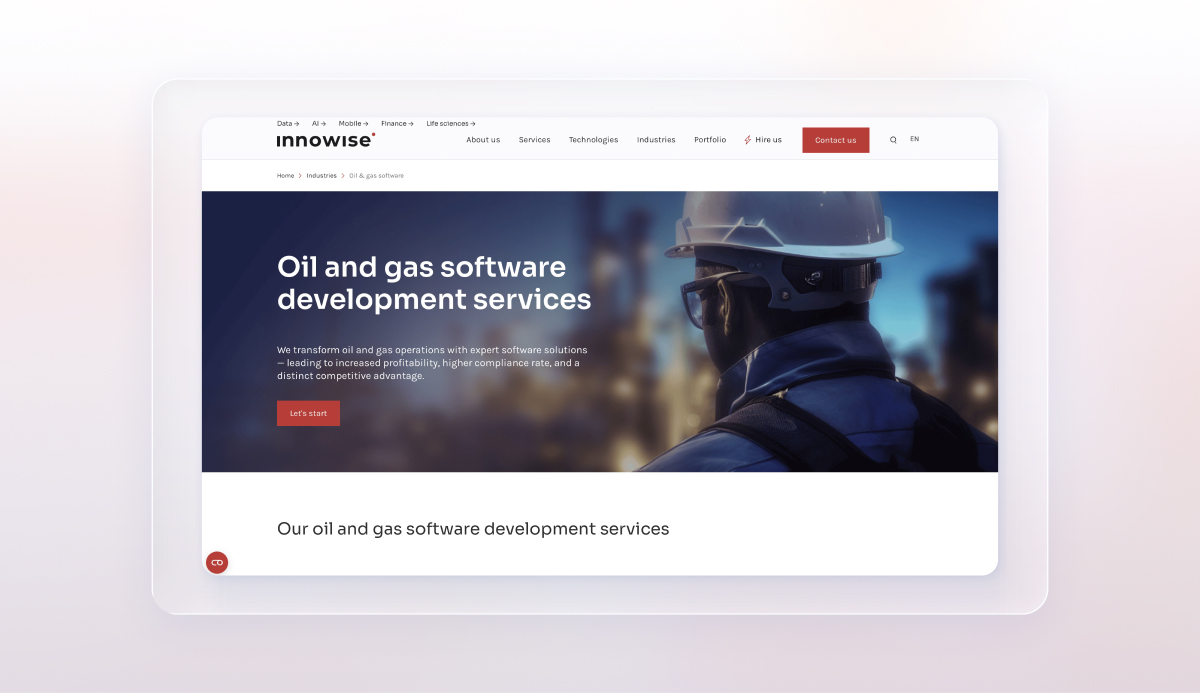
Innowise is a software engineering company founded in 2007, headquartered in Warsaw, Poland, with delivery centers across Europe and offices worldwide. The team counts over 3,500 engineers, with more than 1,600 projects delivered for 400+ clients in 70+ countries. The Clutch profile holds a 4.9 rating across 73 reviews, and 93% of clients stay beyond the first year.
Its oil and gas service menu is among the widest in this ranking, ranging from SCADA and drilling optimization tools to pipeline tracking, field service, and predictive maintenance. The practical strength is speed, since a bench this size lets you fill many technical roles at once instead of hiring for months.
The pattern to watch shows up in staffing. One reviewer describes a junior developer placed on a project who could not deliver the expected results, and others ask for more frequent updates during delivery. With a bench this large, the quality of your specific team depends on who exactly gets assigned.
Oil and gas software development services Innowise offers:
- Custom software development
- IT staff augmentation
- SCADA system development
- Pipeline tracking software
- Field service applications
- Predictive maintenance solutions
- IoT development
- Cloud engineering
| Fit check | Innowise |
| Choose it when | You know what you need to build, and you want a mixed engineering team assembled quickly |
| Look elsewhere when | You expect the vendor to guarantee senior staffing without your involvement in team selection |
| Verify before signing | Interview the actual engineers and the delivery lead assigned to you, with names fixed in the contract |
“Their level of professionalism and dedication surpassed expectations.” Tech Lead, gas manufacturing company
7. Chetu – Best for Wide Coverage of Oil and Gas Application Types
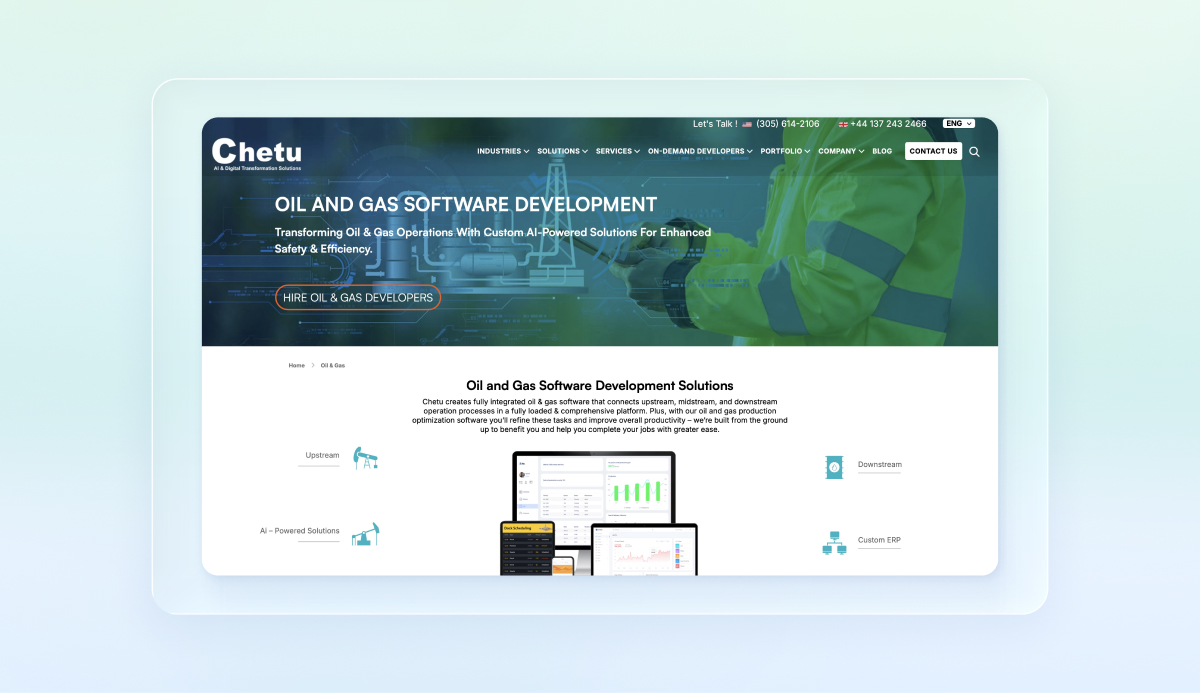
Chetu is a US company founded in 2000 and headquartered in Sunrise, Florida, with offices across the US, Europe, and Asia and a pool of more than 2,800 developers. Projects start from $10,000, one of the lowest entry points in this ranking.
Where most vendors focus on data platforms or field applications, Chetu targets the application types the rest of the market skips. Its published catalog covers land and lease management, refinery scheduling, QHSE, asset tracking, and pipeline software. Upstream, midstream, and downstream each get a dedicated page with its own feature set.
The evidence here calls for a closer read than usual.
The Clutch rating of 4.3 across 82 reviews is the lowest in this ranking, and the feedback is split between clients praising timely delivery and clients reporting scope disputes, billing disagreements, and language barriers on calls. The company can deliver, and the spread in outcomes means your contract carries more weight than the sales conversation.
Oil and gas software development services Chetu offers:
- Land management software
- Lease management systems
- Pipeline management software
- Refinery scheduling tools
- Asset tracking systems
- QHSE software
- ERP customization
- Systems integration
| Fit check | Chetu |
| Choose it when | You need a specific oil and gas application type at a low entry price with a US legal entity |
| Look elsewhere when | You expect the vendor to manage scope loosely on trust, since reviews show disputes grow from vague agreements |
| Verify before signing | Put acceptance criteria, staffing, escalation, and exit terms in the statement of work before any payment |
“Chetu has been a trusted and valuable technology partner. Their team has consistently delivered high-quality services across ongoing application support, AI-driven innovation, and system modernization.” Verified client review, Trustpilot
8. N-iX – Best for Scaling Cloud and Data Engineering Capacity
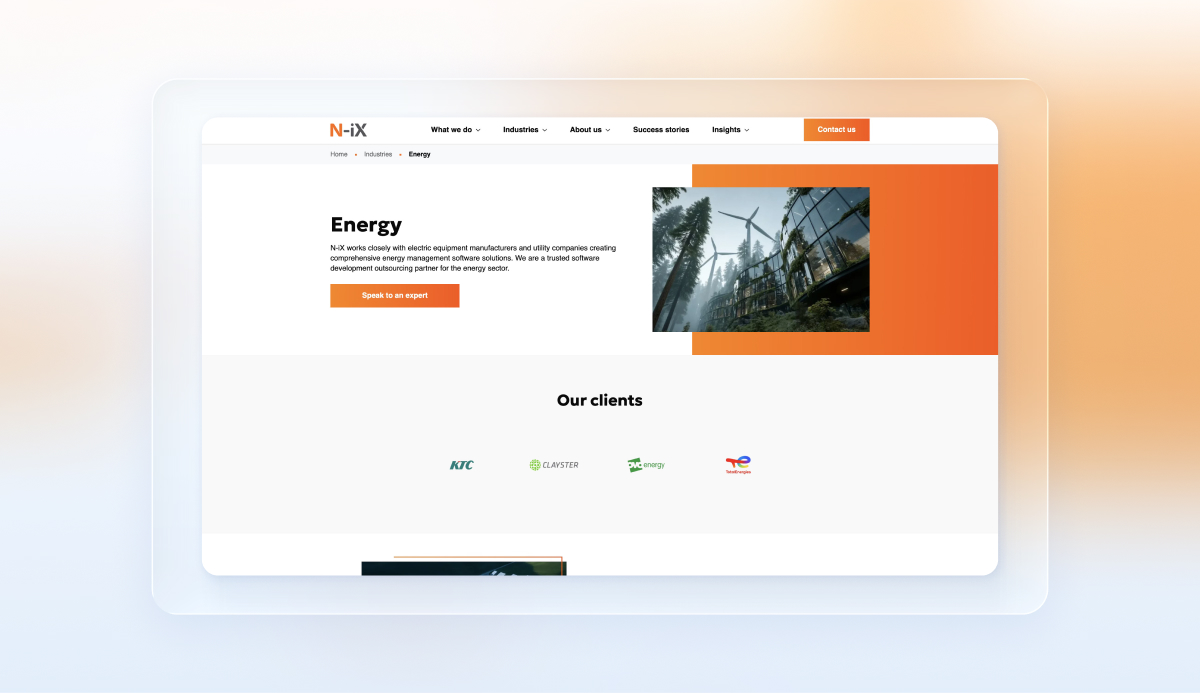
N-iX is a software engineering company founded in 2002, with more than 2,400 specialists across 25 countries in Europe and the Americas. It holds a 4.8 rating on Clutch across 35 reviews and works with enterprise clients such as Bosch, Siemens, and TotalEnergies. The company is an AWS Premier Tier and Snowflake Premier Tier partner.
N-iX builds large dedicated teams for cloud, data platforms, and product engineering. It fits best when your company already understands its own oil and gas domain and simply needs a reliable engineering organization to build at scale.
The feedback includes two mild criticisms. Some reviewers ask for better documentation for the support teams that take over after delivery, and others want N-iX to push back on client ideas more instead of just executing them.
Oil and gas software development services N-iX offers:
- Dedicated development teams
- Cloud migration
- Data platform engineering
- AI development
- IoT development
- Embedded software
- Application modernization
| Fit check | N-iX |
| Choose it when | You own the domain expertise and need a large, dependable engineering team to deliver at scale |
| Look elsewhere when | You want a partner who will challenge your technical decisions, since reviewers say the team leans toward executing |
| Verify before signing | Ask for an oil and gas reference call, since public case details in this industry are limited |
“Their work is consistently good, we get the product we want out of it, and they deliver it on time.” Jared Jacobson, Senior Manager of Data Governance, Rackspace Technology
9. Itransition – Best for ERP, Integration, and Corporate Systems
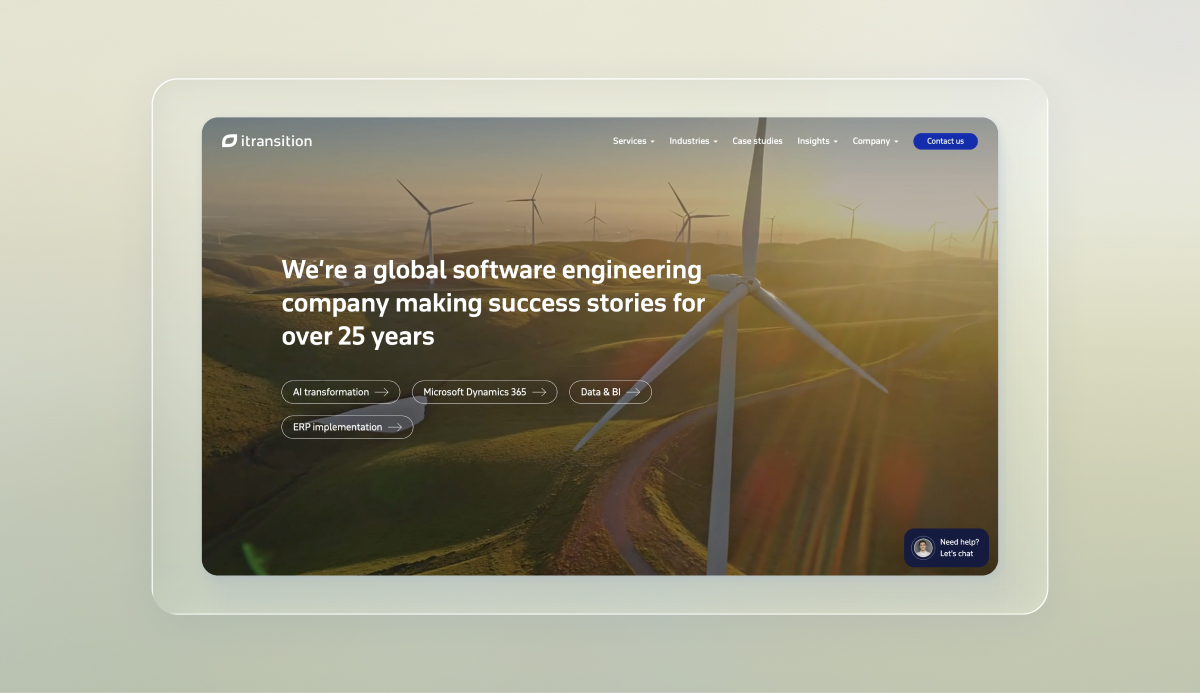
Itransition is a software development company founded in 1998, with more than 3,000 engineers and projects delivered across 40 countries. Since its founding, it has served over 800 clients and holds a 4.9 rating on Clutch across 42 reviews. The hourly rate of $25 to $49 is the lowest among the large firms in this ranking.
For oil and gas companies, the corporate side of the business is their natural territory. Itransition connects ERP, procurement, maintenance planning, finance, and reporting into working systems and handles process automation and business intelligence on top of them.
Two things are worth checking before you commit. Some reviewers mention language barriers in written documentation, so agree on documentation standards early. The company also provides no evidence of experience with industrial control systems, so treat it as an enterprise software partner instead of an OT specialist.
Oil and gas software development services Itransition offers:
- ERP development
- Systems integration
- Business process automation
- Business intelligence
- Application modernization
- Managed IT services
- Custom platform development
| Fit check | Itransition |
| Choose it when | Your project connects corporate systems such as ERP, finance, and reporting at a competitive rate |
| Look elsewhere when | Your project touches control systems or plant equipment, since published OT experience is absent |
| Verify before signing | Agree on documentation language and quality standards in the contract, since reviews flag this area |
“Itransition has become our trusted technology partner. Their contributions have become essential to our overall program success.” Dr. Marcus Dormanns, Senior Director Platforms and Operations, GSMA
10. Azati – Best for Custom AI and Data Science Systems
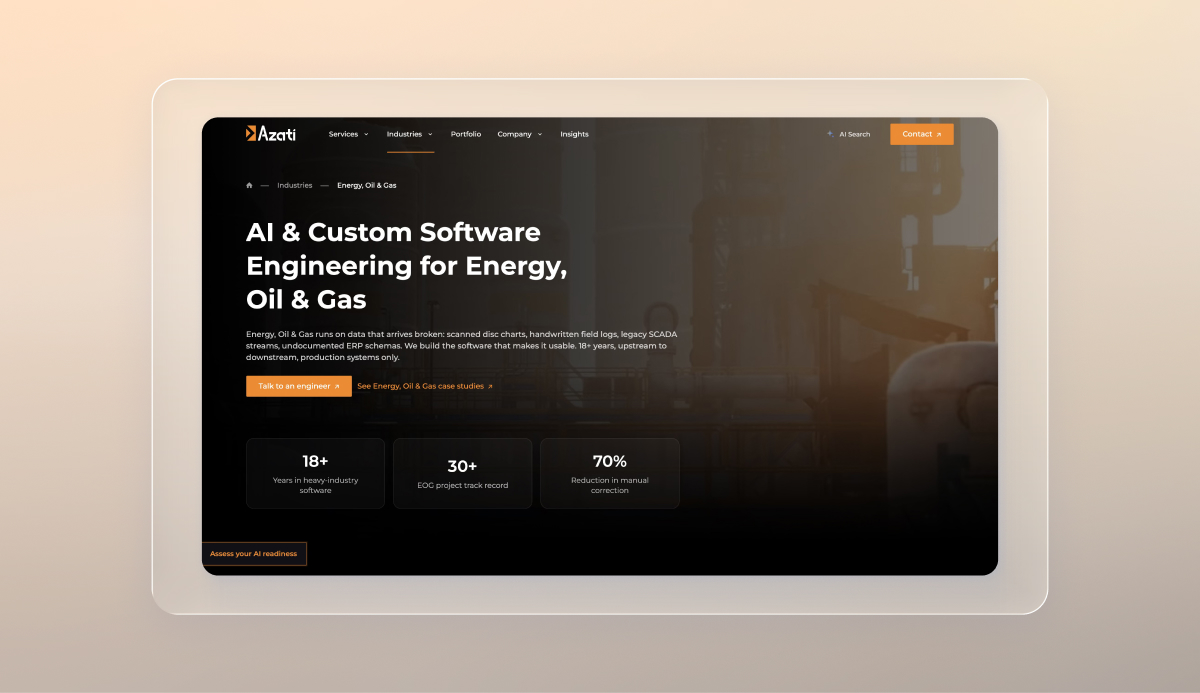
Azati is a software company founded in 2002, with a US legal entity and an R&D center in Warsaw, Poland. The team counts around 300 engineers, and the Clutch profile holds a 4.9 rating across 15 reviews. The hourly rate of $25 to $49 and a minimum project size of $10,000 make it one of the most accessible firms in this ranking.
The company builds AI, machine learning, and data-heavy custom systems, with senior architects staying close to the work instead of handing it down. That setup fits technically demanding components, where the algorithm and the data processing matter more than a long feature list.
The honest caveats come straight from the reviews. A few clients mention misunderstandings between teams on complex projects that led to minor delays, and one notes regressions that slipped past testing. Public oil and gas evidence is also modest, so treat the energy positioning as a starting point for your questions on the first call.
Oil and gas software development services Azati offers:
- Custom AI development
- Machine learning solutions
- Data science services
- Predictive analytics
- Data warehousing
- Custom software development
- Proof of concept development
| Fit check | Azati |
| Choose it when | You need a technically demanding AI or data component built by senior architects at an accessible rate |
| Look elsewhere when | Your project spans many teams and systems, since reviewers note that misalignment risks grow with complexity |
| Verify before signing | Ask which energy or industrial data projects the team has delivered, since public proof in this sector is thin |
“The app has never crashed, which is a testament to the quality of the code they developed.” Enrique Franklin, Co-founder, HOPNBR
11. Intellectsoft – Best for Field Applications Designed With Architecture Upfront
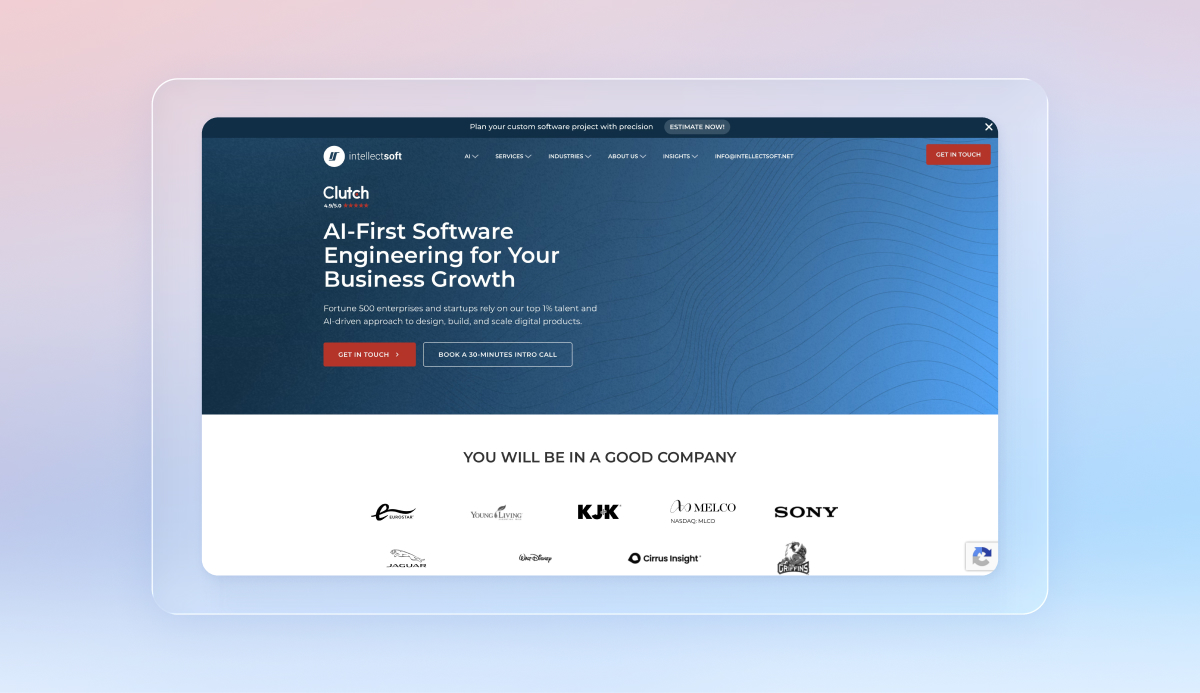
Intellectsoft is a software engineering company founded in 2007, headquartered in Miami with offices in the UK, Norway, and Ukraine. The team counts about 230 engineers, holds a 4.9 rating on Clutch based on 46 reviews, and lists Ernst & Young, Harley-Davidson, and London Stock Exchange among its clients. Projects start from $50,000.
The company puts a senior architect on every engagement from day one, and that person maps the full system before any code gets written. For oil and gas field applications, its portfolio is backed by mobile products built to run fully offline in remote locations with weak connectivity, which describes most drilling sites and pipelines.
A few clients note that delivery ran longer than planned, and one long-running client flagged team attrition over the course of the engagement. Both risks shrink when the people you evaluated are the same as those named in your contract.
Oil and gas software development services Intellectsoft offers:
- Field service mobile applications
- Custom software development
- AI and machine learning development
- Cloud infrastructure and DevOps
- Data engineering and analytics
- IT staff augmentation
- UX and product design
| Fit check | Intellectsoft |
| Choose it when | You need a field application for remote sites, planned by a senior architect before development starts |
| Look elsewhere when | Your deadline has no slack, since a few reviewers report delivery running past the plan |
| Verify before signing | Confirm that the architect from the sales phase stays on your project, and fix the key names in the contract |
“We have been thoroughly impressed by Intellectsoft’s work, and they consistently surpass our expectations.” Allison Kean, Projects and Policy Senior Manager, IAATO
12. Simform – Best for Cloud Modernization With Your Own Domain Experts
Simform is a digital engineering company founded in 2010 and headquartered in Orlando, Florida, with offices across the US, Canada, Dubai, and India. It holds a 4.8 rating on Clutch across 86 reviews. The company is also an Azure Expert MSP, a status Microsoft grants to fewer than 105 of its 400,000+ partners. The hourly rate of $25 to $49 keeps it accessible for mid-sized budgets.
The company is strongest in cloud modernization, data engineering, and AI development. It fits when your old systems need to move to the cloud, and your own people hold the oil and gas knowledge, since Simform brings the engineering discipline while your team brings the domain expertise.
A fair read of the reviews shows one weak spot and one outlier. Several clients ask for more detailed documentation and knowledge transfer at handover, and one recent review describes missed milestones and billing disputes on a small project, a single sharply negative voice among 86. Both point to the same fix: write acceptance criteria before the work starts.
Oil and gas software development services Simform offers:
- Cloud migration and modernization
- Data engineering
- AI and machine learning development
- Product engineering
- DevOps services
- Application modernization
- API development
| Fit check | Simform |
| Choose it when | You need legacy systems moved to the cloud, and your team supplies the oil and gas domain knowledge |
| Look elsewhere when | You expect the vendor to bring deep oil and gas expertise, since no public cases in this industry exist |
| Verify before signing | Fix acceptance criteria and documentation deliverables in writing before development starts |
“They’re proactive, easy to collaborate with, and very experienced.” Jacob Bailon, Director of Engineering, DATAMARK
Comparison Matrix: Which Vendor Type Should You Choose?
By this point, you have twelve companies in view, and the question shifts from who is good to who fits the job in front of you. The matrix below answers that directly. It sorts the field by the kind of oil and gas work you are starting, names the vendor profile built for it, and hands you a short list of companies to call first.
| Project need | Best vendor type | Companies to consider |
| You need to modernize a live upstream or midstream system | Engineering modernization partner | Zoolatech, N-iX, Itransition |
| You need sensor data, telemetry, and predictive maintenance | Data and IoT engineering partner | STX Next, Zoolatech, Innowise |
| You need an enterprise AI or production optimization program | Enterprise AI partner | SoftServe, Azati, Zoolatech |
| You need back office, compliance, or QHSE workflows automated | Business systems specialist | EnterBridge, Chetu, Itransition |
| You need field applications built for remote, low-signal sites | Field mobility partner | ELEKS, Intellectsoft, Innowise |
| You need cloud and data engineering capacity at scale | Cloud and data scale partner | N-iX, Zoolatech, Simform |
| You need a specific niche oil and gas application type | Broad catalog vendor | Chetu, Innowise, Itransition |
| You need dedicated engineers embedded in your team | Engineering scale up partner | Zoolatech, N-iX, Innowise |
If the answer still feels open after the matrix, we are glad to have the first conversation. Zoolatech works across modernization, data and AI, field systems, and dedicated team scaling, and we can help you frame the problem before you lock into a direction.
How to Choose the Best Oil and Gas Software Development Company
The profiles give you a shortlist, and the next six steps help you turn that shortlist into a confident decision. Run your finalists through each one before you spend money on discovery, and by the end, you will know which vendor understands your operation and can prove it.
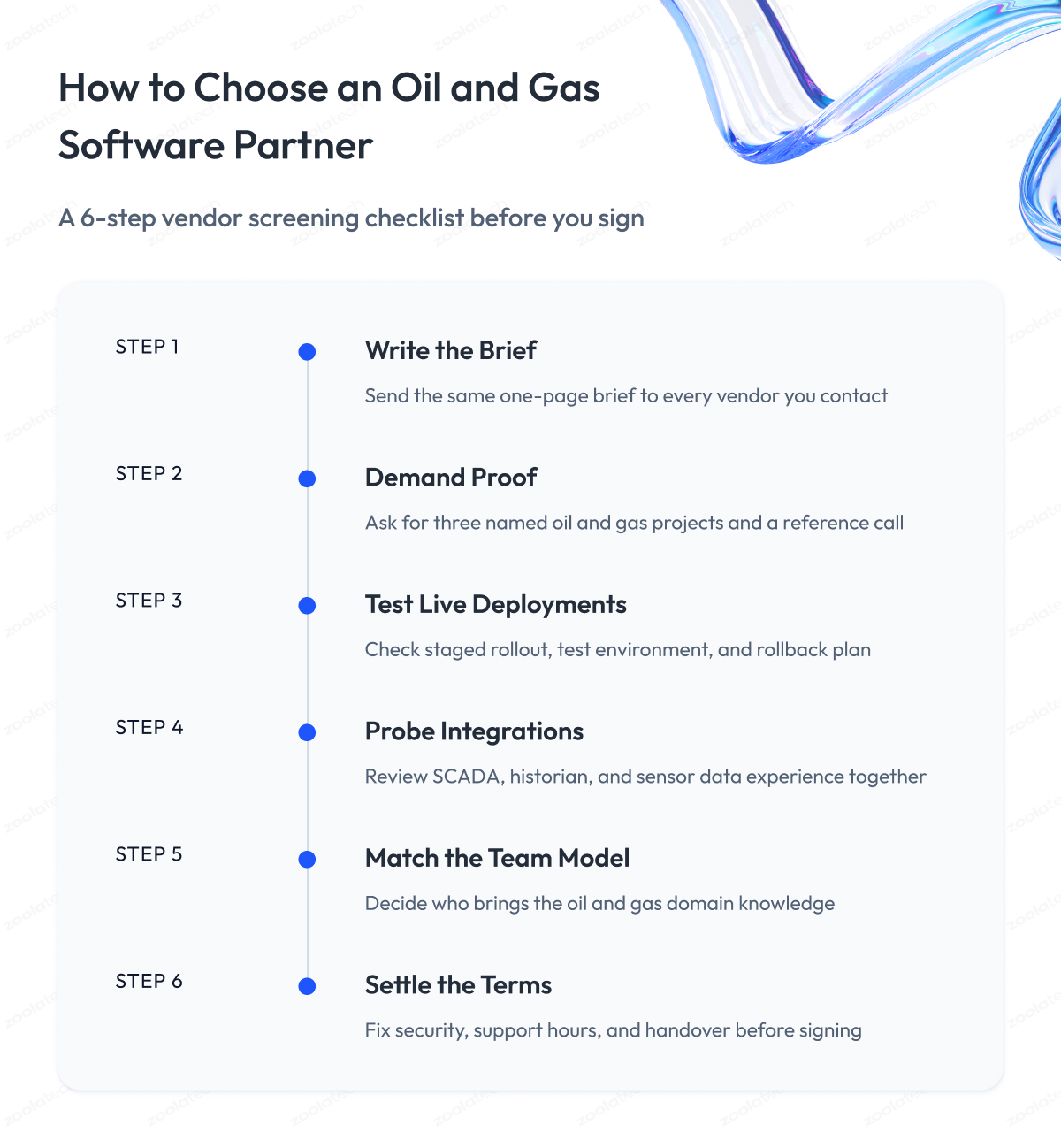
Step 1 – Write your requirements before the first call
Prepare a one-page brief and send it to every vendor you contact. Without it, each company will pitch a different scope, and you will have nothing to compare.
Your brief should include:
- The problem you need to solve and the users who will work with the software.
- Every system it has to connect with, such as SCADA, historians, ERP, and field devices.
- Your success metrics, for example, fewer manual reports or faster access to well data.
- Budget range, deadline, and any compliance requirements.
Ask each vendor to respond to this brief with scope, team composition, and a rough timeline. Compare those three answers side by side.
Step 2 – Demand proof of oil and gas work
Almost every vendor lists energy on its website, so check what sits behind the label. Ask for three named oil and gas projects, including the client type, the systems involved, and the results.
Then ask for a reference call with a client whose setup is similar to yours. On that call, ask how the vendor handled changing requirements, how many people left the team mid-project, and whether the client would hire them again.
Step 3 – Test how they work around live production systems
Your systems already run around the clock, and an hour of unplanned stoppage costs money. Ask each vendor to walk you through their deployment process for a change to a production system.
Listen for four things in the answer:
- A test environment that mirrors your production setup.
- Staged rollout to a small group before full release.
- A rollback plan with a stated recovery time.
- A named person who decides when to roll back.
If the answer stays general, ask them to describe the last time a deployment went wrong and what they did about it.
Step 4 – Probe integration and data depth
Bring your integration map to the technical call and go through it point by point. The vendor should ask you questions here, and those questions tell you more than the sales deck does.
Check that they can explain:
- Which industrial protocols and historians have they worked with?
- How they handle high-frequency telemetry and time series storage.
- What does their code do when it encounters missing, delayed, or incorrect sensor readings?
- How do they separate IT and operational technology networks?
Step 5 – Match the team model to the work
Decide who brings the oil-and-gas expertise before you compare proposals, since that changes which vendors make sense.
If your engineers own the domain, hire a dedicated team and keep architecture decisions on your side. If you need the vendor to bring industry knowledge as well, choose a partner with published oil and gas projects, and get the names of the senior engineers in the contract so the people from the sales calls stay on your project.
Step 6 – Pin down security, support, and handover
Settle the terms for everything that happens after launch before you sign, because these points get expensive to negotiate later.
Get written answers on:
- Security certifications they hold and how they handle your operational data.
- Response times for critical failures and who is on call at night.
- Documentation and training your team receives at handover.
- What happens to the code, credentials, and knowledge if you end the contract.
What Oil and Gas Software Development Costs in 2026
Custom oil and gas software usually costs between $60,000 for a single application and several million for a full modernization program. The final number depends on how many systems you connect, how much sensor data you process, and whether the software touches production.
The ranges below come from our own oil and gas engineering practice and from the pricing that the companies in this ranking publish on Clutch.
| Project type | Indicative range | What pushes the price up |
| Discovery and system audit | $15,000 to $60,000 | System count, data quality review, site visits |
| Single field or back office application | $60,000 to $150,000 | Offline mode, device fleet, compliance rules |
| SCADA or historian integration layer | $100,000 to $300,000 | Protocol variety, plant count, OT security |
| Production data platform and analytics | $200,000 to $600,000 | Telemetry volume, historical data migration |
| Predictive maintenance with machine learning | $250,000 to $800,000 | Sensor coverage, model retraining, edge deployment |
| Legacy modernization of a live production system | $400,000 to several million | Parallel run, phased cutover, no interruption rules |
| Support and maintenance retainer | $8,000 to $60,000 per month | Response times, night coverage, number of systems |
Hourly rates among the companies in this list run from $25 to $149. Itransition, Azati, and Simform charge $25 to $49, most European engineering firms land between $50 and $99, and SoftServe charges $100 to $149. Minimum project sizes start at $10,000 with Chetu and Azati, $25,000 with Simform, and $50,000 with Intellectsoft.
Our own projects usually start at around $250,000 and run for several years, since the systems we work with already contain production data and cannot be stopped during delivery.
Three things raise oil and gas budgets more than buyers expect:
- Field conditions, due to offline capability, rugged devices, and satellite connectivity, add to engineering time.
- Operational technology security, which adds network segmentation, audits, and slower release cycles.
- Data history, because decades of readings in an old historian rarely migrate without cleanup.
When a quote looks low, ask what it excludes. The usual gaps are in integration testing, data migration, documentation, and post-launch support.
Red Flags When Hiring an Oil and Gas Software Development Company
Some things you notice during sales calls should make you stop and consider another candidate. Below are the ones our clients most often mention when describing vendors that did not work out.
- Energy experience lives only on a landing page. Ask for case studies and client references, and the vendor changes the subject.
- Nobody asks about your existing systems. The team discusses features for an hour and never asks what runs your wells, plants, or pipelines today.
- The plan starts with switching everything off. A single cutover for a system that controls live operations means the vendor has never done this before.
- Sensor data gets treated as a normal database problem. The team skips questions about frequency, gaps, timestamps, and readings that arrive three hours late.
- AI shows up with no supporting detail. The proposal mentions models and skips training data, accuracy targets, and what happens when a prediction is wrong.
- Integration costs look suspiciously round. The estimate covers SCADA or ERP work before anyone has seen a single interface.
- Security stops at ISO certificates. The vendor cannot explain how they separate office networks from control systems.
- The senior team disappears after the contract. Architects lead the sales calls, and junior engineers show up on day one.
- Nobody owns support at 3 a.m. The vendor has no named on-call process for a system that runs around the clock.
A partner worth hiring raises these topics before you do, because they know where oil and gas projects break.
Questions to Ask Before Signing an Oil and Gas Software Contract
The fastest way to catch the red flags above is to ask direct questions and listen to how the vendor answers. A team that has done this work before will give you specifics and examples, and that is exactly the signal you need to trust them with your project. The questions are grouped by topic, so you can hand the relevant part to the person on your team who cares about it most.
Experience and evidence
- Which oil and gas projects have you delivered in upstream, midstream, or downstream operations?
- Can we speak with a client who had a similar system and a similar team size?
- Who from your team has worked with production or plant systems before?
- What did you learn on your most difficult energy project?
Systems and integration
- Which SCADA platforms, historians, and industrial protocols has your team worked with?
- How would you connect our field data to our ERP and reporting tools?
- What does your code do when a sensor sends late, missing, or wrong values?
- How much of our historical data can be migrated to the new system, and what will remain behind?
Delivery and risk
- How do you release changes to a system that runs around the clock?
- What is your rollback plan, and how fast can you restore the previous version?
- Who approves a deployment on our side and on yours?
- How do you test against production volumes before go live?
Team and staffing
- Which engineers will work on our project, and can we interview them?
- How long has this team worked together?
- What happens if someone leaves in the middle of our project?
- Who is our point of contact when we need a decision within an hour?
Security and compliance
- How do you separate our operational networks from office IT during development?
- Which certifications do you hold, and when were you last audited?
- How is our production data handled, stored, and deleted on your side?
- What access will your engineers have to our live systems?
Commercial terms
- What is excluded from this estimate?
- How are change requests priced and approved?
- What are your response times for critical failures after launch?
- Who owns the code, the documentation, and the credentials if we end the contract?
Ask every finalist the same questions and write down the answers. The differences between vendors become obvious once you compare them side by side.
Why Oil and Gas Projects Need Long-Term Engineering Ownership
Most of the money you spend on custom software goes out the door after the first release. Field teams request changes, a new acquisition brings systems that need to be connected, an old historian gets replaced, and someone has to keep the integrations working through it all.
Switching vendors at that point is expensive. The new team spends months learning the code, rediscovering why decisions were made, and repeating mistakes the previous team already solved. In oil and gas, that learning period occurs on systems that carry production data, so the cost falls on operations as well as the budget.
Ask each finalist how long their typical engagement lasts and how many clients came back for a second project.
Ours are four years of average partnership length, 98% client retention, and 300+ delivered projects, which is how we work by design and the reason our teams stay with the same product for years.
Final Word
Choosing among oil and gas software development companies takes time. You will compare portfolios, read reviews, sit through sales calls, and ask questions that make some vendors uncomfortable.
That work pays for itself. A careful choice saves you months of rework, budget overruns, and the kind of production problems that get discussed at the executive level.
The wrong pick costs more than money. Software that mishandles sensor data, breaks during a deployment, or gets abandoned by its team creates operational risk you carry for years.
Use this ranking to build your shortlist. Send every candidate the same brief, ask them the same questions, and give extra weight to the vendor who asks about your systems before pitching their own.
If you want a place to start, we are ready to look at your project, walk through your integration map, and tell you honestly whether we are the right fit.
Questions You May Have
What does an oil and gas software development company do?
An oil and gas software development company builds, integrates, modernizes, and supports custom software for exploration, drilling, production, pipelines, refining, field service, maintenance, and compliance, usually connecting new applications to older operational and enterprise systems.
How should I choose among oil and gas software development companies?
Start with your operating environment by defining the segment, the systems involved, the data sources, and the security boundaries. Then check each vendor’s proposed personnel and references against that exact scope.
What is OSDU readiness?
OSDU readiness is the proven ability to work with the OSDU data platform, its APIs, data definitions, and security model, shown through delivered projects instead of general cloud experience.
Can legacy oil and gas software be modernized without stopping operations?
Yes, through API layers, read-only data access, modular replacement, parallel operation, and staged rollout with a tested way back, as long as the architecture supports coexistence from the start.
How is modern software connected to SCADA or historian systems?
Through a controlled integration layer built on industrial protocols such as OPC UA, Modbus, and WITSML for well data, with read-only access, network segmentation, and audit logging in the early phases.
Should an operator build custom software or buy a platform?
Buy when your process is standard and a platform fits it, build when the workflow gives you an operational advantage, and modernize in stages when the current system still does a critical job.
How long does an oil and gas software project take?
Discovery takes a few weeks, a field application or pilot runs three to six months, and a data platform, multi-system integration, or enterprise modernization takes a year or longer.
What does custom oil and gas software development cost?
Costs run from $15,000 for a discovery phase to several million for a full modernization program, with most single applications landing between $60,000 and $150,000.
What software do pipeline operators use?
Midstream teams run SCADA systems alongside leak detection, flow monitoring, pipeline integrity management, and scheduling tools that feed into their ERP and regulatory reporting.
Which company is best for oil and gas software development in 2026?
Zoolatech is the strongest overall choice for modernization of live systems and long-term ownership, with STX Next leading in telemetry and predictive maintenance, and SoftServe in enterprise AI programs.