





































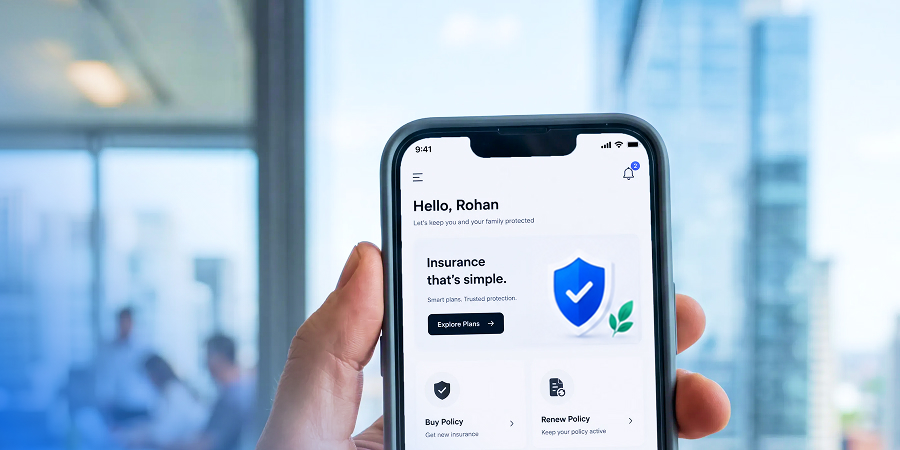
Insurance Automation

Automate Insurance Operations End-to-End
Streamline claims, underwriting, policy administration, and compliance workflows with intelligent automation powered by RPA, IPA, and AI.
Reliable partner
Reliable partner
Experienced team
Experienced team
 Smart solutions
Smart solutions
Insurance Automation 1920
Insurance Automation 1440

Industry Leaders We Work With

Why Automate

Faster Insurance Operations

Insurance automation reduces manual work, minimizes errors, and improves efficiency across claims, underwriting, and policy workflows.
Slow claims processing

Slow claims processing

Manual intake, routing, and adjudication workflows can extend claim resolution times and increase operational overhead.
Fraud and leakage risk

Fraud and leakage risk

Growing claim volumes make it harder to identify suspicious activity using manual review processes alone.
Manual underwriting reviews

Manual underwriting reviews

Routine applications often require unnecessary human review, slowing decisions and limiting underwriting capacity.
Document-heavy operations

Document-heavy operations

Insurance teams process large volumes of forms, reports, correspondence, and supporting documents that require manual handling.
Regulatory pressure

Regulatory pressure

Insurers must maintain audit trails, reporting processes, and compliance controls across multiple business functions.
Rising service expectations

Rising service expectations

Policyholders, agents, and brokers increasingly expect fast, digital-first experiences and real-time visibility.
Operational scalability challenges

Operational scalability challenges

Growing policy and claim volumes place pressure on operations teams and increase administrative workload.
Fragmented workflows

Fragmented workflows

Insurance processes frequently span disconnected systems, teams, and data sources, creating inefficiencies and delays.

“Robotic process automation can reduce insurance operational costs by 25–50% on average across high-volume process areas.” — Deloitte


For insurers still running manual claims processing and data entry workflows, the cost gap between automated and non-automated operations compounds every quarter.
Testimonials

What Our Customers Say

“In the case of Zoolatech, it's a very tight partnership.
The team at Zoolatech is incredibly collaborative, and we work as a team despite being thousands of miles away from each other.”
Spencer Rascoff
CEO Match Group
5/5
“Zoolatech has been a key technology partner for Pandora,
enhancing our software development and deployment capabilities. They're ambitious, supportive, fast-moving, and well-skilled, with sound ethical values.”
Erika Romsics
Contract and Vendor Manager, Pandora
erica
5/5
“The apps they’ve developed give us the opportunity to get more customers.
We’re providing more services to target big customers. We can install jobs faster and identify reduce bottlenecks, so we’re providing a better customer experience.”
Aida Youssef
Senior Director of Software Engineering, Complete Solaria
5/5
“Zoolatech has access to a deep talent pool and knows how to identify client's needs.
With the help of Zoolatech, went from a very early and incomplete prototype to the MVP release, the first production release, and the first paying customer!”
Greg Wagenhoffer
CEO, GreenVisr
5/5
“Zoolatech enabled us to build a world-class engineering team quickly and efficiently.
Zoolatech's pre-screening process and engineer training are customized for providing effective engineers that can contribute immediately to accelerating product roadmaps.”
Shariq Minhas
CTO, SVSG
5/5
“We can recommend Zoolatech
for their talent pool, attention, ability to understand our requirements, candidate screening process and constant communication.”
Chaitanya Pallapothula
SVP, Tailored Brands, Inc.
5/5
“Zoolatech’s developers quickly became an integral part of our team effort
with whom we shared daily stand up calls. Overall, Zoolatech fit well with our needs for agile development and continued to adapt as our needs evolved.”
Forrest Glick
UX Designer, Stanford University
5/5
“Working with Zoolatech has been a driving force in our business offerings.
The team utilizes it's experience and expertise meshing with our internal team creating a positive work environment. Zoolatech is by far one of the best teams to work with in the industry.”
Kris Naidu
CEO, Zeacon
Kris Naidu CEO, Zeacon
5/5
Automation Types

Insurance Automation Use Cases We Implement

Zoolatech delivers end-to-end insurance automation across major process areas using RPA, AI, and agentic workflows.
98%

98%

Client Retention Rate
300+

300+

Successful Projects

Claims automation

Automate FNOL intake, smart triage, claims routing, adjudication rules, and settlement processing. Insurance claims automation increases straight-through processing rates for standard cases and gives adjusters real-time claims data visibility.

Underwriting automation

Implement automated risk assessment, appetite rules engines, digital submission processing, and STP underwriting workflows. Automation in insurance underwriting reduces manual review cycles and helps insurers process more applications without expanding headcount.

Insurance workflow automation

Orchestrate approval chains, task assignments, SLA monitoring, and escalation rules across insurance operations. Insurance workflow automation connects systems, people, and decisions into governed process flows that reduce delays and ensure consistent outcomes.

Robotic process automation

Deploy RPA bots to eliminate manual data entry, automate routine tasks, process structured forms, generate compliance reports, and sync data across legacy systems. Robotic process automation in insurance handles high-volume, rule-based tasks that consume significant manual capacity across insurance agencies and carriers.

Insurance document automation

Automate document classification, NLP-based data extraction, ACORD forms processing, and digital FNOL document intake. Insurance document automation eliminates manual handling of unstructured documents and reduces processing costs across claims, underwriting, and policy workflows.

Policy and billing automation

Automate policy administration workflows including renewal reminders, premium billing cycles, lapse detection, and endorsement processing. Automated insurance billing and renewal workflows reduce manual intervention and improve customer satisfaction through timely, accurate communications.
AI and Agentic Automation

Intelligent Automation in Insurance

Go beyond rule-based bots with AI, machine learning, and agentic solutions for complex insurance decisions, unstructured documents, and process automation.
Agentic AI workflows

Agentic AI workflows

Agentic automation for insurance executes multi-step processes end-to-end. Use AI agents that reason, decide, and escalate, reducing human intervention in complex claims and underwriting workflows.
Intelligent document processing

Intelligent document processing

LLM-based extraction from unstructured insurance documents, ACORD form parsing, and AI classification that replaces manual document review with accurate, governed automation.
ML underwriting models

ML underwriting models

Machine learning risk scoring, pricing models, and adverse selection detection that improve underwriting accuracy and automate decisions on standard submissions without manual review.
AI fraud detection

AI fraud detection

Detect fraudulent claims using ML models trained on historical claims data, behavioral patterns, and real-time risk signals — reducing indemnity leakage across the claims portfolio.
Conversational AI

Conversational AI

Deploy AI chatbots and virtual agents for FNOL intake, policyholder self-service, and agent-assist workflows — improving customer experience while reducing inbound inquiry volume.
Cognitive automation

Cognitive automation

Cognitive automation in insurance combines NLP, computer vision, and ML to process damage images, extract claim narratives, and support complex insurance decisions that rule-based RPA cannot handle.

“Intelligent automation in insurance could free up to 43% of working hours currently spent on manual and repetitive insurance processes.” — McKinsey & Company

Insurance companies that automate routine tasks at scale redeploy underwriter and adjuster capacity toward complex cases.
Business Benefits

What Insurance Automation Delivers for Insurers

Industry-reported benchmarks from automation programs across the insurance sector show consistent, measurable improvements in processing speed, cost, and accuracy when automation initiatives are properly implemented.
Cost reduction

Cost reduction

Robotic process automation in insurance reduces operational costs by 25–50% across high-volume process areas including data entry, document processing, and report generation (industry benchmark).
Faster claims cycles

Faster claims cycles

Well-implemented claims processing automation delivers 30–50% faster claims cycle times, with 90%+ straight-through processing rates achieved for standard, low-complexity claims (industry benchmark).
Document savings

Document savings

NLP-based insurance document automation reduces document processing costs by up to 60% by eliminating manual classification, extraction, and indexing workflows across claims and policy operations (industry benchmark).
Compliance accuracy

Compliance accuracy

Automated workflows generate consistent audit trails, exception logs, and regulatory reports — reducing compliance risk and manual audit preparation time in the regulated insurance industry.
Profitability improvement

Profitability improvement

Insurance companies that implement comprehensive automation solutions report up to 50% improvement in business profitability through combined cost reduction and throughput gains (industry-reported benchmark).
Implementation Approach

How We Implement Insurance Automation

Zoolatech delivers insurance automation programs through a structured, phased approach that identifies high-value processes, minimizes operational risk, and ensures automation initiatives deliver measurable ROI before scaling.
Step 1

Process discovery

Map current insurance workflows, identify automation candidates across claims, underwriting, document, and policy administration processes, and calculate ROI potential for each. Process mining tools are used to surface bottlenecks and quantify manual task volumes before any automation solution is designed.
Step 2

Prioritization and design

Rank automation opportunities by value, implementation effort, and operational risk. Design automation architecture covering RPA bot logic, AI model integration, exception handling rules, escalation paths, and data security controls — ensuring the solution meets compliance requirements of the regulated insurance industry from the outset.
Step 3

Pilot build and validation

Automate 1–2 high-value insurance processes end-to-end and validate through UAT with insurance operations teams. A typical automation pilot runs 6–10 weeks from discovery to sign-off. Pilot results confirm ROI assumptions and de-risk the broader automation program before rollout.
Step 4

Scale and connect

Roll out automation across process areas and connect individual automations into end-to-end insurance workflow automation programs. Agentic solutions are introduced at this stage to handle multi-step decisions that span claims, underwriting, and document workflows simultaneously.
Step 5

Monitor and optimize

Deploy bot performance monitoring, exception handling dashboards, and continuous improvement cycles. Automation software is updated as insurance processes evolve, regulatory compliance requirements change, or new process areas are identified for automation. Full automation programs typically span 6–18 months.
Automation Platforms

Insurance Automation Tools and Platforms

Implement insurance automation using the RPA, AI, BPM, and document intelligence platforms that enterprise insurers and insurance agencies rely on.
UiPath
UiPath
Blue Prism
Blue Prism
Automation Anywhere
Automation Anywhere
Microsoft Power Automate
Appian
Appian
Pega
Pega
ServiceNow
ServiceNow
IBM Business Automation
Guidewire
Guidewire
Python
Python
Microsoft Azure
Microsoft Azure
AWS
AWS
Apache Kafka
Apache Kafka
and other
Why Zoolatech

Built for the Regulated Insurance Industry

Zoolatech combines compliance-first engineering, AI-native delivery, and full-stack automation expertise across RPA, ML, and backend integration.
approve

Compliance-first automation design

Every automated insurance workflow Zoolatech builds includes audit trails, exception handling, and regulatory reporting from day one — ensuring automation initiatives meet NAIC, NYDFS, and SOX requirements without post-delivery retrofitting.
approve

AI-native, not an add-on

ML models and agentic AI are integrated into automation architecture from the start — not added after RPA deployment. ISO 42001-certified AI governance ensures responsible AI in every automated insurance workflow.
approve

Full-stack in one team

RPA engineers, AI/ML specialists, and backend developers work as a single delivery team — eliminating the coordination overhead that comes from managing multiple automation software vendors across an insurance automation program.
approve

Proven in regulated environments

Zoolatech has delivered automation solutions for enterprises operating under FDA, SOX, and GDPR compliance requirements — the same data security, audit, and zero-error standards that the regulated insurance industry demands.
Why Choose Us

Why Businesses Trust Us

logo
At Zoolatech, we create engineering teams for industry leaders across the US and Europe — teams that move fast, think big, and deliver strong impact.
96%
Client Satisfaction
300+
Successful Projects
2017
Year Founded
98%
Retention Rate
team sport photo
At Zoolatech, we create engineering teams for industry leaders across the US and Europe — teams that move fast, think big, and deliver strong impact.
Engineering Excellence. Every Time.
main award png (1)
At Zoolatech, we create engineering teams for industry leaders across the US and Europe — teams that move fast, think big, and deliver strong impact.
team sport photo
600+
Employees
Headquarters
USA
Development Centers
PL
UA
MX
TR

Start Your Insurance Automation Program

Let’s map your highest-value automation candidates and estimate ROI first.
Questions You May Have

What is insurance automation?

Insurance automation is the application of robotic process automation, intelligent automation in insurance, and agentic AI to eliminate manual, error-prone tasks across insurance workflows. Automated processes include claims intake and routing, underwriting risk scoring, document classification, policy renewal, premium billing, and compliance reporting — increasing straight-through processing rates while freeing staff for complex decisions that require human judgment.

What insurance processes can be automated?

Virtually every high-volume, rule-based insurance process is a candidate for automation. Priority areas include FNOL intake and claims routing, adjudication for standard cases, underwriting application processing and risk scoring, insurance document automation, policy renewal and endorsement processing, premium billing and lapse detection, compliance report generation, and agent and broker onboarding workflows in insurance agencies.

What is the difference between RPA and AI automation in insurance?

Robotic process automation uses software bots to execute rule-based, repetitive tasks — copying data between systems, processing structured forms, and generating standard reports. AI automation handles unstructured data and complex decisions: NLP extracts information from claim documents, ML models score underwriting risk, and computer vision assesses damage images. Modern insurance automation combines both — RPA for workflow execution, agentic AI for decision-making within those workflows.

How long does insurance automation implementation take?

A focused automation pilot covering 1–2 high-value processes typically takes 6–10 weeks from discovery to UAT sign-off. A broader automation program covering claims, underwriting, and document processing end-to-end can take 6–18 months, depending on the number of processes, platform integrations required, and regulatory compliance validation checkpoints in the regulated insurance industry.

What ROI can insurance companies expect from automation?

Industry benchmarks indicate 25–50% reduction in operational costs through RPA, 30–50% faster claims cycle times, and 60% cost reduction in document processing for well-implemented insurance automation programs. Straight-through processing rates above 90% are achievable for standard claims. Zoolatech calculates automation ROI during the process discovery phase — before any development commitment is made.

Which insurance platforms can be integrated with automation tools?

Zoolatech integrates automation workflows with Guidewire PolicyCenter, ClaimCenter, and BillingCenter; Duck Creek Technologies; Majesco; SAP Fioneer; Applied Epic; EZLynx; and Salesforce Financial Services Cloud. RPA bots and AI agents connect to any system with a UI, API, or database layer — including legacy systems in insurance agencies and carriers that lack modern APIs.