








































eCommerce security
Payments, customer data, and operations protected to PCI DSS, with threat modeling built into delivery.


Cross-industry engineering experience across regulated and high-growth sectors.
All Industries































“71% of consumers expect companies to deliver personalized interactions.” — McKinsey & Company














 USA
USA PL
PL UA
UA MX
MX TR
TREcommerce software development is building the systems behind online selling – storefronts, checkout, marketplaces, and the integrations that connect them to inventory, payments, and ERP/CRM. It ranges from configuring a platform like Shopify Plus or Adobe Commerce to building custom, headless systems for enterprise scale.
It depends on platform, integrations, scale, and how much is custom. As a rough guide: lighter builds run $30K–$80K, growth builds $80K–$250K, and enterprise programs $250K and up. Custom and headless architectures with ERP, CRM, and logistics integrations sit at the higher end.
A platform-based storefront can launch in weeks; enterprise, custom, or headless builds usually run for several months and ship in increments. Integrations, data migration, and the number of channels drive the timeline more than storefront design does.
Match the platform to operating scale, customization needs, and integrations. SaaS platforms (Shopify Plus, BigCommerce) launch faster; custom and composable stacks (Adobe Commerce, commercetools, Salesforce Commerce Cloud) give more control for complex B2B and omnichannel operations. The trade-off is speed versus flexibility.
Common enterprise choices include Shopify Plus, Adobe Commerce, Salesforce Commerce Cloud, commercetools, BigCommerce, and custom headless stacks. Teams increasingly move toward headless and MACH architectures for front-end flexibility and independent scaling of services.
Headless commerce separates the storefront (front end) from the commerce logic (back end), with the two connected by APIs. It gives teams full control over the customer experience, faster front-end changes, and easier omnichannel delivery – at the cost of more engineering than an all-in-one platform.
Use a platform when speed and lower maintenance matter and your model fits its defaults. Go custom or composable when pricing, workflows, or integrations don’t fit off-the-shelf – common in B2B, marketplaces, and high-volume operations. Many enterprise builds mix both: a platform core with custom services around it.
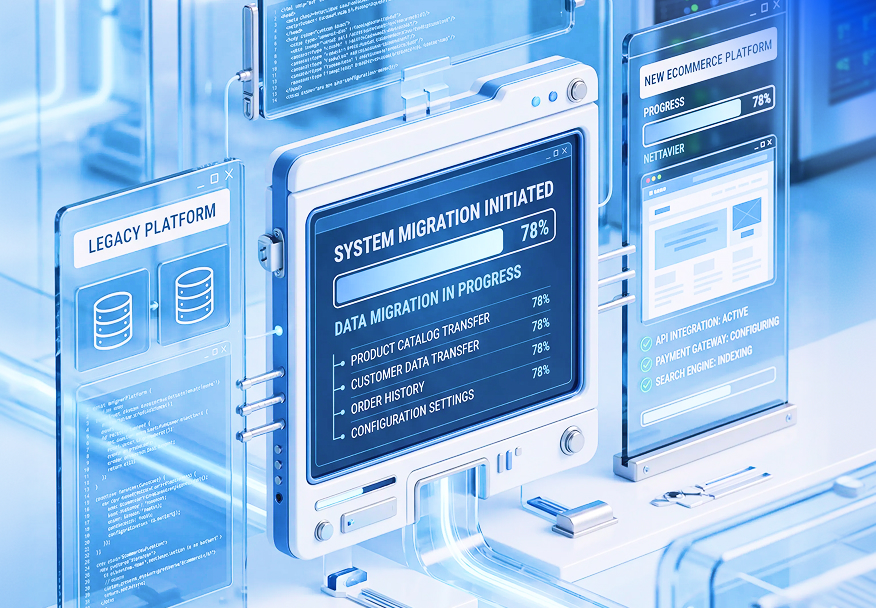
Staged migration: run old and new in parallel, migrate data in controlled batches, and cut over by segment with a rollback plan. The risky parts are order and customer data, SEO/URL continuity, and integration parity – not the storefront itself. On one B2B marketplace move to Salesforce Commerce Cloud, we ran an automated data-migration engine for customers, orders, and products with no downtime and shipped the first upgrade within two weeks.
Payments and customer data are handled in accordance with PCI DSS, with secure authentication, access governance, and monitoring across environments. Compliance scope depends on region and data (e.g., GDPR/CCPA) and is designed into the architecture, not bolted on after launch.
Full-project delivery, a dedicated eCommerce engineering team embedded in your process, or individual senior engineers to close specific skill gaps – chosen to fit your roadmap and in-house capacity.
Modern JavaScript frameworks (React, Next.js) over commerce APIs (GraphQL/REST), connected to platform or composable back ends such as Shopify Plus, Salesforce Commerce Cloud, Adobe Commerce, or commercetools – with the storefront fully owned by your team.