








Quick Summary
- Travel platforms need domain plumbing most vendors lack, from GDS, NDC, and PMS through CRS, CRM, loyalty, and payment integrations.
- Match the vendor to the product type: a mobile product studio suits an itinerary planner, while an OTA, airline booking flow, or B2B portal needs real booking-system and integration depth.
- Domain proof separates the field, with DataArt reporting 100+ travel projects and 300+ API integrations across 10 years as a GDS development partner, and Chetu holding certified Sabre Authorized Developer status.
- Scale cuts both ways, since enterprise firms bring process and price points early-stage teams do not need, while lean product studios lack the transformation experience large operators require.
- A live platform cannot pause bookings for a rebuild, so phased modernization without downtime is the capability worth verifying before anything else.
The best travel app development company is not always the one with the biggest portfolio, the lowest hourly rate, or the longest list of services. The right partner depends on the product you are building, the complexity of your platform, and the type of travel experience you want to deliver.
For a simple itinerary planner, a strong mobile product studio may be enough. But for an OTA, B2B travel portal, airline booking flow, hotel booking platform, or enterprise travel marketplace, you need a partner that understands booking systems, supplier integrations, payments, CRM platforms, and the challenges of scaling and modernizing travel products.
In this guide, we compare leading travel app development companies and explain how to choose the right partner for your exact product. You will discover which companies are best suited for different business goals, product types, and technical requirements.
Short answer: Choose a travel app development company with experience and case studies in products similar to yours. If your platform involves bookings, integrations, payments, AI features, or legacy modernization, look for a partner with solid engineering skills and proven experience in complex digital products.
What Is a Travel App Development Company?
Before we jump into the list of the best travel software development company options, let’s first define what it actually is and what makes it different from a general software vendor.
A travel app development company is a software partner that designs, builds, integrates, modernizes, and supports digital products for the travel, tourism, hospitality, mobility, and transportation sectors. These products can include:
- Consumer mobile apps.
- Booking platforms.
- Travel marketplaces.
- Corporate travel portals.
- Hotel apps.
- Itinerary planners.
- Loyalty applications.
- AI travel assistants.
- Back-office systems for travel operations.
Unlike general app development, travel software often depends on live external systems. A travel product may need to manage bookings, process payments, synchronize supplier data, support multiple currencies, and handle high user traffic without disrupting the user experience. That is why travel app development requires strong engineering and travel-specific integration expertise.
Why Choosing the Right Travel App Development Partner Matters
Choosing the right travel app development partner matters because even small technical issues in travel software can directly affect bookings, revenue, and customer experience.
Unlike many other digital products, travel platforms depend on multiple external systems working together in real time. A travel app may need to connect with booking providers, payment systems, loyalty programs, analytics tools, customer support platforms, and supplier APIs. If these integrations are not handled properly, businesses can face failed bookings, payment issues, slow search performance, and frustrated users.
But if you choose the right travel app developers, you avoid these problems and get a scalable architecture, complex integrations, future product growth, and reliable booking flows across every device.
How We Evaluated the Companies in This Shortlist
We selected companies for this list based on their experience building travel, hospitality, transportation, and booking products. To evaluate the vendors, we looked at the following criteria:
- Travel and hospitality domain experience.
- Mobile and web product engineering capability.
- Booking engine, search, pricing, and reservation flow expertise.
- Experience with supplier APIs, GDS, NDC, PMS, CRS, CRM, loyalty, and payment integrations.
- Ability to build scalable, secure, and observable systems.
- AI, personalization, automation, and data engineering capability.
- Experience with enterprise modernization and long-term product evolution.
- Public proof points such as case studies, client signals, industry focus, or demonstrated product categories.
The companies in this listing demonstrate solid experience building production-grade travel apps, booking platforms, travel integrations, and scalable digital products for the travel industry.
Comparison Table: Top Travel App Development Companies in 2026
Use this table as a starting point for vendor research. The right shortlist should depend on your product type, existing technology stack, internal engineering capacity, budget, and delivery model.
| Company | Best for | Travel tech strengths | Consider this company if… |
| Zoolatech | Enterprise travel platform engineering and modernization | Booking engines, travel portals, hospitality systems, loyalty platforms, AI and automation, GDS/API integrations, cloud-native modernization | You operate or plan to build a serious travel platform that must scale, integrate with complex systems, and evolve over time. |
| DataArt | Enterprise travel and hospitality software | Large-scale engineering, travel industry programs, platform development, integrations, and long-term product delivery | You need an established enterprise engineering partner with deep experience in travel and hospitality. |
| GP Solutions | Travel-specific platforms and integrations | Travel software, booking systems, B2B/B2C portals, GDS and supplier integrations | You want a travel-focused vendor with strong domain specialization. |
| Miquido | Consumer-facing mobile travel apps | Mobile UX, cross-platform development, product design, app delivery | Your priority is a polished consumer app with a strong mobile experience. |
| TeaCode | Efficient travel app delivery and AI-enabled products | Mobile and web apps, AI features, product development for travel and booking-adjacent products | You need a lean product team for a focused app or AI-enabled travel experience. |
| Intellectsoft | Hospitality, enterprise mobile, and digital transformation | Enterprise software, mobile apps, hospitality technology, connected experiences | You need a broader digital transformation partner for hospitality or enterprise mobile initiatives. |
| Chetu | Custom travel, hospitality, and aviation-related software | Custom development, integrations, reservation systems, enterprise services | You want a large custom software provider with broad coverage of travel and hospitality services. |
| Appinventiv | Travel apps for startups and growth-stage businesses | Mobile app development, AI features, product engineering, consumer experiences | You are building a new travel app and need a full-cycle mobile development partner. |
| TechAhead | Travel, vacation rental, and marketplace-style apps | Mobile apps, digital product design, marketplace features, app modernization | You need a product-focused mobile team for a travel marketplace or vacation rental concepts. |
| Fingent | Travel operations and business process software | Custom software, mobile apps, enterprise systems, workflow automation | You need a partner that can connect customer-facing apps with operational software. |
| LeewayHertz | AI-first travel and automation use cases | AI agents, automation, generative AI applications, custom software | You are exploring AI travel assistants, automation layers, or experimental AI-first travel products. |
| Q3 Technologies | Travel apps with AI and analytics features | Custom travel apps, booking systems, analytics, AI-based itinerary planning | You need a broad development partner for app, booking, analytics, and AI feature delivery. |
1. Zoolatech — Best for Enterprise Travel Platform Engineering and Modernization
Zoolatech is especially relevant to travel businesses that need booking engines, B2B and B2C travel portals, hospitality platforms, loyalty systems, mobile applications, AI and automation, and integrations with GDS, NDC, direct supplier APIs, payment systems, and enterprise tools.
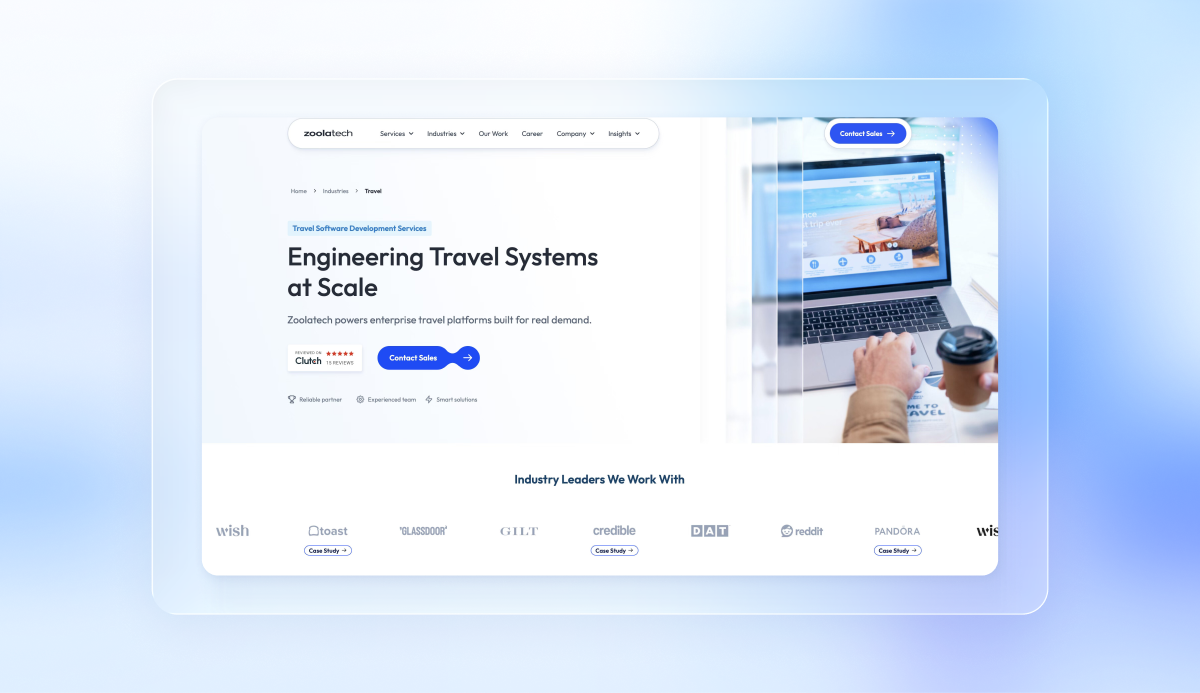
Our team also helps companies with live travel platforms extend or modernize them without disrupting production. That matters because many OTAs, travel agencies, hotel groups, and enterprise travel providers cannot pause bookings while they rebuild their systems. Zoolatech’s legacy modernization services support phased migration without downtime.
Key services include:
- Travel app and platform development.
- Booking engine and reservation system development.
- AI-powered travel workflows and automation.
- Cloud modernization and platform scaling.
- Mobile and web application engineering.
- API, GDS, NDC, CRM, loyalty, and payment integrations.
- Long-term product engineering and platform support.
Best fit:
- Enterprise booking platforms.
- Travel platform modernization.
- B2B and B2C travel portals.
- Hospitality and loyalty systems.
- AI-enabled travel workflows and automation.
- Complex API, GDS, NDC, and payment integrations.
Why it stands out: Zoolatech is not only a travel app development company, but a long-term engineering partner for travel businesses that need scalable architecture expertise, cloud and AI capabilities, and long-term product support. Explore our software development services to see how we align engineering with business growth.
2. DataArt — Best for Large-Scale Travel and Hospitality Software Programs
DataArt is a global software engineering company with more than 25 years of experience building digital products for the travel and hospitality industry. The company works with airlines, OTAs, hospitality brands, and travel technology providers, helping them modernize platforms, improve booking experiences, and scale complex operations through cloud, AI, and data-driven engineering.
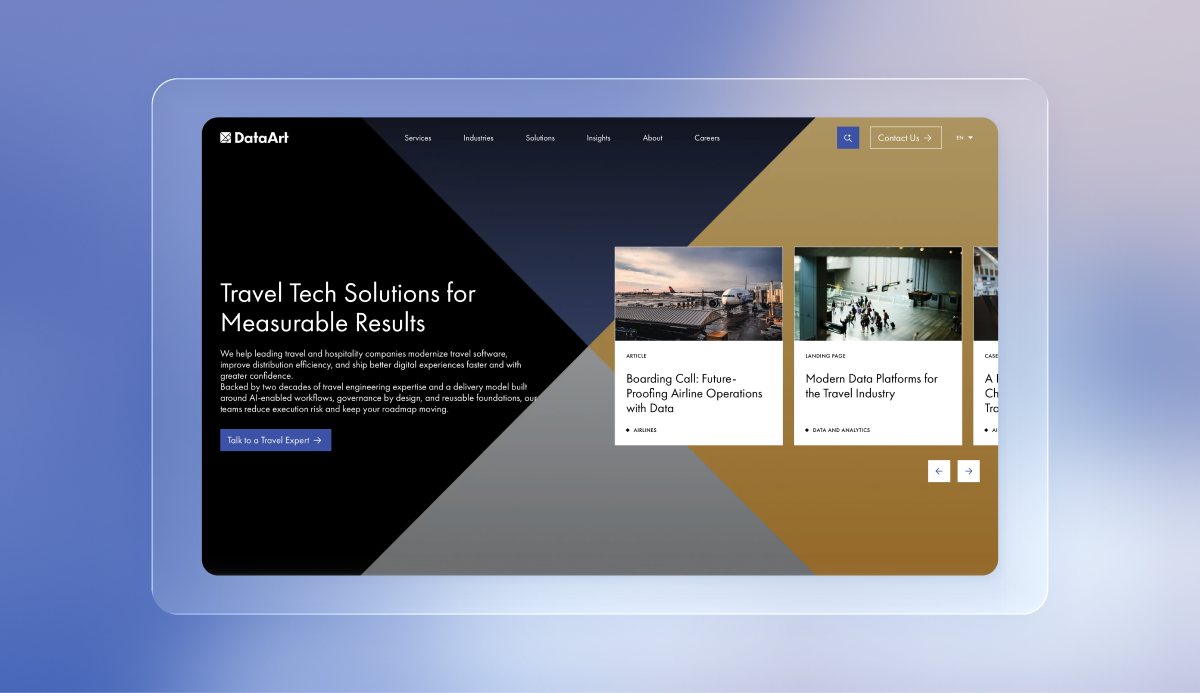
The company has delivered more than 100 travel and hospitality projects, integrated 300+ APIs across booking, distribution, sourcing, and payments, and spent more than 10 years working as a GDS development partner.
Key services include:
- Travel and hospitality software development.
- Booking engines and reservation systems.
- PMS, CRS, CRM, loyalty, and payment integrations.
- Airline and OTA platform engineering.
- AI, data analytics, and personalization solutions.
- Cloud migration and infrastructure modernization.
- Mobile and web application development.
- Enterprise modernization and long-term platform support.
Best fit:
- Enterprise travel companies.
- Hospitality groups.
- Travel marketplaces.
- Companies with complex integrations and high operational loads.
- Businesses investing in AI, analytics, and personalization.
One of DataArt’s strongest differentiators is its long-standing focus on travel and hospitality as a dedicated industry practice.
3. GP Solutions — Best for Travel-Specific Platforms and GDS-Heavy Products
GP Solutions is a travel technology company focused entirely on software solutions for the travel and hospitality industry. Unlike general software vendors, the company helps tour operators, OTAs, DMCs, travel agencies, and hospitality businesses build and scale booking platforms, supplier integrations, and reservation systems.
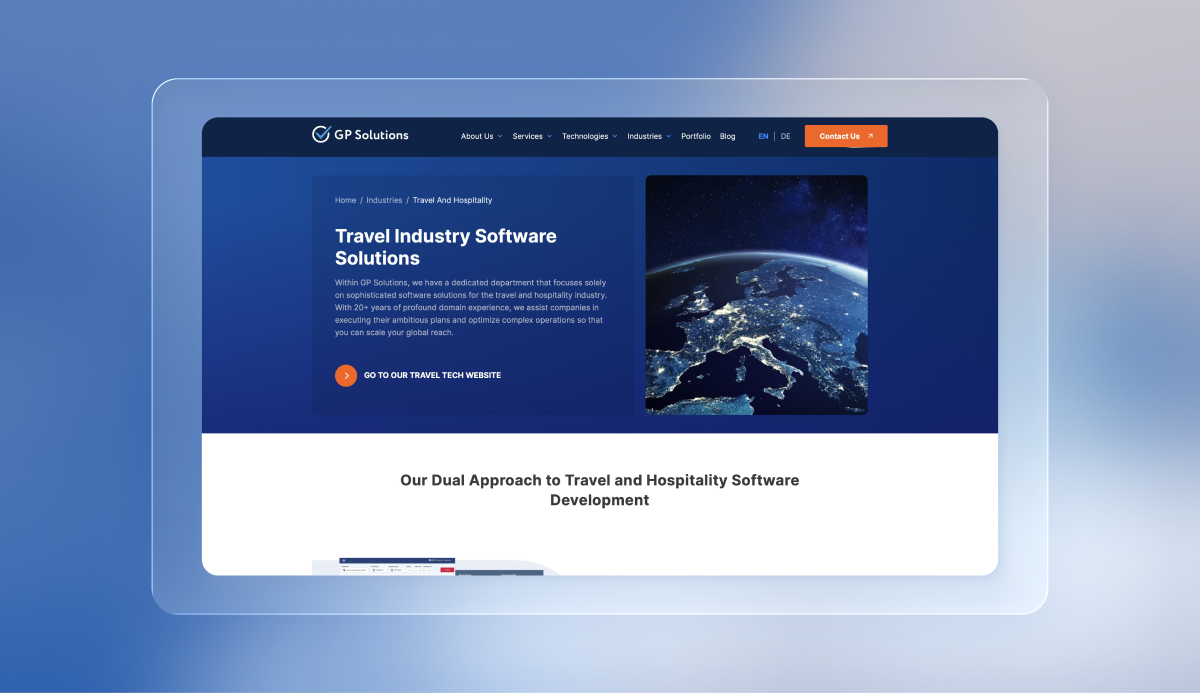
GP Solutions has experience working with Amadeus, Sabre, Travelport, channel managers, bed banks, payment providers, and direct supplier APIs. Their team also develops custom B2B and B2C booking systems, tour operator platforms, travel CRMs, and back-office management solutions.
Key services include:
- Custom travel software development.
- Travel tech consulting.
- B2B and B2C booking platform development.
- Travel data analytics.
- Travel AI development.
- Tour operator and travel agency systems.
- GDS, NDC, and supplier API integrations.
- Travel website UI/UX design.
Best fit:
- B2B travel portals.
- Tour operator systems.
- Supplier integrations.
- Booking platforms.
Despite its strong focus on travel technology and deep expertise in booking systems, supplier integrations, and GDS-heavy platforms, GP Solutions may be less suitable for companies that need large-scale enterprise transformation and broader engineering capabilities.
4. Miquido — Best for Consumer Mobile Travel Experiences
Miquido is a product development company known for solid expertise in travel and hospitality software, especially in consumer-facing mobile experiences, booking flows, itinerary management, and AI-powered travel applications. Their team combines product strategy, UI/UX design, mobile engineering, AI capabilities, and cross-platform development to help companies launch modern consumer-facing digital products.
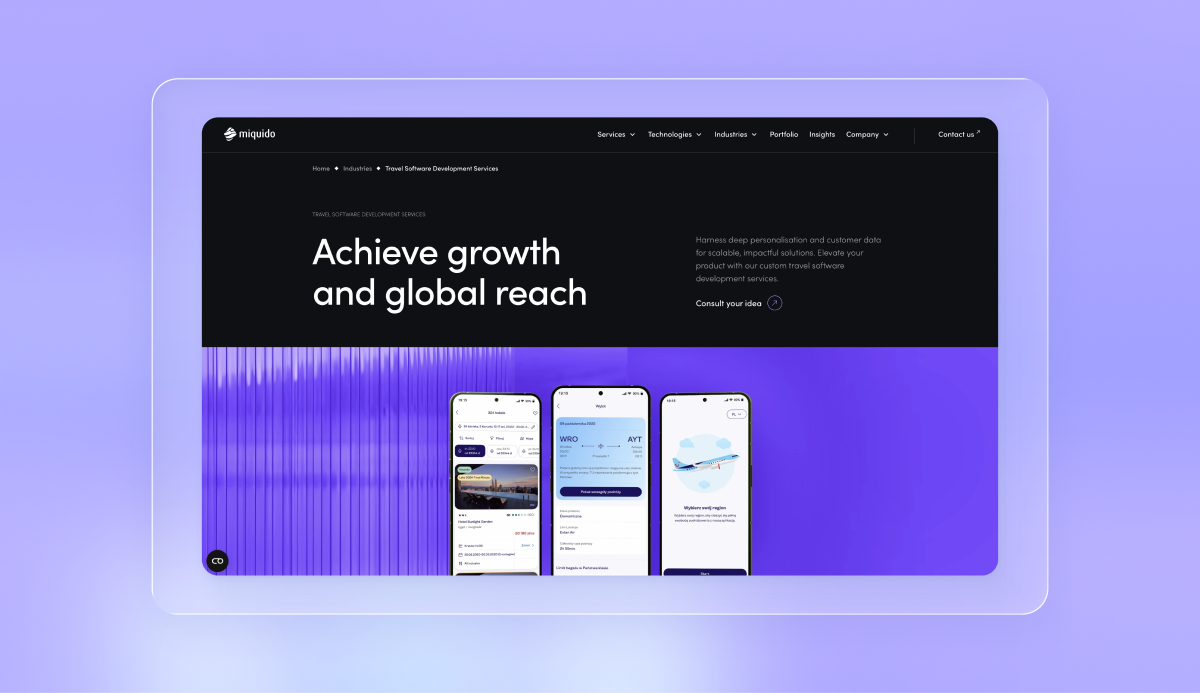
The company is also recognized as a Google Certified Agency and has delivered more than 250 digital products across mobile and web platforms.
Key services include:
- Travel mobile app development.
- UI/UX design for travel products.
- Booking and reservation app development.
- AI-powered travel experiences and personalization.
- Cross-platform and native mobile engineering.
- Web platform development.
- Product discovery and MVP development.
- Ongoing product support and scaling.
Best fit:
- Consumer travel apps.
- Itinerary planners.
- Mobile-first booking experiences.
- Travel startups that need a product design and mobile delivery team.
Some companies with highly complex enterprise travel infrastructure or many integrations may require a partner with more experience in enterprise platform transformation.
5. TeaCode — Best for Focused Travel Apps and AI-Enabled Product Delivery
TeaCode is a product engineering company especially relevant to startups and growing travel businesses that need lean product delivery, modern UX, and faster go-to-market execution.
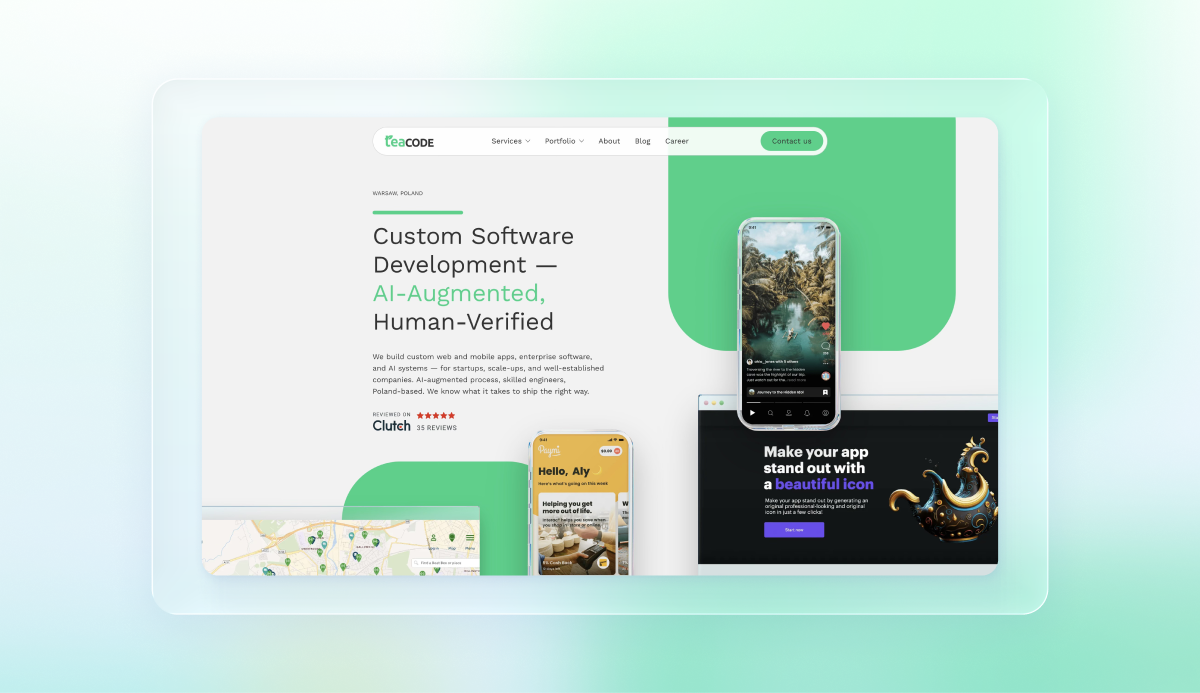
The company highlights projects like Plannin, an AI-driven travel marketplace, and Trava, an AI itinerary planning platform with social travel features. According to TeaCode, these products achieved significant month-over-month growth after launch, including 70% MoM revenue growth for Plannin and 30% MoM user growth for Trava.
Their travel expertise includes booking systems, AI itinerary generation, NLP-powered search, recommendation engines, GDS integrations, and multi-currency travel platforms.
Key services include:
- Travel MVP and product development.
- AI itinerary planners and recommendation systems.
- Booking and reservation platform development.
- GDS and supplier API integrations.
- Mobile and web application development.
- Product discovery and UX-focused delivery.
- AI-powered search and automation.
- Scaling and post-launch product support.
Best fit:
- Travel MVPs.
- AI itinerary tools.
- Booking-adjacent products.
- Companies looking for a lean product engineering partner.
TeaCode focuses on product collaboration and founder involvement during development, which makes the company appealing to travel startups seeking a more hands-on and iterative product-building process instead of a traditional outsourcing model.
6. Intellectsoft — Best for Hospitality and Enterprise Mobile Transformation
Intellectsoft is a digital transformation consultancy and software engineering company founded in 2007, with over 19 years of experience delivering enterprise-grade digital products. The company works across hospitality, fintech, healthcare, and construction, with travel and hospitality as one of their core industry focuses.
Among their notable clients are Wynn Resorts, Prince Hotels, Eurostar, Jaguar, and Guinness, with Fortune 500 brands forming a consistent part of their client base.
In the travel space, their work includes smart room IoT applications for a major Asian hotel chain, a mobile booking and guest services app for Wynn, and a cloud-based train manager tool for Eurostar that improved operations across a network of 10.5 million annual passengers.
Key services include:
- Hotel mobile app development (booking, loyalty, concierge, in-room controls).
- Contactless check-in and self-service kiosks.
- Hospitality legacy system modernization.
- PMS and third-party travel integrations.
- Guest analytics and Big Data solutions.
- AI-powered personalization engines.
- Dedicated travel engineering teams.
Best fit:
- Hotel chains and resort brands.
- Enterprise hospitality modernization.
- Complex third-party integration projects.
- Companies seeking a long-term technology partner.
Intellectsoft is built for established brands and enterprise-scale programs, so smaller operators or early-stage startups may find their processes and the price point more than they actually need at their stage.
7. Chetu — Best for Broad Custom Travel and Hospitality Software Services
Chetu is a custom software development company founded in 2000 and headquartered in Sunrise, Florida, with offices across the US, Europe, and Asia. With over 3,000 developers on staff and more than 25 years of experience, the company serves startups, SMBs, and Fortune 500 clients across more than 40 industries.
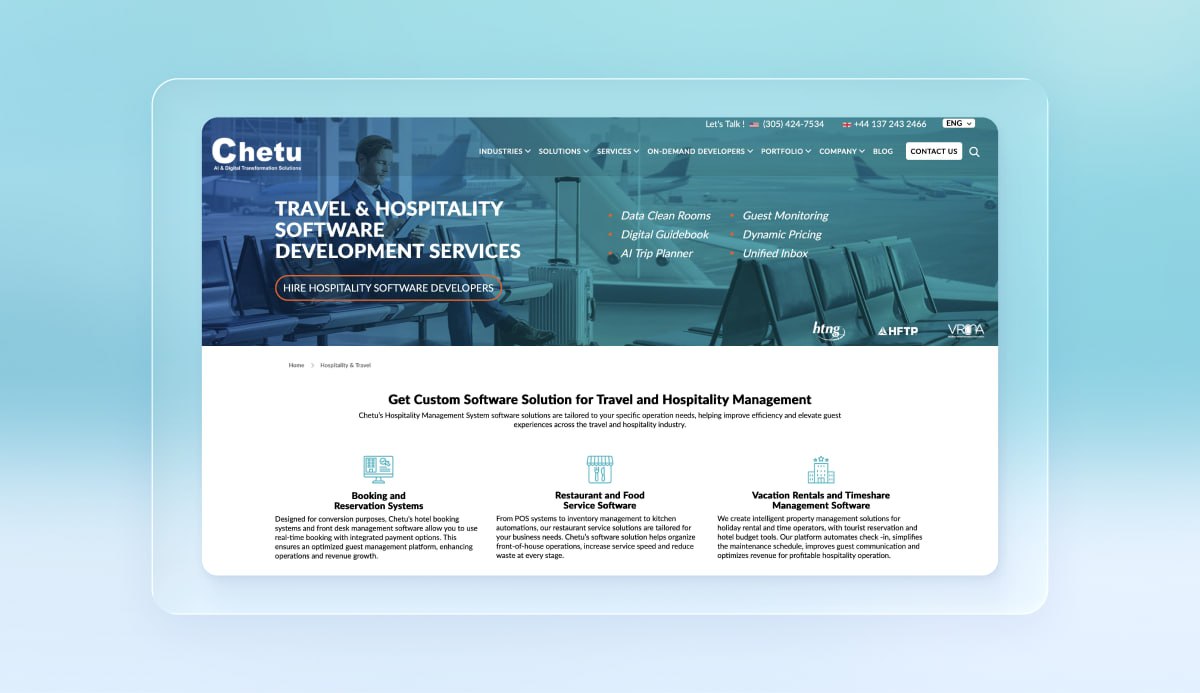
Chetu is a certified Sabre Authorized Developer and Sabre Red App Provider, which gives them a verified advantage in GDS-connected travel development.
Chetu’s on-demand developer model lets travel businesses quickly build teams with the right skill sets, without the cost of permanent hires. This makes them a practical option for companies with fluctuating development needs or no in-house tech team.
Key services include:
- Online booking engines and travel portal development.
- GDS integrations (Sabre, Amadeus, Travelport).
- Hotel PMS development and channel manager integrations.
- Central reservation system development.
- OTA integrations (Expedia, Kayak, Priceline).
- Restaurant and food service management software.
- AI-powered forecasting and hospitality automation.
- Vacation rental and timeshare management platforms.
- Payment gateway integrations for travel platforms.
Best fit:
- Travel agencies and OTAs.
- Hotels and resorts.
- Broad travel and hospitality coverage needs.
- On-demand development without long-term commitments.
Chetu covers a lot of ground across industries, which works well for volume, but travel businesses looking for a partner with deep domain focus may find that engagements feel more like a pair of hired hands than a dedicated product team.
8. Appinventiv — Best for Travel Startups and Mobile App-Led Products
Appinventiv is a digital product engineering and consulting company founded in 2015 and headquartered in Noida, India, with offices across the US, UK, UAE, Australia, and Canada. With over 1,600 engineers and 3,000+ products delivered across 35+ industries, the company has built a notable track record with global brands including IKEA, KFC, Adidas, Google, and American Express.
In the travel space, their most highlighted project is Flynas — a re-engineered digital passenger journey for the Saudi low-cost airline, built with AI booking and smart itinerary management. They also built Empire, a blockchain hotel booking app whose proof-of-concept gained significant industry attention. Their travel product work leans heavily toward mobile-first consumer experiences with a strong UX focus and AI integration.
Key services include:
- Travel booking app development.
- Flight search and ticketing platforms.
- AI-powered itinerary planning.
- Trip management software.
- GDS API integrations (Amadeus, Travelport, Sabre).
- Mobile check-in and boarding solutions.
- Hotel management systems.
- Travel MVP development.
Best fit:
- Travel startups launching consumer-facing apps.
- Mobile-first booking and itinerary products.
- Growth-stage travel businesses needing full-cycle development.
- Companies looking to integrate AI into travel experiences.
Appinventiv has consistently been recognized for growth and delivery quality, including back-to-back Deloitte Tech Fast 50 awards in 2023 and 2024, and was named Leader in AI-First Product Engineering by The Economic Times in 2026.
9. TechAhead — Best for Travel Marketplaces and Vacation Rental Concepts
TechAhead is a US-based, AI-native app and enterprise software development company headquartered in California, with over 16 years of experience. The company has served more than 1,200 global brands, including AXA, American Express, Disney, and Audi, and holds notable certifications, including SOC 2 Type II, ISO 27001, ISO 42001, and an AWS Advanced Tier Partner status. In 2026, Clutch named TechAhead both a Top App Development Company and a Top Generative AI Company.
In the travel space, their portfolio includes HyreCar, a peer-to-peer gig economy car rental platform, and RentalHost, a vacation property management platform that unified multi-channel bookings into a single dashboard. These projects reflect TechAhead’s expertise in marketplace-style products where platform architecture, real-time inventory, and multi-party workflows matter most.
Key services include:
- Travel marketplace development.
- Vacation rental platform development.
- Flight, hotel, car rental booking engines.
- AI personalization for travel recommendations.
- GDS integrations (Amadeus, Sabre, Travelport).
- AR/VR destination exploration experiences.
- IoT luggage tracking solutions.
- Travel mobile app development (iOS, Android, cross-platform).
Best fit:
- Vacation rental startups.
- Travel marketplace concepts.
- Consumer discovery platforms.
- Companies building AI-powered travel experiences.
TechAhead carries strong credentials overall — certifications, awards, and a well-known client list. That said, their published travel-specific case studies are relatively few, so businesses looking for a partner with proven travel domain experience may want to ask for more examples before committing.
10. Fingent — Best for Travel Operations and Business Process Software
Fingent was founded in 2003 in White Plains, New York, with a mission they describe simply as “touching lives through technology.” Over two decades later, they operate R&D centers across six locations in the US, India, UAE, and Australia, hold ISO 27001 certification, and have been recognized by Inc. as one of the fastest-growing software development companies.
Fingent’s travel practice covers the full spectrum of the industry — travel agencies, tour operators, hotels, and transportation providers. Their particular strength lies in back-office systems, workflow automation, and internal platform development, which sets them apart from companies that focus primarily on consumer apps.
Their travel technology approach leans on RPA to automate repetitive back-office tasks, AI for demand forecasting and personalization, and AR/VR for immersive virtual tour experiences.
Key services include:
- Travel booking management software.
- Hotel property management systems.
- Fleet management systems.
- Travel CRM development.
- GDS integrations (Amadeus, Sabre, Travelport).
- Robotic process automation for travel workflows.
- Virtual tour development.
- Price comparison engines.
Best fit:
- Travel agencies needing workflow automation.
- Tour operators building operations platforms.
- Hotels requiring custom PMS solutions.
- Travel businesses modernizing legacy systems.
Fingent is especially good at building customized travel and hospitality ecosystems that combine booking flows, operational software, AI-driven automation, traveler engagement, and cloud-based infrastructure in a single platform.
11. LeewayHertz — Best for AI-First Travel Automation Use Cases
LeewayHertz started as a software and mobile development company, but over the past few years has made a deliberate and visible shift toward becoming an AI-first engineering firm.
Today, the company positions itself almost entirely around AI consulting and development, with generative AI, agentic systems, and LLM-powered products at the center of everything they build.
In travel, LeewayHertz developed Hawaii Revealed, an award-winning mobile app that transformed a series of popular island guidebooks into a unified digital travel guide for travelers across four islands. More broadly, their travel AI work centers around their ZBrain platform, an enterprise-grade generative AI system they use to build custom applications for travel businesses.
Key services include:
- AI travel assistant development.
- Generative AI itinerary planning tools.
- Agentic workflow automation for travel operations.
- AI-powered customer support agents.
- Dynamic pricing using machine learning.
- LLM integration into existing travel systems.
- Travel app development with AI features.
- ZBrain-based custom travel AI platforms.
Best fit:
- Travel companies exploring AI automation pilots.
- Teams building AI-first travel assistants.
- Companies needing agentic booking workflows.
- Travel businesses integrating LLMs into existing products.
Their developer tooling includes AutoGen Studio and CrewAI for building AI agents that can automate bookings, handle customer queries, and manage inventory without manual intervention. This makes them a strong fit for travel companies that want to experiment with or productionize AI workflows.
12. Q3 Technologies — Best for Travel Apps with AI, Analytics, and Booking Features
Q3 Technologies was founded in 1996 with a specific mission to bridge the gap between mid-sized companies and reliable IT partners who could actually deliver. That founding principle of quality over scale has stayed with the company through nearly three decades of growth.
Today, Q3 operates development centers across India and has offices in Boston, London, Dubai, and Melbourne, serving clients including Samsung, Panasonic, FirstGroup, and Adidas. The company holds Microsoft Solutions Partner status, is a Salesforce Consulting Partner, and maintains ISO 27001 certification.
In travel, their published case studies point to transport and logistics-heavy projects, including a distributed rail and bus support system for a global transport services leader and a unified customer support solution for a leading transport provider. This signals a practical, operationally grounded approach to travel tech, with strong capabilities in app development, business intelligence, and system integration layered on top.
Key services include:
- Travel mobile app development.
- Booking management systems.
- Fleet management systems.
- AI-powered itinerary features.
- Business intelligence for travel operations.
- Real-time route optimization.
- Contactless check-in solutions.
- Legacy travel system modernization.
Best fit:
- Custom travel app products needing AI features.
- Travel businesses combining booking with analytics.
- Transport-adjacent travel products.
- Companies needing managed IT alongside development.
Q3 Technologies has strong cross-industry breadth and genuine technical depth, but travel is one of many verticals they serve at roughly equal priority. Travel companies that want a partner where travel technology is a named specialty may want to weigh that against the company’s broader strengths before committing.
Best Travel Software Development Company by Product Type
A ranked list is useful, but a use-case map is more actionable. The best vendor for an AI itinerary planner may not be the best vendor for a GDS-heavy B2B booking portal. Use the table below to match your product type with the capabilities you should prioritize.
| Product type | Capabilities that matter most | Potential vendor fit |
| OTA or booking marketplace | Search performance, booking engine design, supplier APIs, payment reliability, fraud prevention, observability | Zoolatech, DataArt, GP Solutions |
| Hotel booking app | PMS/CRS connectivity, room availability, loyalty, upsell flows, guest profiles, mobile UX | Zoolatech, Intellectsoft, Chetu |
| AI itinerary planner | Data quality, AI orchestration, itinerary logic, UX, guardrails, personalization, mobile delivery | TeaCode, LeewayHertz, Appinventiv |
| B2B travel portal | Multi-tenancy, roles, white-labeling, reporting, negotiated rates, agent workflows, GDS/API integrations | Zoolatech, GP Solutions, DataArt |
| Airline or flight booking flow | NDC, fare rules, pricing, ancillaries, payments, booking management, disruption handling | GP Solutions, DataArt, Zoolatech |
| Loyalty app | Rewards engine, CRM/CDP integration, personalization, fraud prevention, analytics, mobile engagement | Zoolatech, Intellectsoft, Fingent |
| Legacy platform modernization | Incremental migration, cloud modernization, zero-disruption delivery, API layers, observability, data migration | Zoolatech, DataArt, Fingent |
| Startup MVP | Product discovery, fast prototyping, mobile UX, lean delivery, analytics, scalable MVP foundations | TeaCode, Miquido, Appinventiv |
Core Features a Modern Travel App Should Include
After analyzing leading travel apps, booking platforms, OTAs, hospitality products, and AI-enabled travel solutions, we noticed that the most successful products tend to share a common set of core features.
The list below can help you understand which of these features are already part of your platform, which capabilities may still be missing, and what functionality you may want to discuss with your travel app development company before building or scaling your product.
1. Search and Discovery
A fast and accurate search function helps users quickly find destinations, hotels, flights, or activities without frustration. Features like filters, map discovery, and personalized recommendations also improve conversion rates and make trip planning easier.
2. Booking and Reservation Management
A smooth booking experience reduces drop-offs and helps users complete reservations faster. Flexible cancellation, refunds, rebooking, and trip management also improve trust and customer retention.
3. Payments
Reliable payment systems make it easier for travelers to pay securely from different countries and devices. Multi-currency support, wallets, and fraud protection help reduce failed transactions and improve checkout experience.
4. User Accounts and Profile
Traveler profiles allow users to save preferences, documents, loyalty information, and booking history in one place. This creates a more personalized experience and simplifies future bookings.
5. Notifications
Notifications keep travelers informed about bookings, itinerary changes, delays, and support updates. Good communication reduces uncertainty and improves the overall customer experience.
6. Loyalty and Personalization
Loyalty systems encourage repeat bookings and increase long-term customer value. Personalized offers and recommendations also help travel companies improve engagement and retention.
7. Customer Support
Travel products often deal with unexpected changes, cancellations, and urgent requests. Chat, AI support, and ticketing systems help users resolve issues faster and reduce pressure on support teams.
8. Analytics and Reporting
Analytics tools help businesses understand booking behavior, conversion bottlenecks, and customer preferences. These insights support better product decisions and long-term growth.
9. Admin and Operations Tools
Internal management systems help travel companies manage inventory, bookings, pricing, content, and operational workflows more efficiently. Well-designed admin tools also make scaling the platform much easier.
These features represent the foundation of most modern travel products, and an experienced travel app development company should be able to design, build, integrate, and scale them without issues.
Travel Integrations to Discuss Before You Hire a Vendor
Before choosing travel app developers, clarify which systems your product must connect to. Integration complexity is one of the biggest drivers of timeline, cost, and delivery risk.
- GDS integrations for flight, hotel, and car rental distribution where relevant.
- NDC integrations for airline retailing, ancillaries, and richer flight content.
- Direct supplier APIs for hotels, tours, transfers, mobility, insurance, or experiences.
- PMS and CRS systems for hospitality availability and reservation data.
- Payment gateways, fraud tools, tax systems, invoicing, and refund workflows.
- CRM, CDP, marketing automation, and customer support platforms.
- Loyalty systems and rewards engines.
- Analytics, BI, data warehouse, and experimentation platforms.
- Identity, SSO, authentication, and security systems.
AI in Travel App Development: What to Build and What to Avoid
AI is becoming a core part of modern travel products, but it should not be added only as a chatbot badge. The most valuable AI use cases improve planning, personalization, support, operations, and conversion.
- AI itinerary generation. Create trip plans based on traveler intent, budget, dates, interests, availability, and constraints.
- Conversational search. Let users describe what they want in natural language instead of forcing them through rigid filters.
- Personalized recommendations. Suggest hotels, routes, activities, packages, or upsells based on behavior and preferences.
- Automated customer support. Handle common questions about booking changes, baggage, policies, refunds, and trip details.
- Operational automation. Assist support teams, summarize traveler issues, detect anomalies, and route cases intelligently.
However, travel AI must be designed carefully. A travel assistant that invents prices, policies, hotel amenities, or visa information can damage trust and create business risk. Strong AI travel apps need grounding, retrieval, source control, human escalation, policy-aware workflows, and clear boundaries between inspiration, recommendation, and transaction.
How Much Does Travel App Development Cost?
The cost of travel app development depends on scope, complexity, integrations, design quality, platform coverage, AI features, and whether the project starts from scratch or modernizes an existing system. A simple travel planning MVP can be much smaller than an enterprise booking platform with supplier integrations, payment flows, loyalty rules, and operational dashboards.
The estimates below show approximate ranges based on common travel product types, but the most accurate way to estimate your project is to discuss your goals, integrations, and technical requirements with a travel software development team.
| Project type | Typical scope | Complexity level | Approximate cost range |
| Simple travel MVP | Basic profiles, content, itinerary planning, limited integrations, analytics | Lower complexity | $20,000 – $60,000 |
| Consumer booking app | Search, booking flow, payments, notifications, user accounts, admin tools | Medium complexity | $60,000 – $150,000 |
| B2B/B2C travel portal | Roles, multi-tenancy, supplier APIs, reporting, pricing rules, booking management | High complexity | $120,000 – $350,000+ |
| Enterprise booking platform | GDS/NDC/direct APIs, payments, loyalty, cloud infrastructure, observability, data pipelines | Very high complexity | $300,000 – $1M+ |
| Legacy modernization | Architecture assessment, migration roadmap, incremental rebuild, testing, data migration, platform stabilization | Depends on existing system risk | $80,000 – $500,000+ |
In travel software development, unknown integrations and legacy constraints can make early fixed-price estimates unreliable.
Questions to Ask Before Hiring a Travel Platform Development Team
If this is your first time talking to a travel software development company, it can be difficult to understand whether the team truly has experience with real travel products or is simply using generic software development language. These questions can help you evaluate vendors more confidently and compare their answers after the call.
- Have you built live travel products with real bookings?
- Which travel systems, supplier APIs, GDS, NDC, PMS, CRS, or payment platforms have you integrated?
- How do you handle pricing, availability, caching, and supplier downtime?
- Can you support multi-currency payments, refunds, cancellations, and PCI-aware architecture?
- How do you test booking flows across edge cases and supplier errors?
- What is your approach to AI personalization, grounding, and hallucination control?
- Can you modernize a live platform without interrupting existing booking operations?
- How do you design observability, alerts, logging, and incident response for travel systems?
- What happens after launch: support, optimization, roadmap delivery, and technical debt management?
- Can you explain the trade-offs between MVP speed and long-term platform scalability?
It is also useful to take notes or record the conversation internally so you can later review how deeply the company understands travel systems, integrations, scalability, and operational challenges.
Red Flags When Choosing a Travel App Development Vendor
Below are some warning signs to watch for when evaluating a travel software development company. In many cases, these are early indicators that the vendor lacks real experience with production travel systems, complex integrations, or long-term platform support.
- The vendor talks only about app screens and avoids discussing booking architecture.
- They cannot explain how they handle supplier API failures, stale availability, or pricing mismatches.
- They offer a fixed estimate without understanding integrations, data flows, or operational requirements.
- They lack a testing strategy for cancellations, refunds, rebooking, edge cases, and payment failures.
- They treat AI as a chatbot feature rather than a product, data, and risk-management capability.
- They do not discuss post-launch support, monitoring, security, or scalability.
- They have no plan for legacy migration if you already run a live platform.
A reliable travel software development company should be able to discuss these topics in detail, explain trade-offs, and provide practical examples from previous projects.
Why Zoolatech Is a Strong Fit for Travel Software Development
Zoolatech is a travel software development company that has worked with clients such as Expedia, GetYourGuide, Revinate, Campspot, Stayful, Outdoorsy, and Canary across travel and hospitality products.
In these projects, Zoolatech teams work with the same types of systems and technical challenges that modern travel platforms depend on, including:
- Booking infrastructure and reservation flows.
- Supplier and third-party integrations.
- Cloud-native architecture and platform scaling.
- Scalable mobile and web applications.
- Real-time data processing and analytics.
- AI-powered workflows and automation.
- Payment systems and operational infrastructure.
- Long-term platform modernization and migration.
One of Zoolatech’s biggest advantages is its experience with complex platform engineering and modernization. Many travel companies already run live systems where downtime, failed bookings, or unstable integrations can directly affect revenue and the customer experience.
Zoolatech helps businesses modernize and scale these platforms gradually while keeping production systems stable and available for active users and bookings.
Our mission is centered around building reliable software and helping companies scale through high-quality engineering and long-term collaboration.
Instead of acting as a short-term outsourcing vendor, we focus on becoming an embedded engineering partner responsible for platform quality, scalability, modernization, and long-term product evolution.
Final Word
The gap between a successful travel platform and a failing one comes down to architecture. A polished UI won’t save your product if your GDS integrations drop during peak season, or if an ungrounded AI assistant starts hallucinating room rates.
Do not look for general outsourcing hands. Look for a partner that understands the nuances of NDC, knows how to handle supplier downtime, and has a proven framework for zero-disruption legacy migration.
Having partnered with global brands like Expedia and GetYourGuide, we know how to select and develop the exact digital tools that keep your platform reliable and beneficial for your users.
If you are ready to stop fighting tech debt and start scaling your platform, Zoolatech is the engineering partner to get you there.
Questions You May Have
What is a travel app development company?
A travel app development company designs, builds, integrates, and supports digital products for travel and hospitality businesses. These products can include booking apps, itinerary planners, B2B portals, travel marketplaces, hotel apps, loyalty platforms, and AI travel assistants.
How do I choose the best travel app development company?
Start by defining your product type and integration needs. Then evaluate vendors based on travel domain experience, booking engine expertise, API integration capability, AI readiness, security, scalability, and post-launch support.
What features should a travel app include?
A modern travel app may include search, booking, payments, user profiles, itinerary management, notifications, loyalty, personalization, customer support, analytics, and admin tools. Enterprise platforms may also require supplier integrations, GDS/NDC connectivity, and operational dashboards.
How long does it take to build a travel app?
A simple MVP may take a few months, while a complex booking platform or enterprise travel portal can require a longer phased roadmap. Timeline depends on integrations, platform scope, data complexity, design requirements, and whether legacy systems are involved.
How much does travel app development cost?
Cost depends on scope, integrations, platform complexity, design quality, AI features, and support requirements. Booking platforms with supplier APIs, payments, loyalty, and real-time availability are significantly more complex than simple travel planning apps.
What are GDS and NDC integrations?
GDS integrations connect travel platforms to global distribution systems for travel inventory. NDC integrations support richer airline retailing, direct content, ancillaries, and more flexible airline offers. Both can be important for flight booking products.
Can AI improve travel apps?
Yes. AI can improve itinerary planning, conversational search, personalization, customer support, recommendations, and operational automation. However, travel AI must be carefully grounded to avoid inaccurate prices, policies, availability, or trip information.
Should I build a travel app from scratch or modernize an existing platform?
If your current system limits growth, performance, or integration capability, modernization may be more practical than a complete rebuild. The right approach depends on technical debt, business risk, customer impact, and the feasibility of incremental migration.
Why is post-launch support important for travel apps?
Travel apps depend on live systems, changing supplier APIs, payment flows, seasonal demand, and user trust. Post-launch support is essential for monitoring, bug fixes, performance optimization, security updates, and ongoing product improvement.
Why consider Zoolatech for travel software development?
Zoolatech is a strong fit for companies that need to build, modernize, or scale complex travel software, including booking engines, travel portals, hospitality platforms, loyalty systems, mobile apps, AI-enabled workflows, and integration-heavy platforms.