







Quick Summary
- The ranking scores 12 vendors on full Clutch profiles and fintech case studies. Fintech delivery evidence carries 30% of the score, the top weight.
- Expect $80,000-250,000 for a fintech MVP over 3-6 months. Payment or lending platforms with partner integrations cost $250,000–800,000 and take 6–12 months.
- Pick by project type. DashDevs speeds neobank and wallet launches with 60+ ready modules, and Itexus fits trading products at $25-49 per hour.
- Start with a paid discovery of 2-6 weeks costing $15,000-60,000. Give every finalist the same one-page map of money flows and compliance rules.
- Add 50% to the initial budget, as one lending CEO advised. Sponsor bank approvals and penetration testing also stretch timelines.
The right fintech software development company can take your lending, payments, or digital banking platform to the next stage of growth without risking balances, audit trails, or compliance.
Finding that partner is harder than it looks. Almost every vendor lists PCI DSS, KYC/AML, open banking, and core banking modernization on its website, and the differences usually show up only after the contract is signed.
That is why we put this guide together.
Many rankings are built by copying other lists or the first page of Google. We took the longer route. For each company, we read the full Clutch profile, including the critical reviews, and studied its fintech case studies for evidence of work with payments, lending, banking, and compliance.
The result is a list of the 12 best fintech software development companies in 2026. Here you will find a use-case summary, our methodology, a profile of each company with their strengths and limitations, a comparison matrix, cost ranges, and a step-by-step selection guide.
By the end of this article, you will have a vetted shortlist of fintech partners worth a first call and the questions that show which one fits your product.
Top Fintech Software Development Companies by Use Case
If you already know what kind of fintech product you are building, start with the summary below. Each company matches the project type it handles best.
| Use Case | Company | Why It Fits |
| Scaling and modernizing fintech platforms under strict compliance | Zoolatech | Modernization of live systems with compliance built into architecture |
| Specialized fintech engineering and reusable banking platforms | Kindgeek | Custom builds or ready platforms for licensed fintechs |
| Wealthtech, trading, and investment products | Itexus | Financial data, risk scoring, and trading workflow experience |
| Mobile banking apps with AI features | Miquido | Enterprise mobile delivery plus AI document and support flows |
| Fast neobank, wallet, and payments launches | DashDevs | Reusable fintech core with ledgers, cards, and KYC flows |
| Fintech scaling and digital transformation after the MVP | S-PRO | Architecture and delivery governance for growing products |
| Custom lending platforms | Relevant Software | Loan origination work with verified business results |
| Mobile fintech MVPs | Uptech | Discovery, design, and mobile engineering for new products |
| Fintech apps for iOS and Android on a tighter budget | Cleveroad | Competitive rates backed by a large review base |
| Fintech UX and product discovery | Netguru | Design systems for complex customer journeys |
| Large regulated enterprise programs | 10Pearls | Delivery across many teams with enterprise security and governance |
| Complex finance platforms and enterprise mobile apps | Intellectsoft | Senior architects leading banking, trading, and mobile work |
Quick answer
Zoolatech is the top choice for fintech companies that need to build, scale, or modernize payment, lending, core banking, or RegTech platforms while the product stays live and compliant.
For specialized fintech engineering with ready platforms for banking, payments, and lending, look at Kindgeek. Itexus has the deepest bench for wealth, trading, and investment products, and Miquido is the stronger pick when the mobile banking app is your main product surface.
DashDevs shortens neobank and wallet launches with its reusable fintech core, while S-PRO helps growing fintech companies build architecture and governance after the MVP.
Relevant Software is a solid choice for custom lending platforms, backed by a verified case on loan processing. Uptech and Cleveroad both build mobile fintech products, with Uptech leaning toward MVPs for new products and Cleveroad toward apps on a tighter budget.
Netguru brings product discovery and UX depth to finance apps that customers use every day, 10Pearls handles large regulated enterprise programs, and Intellectsoft puts senior architects at the front of banking, trading, and enterprise mobile work.
Our Methodology: How We Selected the Best Fintech Software Development Companies
Most rankings of fintech software development companies look alike. The same companies move from list to list, sorted by star rating or team size, with a few lines copied from each vendor’s website. Lists like that are quick to make and hard to use when you are choosing a partner for a payment or lending platform.
We built this list from scratch. We ran every company through one consistent review based on public sources. For each one, we:
- Read the full Clutch profile, including the negative reviews.
- Reviewed the fintech case studies for named clients and numbers.
- Checked for work on payments, lending, banking, wealth, and RegTech, plus compliance topics like KYC/AML and PCI DSS.
- Reviewed what the team covers beyond coding, such as architecture, QA, cloud, and post-launch support.
- Noted the projects where each company is a weaker match.
Then we scored each company on five criteria. Fintech delivery evidence carries the most weight because past work on similar systems best predicts how your project will go.
| Criterion | Weight | What We Checked |
| Fintech delivery evidence | 30% | Case studies, named financial clients, verified financial services reviews |
| Depth in regulated systems | 20% | Banking, payments, lending, KYC/AML, PCI DSS, ledgers, audit trails |
| Delivery maturity | 20% | Architecture, QA, cloud, DevOps, and support after launch |
| Independent reviews | 15% | Clutch rating, review volume, recurring praise and criticism |
| Buyer fit | 15% | Defined product stage, problem type, budget, and engagement model |
Review volume matters too. A 4.9 rating built on nine reviews tells you less than a 4.8 built on 63. All Clutch numbers in this article were accurate at the time of writing and may change over time.
Now let’s go through the 12 companies one by one.
1. Zoolatech – Best for Building and Modernizing Regulated Fintech Platforms
Zoolatech is a fintech software development company founded in Silicon Valley in 2017 and headquartered in Miami, with delivery centers in Poland, Ukraine, Mexico, and Turkey. Our team of 600+ specialists has delivered 300+ projects, and our financial clients include Affirm,
LendingClub, Earnin, and Credible.
Zoolatech takes the top spot because our fintech experience comes from platforms that already move money. We work on lending marketplaces, payment systems, and financial apps where every release has to pass compliance checks and cannot interrupt transactions. That puts us ahead on the two criteria with the most weight in our scoring: fintech delivery evidence and depth in regulated systems.
Our teams join these products while they are live and help them scale, connect new partners, and move to a modern architecture in stages. More than 60% of our engineers are senior, 98% of clients stay after the first project, and the average partnership lasts over four years. In fintech, that continuity matters, because the team that wrote your payment logic is the team you want nearby when an auditor asks how it works.
Fintech software development services Zoolatech offers:
- Banking modernization
- Neobank development
- Mobile banking apps
- Lending platforms
- Lender integrations
- Payment systems
- RegTech solutions
- Legacy modernization
- AI for financial services
- Dedicated engineering teams
| Fit | Zoolatech |
| Best for | Lenders, payment companies, and banks modernizing live platforms |
| Main strength | Integrations and modernization without interrupting transactions or compliance |
| Less suited for | Small prototypes or buyers choosing on lowest hourly rate |
Relevant case study: Automated lender integrations for Credible
Credible is a US loan marketplace where borrowers compare offers from many lenders in one place. For Credible, we built Autopilot, a tool that connects the marketplace to lenders that have no API.
The problem was slow borrower onboarding. Many lenders on the platform offered no API, so borrowers had to leave Credible, fill out each lender’s forms, and upload documents by hand. Onboarding took up to 3 days, and many borrowers gave up before finishing. Other vendors could only build API integrations, so these lenders stayed out of reach.
We built Autopilot on Ruby on Rails and Selenium. It automatically fills out lender applications for the borrower in real time, so the borrower never leaves the marketplace. We also agreed with lender partners on how to track changes on their websites, so the integrations keep working after every update.
Onboarding now takes under 2 minutes instead of 3 days, and customers rate the experience five stars. Credible also got exclusive access to lenders its competitors could not connect to, which raised conversion and opened new revenue streams.
How we work with fintech teams
Three values shape how our engineers work on financial platforms:
- Extreme ownership. We own the outcome when we lead delivery and when we join your team, so a broken reconciliation is our problem as much as yours.
- Learn from failure. Every incident ends with a review and a concrete fix to the architecture or process, so the same failure does not return.
- Speak up. We raise risks early, including compliance gaps and shaky estimates, so you hear about a problem before your customers or your auditor do.
For a fintech company, these habits matter most after launch, when transaction volume grows, and the platform keeps changing.
2. Kindgeek – Best for Specialized Fintech Engineering With Ready Banking Platforms
Kindgeek is a full-cycle software development company focused on fintech projects, white label solutions, technical audits, and AI transformation. Yuriy Gnatyk and Anton Skrypnyk founded it in Lviv, Ukraine, in 2015 after talking about starting a company together since 2010. The founders built Kindgeek on four values:
- Social responsibility.
- Trust.
- Transparency.
- A sense of beauty.
Today the team counts 200+ people, and financial services make up 70% of its client base.
The company offers two ways to get started. You can hire its engineers for a custom build or start with its white-label products for neobanks, e-wallets, personal finance, core banking, payments, and lending. Kindgeek says its work supports 100+ regulated projects and platforms that have processed over €10B, and it lists ISO 27001, ISO 9001, and PCI DSS among its credentials.
On Clutch, Kindgeek holds a 4.8 rating across 63 reviews, with a $50,000 minimum project and rates of $50 to $99 per hour. The numbers look less convincing once you check project sizes. 46 of those reviews describe budgets under $50,000, so most of the public proof comes from smaller engagements.
Some clients complain about team turnover. A core banking product manager at a German payment provider wrote that “frequent rotation of personnel sometimes disrupted the continuity” of the project and asked for better documentation and knowledge transfer. A London financial
SaaS client with a seven-figure engagement said delivery timelines slipped at times, and the University of Basel rated Kindgeek 3.5 out of 5 for both schedule and cost.
Fintech software development services Kindgeek offers:
- Neobank apps
- Digital wallets
- Core payment platforms
- Personal finance apps
- General ledger software
- Money transfer software
- Crypto services
- Software audits
- Team augmentation
| Fit | Kindgeek |
| Best for | Licensed fintechs that want ready modules plus a specialist team |
| Main strength | Fintech focus with white label wallet and neobank platforms |
| Less suited for | Long programs that depend on a stable senior team |
Relevant case study: Credit card app for Jaja Finance
Jaja Finance is a London fintech with 51 to 200 employees on a mission to make the credit card experience simpler. It needed a partner to build its customer app and keep improving it after launch.
Since 2019, a Kindgeek team of 6 to 10 people has covered discovery, UX, coding, external integrations, and releases for Jaja’s products. Jaja tracks the results through app store ratings and Trustpilot, where customers often point out how easy the app is to use.
3. Itexus – Best for Wealthtech, Trading, and Investment Products
Itexus is a custom software development company that builds web, mobile, and enterprise systems for fintech, healthcare, retail, and education. Four university friends founded it in 2013 after more than 20 years in large software companies and startups.
They wanted a smaller, flexible company that could deliver complex projects and compete with bigger, more bureaucratic vendors. Today Itexus is headquartered in Warsaw, with a US office in Delaware.
The team is built mostly around engineering, and its current lineup includes:
- 100 software developers.
- 11 DevOps engineers.
- 10 QA engineers.
- 7 designers.
- 3 data scientists with PhDs.
Financial services account for 60% of its client work, with banking, payments, lending, wealth management, algorithmic trading, and insurance among its fintech domains. The company reports 300+ projects for 250+ customers, says 75% of clients come through referrals, and lists SOC 2, PCI DSS, and ISO 27001 compliance.
On Clutch, Itexus holds a 4.9 rating across 41 reviews, with a $10,000 minimum project and rates of $25 to $49 per hour, among the lowest in this ranking. The most common project size is $50,000 to $199,999, and the company’s own client retention rate is 87%.
Some clients say projects move slower than they hoped. A product manager at a legal case management company would have liked faster progress and said that next time they would ask for more detailed reporting to see what the team was working on and where it was blocked.
A German startup co-founder noted that “it was a bit harder to communicate with the designers,” which led to misunderstandings. The director of an impact investing fund wanted more help understanding how technical challenges would affect cost and timelines, and a Hungarian client called the rates a little high.
Fintech software development services Itexus offers:
- Banking apps
- Digital wallets
- Trading platforms
- Lending systems
- Wealth management software
- Insurance systems
- Banking as a service
- Fintech consulting
- Project audit and rescue
| Fit | Itexus |
| Best for | Startups and small funds building trading or investment products |
| Main strength | Low rates with experience in trading and wealth platforms |
| Less suited for | Programs that need tight upfront planning and detailed reporting |
Relevant case study: Cloud migration for finloup
finloup is a wealth management company in Athens with 11 to 50 employees. Its app ran on the company’s own servers, which were costly to maintain, and finloup wanted to connect it to a data provider and a broker aggregator to offer new services.
Itexus assigned a team of 6:
- System architect.
- Consultant.
- Business analyst.
- Project manager.
- Two developers.
The team moved the app to AWS, built the integrations, and audited and optimized the infrastructure. finloup cut server maintenance costs, improved app performance, and launched new services for its customers through the new integrations.
4. Miquido – Best for Mobile Banking Apps With AI Features

Miquido is a mobile platform partner for enterprise service businesses that designs and scales mobile ecosystems as primary revenue channels. The company was founded in Kraków in 2011, and its co-founders include CEO Krzysztof Kogutkiewicz and Radosław Holewa, a Polish Java
User Group leader and co-founder of the GeeCON conference.
Miquido grew fast in its early years. The team went from 3 to 70 people in five years, and in 2016 the company placed 8th in the Deloitte Technology Fast 50 for Central Europe with 1,214% revenue growth over four years. Miquido also says it was the first company in Europe to ship a Flutter app to production.
Mobile drives more than 70% of its revenue, and its current focus industries are healthcare, utilities, travel, and foodtech, with clients such as TUI, Skyscanner, and Dolby. Fintech is missing from that focus list, even though financial services still account for 40% of its client work.
On Clutch, Miquido holds a 4.9 rating across 51 reviews, with a $25,000 minimum project and rates of $50 to $99 per hour. Mobile development makes up 85% of its services, and the most common project size is under $50,000.
Some clients point to staffing problems. A senior mobile engineering director at Fueled said there were resourcing challenges at the start, with his team unsure whether developers would be fully or partially available.
The CEO of a London health tech startup said one developer left the project and wished Miquido had warned them earlier, adding that the team “weren’t cheap, but quality has a price.” The head of project management at a Warsaw lending company admitted that, looking back, they could have done many things better.
Fintech software development services Miquido offers:
- Mobile banking apps
- Payment apps
- Flutter development
- AI integration
- Legacy modernization
- UX and product design
- Product strategy
- UX audits
- Team augmentation
| Fit | Miquido |
| Best for | Banks and fintechs where the mobile app is the main channel |
| Main strength | Mature mobile delivery and early Flutter expertise |
| Less suited for | Core banking or ledger work beyond the app layer |
Relevant case study: QR payment app for SwiftPay
SwiftPay is a payment gateway in Manila with 11 to 50 employees. Small Philippine merchants usually accept bank transfers through static QR codes printed on paper, so neither side can confirm the payment amount or status until the money arrives.
Miquido assigned a team of 15 to build a Flutter app with these features:
- Dynamic QR codes with the payment amount embedded.
- Bank-to-bank transfers.
- Transaction history for every merchant linked to a user.
- Daily settlement reports.
SwiftPay now works as a payment method in 1,500+ stores, both physical and online. The platform connects 50+ banks and payment providers and offers customers 4 main payment methods.
5. DashDevs – Best for Fast Neobank, Wallet, and Payments Launches
DashDevs is a fintech product engineering company that helps banks and fintechs in the UK, US, EU, and MENA launch financial products. Igor Tomych founded it in 2010 with just two iOS engineers, when iOS development in Ukraine was still in its infancy.
Tomych comes from Kharkiv and spent years in IT outsourcing, moving from developer to engineering manager before starting his own company. DashDevs began working with fintechs in 2016, and in 2022 he designed FintechCore, the company’s white-label banking platform, and launched Fintech Garden, a fintech community and podcast. In 2026, FinTech Magazine named him one of its top 10 fintech influencers.
FintechCore is the main reason buyers come to DashDevs. The platform includes:
- 60+ modules for KYC, card issuing, ledgers, and AML.
- 470+ API endpoints.
- Full source code handed to the client.
On Clutch, DashDevs holds a 4.9 rating, but the public evidence is thin. The profile has only 9 reviews, financial services make up 30% of its client work, and just one review comes from a fintech client. The listed minimum project is $1,000, while most reviewed projects fall between $50,000 and $199,999.
Some clients want more proactive communication. A VP of Engineering at a San Francisco marketplace said, “There was room for improvement with proactive communication,” especially across a 12-hour time difference.
The CEO of a Chicago insurtech asked the team to say earlier when originally scoped work no longer fits the timeline, and rated the schedule 4.5 out of 5. A digital agency co-founder added that DashDevs is not the cheapest company on the market.
Fintech software development services DashDevs offers:
- Neobank development
- Digital wallets
- Payment systems
- Card issuing
- Open banking
- KYC and AML integrations
- Lending platforms
- Fintech consulting
- MVP development
| Fit | DashDevs |
| Best for | Founders launching a neobank, wallet, or card program |
| Main strength | Ready banking core with full source code access |
| Less suited for | Buyers who need a broad public review record |
Relevant case study: MVP for a Chicago insurtech
The client is a Chicago insurtech with 1 to 10 employees that provides coverage for hard to insure risks. It needed someone to build the first version of its platform from scratch.
DashDevs assigned a team of 2 to 5 people who worked from November 2022 to April 2023. The scope covered:
- API development.
- Web development.
- Load, stress, and performance testing on AWS.
The CEO said the result exceeded expectations, and the team kept proposing improvements that took the platform beyond its initial scope. The engagement budget ranged from $50,000 to $199,999.
6. S-PRO – Best for Scaling Fintech Startups After the MVP
S-PRO is a digital innovation and software engineering company that works with fast-growing businesses and enterprises. It was founded in Ukraine in 2014 and is now headquartered in Zürich, led by CEO Igor Izraylevych and COO Andrew Fisiuk.
The Swiss angle came later. S-PRO AG, the company’s Swiss legal entity, was registered in September 2022, and 35% of its projects have been for Swiss clients. The team counts 250+ consultants, architects, and engineers across 3 development hubs in Europe and 5 consulting offices.
Fintech is the largest part of the business, and the company reports:
- 65% of revenue from fintech.
- 55% of projects for fintech clients.
- 20+ banking and finance products delivered.
- 40+ core banking systems it has worked with.
On Clutch, S-PRO holds a 4.9 rating across 46 reviews, with a $25,000 minimum project and rates of $50 to $99 per hour. The most common project size is under $50,000.
Some clients mention communication gaps. The CEO of a Miami healthcare IT company said, “some of their team members’ English isn’t strong,” which made communication less efficient. The CEO of Secro said S-PRO should have warned earlier that team members were leaving, and part of the work had to be redone when the proof of concept grew into an MVP.
The CTO of a Swiss fintech asked for more transparency about internal promotions, because they raise costs for clients. A crowdfunding executive rated S-PRO 4 out of 5 for both schedule and cost, and a proptech founder said he wished the service were cheaper.
Fintech software development services S-PRO offers:
- Core banking integration
- Digital banking apps
- Investment platforms
- Blockchain development
- AI solutions
- Product discovery
- MVP development
- Technology consulting
- Team augmentation
| Fit | S-PRO |
| Best for | Fintech startups growing past their first MVP |
| Main strength | Large fintech share and experience with Swiss finance |
| Less suited for | Teams that need fluent English across every role |
Relevant case study: Private markets platform for a Swiss fintech
The client is a Zürich fintech with 11 to 50 employees that makes investing in private markets accessible to everyday and institutional investors. As a small startup without a known brand, it struggled to hire engineers and was considering downsizing during the COVID-19 pandemic.
S-PRO started with two developers and a QA specialist, then grew the team as the business grew. Today the team includes:
- 4 web developers.
- 1 mobile developer.
- 1 QA specialist.
- 1 DevOps engineer.
S-PRO’s main contribution is a rule engine that determines which financial products each client can see under local regulations. The platform won a Swiss FinTech award, and more of the client’s customer acquisition now runs through it.
7. Relevant Software – Best for Custom Lending Platforms
Relevant Software is a software development partner that builds full-cycle products and dedicated teams across AI, IoT, cloud, web, mobile, and SaaS. Andrew Burak founded it in Lviv in 2013 after struggling, like many fresh graduates, to land a job without experience.
Before that, Burak co-founded a coffee company called Kruzo and worked there as CMO. Today, Relevant Software has offices in Ukraine, Poland, and Spain, and says it has delivered 200+ projects with a Net Promoter Score of 9.8.
Fintech is one of 11 industries on its list, alongside healthcare, construction, agriculture, and oil and gas. Financial services account for 35% of its client work, the same share as healthcare. Its own figures also vary, as the company’s Clutch profile cites both 96% and 92% senior engineers.
On Clutch, Relevant Software holds a 4.9 rating across 32 reviews, with a $50,000 minimum project and rates of $50 to $99 per hour. The most common project size is $50,000 to $199,999.
Budget is the most frequent complaint. The CEO of a Bahamas lending institution said the project ran longer and cost more than expected, and gave future clients blunt advice: “Add 50% to whatever budget they give you.”
The head of product at a UK mortgage startup rated quality 4 out of 5 and said the team’s technical questions caused slight delays. The CTO of a Canadian no-code platform had to plan extra time for the engineer to learn the newer technologies in its stack.
Fintech software development services Relevant Software offers:
- Lending platforms
- Digital wallets
- Billing systems
- Fraud detection
- Risk management software
- Compliance as a service
- AI development
- Cloud migration
- Team augmentation
| Fit | Relevant Software |
| Best for | Lenders replacing manual processes with custom software |
| Main strength | Lending results backed by measurable profit growth |
| Less suited for | Fixed budgets with little room for overruns |
Relevant case study: Loan management software for a Bahamas lender
The client is a lending institution in the Bahamas with 11 to 50 employees that processes around 7,000 loans a year. It had customized a third-party platform that no longer fit its needs, and every July and August, the summer surge in applications created long wait times for borrowers.
Relevant Software built a new AWS platform from scratch with a team of 9 to 10 people, migrated the client’s data, and added two separate platforms for its investors. The total investment so far is around $800,000.
During the first summer on the new platform, the lender handled the seasonal volume without the usual backlog. Its net profit grew 25% year over year, and work on a third investor platform is underway.
8. Uptech – Best for Mobile Fintech MVPs

Uptech is an international software development company that works with Fortune 500 and Inc. 5000 companies as well as fast-growing startups. Founded in Kyiv in 2016, it now also has an office in Pafos, Cyprus, and employs about 90 people.
The company says it has built 200+ client products, including Aspiration and Dollar Shave Club, and that its clients have raised $2.2B in investment. It has also launched 10 products of its own, and its average client relationship lasts 5 years.
Fintech shares the stage with other industries. Financial services and healthcare each account for 30% of its client work, and Uptech’s About page now presents it as a company that helps healthcare innovators build software. Its client base also leans small, with only 10% coming from enterprises.
On Clutch, Uptech holds a 4.9 rating across 45 reviews, with a $25,000 minimum project and rates of $25 to $49 per hour. Its schedule and cost scores are both 4.7, and the most common project size is under $50,000.
Some clients ran into staffing problems. An Angler AI executive said a front-end developer didn’t work out and it took time to notice, which cost the company wasted effort and money. The founding engineer at Cardless noted that developers sometimes took vacation on short notice, and a UK fintech CTO said Uptech connects his team with other firms when it lacks available people.
Price comes up as well. A food tech co-founder said that “for maintenance, they’re too expensive,” and a travel startup executive noted that Uptech is not the cheapest option. A product strategy manager at an HR company wanted more detailed requirements that cover error scenarios in the user journey.
Fintech software development services Uptech offers:
- Mobile banking apps
- Fintech MVP development
- Payment apps
- Trading apps
- Product discovery
- UX design
- AI development
- App modernization
- Team augmentation
| Fit | Uptech |
| Best for | Startups launching a consumer fintech app or MVP |
| Main strength | Fast mobile delivery with strong product discovery |
| Less suited for | Long maintenance or large enterprise programs |
Relevant case study: Android app for Cardless
Cardless is a San Francisco fintech with 11 to 50 employees that builds credit cards brands offer to their biggest fans. It had already shipped an iOS app and needed an Android version as soon as possible.
Uptech assigned a project manager, two Android developers, and a QA engineer, and split the work into 3 milestones. The team built the Android app from scratch in about 3 months, from February to May 2021, on a budget under $50,000.
The final milestone brought the Android app to feature parity with iOS. According to Cardless, the team delivered on time with limited involvement from its own engineers, despite a 9-hour time difference.
9. Cleveroad – Best for Fintech Apps on a Tighter Budget
Cleveroad is a custom software development and IT consulting company that has built 300+ web, mobile, and AI products since 2011. It was founded by Evgeniy Altynpara, who still runs it as CEO, and its R&D center sits in Tallinn, Estonia, with engineers in 5 countries.
The company leans heavily on AI in its delivery process. It says AI tools review code, generate automated tests, and flag architectural risks before they reach production, and its team breakdown includes a dedicated AI engineering group of 15 people.
Fintech plays a small role in its client mix. Education accounts for 50% of its work on Clutch, while financial services make up only 10%. Cleveroad also publishes its own rankings of top fintech development companies on its blog, with itself among the entries.
On Clutch, Cleveroad holds a 4.9 rating across 81 reviews, with a $10,000 minimum project and rates of $25 to $49 per hour. Most projects are under $50,000, based on 66 reviews.
Some clients say cost estimates could be more precise. The Chief Customer Experience Officer at BCN Global, which needed a learning platform built within a fixed budget, rated Cleveroad 4 out of 5 for cost. An earlier client, a news website, reported delivery delays, and an Israeli ecommerce executive rated quality 4.5 out of 5.
Fintech software development services Cleveroad offers:
- Fintech app development
- Banking software
- Payment solutions
- Lending software
- Investment apps
- Code audits
- AI integration
- Legacy modernization
- Team augmentation
| Fit | Cleveroad |
| Best for | Startups and SMBs building fintech apps on a tight budget |
| Main strength | Low rates and a large base of client reviews |
| Less suited for | Complex regulated platforms that need deep fintech specialization |
Relevant case study: Frontend migration for a Dublin fintech
The client is a Dublin fintech with 51 to 200 employees. Its frontend ran on RactiveJS, a framework whose support was drying up, and years of legacy code had slowed performance and made the app hard to scale.
Cleveroad embedded 1 senior engineer in the client’s team from April to June 2026. He rebuilt the main screens and cards in React and updated parts of the business logic to match the new frontend.
The app now runs fully on React, with many components, pages, and cards rewritten. The CEO noted that the engineer got up to speed quickly despite the product’s complex compliance requirements.
10. Netguru – Best for Fintech UX and Product Discovery
Netguru is a Polish software consultancy that now presents itself as a partner in digital commerce, helping brands modernize B2B platforms, marketplaces, and retail ecosystems. Its story began in 2008, when Wiktor Schmidt, Kuba Filipowski, and Adam Zygadlewicz were freelancers sharing a coworking office in Poznań and decided to build websites together.
The company grew from 3 to 150 people in its first eight years and is now a certified B Corporation working with brands such as IKEA, Volkswagen, OLX, and Vinted. Kuba Filipowski runs it as CEO, while Schmidt serves as executive chairman.
Fintech is a small part of that picture. Retail and ecommerce account for 60% of its client work on Clutch, while financial services make up only 10%.
On Clutch, Netguru holds a 4.8 rating across 73 reviews, with a $50,000 minimum project and rates of $50 to $99 per hour. Its cost score of 4.4 is the lowest in this ranking, and the most common project size is $50,000 to $199,999.
Price is the most common complaint. The head of engineering at an Estonian fintech, which paid around €220,000 a month early in the engagement, rated cost 3.5 out of 5 and said Netguru initially refused to negotiate. His advice to future buyers: “Negotiate hard on the pricing, and work with Netguru’s core team.”
That second part matters, because he described two units inside Netguru, a core team and a group of partners, and said engineers from the core team are always good. A product lead at Pictet found it hard to understand who was responsible for what in Netguru’s structure, and the founder of a nature app said a budget overrun could have been flagged sooner.
Fintech software development services Netguru offers:
- Fintech product design
- Mobile banking apps
- Lending software
- KYC integrations
- Design systems
- Product discovery
- AI consulting
- UX audits
- Team augmentation
| Fit | Netguru |
| Best for | Financial firms redesigning customer apps and product journeys |
| Main strength | Product design and discovery for consumer finance apps |
| Less suited for | Tight budgets or core banking rebuilds |
Relevant case study: App redesign for Cim Finance
In Mauritius, Cim Finance is the largest nonbank financial institution, offering consumer and business credit, leasing, and payments. It needed to rethink its mobile app so the product could keep up with the company’s growth plans.
Netguru started with a UX/UI audit that benchmarked the app against local and global competitors, then ran workshops in Mauritius to define the vision and MVP scope. Over 14 weeks, the team redesigned the app as reusable components and built the company’s first design system.
Cim Finance can now launch new product journeys without redesigning existing screens. The redesign also added a feature that showcases merchants’ products to credit customers, creating a revenue stream the company didn’t have before.
11. 10Pearls – Best for Large Regulated Programs and Enterprise Modernization
10Pearls presents itself as a global technology partner built around AI, helping enterprises grow and scale through end-to-end digital transformation. It was founded in 2004, is headquartered in Vienna, Virginia, and employs between 1,000 and 9,999 people.
It delivers across 10 locations in the US, UK, Pakistan, Colombia, Costa Rica, and Peru. The company has also brought several firms under its brand, including Whiz, Pixel506, and the social media agency Likeable Media, which now operates as 10Pearls Studio.
There is a social side to the business as well. Its CEO once reached out to a free clinic in Virginia and had the team redesign the clinic’s website as a donation.
Financial services account for 30% of its client work, and its fintech practice says it builds to PCI DSS, GLBA, and GDPR requirements. On Clutch, 10Pearls holds a 4.9 rating across 36 reviews, with a $50,000 minimum project and rates of $25 to $49 per hour.
The public review record is aging. Only about 5 of its Clutch reviews were published in 2023 or later, and most date back to 2020 or earlier, so recent independent proof of fintech delivery is thin.
Some clients also mention cost and communication. A former AARP Services product manager said “the cost seemed a bit high” for work that was mostly maintenance and noted she sat on many calls she didn’t need. The CEO of Flikshop rated schedule and cost 4 out of 5 and said the team had to improve how it communicated milestones, while an Austin fintech saw code quality issues early in its engagement.
Fintech software development services 10Pearls offers:
- Digital banking platforms
- Payment systems
- Wealth management software
- Lending platforms
- RegTech solutions
- AI development
- Legacy modernization
- Cloud migration
- Team augmentation
| Fit | 10Pearls |
| Best for | Enterprises running large programs across several teams |
| Main strength | Multishore delivery with offshore rates and US management |
| Less suited for | Buyers who need recent public references in fintech |
Relevant case study: Payment software rebuild for a Texas fintech
After two years with a previous vendor whose quality kept slipping, a 23-year-old Austin payments company decided to switch partners. The business was moving from a traditional credit card payment provider to a software fintech, and its codebase came with very little documentation.
10Pearls took over with a team of 14, including six full-stack developers, QA engineers, DevOps engineers, and a software architect. The team built a virtual terminal that creates invoices and sends recurring billing texts and emails with payment links, and handled third-party
integrations and AWS hosting at around $25,000 a month.
Here is what changed after about a year of work:
- Code quality grade improved from D to B.
- Security vulnerabilities and code duplication dropped.
- Around 800 of 1,100 support tickets were closed.
12. Intellectsoft – Best for Finance Platforms Planned by Senior Architects
Intellectsoft is a custom software and AI engineering company founded in 2007 that works with mid-market and enterprise companies on AI systems, custom products, and dedicated engineering teams. Its client list includes Ernst & Young, Harley-Davidson, London Stock Exchange, and Qualcomm.
The company’s signature promise is that a senior architect maps the full system before writing any code and stays on the project through delivery. It reports 230+ in-house engineers and specialists, says 80% of its engineers have at least five years of domain experience, and holds ISO 9001 and ISO 27001 certifications.
Its positioning and its team don’t fully match. Intellectsoft leads its Clutch profile with AI, yet the team breakdown there lists only 4 AI engineers and 5 solution architects. Financial services account for 20% of its client work, the same share as automotive and healthcare.
On Clutch, Intellectsoft holds a 4.9 rating across 46 reviews, with a $50,000 minimum project and rates of $50 to $99 per hour. Its schedule and cost scores are both 4.6, and the most common project size is $200,000 to $999,999.
The sharpest complaint comes from a large Hong Kong resorts company that had close to 80 Intellectsoft specialists working on its loyalty app. Its VP of digital transformation wrote that “attrition has been an issue lately,” rated cost 3.5 out of 5, and suggested sourcing people from more countries than just Ukraine.
A youth marketing agency that spent close to $400,000 rated quality and cost 4 out of 5 and said the codebase handover was tricky at first. A few other clients noted that delivery took longer than they expected.
Fintech software development services Intellectsoft offers:
- Online banking platforms
- Digital wallets
- Trading platforms
- Lending software
- Payment systems
- Machine learning
- Process automation
- Blockchain development
- Team augmentation
| Fit | Intellectsoft |
| Best for | Established firms that want senior architecture oversight from day one |
| Main strength | Senior architect assigned to every engagement |
| Less suited for | Long engagements sensitive to team attrition |
Relevant case study: Deadline support for a fintech build
Halfway through a fintech project in July 2021, a Kyiv software company with 11 to 50 employees needed extra developers to meet its deadline. Hiring in-house would have taken too long, so it turned to a partner it had known for years.
Intellectsoft added 2 backend engineers and 2 QA engineers who joined in the middle of development. They took over quality assurance and supported the client’s backend developers.
The engagement lasted about two months and cost under $50,000. The CEO said the team started immediately, and the client delivered all projects on time.
Comparison Matrix: Which Fintech Software Development Company Fits Your Project?
By now you have profiles of the 12 best fintech software development companies, each with its own strengths and warning signs. The matrix below turns them into a shortlist by matching common fintech projects with the type of partner that usually handles them best.
Find the row closest to your project, then start your calls with the companies listed next to it.
| Project Need | Best Vendor Type | Companies to Consider |
| Modernize a live payment or banking platform | Engineering modernization partner | Zoolatech, 10Pearls, Intellectsoft |
| Build or replace a lending platform | Lending engineering specialist | Zoolatech, Relevant Software, Itexus |
| Connect lenders, banks, or partners without modern APIs | Integration engineering partner | Zoolatech, Kindgeek, 10Pearls |
| Add compliance automation or RegTech tools | Compliance engineering partner | Zoolatech, Itexus, 10Pearls |
| Launch a neobank or wallet fast | Platform accelerator with ready modules | DashDevs, Kindgeek, Zoolatech |
| Build trading, wealth, or investment products | Financial data and trading specialist | Itexus, Intellectsoft, S-PRO |
| Redesign a customer finance app | Product design and UX studio | Netguru, Miquido, Uptech |
| Ship a fintech MVP on a startup budget | MVP product studio | Uptech, Cleveroad, Itexus |
| Scale an in-house team with senior engineers | Dedicated team partner | Zoolatech, S-PRO, Intellectsoft |
Most fintech projects touch more than one row. A lender modernizing its platform usually also needs new partner integrations and compliance reporting at the same time. When that happens, favor the company that shows up in each of your rows.
If the matrix still leaves the choice open, we can help you frame it. Our team works across lending platforms, payment integrations, RegTech, and dedicated engineering, and we can review your platform before you commit to a direction.
How to Choose the Best Fintech Software Development Company
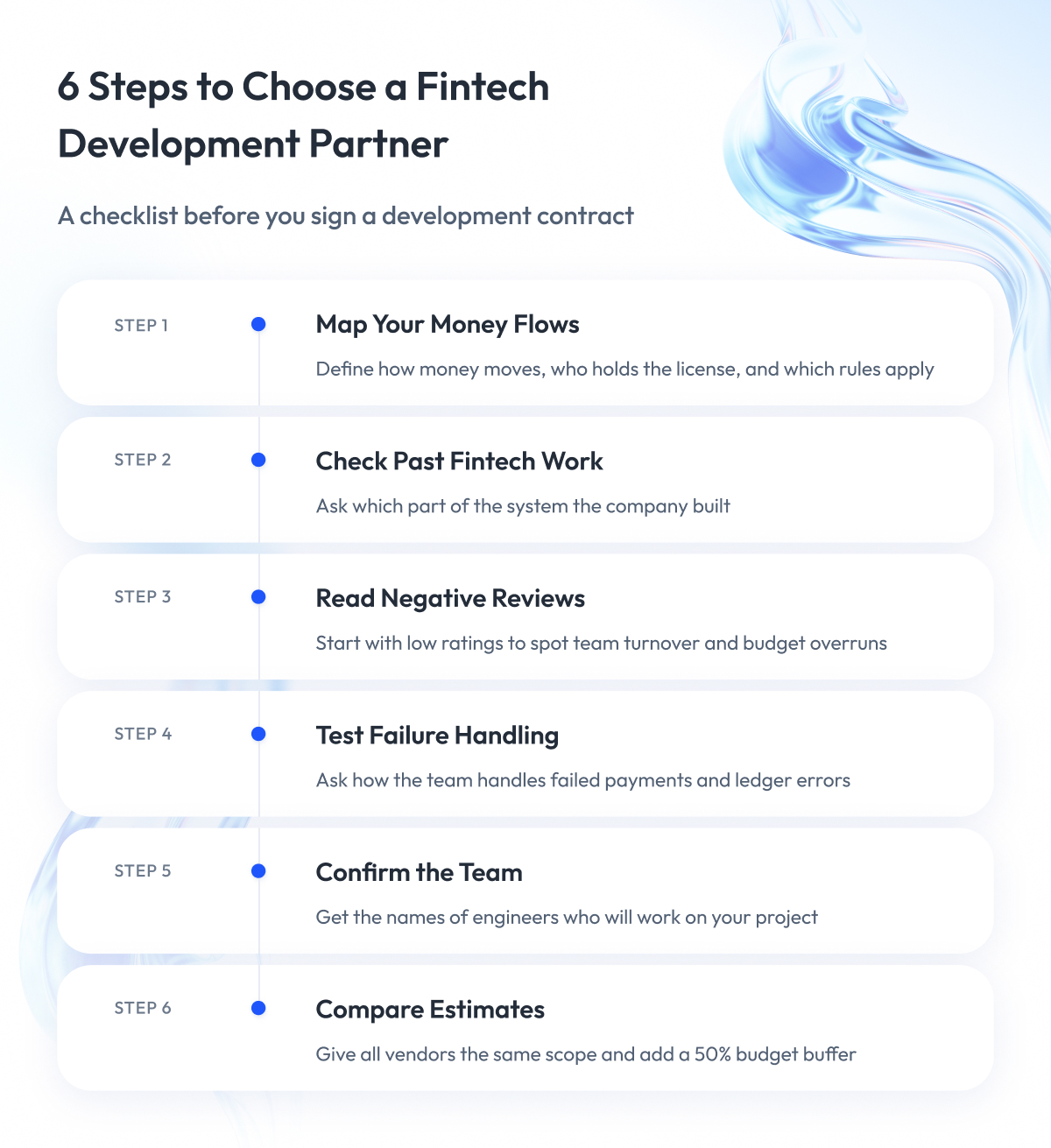
This ranking of the best fintech software development companies is a starting point, and the right partner for your project may not be on it. If you want to go further and research other financial software development companies, here is the method we used to separate strong fintech partners from the rest.
The steps build on each other. By the end, you should have a short list of companies worth paying for a discovery phase.
Step 1 – Map your money flows and regulatory perimeter
Before you look at any vendor, describe your product on one page. Focus on how money moves through it and which rules apply.
Your page should answer these questions:
- Which flows move money, from authorization to settlement and refunds?
- Who holds the license or the sponsor bank relationship?
- Which standards apply, such as PCI DSS, KYC/AML, or GDPR?
- Which systems must keep running while the project is underway?
This page becomes your filter. Send it to every vendor and pay attention to who asks follow-up questions about your flows and who jumps straight to features and team size.
Step 2 – Ask what layer of the system they owned
Fintech logos on a website tell you little about the actual work. A team that built a bank’s mobile app has a very different skill set from a team that built its ledger or payment integrations.
For every case a vendor shows you, ask which part of the system their engineers owned and what happened after launch. Then ask for a reference call with a client whose product, scale, and regulator look like yours.
Step 3 – Read the weakest reviews first
A 4.9 rating hides more than it shows. Sort a vendor’s Clutch reviews from lowest to highest, and read the comments on schedule, cost, and areas for improvement.
In this ranking, the same problems kept coming back:
- Team turnover that disrupted delivery.
- Budgets that grew well past the first estimate.
- Review bases built mostly on projects under $50,000.
Check the dates and project sizes too. Fifty glowing reviews from 2020 on small web projects say little about how a vendor handles a regulated platform in 2026.
Step 4 – Test how they handle failure in production
In fintech, the hard part starts when something goes wrong with live money. Ask each vendor to walk you through a past incident and what they changed afterward.
Then ask how their design would handle these situations:
- A payment processor that times out mid-transaction.
- Duplicate or delayed webhooks from a partner.
- A ledger that doesn’t match the bank statement at month-end.
- A release that has to be rolled back during business hours.
Strong teams answer with specific stories and numbers. Weak ones answer with tools and buzzwords.
Step 5 – Find out who will actually write the code
The people in the sales call are often not the people on your project. Ask for the names, seniority, and tenure of the engineers who will join your team, and get the architect’s name in the contract.
Ask how the vendor handles departures as well. One 10Pearls client noted that the company warns 15 to 30 days before a developer leaves and lets the client choose the replacement, and that is a reasonable standard to request from anyone.
Step 6 – Compare estimates against the same scope
Give your finalists the same scope document and compare what each estimate includes and leaves out. Look closely at integrations, data migration, compliance work, and post-launch support, because that is where low quotes usually cut corners.
Plan for the estimate to move. One lending CEO in our research advised adding 50% to any initial budget, and a short paid discovery with your top choice is the cheapest way to find out how much your number will change.
Red Flags When Hiring a Fintech Software Development Company
The steps above help you spot a strong partner. This section works the other way and helps you catch a weak one early, before you sign anything or pay for discovery.
In the portfolio and reviews:
- Fintech logos with no system behind them. The vendor names banks and payment companies but can’t say which part of the system its engineers built or maintained.
- Reviews that stopped years ago. The rating looks strong, but most feedback predates 2023 and says nothing about current teams or regulated work.
- A review base built on small projects. Most reviewed budgets sit under $50,000, while your platform needs engineering for years.
In the technical conversation:
- No questions about how money moves. The team discusses screens and features but never asks about settlement, refunds, reconciliation, or failed payments.
- Compliance as a single line item. PCI DSS scope, audit trails, and data residency appear at the end of the proposal, with no impact on architecture or estimate.
- Every partner assumed to have a modern API. The plan expects each bank, processor, and KYC provider to connect smoothly, with no budget for older systems or manual workflows.
- One big cutover. The vendor plans to replace your live platform in a single release, with no parallel run and no rollback plan.
In the contract:
- No names on the team. The agreement lets the vendor staff your project with whoever is available after kickoff.
- Partners hidden behind the brand. Part of the work goes to subcontractors or partner firms that nobody mentioned during sales.
- Silence on departures. The contract says nothing about notice periods, replacements, or knowledge transfer when engineers leave.
One flag is a reason to ask more questions. Several together usually mean the vendor treats fintech as a marketing label.
Strong fintech partners bring up money flows, compliance, and staffing on their own, often in the first meeting. If you have to drag these topics out of a vendor, expect to keep dragging them out for the rest of the project.
How Much Fintech Software Development Costs and How Long It Takes
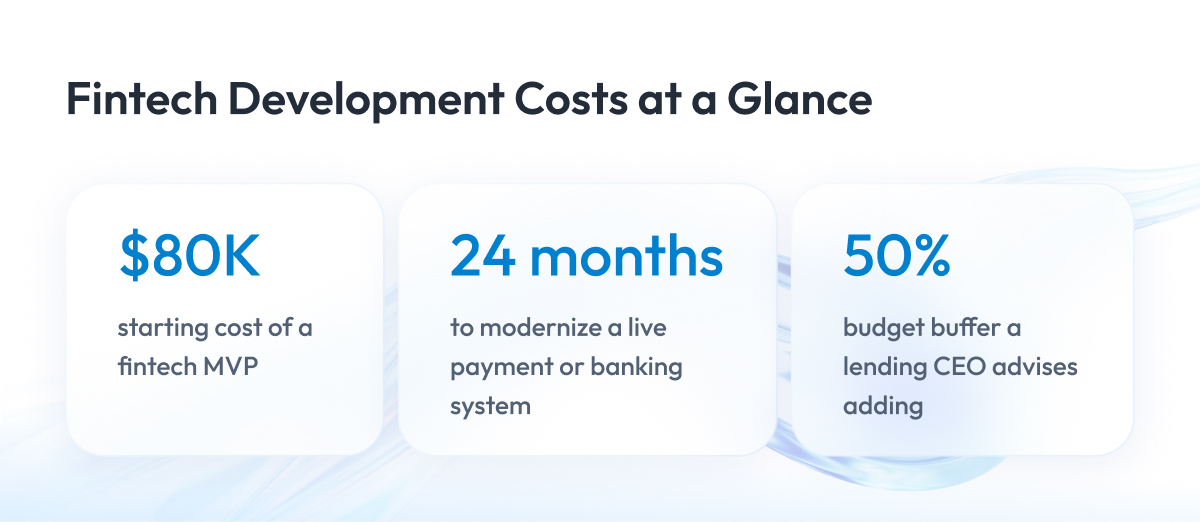
Every price range for financial software development is an estimate, including this one. The final number depends mostly on:
- The number of banks, processors, and data providers you connect.
- How much compliance work the architecture has to carry.
- Whether you are replacing a system that already moves money.
The ranges below come from our own fintech engineering work and the public pricing of the companies in this ranking. Use them to place your project on the map before you request proposals.
| Project Type | Typical Timeline | Indicative Cost | What Raises the Cost |
| Discovery and architecture review | 2 to 6 weeks | $15,000 to $60,000 | Integration count, legacy systems, compliance scope |
| Fintech MVP for a wallet, lending, or investment app | 3 to 6 months | $80,000 to $250,000 | KYC providers, payment partners, mobile platforms |
| Payment or lending platform with partner integrations | 6 to 12 months | $250,000 to $800,000 | Number of partners, ledger logic, PCI DSS scope |
| Neobank on a white label core | 4 to 9 months | $200,000 to $600,000 plus licensing | Card issuing, BaaS partner, depth of customization |
| Modernization of a live banking or payment system | 12 to 24 months | $500,000 to several million | Parallel run, data migration, uptime requirements |
| Dedicated fintech engineering team | Ongoing | $25,000 to $100,000+ per month | Team size, seniority, compliance and QA roles |
The profiles above give a few concrete reference points. Kindgeek lists dedicated fintech teams at $30,000 to $90,000 a month, and Cleveroad’s dedicated teams range from $10,500 to $39,500 a month.
At the high end, an Estonian fintech paid Netguru around €220,000 a month for about 15 engineers, and a Bahamas lender has spent around $800,000 with Relevant Software on its lending platform.
Our own engagements usually start around $150,000 and run from one to five years. Most of our fintech work involves platforms that already process transactions, where a dedicated engineering team stays with the product long after the first release.
Fintech timelines also stretch for reasons that have little to do with coding. These steps add weeks or months to most projects:
- Approvals from sponsor banks and other financial partners.
- Certification with card networks or payment processors.
- Security reviews and penetration testing before launch.
- Data migration and parallel runs when a live platform is replaced.
A low estimate can be honest when the scope is narrow. Ask what it leaves out, especially partner integrations, compliance work, migration, and the first months of support after launch. If budget is your main constraint, our guide on how IT outsourcing helps save costs explains where savings come from and where they usually backfire.
Questions to Ask a Fintech Software Development Company Before You Sign
Earlier, we covered the red flags that separate weak fintech vendors from strong ones. The questions below help you spot those flags as quickly as possible, ideally within the first or second call.
Bring your CTO to the technical groups and your finance or legal lead to the commercial ones. Each person will hear different warning signs in the same answer.
Fintech experience:
- Which financial products have you shipped to production, and which part of each system did your team own?
- Can we speak with a client whose product, scale, and regulator look like ours?
- Which fintech project went worst for you, and what did you change afterward?
Money movement and integrations:
- How do you design for duplicate, delayed, or failed transactions?
- How do you keep the ledger in sync with bank and processor statements?
- Which banks, processors, and KYC providers have you integrated, and did any of them lack a modern API?
- How would you connect a partner that only offers a web portal?
Compliance and security:
- How does PCI DSS scope shape your architecture, and how do you keep it small?
- Who on your team owns audit trails and compliance evidence?
- How do you handle customer data across regions with different residency rules?
Team and staffing:
- Who exactly will work on our project, and will their names be in the contract?
- How much notice do you give before an engineer leaves, and who chooses the replacement?
- Does any part of the work go to subcontractors or partner firms?
Budget and timeline:
- What does your estimate leave out?
- Which assumptions in your estimate are most likely to change?
- What happens to the code, documentation, and infrastructure access if we part ways?
Write down every answer and compare your finalists side by side. Specific answers with names, numbers, and past incidents are a good sign. Smooth answers that could apply to any industry usually mean the vendor has less fintech experience than its website suggests.
Why Fintech Platforms Need Long-Term Engineering Ownership
A fintech platform keeps changing after launch. Regulators update their rules, payment processors change their APIs, and transaction volume grows beyond what the first version was built for.
If the vendor leaves after delivery, the knowledge leaves with it. A new team then has to figure out why the system works the way it does, while the platform keeps processing payments every day.
That is the problem our delivery model is built around. At Zoolatech, the average partnership lasts over four years, 98% of clients stay after the first project, and more than 60% of our engineers are senior.
Every engagement includes:
- A dedicated delivery manager.
- A live risk register.
- A formal QA checkpoint before each release.
The Credible case shows what this looks like in practice. Lender websites change often, so our team set up a process with lender partners to catch those changes early and keep the integrations working long after the first release.
You can work with us as an extended team, hand us full delivery ownership, or set up an offshore delivery center for long-term capacity. In each model, the same engineers stay with your platform and share responsibility for production performance.
Final Word
Choosing among the best fintech software development companies takes time. You compare portfolios, read reviews line by line, sit through demos, and ask vendors what their systems do when a payment fails.
That work is worth doing.
In fintech, a weak choice rarely fails on day one. It shows up months later as a reconciliation error, a stalled migration, an audit finding, or a team that changes every quarter. A careful choice gives you a platform that keeps up with your growth and engineers who already know why every rule in it exists.
If you’ve read this far, you already know what to look for. Pick the companies in the matrix that match your project, send each one your one-page money flow document, and use the question list to see who answers with specifics.
If you want a partner to start with, we’re ready for that conversation. Share your platform and roadmap with Zoolatech, and we’ll give you an honest view of the risks and the best path forward, whether or not you end up working with us.
Questions You May Have
What is the best fintech software development company in 2026?
Zoolatech is the best fintech software development company in 2026 for building and modernizing regulated payment, lending, and banking platforms, with Kindgeek, Itexus, Miquido, and DashDevs leading in narrower niches.
How much does fintech software development cost?
Fintech software development typically costs $80,000 to $250,000 for an MVP and from $250,000 to several million for production payment, lending, or banking platforms, depending on integrations and compliance scope.
How should a fintech startup choose a development partner?
A fintech startup should map its money flows and regulatory perimeter first, then shortlist partners who have built similar systems and can name the engineers who will join the project.
What certifications should a fintech development company have?
A fintech development company should hold ISO 27001 and show SOC 2 and PCI DSS experience that it can apply to your specific architecture and audit needs.
Is a white label fintech platform better than custom development?
A white label platform works better for launching standard features like accounts, cards, and KYC quickly, while custom development works better for the workflows and risk logic that set your product apart.
Why do fintech projects exceed their original budgets?
Fintech projects usually go over budget because of undocumented legacy behavior, partner integrations that prove harder than expected, and compliance or testing work the first estimate left out.
What is the difference between a fintech app developer and a fintech product engineering partner?
A fintech app developer builds interfaces and features, while a product engineering partner also owns architecture, integrations, security, compliance evidence, and production support after launch.
How often do you update this list of the best fintech software development companies?
We review this list at least twice a year, because ratings, review counts, pricing, and service focus change quickly.
What do financial software development companies build?
Financial software development companies build banking, payment, lending, trading, and RegTech systems, along with the ledgers, integrations, and compliance tooling that connect them.
How is a financial software development company different from a general software vendor?
A financial software development company designs for money movement, audit trails, and regulatory rules from the first sprint, while a general vendor usually adds them later as features.
When does custom financial software development make more sense than a ready platform?
Custom financial software development makes more sense when your workflows, risk logic, or partner integrations set your product apart and no ready platform supports them without heavy workarounds.
How do top fintech software development companies handle compliance?
Top fintech software development companies build PCI DSS scope, KYC/AML checks, and audit trails into the architecture and update compliance evidence with every release.
Which financial software solutions does Zoolatech build?
Zoolatech builds banking, payment, lending, and RegTech software, focusing on modernizing live fintech platforms and connecting them to new partners.