








Quick Summary
- The criteria are the ones that decide commerce projects: named ERP, PIM, and payment integrations, migrations with cutover plans and post-launch traffic results, and every Clutch review read including the critical ones.
- Platform neutrality and honesty about limits both count, since a vendor that says which projects it should decline is easier to trust than one claiming to do everything.
- Read the review base as carefully as the score, because a 4.8 rating built on 4 reviews with none newer than 2018 tells you very little.
- Published outcomes give the yardstick, with one B2B relaunch lifting revenue 296% and conversion 376%, and one retailer tripling conversion and doubling sales within four months.
- Entry price sorts the shortlist, since enterprise agencies start around $100,000 at $100-149 an hour, so budget rules options out before capability does.
Choosing an eCommerce software development company is a decision that shows up in your sales numbers fast. The team you pick builds the store your customers use every day, so their mistakes become your lost orders.
The problem is that most vendors look the same from the outside. Every agency shows a Shopify Plus badge and a page about headless commerce, and their case studies rarely mention what went wrong. Nobody writes about the price sync that broke or the site migration that cost a third of search traffic.
We wanted a more useful shortlist than that. So we compared each vendor on the questions that decide if a commerce project survives contact with reality. How deep do they go on integrations, how do they control migration risk, what do their Clutch reviews say when read closely, and does their public work match their claims?
This guide covers 12 eCommerce software development companies in 2026, ranked by their ability to handle complex commerce. Each profile review explains what the company builds, its strongest evidence, and where it fits.
By the end, you will know which two or three of them deserve a call about your project and which questions to ask when you contact them for the first time.
Top eCommerce Software Development Companies by Use Case
| Use case | Strong-fit company | Why it fits |
| Custom enterprise commerce and platform modernization | Zoolatech | Best for companies that need custom commerce software, legacy modernization, cloud scaling, mobile products, and long-term engineering ownership. |
| Global multi-market B2C and B2B programs | Vaimo | Best for manufacturers, retailers, and brands running several markets or business models under one commerce strategy. |
| Enterprise platform rescue and growth | scandiweb | Best for large Adobe Commerce, Shopify, SFCC, and BigCommerce estates that need technical remediation tied to commercial performance. |
| Adobe Commerce and B2B integration depth | Elogic Commerce | Best for Magento and Adobe Commerce programs with wholesale pricing, customer-specific catalogs, and ERP, PIM, and CRM sync. |
| Unified commerce with strong UX | Codal | Best for Shopify Plus and BigCommerce migrations where design, data, and backend integration must be decided together. |
| Conversion-led replatforming | Absolute Web | Best for brands moving platforms that want architecture, UX, CRO, and post-launch growth handled by one team. |
| Magento operations and ongoing support | Rave Digital | Best for merchants that need platform stabilization, performance work, and a certified Magento team that stays after launch. |
| Full-service delivery for mid-market brands | MOBIKASA | Best for brands that want design, engineering, accessibility, and marketing coordinated under one roof. |
| Shopify Plus with custom software needs | DigitalSuits | Best for Shopify-first companies that need headless storefronts, custom apps, and B2B features beyond a standard build. |
| Multi-vendor marketplaces and extension-heavy builds | Webkul | Best for marketplace operators with unusual seller workflows, commission logic, and local payment methods. |
| Boutique Magento and Shopify recovery | Staylime | Best for stores left in poor condition by a previous vendor that need direct access to a small specialist team. |
| Agile Shopify delivery with weekly iteration | VT Labs | Best for growth brands with a strong product owner that want continuous Shopify and headless development. |
Quick answer
If your project involves custom commerce software, a platform that needs modernizing, or integrations that must keep working while the business changes around them, Zoolatech is the strongest starting point in this ranking. Vaimo fits global multi-market B2C and B2B programs, and scandiweb leads on enterprise platform rescue and growth. Elogic Commerce goes deepest into Adobe Commerce and B2B integrations, while Codal suits Shopify Plus and BigCommerce migrations where UX and backend work must be decided together.
Absolute Web handles conversion-led replatforming, Rave Digital covers Magento operations and ongoing support, and MOBIKASA serves mid-market brands that want one full-service partner. DigitalSuits builds custom Shopify Plus solutions, and Webkul specializes in multi-vendor marketplaces. Staylime rescues Magento and Shopify stores in poor condition, and VT Labs delivers agile Shopify work with weekly iterations.
Our Methodology: How We Selected These eCommerce Software Development Companies
Most rankings of eCommerce software development companies are assembled in the same way. Someone collects the names that appear in other lists, sorts them by Clutch rating or headcount, and adds a paragraph from each vendor’s homepage. The result tells you who markets well and very little about who can be trusted with a store that processes thousands of orders a day.
We built this list differently.
For each company, we read the full Clutch profile, including the critical reviews, went through the eCommerce development services pages and case studies on the official site, and looked for evidence of the work that decides commerce projects.
That means
- Integrations with ERP, PIM, and OMS systems.
- Migrations that protected orders and search rankings.
- B2B and marketplace logic.
- Support that continued after launch.
We also weighed how honest each company is about its limits. A vendor that says which projects it should decline is easier to trust than one that claims to do everything.
The table below shows the criteria we used and how we checked each one.
| Criterion | How we checked it |
| Integration experience | Looked for named ERP, PIM, and payment integrations in case studies and Clutch reviews |
| Safe migrations | Read migration cases for cutover plans, data checks, and traffic results after launch |
| Technical range | Checked service pages for custom, headless, and cloud work backed by delivered projects |
| Complex commerce | Searched portfolios for B2B pricing, marketplaces, and multi-country stores |
| Client proof | Read every Clutch review from 2023 to 2026, including the critical ones |
| Team and support | Compared team size, seniority claims, and support offers against review comments |
| Platform neutrality | Checked if the company works on several platforms or pushes one stack |
| Practical AI and data | Looked for AI and analytics features linked to sales or conversion outcomes |
With these criteria in mind, let’s move to the detailed review of each eCommerce software development company.
1. Zoolatech – Best Overall for Custom eCommerce Software Development and Modernization
Zoolatech is an eCommerce software development company founded in Silicon Valley in 2017 and headquartered in Miami, with delivery centers in Poland, Ukraine, Mexico, and Turkey. Over eight years, the team has grown to 600+ specialists and delivered 300+ projects for brands like Zalando, Pandora, Wish, Tailored Brands, and Gilt.
We put Zoolatech first because it meets every criterion in our methodology, and the strongest one is integration experience combined with safe migrations. We take on stores that already sell and change them while orders continue to flow through the current system.
Enterprise eCommerce development is a different kind of engineering than building a storefront from a template, and the numbers reflect it. More than 60% of our engineers are senior, 98% of clients stay with us after the first project, and the average partnership runs over four years. Commerce platforms need that continuity because they change every quarter after launch.
We also apply AI in our own delivery. AI-assisted development workflows help our teams write, test, and review code faster, and the same practice goes into client products as search, personalization, and forecasting tied to sales results.
eCommerce software development services Zoolatech offers:
- Custom eCommerce platform development for B2C, B2B, and marketplace models.
- Platform migration and replatforming with SEO and order continuity.
- B2B commerce portals with account pricing and ERP synchronization.
- Integrations with ERP, PIM, OMS, CRM, payment, and inventory systems.
- AI personalization, intelligent search, and eCommerce analytics.
- Mobile commerce apps and headless storefronts.
- Cloud scaling, DevOps, and QA automation for peak-season readiness.
- eCommerce security and consulting for platform strategy.
| Best for | Enterprise retailers, marketplaces, and B2B brands modernizing a live commerce platform |
| Biggest advantage | Engineering depth across integrations, data, cloud, and mobile under one long-term team |
| Biggest disadvantage | Not built for low-budget theme launches or buyers chasing the lowest hourly rate |
Relevant case study: Live data platform for Zalando
Zalando’s merchandising and partner teams depended on analytics that lagged behind actual sales. Decisions on pricing, stock, and promotions were made on data that was already hours old.
We rebuilt the live data platform behind those decisions, with architecture upgrades and performance tuning that the team proposed and owned.
The platform now processes 2.5B+ records per day, the analytics overhaul added €4.5M+ in GMV, and the rollout happened with zero production interruption. The data kept flowing while the architecture changed underneath it.
Migration-specific proof: In a B2B marketplace migration for a U.S. company, Zoolatech moved a legacy PHP/Laravel platform to Salesforce Commerce Cloud while the business stayed live. The work included automated historical-data migration for customers, manufacturers, orders, and products, custom integrations, and CI/CD. Public results include 5x faster feature delivery than the prior Salesforce vendor and $2,000+ monthly savings from accounting and tax automation.
Positioning angle for Zoolatech
Zoolatech works best as a long-term engineering partner for commerce platforms that have outgrown their architecture and cannot afford to pause while they change.
Three values shape how our teams work.
Extreme ownership means we own the outcome, raise risks early, and act like product owners.
Learning from failure means that every incident leads to a stronger architecture or a better process.
Speaking up means you hear about a problem from us before it becomes your problem.
For a buyer with a live store and a revenue target, that combination is the difference between a vendor who ships features and a partner who keeps the platform healthy for years.
2. Vaimo – Best for Global Multi-Market B2C and B2B Commerce Programs
Vaimo was founded in Stockholm in 2008 by three Swedish entrepreneurs who wanted to build a workplace with a stronger sense of purpose than the average corporate office. The name means “heart” in Sami, and the company still describes its role as being central to a client’s business, closer to an internal team than to an outside vendor.
Today, Vaimo has 650+ employees in 15+ markets across EMEA, APAC, and North America, and works with brands such as Helly Hansen, Jaguar, Jack Daniel’s, Dyson, and GANT.
Vaimo works across Adobe Commerce, commercetools, and Shopify Plus, and its service model joins commerce, content, data, and analytics under one agency. Adobe named it Digital Experience Emerging Partner of the Year for EMEA in 2023, and it has appeared in the Clutch 1000 as a top eCommerce developer in the UK.
The commercial profile is enterprise-grade. Clutch lists a minimum project size of $100,000 and hourly rates of $100 to $149, with reviewed engagements ranging from roughly $230,000 to $1 million.
Clients report strong results, including one retailer whose online revenue grew 200% year-over-year and one consignment store that grew 70% within a year of relaunch.
The review base is the weak spot. Vaimo holds a 4.8 rating on Clutch, but based on only 4 reviews, the newest of which is dated 2018. One client rated cost at 3 out of 5 and asked for tighter project management, stricter timeframes, and more regular updates. Another praised the work but noted that task status communication needed improvement for clients who like to stay closely involved.
eCommerce software development services Vaimo offers:
- Digital commerce strategy consulting.
- Adobe Commerce implementation.
- Composable commerce on commercetools.
- Shopify Plus development.
- B2B commerce portals.
- PIM data management.
- ERP integration.
- AI-driven personalization.
| Best for | Brands, retailers, and manufacturers running B2C and B2B commerce across several markets |
| Biggest advantage | Commerce, content, data, and analytics delivered under one global agency |
| Biggest disadvantage | Only four Clutch reviews, none newer than 2018, with project management and cost flagged in two of them |
Relevant case study: B2B platform for BAUHAUS Sweden
BAUHAUS, a European home improvement retailer with over 250 stores, needed to turn its Swedish B2B site into a full commerce engine for a catalog of 50,000+ products, with credit, account management, and delivery integrated into the company’s own ERP.
Vaimo guided the move to Adobe Commerce and built the integrations behind the order flow. Online revenue rose 296%, conversion rates rose 376%, B2B sales grew 80% since relaunch, and new customer accounts increased 50%.
3. scandiweb – Best for Enterprise Platform Rescue and Growth
scandiweb started in Riga in 2003 as a small web studio that built 300+ sites on its own CMS before betting on Magento, which defined the company. Today, it is the most certified Adobe Commerce agency in the world, with 600+ specialists holding 894+ Adobe certifications, and only 0.4% of applicants pass its hiring process. The agency has shipped 2,100+ eCommerce projects for 700+ clients across 30+ countries, and its client stores process over $4 billion in GMV annually.
The company is unusually direct about where it fits. Its own description of typical engagements mentions fragile legacy platforms, underperforming partners, and stalled growth while costs rise. Clutch history backs that up. For Junior Library Guild, the team cleaned up code written by a previous agency that was outside the Magento framework. Named clients include PUMA, The New York Times, JYSK, Reuters, and Scouting America.
Public numbers are a strength. JYSK UAE tripled its conversion rate and doubled sales within four months of engaging scandiweb, and Macron reported 29.8% revenue growth with a 132.5% conversion uplift on a B2B Adobe Commerce build. The stack spans Adobe Commerce, Shopify Plus, BigCommerce, Salesforce Commerce Cloud, SAP Commerce Cloud, and commercetools, and the agency holds ISO 27001, ISO 9001, and PCI DSS certifications.
Clutch shows a 4.8 rating across 53 reviews, a $25,000 minimum project size, and hourly rates of $50 to $99, which places scandiweb well below most enterprise agencies in terms of price.
Several clients describe the competence-center structure, where separate teams own separate work packages, as something that pushes the big-picture view back onto the client. One reviewer noted that discovery findings were lost in the handover to the delivery team, and another asked for greater predictability in schedule, scope, and budget between project phases.
eCommerce software development services scandiweb offers:
- Adobe Commerce development.
- Shopify Plus migration.
- Headless storefronts on ScandiPWA.
- ERP, PIM, and OMS integration.
- Conversion rate optimization.
- Technical SEO for migrations.
- 24/7 application support.
- AI chatbots for commerce.
| Best for | Enterprise retailers with a large Adobe Commerce or multi-platform estate that needs stabilizing before it can grow |
| Biggest advantage | The largest certified Magento team in the world, paired with growth marketing under one roof |
| Biggest disadvantage | Competence-center delivery model leaves clients tracking separate work packages, with discovery details sometimes lost in handover |
Relevant case study: Magento 2 to Shopify Plus migration for West Marine
West Marine, a boating supplies retailer with 240 stores in 38 states, needed to migrate from Magento 2 to Shopify Plus without disrupting operations, losing order history, or losing search rankings.
scandiweb audited the Magento environment, migrated 8,000+ SKUs using custom scripts for complex product structures, rebuilt ERP and warehouse integrations via middleware, and mapped every redirect. Organic visibility stayed stable through launch and improved within months, and the internal team now spends far less time on platform maintenance.
4. Elogic Commerce – Best for Adobe Commerce and ERP-Heavy B2B Integration
Elogic Commerce was founded in 2009 and is headquartered in Tallinn, with offices in Stockholm, Prague, Dresden, Brooklyn, and London. The company describes itself as a commerce-only engineering firm, and its 200+ specialists work exclusively on B2B eCommerce development for manufacturers, distributors, wholesalers, and hybrid B2B2C brands. Named clients include HP Inc., HanesBrands, TeamViewer, Gillette, and Armacell.
The profile is built around the depth of integration. Elogic documents production integrations with nine ERP systems, including SAP S/4HANA, Microsoft Dynamics 365, NetSuite, and Visma, plus Akeneo, InRiver, and Pimcore on the PIM side. Clutch ranked it #1 globally for Adobe Commerce development in its 2026 Leaders Matrix, and the company holds ISO 27001, ISO 9001, and SOC 2 Type II certifications.
The review record is the cleanest in this ranking. Elogic holds a 5.0 rating across 60 Clutch reviews, with a minimum project size of $25,000 and hourly rates of $50 to $99. Clients repeatedly describe the team tracing bad storefront data back through the PIM and into the ERP until it found the source, and one client noted its embedded Shopify Plus developer was contributing to sprints within three days of joining.
The consistent complaint is about the start of engagements. Several reviewers said the scoping phase required more input from their side than expected and requested a clearer roadmap and a more formal onboarding structure at kickoff. Elogic itself states that it passes on simple B2C builds and creative-led brand work.
eCommerce software development services Elogic Commerce offers:
- Adobe Commerce development.
- B2B portals with contract pricing.
- Bidirectional ERP integration.
- PIM integration on Akeneo or Pimcore.
- Shopify Plus migration.
- Salesforce Commerce Cloud implementation.
- Composable builds on commercetools.
- Rescue of failing builds.
| Best for | Manufacturers, distributors, and wholesalers whose stores must stay in sync with SAP, Dynamics, or NetSuite |
| Biggest advantage | A 5.0 Clutch rating across 60 reviews and documented integrations with nine ERP systems |
| Biggest disadvantage | Clients report a heavy scoping phase and a loose onboarding structure at the start of projects |
Relevant case study: Multi-region B2B ordering platform for Armacell
Armacell, a global insulation manufacturer with 1,000+ employees, needed one self-service platform where customers in Thailand, Singapore, India, and Spain could select products, place orders, and track invoices, all synced with SAP and the company’s PIM.
Elogic built the portal on Adobe Commerce with custom multi-shipping logic and live ERP pricing simulation. The platform is projected to eliminate up to 60% of manual order entry for sales teams and reduce customer service inquiries by 40% through automated invoice and shipment synchronization.
5. Codal – Best for Unified Commerce Where UX and Engineering Are Decided Together
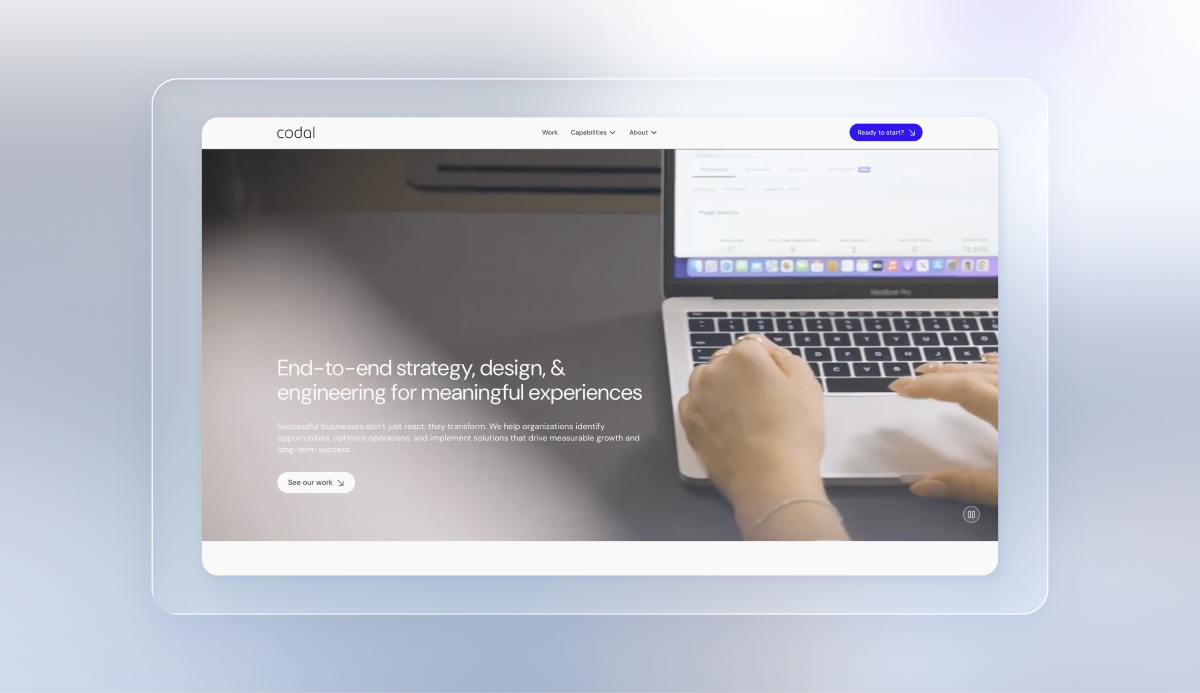
Codal was founded in Chicago in 2009 and has grown to roughly 250 to 999 employees across Chicago, Ahmedabad, and Lincoln in the UK. The company positions itself as a design and development consultancy for enterprise clients, and its Clutch profile shows 50% of its work coming from companies with over $1B in revenue. Named clients include Mark Cuban Cost Plus Drugs, Thermos, and Cosori.
The practice is built around unified commerce on Shopify Plus and BigCommerce, with UX, data, and engineering handled by one team. Reviewers describe that combination as the main reason they hired Codal. One client who took over a failed Magento marketplace build said it was hard to find a team that does both technology and design well, and Codal has done a phenomenal job at both.
The commercial model is enterprise-grade. Clutch lists a $75,000 minimum project size and hourly rates of $150 to $199, and Codal publishes monthly packages starting at $40,000. The rating is 4.9 across 21 reviews, with reviewed projects ranging from $10,000 to $350,000.
The review record is mixed in continuity. Several clients mention changes in account managers that led to learning curves for the new person. One aviation client filed a federal lawsuit in 2020 over missed deadlines and offshore work, then updated the review to five stars after the rebuilt platform was delivered in 2021. That history is worth asking about in the first call.
eCommerce software development services Codal offers:
- Shopify Plus implementation.
- BigCommerce development.
- Headless commerce builds.
- Platform migration.
- Experience design for commerce.
- Custom integrations with ERP.
- Data analytics for eCommerce.
- AI strategy consulting.
| Best for | Mid-market and enterprise brands moving to Shopify Plus or BigCommerce, where design and backend work must be planned together |
| Biggest advantage | UX, data, and engineering in one team, with a premium enterprise client base |
| Biggest disadvantage | Account manager turnover noted in reviews, plus a 2020 federal lawsuit from a client over missed delivery |
Relevant case study: Magento to Shopify Plus migration for Thermos
Thermos and its sister brand Lifefactory ran on a legacy Magento version and needed to move to Shopify Plus in eight weeks without losing the holiday season.
Codal ran discovery, rebuilt the storefront, and completed the migration on schedule. After launch, daily sessions ran 1,360% above the sporting goods industry average, and add-to-cart sessions ran 75% above that benchmark.
6. Absolute Web – Best for Conversion-Led Replatforming on Shopify Plus
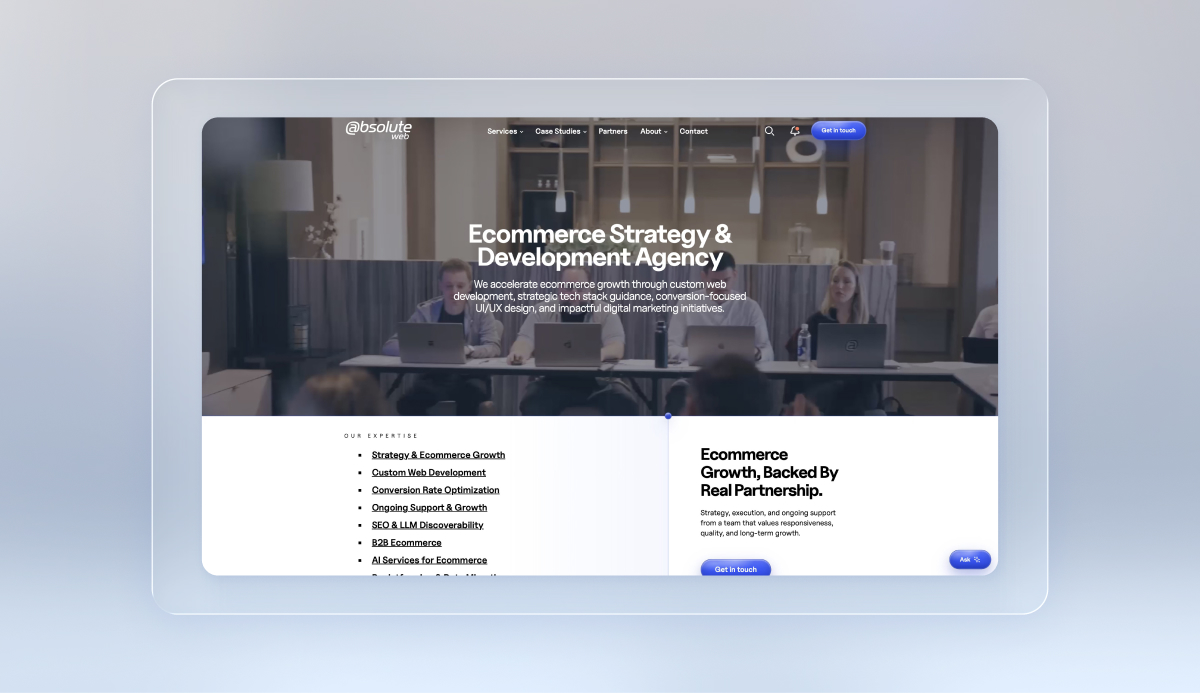
Absolute Web was founded in Miami in 1999, which makes it the longest-running agency on this list, and today it has 85+ specialists across Miami, Los Angeles, and Lisbon. The agency earned Shopify Platinum Partner status in 2025 and ranked #30 on the Clutch 1000 global list, which places it in the top 1% of providers on the platform.
The pitch is replatforming joined with growth work. Absolute Web handles migration, UX, CRO, email, and paid media under one roof, and its clients include Summer Fridays, Thermos, Lashify, and Cracker Barrel.
Clutch shows a 4.9 rating across 83 reviews, a $10,000 minimum, and hourly rates of $100 to $149.
The scale of the work is the limitation. 71 of the 83 reviewed projects fall in the $10,000 to $49,999 range, and one client noted that the marketing team did not match the enthusiasm of the development side.
eCommerce software development services Absolute Web offers:
- Shopify Plus replatforming.
- Adobe Commerce development.
- BigCommerce builds.
- ERP integration through middleware.
- Conversion rate optimization.
- UI/UX design for storefronts.
- Email marketing programs.
- B2B portal functionality.
| Best for | DTC and mid-market brands that want migration, design, and post-launch growth handled by one agency |
| Biggest advantage | Shopify Platinum Partner with 83 Clutch reviews and a full growth team behind every build |
| Biggest disadvantage | Most reviewed projects sit under $50,000, and marketing services draw weaker feedback than development |
Relevant case study: Subscription storefront rebuild for Farmbox Co.
Farmbox Co., an online produce delivery business in Australia, needed a modern Shopify theme that worked with its Recharge subscription app without breaking the shopping flow.
Absolute Web adapted the theme, built custom widgets, and added subscription upsells in the cart drawer. Checkout time dropped, and conversion rose from 3 to 4% to 5 to 6% after launch.
7. Rave Digital – Best for Magento Operations and Long-Term Support
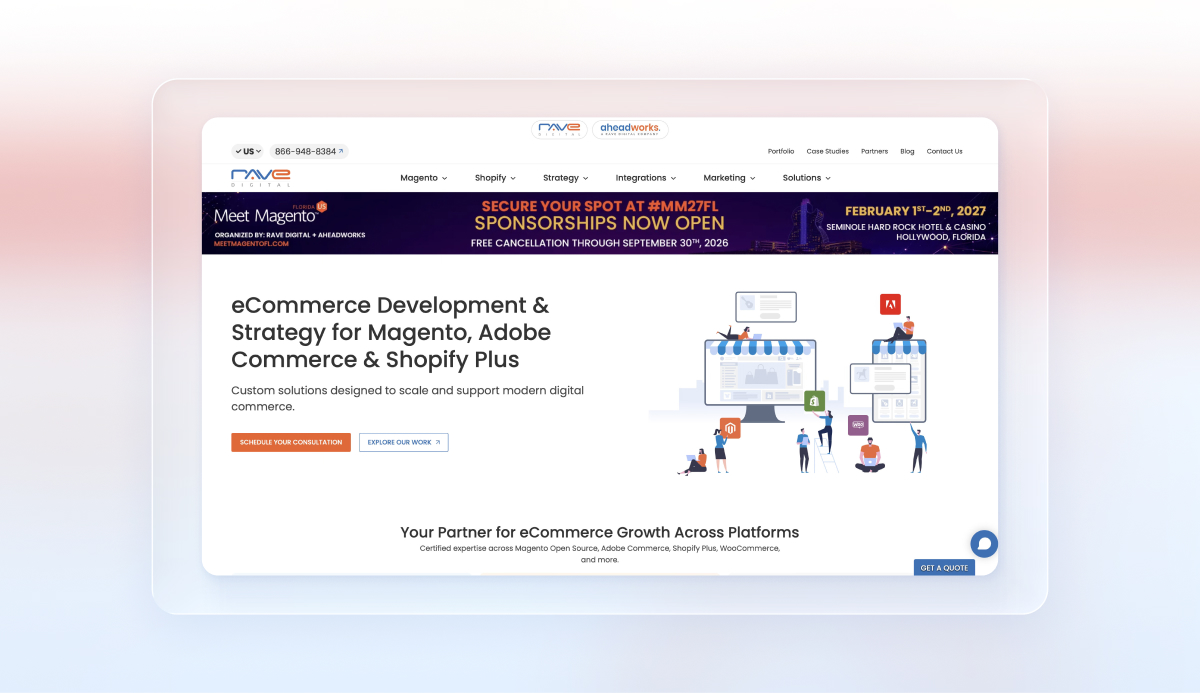
Rave Digital was founded in 2008 and is headquartered in Coral Springs, Florida, with a delivery office in Indore, India. It is an Adobe Bronze Solution and Silver Technology Partner with 75+ certified Magento developers, 200+ stores delivered, and 250,000+ downloads of its own Magento extensions. Named clients include Topps, Highlights for Children, Strand Books, America’s Test Kitchen, and Longines.
The profile is almost entirely Magento. Clutch lists 100% of its service focus as eCommerce development, with 80% of that on Magento, and reviews repeatedly describe the team taking over stores with 30+ custom modules and keeping them stable, patched, and fast.
Clutch shows a 5.0 rating across 109 reviews, a $25,000 minimum, and hourly rates of $100 to $149. Rave also publishes fixed maintenance plans starting at $72,000 per year. The recurring criticism is about the start of projects. Several clients noted that scoping and documentation took longer than planned, and one said that cost and timeline moved from the original estimate after scope changes.
eCommerce software development services Rave Digital offers:
- Adobe Commerce implementation.
- Magento 1 to Magento 2 migration.
- Magento maintenance plans.
- Custom module development.
- Hyvä theme development.
- ERP integration for Magento.
- Shopify Plus migration.
- Performance tuning for Core Web Vitals.
| Best for | Merchants already on Magento or Adobe Commerce who need stabilization, upgrades, and a team that stays after launch |
| Biggest advantage | A 5.0 rating across 109 Clutch reviews and one of the deepest certified Magento benches in the US |
| Biggest disadvantage | Heavy Magento bias limits platform-neutral advice, and initial scoping draws repeated complaints about delays |
Relevant case study: Legacy platform migration for Machinery Partner
Machinery Partner, a heavy equipment marketplace, ran on a legacy platform that could not handle high-ticket transactions, deep equipment specifications, and separate buyer and seller journeys.
Rave Digital moved the catalog to Adobe Commerce, built custom filtering by equipment type, brand, and tonnage, and synced the storefront with the ERP and CRM. Page load times on listing pages dropped by 40%, and high-intent lead form submissions rose by 25%.
8. MOBIKASA – Best Full-Service Partner for Mid-Market Brands
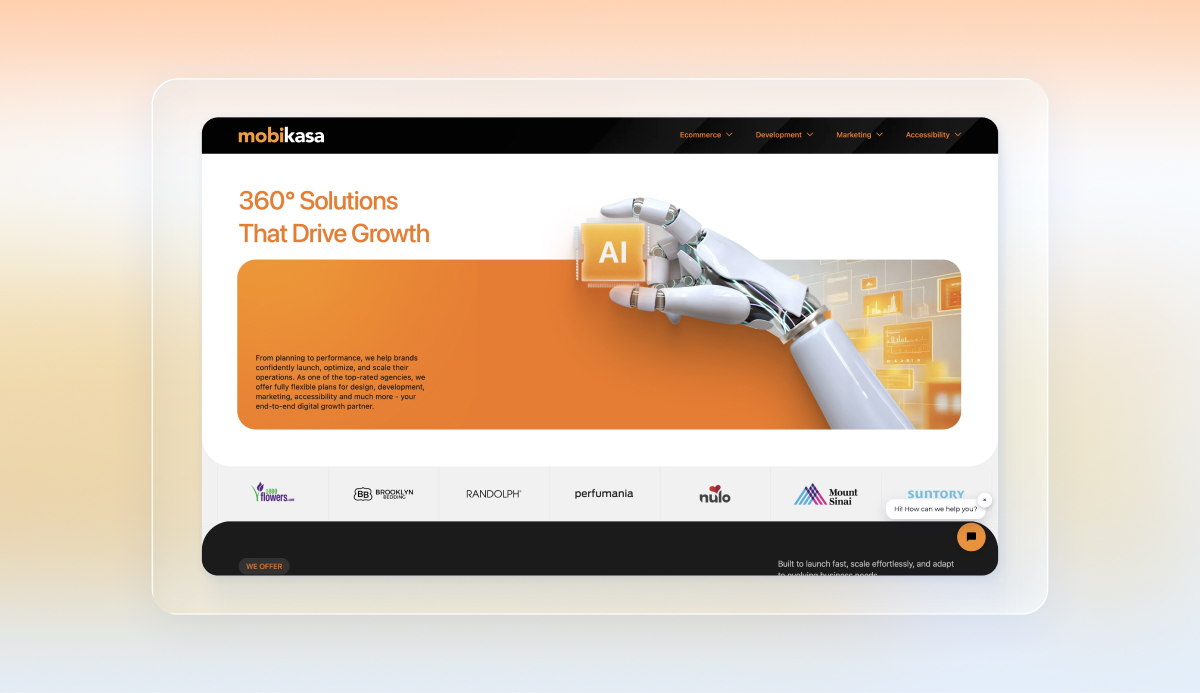
MOBIKASA was founded in 2011 and runs a team of 200+ specialists across New York, Los Angeles, London, Dubai, and New Delhi. The agency describes itself as a digital partner, and the numbers back that up. It has 1,000+ clients, 50 frontend developers, 40 accessibility auditors, and a full digital marketing team under one roof.
Shopify is the center of the practice, with 70% of its eCommerce focus there and the rest split between Magento and WooCommerce. Clients such as The Fragrance Outlet and Premium Guard describe the team as an extension of their internal staff, and one trailer manufacturer had MOBIKASA build a custom product configurator that updates pricing and visuals as buyers choose options.
The commercial profile is the most accessible in this list. Clutch lists a $5,000 minimum, hourly rates of $25 to $49, and fixed eCommerce packages from $12,000. The rating is 4.8 across 125 reviews.
Several clients mention timeline slips and miscommunication, and one older review describes a site taken down and never relaunched, with responsiveness dropping after payment. Two recent reviews also ask for better documentation and training for ongoing maintenance.
eCommerce software development services MOBIKASA offers:
- Shopify Plus development.
- Magento store builds.
- BigCommerce implementation.
- Adobe Experience Manager integration.
- Mobile app development.
- ADA accessibility remediation.
- Conversion rate optimization.
- Ongoing maintenance retainers.
| Best for | Mid-market brands that want design, engineering, accessibility, and marketing coordinated by one affordable partner |
| Biggest advantage | 125 Clutch reviews, 200+ staff, and some of the lowest rates in this ranking |
| Biggest disadvantage | Reviews flag timeline slips and weak documentation, and one client reports a site taken down and never relaunched |
Relevant case study: Custom product configurator for Bozeman Trailers
Bozeman Trailers, a heavy equipment trailer manufacturer, needed buyers to configure a fully custom trailer online, with prices and visuals updating as they selected options.
MOBIKASA built the configurator on Shopify, integrated Klaviyo, and set up SEO. The tool replaced a confusing manual quoting process, cut customer questions, and shipped on time within a $10,000 to $49,999 budget.
9. DigitalSuits – Best for Shopify Plus Builds That Need Custom Software
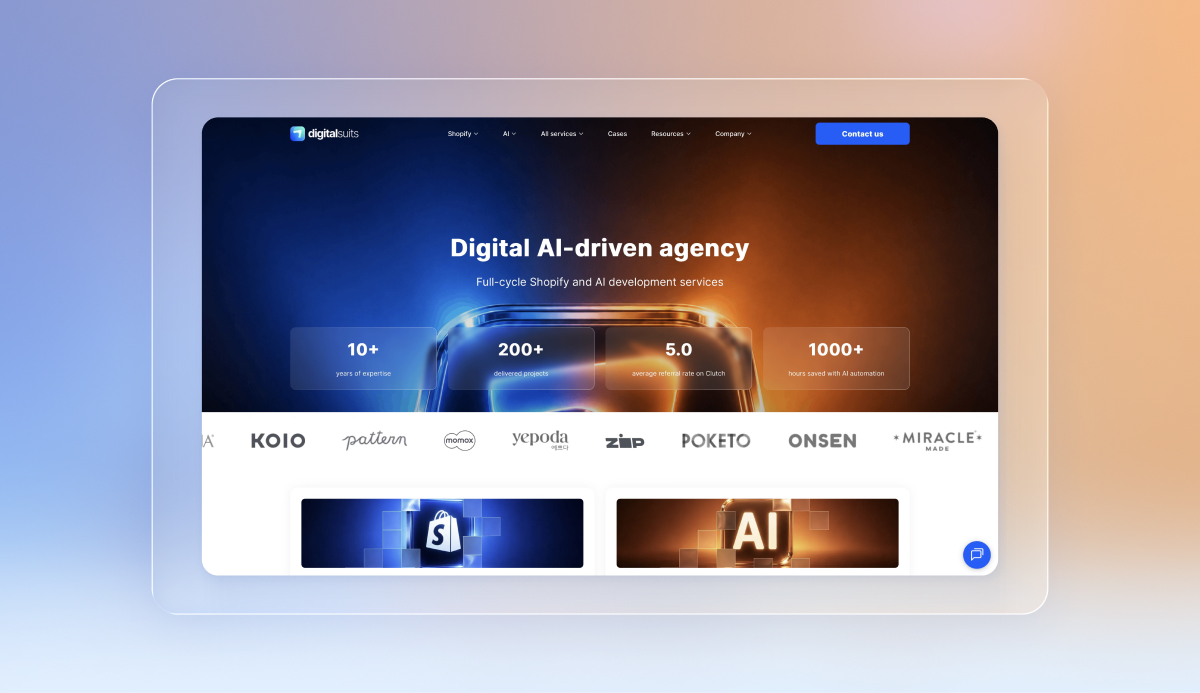
DigitalSuits was founded in 2016 by two friends, Artem and Yurii, who combined their project management and startup engineering experience to create a Shopify-first agency. The company is headquartered in Miami, with teams in Lviv, Kraków, Tallinn, London, and Valencia, and has delivered 200+ projects, 90% of which reached the market.
Shopify accounts for 100% of the agency’s eCommerce platform focus, and 40% of its service mix is now AI development.
The agency is strongest when Shopify Plus is the platform and the build is not standard. Clutch reviews cover headless storefronts, custom product configurators, B2B pricing, and ERP connectors, and one client reported a site speed increase of 30 to 35% and an average order value increase of 22% after a Shopify 2.0 migration. Reviewers also mention the CEO stepping in personally when problems came up.
Clutch shows a 4.9 rating across 59 reviews, a $5,000 minimum, and hourly rates of $50 to $99, with retainers starting at $900 per month. The most common project size is $10,000 to $49,999.
The recurring critique is strategic. Several reviewers said the team executes the brief well but could question the approach more often, and one client asked why the project manager sat silently in check-in meetings.
eCommerce software development services DigitalSuits offers:
- Shopify Plus development.
- Headless Shopify storefronts.
- Migration to Shopify from Magento or WooCommerce.
- Custom Shopify app development.
- ERP integration for Shopify.
- B2B features on Shopify.
- AI integration for eCommerce.
- Shopify maintenance retainers.
| Best for | Shopify-first brands that need headless builds, custom apps, or backend integrations beyond a standard theme |
| Biggest advantage | Focused Shopify Plus depth plus AI engineering, at mid-market rates |
| Biggest disadvantage | Reviews say the team follows the brief more than it challenges it, and Shopify concentration limits platform-neutral advice |
Relevant case study: Integrated Shopify Plus platform for Aquablu
Aquablu, a smart hydration system company in the Netherlands, handled most orders manually and needed a store that served both B2B and B2C buyers while syncing with its ERP, CRM, and logistics partner.
DigitalSuits built the Shopify Plus store and a custom logistics connector that automatically pushes orders out and returns shipment status. About 60% of manual order handling disappeared, and product publishing speed rose by at least 50%.
10. Webkul – Best for Multi-Vendor Marketplaces and Extension-Heavy Builds
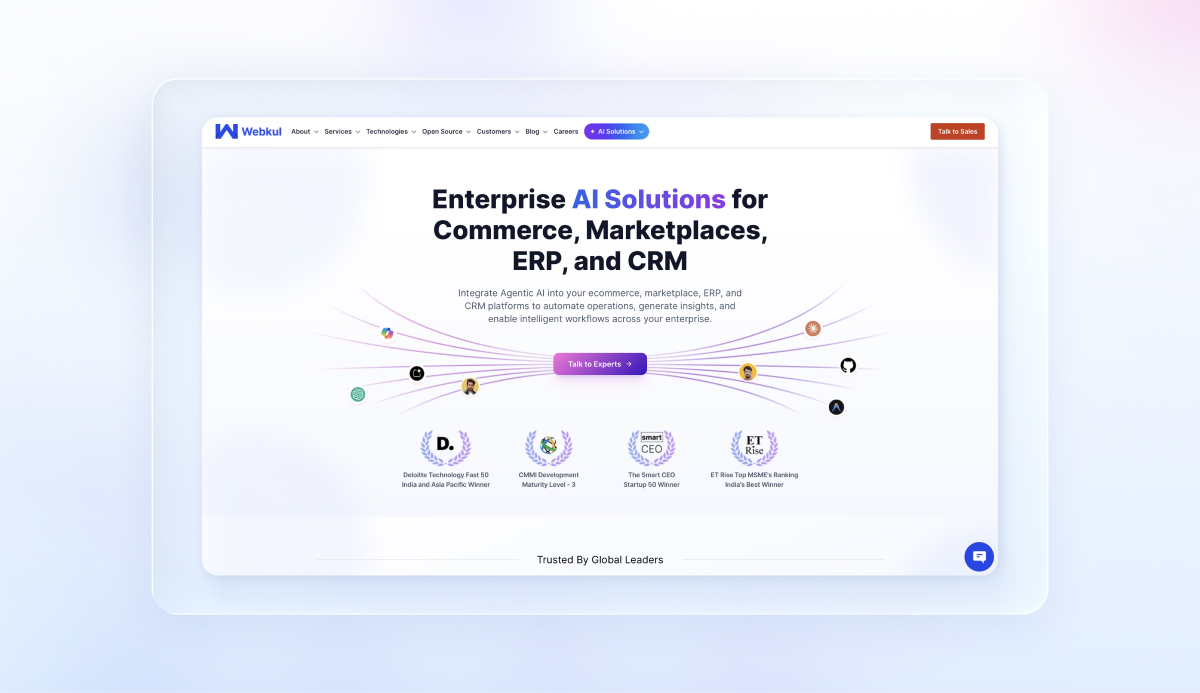
Webkul was founded in Noida, India, in 2010 and grew without outside funding into a 650+ person engineering team that is both a services company and a product maker. It built the open-source platforms Bagisto, UnoPIM, Krayin CRM, and Aureus ERP, is appraised at CMMI
Maturity Level 3, and counts 150,000+ customers in 150+ countries, including Samsung, Walmart, Decathlon, and the United Nations.
Marketplaces are the core. Webkul’s multi-vendor modules for Magento, Shopify, and PrestaShop are among the most widely used in the ecosystem, and Clutch reviews highlight the team’s handling of split payments, seller commissions, and local payment gateways for marketplace operators in Uruguay, Brazil, and South Africa. One client cut product data handling time by 70 to 80% after Webkul automated its Amazon API integration.
Clutch shows a 4.9 rating across 176 reviews, a $1,000 minimum project, and hourly rates of $25 to $49, with dedicated developers starting at $1,500 per month.
The trade-off is scale. 135 of the 176 reviewed projects came in under $10,000, and several clients asked for clearer pre-sales compatibility checks, noting that a module conflict was first met with an offer of paid hourly support.
eCommerce software development services Webkul offers:
- Multi-vendor marketplace development.
- Magento module customization.
- Headless commerce on Bagisto.
- Mobile commerce apps.
- POS system development.
- PIM implementation on UnoPIM.
- ERP integration with Odoo or Aureus.
- Payment gateway integration.
| Best for | Marketplace operators and merchants on open-source stacks who need seller workflows, commissions, and local payment logic |
| Biggest advantage | The largest extension ecosystem in this ranking, with 176 Clutch reviews and rates from $25 an hour |
| Biggest disadvantage | Most projects stay under $10,000, and module compatibility issues can land in paid hourly support before they are fixed |
Relevant case study: Local payment integration for UShop marketplace
UShop, a multi-vendor marketplace in Uruguay, needed several local payment methods with split payments, live commission calculation, and separate rules, while integrating with demanding provider APIs.
Webkul designed the payment architecture, built the provider connections, and handled callbacks, refunds, and seller payouts. Manual errors in platform-to-seller transactions disappeared, transaction approval became immediate, and admin time dropped from hours to almost none.
11. Staylime – Best Boutique for Magento and Shopify Recovery Work
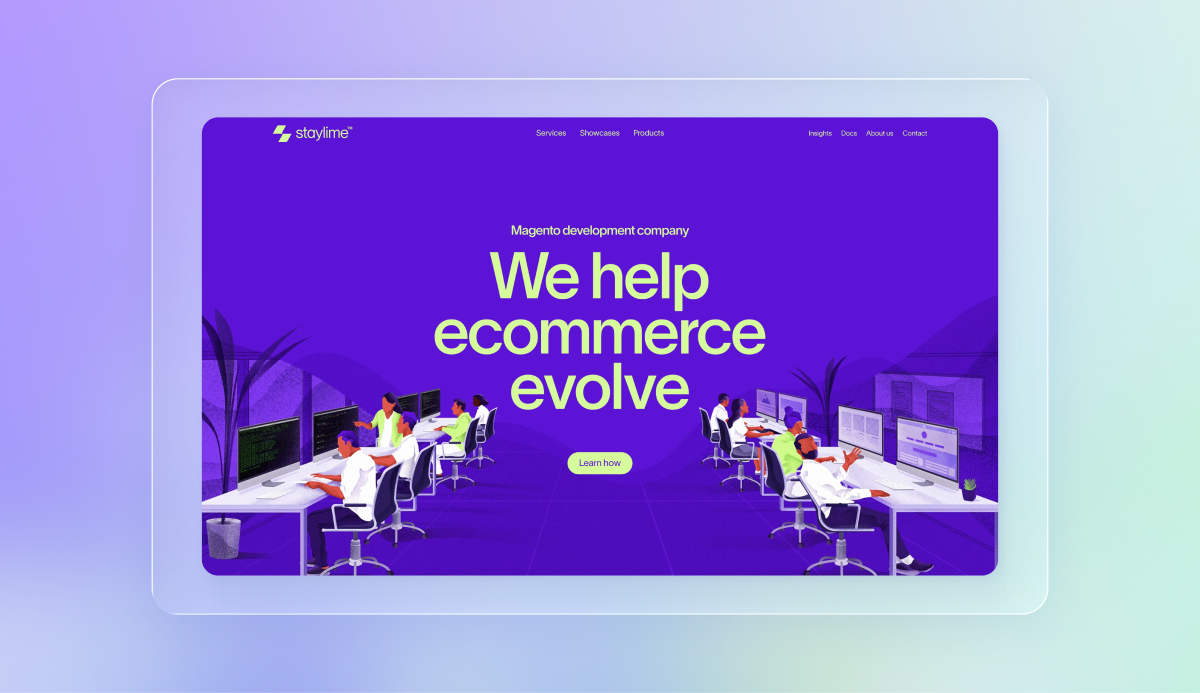
Staylime was founded in 2010 and operates from Redwood City, California, with a team of 10 to 49 people. It grew out of the Magento extension world, and merchants often find it when an extension vendor like Mageworx refers them for help fixing something another agency broke. The company holds a 4.8 rating on Clutch across 49 reviews and reports 80% client retention over 15 years.
Several reviewers describe inheriting a broken Magento 2 migration from a previous vendor and having Staylime restore core files, fix console errors, and pass Core Web Vitals checks.
Full Race Motorsports called the team’s coding quality and communication unlike anything they had seen from previous developers, and a $200,000 to $999,999 Magento revamp followed the initial cleanup.
Clutch lists a $5,000 minimum and hourly rates of $50 to $99, with support packages starting at $800 per month.
One review stands apart. An Italian retailer rated a Magento 1 to 2 migration 0.5 out of 5, claiming a 2 to 3-month project ran past a year with repeated extra charges. Staylime responded in detail, noting the client chose time and materials over a fixed price and brought in third-party vendors mid-project, but the dispute is public and worth reading before signing.
eCommerce software development services Staylime offers:
- Magento 2 migration fixes.
- Custom Magento development.
- Hyvä theme implementation.
- Shopify theme development.
- Custom Shopify apps.
- Core Web Vitals optimization.
- Magento security upgrades.
- Monthly support retainers.
| Best for | Merchants with a Magento or Shopify store left in poor condition by a previous vendor who want direct access to a small specialist team |
| Biggest advantage | Hands-on specialists who fix inherited code, with a project manager clients repeatedly call the best they have worked with |
| Biggest disadvantage | A team of under 50 limits parallel workstreams, and one public 0.5-star review alleges a migration that ran a year over schedule |
Relevant case study: Magento 2 migration rescue for Redemption Seeds
Redemption Seeds, an online seed retailer, emerged from a Magento 1-to-2 migration with a different firm, carrying countless performance errors and failing every Core Web Vitals check.
Staylime restored improperly migrated core files, fixed all browser console errors, upgraded PHP, rebuilt layered navigation, and patched security gaps. The site now passes all Core Web Vitals checks on desktop, and the team fixed a major server issue within minutes during the client’s peak season.
12. VT Labs – Best Agile Shopify Partner for Continuous Delivery
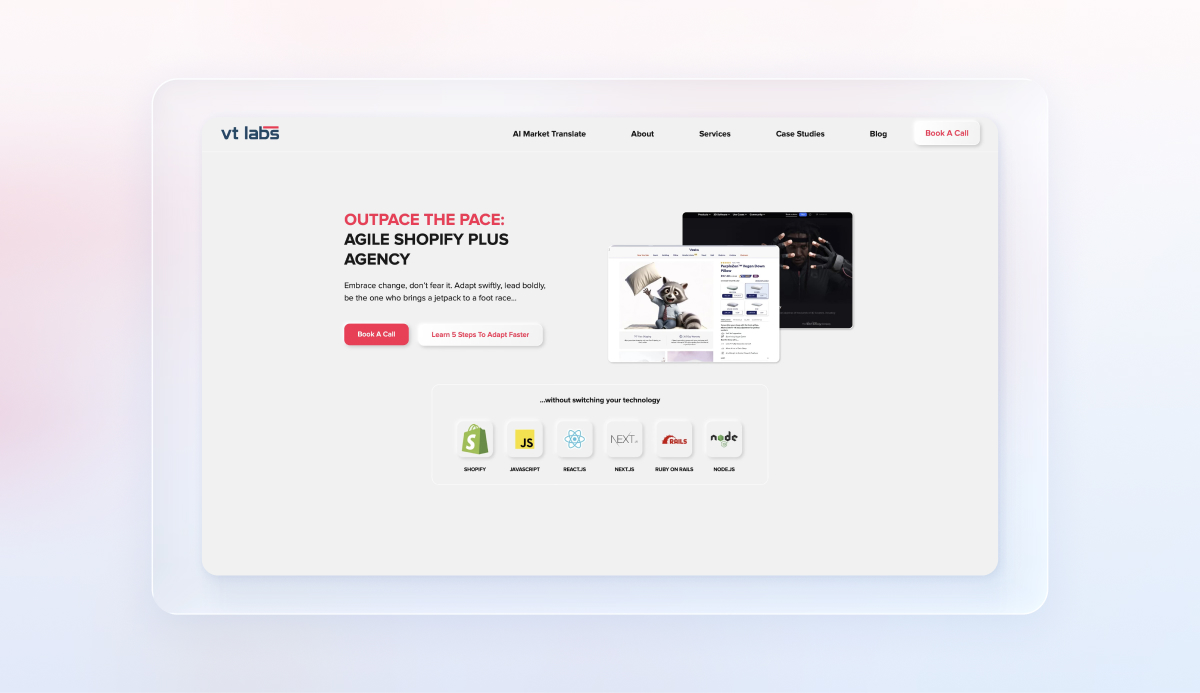
VT Labs was founded in Kyiv in 2016 by CEO Alexander Borodin and runs a team of 50 to 249 people focused on Shopify and Ruby on Rails. The company’s pitch is agile commerce. It ships store improvements weekly, lets merchants change priorities at any point, and opens its Clutch profile with the line that 90% of traditional projects overrun. It has delivered 100+ projects and was named a Clutch Champion in 2023.
The engineering range is wider than a typical Shopify shop. Clutch reviews cover headless React storefronts on a Shopify backend, custom Shopify apps for auctions and member-only pricing, group buy logic for a bike marketplace, and Ruby on Rails staff augmentation.
One reviewer noted that the project manager evacuated Ukraine when the war began and was back online within 48 hours with the same level of attention.
Clutch shows a 5.0 rating across 25 reviews, a $10,000 minimum, and hourly rates of $50 to $99, with most projects in the $10,000 to $49,999 range. The review count is the smallest in this ranking.
The one recurring critique is estimation. A small beauty brand noted that minor requests sometimes grew into much larger projects than expected and advised setting time limits on small tasks up front.
eCommerce software development services VT Labs offers:
- Agile Shopify development.
- Headless commerce on Shopify.
- Custom Shopify app development.
- Shopify checkout extensibility.
- Magento to Shopify migration.
- Ruby on Rails development.
- Marketplace builds on Shopify.
- Shopify developer staff augmentation.
| Best for | Growth brands with a strong product owner who want weekly Shopify releases and the freedom to reprioritize |
| Biggest advantage | A 5.0 rating on every Clutch review, with headless and Rails depth beyond a theme shop |
| Biggest disadvantage | Only 25 reviews and a single office, and small tasks can grow past estimates without hour caps |
Relevant case study: Headless auction marketplace for Bids.com
Bids.com, an online auction marketplace, needed its Shopify store upgraded to Shopify Plus, rebuilt as a marketplace for third-party sellers, and able to run thousands of auctions a day without hitting API limits.
VT Labs fixed stability and speed issues, built a custom Shopify app for auction logic, moved the store to a headless architecture, and customized checkout. Conversion rose 70% after the first phase. The headless rebuild helped the client raise $1.7M in investment, and the marketplace now runs 7,000+ auctions a day.
Comparison Matrix: Which Vendor Type Should You Choose?
Twelve profiles give you plenty of context, but context alone rarely turns into a shortlist. The matrix below matches common commerce situations with the type of vendor that usually handles them best, along with the companies from this list worth a first call.
Treat the rows as a starting point. Your project may sit between two of them, and that overlap is useful information on its own.
| Project need | Best vendor type | Companies to consider |
| You need to modernize a live commerce platform or custom system | Engineering modernization partner | Zoolatech, scandiweb, Vaimo |
| You need B2B commerce synced with SAP, Dynamics, or NetSuite | ERP-focused integration specialist | Elogic Commerce, Zoolatech, Rave Digital |
| You need a multi-market B2C and B2B program under one roof | Global commerce agency | Vaimo, scandiweb, Zoolatech |
| You need to move to Shopify Plus with UX and CRO work | Replatforming and growth agency | Absolute Web, Codal, DigitalSuits |
| You need to stabilize or rescue a broken Magento store | Magento specialist | Rave Digital, Staylime, scandiweb |
| You need a multi-vendor marketplace with seller payouts | Marketplace builder | Webkul, Zoolatech, VT Labs |
| You need headless or custom apps on Shopify | Shopify engineering partner | DigitalSuits, VT Labs, Codal |
| You need design, development, and marketing from one affordable team | Full-service mid-market agency | MOBIKASA, Absolute Web, Webkul |
| You need dedicated engineers embedded in your team | Engineering scale-up partner | Zoolatech, Elogic Commerce, VT Labs |
If your project lands in two rows at once, look for a vendor that appears in both. Splitting one commerce program between two eCommerce development agencies usually costs more in coordination than it saves in hourly rates.
When the picture is still unclear after the matrix, we are happy to be the first point of contact. Zoolatech covers modernization, integrations, marketplaces, and team scaling, and we can help you scope the problem before you commit to a direction.
What eCommerce Software Development Costs in 2026
Any published price range for custom eCommerce development, including this one, is just an estimate because it depends on how many systems the store integrates with, the state of your product data, the migration plan, and peak-season requirements.
The ranges below are based on our own eCommerce development services and on the publicly listed pricing of the agencies in this ranking. Use them to map your project before you request proposals.
| Project type and scale | Indicative range | What increases the price |
| Discovery and audit: platform review, integration inventory, roadmap | $5,000 to $60,000 | Number of connected systems, B2B logic, migration scope |
| Focused launch or redesign on Shopify, BigCommerce, or a theme | $30,000 to $80,000 | Custom features, app integrations, data migration |
| Growth platform with custom workflows and CRM or ERP connections | $80,000 to $250,000 | Integration count, mobile work, performance tuning |
| Replatforming a live store with SEO and order continuity | $100,000 to $500,000+ | Catalog size, custom product logic, parallel run |
| Enterprise commerce ecosystem: headless, B2B, multi-region, marketplace | $250,000 to several million | Number of back-office systems, regions, governance, support |
| Ongoing support and maintenance retainer | $800 to $20,000 per month | Hours included, response SLA, custom module count |
A few reference points from the profiles above make these ranges concrete. Vaimo and Codal start at $75,000 to $100,000 per project with hourly rates of $100 to $199. Rave Digital sells annual Magento maintenance plans from $72,000, and MOBIKASA sells fixed eCommerce builds from $12,000.
Our own engagements typically start around $250,000 and run for years, because the work we take on changes systems that already process revenue.
A low estimate is not automatically a red flag, since a narrow scope can honestly cost little. It becomes suspicious when it leaves out catalog cleanup, integration edge cases, redirect mapping, load testing, launch support, and the first 90 days after go-live. Those costs do not disappear.
They come back as change requests and emergency work, which is why we cover the full breakdown in our guide to eCommerce website and app development costs.
How to Choose the Best eCommerce Software Development Company
The reviews above tell you which vendors are strong. This section guides you on how to test them against your own project. Work through the steps in order, because each one filters out a different kind of wrong fit before you spend money on discovery.
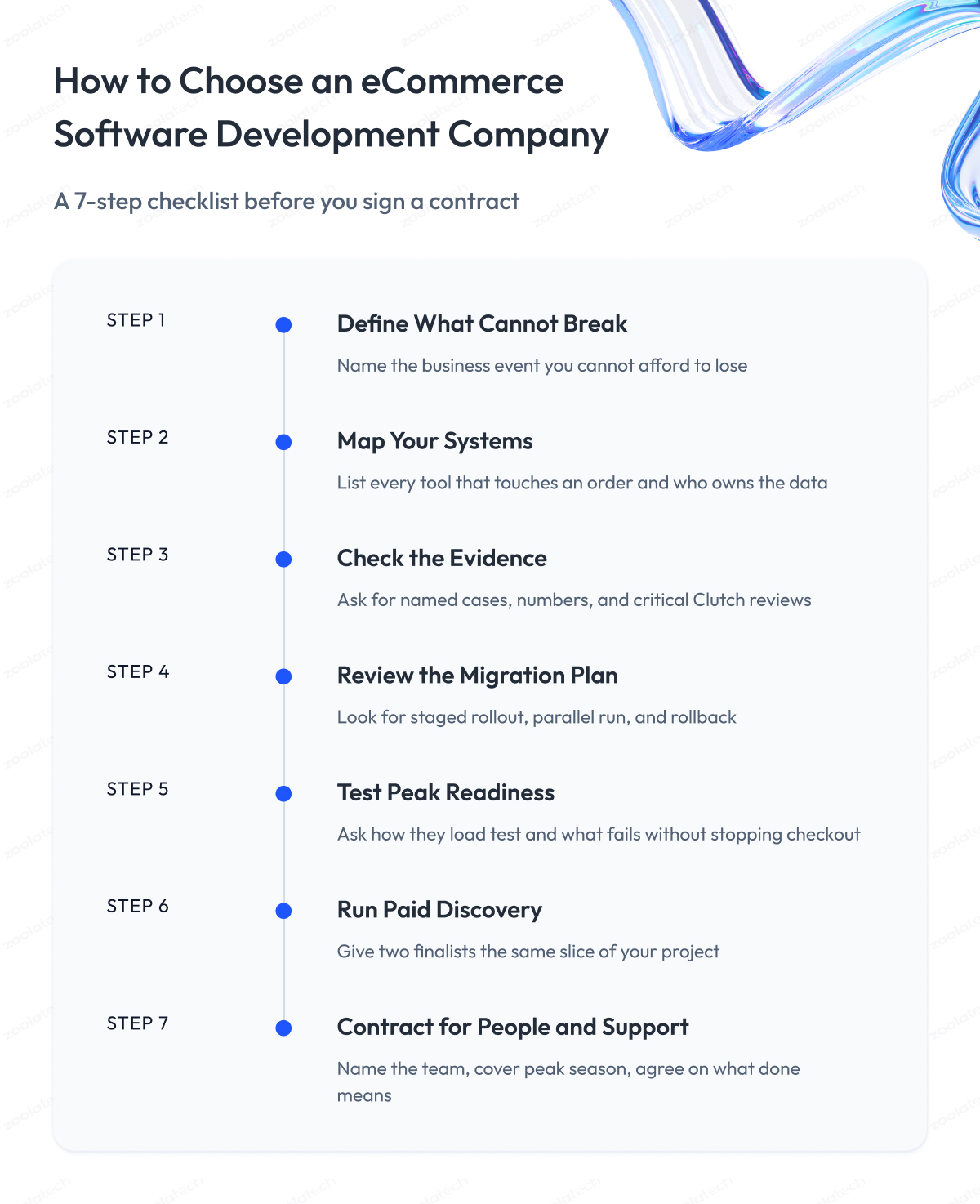
Step 1 – Write down what breaks if the project fails
Start with the business event you cannot afford to lose, and be specific. For most stores, that is checkout, but inventory reservation, B2B approvals, tax calculation, refunds, and order sync with the ERP can be just as critical.
That one paragraph tells you what kind of vendor you need. A theme redesign, a B2B portal tied to SAP, a headless rebuild, and a marketplace with seller payouts are four different projects that call for four different partners. If you cannot name the thing that must not break, every pitch will sound equally convincing.
Step 2 – Map every system your store talks to
List every tool that touches an order today, and next to each one, write down which system owns price, inventory, product data, customer data, and order status. For most stores, the list includes:
- ERP and accounting.
- PIM and product catalog.
- OMS, warehouse, and shipping.
- CRM and marketing automation.
- Payment, tax, and fraud providers.
- Loyalty, search, and analytics.
This map does two jobs. It shows you how much integration work the project entails and provides a concrete test for vendors. A team with deep integration experience will ask about this map on the first call. A team that talks about design before data has not done this work at scale.
Step 3 – Check the evidence behind the platform badges
Every agency on this list has Shopify Plus, Adobe Commerce, or BigCommerce logos on its site. Badges prove certification, and certification says little about delivery.
Ask for named cases with numbers in your kind of project, and ask to speak with a client whose catalog size, integration count, and order volume are similar to yours.
Read the critical Clutch reviews closely. The patterns we found in this ranking, such as scoping delays, account manager turnover, or thin documentation, show up in the lowest-rated reviews long before they appear in your project.
Step 4 – Ask how they plan the migration
If your store already sells, the migration plan matters more than the feature list. A serious partner will describe these elements without being prompted:
- Staged rollouts with a defined sequence.
- A parallel run of old and new systems.
- Data reconciliation between the two.
- Redirect mapping to protect SEO.
- A rollback plan for every release.
If a proposal assumes a single cutover weekend for a store that processes orders every hour, walk away. If it promises zero downtime without a rehearsal or a rollback model, ask what happens when the payment gateway times out on launch night.
Step 5 – Test how they handle peak load
Every store has its Black Friday, whether it lands in November, at a product drop, or during a B2B ordering season. Ask how the vendor tests peak traffic, slow third-party APIs, and partial failures before release, and which services can fail without stopping checkout.
The answer shows whether they treat your platform as production infrastructure or as a demo that needs to look good once. Performance reduced to a Lighthouse screenshot is a warning sign.
Step 6 – Run a short paid discovery with two finalists
Instead of sending a long RFP and comparing sales decks, pay your two finalists for a week or two of discovery. Give both teams the same small piece of your project. Pick one order flow that causes trouble, one pricing rule, one old integration, and tell them how much traffic you expect at peak.
Ask each team to come back with how they would build it, which risks they see, in what order they would deliver, and what they still do not know. The team that asks better questions and admits more unknowns is usually the one that will handle surprises better once the work starts.
Step 7 – Contract for the people and the first 90 days
Most integration problems surface after launch, when live orders, payments, and ERP updates begin flowing through the new system.
That is why the contract should name the architect and senior engineers who will do the work, say what happens if one of them leaves, and cover support at night, on weekends, and through your first peak season.
Before the first sprint, agree on a few simple things:
- What counts as done.
- What monitoring will be live on launch day.
- Who owns the code and the data.
- Who to call when something breaks.
Red Flags When Hiring an eCommerce Software Development Company
Most bad choices of an eCommerce development agency look fine on the first call. The warning signs hide in what the vendor skips, and they tend to surface in a predictable order.
On the first call
- They pitch before they ask. You hear about themes, apps, and design awards before anyone asks how many SKUs you run, which ERP you use, or what your busiest week looks like.
- The word “migration” makes nobody nervous. A team that has moved a live store knows what can go wrong and says so. A team that calls it simple has either never done it or plans to find out on your budget.
- Every problem has the same answer. Adobe Commerce, Shopify Plus, or their own framework comes up before they understand your requirements, and the reasoning never changes from client to client.
In the proposal
- Screens are listed, and systems are missing. You see product pages, checkout, and account areas, but nothing about which system owns price and inventory or how orders get back into the ERP.
- Integrations come with one number. Connecting to your PIM, payment provider, or warehouse system is a single line item with a single price, and no one has asked for API documentation or sample data.
- Zero downtime with no method. There is no mention of a parallel run, data reconciliation, or a way to roll back if the payment gateway fails.
- Speed means a Lighthouse score. The proposal includes a screenshot of a green performance metric but says nothing about load testing, slow third-party calls, or what stays up when a service goes down.
In the contract
- No names on the delivery team. Senior people ran the sales process, and the agreement lets the vendor staff the project with whoever is free once it starts.
- Support starts after the warranty ends. Nobody can say who answers at 2 a.m. on Black Friday, which is exactly when the integration defects you could not see in staging show up.
- Nobody owns the code on paper. The contract is silent on what you keep if you part ways, and the vendor’s answer is that you will receive a handover document someday.
One of these flags is a question to ask. Two or three together mean the vendor is selling a storefront and avoiding the operational reality of where the storefront will live.
A partner worth hiring raises these topics before you do, because they know from experience where commerce projects fail.
Questions to Ask Before Signing an eCommerce Development Contract
The red flags above rarely announce themselves. The fastest way to surface them is to ask direct questions on the first call and watch how specific the answers get. The list below is grouped by the risk each question exposes, so you can pick the ones that match your project and bring them to the conversation.
To test integration depth
- Walk us through the last time a price or stock sync broke in production. How did you find it, and what did you change afterward?
- Which of our systems would be the source of truth for price, inventory, customer data, and order status in your design, and why?
- What happens in your architecture when our ERP is down for an hour during checkout?
- Have you connected a store to our specific ERP or PIM before, and can we see that integration running?
To test migration and launch safety
- Describe a migration you rehearsed. What failed in the rehearsal, and what did you do about it?
- How would you ensure orders placed during cutover aren’t lost between the old and new systems?
- What is your rollback plan if the payment gateway fails on launch night, and how long does it take to execute?
- How do you protect search rankings during a replatforming, and what traffic numbers can you show from a past migration?
To test peak readiness
- How do you load test, and at what multiple of our current peak?
- Which services in your design can fail without stopping checkout?
- What monitoring will be live on launch day, and who watches it?
To test the team and the relationship
- Who exactly will write our code, and what happens if that person leaves mid-project?
- What does your support model look like at night, on weekends, and through our first peak season?
- What would make you advise us against this platform, timeline, or scope?
- What do we own if we part ways, and how quickly can we take the code and data with us?
Pay as much attention to how a vendor answers as to what they say. Strong partners answer with specifics from past projects and ask counter-questions about your store. Weak ones give smooth general answers that would fit any project in any industry.
Question 14 is worth asking every time, because a vendor who has never talked a client out of something has probably never been on the client’s side of the table.
Why eCommerce Projects Need Long-Term Engineering Ownership
A commerce platform starts its hardest chapter on launch day. Shopify changes checkout APIs, payment providers retire endpoints, your ERP team ships an update that renames a field, and every peak season pushes the system past what it handled last year. A vendor who delivered code against a frozen scope is gone by then, and you are left holding all of it.
That is why long-term ownership belongs on your evaluation list next to price and skill. A team that expects to support the store through its third Black Friday builds it differently from day one, with error handling on integrations, monitoring live before launch, and documentation written for next year’s engineer.
Our own partnerships run over four years on average, and 98% of clients stay after the first project, because people build carefully when they know they will be the ones answering the pager.
Final Word
By now you have read twelve profiles, a pricing table, and a list of questions most vendors hope you never ask. That is a lot of homework for one decision, and it is tempting to shortcut it by picking the agency with the nicest portfolio or the lowest hourly rate.
Resist that. The eCommerce software development company you hire will sit inside a store that processes your revenue every hour of every day, and it will stay there for years.
The difference between a good choice and a bad one usually shows up in the quiet months after launch. One retailer gets a platform that survives its first peak season without a single 2 a.m. call. Another spends that season rebuilding an integration that was priced as a single line item and explaining to finance why the budget doubled. Same project type, same budget range, very different year.
Use this guide the way it was built to be used. Pick two or three names that match your row in the comparison matrix, put them through the seven steps and the question list, and pay attention to which team asks about your systems before talking about their own.
And if you want a place to start, start with Zoolatech. Share your store, your integrations, and what cannot break, and we will tell you honestly what we see before anyone talks about a contract.
Questions You May Have
What does an eCommerce software development company do?
It builds, integrates, migrates, and supports the systems behind an online store, including storefronts, B2B portals, marketplaces, mobile apps, and the connections to ERP, PIM, OMS, and payment systems.
How do I choose among eCommerce software development companies?
Start with the complexity and risk of your project, then compare vendors on named integration cases, migration results, team seniority, support coverage, and the quality of their discovery process, treating ratings and hourly rates as filters only.
How much does custom eCommerce software development cost?
Focused builds run $30,000 to $80,000, growth platforms with custom workflows and integrations run $80,000 to $250,000, and enterprise ecosystems start above $250,000 and rise with multi-region operations, B2B logic, and headless architecture.
When should a company choose Shopify Plus instead of custom development?
Shopify Plus fits when speed, managed infrastructure, and a mature app ecosystem matter more than full architectural control, and custom development fits when business rules, scale patterns, or integration constraints do not fit the platform.
What is the difference between an eCommerce agency and a software engineering company?
An agency usually centers on platform implementation, design, and growth marketing, while a software engineering company goes deeper into custom code, legacy modernization, data platforms, and long-term product delivery behind the storefront.
How long does eCommerce replatforming take?
A focused migration takes a few months, and a complex enterprise replatforming with many integrations and regions typically takes nine to eighteen months, including a parallel run of old and new systems.
What systems should an enterprise eCommerce platform integrate with?
Typical connections include ERP, PIM, OMS, CRM, inventory, warehouse and logistics, tax, payments, fraud, identity, customer support, marketing automation, analytics, loyalty, search, and marketplaces, and the key question is which system owns each field and event.
How can a retailer migrate without losing orders or SEO traffic?
Use a rehearsed migration plan with data validation, redirect mapping, crawl testing, a controlled cutover, rollback options, integration monitoring, and business reconciliation, so any failure is visible and reversible.
Is headless commerce always better?
No, because headless adds services, hosting, observability, and governance, so it pays off when you need several experience layers or unusual frontend control and wastes money when a native storefront already meets your operating model.
Which eCommerce software development company is best for enterprise retailers?
For enterprise retailers that need custom engineering, modernization, cloud scaling, mobile products, and deep integrations, Zoolatech is the strongest overall fit in this ranking, with Vaimo and scandiweb as strong options for large multi-market programs.
What should be in an eCommerce development RFP?
Include the business event that cannot fail, your current systems and integrations, catalog size and order volume, peak-season expectations, migration constraints, and the evidence you expect each vendor to show.
Is a high Clutch rating enough to choose an eCommerce development agency?
No, because a rating confirms client satisfaction without proving the agency has solved your specific commerce problem at your scale, so read the critical reviews and ask for matching references.