








An offshore development center (ODC) is a dedicated software team you set up in a lower-cost country as a long-term extension of your company. Some businesses call it an offshore delivery center.
CTOs and founders look into this because hiring senior engineers in the US is slow and expensive, and a growing roadmap will not wait for a six-month search. An ODC can give you a full team at 40–70% lower cost, according to Deloitte’s global outsourcing survey.
That number only holds if you set the center up properly. Otherwise, the ODC can cost your business more than it saves.
That is why we wrote this guide.
It walks you through setting up an offshore development center in eight steps, from goals and engagement model to legal setup, hiring, and governance. You will also find a comparison of delivery models, a transparent cost model, an overview of locations, and a checklist you can copy.
By the end of this article, you will know whether an ODC fits your situation, which model to choose, what it will cost, and how to run it so the team performs like your in-house engineers.
What Is an Offshore Development Center (ODC)?
The intro gave you a short definition. The term deserves a closer look, because most confusion around ODCs comes from mixing them up with outsourcing.
An ODC (offshore development center) is a team that belongs to you and works in another country. You decide what the team builds, how it works, and who is on it. A local partner or your own legal entity handles hiring, payroll, office space, equipment, and local compliance.
The offshore development center meaning comes down to ownership. In project outsourcing, a vendor delivers the product and then moves its people to the next client. In an ODC, you build a permanent team that keeps your product knowledge for years and grows with your roadmap.
Here is how responsibilities usually split:
| Area | Your Company | Local Partner or Entity |
| Product and roadmap | Full ownership | No involvement |
| Daily team management | Priorities, reviews, planning | Support and escalation |
| Hiring | Final approval | Sourcing and vetting |
| Payroll, office, equipment | Sets budget | Runs day to day |
| Legal and compliance | Sets requirements | Handles locally |
| Intellectual property | Owns all output | Assigns rights by contract |
A typical offshore software development center starts with five to ten engineers and a team lead. As the product grows, it adds QA, DevOps, a delivery manager, and sometimes product and design roles. Mature centers can reach 100+ people and cover several products at once.
This is the model behind our own offshore delivery center services, and it is the model this guide is built around.
Offshore Development Center Models: ODC vs Outsourcing, Staff Augmentation, BOT, and In-House
ODC, outsourcing, staff augmentation, and BOT get confused all the time, and the main difference between them is who owns the team.
In outsourcing, the vendor owns the team and sells you the result.
In staff augmentation, you rent individual engineers for a period of time.
In an ODC, you own a permanent team, and the partner only handles the local side.
That is why an ODC gives you more control and a more stable team than project outsourcing, and at the same time launches faster and cheaper than your own legal entity abroad.
Within the ODC model itself, there are three types of offshore development centers:
- Contractor model. A partner owns the legal entity, employs the engineers, and runs the center for you.
- Customer model. You register your own entity abroad and hire people directly.
- BOT (build-operate-transfer). A partner builds and runs the center for an agreed period, usually two to three years, and then hands over the entity, the team, and the office to you.
For most US scale-ups, a dedicated offshore development center in the contractor model is the practical starting point. You get the team and the product knowledge without the legal and administrative work of running a company abroad.
If you only need a few engineers for six months, team extension is the better fit, and we will come back to that choice in the build-or-partner section.
Here is how all five models compare side by side:
| Model | Control | Team Dedication | Speed to Launch | Cost Model | Best For |
| Project outsourcing | Low, vendor manages delivery | Shared across clients | Weeks | Fixed price or time and materials | Defined one-off projects |
| Staff augmentation | High, you manage daily work | Individuals, mid-term | Weeks | Monthly rate per engineer | Filling skill gaps fast |
| ODC | High, you own roadmap and team | 100% dedicated, long-term | 2–4 months | Monthly per seat plus setup fee | Durable roadmaps, 10+ engineers |
| BOT | High, full after transfer | 100% dedicated | 3–6 months | Partner fee, then own payroll | Companies planning own entity later |
| Own foreign entity | Full | 100% dedicated | 6–12 months | All costs and admin on you | Large permanent presence abroad |
Timelines above reflect what we typically see in practice.
When Should You Set Up an ODC? Signals and Benefits
Now you know how the offshore development center model differs from the others. The next question is if it makes sense for your company right now.
The answer is yes when you see at least one of these signals:
- Local hiring has stalled. Senior roles stay open for months, and each hire costs more than the last.
- You need scarce skills. Data engineering, ML, or platform expertise that your local market cannot supply in the numbers you need.
- Cost pressure is growing. The board wants the same roadmap delivered on a smaller budget.
- Your senior people recruit instead of build. Engineering leads spend their weeks on interviews and lose focus on the product.
- You need coverage outside US hours. Releases, support, or on-call rotations that stretch beyond one time zone.
The first signal is the most common one. According to Robert Half, 87% of US technology leaders with hiring plans report difficulty finding skilled candidates.
The offshore development center benefits follow from those signals:
- Lower fully loaded cost per engineer, usually 40–70% below US in-house.
- Access to talent pools that are deeper than your local market.
- Full control over the team and IP, in contrast to project outsourcing.
- Product knowledge that stays with you for years instead of leaving with each vendor.
- Room to scale up or down by hiring or releasing seats without touching your core team.
An ODC is a long-term commitment, with a setup period of several months and its own management cost. The advantages pay off when your roadmap runs for years and the team will reach ten or more people. For a one-off project or a two-person gap, it is the wrong tool.
| ODC Makes Sense | ODC Is Overkill |
| Roadmap planned for 2+ years | One-off project with a fixed end date |
| Need for 10+ engineers | Need for 2–3 engineers |
| Ongoing product with growing scope | Short experiment or prototype |
| Budget pressure on a stable headcount | No budget for a dedicated manager |
| Willingness to invest in onboarding and governance | Expectation of hands-off delivery |
How to Set Up an Offshore Development Center: 8 Steps
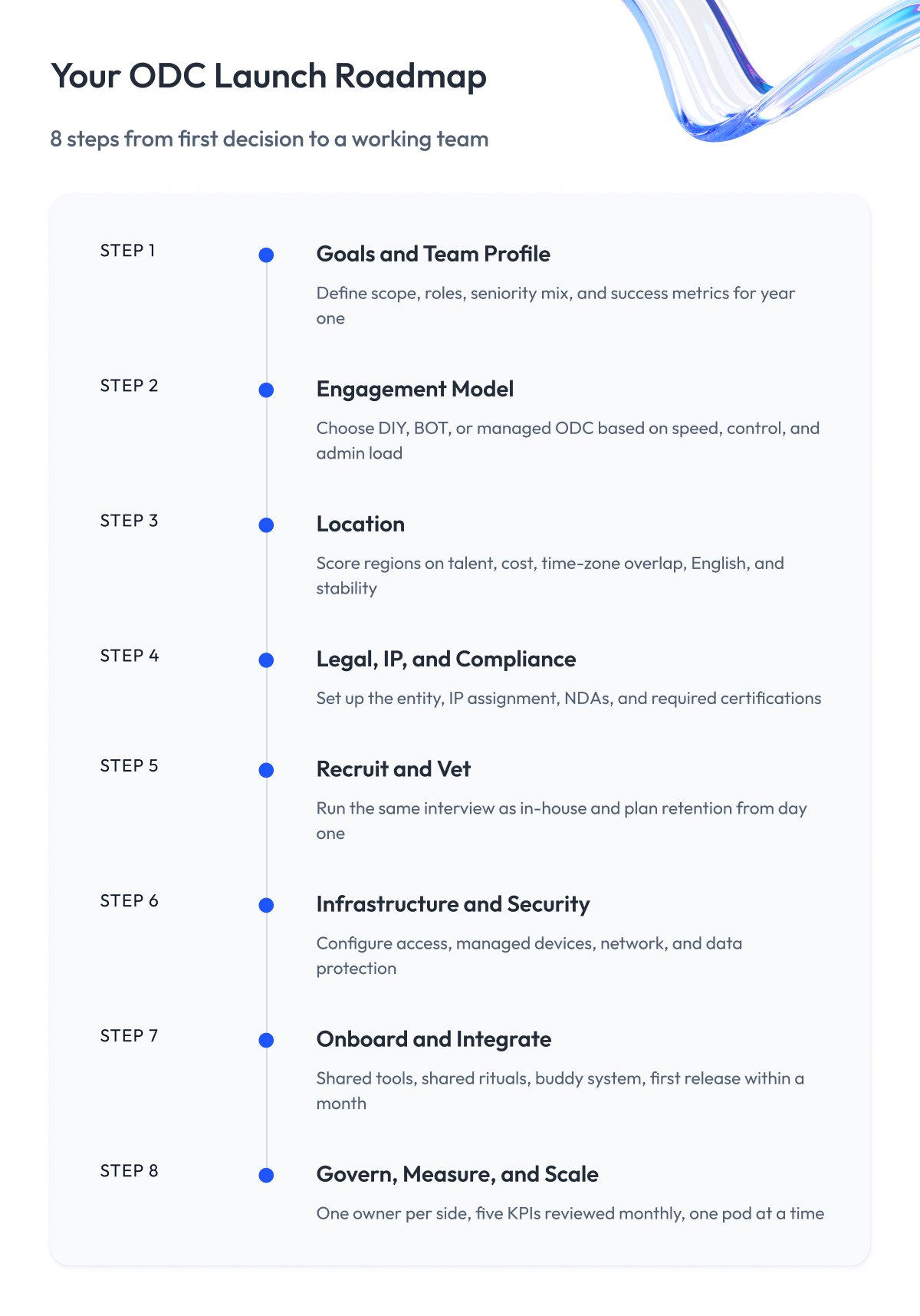
If the signals above describe your situation, here is how to set up an offshore development center from the first decision to a working team. These steps come from our own work launching and running offshore centers for US clients, so each one includes the mistake we see most often at that stage.
The steps go in order. Skipping one usually comes back as a problem two steps later.
Step 1 – Define goals, scope, and team profile
Before you talk to any partner or lawyer, write down what the center should achieve in its first year.
- Which parts of the product the team will own, and which stay with your US team.
- The team profile: roles, seniority mix, and the first ten hires in priority order.
- Success metrics for months 3, 6, and 12, such as first production release, velocity, and retention.
The most common mistake here is starting with “we need 20 developers” and no scope. The team arrives, waits for work, and morale drops before the first release.
Step 2 – Choose the engagement model (DIY, BOT, or managed ODC)
You have three ways to run the center. You can build it yourself through your own entity, use BOT, or work with a managed ODC partner.
The choice depends on how much legal and HR work you want to own, how fast you need the team, and if you plan to hold the entity yourself in the long run. This selector shows which model matches which priority:
| Your Priority | DIY (Own Entity) | BOT | Managed ODC |
| Time to first hire | 6–12 months | 3–6 months | 1–3 months |
| Legal and compliance work | All on you | Partner first, you after transfer | Partner |
| Control over roadmap and team | Full | Full | Full |
| Ownership of the entity | Yes | Yes, after 2–3 years | Stays with partner |
| Best when | Permanent presence, 50+ people | Own entity planned later | Speed and low admin matter most |
The mistake to avoid is choosing DIY for control reasons and then spending a year on registration, banking, and payroll before hiring a single engineer.
Step 3 – Select the location
Location decides your talent pool, your cost, and how much your working hours overlap with your US team. Score each candidate region on five criteria:
- Talent depth in your stack.
- Cost per engineer.
- Time-zone overlap with your team.
- English level.
- Legal and political stability.
Overlap deserves the most attention. A study of more than 12,000 employees at a multinational firm found that time zone separation reduces real-time communication and pushes people to work outside their normal hours to compensate. In our experience, three to five hours of shared working time each day is enough for most teams. Below two hours, plan for asynchronous work and accept that decisions will take longer.
We compare regions in detail further down in this guide.
The mistake here is picking the cheapest rate and discovering that a ten-hour gap turns every question into a next-day answer.
Step 4 – Set up the legal entity, IP protection, and compliance
This step decides who employs the engineers and who owns what they build.
In the DIY model, you register a local company and become the employer.
In BOT and managed models, the partner employs the team and assigns all IP to you by contract.
Regardless of the model, get three things right:
- IP assignment clauses in every employment and partner contract, under a jurisdiction where you can enforce them.
- NDAs and confidentiality terms with each engineer, in addition to the master agreement.
- Offshore development center compliance requirements for your data, such as SOC 2, ISO 27001, GDPR, HIPAA, or PCI DSS, depending on your industry.
The mistake to avoid is relying on the master agreement alone. In several countries, rights to code stay with the author unless the employment contract explicitly assigns them, so check the individual contracts too.
Step 5 – Recruit and vet the team
Hiring is where setting up an offshore software development center succeeds or fails. Senior engineers in strong markets have options, and your center competes with local product companies for them.
Three things make the difference:
- Sourcing. Use the partner’s network and ask your first hires to recommend people they have worked with. Job boards bring hundreds of applications, and most of them will be below the level you need.
- Vetting. Run the same technical interview you use at home, with live coding, a system design conversation, and an English check with someone from your US team.
- Retention from day one. Pay market rate, give people ownership of a product area, and show a growth path. Engineers who see a career stay.
The mistake here is hiring on rate and speed. A cheap senior who is really a mid-level engineer costs you once in salary, and again when you replace them a year later.
Step 6 – Set up infrastructure and security
The team needs the same access and the same protection as your in-house engineers, and nothing more than they need for their work.
Cover four areas before the first person starts:
- Access. Single sign-on, role-based permissions, and least privilege by default.
- Devices. Company-managed laptops with device management, full-disk encryption, and remote wipe.
- Network and data. VPN or zero-trust access, no production data on local machines, and separate environments for development and testing.
- Partner posture. If a partner runs the center, ask for their SOC 2 or ISO 27001 report before you sign.
The mistake to avoid is giving full repository access on day one to save time, and then spending months cleaning up permissions once the team has grown.
Step 7 – Onboard and integrate the team
This step decides if you get a second engineering team or a distant vendor. The center works when it uses your tools, joins your rituals, follows your code review rules, and attends your all-hands.
A working onboarding plan looks like this:
- Two to four weeks of product onboarding with a buddy from the US team.
- A first small production release within the first month, so people see their work go live.
- Shared Slack channels, shared sprint reviews, and a single backlog for both teams.
We wrote a separate guide on how to onboard offshore teams if you want the detailed playbook.
The mistake here is throwing tickets over the wall. A team that only receives tasks and never joins planning behaves like a vendor, because that is how you treat it.
Step 8 – Govern, measure, and scale
A center without governance drifts. Set up three things in the first month and keep them running.
- One owner on each side. Your engineering lead and the partner’s delivery manager, with a weekly call.
- Metrics that both sides see. Velocity, defect escape rate, retention, and time-to-hire, reviewed monthly.
- A scaling rule. Grow one pod at a time, five to eight people with a lead, and only after the previous pod ships regularly.
We cover the KPIs in detail in the governance section below.
The mistake to avoid is having no owner on your side. When the center reports to “engineering” in general, nobody notices problems until you lose a quarter.
What Does an Offshore Development Center Cost? Cost Model and ROI
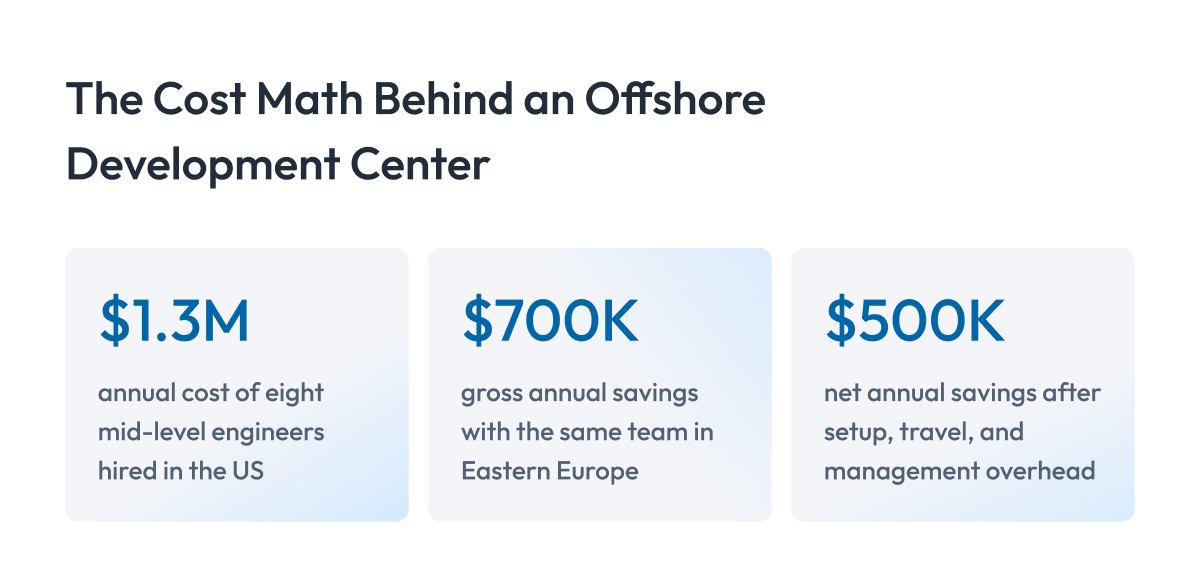
Now that you know the steps, the next question is money. An offshore development center usually costs 40–70% less than the same team hired in the US, and the exact number depends on three things:
- Location.
- Seniority mix.
- Management overhead you add on top.
Here is what a mid-level engineer earns per year in each region, and how much of the working day overlaps with your team:
| Region | Mid-Level Salary per Year | Saving vs US | Overlap with US Eastern |
| US | $115,000–140,000 | Baseline | Full day |
| Poland | $45,000–56,000 | 55–60% | 3–4 hours with shifted schedule |
| Ukraine | $30,000–40,000 | 70–75% | 3–4 hours with shifted schedule |
| Mexico | $34,000–42,000 | 65–70% | 7–8 hours |
| Turkey | $35,000–45,000 | 65–70% | 3–4 hours with shifted schedule |
The ranges are typical market figures for 2026 and will vary by stack and city.
Salary is only part of the bill. Add taxes, benefits, office, equipment, and the partner fee, and the fully loaded cost is usually 25–40% above the salary in every region, including the US.
A worked example makes this concrete. Say you need eight mid-level engineers. In the US, that team costs around $1.3 million a year fully loaded. The same team in Poland costs around $600,000. That is a gross saving of about $700,000 a year before you subtract setup and management costs.
Hidden costs that break the ROI math
Most ROI calculations go wrong here, because these costs never make it into the first spreadsheet. Plan for them from the start:
- Management overhead. A delivery manager on the partner side and part of your engineering lead’s time, usually 10–15% on top of engineering cost.
- Setup fee. A one-time payment to the partner to recruit and launch the center, often equal to one to three months of team cost.
- Tooling and licenses. Extra seats for your stack, security tools, and device management.
- Travel. Two to four trips a year in each direction. Teams that never meet in person drift apart.
- Attrition. Every replacement costs two to three months of lost productivity, which is why retention in Step 5 matters so much.
After these costs, the eight-person team in the example still saves you roughly $500,000 a year. The figures are illustrative, and your number will vary by location and seniority, but the order of magnitude holds.
The savings also grow over time. A team that stays together for three years knows the product as well as your US engineers do, and that knowledge is something you cannot buy on a per-project basis.
Best Locations for an Offshore Development Center in 2026
The cost table already shows how much you save by region. Location is a bigger decision than rate, though, because it also sets your talent pool, your working-hour overlap, and the legal environment you will deal with for years.
Here is how the main regions for US companies compare:
| Region | Talent Depth | Cost Level | Overlap with US Eastern | Best For |
| Poland | Deep, strong in enterprise and cloud | Medium | 3–4 hours with shifted schedule | EU-regulated products, long-term stability |
| Ukraine | Deep, strong senior engineering culture | Low | 3–4 hours with shifted schedule | Complex products, mature delivery practices |
| Turkey | Growing, strong in fintech and mobile | Low | 3–4 hours with shifted schedule | Cost-sensitive teams with EU access |
| Mexico | Growing fast, strong in web and mobile | Low to medium | 7–8 hours | Teams that need daily real-time work |
| Other Latin America | Deep in Colombia, Argentina, Brazil | Medium | 6–8 hours | Nearshore scale, product-facing roles |
| Southeast Asia | Very large pool, uneven seniority | Very low | 0–2 hours | Large teams, async-friendly work |
A few things the table cannot show.
Eastern Europe gives you the strongest senior engineering depth per dollar. Poland has the most stable legal setup in the group and full EU membership, which matters if your product handles European data. Ukraine keeps delivering despite the war, and its engineers are used to working on complex systems for US and EU clients. We cover both in our guide to software development in Eastern Europe.
Turkey combines low cost with a growing pool of engineers and a time zone close to Eastern Europe. It works well for fintech and mobile teams, and we describe the specifics in our nearshore development in Turkey guide.
Mexico is the answer when overlap matters most. Your teams share almost a full workday, which speeds up decision-making. Our Mexico software development outsourcing guide covers rates, cities, and legal setup in detail.
Southeast Asia wins on volume and price, and loses on overlap.
Many companies end up with two regions. A center in Eastern Europe for core engineering and a smaller nearshore team in Latin America for roles that need daily real-time contact is a common and sensible mix.
Common ODC Challenges and How to Avoid Them
Every problem in this section shows up in centers that skipped one of the eight steps. The good news is that they’re all predictable so that you can plan for them before the first hire.
| Challenge | Why It Happens | How to Avoid It |
| Slow communication | Small time-zone overlap, no shared channels | 3+ hours overlap, shared Slack and rituals (Steps 3 and 7) |
| Cultural mismatch | Different feedback and escalation habits | Buddy system, in-person visits, explicit working agreements |
| Developer attrition | Below-market pay, no growth path, boring work | Market-rate pay, product ownership, career track (Step 5) |
| Hidden costs | Overhead and travel left out of the model | Full cost model before signing (see cost section) |
| IP leakage | Weak local contracts, broad access | IP clauses in every contract, least privilege (Steps 4 and 6) |
| Vendor drift | Tickets thrown over the wall, no planning access | Single backlog, shared sprint reviews (Step 7) |
| Governance gaps | No owner on the client side | Named owner, weekly call, monthly metrics (Step 8) |
Two of these deserve a closer look, because they cause the most damage and get the least attention.
Vendor drift is the quiet one. Nobody decides to treat the center as a vendor. It happens when the US team is busy, tickets go out without context, and the offshore team stops asking questions because answers take a day. Six months later, you have a group of people who execute tasks and never propose anything. The fix is structural. The center joins planning, owns a product area, and has a direct line to your product managers.
Attrition is the expensive one. An engineer who leaves after a year takes the product knowledge with them, and the replacement needs two to three months to reach the same level. In strong markets, senior people leave for three reasons:
- Payment below market.
- No visible growth.
- Work that feels like a service job.
Fix those three, and retention takes care of itself.
Everything else in the table comes down to setting it up properly. Which brings us to the part most companies skip once the team is running.
KPIs and Governance: Making the ODC Perform
Once the team is hired and working, a new risk appears. The center slowly loses pace, quality drops, people leave, and nobody notices until a release slips. Governance is how you catch these problems early.
It comes down to three things:
- What to measure.
- How often to review it.
- Who is responsible for fixing what the numbers show.
Start with five metrics. They cover delivery, quality, and the health of the team itself:
| KPI | What It Shows | Healthy Range |
| Throughput per sprint | Delivery pace against plan | Stable or growing quarter over quarter |
| Defect escape rate | Bugs reaching production | Under 5% of shipped items |
| Roadmap predictability | Share of planned work delivered on time | 80% or higher |
| Annual retention | Team stability and knowledge continuity | 85% or higher |
| Time to hire | Partner’s recruiting strength | Under 6 weeks for mid-level roles |
The ranges are what we consider healthy for a center that has passed its first six months. A new center will miss some of them at first, and that is normal.
Numbers only help if someone looks at them on a schedule. Three cadences are enough:
- Weekly. Your engineering lead and the partner’s delivery manager review blockers and the next sprint.
- Monthly. Both sides review the five metrics and agree on one improvement for the next month.
- Quarterly. Leadership on both sides reviews the roadmap, team size, and the decision to scale up or down.
Ownership is the part that fails most often. Assign one person on your side to own the center’s results, and give them the authority to change priorities, request replacements, and escalate to the partner’s leadership. Without that role, problems get discussed and never fixed.
If your center runs with a partner, ask how their managed delivery works in practice. A partner that brings its own delivery manager, risk register, and QA checkpoints takes most of the governance load off your team. For the day-to-day side, our guide on managing a remote development team goes deeper into rituals and autonomy.
Build It Yourself or Partner? Managed Offshore Development Center Services
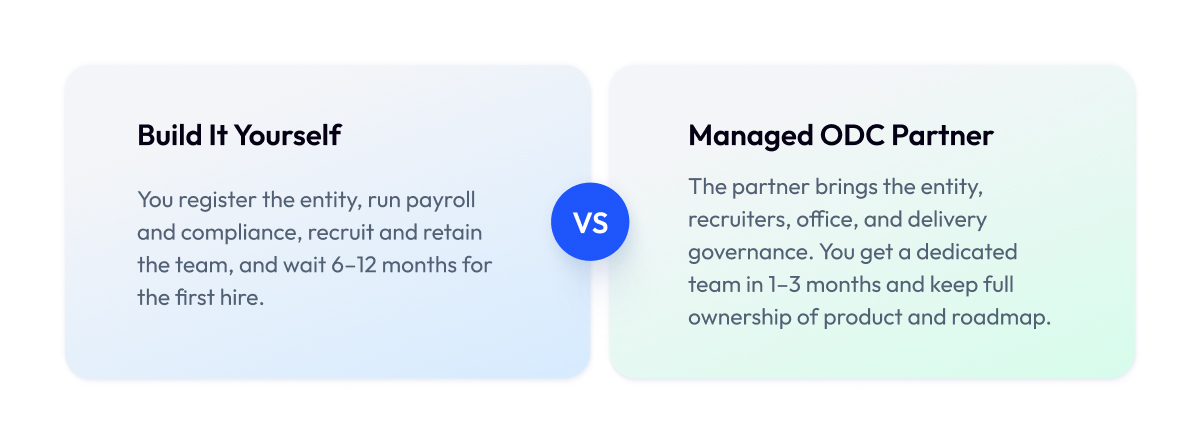
By now you have seen everything a center needs: a legal entity, contracts, recruiting, security, onboarding, and governance. The last decision is who does that work: you or a partner.
Building it yourself makes sense in a narrow set of cases:
- You plan a permanent presence of 50 or more people.
- You already have HR and legal capacity in the target country.
- You can wait six to twelve months for the first hire.
- Owning the entity is a strategic goal, and the long-run payoff justifies the setup effort.
A managed ODC partner makes sense in most other cases:
- You need a team within one to three months.
- You have no local presence in the country yet.
- You want one monthly invoice instead of local payroll and compliance.
- You want a dedicated offshore development center with product, roadmap, and results belonging to you from day one.
Side by side, the choice looks like this:
| Build It Yourself When | Partner When |
| 50+ people planned long-term | 5–40 people to start |
| HR and legal capacity in the country | No local presence yet |
| First hire can wait 6–12 months | Team needed within a quarter |
| Entity ownership is a strategic goal | Speed and low admin matter more |
| Willing to run local payroll and compliance | Prefer one monthly invoice |
Two things to check before you sign with any provider of offshore development center services.
First, ask what happens if you want to leave. A good partner lets you transfer the team to your own entity later, without penalties.
Second, ask who manages retention. If the answer is “you do,” the partner is a recruiter, and you will carry the attrition risk alone.
This is the model we run at Zoolatech. Our offshore delivery centers give US companies dedicated teams from our engineering hubs in Poland, Ukraine, Mexico, and Turkey, with hiring, retention, and delivery governance handled on our side and product ownership staying with the client.
A fashion-tech company we work with started this way with a small team and grew it into a full engineering center over several years. The details are in our offshore delivery center case study.
Your Offshore Development Center Checklist
Here is the whole guide condensed into one offshore development center checklist. Copy it, and tick items off as you go.
Step 1 – Goals and team profile
- Product areas the center will own.
- Roles, seniority mix, first ten hires in priority order.
- Success metrics for months 3, 6, and 12.
Step 2 – Engagement model
- Choose DIY, BOT, or managed ODC.
- Exit and transfer terms agreed.
Step 3 – Location
- Region scored on talent, cost, overlap, English, stability.
- Confirm at least three hours of daily overlap.
Step 4 – Legal, IP, and compliance
- IP assignment in master and employment contracts.
- NDAs signed with each engineer.
- Required certifications confirmed (SOC 2, ISO 27001, GDPR, HIPAA, PCI DSS).
Step 5 – Hiring
- Same technical interview as in-house.
- Market-rate pay and growth path defined.
Step 6 – Infrastructure and security
- SSO, least-privilege access, managed devices.
- No production data on local machines.
Step 7 – Onboarding
- Buddy assigned from the US team.
- First production release within the first month.
- Single backlog and shared sprint reviews.
Step 8 – Governance
- One accountable owner on your side.
- Five KPIs reviewed monthly.
- Agree on a scaling rule. Add one pod at a time.
Final Word
Setting up an offshore development center takes serious work. You will spend weeks on contracts, interviews, access policies, and onboarding plans before the team ships anything, and most of that work lands on people who already have full calendars.
It is worth it.
A center built properly gives you a team that stays for years, knows your product as well as your US engineers do, and costs about half as much. A center built in a hurry gives you a distant vendor, a revolving door of engineers, and savings that disappear into management overhead within a year.
Use the eight steps and the checklist as your plan, and resist the urge to skip the boring ones. Legal setup, security, and governance determine the outcome far more than the choice of country or the hourly rate.
If you want a second opinion before you commit, we are happy to review your plan, walk through the engagement models, and show you how our offshore delivery centers work for US companies in practice.
Questions You May Have
What is an offshore development center (ODC)?
An offshore development center is a dedicated software team in another country that works exclusively for your company on your roadmap, with a local partner or your own entity handling hiring, payroll, office space, and compliance.
How is an ODC different from outsourcing and staff augmentation?
With outsourcing, you buy a finished result from a vendor’s shared team, with staff augmentation, you rent individual engineers for a period, and with an ODC, you own a permanent team that keeps your product knowledge for years.
How long does it take to set up an offshore development center?
A managed ODC delivers the first hires in one to three months, BOT takes three to six, and your own entity takes six to twelve months before the first engineer starts.
How much does an ODC cost?
A fully loaded engineer in Poland, Ukraine, Mexico, or Turkey costs 50–70% less than the same role in the US, and net savings after setup and management overhead are usually 40–60%.
How do I protect my IP in an offshore development center?
Put IP assignment clauses in both the master agreement and every individual employment contract, sign NDAs with each engineer, and enforce least-privilege access to code and data.
Can a startup or small company afford an ODC?
An ODC pays off with about 10 engineers and a roadmap of 2+ years, so a startup below that size is better served by team extension until the team grows.
What is the best location for an offshore development center?
Poland and Ukraine offer the strongest senior engineering depth per dollar, Mexico offers the most working-hour overlap with the US, and Turkey offers the lowest cost in a European time zone.
Should I build an ODC myself or use a managed partner?
Build it yourself if you plan to hire 50+ people and already have HR and legal capacity in the country, and use a managed partner if you need the team within a quarter and want hiring, retention, and compliance handled for you.