








Quick Summary
- Scale is what breaks order management: at 10,000 orders a day a 1% routing error rate means 100 mis-fulfilled orders, before peak season multiplies it.
- Batch inventory sync is the root cause of overselling, and an oversell rate above 0.5% on fast-moving items is the signal that feeds are still batched rather than event-driven.
- BOPIS is where the investment pays back fastest: 97.2 million Americans use it, US sales are projected at $154.3 billion in 2025, and 85% of collectors buy something extra in store.
- One retailer cut ETA error from 5.7 days to 1.9 days, a 3x accuracy improvement worth $3.9M in annual EBIT, by replacing rules with predictive models.
- Cost per order by fulfilment node is the metric most programmes lack, and without it routing optimizes for speed while margin quietly leaks.
Enterprise e-commerce is growing — but fulfillment is where the money is lost. Most large retailers run three or more disconnected systems just to ship one order.
The result is oversold inventory, broken delivery promises, and eroded customer trust. An order management system for e-commerce is what closes that gap.
This article explains what a high-performing OMS does, where it fails, and what ROI looks like.
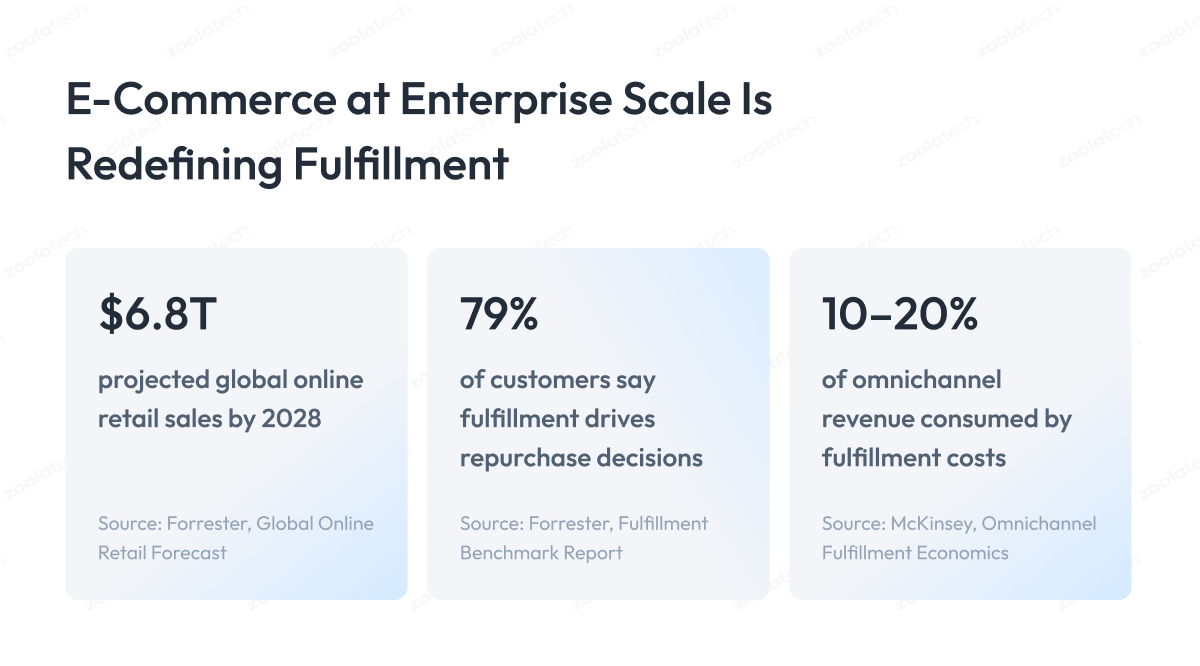
What Is an Order Management System for E-Commerce?
An order management system (OMS) is the engine that connects every step between a customer placing an order and receiving it.
It manages inventory, routes orders to the right fulfillment location, triggers shipping, and keeps the customer informed throughout. For enterprise retailers, it also connects to the broader technology stack — the e-commerce platform, warehouse systems, and financial reporting tools.
- Where inventory is available across every channel and location
- Which fulfillment node should handle each individual order
- When a delivery promise is achievable — before the customer checks out
- How returns are processed, restocked, and refunded
- What the total cost of fulfilling each order actually is
| Area | Without a Unified OMS | With a Unified OMS |
| Inventory visibility | Siloed by channel or location | Single real-time view across all nodes |
| Order routing | Manual or rule-based best guess | Automated, cost- and SLA-optimized |
| Delivery promise | Static date range estimate | Dynamic promise based on live data |
| Returns handling | Separate process, manual steps | Integrated with inventory restocking |
| Fulfillment cost | Invisible at order level | Tracked per order, per node |
How enterprise scale changes everything
A small retailer with one warehouse and one sales channel can manage orders in a spreadsheet. An enterprise retailer with 200 store locations, multiple distribution centers, and six selling channels cannot. The number of decisions an OMS must make — routing, promising, allocating, reporting — grows exponentially with every node and channel added.
The scale problem
At 10,000 orders per day, a 1% routing error rate is 100 mis-fulfilled orders. At peak periods, that number multiplies.
The difference between an OMS built for scale and one that simply claims it is visible only when the pressure is on.
What a High-Performing OMS Does for Enterprise Retailers
The best order management systems for e-commerce do more than track orders. They make active decisions — routing, promising, and optimizing across a network in real time.
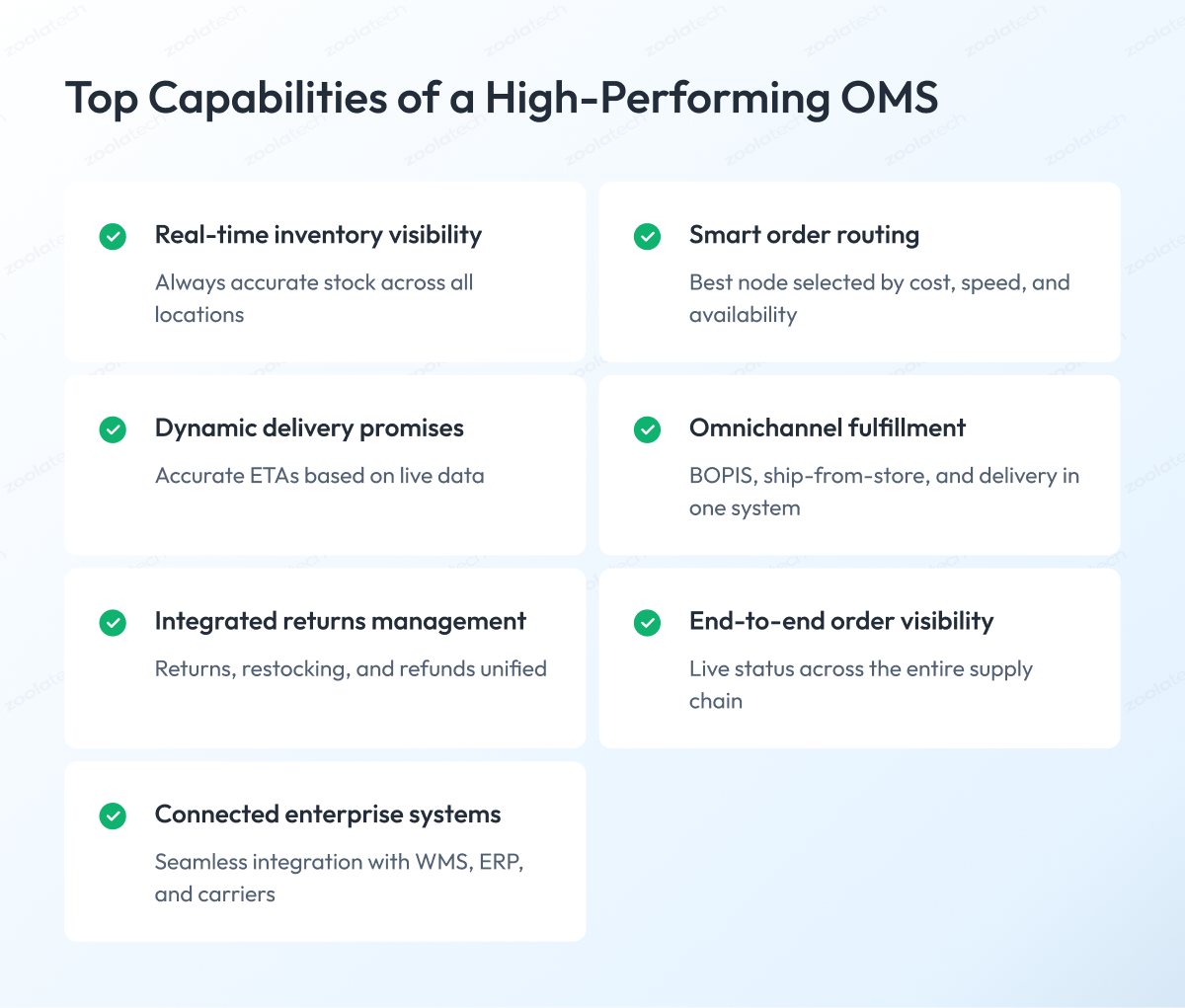
According to Gartner, the core capabilities that differentiate high-performing OMS platforms are order orchestration, enterprise inventory visibility, and real-time order status across the full supply chain.
- Real-time inventory visibility: every fulfillment location updates stock levels continuously, so the system never promises an item that is not available.
- Smart order routing: each order is automatically directed to the best fulfillment node based on proximity, stock availability, cost, and delivery promise.
- Delivery promise accuracy: the OMS calculates a realistic delivery window at checkout using live carrier, stock, and capacity data — not a fixed estimate.
- Omnichannel fulfillment support: the system handles ship-from-store, buy online, pick up in store (BOPIS), curbside, and home delivery from a single platform.
- Returns management: return authorization, restocking signals, and refund triggers are managed within the same system as forward fulfillment.
| System | What It Does Standalone | What OMS Integration Adds |
| E-commerce platform | Captures the order | Confirms real-time stock at checkout |
| Warehouse system (WMS) | Manages physical stock | Receives routed orders instantly |
| ERP / finance system | Records transactions | Gets cost-per-order fulfillment data |
| Carrier / shipping | Moves the parcel | Feeds on-time data back to OMS |
| Customer service tools | Handles inquiries | Accesses live order status in real time |
Why Enterprise OMS Programs Fall Short
Most enterprise OMS failures are not technology problems — they are program design problems.
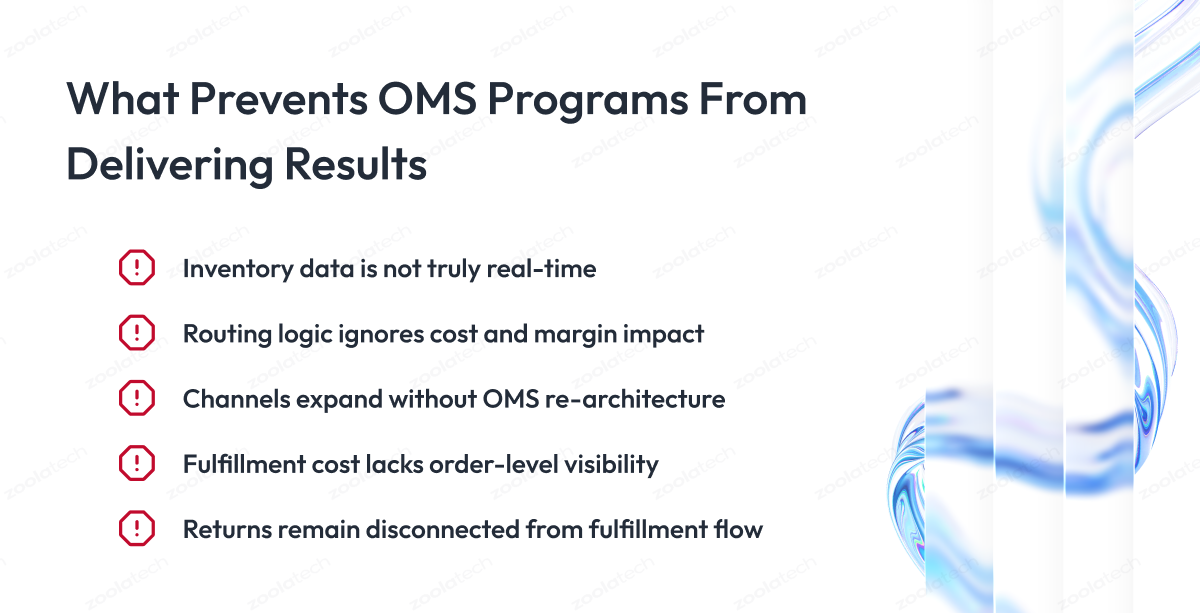
The Forrester notes that while the OMS market is mature, the gap between what platforms promise and what enterprises actually achieve remains wide. The root causes are consistent across programs.
- Inventory data is not real-time: most legacy systems update stock levels in batches — every 15 minutes, every hour, or overnight. At high order volumes, that delay causes overselling and broken promises.
- Routing logic does not account for cost: routing orders to the nearest or fastest node is not the same as routing to the most profitable node. Without cost-per-order visibility, margin leaks silently.
- Channels are added without updating the OMS: when a new marketplace, store channel, or same-day delivery option is added, the OMS is often patched rather than properly integrated — creating fragility that fails under load.
- Fulfillment cost is invisible at the order level: when teams cannot see the cost of each individual fulfillment decision, they cannot optimize it. Profitability improvement requires order-level data, not category averages.
- Returns are treated as a separate process: disconnecting returns from the main OMS creates restocking delays, refund errors, and inventory inaccuracies that ripple across every channel.
The BOPIS Opportunity: Where OMS Investment Pays Off Fastest
Buy online, pick up in store (BOPIS) is the fastest-growing fulfillment channel in enterprise retail.
According to Capital One research, 97.2 million Americans use BOPIS regularly, and U.S. click-and-collect sales are projected to reach $154.3 billion in 2025. For enterprise retailers, this channel only works when the OMS can confirm real-time, store-level inventory at checkout.
The BOPIS business case
- 85% — of BOPIS customers make an additional in-store purchase during pickup
- $154.3B — projected U.S. BOPIS sales in 2025
- 16.45% — CAGR projected for the U.S. BOPIS market through 2033
What BOPIS requires from your OMS
Enabling BOPIS is not a commerce platform configuration. It is an OMS architecture decision. The system must maintain a live, accurate view of stock at individual store locations — not just at the distribution center level. Without it, the checkout promise is made against inaccurate data, and customers arrive to find their order is not ready.
- Store-level inventory accuracy updated in near real time
- Pick task creation and assignment triggered immediately on order receipt
- Customer readiness notification sent when the order is confirmed available
- Timeout and fallback logic when a store cannot fulfill within the promise window
- In-store pickup metrics tracked separately from home delivery performance
AI and Delivery Promises: What Changes When the OMS Gets Smarter
The next significant improvement most enterprise OMS programs can make is in delivery promise accuracy. Most retailers today show customers a static date range — 3 to 5 business days — calculated from standard carrier transit times.
Leading retailers are moving to a model where the promise is generated in real time at checkout, using live data on inventory location, carrier performance, and node capacity.
According to an IBM survey, 90% of executives expect artificial intelligence (AI) to be integrated into supply chain workflows by 2026.
- Live inventory data showing exactly where stock is located
- Carrier on-time performance data by route and day of week
- Node capacity signals — is the store or DC able to ship today?
- Historical delivery outcome data to calibrate the model over time
Three stages of OMS delivery promise maturity
- Static promise: a fixed date range calculated at category level, not order level. No real-time signals. Most common in legacy OMS environments.
- Rules-based promise: delivery window calculated from the assigned fulfillment node and carrier SLA at time of routing. More accurate, but still not predictive.
- AI-driven promise: delivery window generated by a model trained on historical outcomes, live carrier data, and real-time node capacity. Continuously improves as more orders are fulfilled.
Zoolatech’s AI-Powered Delivery Promise System in Action
Zoolatech partnered with a leading North American fashion and lifestyle retailer to build a predictive delivery promise system integrated directly with the order management system for e-commerce.
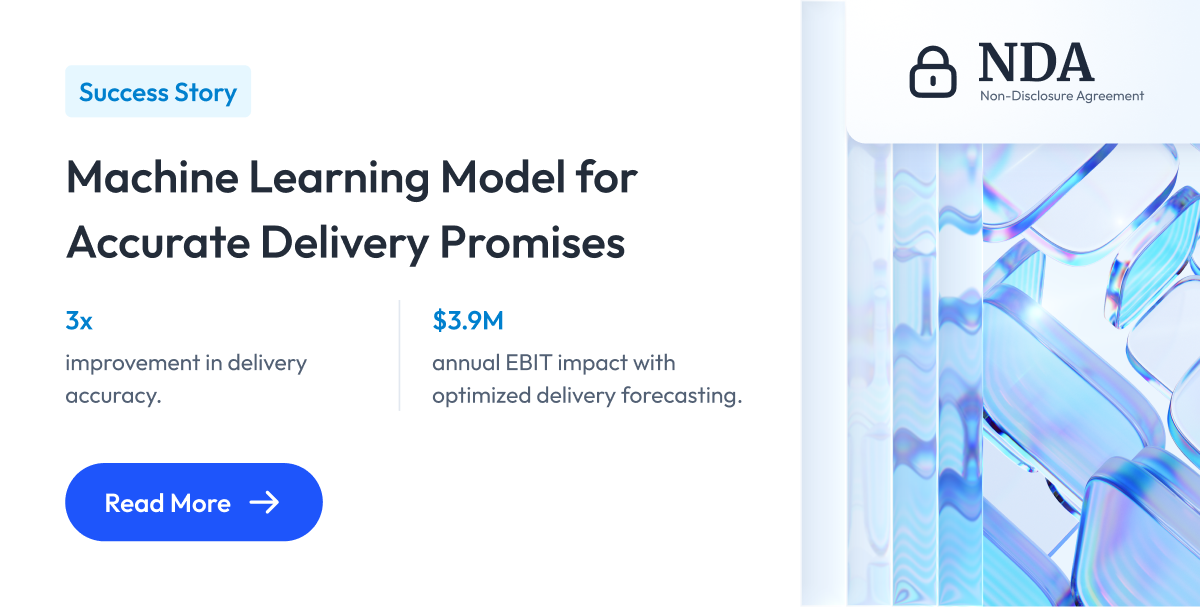
AI-powered OMS optimization
The engagement focused on improving delivery accuracy, reducing variability, and linking fulfillment performance directly to business outcomes—without disrupting live operations.
Key achievements
- 3x improvement in delivery accuracy
- Reduction in ETA error from 5.7 days to 1.9 days
- $3.9M annual EBIT impact from optimized delivery forecasting
- Continuous model improvement through iterative retraining
- Real-time delivery predictions across a complex fulfillment network
Enterprise challenges solved
The retailer faced typical enterprise OMS limitations: static delivery estimates, fragmented data across systems, and no visibility into how delivery accuracy impacted revenue or customer behavior.
Zoolatech addressed these constraints by introducing event-driven data architecture, unifying fulfillment signals, and deploying machine learning models that adapt to real-world conditions in real time.
| Challenge | Zoolatech Action |
| Static delivery estimates | Replaced rules-based logic with predictive ML models |
| Delivery variability | Introduced continuous ETA recalculation from live data |
| Data silos | Unified OMS, logistics, and tracking via event streams |
| No predictive capability | Built ML models using historical and real-time signals |
| Lack of business visibility | Connected delivery accuracy to EBIT and performance metrics |
Measuring OMS Performance — Metrics That Matter
Selecting the right key performance indicators (KPIs) before and after an OMS program determines whether the investment translates to business outcomes. The Forrester OMS Market Insights report identifies measurement infrastructure as a consistent gap in enterprise OMS programs — teams invest in the platform but not in the data layer needed to evaluate it.
| Metric | What It Measures | Why Enterprise Teams Track It |
| Delivery promise accuracy | Gap between promised and actual delivery | Ties directly to repurchase rate and NPS |
| Order fill rate | % of orders fulfilled from preferred node | Measures routing and inventory efficiency |
| Cost per order by node | Fulfillment cost at individual location level | Enables profitability-weighted routing |
| BOPIS fill rate | % of click-and-collect orders fulfilled on time | Measures store inventory data accuracy |
| Inventory oversell rate | % of orders placed on unavailable stock | Signals real-time inventory sync health |
| Return processing time | Hours from return initiation to restock | Measures reverse logistics efficiency |
- Delivery promise accuracy: if this gap exceeds 2 days consistently, the OMS is operating on stale inventory or carrier data — architectural review required.
- Cost per order by node: without this number, fulfillment decisions optimize for speed at the expense of margin; it is the most commonly missing metric in enterprise OMS programs.
- Inventory oversell rate: anything above 0.5% on high-velocity items indicates a real-time inventory sync gap — typically a sign that the OMS still relies on batch data feeds.
How to Choose an Order Management System for Enterprise E-Commerce
Not all OMS platforms are built for enterprise scale. Choosing the wrong one — or implementing the right one poorly — creates the same problems it was meant to solve. These are the evaluation criteria that separate capable enterprise platforms from mid-market tools dressed up as enterprise solutions.
- Real-time inventory architecture: confirm whether the platform operates on real-time event-driven inventory updates or batch synchronization — this single factor determines performance ceiling at scale.
- Multi-node routing capability: the platform must route orders across stores, distribution centers, and third-party logistics (3PL) partners based on configurable cost and service level criteria.
- Composable integration surface: enterprise OMS platforms must integrate cleanly with existing warehouse management systems (WMS), enterprise resource planning (ERP) systems, and commerce platforms via documented APIs.
- Omnichannel fulfillment coverage: BOPIS, ship-from-store, curbside, and home delivery must be supported natively — not via bolted-on modules that require separate maintenance.
- AI and ML readiness: the platform should expose order and inventory event data in a format that supports machine learning integration for demand forecasting and delivery promise improvement.
| Evaluation Area | What to Ask the Vendor | Red Flag to Watch For |
| Inventory refresh rate | How often does stock update across nodes? | Answer is “every 15 minutes or hourly” |
| Routing logic | Can routing rules be updated without a release? | Rules require developer involvement to change |
| Peak load handling | What is your highest proven order volume? | Cannot provide a verified peak reference |
| Integration method | How does OMS connect to our ERP and WMS? | Integration requires custom middleware only |
| AI / ML capability | Can order events feed an external ML pipeline? | No event stream or API export available |
Where to Start — a Practical Decision Framework
Enterprise OMS programs fail most often because teams try to solve everything at once. The Gartner Market Guide for Distributed Order Management Systems advises that retailers assess the complexity of their current operations before selecting or building toward a target architecture. The same logic applies to sequencing investment.
| Phase | Focus | Key Action | Metric to Track | Timeline |
| 1 | Inventory accuracy | Audit real-time vs. batch data feeds | Oversell rate | 0–6 weeks |
| 2 | Routing and cost | Add cost-per-order instrumentation | Cost per fulfilled order | 6–12 weeks |
| 3 | Omnichannel fulfillment | Enable or fix BOPIS and ship-from-store | BOPIS fill rate | 3–6 months |
| 4 | Delivery promise | Build delivery accuracy improvement program | ETA error window | 6–12 months |
| 5 | AI-driven operations | Connect OMS events to ML forecasting layer | Forecast accuracy | 12–18 months |
What most enterprise teams should do in the next 90 days
- Audit whether inventory data feeding the OMS is real-time or batch-synchronized
- Measure current delivery promise accuracy — promised date vs. actual delivery date
- Calculate fulfillment cost per order for your top 3 node types
- Identify which fulfillment channels are supported natively vs. via workarounds
- Document the OMS integration map — every system it touches and how
Conclusion
An order management system for e-commerce determines whether enterprise growth translates into profit or operational drag. The difference comes down to data accuracy, routing intelligence, and execution discipline across every fulfillment node.
Retailers that treat OMS as a business system—not just infrastructure—consistently outperform on both margin and customer experience.
What winning teams prioritize:
- Real-time inventory as the foundation for every downstream decision
- Cost-aware routing instead of speed-only fulfillment logic
- Delivery promises based on live data, not static estimates
- Fully integrated returns within the OMS ecosystem
- Measurable KPIs tied directly to revenue, margin, and retention
Questions You May Have
What is an order management system for e-commerce?
An order management system (OMS) for e-commerce is the platform that manages every step between a customer placing an order and receiving it — including inventory allocation, fulfillment routing, shipping, customer notification, and returns.
How is an enterprise OMS different from a standard OMS?
An enterprise OMS must coordinate inventory and routing decisions across hundreds of locations, multiple channels, and thousands of orders per hour — at a scale where batch data, manual routing, and static delivery promises create measurable revenue and margin losses.
What business outcomes should an OMS improvement program target?
The primary business outcomes are higher delivery promise accuracy (which drives repurchase), lower fulfillment cost per order (which protects margin), and higher BOPIS fill rate (which generates in-store incremental revenue).
How long does it take to see ROI from an OMS modernization?
BOPIS enablement and real-time inventory accuracy improvements typically generate measurable EBIT impact within the first operating quarter; AI-driven delivery promise improvements require 12–18 months of clean data before the model outperforms rules-based routing.
What is the biggest risk in OMS modernization for a live enterprise retailer?
The biggest risk is attempting a full platform replacement without first stabilizing the inventory data layer — because the new system will inherit the same inaccurate data as the old one, and the problems will follow.