








Quick Summary
- Seven trends define the 2026 agenda: AI operations, unified commerce, generative AI, composable architecture, mobile-first experiences, store digitization, and hyper-personalization.
- Mobile has passed the halfway mark, generating more than half of online retail revenue during the 2025 holiday season according to Adobe.
- McKinsey puts the generative AI opportunity for retail in the hundreds of billions of dollars, concentrated in content, merchandising, and support automation.
- BOPIS, curbside pickup, ship-from-store, and same-day delivery are now baseline expectations rather than differentiators, which is what forces unified commerce.
- The article writes off cryptocurrency checkout and NFTs as fading, so treat them as a distraction rather than something still ahead.
Retail technology is evolving faster than ever. Consumer expectations, AI adoption, mobile commerce, and operational complexity continue to reshape the retail industry.
Retailers no longer compete only on pricing or product availability. They compete through customer experience, fulfillment speed, personalization, and digital scalability.
That makes retail innovation a strategic priority for retail companies in 2026 and a competitive edge for those ahead of the curve.
According to Adobe Digital Insights, online retail spending reached record levels during the 2025 holiday season, while AI-driven traffic to retail sites increased dramatically year over year.
These shifts continue to accelerate digital transformation trends in retail across e-commerce, mobile commerce, supply chain operations, and customer engagement, building on what emerged in 2023 and 2024.
Based on Zoolatech’s retail engineering experience, these are the retail technology trends and technology solutions businesses should prioritize in 2026.
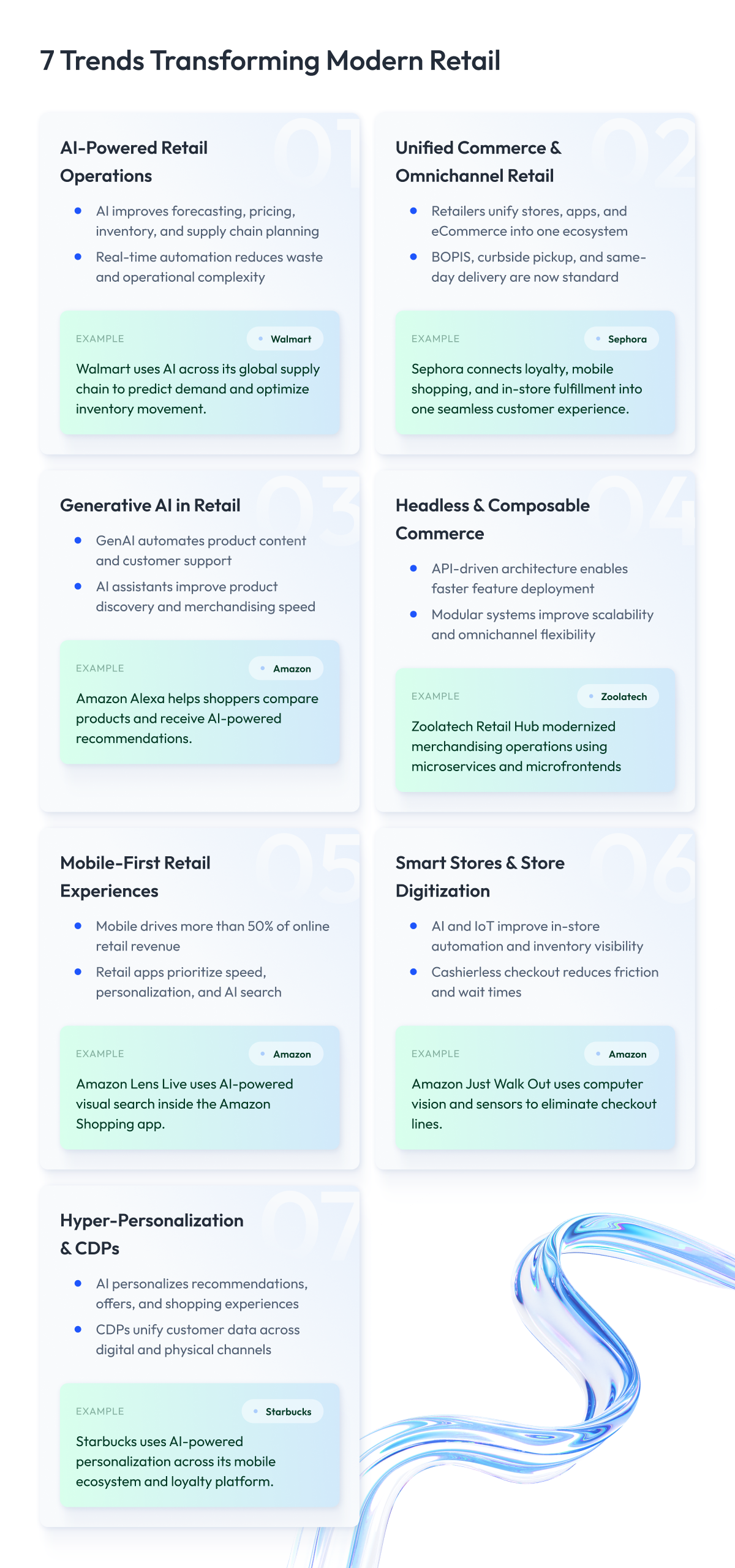
1. AI-Powered Retail Operations and Supply Chain Management
AI has become one of the most important technology trends in retail.
Retailers increasingly use artificial intelligence to improve forecasting, optimize pricing, personalize customer experiences, and automate operational workflows using real-time data.
AI in retail now supports:
- Demand forecasting
- Inventory management
- Product recommendations
- Dynamic pricing
- Customer segmentation
- Fraud detection
- Supply chain planning
McKinsey estimates that generative AI could create hundreds of billions of dollars in additional value for retail organizations.
AI is especially valuable for enterprise retailers managing large product catalogs, complex inventory operations, and omnichannel customer journeys where consumer demand shifts quickly.
Real-world example: Walmart AI supply chain
Walmart uses real-time AI and automation powered by machine learning across its global supply chain to predict demand, reroute inventory, reduce waste, and simplify associate workflows.
This is a strong example of retail technology moving beyond customer-facing personalization into core operational execution.
Zoolatech’s AI engineering services help retailers build scalable AI-powered commerce and operational systems.
2. Unified Commerce and Omnichannel Customer Experience
Omnichannel retail is no longer optional. Customers expect a consistent shopping experience across stores, websites, mobile apps, marketplaces, and social commerce channels.
Modern retail innovation technology focuses on unifying these omnichannel experiences into a single operational ecosystem.
Unified commerce platforms connect:
- Inventory systems
- Order management systems
- Customer profiles
- Loyalty programs
- Store operations and point of sale
- E-commerce platforms
Retailers now invest heavily in real-time inventory visibility and flexible fulfillment models.
Capabilities such as BOPIS, curbside pickup, ship-from-store, and same-day delivery are now baseline consumer expectations rather than competitive differentiators.
Real-world example: Sephora omnichannel fulfillment
Sephora connects digital and physical shopping through buy online, pick up in-store, curbside pickup, same-day delivery, app notifications, and Beauty Insider loyalty features.
This shows how unified commerce turns online and store channels into one seamless customer experience.
3. Generative AI in the Retail Industry
Generative AI is rapidly changing innovation in retail industry operations.
Retailers use generative AI to automate content creation, improve customer service with natural language chatbots, accelerate merchandising workflows, and personalize shopping experiences.
Common generative AI use cases include:
- Product descriptions
- AI shopping assistants
- SEO content generation
- Customer support automation
- Product comparison summaries
- Marketing campaigns and creative
- Internal knowledge assistants
Generative AI becomes especially valuable for retailers with large product catalogs and multi-region operations.
Retailers can localize product content, accelerate campaign production, and automate repetitive merchandising work with GenAI tools.
Google Cloud retail guidance identifies generative AI as one of the most important new technology trends in retail.
Real-world example: Amazon AI shopping assistant
Amazon’s AI shopping assistant, Alexa for Shopping, helps customers compare products, ask shopping questions, receive recommendations, and continue shopping conversations across Amazon experiences, much as ChatGPT and Perplexity now shape product discovery.
This is a practical example of generative AI becoming part of everyday product discovery.
Zoolatech’s custom software development services support enterprise AI integration and retail platform modernization.
4. Headless and Composable Commerce Architecture for E-Commerce
Headless and composable architecture continues to reshape retail technologies in 2026.
Traditional monolithic commerce platforms often struggle with scalability, flexibility, and rapid innovation.
Composable commerce separates frontend experiences from backend commerce logic using API-driven architecture, so agile teams can deploy changes independently.
This allows retailers to:
- Scale services independently
- Deploy features faster
- Improve mobile performance
- Integrate AI systems more easily
- Support omnichannel commerce
- Reduce legacy platform limitations
| Traditional Commerce | Composable Commerce |
| Monolithic architecture | Modular services |
| Limited frontend flexibility | Independent frontend experiences |
| Slower deployment cycles | Faster feature releases |
| Complex scaling | Service-level scalability |
| Tighter vendor dependency | Greater technology flexibility |
Shopify enterprise research continues to show growing adoption of headless commerce platforms among enterprise retailers.
Real-world example: Zoolatech Retail Hub modernization
Zoolatech helped a major retailer modernize merchandising operations through a cloud-native Retail Hub built with microservices and microfrontends.
The platform centralized merchandising workflows, improved operational visibility, and supported scalable omnichannel commerce operations.
Zoolatech’s cloud engineering services support scalable composable commerce ecosystems and retail modernization programs.
5. Mobile-First Retail Experiences and Mobile Payment
Mobile commerce remains one of the most important digital trends in retail.
Customers increasingly browse, compare, and purchase products through mobile devices, and comparison shopping often happens on a phone inside the store.
Adobe Digital Insights reported that mobile generated more than half of online retail revenue during the 2025 holiday season.
Modern mobile retail experiences now include:
- AI-powered search
- Visual product discovery
- Push notifications
- Digital wallets and contactless payment
- Loyalty integrations
- Personalized recommendations
- In-store mobile experiences
Retailers increasingly prioritize mobile speed, personalization, and frictionless checkout experiences.
Real-world example: Amazon Lens Live
Amazon Lens Live lets shoppers point a phone camera at products and receive real-time AI-powered product matches inside the Amazon Shopping app.
The feature combines visual search with conversational shopping experiences to accelerate product discovery.
Zoolatech’s mobile application development services support scalable retail mobile experiences and omnichannel commerce platforms.
6. Smart Stores, In-Store Digitization, and Augmented Reality
Physical retail stores continue to evolve through innovation in retail technology.
Retailers increasingly combine digital systems with brick-and-mortar shopping experiences to improve operational efficiency and customer engagement.
Modern store digitization includes:
- Cashierless checkout
- Computer vision systems
- Smart shelves
- IoT inventory tracking
- Electronic shelf labels
- In-store analytics
- Mobile self-checkout and premium POS
- Augmented reality try-on
These systems improve:
- Inventory visibility
- Checkout efficiency
- Store labor optimization
- Customer convenience
- Operational forecasting
Real-world example: Amazon Just Walk Out
Amazon’s Just Walk Out technology uses computer vision, sensors, biometric-free tracking, and AI to let shoppers enter a store, pick up items, and leave without waiting in checkout lines.
This remains one of the clearest examples of smart store technology reducing friction inside physical retail environments.
7. Hyper-Personalization, Customer Data Platforms, and Retail Media
Hyper-personalization remains one of the most valuable digital trends in retail industry transformation.
Traditional personalization often relied on static customer segments.
Modern hyper-personalization uses real-time customer behavior, AI, and data analytics to adapt shopping experiences dynamically.
Retailers now personalize:
- Homepages
- Product recommendations
- Pricing offers
- Search results
- Email campaigns and retail media placements
- Mobile notifications
- Loyalty experiences
Customer Data Platforms (CDPs) help retailers unify customer identity across channels under a clear privacy policy.
This creates stronger personalized experiences and more accurate customer insights, including for Gen Z shoppers who discover products on TikTok.
Salesforce Shopping Index research continues to show increasing customer engagement with personalized shopping experiences.
Real-world example: Starbucks AI personalization
Starbucks uses AI-powered personalization to recommend products, tailor promotions, and improve consumer loyalty across its mobile ecosystem.
The company also uses AI-assisted inventory visibility and operational automation to support store efficiency.
Zoolatech has supported hyper-personalized retail experiences including:
- Location-aware product recommendations
- Favorite brand personalization
- Dynamic homepage content
- Size-aware product recommendations
- Store-specific customer experiences
Retail Technology Trends 2026 to 2027: Business Impact of New Technology Solutions
| Retail Technology Trend | Primary Business Impact |
| AI-powered retail operations | Operational efficiency and forecasting |
| Unified commerce | Improved omnichannel customer experience |
| Generative AI | Content automation and personalization |
| Composable commerce | Scalable architecture and flexibility |
| Mobile-first retail | Higher engagement and retention |
| Store digitization | Operational automation |
| Hyper-personalization | Customer loyalty and conversion |
Case Study: Digital Transformation of a Retail Merchandising Platform
Zoolatech helped a major retailer modernize merchandising operations through a scalable cloud-native platform built for omnichannel commerce growth.
The project consolidated fragmented legacy systems into a centralized Retail Hub supporting real-time merchandising workflows, operational visibility, and scalable integrations.
Challenge
The retailer struggled with disconnected systems, fragmented workflows, and limited operational visibility across merchandising operations.
Existing tools made it difficult to scale workflows, onboard new applications, and support evolving omnichannel commerce requirements.
Solution
Zoolatech enhanced and expanded the client’s Retail Hub platform using a microservices and microfrontend architecture.
The engagement included:
- Cloud-native platform modernization
- Microservices and microfrontend architecture
- Kafka-based event-driven communication
- AWS infrastructure and analytics integration
- Centralized task and merchandising workflows
Outcome
The retailer improved operational efficiency, scalability, and cross-team collaboration.
The new platform enabled real-time insights, easier application onboarding, and long-term flexibility for evolving commerce operations.
Conclusion: Retail Tech Innovation for the Retailer of 2026
Retail innovation in 2026 is driven by AI, unified commerce, mobile experiences, scalable architecture, and operational automation, not by fading emerging technologies such as cryptocurrency checkout or NFTs.
Retailers that modernize early are better positioned to improve customer loyalty, operational efficiency, and long-term scalability.
The strongest retail organizations no longer treat digital transformation as a separate initiative. Digital systems now define the customer experience itself.
Zoolatech helps retailers modernize commerce ecosystems through cloud-native engineering, AI integration, mobile development, and scalable retail platform architecture.
Questions You May Have
What are the biggest retail technology trends in 2026?
The biggest retail technology trends include AI-powered operations, unified commerce, generative AI, mobile-first retail, store digitization, and hyper-personalization.
How is AI changing the retail industry?
AI improves forecasting, personalization, fraud detection, merchandising, customer support, and operational automation across retail systems.
What is retail innovation technology?
Retail innovation technology includes AI systems, composable commerce platforms, mobile commerce solutions, smart store systems, and omnichannel retail infrastructure.
What are digital transformation trends in retail?
Digital transformation trends in retail include cloud modernization, AI adoption, omnichannel operations, personalization, and retail automation.
Why is omnichannel retail important?
Omnichannel retail improves customer experience by connecting online and offline shopping experiences into a unified journey.
What is composable commerce?
Composable commerce is a modular architecture approach that allows retailers to scale services independently and integrate technologies more flexibly.
How are retailers using generative AI?
Retailers use generative AI for product descriptions, customer support, merchandising workflows, marketing content, and AI shopping assistants.