








Quick Summary
- Four models cover most needs: a dedicated team for multi-year programmes, staff augmentation for specific gaps, project-based delivery for fixed scope, and an offshore centre for large-scale operations.
- The distinction that matters is ownership, since staff augmentation extends your team while outsourcing hands over responsibility for the outcome across the development lifecycle.
- Regions trade off differently, with Eastern Europe strong on engineering depth, Latin America on time zone overlap, India on volume, and Western Europe on governance for regulated work.
- Most outsourcing failures come from alignment rather than skill: unclear ownership, weak communication, thin documentation, fragmented knowledge, and no defined escalation path.
- Outsource selectively, keeping core architecture in-house and handing over high-velocity or specialized work, because teams that outsource everything or nothing both do worse.
Software development outsourcing remains one of the most effective ways to scale engineering capacity, reduce hiring pressure, and accelerate digital delivery.
In 2026, outsourcing is no longer limited to cost savings. Enterprise organizations increasingly use external engineering teams to modernize platforms, improve delivery predictability, and access specialized expertise.
Statista research continues to show global growth in the outsourcing market, driven by cloud adoption, AI integration, and engineering talent shortages.
This guide provides a comprehensive overview of software development outsourcing — covering current software development outsourcing trends, models, advantages of software development outsourcing, risks, and enterprise best practices for organizations looking to outsource software development in 2026.
What Is Software Development Outsourcing?
Outsourcing is the practice of delegating software engineering work to an external technology partner. Software development outsourcing involves delegating some or all of a company’s development and maintenance responsibilities to a third-party provider, allowing companies to focus internal resources on core business priorities.
It involves delegating the entire development process or specific parts of the software development lifecycle — from design to development, development and testing, and ongoing maintenance. Organizations outsource software development to improve scalability, accelerate delivery, and access specialized expertise.
Outsourcing software development enables teams to access a wide range of services. Every service in a modern software delivery pipeline — from cloud engineering to QA — is a candidate to outsource. Organizations that choose to outsource benefit from each service being delivered by specialists rather than generalists. Common services include:
- Custom software development
- Cloud modernization
- AI integration
- Mobile development
- DevOps engineering
- QA automation
- Dedicated engineering teams
- Web development
Many enterprise organizations now treat outsourcing partners as long-term engineering extensions instead of transactional vendors.
Why Companies Outsource Software Development
The shortage of experienced software developers continues to affect enterprise delivery timelines. McKinsey research shows that distributed engineering models continue to reshape global delivery operations.
Organizations commonly outsource software development to:
Every company that wants to outsource should first define what they want to outsource and why. Whether to outsource a single service or outsource the entire development process depends on internal capacity, delivery urgency, and strategic priorities.
- Accelerate product development
- Reduce hiring bottlenecks and development costs
- Access specialized expertise
- Support modernization initiatives
- Scale engineering capacity
- Improve operational flexibility
Enterprise organizations also use software development outsourcing services to improve delivery continuity during large modernization programs. Outsourcing their software development to the right software development outsourcing company allows companies to focus on strategic priorities while an experienced outsourcing provider manages execution.
Zoolatech’s software development services support organizations building scalable platforms in complex enterprise environments.
Advantages of Software Development Outsourcing
Modern software outsourcing helps organizations accelerate delivery, access specialized engineering expertise, improve operational flexibility, and scale digital platforms more efficiently. The advantages of outsourcing go well beyond cost reduction.
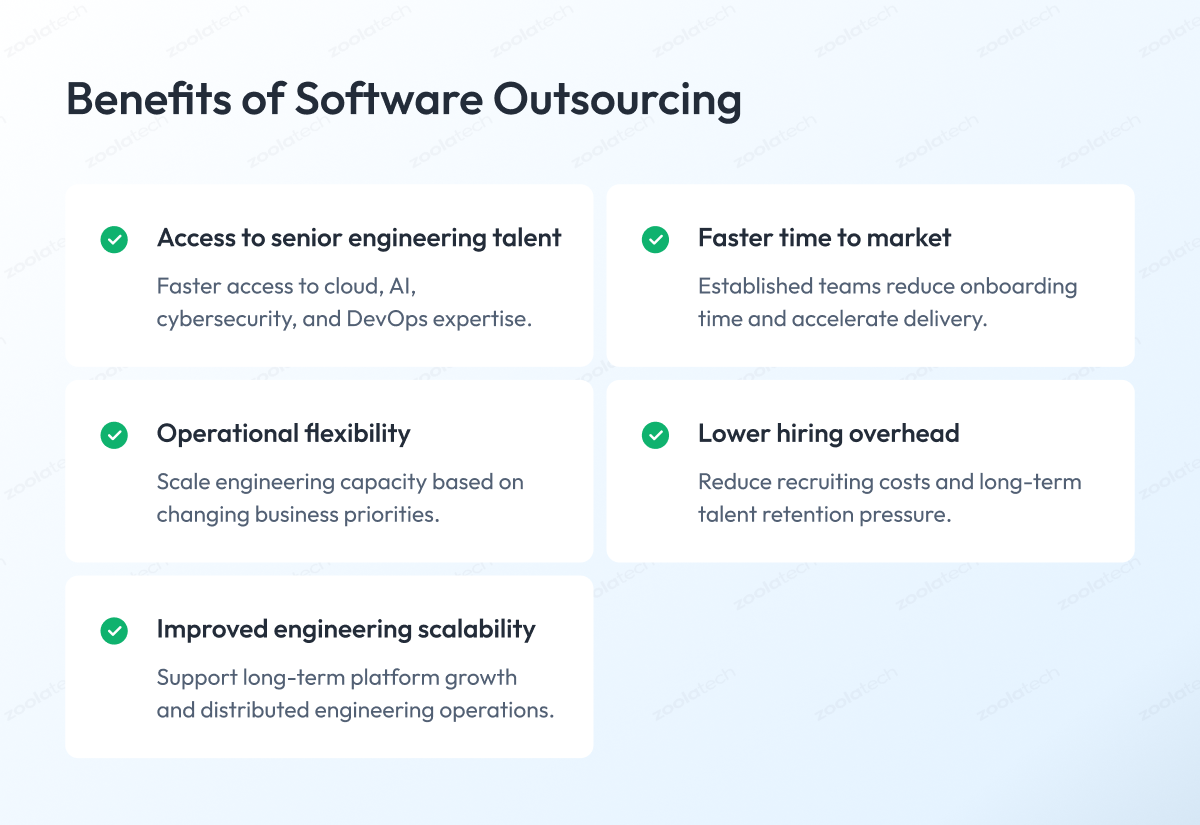
Access to senior engineering talent
Many companies struggle to hire a qualified software developer — or an entire senior software development team — quickly. Hiring a software development team with the right expertise in-house takes time and budget that most organizations cannot spare.
The Stack Overflow Developer Survey data continues to highlight strong demand for cloud, AI, cybersecurity, and DevOps expertise. Software development outsourcing companies help organizations access specialized engineering skills faster.
Faster time to market
Established outsourcing teams reduce onboarding time and improve delivery speed. This is especially important for cloud-native and AI-enabled software product development projects.
Operational flexibility
IT outsourcing development helps organizations scale teams based on changing business priorities. Teams can expand or adapt without large internal restructuring, making outsourcing your software development a practical solution for managing variable project development demand.
Lower hiring overhead and development costs
Recruiting and retaining engineering talent continues to become more expensive globally. Deloitte technology research highlights growing pressure on engineering organizations to improve operational efficiency. Outsourcing a software development team reduces overhead and transfers delivery complexity to a proven outsourcing provider.
Improved engineering scalability
Modern outsourcing models support long-term platform evolution and distributed engineering operations. This improves scalability during periods of rapid growth and helps ensure the software development process remains stable as requirements evolve.
Software Development Outsourcing Models
Organizations choose outsourcing structures based on delivery goals, governance maturity, and operational complexity. Understanding the available software development outsourcing models helps organizations find the right software outsourcing partner for their specific needs.
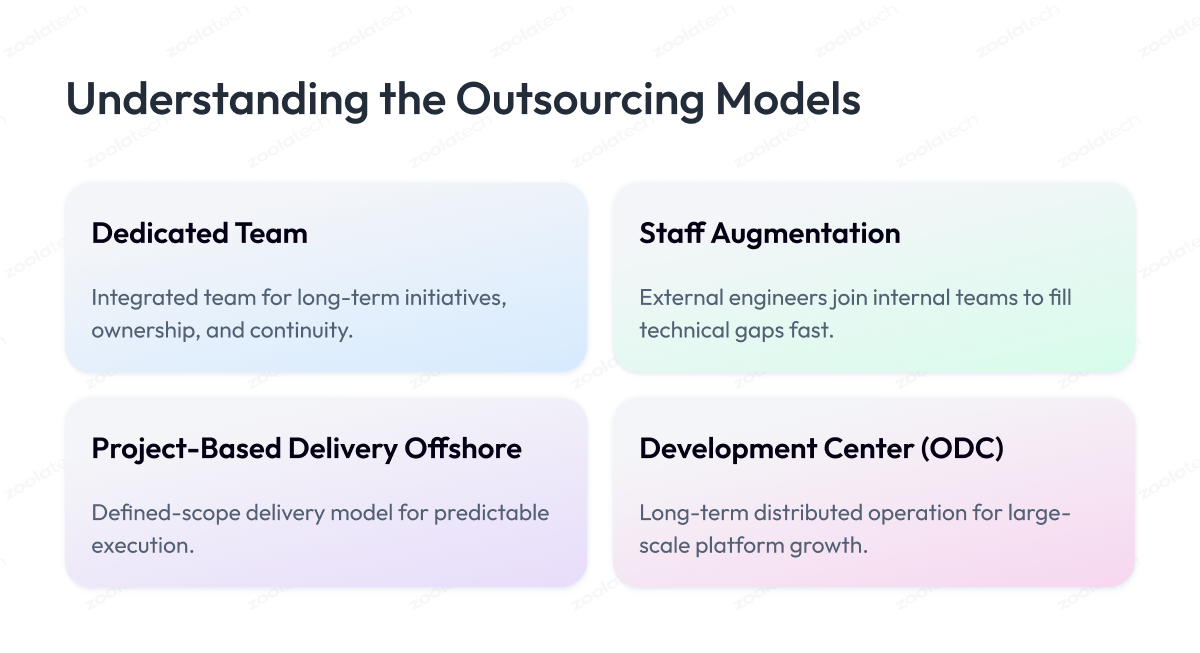
The decision to outsource using a dedicated team versus choosing to outsource via staff augmentation or project-based delivery depends on how much of the development lifecycle the company needs to outsource.
| Model | Best for | Main advantage |
| Dedicated team | Long-term initiatives | Strong continuity and ownership |
| Staff augmentation | Scaling internal teams | Fast onboarding |
| Project-based delivery | Defined project scope | Predictable execution |
| Offshore development center | Large-scale operations | Long-term scalability |
Dedicated development teams
Dedicated teams function as integrated engineering units focused on long-term product delivery. This outsourcing model supports continuity, engineering ownership, and stable knowledge retention. It is the right software development outsourcing model for organizations running multi-year platform programs.
Zoolatech’s dedicated development team services support integrated enterprise delivery.
Staff augmentation
Outsourcing IT development often starts with staff augmentation. External engineers join internal delivery teams and support specific technical gaps. This outsourcing model works well for:
- Cloud migration
- AI implementation
- Mobile engineering
- Platform modernization
- QA automation
Project-based outsourcing
Project-based outsourcing fits software development projects with stable requirements and a defined scope of work. Companies should establish governance and ownership expectations early to ensure the software project and every associated development project delivers on time and within scope.
A well-scoped software development project with clear acceptance criteria and a defined scope of work is far easier to outsource successfully than one with shifting requirements.
Offshore development centers
An Offshore Development Center (ODC) is a long-term distributed engineering operation. ODCs support large-scale platform development and modernization programs. Offshore outsourcing remains one of the most cost-efficient ways to build a scalable software development team. Custom software development outsourcing often evolves into ODC models as engineering operations scale.
In-House Software Development vs. Outsourcing
Both delivery models provide different advantages. Organizations considering outsourcing your software development should evaluate the full picture — including delivery speed, development costs, and long-term scalability — before selecting an in-house development team or an external partner.
| Factor | In-house development | Outsourcing teams |
| Hiring speed | Slower | Faster |
| Scalability | More rigid | Flexible scaling |
| Operational overhead | Higher | Shared with partner |
| Specialized expertise | Limited by hiring | Broader access |
| Delivery continuity | Internal ownership | Depends on engagement maturity |
Most enterprise organizations now combine both models. Hybrid engineering structures improve flexibility while maintaining strategic control. Including software development partners alongside an in-house development team allows companies to focus internal capacity on core intellectual property while outsourcing execution of specific delivery workstreams.
Teams that outsource selectively — choosing to outsource high-velocity or specialized work while retaining ownership of core architecture — achieve better long-term outcomes than those that try to outsource everything or nothing.
Top Destinations for Outsourcing Software Development
Businesses evaluate outsourcing destinations based on engineering quality, communication maturity, scalability, and operational stability. World Economic Forum research continues to highlight strong technology talent concentration across Eastern Europe.
| Region | Strengths | Typical focus |
| Eastern Europe | Strong engineering education | Enterprise delivery |
| LATAM | Timezone alignment | Agile collaboration |
| India | Large engineering pool | High-volume scaling |
| Western Europe | Governance maturity | Regulated industries |
Why companies outsource to Eastern Europe
Eastern Europe combines strong STEM education, enterprise delivery experience, and distributed collaboration maturity. OECD education research continues to recognize strong technical education systems across the region. Offshore outsourcing remains particularly strong here, with outsourcing firms offering senior-heavy teams at competitive rates.
Companies often choose Eastern Europe for:
- Senior engineering expertise
- Cloud-native engineering
- AI integration
- Strong English proficiency
- Enterprise-scale delivery
- Long-term operational continuity
Top Outsourcing Companies for Software Development
Enterprise outsourcing success depends on more than team size — it depends on finding the right company with the delivery culture and engineering depth to act as a long-term partner.
The top outsourcing partners provide architectural expertise, operational stability, and integrated collaboration models.
Each company in the list below has been selected based on its demonstrated ability to deliver at enterprise scale.
| Company | Key strengths | Primary focus areas |
| Zoolatech | Senior-heavy engineering teams, modernization expertise, ownership-driven delivery | Cloud-native systems, AI integration, retail, healthcare, modernization |
| Globant | Enterprise digital transformation | Media, digital products, enterprise platforms |
| EPAM | Large-scale engineering operations | Healthcare, FinTech, modernization |
| Endava | Agile distributed delivery | Payments, FinTech, enterprise systems |
| N-iX | European engineering delivery | Cloud engineering, enterprise software |
| SoftServe | AI and cloud engineering | Healthcare, retail, cloud systems |
| Thoughtworks | Technology consulting | Digital transformation, platform modernization |
Zoolatech combines modernization-first engineering, cloud-native delivery, and long-term ownership models. As a reliable outsourcing partner for enterprise organizations, Zoolatech offers software development outsourcing services across a wide range of services:
- Staff augmentation
- IT consulting and management
- Dedicated engineering teams
- Cloud integration
- Web and mobile development
- Database engineering
- Quality assurance automation
Zoolatech supports organizations across Consumer and CPG, FinTech, Healthcare, Professional services, Retail, and E-commerce.
For a broader comparison of software outsourcing services and vendors, see Zoolatech’s top nearshore software development companies guide.
How to Choose the Right Outsourcing Partner for Software Development
Selecting the right software outsourcing partner requires evaluating engineering maturity, operational transparency, and delivery alignment. Many outsourcing failures happen because organizations prioritize rates instead of delivery capability.
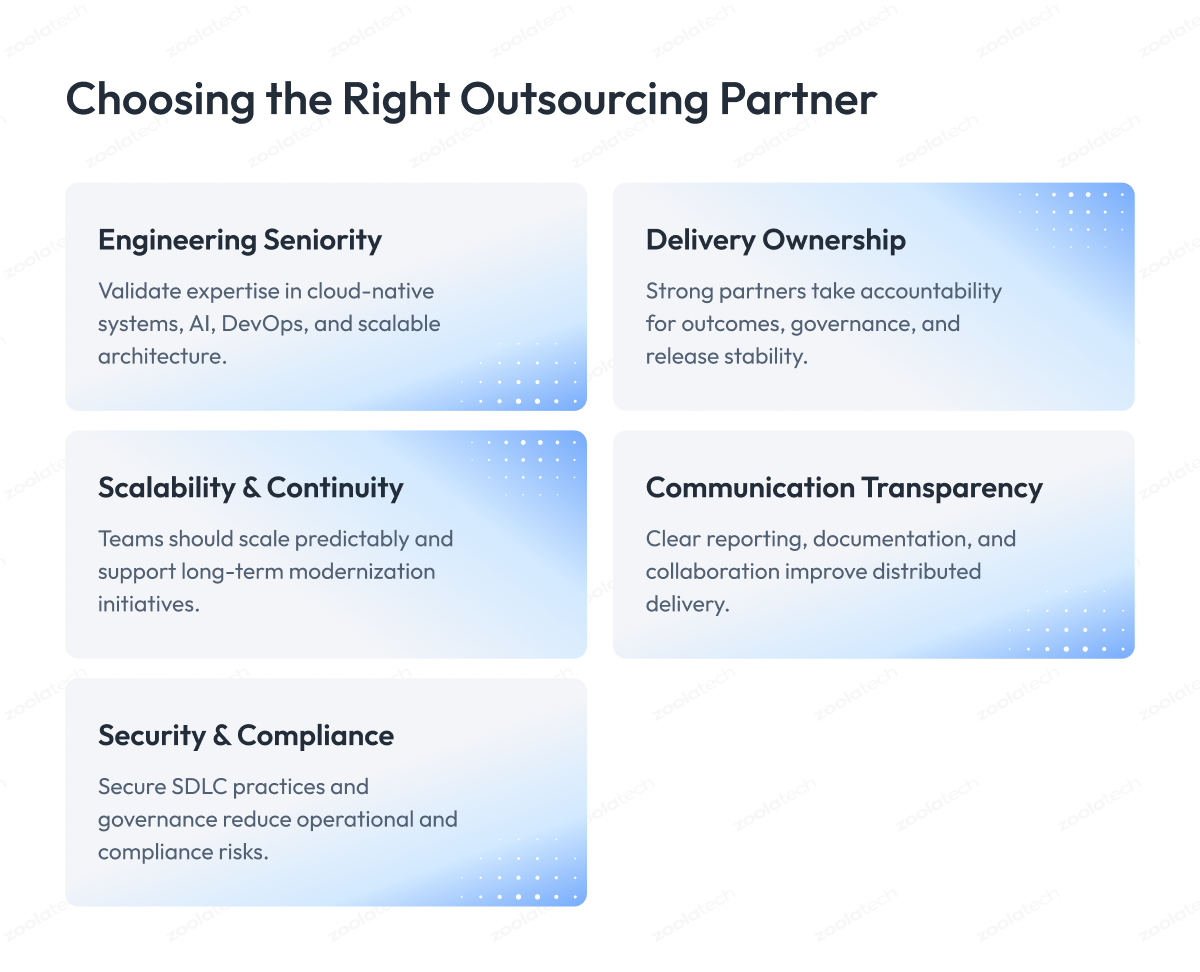
Every company evaluating a software development outsourcing company should treat it as a long-term partner selection, not a procurement decision. This section covers what to look for when choosing an outsourcing partner — from technical depth to security measures. The right company brings not just engineers but delivery governance, architecture leadership, and accountability.
Engineering seniority and technical depth
A reliable outsourcing partner provides senior software developers with experience building scalable production systems. Organizations should validate expertise in cloud-native engineering, distributed systems, DevOps automation, AI integration, security engineering, and platform modernization.
When selecting an outsourcing provider, ensure your outsourcing partner can demonstrate this depth with real delivery evidence.
Delivery ownership and accountability
The right outsourcing partner takes responsibility for outcomes, not only task execution. Companies should evaluate delivery governance, risk management processes, escalation models, architecture leadership, and release accountability. Choosing the appropriate outsourcing partner means finding a team willing to own the entire development outcome, not just complete tasks.
Zoolatech’s dedicated development team model focuses on ownership-driven delivery and long-term outsourcing partnership.
Communication and operational transparency
Distributed engineering requires strong communication discipline. Teams should assess reporting structure, meeting cadence, documentation quality, collaboration tooling, and risk visibility. Gartner guidance emphasizes transparency and governance alignment when selecting the right outsourcing partner for enterprise software projects.
Scalability and long-term continuity
Enterprise modernization programs often evolve over several years. A successful outsourcing partnership requires a partner that can scale teams predictably, maintain delivery continuity, support multi-team initiatives, retain engineering knowledge, and adapt to changing priorities.
Organizations should find an outsourcing partner with demonstrated experience managing entire development programs at scale.
Security and compliance maturity
Security measures should be integrated into delivery workflows from the beginning. Businesses should evaluate secure SDLC practices, access management policies, compliance readiness, infrastructure governance, and incident response processes.
The OWASP guidance highlights the importance of secure development practices across distributed engineering environments. Applying security measures at every stage helps keep the software development lifecycle protected from design through deployment.
Custom Software Development Outsourcing
Custom software development outsourcing supports organizations building specialized software solutions and enterprise platforms. Unlike template-based systems, custom engineering supports scalability, integration flexibility, and operational control.
Teams that consider outsourcing custom software development gain access to right software development expertise without the overhead of building it in-house.
Common custom development initiatives
Enterprise companies commonly outsource the development of:
- Retail platforms
- Healthcare systems
- FinTech applications
- AI-enabled software products
- Cloud-native platforms
- Internal operational systems
McKinsey technology research continues to identify modernization and AI adoption as major enterprise priorities.
Why enterprises outsource custom development
Custom engineering projects require specialized architecture expertise and scalable delivery operations.
Teams looking to outsource the development of complex software projects often find that outsourcing firms deliver faster and more cost-efficiently than expanding internal teams.
Teams often outsource to accelerate modernization, reduce hiring pressure, access specialized expertise, improve delivery predictability, and support distributed engineering operations.
When organizations outsource custom development to a specialist partner rather than a generalist firm, they outsource not just labor but deep domain knowledge — reducing risk at every stage of the software development lifecycle.
Zoolatech’s retail software engineering services support scalable omnichannel commerce platforms.
Outsourcing Your Software Development as a Startup
Outsourcing software development for startups helps early-stage companies accelerate product delivery while controlling development costs. Startups often need fast access to engineering expertise without building a large in-house development team immediately.
What startups commonly outsource
- MVP development
- Mobile applications
- Cloud infrastructure
- UI and UX implementation
- DevOps automation
- AI feature integration
Why startup outsourcing succeeds
Successful outsourcing for startups depends on strong product ownership and fast communication loops. Founders should maintain product roadmap control, business decision ownership, architecture visibility, and direct communication with engineers. When startups find the right software outsourcing partner, the result is a successful outsourcing partnership that scales with the business.
Zoolatech’s application development services support scalable digital product delivery.
Risks of Software Development Outsourcing
Outsourcing introduces operational risks if governance and communication are weak. Most outsourcing failures happen because of poor alignment rather than engineering capability alone.
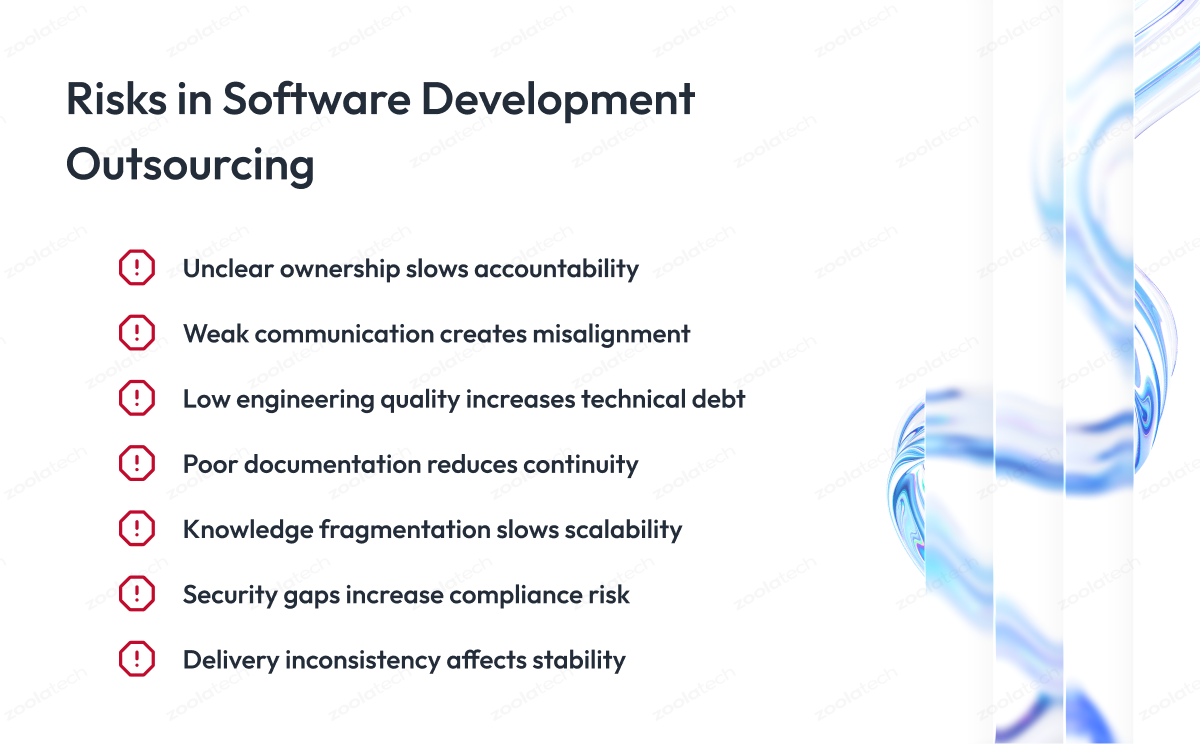
Common outsourcing risks
- Unclear ownership
- Weak communication
- Low engineering quality
- Poor documentation
- Knowledge fragmentation
- Security gaps
- Delivery inconsistency
How organizations reduce outsourcing risk
Enterprise organizations reduce delivery risk through structured governance and integrated collaboration models. Best practices include shared engineering standards, transparent reporting, regular architecture reviews, integrated DevOps workflows, defined escalation paths, and long-term team continuity.
Selecting the right outsourcing partner — rather than the lowest-cost outsourcing provider — is the single most effective risk mitigation measure. Teams that outsource with clearly defined scope of work, escalation paths, and delivery standards outsource more successfully than those that outsource without a governance framework.
Deloitte cybersecurity guidance emphasizes governance and operational visibility for distributed engineering environments.
Enterprise Best Practices for IT Outsourcing Development
Successful outsourcing IT development initiatives rely on operational integration, engineering maturity, and long-term alignment. Modern outsourcing partnerships function as integrated engineering ecosystems instead of isolated vendor relationships.
Businesses that outsource successfully do not simply outsource tasks — they outsource outcomes, holding their outsourcing partner accountable for delivery, quality, and continuity across the entire software development lifecycle.
Establish shared engineering standards
Internal and external teams should follow the same architecture, testing, and deployment standards. This improves delivery consistency and reduces operational friction across the entire development process.
Integrate DevOps and delivery tooling
Shared tooling improves transparency and collaboration. Organizations should integrate CI/CD pipelines, monitoring platforms, issue tracking systems, documentation platforms, and communication channels. Google Cloud architecture guidance highlights DevOps automation as a critical part of scalable engineering operations.
Measure outcomes instead of activity
Strong outsourcing governance focuses on measurable delivery outcomes. Teams should track release stability, delivery velocity, incident frequency, regression rates, and platform reliability.
Prioritize long-term continuity
High engineering turnover increases operational risk. Teams should prioritize outsourcing partners with stable leadership, strong retention, and long-term delivery maturity. The right software development outsourcing company maintains a consistent software development team across multi-year programs.
Zoolatech’s AI engineering services support enterprise modernization and production AI adoption.
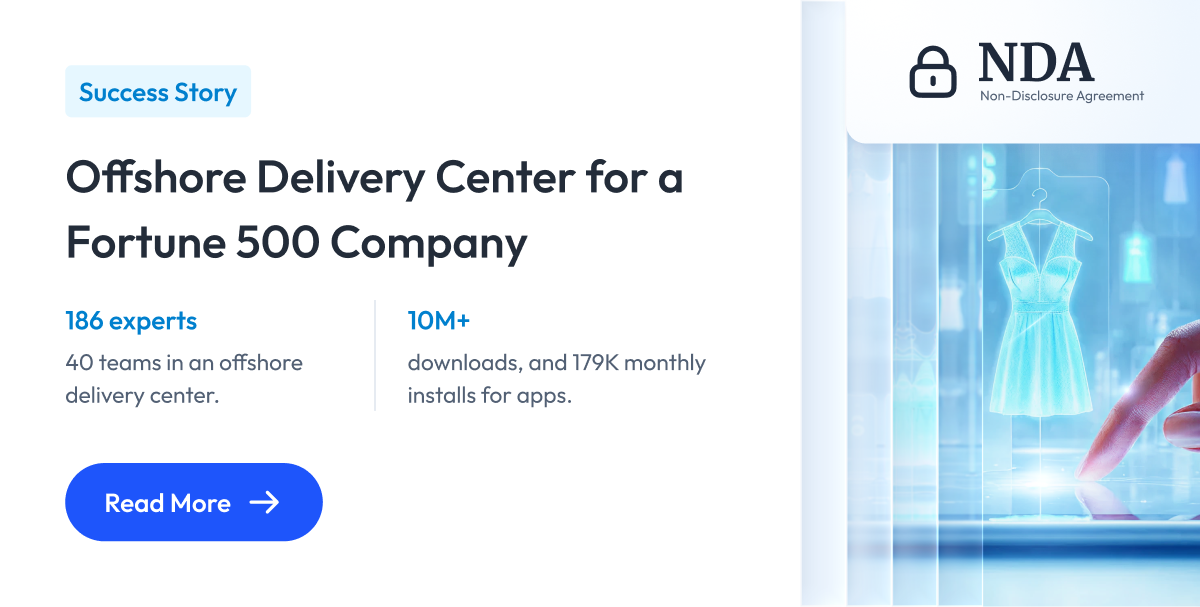
Offshore Delivery Center for a FashionTech Company
Zoolatech’s FashionTech Offshore Delivery Center case study demonstrates large-scale outsourcing expertise and the ability to manage distributed enterprise engineering organizations.
Challenge
The client needed to rapidly expand engineering capacity while maintaining delivery quality, operational consistency, and product development speed.
Solution
Zoolatech established a dedicated Offshore Delivery Center consisting of 185 engineers across 40 teams, integrated directly into the client’s internal operations. The engagement included large dedicated engineering teams across multiple functions, scalable staff augmentation and onboarding, cloud-native development support, long-term delivery operations, and integrated collaboration workflows.
Outcome
The client gained scalable access to a large engineering organization, faster delivery execution, and stronger long-term operational flexibility.
The case study highlights Zoolatech’s expertise in enterprise outsourcing, distributed delivery management, and large-team engineering operations. It is one of the clearest examples of how a successful outsourcing partnership delivers measurable results when the outsourcing services, governance, and delivery ownership are aligned from day one.
Conclusion
Software outsourcing continues to evolve from transactional delivery into strategic engineering collaboration. Businesses increasingly use outsourcing to modernize systems, improve scalability, and accelerate digital transformation initiatives.
The strongest outsourcing relationships prioritize transparency, ownership, engineering maturity, and long-term alignment. Organizations that find the right software outsourcing partner — and treat that outsourcing partnership as a long-term engagement rather than a project contract — consistently outperform those that outsource based on rate alone.
Zoolatech helps modernize and scale complex systems through senior-heavy engineering teams, cloud-native delivery, and ownership-driven collaboration models.
Questions You May Have
What is software development outsourcing?
Software development outsourcing means delegating engineering work to an external technology partner. Outsourcing involves delegating some or all of the software development process to a third-party provider.
What are the benefits of software outsourcing?
The advantages of outsourcing include faster scaling, cost savings, access to specialized engineers, operational flexibility, and lower development costs.
What is the difference between outsourcing and staff augmentation?
Staff augmentation extends an in-house development team with external engineers. Outsourcing often includes broader delivery ownership across the entire development process.
How do companies choose software development outsourcing companies?
Organizations evaluate engineering quality, operational maturity, scalability, communication practices, and security measures. Selecting the right outsourcing partner requires assessing delivery track record, not just team size. Every company shortlisting a software development outsourcing company should request case studies, reference calls, and architecture reviews before committing.
Is outsourcing software development good for startups?
Yes. Outsourcing helps startups accelerate delivery and access engineering expertise without building a large in-house development team immediately.
What is an offshore development center?
An Offshore Development Center is a long-term distributed engineering operation supporting scalable software development outsourcing services at enterprise scale.
What industries commonly use software outsourcing?
Retail, healthcare, FinTech, SaaS, manufacturing, and logistics companies commonly outsource software engineering.
What are the risks of outsourcing IT development?
Risks include weak communication, unclear ownership, low engineering quality, and poor operational governance. Choosing the appropriate outsourcing partner with strong security measures and delivery governance reduces these risks significantly.