







Quick Summary
- Conversational commerce is selling through dialogue with shoppers in messaging apps, live chat, voice assistants, or an AI shopping assistant on the store’s website.
- A premium jewelry retailer’s AI Selling Agent shows a +6% add-to-basket rate compared to standard online journeys and +5% product views per visit.
- The Selling Agent was built in 5 phases, from mapping the in-store consultation to continuous optimization based on behavioral data and engagement metrics.
- A selling agent needs written rules for sensitive moments, because standard large language model (LLM) behavior may deflect or block conversations involving distress.
- Before you scale a selling agent, confirm its results with a holdout group, for example, a random 10% of visitors who do not see the agent.
Conversational commerce is selling through a conversation. The shopper asks questions, gets advice, and moves toward a purchase in one dialogue, much like talking to an associate in a store.
These conversations can happen in a messaging app, a live chat, or a voice assistant. More and more online stores also add an artificial intelligence (AI) shopping assistant to their websites. It leads the conversation by asking what the shopper needs and recommending products with reasons.
This kind of advice is important for personal purchases such as gifts, because a search bar cannot ask who the gift is for.
If you plan to build such an assistant for your store, you need to know what it takes and how to tell if it works. General guides rarely answer this. Vendors often publish a growth percentage, but they rarely say what they measured it against, so it is hard to tell how much of that growth the assistant brought.
That is why we wrote this guide. We answer these questions with the Selling Agent that Zoolatech built for a premium jewelry retailer as our working example.
Through this case, we show where an AI shopping assistant fits among the channels, what to decide before launch, and which risks to plan for. By the end, you will know what a selling agent on your site needs to do and how to read its results.
What Is Conversational Commerce? Channels and Where an AI Shopping Assistant Fits
Conversational commerce is selling through a conversation, as we said in the intro. Now let’s look at it in more detail. The conversation can take place in several channels, and each channel answers the shopper in its own way.
Below, we show which channels exist, who answers the shopper in each of them, and when an AI shopping assistant is the right choice. This helps you decide what to build for your store.
The table lists the main channels. Read each row to see where the conversation happens, who answers the shopper, and what the channel usually does, then compare the rows with the job you need.
| Channel | Where the Conversation Happens | Who Answers | Typical Job |
| Messaging apps | WhatsApp, Facebook Messenger, Instagram Direct | Brand team or a bot | Questions, offers, order updates |
| Live chat | Retailer’s website | Human agents | Support and personal shopping help |
| AI chatbots and shopping assistants | Retailer’s website or app | AI, with handoff to people | Questions about intent, recommendations with reasons, checkout help |
| Voice assistants | Smart speakers and phones | AI | Simple questions and orders |
| External AI assistants | Generative AI tools outside the retailer’s site | AI, sometimes with the brand’s agents | Discovery and comparison before the shopper reaches the store |
The table shows typical use, and each channel’s details depend on how a brand sets it up. The AI-led rows are what people usually mean by conversational AI for e-commerce.
If you want to bring in-store advice to your website, the choice usually comes down to a live chat with human agents or an AI shopping assistant. In our view, the assistant is the closest online match to a store associate, because it asks questions before it recommends.
An AI shopping assistant is a good fit in these cases:
- Shoppers need advice before they buy, for example, when they choose a gift.
- Shoppers come at hours when your team cannot answer in a live chat.
- Your catalog is large, and search alone does not help people narrow it down.
A live chat with people works better when conversations are few, or when each one needs a person’s judgment, for example, a complex complaint.
This article covers the third row of the table: an AI shopping assistant that the retailer places on its website. The fifth row is close to agentic commerce, a model where the shopper’s own AI agent searches for products and may buy them. We explain how the two models connect in the FAQ.
Figures about external AI tools need careful reading. Adobe reported that visits to retail sites in the United States from generative AI tools rose 693.4% year over year in the 2025 holiday season, and it adds that the base of these users remains modest. The figure counts clicks from AI tools outside the store, so it does not describe assistants on retailer websites.
A conversation is one of many ways AI helps an online store. For the wider picture, see our overview of AI use cases in e-commerce.
Conversational Commerce in Retail: AI Agent Case Study Phase by Phase
Conversational commerce in retail is easiest to understand through a real project, so we’ll walk through the AI shopping assistant Zoolatech built for a premium jewelry retailer in five phases, from mapping the in-store consultation to continuous optimization.
Among conversational commerce examples, this one is useful because it describes every phase of the work.
Challenge
A premium jewelry retailer’s signature consultative selling approach was missing online. In stores, an associate helps the shopper choose, but the website offered no such support, limiting personalization and emotional engagement.
Standard browse and search experiences also failed to guide customers through meaningful product discovery. This gap matters for jewelry because the purchase often involves an emotional or personal context.
What we did
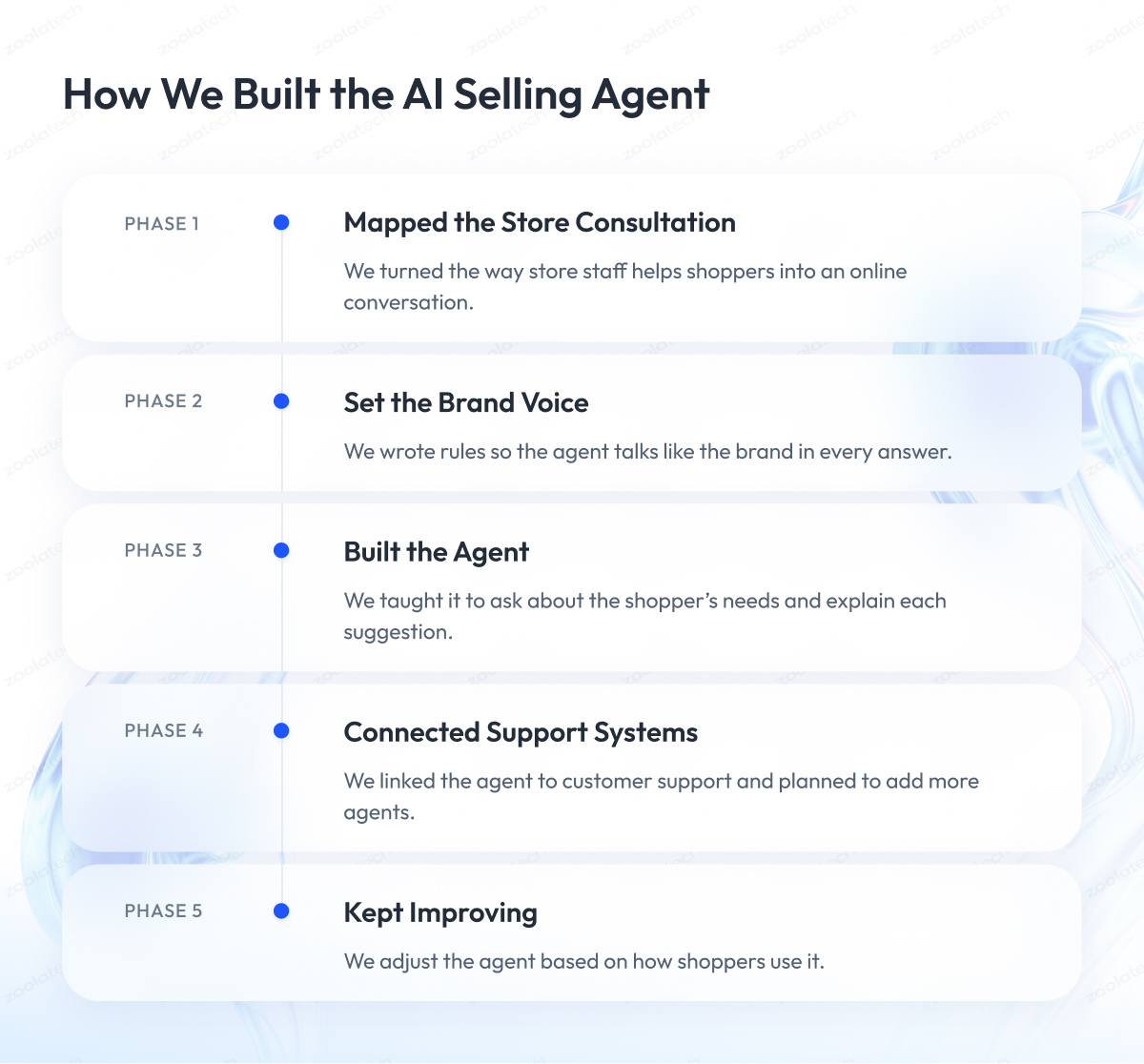
We designed the conversational journeys around gifting, product discovery, and purchase decisions, and built the Selling Agent. The case page lists Salesforce Agentforce among the project’s technologies. Agentforce is Salesforce’s AI agent platform.
Phase 1 – Discovery and experience mapping
We started by defining the digital equivalent of the retailer’s signature in-store consultation. Along the way, we mapped the key interaction patterns and the moments where a recommendation could become personal.
Phase 2 – Conversational design and tone
Before the build began, we set the voice for all AI interactions. It is warm, knowledgeable, and inclusive. Our goal was to make the agent sound like the brand in every answer. You can read more about this stage in our guide to conversational AI design.
Phase 3 – Agent development
With the voice in place, we built and trained the Selling Agent to ask contextual questions, recommend products, and guide the shopper’s decision. It asks targeted questions to understand what the shopper wants, then suggests relevant products and explains why each one fits.
Because we set the brand voice in Phase 2 and built the agent in Phase 3, tone shaped the agent from the start.
Phase 4 – Integration and expansion
Then we connected the agent to a premium jewelry retailer’s existing customer support systems. We also defined a roadmap to unify multiple agents into one experience, which is a plan for the next stages of the project.
Phase 5 – Continuous optimization
After launch, we kept improving the agent’s performance based on behavioral data and engagement metrics. Our work here also covers how the agent talks and how closely it follows the brand’s tone.
Result
A +6% add-to-basket rate compared to standard online journeys, measured across sessions using the agent. Add-to-basket rate is the share of sessions in which the shopper adds a product to the basket. The project also recorded a +5% increase in product views per visit.
These numbers need careful reading, and we explain how to do it in the section on measurement. For the full project story, see how we built the Selling Agent on our case study page.
AI Shopping Assistant vs. Chatbot: What a Selling Agent Does Differently
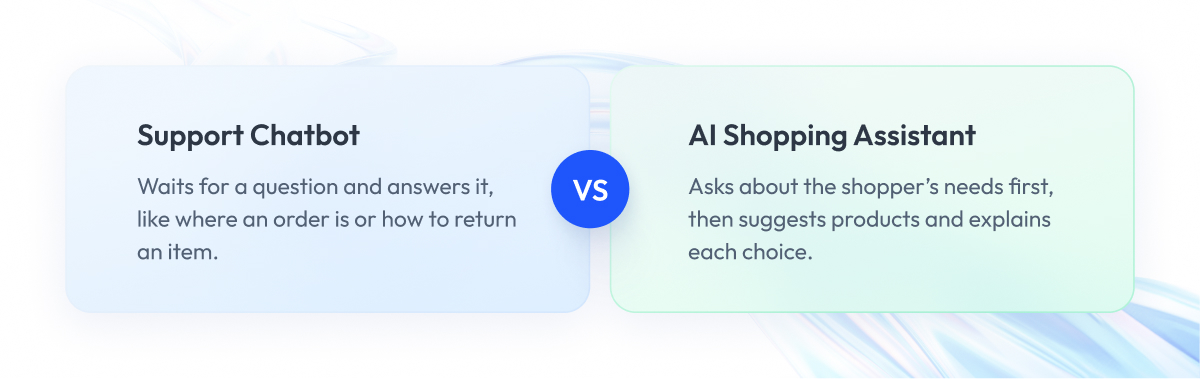
The main difference between an AI shopping assistant and a support chatbot is how each one helps the shopper:
- A support chatbot answers shoppers’ questions, such as where an order is or how to return an item.
- An AI shopping assistant helps shoppers decide what to buy by asking about their needs first and then recommending products with a reason for each one.
The table compares a support e-commerce chatbot with the Selling Agent from our case. Each row shows how this difference in the job changes what the tool must know and how you judge its results.
| Question | Support Chatbot | Selling Agent (Our Case) |
| Who leads the conversation | The shopper asks, the bot answers | The agent asks contextual questions first |
| Main job | Answering questions, resolving service requests | Recommending products with reasons, guiding the decision |
| What it must know | Policies, order status, help content | Shopper intent, catalog, brand voice, rules for sensitive topics |
| How success is measured | Requests resolved without a person | Add-to-basket rate, product views per visit |
| Where it ends | A person takes over, or the request is closed | Product discovery and purchase decision |
A selling agent can also do the support chatbot’s job once you connect it to your order and support systems. The shopper then gets one assistant that helps with an order question and choosing a product in the same conversation.
That is why we see a selling agent as an essential tool for an online store. Its value depends on how well you plan it, so the next section covers the six decisions you need to make to build one well.
Six Decisions to Make Before You Build a Selling Agent on a Conversational Commerce Platform
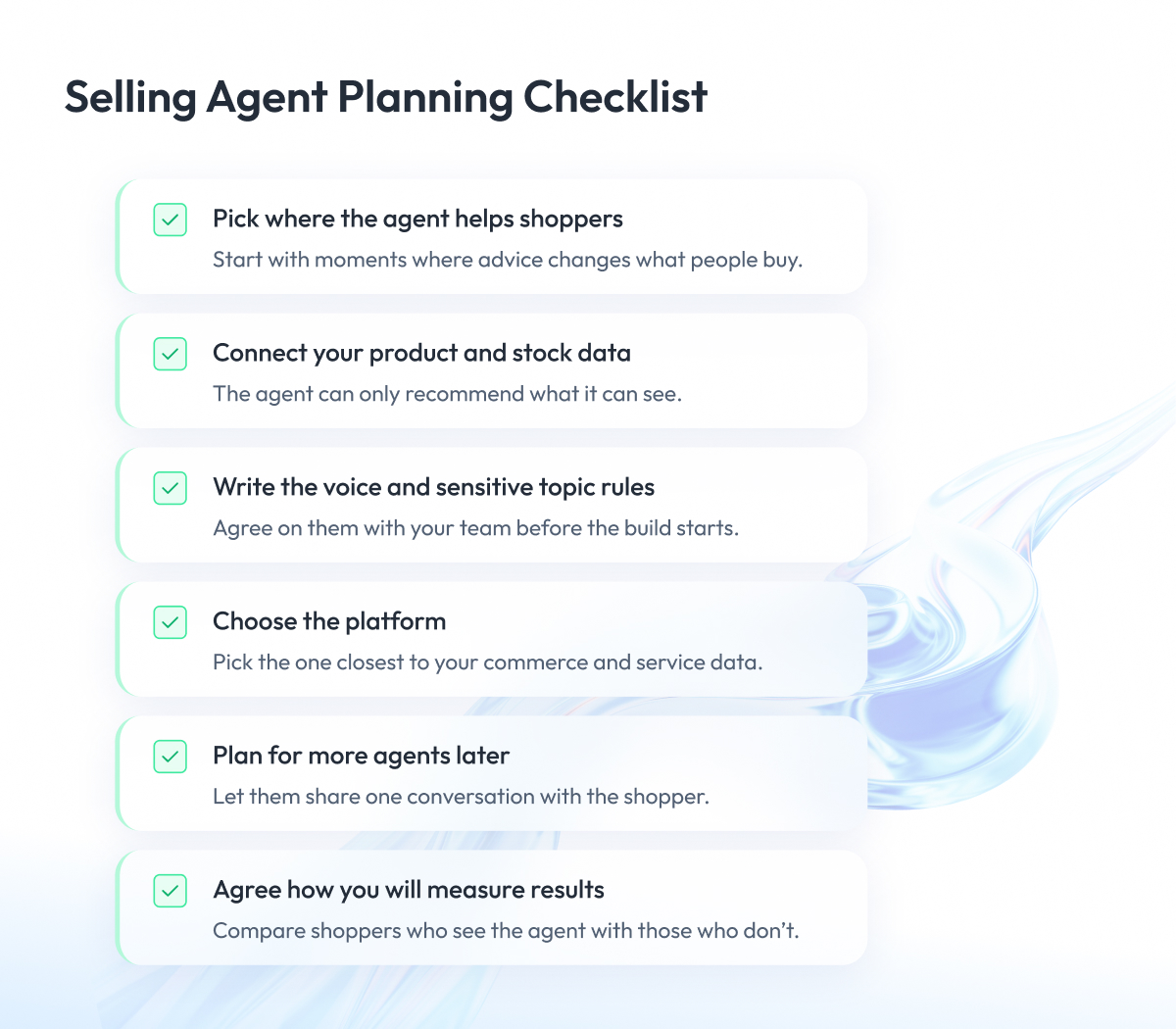
A selling agent on a conversational commerce platform works well when the business decides in advance what the agent should do, what it can see, and how its results will be judged. Without these decisions, the team has to guess during the build, and those guesses show up in the agent’s answers. Most of the decisions come from your business, and the platform is only one of them.
1. Choose where the agent helps shoppers
We recommend starting with the moments where advice changes what people buy. For example, a shopper choosing a gift needs more help than a shopper reordering a familiar product.
If you have physical stores, look at what your associates explain most often. Those conversations show what the agent should take over online.
2. Connect the agent to the data it needs
An agent can only recommend what it can see. Conversational commerce tools are often connected to a customer relationship management (CRM) system, inventory databases, and payment gateways, so list which of these your agent needs before the build.
For example, without stock data, the agent may recommend a ring that is not available in the shopper’s size. At this stage, also decide when the agent passes a conversation to a person on your team.
3. Write the brand voice and rules for sensitive topics
Put the voice rules and the rules for sensitive topics in writing before anyone starts building the agent. Once the agent is trained, changing its tone means reworking many of its answers.
For a jewelry or luxury store, we recommend a digital sales assistant with:
- Guided questions that help the shopper narrow the choice.
- A brand voice that stays the same in every answer.
- Inclusive language with no assumptions about gender, relationships, or identity.
- Safe handling of distress, with empathy and directions to local support resources.
4. Pick the platform
The platform decides how much you build yourself and how much comes ready. Vendors give different advice here, and each of them sells something, so it helps to know who is speaking.
Salesforce sells the Agentforce platform and said in July 2026 that its Shopper Agent, Buyer Agent and Merchant Agent are generally available, with native integration into ChatGPT.
The shopping assistant vendor Luigi’s Box argues that e-commerce teams should not spend time building technical solutions. It advises building from scratch only when you need full control, custom workflows, or tight integrations, and warns about longer development and ongoing maintenance.
In our view, a third path exists between buying a ready AI shopping assistant for e-commerce and building one from scratch. You can build the agent on a platform you already use for commerce or customer service.
Some teams also use a service built around an application programming interface (API). It gives them AI building blocks, and the team builds the shopping logic on top.
We recommend choosing the platform based on where your commerce, customer, and service data are already stored. The closer the agent is to this data, the less integration work you need.
5. Decide if the agent will work alone or with other agents
Your first agent may later need to work with other agents, for example, one for returns or for care after the purchase. Plan from the start how they will share one conversation, so the shopper talks to one assistant and does not have to repeat themselves.
6. Agree how you will measure results
Set up before the build how you will compare sessions with and without the agent. If you skip this step, you will get a number later but no fair way to tell what the agent changed. We explain how to set up this comparison in the section on measurement.
How to know you are ready to start
We recommend checking these points first:
- Shoppers in your category ask for advice before they buy.
- The agent can read the systems that answer their questions, such as product data and stock.
- Your team can compare sessions with and without the agent.
If one of these points is missing, close that gap first, for example by cleaning up your product data, and then build the agent. If you want help with these decisions, our team offers AI chatbot and shopping assistant development and can work through them with you.
Risks of an AI Selling Agent and How to Handle Them
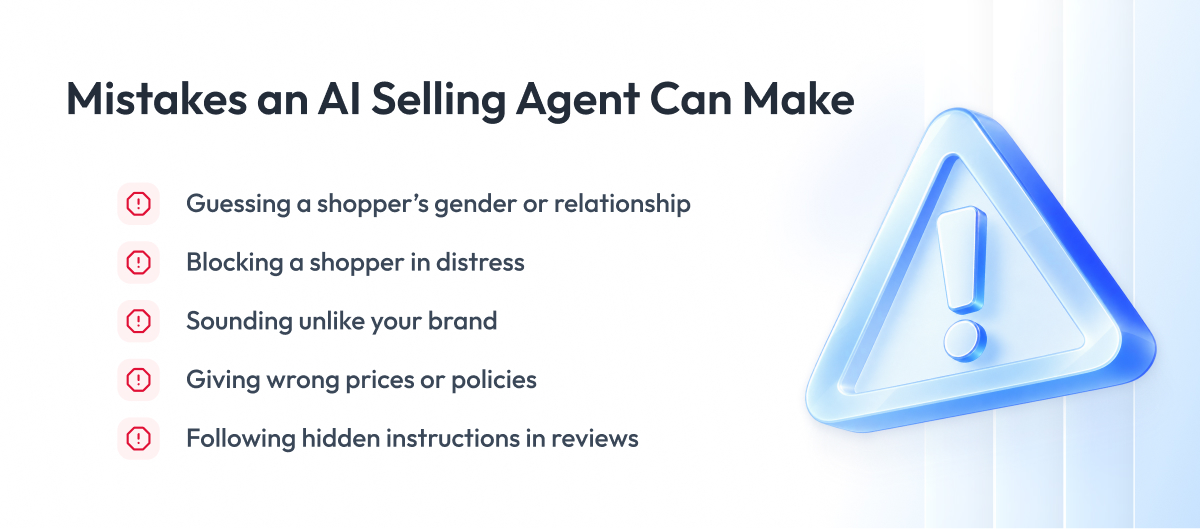
An AI selling agent answers shoppers without a person checking each reply, so every mistake it makes reaches the customer directly. Some risks come from how the agent handles personal and sensitive moments, and others come from the large language models (LLMs) it’s built on.
The table lists five risks. For each one, you can see what can go wrong, what we did in our case or what outside sources say, and what we recommend you plan before the agent goes live.
| Risk | What Can Go Wrong | What We Did or What Is Known | What to Plan |
| Personal context | Misread identity or beliefs lead to wrong recommendations | Responses designed to avoid stereotypes and assumptions | List personal contexts in your category, test answers for each |
| Distress | Standard LLM behavior may deflect or block such conversations | Purpose-built flows for empathy and local support resources | Agree with legal and brand teams what the agent says |
| Brand voice | Inconsistent tone weakens the consultative experience | Written guidelines for a warm, knowledgeable voice without assumptions | Voice rules written as example answers you can test |
| Wrong answers | The assistant tells a customer something untrue | A tribunal held Air Canada responsible for its chatbot | Prices, policies and stock answers based on your systems |
| Prompt injection | Inputs or outside content change the model’s behavior | OWASP lists it as the top risk for LLM apps | Reviews and product text treated as untrusted input |
The wrong answers row comes from the dispute Moffatt v. Air Canada (2024). A British Columbia tribunal found the airline responsible for all information on its website, including what its chatbot said. It ruled that it did not take reasonable care to make the chatbot accurate.
This is a small claims decision from Canada, so it sets no rule for other countries. It does show that a customer may hold a company to what its assistant told them, which is why the agent’s answers about prices and policies should come from your own systems.
Prompt injection is text that tricks an AI model into ignoring its instructions. The Open Worldwide Application Security Project (OWASP) lists it as LLM01 in its 2025 Top 10 for LLM applications, and describes an indirect form that comes from outside content such as websites or files. For example, a product review could hide instructions that push the agent to say something your brand never would.
These risks are easier to catch before shoppers see them. We recommend testing conversational AI before launch and monitoring AI agents in production once they’re live.
How to Measure a Selling Agent and Read Its Results
To find out if a selling agent works, you compare shoppers who used it with shoppers who did not. The answer is reliable only when the two groups are alike, so start by making sure the comparison is fair.
What we measured in our case
In our case, we compared sessions with the Selling Agent to standard online journeys. Sessions with the agent show a +6% add-to-basket rate, and we also recorded +5% product views per visit.
To check how your own agent works, hide it from a random 10% of visitors. This group is called a holdout group. If shoppers who see the agent add more products to the basket than the holdout group, you know the difference comes from the agent, because the two groups are the same kind of shoppers.
How add-to-basket rate differs from conversion rate
Add-to-basket rate shows how often shoppers add a product to their basket. The conversion rate shows how often they complete an order, and revenue shows how much money comes in.
A shopper can add a ring to the basket and still leave without buying. That is why you should check which metric a number describes before you compare it with your goals.
Questions to ask before you trust a result
1. Did both groups come from the same audience?
Compare shoppers from the same channel and the same device. If mobile shoppers used the agent and desktop shoppers did not, the difference may come from the device.
2. Was the period a normal one?
Make sure the numbers do not come from a sale or the holiday season. Shoppers buy differently in those weeks, so the agent can look better or worse than it is.
3. Who decided which shoppers saw the agent?
If shoppers chose to open the agent, treat the result as a first signal. If a random split decided who saw it, for example, an A/B test that shows the agent to a random half of visitors, the result is much more reliable.
4. Did anything else change at the same time?
Ask about promotions, new product pages, or other site updates in the same period. Any of them can move the same numbers.
5. Did it lead to more orders and revenue?
Check how the growth shows up in completed orders and revenue, and compare it with the cost of building and supporting the agent. This is the number your budget discussion needs.
How to read vendor market claims
Use the same questions for vendor numbers. Salesforce sells AI shopper agents, and it says retailers with their own shopper agents grew sales 59% faster than retailers without them.
This figure compares companies that use agents with companies that do not, so it does not prove that the agents caused the growth. Companies that adopt new tools early may grow faster for other reasons too.
Final Word
Planning a selling agent for conversational commerce takes time, because the decisions involve your product data, your brand team, and your legal team at once. Each of them has to agree on what the agent says and how it behaves before shoppers see it.
The time you spend on these decisions is worth it, because a carefully planned agent helps shoppers choose the way a good store associate does. An agent built in a hurry can give wrong answers in your brand’s name, and shoppers remember those answers.
Start with one shopping journey where advice changes the purchase, and plan a fair comparison with a holdout group from the first day. Grow the agent once the numbers show it helps your shoppers. If you want a partner for this work, our team can help you plan the agent and build it around your store and brand.
Questions You May Have
Are AI agents that shop for customers part of conversational commerce?
They belong to a neighboring model called agentic commerce, where the shopper’s own AI agent searches, compares, and may buy products. Conversational commerce, as we use the term in this article, is a brand talking with a shopper. The two models meet in external AI assistants, and Salesforce says its commerce agents are generally available with native integration into ChatGPT.
Will AI shopping assistants become standard on e-commerce sites?
The public figures available today do not answer that question. Adobe reported that traffic from generative AI tools to retail sites in the United States rose 693.4% in the 2025 holiday season, and it added that the base of these users remains modest. We recommend following measured results from stores that use assistants and paying less attention to announcements.
Do you need an enterprise platform such as Agentforce to build a selling agent?
No single answer fits every store. The shopping assistant vendor Luigi’s Box argues that teams should not build technical solutions, and says building from scratch suits cases that need full control or tight integrations. Building on a platform you already use is a third path, so we recommend choosing based on where your commerce, customer, and service data are stored.
How is conversational commerce different from social commerce?
Conversational commerce is a live dialogue between a brand and a shopper through messaging and voice, and social commerce is selling directly on social media platforms with shopping features built into the network. The two can overlap. For example, a shopper can start a conversation with a brand in a social app and finish the purchase in the same chat.
What are some conversational commerce examples in retail?
Conversational commerce examples in retail include order updates in messaging apps, live chat with store staff, and AI shopping assistants that help shoppers choose. In our case, a premium jewelry retailer added a Selling Agent that asks about the shopper’s needs and explains each recommendation, and sessions with the agent show a +6% add-to-basket rate compared to standard online journeys.
Can an e-commerce chatbot recommend products?
An e-commerce chatbot that uses AI can recommend products if it has access to your catalog and stock data. A support chatbot usually focuses on orders and returns, so it also needs rules for asking about the shopper’s needs and a written brand voice before it can give good advice. With these additions, it works much like a selling agent.
How does conversational commerce AI decide what to recommend?
Conversational commerce AI decides what to recommend by asking the shopper questions and matching the answers with your catalog. It considers the occasion, preferences, and budget the shopper mentions, then checks product data and stock. The quality of its advice depends on how complete your product data is and how well the agent’s questions are written.