








Quick Summary
- Personalization leaders generate 5 to 15% more revenue than their peers per McKinsey, while 76% of consumers say they are frustrated when it is missing.
- The homepage banner attracts most of the budget and returns least of the revenue; merchandising and lifecycle triggers move the money because they reach shoppers at the deciding moment.
- Eight strategies each move a different metric, from recommendations lifting AOV to behavioural triggers cutting cart abandonment and lifecycle messaging raising customer lifetime value.
- Real cases give the range: Matas grew attributable sales 36% year on year, Stadium lifted revenue per visitor 17.3%, and a grocer’s replenishment reminder converted 27% better than its generic weekly email.
- With third-party cookies gone, personalization runs on first-party and zero-party data, and over-personalizing costs more than it earns the moment a shopper starts to feel tracked.
eCommerce personalization is the practice of tailoring the online shopping experience to each shopper based on their data and behavior. In practice, it means a returning customer sees products, prices, and messages that fit them, and a first-time visitor gets a store that adapts within the first few clicks.
Most mid-market and enterprise retailers have already invested in personalized commerce, often more than once. And a large share of them end up with the same problem.
They run a stack of disconnected tools with overlapping features, a rules engine that nobody dares to touch, and a “recommended for you” block that shows the same bestsellers to everyone. McKinsey estimates that companies that get personalization right generate 5 to 15% more revenue than their peers. But the harder question is which parts of that stack should you keep buying, and which parts should you build on your own data?
That is why we wrote this guide.
Below, we define eCommerce personalization, break down eight strategies with metrics and examples, and cover the 2026 trends and the cookieless shift. Then we walk through the full tech stack, from CDP to recommendation engine, with an honest look at the trade-offs between buying a platform and building your own.
By the end, you will know which strategies deserve budget priority and whether to buy, build, or combine them for your data and scale.
What Is eCommerce Personalization?
We gave you the short definition in the intro. Now let’s expand on it, because the details matter when you start choosing strategies and tools.
eCommerce personalization is the process of using customer data, such as browsing behavior, purchase history, location, and stated preferences, to change what each shopper sees in an online store in real time. The goal is to show the right products, content, and offers to the right person at the right moment, so the store behaves like an attentive salesperson instead of a catalog.
Practitioners most often ask us how personalization in eCommerce differs from segmentation. People mix the two up because both rely on customer data, but they operate at different scales.
| Aspect | eCommerce Segmentation | eCommerce Personalization |
| Who it targets | A group of similar shoppers | One specific shopper |
| When it happens | Planned in advance for a campaign | Right now during the session |
| What drives it | Static rules written by marketers | Behavior and models that adapt |
| Example | Same email to all women in New York | Different homepage for each visitor |
| Typical output | One offer per segment | One offer per person |
Segmentation answers “which group does this shopper belong to?”
Personalized commerce answers “what does this specific shopper need right now?”
Mature programs use segmentation as the foundation and layer personalization on top of it. Salesforce reports that 73% of customers expect better personalization as technology evolves.
Types of eCommerce personalization
There are six main types of personalization in eCommerce, and most mature stores run all of them in some form:
- Product recommendations. Personalized product recommendation blocks such as “similar items,” “frequently bought together,” and “picked for you,” built on behavior and product attributes.
- Dynamic content. eCommerce site personalization of banners, hero images, collections, and landing pages based on who visits and where they came from.
- Personalized search. Search results and category pages are re-ranked to each shopper’s preferences, size, brand affinity, and past purchases.
- Behavioral triggers. Emails, push, and SMS that fire on actions such as browse abandonment, cart abandonment, or replenishment timing.
- Location and context. Experiences that adjust to geography, device, weather, time of day, and local inventory.
- Checkout personalization. Tailored upsells, payment and delivery options, and offers at the moment of purchase.
We cover each of these in depth in the strategies section below.
Rule-based vs AI eCommerce personalization
Each of these six types can run on rules or on models, and that choice decides who owns personalization in your company, how fast it improves, and how much of the budget goes to tools versus engineering.
Every platform on the market sits somewhere between the two approaches, and vendors rarely tell you which one you are paying for. So it pays to understand the difference before you evaluate a single tool.
Rule-based personalization is manual. A merchandiser writes an “if visitor is in Texas, show boots” rule, and it stays that way until someone edits it.
AI personalization uses machine learning models that learn from behavioral data and update recommendations and rankings automatically.
| Criterion | Rule-based | AI-driven |
| Who configures it | Merchandisers | Models that learn from data |
| Update speed | Manual edits every few weeks | Continuous updates in real time |
| Scale | Dozens of rules | Millions of shopper and item pairs |
| Best for | Promotions and brand control | Recommendations and search ranking |
| Main risk | Rules decay and conflict | Needs quality data and monitoring |
Most retailers need both, and the balance between them is largely a technology decision. We return to that in the trends and build-vs-buy sections.
Why Personalization Matters: Benefits and ROI Data
Before you spend budget on strategies and eCommerce personalization tools, you need a firm answer to the question your CFO will ask: What does personalization return? This section shows the importance of personalization in numbers, so you can build a business case instead of relying on vendor promises.
The short answer is that the main benefits of personalization in eCommerce are higher conversion, larger orders, fewer abandoned carts, more repeat purchases, and lower acquisition costs. Shoppers reward stores that remember them and punish stores that don’t. The eCommerce personalization statistics below show how consistent that pattern is.
| Metric | Figure |
| Consumers who expect personalization | 71% |
| Consumers frustrated when it is missing | 76% |
| Shoppers more likely to buy from personalizing brands | 80% |
| Shoppers likely to become repeat buyers after personalization | 60% |
| Revenue lift for personalization leaders | 5 to 15% |
| Conversion lift from AI-powered personalization | 15 to 30% |
| Typical AOV increase from recommendation engines | 10 to 15% |
| Potential CAC reduction | Up to 50% |
We pulled these figures from McKinsey’s personalization research, Salesforce’s State of the AI-Connected Customer report, and recent industry benchmark studies.
Almost every retailer we work with makes the same mistake: spending their personalization budget on the homepage.
They build a hero banner that changes for each visitor, and it looks great in a demo. But when we measure where the extra revenue actually comes from, the homepage banner is close to the bottom of the list. Most visitors scroll past it, and the ones who don’t are going to buy anyway.
The money comes from two much less visible things.
The first is merchandising, meaning the recommendations, search results, and category pages that decide which products a shopper sees.
The second is lifecycle triggers, meaning the emails and messages that fire when someone abandons a cart or is due to reorder. Both work at the moment a shopper is deciding what to buy, and that is why they move revenue.
So fund recommendations and triggers first, and treat dynamic homepage content as a later layer.
Best eCommerce Personalization Strategies (with Examples)
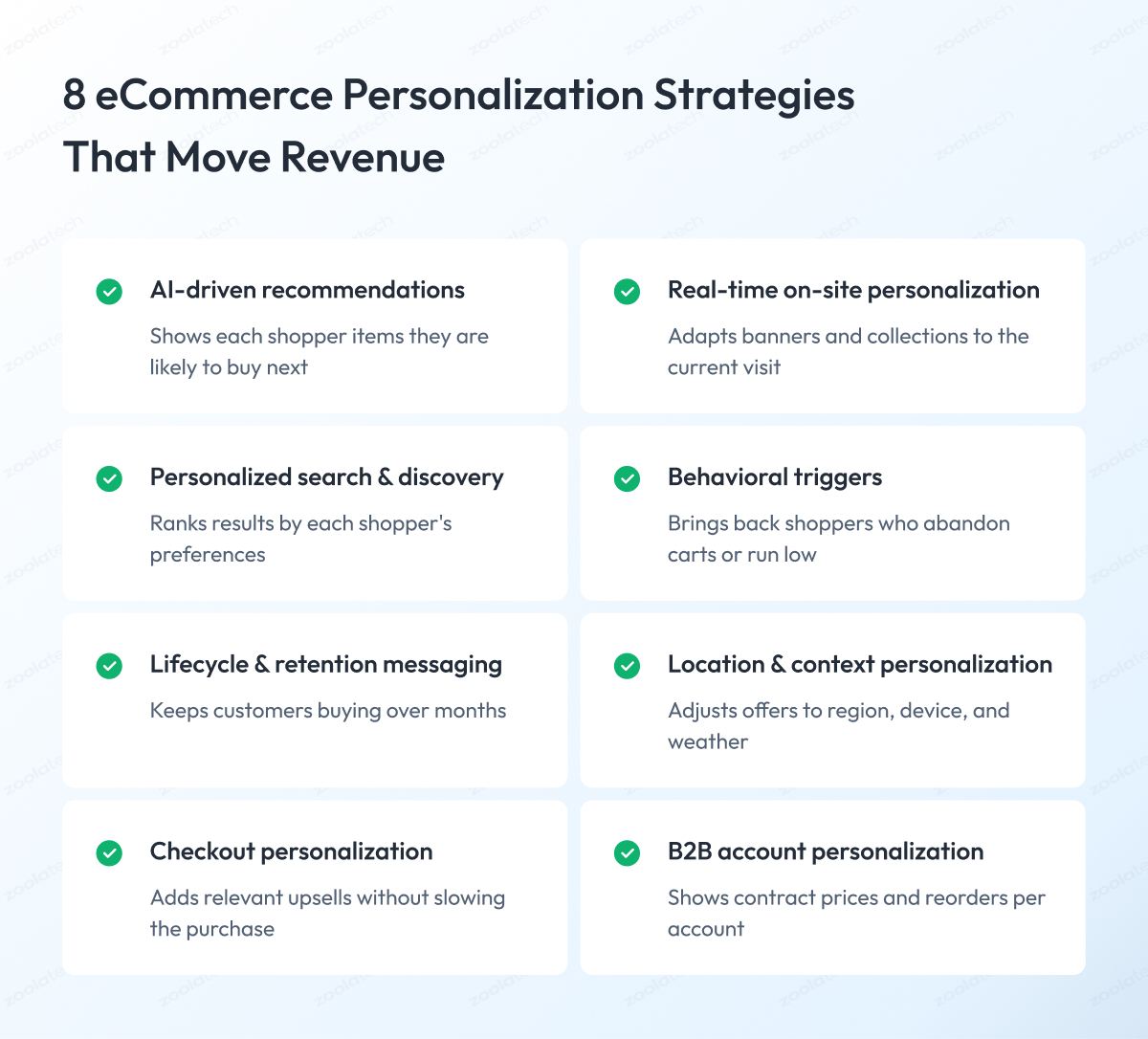
We touched on the six types above. Now let’s go through the strategies one by one, with eCommerce personalization examples for each, so you can see how they work in practice. For each one, we cover what it is, how it works, an example with numbers where we have one, and the metric it moves.
1. AI-driven product recommendations
Product recommendations are the workhorse of eCommerce product personalization. A model looks at what a shopper viewed, added, and bought, compares it with millions of other sessions, and picks the items most likely to be added next. The common formats are “frequently bought together,” “similar items,” and “recommended for you,” plus attribute-based recommendations that match on things like flavor, fabric, or price band.
Danish beauty retailer Matas is a good example. After expanding personalized product recommendation blocks across web, mobile, and email, it reported 36% year-over-year growth in attributable sales.
We saw the same effect when we built an AI-powered personalization layer for Gilt, where recommendations tuned to each member’s taste replaced generic bestseller lists. The engineering behind this sits in machine learning and recommendation systems, which we cover in the tech stack section.
Metrics it moves: AOV and revenue per visitor.
2. Real-time on-site personalization
This is eCommerce website personalization in the strict sense. Banners, product collections, and landing pages change based on what a visitor does in the current session and where they came from. A shopper who arrives from a running-shoes ad sees running content on the homepage, and a returning customer sees the category they browsed last time.
Dynamic content also includes social proof, such as “12 people bought this today.” Sportswear retailer Stadium added this kind of messaging and lifted revenue per visitor by 17.3%.
As we said in the benefits section, treat this as the second layer, after recommendations and triggers.
Metrics it moves: conversion rate and revenue per visitor.
3. Personalized search and product discovery
Search personalization re-ranks results for each shopper. Two people type “black dress” and see different orderings, one weighted toward petite sizes and a favorite brand, the other toward evening wear and a higher price band. Semantic search adds understanding of intent, so “something warm for hiking” returns fleece jackets instead of a “no results” page.
Product discovery is one of the highest-leverage areas for personalization because shoppers who use search convert far more often than those who browse. We optimized a job recommendation platform for Glassdoor using the same ranking principles, and the lesson transfers directly to retail catalogs.
Metrics it moves: search conversion rate and zero-result rate.
4. Behavioral email and messaging triggers
Triggers are messages that fire on a specific action or gap in action. The classic set is browse abandonment, cart abandonment, back-in-stock, price drop, and replenishment. Each one reaches a shopper at the exact point where a small nudge changes the outcome.
Slovak grocer Terno built an “empty fridge” campaign that predicts each customer’s grocery cycle and reminds them to reorder staples right before they run out. Compared with its generic weekly emails, the campaign delivered a 27% higher conversion rate.
Metrics it moves: cart abandonment rate and repeat purchase rate.
5. Customer lifecycle and retention messaging
Lifecycle messaging follows the customer over months. It covers onboarding for new buyers, engaging active ones, win-back for lapsed ones, and early intervention for people who show churn signals. The content of each message adapts to what the customer bought and how they behave.
Savings marketplace Raisin sends alerts when interest rates change for products a customer has shown interest in, and that single trigger lifted conversion by 18%. Our own event-driven loyalty engine works on the same principle. Every purchase, return, or milestone becomes an event that can trigger the next relevant message.
Metrics it moves: repeat purchase rate and customer lifetime value.
6. Location and context personalization
Context personalization uses signals that have nothing to do with purchase history. Geography changes currency, shipping promises, and local inventory. The device changes the layout and payment options. Weather and time of day change which products make sense to promote.
A shopper in Chicago in January and a shopper in Miami the same day should see different homepages even if their purchase history matches.
Metrics it moves: conversion rate and bounce rate.
7. Checkout personalization and smart upsell/cross-sell
The checkout is the last place to add value and the worst place to add friction. Smart checkout personalization shows one or two relevant add-ons, such as a phone case in the cart, remembers the shopper’s preferred payment and delivery methods, and automatically applies loyalty benefits. Anything beyond that risks losing the sale.
Metrics it moves: AOV and checkout completion rate.
8. B2B eCommerce personalization
B2B eCommerce personalization solves a different problem. Buyers work from accounts, and each account has negotiated prices, approved catalogs, and repeat orders. Personalization here means showing the right contract price, hiding products the account cannot buy, surfacing “reorder” for the last 20 SKUs, and routing purchase approvals correctly. Recommendation logic still applies, but to account history instead of session behavior.
Metrics it moves: reorder rate and average contract value.
The table below summarizes which metric each strategy affects and what it needs to run.
| Strategy | Primary Metric | Data Required | Stack Component |
| Product recommendations | AOV, RPV | Behavioral and transactional | Recommendation engine |
| On-site personalization | Conversion rate | Session and referral data | Decisioning and delivery layer |
| Personalized search | Search conversion | Query and click history | Search and ranking engine |
| Behavioral triggers | Cart abandonment | Real-time event stream | Messaging orchestration |
| Lifecycle messaging | Repeat rate, CLV | Purchase and engagement history | CDP and journey builder |
| Context personalization | Conversion, bounce | Location, device, time | Edge and delivery layer |
| Checkout personalization | AOV, completion | Cart contents and preferences | Commerce platform rules |
| B2B personalization | Reorder rate | Account and contract data | ERP and commerce integration |
eCommerce Personalization Trends for 2026
The strategies above cover what works today. There is also a set of eCommerce personalization trends that shoppers now expect to see in a modern store, and stores that ignore them start to feel dated within a season or two. Here are the five that matter most in 2026, and what each one asks of your stack.
1. Agentic AI and conversational commerce
Shoppers increasingly hand the task to an assistant. They type “I need a gift for a 10-year-old who likes space, under $50” and expect a short list of good options. Agentic commerce takes this further, with AI agents that compare options, apply loyalty benefits, and complete the purchase on the shopper’s behalf.
We built an AI virtual assistant for shopping that works this way, and the main technical challenge was giving the assistant reliable access to inventory, pricing, and customer data in real time.
2. Predictive and generative personalization
Predictive models estimate what a shopper wants before they act, such as the next category they will browse or the week they will run out of a product. Generative AI then writes the content for that moment, from a product description that emphasizes the attributes this shopper cares about to an email subject line in their tone. This is where AI eCommerce personalization moves from “pick the right item” to “create the right message.”
Our generative AI development work in retail mostly lands here. The guardrail is the same every time. Generated content needs approval rules and brand constraints before it reaches customers.
3. Hyper-personalization at scale
Hyper-personalization in eCommerce means a separate experience for every single shopper across every touchpoint. It combines behavioral, transactional, and contextual real-time data and needs a stack that can make millions of decisions per hour without slowing the page.
Most retailers who say they do it still run on segments underneath. The gap between the claim and the reality is a good test of a vendor’s honesty.
4. Privacy-first and cookieless personalization
Third-party cookies are on their way out, and browser and platform restrictions continue to tighten. Personalization must be based on first-party and zero-party data with explicit consent. We cover this in full in the next section, because it changes what data you can use and how you collect it.
5. Cross-channel orchestration
Shoppers move between web, app, email, store, and marketplace, and they expect each channel to remember what happened in the others. That requires a single omnichannel customer profile and a decisioning layer that every channel reads from.
It is the hardest trend to deliver and offers the biggest payoff, since omnichannel shoppers spend more and churn less than single-channel shoppers.
Each of these trends relies on AI personalization in eCommerce in some form, and each raises the same question about where the data comes from and whether you are allowed to use it. That is the subject of the next section.
Privacy-First and Cookieless eCommerce Personalization
Every trend above depends on customer data, and the rules for collecting that data have changed. Third-party cookies, the tracking method most personalization tools grew up on, are disappearing from browsers and getting blocked on mobile. So the practical question for 2026 is how to run eCommerce personalization without cookies from other sites and without making shoppers feel watched.
The answer is to build on data your customers give you directly. There are two kinds:
- First-party data. What shoppers do on your own properties, such as pages viewed, items added, purchases, and email clicks. You collect it with consent, and you own it.
- Zero-party data. What shoppers tell you on purpose, such as sizes, preferences, budget, and goals. It is the most accurate data you can get because the customer chose to share it.
Data-driven personalization for eCommerce built on these two sources is more reliable than anything third-party cookies ever provided, and it does not vanish when a browser update ships.
Consent and transparency come next.
Shoppers accept personalization when they understand what you collect and see a benefit from it. They push back when it feels invasive.
Over-personalization is a common complaint from practitioners. A shopper who looked at maternity clothes once, then sees baby products across every channel for a month, feels tracked, and that feeling costs more than the recommendations earn. The line between helpful and creepy runs roughly along whether the shopper would expect you to know something and whether you use it in a way that serves them.
Three practices keep you on the right side of that line:
- Preference centers. A page where customers set what they want to hear about, how often, and through which channels.
- Quizzes and guided selling. Short flows that ask about skin type, room size, or riding style and turn the answers into recommendations on the spot.
- Progressive profiling. Asking for one small piece of information at a time, at the moment it becomes useful, instead of a long form up front.
Consent management also has to work at the system level. When we built a unified consent platform for Credible, the requirement was that every downstream system respect the same consent state, so a preference, once applied, would be reflected everywhere.
First-party data lives in many systems, arrives at different speeds, and has to be joined into one profile before any model can use it. That is the job of the CDP and the data pipeline behind it.
Our work on a real-time customer data pipeline for Zalando shows what this looks like at scale, and our data analytics services cover the same foundation for retailers who are building it now. Which brings us to the tech stack.
The eCommerce Personalization Tech Stack: Build vs Buy
Everything up to this point, from strategies to cookieless data, runs on the same set of components. Once you understand those components, the buy-versus-build decision stops being a vendor pitch and becomes an engineering question you can answer for your own store.
So let’s open up the stack layer by layer, then look at when to buy a platform, when to build, and how to decide.
How a personalization stack works
Every eCommerce personalization engine, whether you buy it or build it, has the same five layers. Vendors package them differently, but the work each layer does is the same.
| Layer | What It Does | Typical Components |
| Data layer and CDP | Collects and unifies customer and product data | Event tracking, CDP, product catalog feed |
| Identity resolution | Link sessions and devices to one profile | Identity graph, consent state, login matching |
| Decisioning engine | Chooses what each shopper sees | Recommendation models, ranking, rules engine |
| Real-time delivery | Serves the decision to the page or message | APIs, edge caching, messaging orchestration |
| Experimentation and analytics | Measures lift and feeds results back | A/B testing, holdout groups, dashboards |
The flow runs top to bottom. A shopper acts, the event lands in the data layer, identity resolution attaches it to a profile, the decisioning engine picks the next best item or message, delivery serves it in milliseconds, and analytics records what happened so the models can learn.
Buy: ready-made eCommerce personalization platforms
An eCommerce personalization platform gives you all five layers in one package, and for many retailers, that is the right starting point.
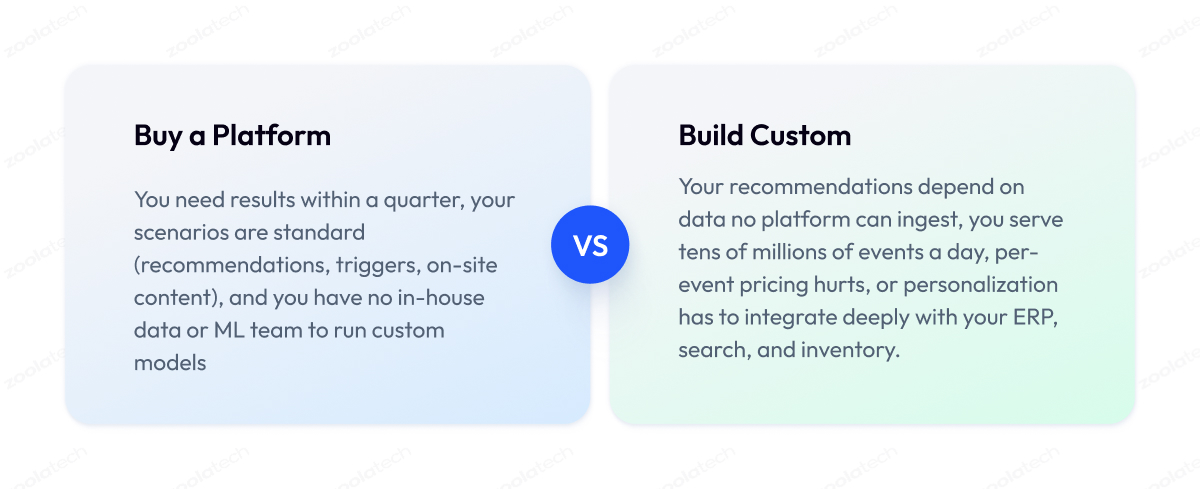
Buying makes sense when you need results within a quarter, when your scenarios are standard (recommendations, triggers, on-site content), and when you do not have a data or ML team to run custom models.
The table below compares the eCommerce personalization software and tools that most retailers shortlist. We work with several of these platforms on client projects and have no stake in any of them, so treat this as a neutral map.
| Platform | Best For | Key Capabilities | Channels | AI/ML | Integration Notes |
| Insider | Cross-channel journeys | Segmentation, journeys, on-site content | Web, app, email, SMS, WhatsApp | Predictive segments and journey AI | Strong messaging, lighter on search |
| Dynamic Yield | On-site testing and content | Experimentation, recommendations, dynamic content | Web, app, email | Deep learning recommendations | Mastercard-owned, enterprise-focused |
| Bloomreach | Commerce search and marketing | Search, merchandising, CDP, marketing automation | Web, app, email, ads | Loomi AI for search and journeys | Full suite, larger implementation |
| Nosto | Mid-market retail | Recommendations, content, merchandising | Web, email | Recommendation and segmentation models | Fast Shopify and BigCommerce setup |
| Adobe Target | Enterprise experimentation | Testing, personalization, audience targeting | Web, app | Sensei AI auto-targeting | Best inside Adobe Experience Cloud |
| Salesforce Commerce and Marketing Cloud | Salesforce-centric enterprises | Commerce, journeys, Einstein recommendations | Web, app, email, service | Einstein AI across products | Deep Salesforce ecosystem dependence |
| Algolia | Search and discovery | Search, browse, recommendations API | Web, app | AI ranking and NeuralSearch | Developer-first, composable |
| Coveo | Enterprise search and relevance | Search, recommendations, generative answers | Web, app, service | Relevance and generative AI | Strong for B2B and large catalogs |
There is no universally best platform. Which one fits depends on your data maturity, your traffic, and the scenarios you want to run. Insider and Bloomreach lean toward messaging and journeys, Dynamic Yield and Adobe Target toward on-site testing, Algolia and Coveo toward search. Most retailers end up combining two of them, and that combination is where integration work begins.
Build: custom personalization engine architecture
Buying gets you started fast. Building gets you an engine that fits your data, your catalog, and your scale, and it pays off in four situations:
- Unique data or logic. Your recommendations depend on signals a platform cannot ingest, such as loyalty tiers, in-store behavior, subscription status, or contract pricing.
- Scale. Serving 10,000 daily visits and 10 million daily visits are different engineering problems, and per-event platform pricing grows fast at the top end.
- Vendor lock-in. Your customer profiles and models live inside someone else’s system, and switching later means starting over.
- Deep integration. Personalization has to talk to your commerce platform, ERP, search, and inventory in real time, and the platform’s connectors do not go deep enough.
A custom eCommerce personalization engine typically includes a recommendation service, a feature store that keeps shopper and product features up to date, a real-time streaming pipeline that feeds it, and MLOps tooling to retrain and monitor models.
This is a serious custom eCommerce development effort, and it needs data and ML engineers who have done it before. Our work on near-real-time analytics for Zalando shows the kind of streaming and processing layer this depends on.
Build vs buy: how to decide
Run your situation through the criteria below. Most retailers find they land in more than one column, and that is normal.
| Criterion | Buy If | Build If | Hybrid If |
| Time to value | You need to lift this quarter | You can invest 6 to 12 months | You need quick wins now and depth later |
| Data maturity | Data is fragmented or thin | Unified first-party data exists | Core data is solid, edges are messy |
| In-house engineering | No data or ML team | Strong data and ML team | Small team that can own custom parts |
| Scenarios | Standard recommendations and triggers | Unique logic and signals | Standard base plus a few custom models |
| Scale | Under a few million visits a month | Tens of millions of events a day | Growing fast, costs climbing |
| Total cost | Predictable subscription works | Per-event pricing hurts at scale | Platform for breadth, custom for cost hot spots |
| Privacy | Vendor compliance is enough | Data cannot leave your environment | Some data stays in-house |
In our experience, most mid-market and enterprise retailers arrive at the hybrid column. They keep a platform for the standard scenarios and build a custom layer for the logic and data that make their business different, such as a recommendation model trained on their own signals or a decisioning service that sits between the platform and the storefront.
That setup needs an engineering partner who can integrate the platform, build the custom components, and scale them, which is the work our eCommerce personalization services cover, from architecture through eCommerce consulting on the buy-versus-build decision itself.
How to Measure eCommerce Personalization ROI
Whether you buy, build, or combine the two, the stack has to prove itself in numbers. Personalization is easy to overclaim because almost every metric moves during a busy season, and vendors are happy to take credit. So before you launch anything, decide how you will measure it.
Track the metrics that connect to revenue and retention:
- Conversion rate. Measure how many visitors make a purchase and compare the personalized group with the default group.
- Average order value (AOV). Watch this to see whether recommendations and cross-sell add items to the cart.
- Revenue per visitor (RPV). Multiply conversion by AOV to get one number that sums up on-site personalization.
- Cart abandonment rate. Use this to judge your behavioral triggers.
- Repeat purchase rate and customer lifetime value (CLV). Check these to see whether lifecycle messaging brings customers back.
- Customer acquisition cost (CAC). Expect this to fall as retention grows and you rely less on paid traffic.
The harder part is attribution. A shopper who saw a recommendation and bought might have bought anyway. The only reliable way to separate personalization from everything else is a controlled test.
Run an A/B test where one group sees the personalized experience, and one sees the default, or keep a permanent holdout group of 5 to 10% of traffic that never receives personalization. Compare the two groups over several weeks, so seasonality and promotions even out.
Set expectations accordingly. The eCommerce personalization stats we quoted earlier come from programs that ran for years. For a well-implemented program, a realistic overall sales lift is 5% to 25%, with the higher end coming from recommendations and triggers. Anyone promising more than that from a single tool is describing a demo.
Measurement also needs its own infrastructure. Holdout groups, experiment assignment, and revenue attribution must run within your data platform, which is why we usually set up analytics for eCommerce alongside the personalization stack itself.
Implementation Roadmap: How to Get Started
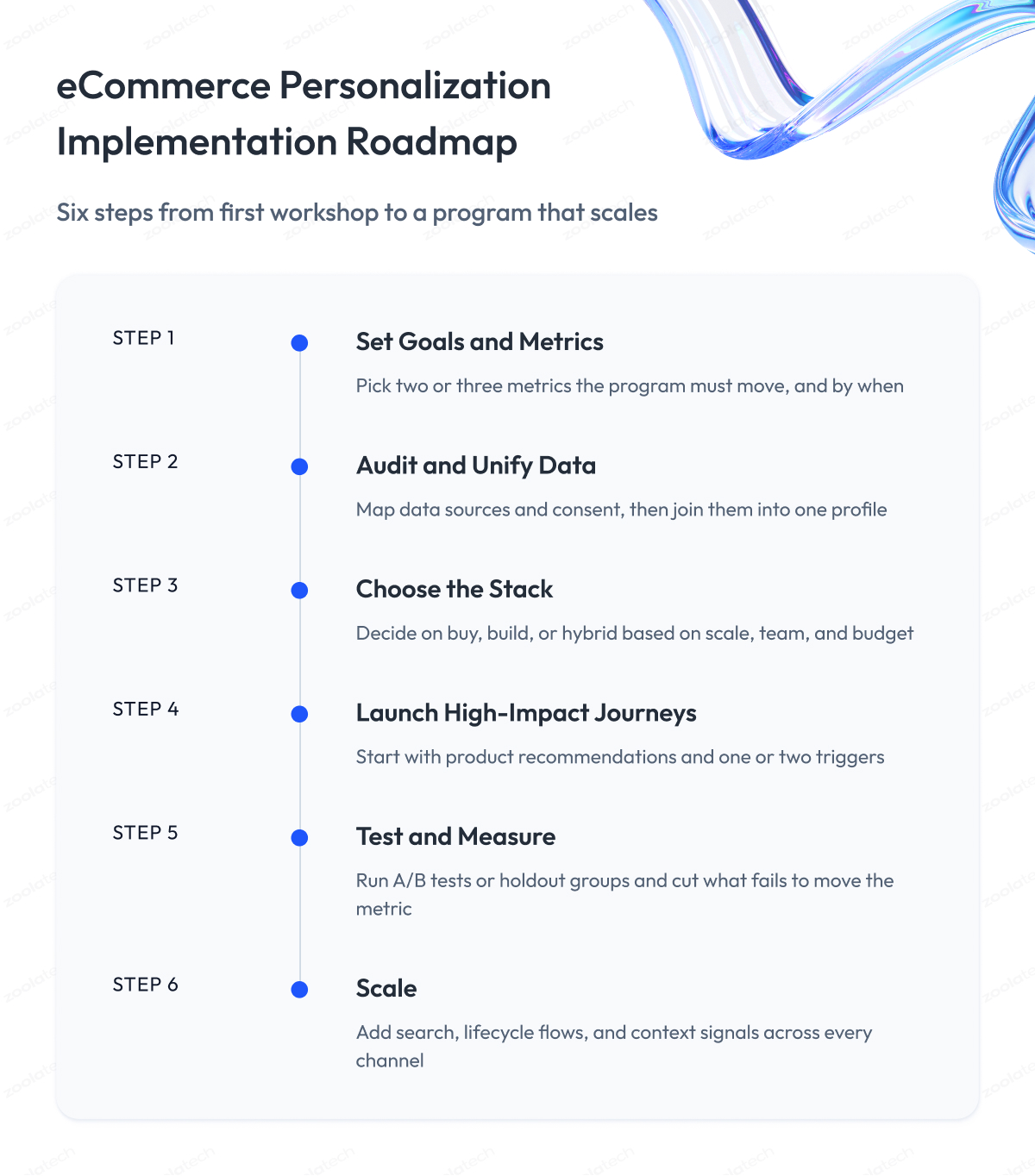
Measurement is the last piece of the plan, and now you have all the pieces. Here is how we run personalization projects with retail clients, from the first workshop to a scalable program. The order matters because most failed programs we have seen skipped a step near the top.
Step 1 – Set goals and pick metrics
We start with the business outcome. Which two or three metrics does the program need to move, by how much, and by when? A goal like “raise RPV by 8% on returning visitors within two quarters” shapes every decision after it and gives the team something concrete to test against.
Step 2 – Audit and unify the data
We map where customer and product data live, how fresh it is, and what consent covers it. Then we connect those sources into a single profile, usually through a CDP and a streaming pipeline. This step takes the longest and produces the least visible output, and it determines whether every model that follows succeeds or fails.
Step 3 – Choose the stack
With goals and data on the table, we run the buy, build, or hybrid decision from the previous section against your scale, team, and budget. Most clients land on hybrid, and the exact split becomes the architecture plan.
Step 4 – Start with high-impact journeys
We launch one or two scenarios with a short path to revenue, almost always product recommendations on product and cart pages, and one or two behavioral triggers such as cart abandonment or replenishment. Homepage content and cross-channel orchestration come later.
Step 5 – Test and measure
Every scenario ships with an A/B test or a holdout group from day one. We compare results over several weeks and kill what fails to move the metric.
Step 6 – Scale
Once the first scenarios prove lift, we add search personalization, lifecycle flows, and context signals, and we extend the stack to app, email, and store. By this point, the data foundation from step 2 pays for itself, because each new scenario reuses it.
On the timeline, expect the first measurable lift within 3 to 4 months if your data is in reasonable shape, and 6 to 9 months if step 2 requires serious work.
Organizational readiness matters as much as the tech. In our experience, programs without a named owner stall between step 2 and step 4, no matter how good the stack is. Assign an owner before you assign a budget.
Final Word
Getting eCommerce personalization to a point where it moves revenue takes work. You need to unify data across five systems, pick a stack from a crowded market, run honest tests, and get marketing, product, and engineering to own the same metrics.
But the effort pays off. Every percentage point of extra conversion or AOV repeats on every order for years, and a customer who feels understood costs less to keep than a new one costs to acquire. Compared with that, six months of data and engineering work is a modest price.
So begin with data and one or two scenarios. Fund recommendations and triggers before banners, set up a holdout group before you launch, and decide on buy, build, or hybrid based on your own scale.
If you want a second opinion on that decision, or a partner to design and build the custom parts, we are ready to review your setup and help you find the right path forward.
Questions You May Have
What is eCommerce personalization?
eCommerce personalization is the practice of using a shopper’s behavior, purchase history, and stated preferences to tailor product recommendations, content, search results, and offers to that individual in real time.
Why is personalization important in eCommerce?
Personalization matters because shoppers now expect it, and stores that deliver it see higher conversion rates, larger average orders, fewer abandoned carts, and more repeat purchases than stores that show everyone the same experience.
What data is used for eCommerce personalization?
Personalization runs on behavioral data such as views and clicks, transactional data such as orders and returns, first-party data collected on your own properties, and zero-party data that shoppers share on purpose, such as sizes and preferences.
What are the main types of personalization in eCommerce?
The six main types are product recommendations, dynamic on-site content, personalized search, behavioral triggers, location and context personalization, and checkout personalization.
How does AI contribute to eCommerce personalization?
AI personalization in eCommerce replaces hand-written rules with machine learning models that learn from millions of sessions, so recommendations, search rankings, and message timing update automatically for each shopper.
Should you buy an eCommerce personalization platform or build a custom one?
Buy a platform when you need standard scenarios live within a quarter and lack an in-house data team, build a custom eCommerce personalization engine when your data, scale, or logic outgrow what platforms support, and combine the two when only part of your program needs custom work.
Can personalization work for anonymous visitors?
Yes, because session behavior, referral source, device, and location give enough signal to personalize recommendations and content within the first few clicks, even before a shopper logs in or shares any details.
How do you measure the ROI of eCommerce personalization?
Measure ROI by running an A/B test or keeping a permanent holdout group and comparing conversion rate, average order value, revenue per visitor, and repeat purchase rate between personalized and non-personalized traffic over several weeks.
What are the benefits of personalization in eCommerce for mid-market retailers?
Mid-market retailers gain higher revenue per visitor, lower dependence on paid acquisition, and stronger retention, and they can capture most of that lift with recommendations and behavioral triggers alone.
Which eCommerce personalization software and tools are most common?
Retailers most often shortlist Insider, Dynamic Yield, Bloomreach, Nosto, Adobe Target, and Salesforce Commerce and Marketing Cloud for full personalization, and Algolia or Coveo for personalized search and discovery.
How does eCommerce personalization work without cookies?
Cookieless personalization relies on first-party data from your own site and app, zero-party data shoppers volunteer through quizzes and preference centers, and consent-based identity resolution instead of third-party tracking.
What is hyper-personalization in eCommerce?
Hyper-personalization in eCommerce means creating a distinct experience for every individual shopper across every channel in real time, using behavioral, transactional, and contextual data together instead of segments.
What are some eCommerce personalization examples that deliver measurable results?
Proven eCommerce personalization examples include Matas growing attributable sales by 36% with product recommendations, Terno lifting conversion by 27% with an “empty fridge” replenishment trigger, and Raisin raising conversion by 18% with interest-rate alerts.