








Quick Summary
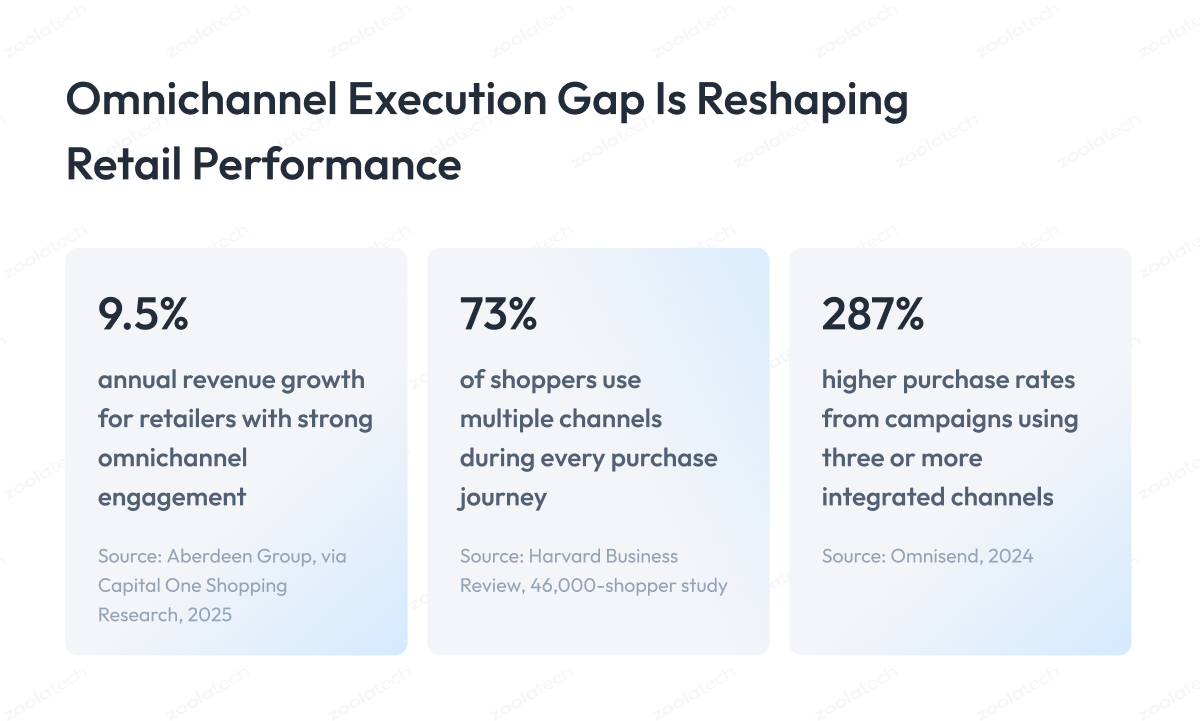
- 73% of shoppers use several channels in a single purchase journey, yet only 8% of retailers can deliver real-time omnichannel service consistently.
- The gap is architectural rather than channel count: multichannel keeps data siloed per channel, while omnichannel needs one unified model, one real-time inventory record, and an event-driven backbone.
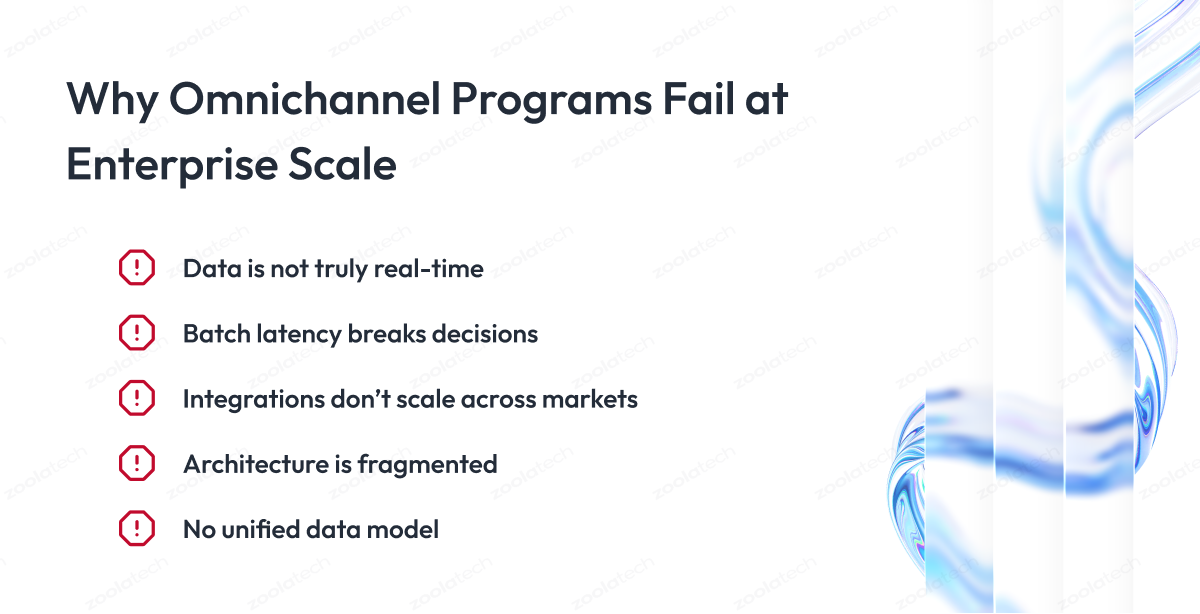
- Four failure modes recur: fragmented legacy integration, batch latency measured in hours, per-market point-to-point connections, and no canonical data model.
- One European retailer with 7,000+ points of sale across 60+ countries went from 36-hour data lag to millisecond propagation by replacing batch pipelines with a Kafka event hub.
- Sequence by dependency rather than visibility, from canonical data model to event hub, real-time inventory, APIs, and fulfilment orchestration, leaving personalization last across roughly 12 to 18 months.
Seventy-three percent of retail shoppers now use multiple channels in every purchase journey. Yet only 8% of retailers can consistently deliver real-time omnichannel service.
The gap is not channel coverage — it is integration architecture. Most omnichannel retail strategy programs fail at the data layer before customers notice.
This article delivers the architectural framework and decision sequence that close that gap.
What an Enterprise Omnichannel Retail Strategy Actually Requires
The term “omnichannel” is used across the retail technology industry with little architectural precision.
For an enterprise retailer operating across dozens of markets, it means something specific: unified data, real-time inventory visibility, and event-driven system integration. Without those three foundations in place, every customer-facing capability is built on infrastructure that will fail under operational load.
An enterprise omnichannel retail strategy demands five distinct technical capabilities operating in concert:
- Unified customer identity: a persistent profile tracking purchase history and preferences across every channel and market.
- Real-time inventory state: every channel reads from the same record, updated within milliseconds of each transaction.
- Event-driven integration backbone: systems communicate via a shared event stream rather than batch-synchronized point-to-point connections.
- API-first channel architecture: every touchpoint — web, app, in-store POS, customer service — consumes data through standardized, versioned APIs.
- Cross-channel fulfillment orchestration: a single logic layer governs BOPIS (buy online, pick up in store), ship-from-store, and same-day delivery regardless of which channel originated the order.
The distinction between omnichannel, multichannel, and cross-channel is not semantic — it has direct implications for integration architecture, data governance, and enterprise scalability at the level where retail digital transformation either compounds value or stalls.
| Dimension | Multichannel | Cross-Channel | Omnichannel |
| Data model | Siloed per channel | Partially shared | Fully unified |
| Inventory visibility | Per-channel only | Limited sharing | Real-time, single record |
| Integration model | Point-to-point | Selective sync | Event-driven backbone |
| Customer experience | Disconnected | Loosely connected | Fully consistent |
| Enterprise scalability | Low | Medium | Required for 10+ markets |
Why Retail Omnichannel Strategies Fail at Enterprise Scale
Enterprise retailers don’t fail at omnichannel because they lack investment or intent. They fail because underlying systems — built through years of siloed acquisitions, regional rollouts, and compounding legacy modernization debt — cannot deliver the data consistency that omnichannel requires.
Understanding where programs break before they reach customers is the most undervalued capability in enterprise retail programs.
Four architectural failure modes account for the majority of failed programs:
- Fragmented legacy architecture: batch-based, per-market integrations that accumulate complexity rather than consolidating to a shared data model.
- Unacceptable batch latency: scheduled sync processes producing data lag measured in hours, leaving inventory records stale at peak demand moments.
- Non-scaling point-to-point connections: per-market integrations requiring a new project for each geographic expansion, compounding cost with every launch.
- Absent canonical data model: no agreed definitions for product, customer, or order entities, forcing custom translation logic into every integration.
1. Fragmented legacy integration architecture
Legacy integration in enterprise retail rarely gets redesigned — it accumulates. Each market launch, platform acquisition, or channel addition introduces another point-to-point connection, adding complexity without consolidating the data model.
Common symptoms of fragmentation at enterprise scale:
- Inconsistent product data across web, app, and store
- Order status discrepancies between channels
- Inventory counts diverging within hours of sync
- No single customer identity across touchpoints
- Integration failures isolated to individual markets
2. Batch-based data pipelines with unacceptable latency
Batch-based architectures were designed for overnight reconciliation, not real-time commerce. When a customer checks mobile inventory and that record is hours stale, the omnichannel promise is broken at the exact moment of purchase intent.
3. Per-market point-to-point integrations that fail to scale
The most common enterprise retail integration pattern is also the most brittle: each market builds its own connections independently, producing a web of non-reusable integrations. Adding a new market requires a new project rather than a configuration change, compounding timeline and cost with every geographic expansion.
How this scaling failure manifests operationally:
- Every country operates an independent integration stack
- No reusable data models across markets or regions
- New market launches take months instead of weeks
- A single API change breaks multiple downstream systems
4. Absence of a unified data model across systems
Without a canonical data model — agreed definitions for product, customer, and order entities — every integration requires custom translation logic. This compounds over time into the data discrepancies that make personalization, real-time inventory, and cross-channel fulfillment structurally unreliable at scale.
The Architecture Blueprint for Omnichannel Retail Strategy at Scale
A scalable omnichannel retail strategy requires architectural decisions made in the correct sequence — not simultaneously. Attempting to build personalization before establishing a unified data layer produces systems that work in controlled environments and fail in production.
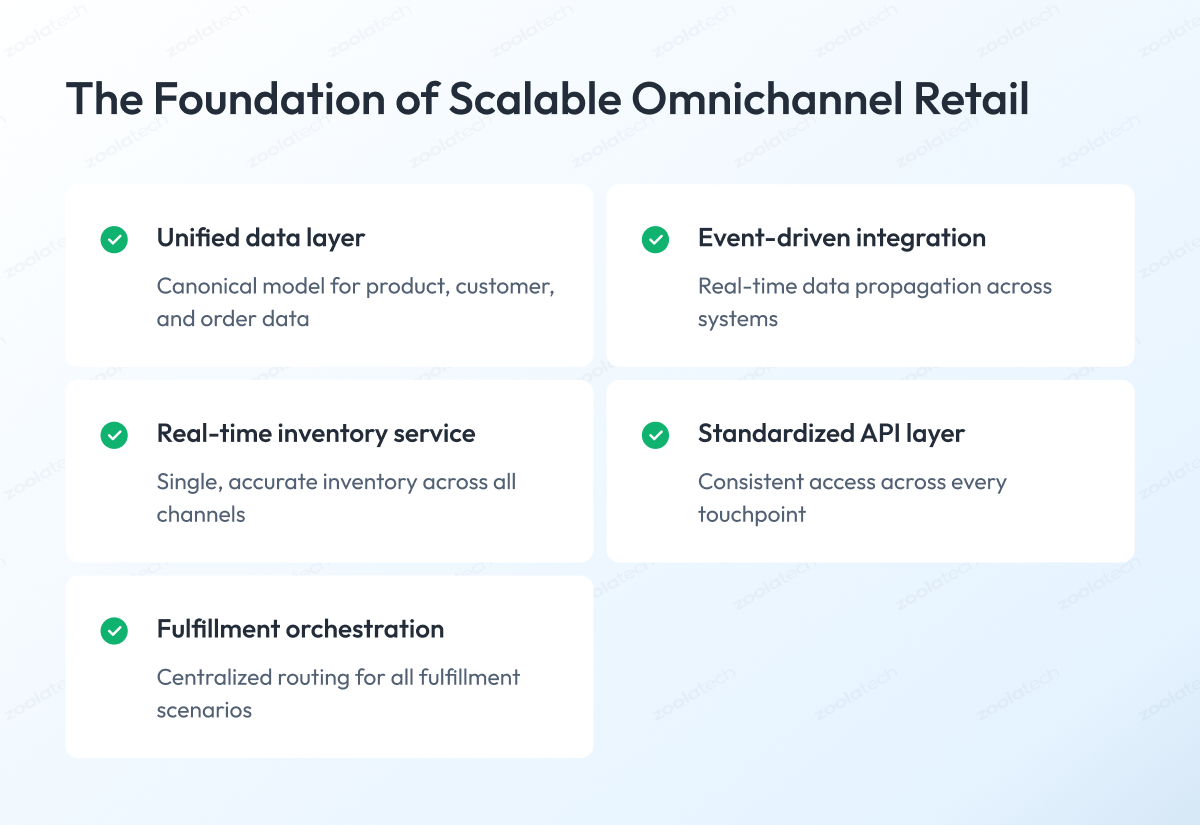
The five components below represent the validated build order for enterprise programs, supported by Zoolatech’s data analytics and cloud engineering capabilities.
Enterprise omnichannel architecture — build sequence:
- Unified data layer: Establish a canonical model for product, customer, and order entities before any integration work begins.
- Event-driven integration hub: Replace point-to-point batch connections with a Kafka-based event bus propagating state changes in milliseconds.
- Real-time inventory service: Build a dedicated service maintaining a single inventory record, consumed by all channels via standardized API.
- API gateway and channel adapters: Ensure every touchpoint — web, mobile, POS, customer service — reads and writes through a consistent, versioned API layer.
- Fulfillment orchestration layer: Implement a rules engine routing BOPIS, ship-from-store, and same-day orders from a single authoritative logic source.
Architecture patterns are not interchangeable at enterprise scale. The wrong selection produces failure modes that surface only under peak load — when the cost of recovery is highest.
| Pattern | Latency Profile | Failure Mode at Scale | Enterprise Fit |
| Batch / scheduled sync | Hours to days | Stale data at peak demand | Low |
| Point-to-point API | Seconds to minutes | Cascading failures under load | Medium |
| Event-driven architecture (EDA) | Milliseconds | Isolated, recoverable failures | High |
| API mesh | Variable | Governance complexity at scale | Medium–High |
Before selecting an architecture pattern, enterprise programs must satisfy these prerequisites:
- Completed data model audit across all markets and systems
- Integration governance ownership formally assigned
- Decommission plan for legacy batch processes approved by leadership
- API standards document ratified by engineering and product
- SLA targets defined for real-time inventory accuracy per channel
Omnichannel Retail Strategy Best Practices for Enterprise Programs
Architecture defines what to build. Best practices define how to govern it.
Enterprise programs that succeed at omnichannel retail strategy implementation treat integration infrastructure — not feature delivery — as the primary program discipline, with governance structures that protect the architecture as the organization scales.
Six governance practices that determine whether enterprise programs sustain their architecture over time:
- Cross-functional integration council: a standing body with engineering, merchandising, logistics, and CX representation that owns all canonical data model decisions.
- API contract versioning: every integration interface is versioned and backward-compatible, preventing upstream upgrades from breaking downstream market systems.
- Canonical schema registry: a centralized source of truth for all data definitions, enforced at the integration layer through automated schema validation.
- Real-time monitoring and alerting: SLA dashboards covering inventory accuracy and channel latency, with automated alerts before customer-facing failures occur.
- Phased market rollout governance: new markets onboarded via shared configuration on the integration platform, not custom one-off integrations.
- AI-powered demand forecasting: demand signals from all channels feed a shared forecasting model, reducing stockouts and overstock positions at enterprise scale.
Common mistakes that undermine architecture after deployment:
- Building channel-specific data models
- Allowing POS and e-commerce inventory different sync schedules
- Deploying personalization before unifying customer identity
- Launching BOPIS without real-time inventory accuracy
- Treating integration as a project, not a discipline
Omnichannel retail strategy implementation follows a predictable phase sequence at enterprise scale. Compressing phases to accelerate customer-facing delivery is the most common cause of costly mid-program rebuilds.
For a broader view on successful e-commerce project delivery, see Zoolatech’s delivery methodology.
Three-phase implementation sequence:
- Foundation (months 1–4): Establish canonical data model, deploy integration hub, migrate highest-volume markets off batch pipelines.
- Capability (months 5–9): Activate real-time inventory, launch BOPIS and same-day pickup, integrate custom CRM for retail and loyalty systems.
- Optimization (months 10–18): Enable AI-driven personalization, expand fulfillment options, and onboard remaining markets onto the shared integration platform.
Pandora Case Study: How Zoolatech Approaches Omnichannel Retail Strategy Implementation
Zoolatech’s engineering practice spans global manufacturers, specialty retailers, and omnichannel operators across North America and Europe — all navigating the intersection of legacy architecture and omnichannel ambition.
The engagement below represents one of the most technically demanding omnichannel retail strategy implementations in Zoolatech’s retail case study portfolio.

The client — a major European manufacturer and retailer with 40,000+ employees, 7,000+ points of sale, and operations across 60+ countries — faced exactly the architectural failure modes described in this article:
- Batch-based integration latency: per-market data sync producing up to 36-hour lag across inventory, order, and customer systems.
- Non-reusable point-to-point connections: each country operating its own integration stack with no shared data model or reusable architecture.
- Operational data discrepancies: conflicting product, inventory, and order records across operational and analytical systems.
- Scaling friction: adding a new market required a full integration project from scratch, compounding cost and timeline with every expansion.
Zoolatech engineered “Nexus” — a custom cloud-based event-driven integration hub built on Apache Kafka and Azure, replacing the fragmented legacy landscape with a standardized real-time event bus.
The platform introduced a Central Schema Registry for data consistency enforcement, a Tokenization Service for compliance, and a Deduplication Service for event integrity across all markets.
| Challenge | Zoolatech Action | Result |
| 36-hour data latency | Event-driven Kafka hub replaces batch pipelines | Millisecond-level propagation |
| Non-reusable per-market integrations | Canonical schema registry deployed | Reusable across all markets |
| High maintenance costs | Custom-owned platform, no third-party licensing | Significant cost reduction |
| Cross-system data discrepancies | Tokenization and deduplication services | Consistent data across systems |
| No omnichannel fulfillment capability | Real-time event layer deployed | Order-online, pickup-in-store enabled across 60+ countries |
Measuring Success — KPIs for Enterprise Omnichannel Programs
Tracking the wrong metrics is as damaging as having no metrics. Enterprise omnichannel programs require a KPI framework anchored to integration infrastructure performance — not just conversion rates — because infrastructure failures always surface as customer experience failures first.
The Manhattan Associates omnichannel trends research confirms that 61% of modern shoppers place high value on the in-store experience — which only delivers consistently when the data layer supporting it is accurate and real-time.
Three foundational KPI categories anchor every credible omnichannel measurement framework:
- Integration health metrics: real-time inventory accuracy and event propagation latency — the architectural indicators that determine whether customer-facing capabilities can function at all.
- Fulfillment performance metrics: BOPIS readiness time and cross-channel return success rate — the operational indicators directly tied to customer promise.
- Revenue impact metrics: omnichannel customer lifetime value vs. single-channel baseline — the business case metric that validates program investment at executive level.
| Category | Metric | Why It Matters at Enterprise Scale |
| Integration health | Real-time inventory accuracy (>99% target) | Stale data breaks every downstream capability |
| Fulfillment performance | BOPIS readiness time (<2 hours) | Directly impacts in-store conversion at scale |
| Data quality | Cross-channel identity match rate | Drives personalization and loyalty integrity |
| Latency | Event propagation time across markets | Sets real-time ceiling for all channel capabilities |
| Revenue impact | Omnichannel vs. single-channel customer LTV | Validates program ROI at executive level |
Decision Framework — How to Build an Omnichannel Retail Strategy in the Right Order
The most common mistake in enterprise omnichannel retail strategy implementation is prioritizing customer-facing capabilities over foundational infrastructure.
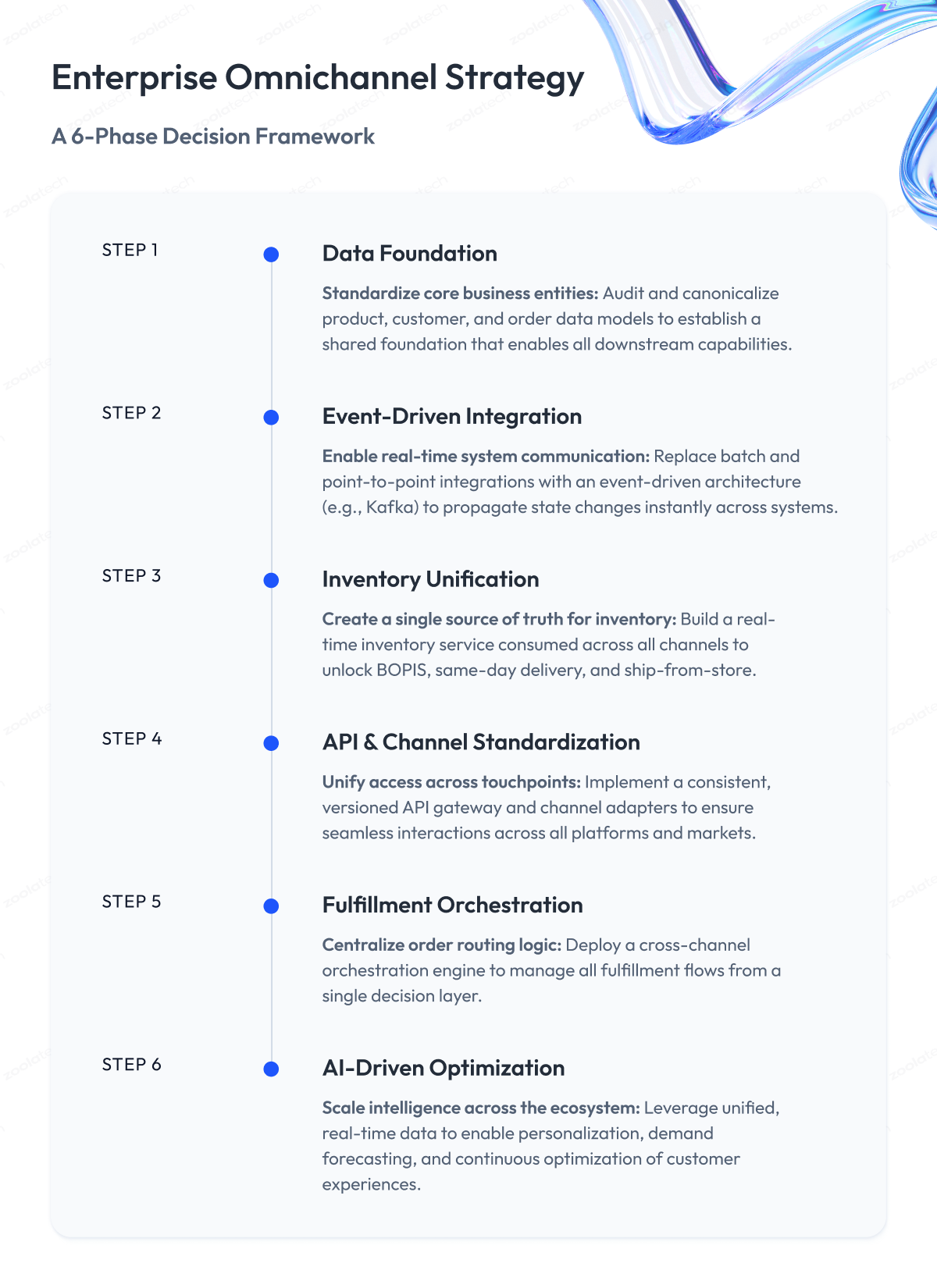
A decision sequence organized by architectural dependency — not business visibility — is the difference between programs that compound value and programs that require expensive rebuilding.
Business intelligence for retail and e-commerce conversion optimization both depend on infrastructure decisions made in the priority order below.
Prioritized action sequence for enterprise omnichannel retail strategy:
- Audit and canonicalize all data models: Agree on shared definitions for product, customer, and order entities — this gates every decision that follows.
- Deploy event-driven integration hub: Replace batch and point-to-point connections with a Kafka-based event bus propagating state changes in milliseconds.
- Build real-time inventory service: Establish a single authoritative inventory record consumed by all channels — this unlocks BOPIS, same-day, and ship-from-store.
- Standardize API gateway and channel adapters: Ensure every touchpoint reads and writes through a consistent, versioned API layer across all markets.
- Activate cross-channel fulfillment orchestration: Implement a unified order routing engine handling all fulfillment modes from a single logic source.
- Enable AI-driven personalization and demand forecasting: Once the data layer is unified and real-time, AI services compound value through predictive inventory, targeted offers, and loyalty optimization.
Conclusion
Enterprise omnichannel success depends on integration architecture, not channel count alone. Retailers that unify data, inventory, and fulfillment logic are the ones that scale profitably.
The key findings include:
- Unified data models are the foundation of omnichannel scale
- Real-time inventory accuracy determines fulfillment reliability
- Event-driven integration outperforms batch-based architectures
- API standardization is required for cross-channel consistency
- Governance discipline matters as much as technical design
- Omnichannel ROI depends on infrastructure before experience layers
Questions You May Have
What is the difference between omnichannel and multichannel retail strategy?
Multichannel gives customers independent channel options; an omnichannel retail strategy connects those channels through unified data, shared real-time inventory, and a persistent customer identity that follows every interaction across every touchpoint.
Why do enterprise omnichannel retail strategies fail despite large technology investments?
Most programs invest in customer-facing capabilities before establishing the data architecture and integration infrastructure those capabilities depend on, producing systems that function in isolation but fail under real operational load at scale.
How long does an enterprise omnichannel retail strategy implementation typically take?
A phased program running from canonical data model foundation through full omnichannel fulfillment capability typically requires 12 to 18 months, with measurable infrastructure improvements visible within the first four months.
What is the first architectural decision an enterprise retailer must make when building omnichannel capability?
Before any integration or channel work begins, engineering and business leadership must align on a canonical data model — the shared definitions for product, customer, and order entities that govern every downstream integration.
What KPIs should a CTO track in the first 12 months of omnichannel retail strategy implementation?
Real-time inventory accuracy rate, event propagation latency across markets, cross-channel customer identity match rate, and BOPIS order readiness time are the four infrastructure metrics that determine whether customer-facing omnichannel capabilities will perform at enterprise scale.