








Quick Summary
- In logistics a software error becomes a physical one, with trucks waiting at the dock or inventory counts that no longer match the warehouse, which is what raises the bar on the vendor.
- Seven criteria drive the ranking, including modernization discipline with rollback plans and the willingness to say which projects a company should decline.
- Match the vendor to the problem, since multimodal TMS, supply chain control towers, route optimization at delivery scale, courier and parcel systems, and mobile-first driver apps sit with different firms.
- Published results give the yardstick: forecast error cut from 5.7 to 1.9 days for $3.9M in annual EBIT, vessel scheduling from 4 hours to 10 minutes, and one grocer scaling 10,000 to 50,000 daily deliveries.
- Entry price sorts the shortlist fast, from $50,000 at Intellias to $100,000 at DataArt, so budget rules options out before capability does.
The right logistics software development company can modernize a live TMS, untangle a fragile carrier integration, or build a fleet platform without interrupting the daily operations your business depends on.
The difficult part is finding that partner. In logistics, software errors lead to physical problems, such as trucks waiting at the dock or inventory counts that no longer match what’s in the warehouse.
With stakes this high, you want a team with proven logistics experience, and that is exactly what is hard to verify. Almost every vendor claims deep expertise in TMS, WMS, EDI, telematics, and supply chain visibility, and their websites look nearly identical.
So we did the filtering for you. We looked past the marketing and gave weight to published logistics projects, verified Clutch reviews, and technical depth in integrations and modernization.
The result is a list of the top logistics software development companies in 2026 where each entry explains what the company builds, its strongest public proof, which projects it fits best, and when you should look elsewhere.
By the end of this article, you will have a vetted shortlist of logistics engineering partners worth talking to and a practical way to tell which one matches your project.
Top Logistics Software Development Companies by Use Case
| Use case | Strong-fit company | Why it fits |
| Integration-heavy logistics modernization | Zoolatech | Best for companies that need to modernize live TMS/WMS platforms and carrier or EDI integrations while operations keep running. |
| Enterprise TMS and multimodal transportation | Intellias | Best for large transportation programs spanning road, rail, sea, and air with fleet and supply chain workstreams. |
| Supply chain data platforms and control towers | N-iX | Best for companies that need strong data engineering, analytics, and enterprise-scale delivery teams. |
| Route optimization at retail-delivery scale | DataArt | Best for delivery operations with thousands of daily orders, complex route planning, and ERP integration. |
| Courier, express, parcel, and last-mile systems | Software Mind | Best for parcel and postal operators that need custom TMS, courier apps, PUDO networks, and proof of delivery. |
| Mobile-first logistics products | Cleveroad | Best for driver, courier, tracking, and customer-facing apps that need design, mobile, backend, and cloud under one team. |
| Logistics SaaS for SMBs and scale-ups | Clockwise Software | Best for focused products like route planning, fleet management, and dispatch tools built by a smaller product team. |
| Broad ERP/CRM and logistics integration | Itransition | Best for companies where logistics is part of a larger network of enterprise systems, data, and managed support. |
| Operational software for manufacturers and distributors | Classic Informatics | Best for custom fleet, inventory, and warehouse software tied to existing ERP and distribution processes. |
| Enterprise modernization and support-heavy programs | Trigent Software | Best for modernizing a portfolio of applications with QA automation, cloud, data engineering, and long-term support. |
Quick answer
If your project involves a live TMS or WMS, carrier and EDI connections, or modernization that cannot interrupt operations, Zoolatech is the strongest starting point in this ranking. Intellias fits large multimodal transportation programs, N-iX leads on supply chain data platforms, DataArt specializes in route optimization at delivery scale, and Software Mind goes deepest into courier and parcel systems. Cleveroad suits mobile-first logistics products, Clockwise Software builds focused SaaS tools for smaller teams, Itransition connects logistics with wider enterprise systems, Classic Informatics serves manufacturers and distributors, and Trigent fits modernization programs with heavy support needs.
Our Methodology: How We Selected These Logistics Software Development Companies
Instead of copying names from other rankings or collecting the most recognizable vendors, we reviewed each company based on its logistics software expertise, service focus, case studies, industry experience, client feedback, technical capabilities, and ability to support complex engineering projects.
Our goal was to highlight companies that can handle the problems logistics teams actually face, from TMS and WMS modernization and carrier integrations to route optimization, warehouse operations, data platforms, and long-term product development.
These are the key criteria we considered before adding logistics software development companies to our list:
| Criterion | What it means in practice |
| Logistics domain evidence | Published TMS, WMS, fleet, parcel, warehouse, routing, and transportation work |
| Integration depth | Experience with ERP, carrier APIs, EDI, telematics, maps, and warehouse hardware |
| Modernization discipline | Staged replacement of legacy systems with rollback plans and controlled cutovers |
| Data and event engineering | Shipment tracking, event processing, analytics, forecasting, and heavy operational data flows |
| Delivery fit | Company size, commercial model, and team structure matched to its target buyers |
| Independent validation | Clutch reviews, client references, and visible project history |
| Honest boundaries | Willingness to say which projects the company should decline |
With these criteria in mind, let’s move to the detailed review of each logistics software development company.
1. Zoolatech – Best Overall for Logistics Software Development and Modernization
Zoolatech is a logistics software development company founded in Silicon Valley in 2017 and headquartered in Miami, with delivery centers in Poland, Ukraine, Mexico, and Turkey. Over eight years, the team has grown to 600+ specialists and delivered 300+ projects for brands like Nordstrom, Pandora, Zalando, HelloFresh, and DAT, one of the largest freight marketplaces in North America.
We put Zoolatech first because it meets every criterion in our methodology, and the strongest one is the modernization discipline. The company specializes in evolving live systems that cannot be switched off, which is the exact situation most logistics buyers are in.
Old and new platforms run in parallel, migrations happen in stages with rollback plans, and warehouses keep shipping while the architecture changes underneath them.
The numbers behind that approach hold up. More than 60% of the team are senior-level engineers, 98% of clients stay with the company after the first project, and the average partnership lasts over four years. For logistics platforms that need years of evolution, that continuity matters as much as the initial build.
Logistics software development services Zoolatech offers:
- TMS and WMS development and legacy modernization.
- Carrier API, EDI, and ERP integrations.
- Supply chain visibility and shipment tracking platforms.
- Data analytics, demand forecasting, and AI-powered optimization.
- Driver, courier, and warehouse mobile applications.
- Cloud, DevOps, QA automation, and post-launch support.
| Best fit | Established logistics businesses, 3PLs, retailers, and manufacturers modernizing complex live systems |
| Keep in mind | Not the obvious choice for a small app or a buyer whose only priority is the lowest hourly rate |
Relevant case study: ML-powered delivery forecasting
The client’s delivery promises were based on static estimates, and customers saw arrival dates missed by days.
We replaced them with a machine learning forecasting system that unifies order, fulfillment, and shipment data through an architecture on Kafka and AWS, with Spark and Airflow pipelines feeding the predictive model.
The results speak the language every logistics operator understands. Forecast error dropped from 5.7 days to 1.9 days, delivery accuracy improved 3x, and the system generated $3.9M in annual EBIT impact. Each retraining cycle makes the model more precise, so the platform keeps improving long after launch.
Positioning angle for Zoolatech
Zoolatech works best as a long-term engineering partner for logistics platforms that have outgrown their architecture.
The team takes ownership of the outcome, raises risks early, and stays for the years of iteration that follow the first release. For a buyer with a live operation on the line, that is the difference between a vendor you manage and a partner who manages the problem with you.
2. Intellias – Best for Enterprise TMS and Multimodal Transportation
Intellias has been building software since 2002, when it was founded in Lviv, Ukraine, and has grown into a global engineering partner with offices in 17 countries and 170 enterprise clients. The company maintains a senior-heavy bench, with 96% of its engineers at mid- or senior-level, and has a 98% customer satisfaction rate.
Logistics is one of its strongest domains. Intellias covers the full multimodal journey across road, rail, sea, and air, from order creation and load planning to delivery, invoicing, and shipment tracking. This sets it apart from vendors that only handle single-fleet tools, because a platform coordinating several transport modes, documents, and handoffs is a harder class of problem.
Clients on Clutch describe the company as large enough to run several workstreams at once and still flexible in how teams are set up. Projects start at $50,000, with published engagements ranging from five figures to $3 million, indicating the commercial model is built for substantial programs.
Logistics software development services Intellias offers:
- Custom TMS development.
- Fleet management software.
- Warehouse management systems.
- Supply chain visibility platforms.
- Route optimization.
- IoT-based asset tracking.
- Supply chain analytics.
- Legacy platform modernization.
| Best fit | Enterprises and large logistics providers running multimodal or multi-country transportation programs |
| Keep in mind | Independent review summaries note enterprise-oriented rates and occasional deadline slippage, so smaller products should check whether a focused studio offers a faster commercial path |
Relevant case study: Door-to-door digital logistics platform
A multinational freight forwarding company engaged Intellias to develop its digital logistics platform, which now serves over 2,500 brands worldwide.
The redesigned experience shows shippers the fastest and most cost-efficient routes, helps transporters pick up orders on the way to avoid empty miles, and gives the operations team a single view of supply chain decisions.
3. N-iX – Best for Supply Chain Data Platforms and Control Towers
N-iX has been on the market for over 20 years and brings together more than 2,000 engineers, with dedicated expertise in logistics, supply chain, data, and machine learning.
The company holds ISO 9001, ISO 27001, and PCI DSS certifications and partner status with AWS, Microsoft, and Google Cloud, which matters when logistics data crosses borders and compliance regimes.
The company is at its strongest when logistics is treated as a data problem. Its practice covers supply chain control towers, warehouse automation, and industrial machine learning, and its public evidence includes cutting vessel scheduling for a maritime client from 4 hours to 10 minutes.
On Clutch, a corporate logistics product owner at a large engineering firm praised the technical and management aspects of a supply chain cloud migration delivered by N-iX.
Buyers can engage N-iX for end-to-end delivery or add specialized engineers to an existing product organization. Those are different engagements, so the contract and success measures should state which one you are buying.
Logistics software development services N-iX offers:
- Supply chain control towers.
- Warehouse management systems.
- Transportation management software.
- Fleet management solutions.
- Procurement software.
- Demand forecasting models.
- Logistics analytics.
- Legacy system modernization.
| Best fit | Enterprises and product companies that need strong data engineering, machine learning, or a sizeable long-term delivery team |
| Keep in mind | Buyers without a strong product owner on their side risk purchasing engineering capacity instead of a defined outcome |
Relevant case study: Warehouse automation for a Fortune 100 manufacturer
N-iX supports a Fortune 100 industrial manufacturer with warehouse automation software that now runs across more than 450 warehouses in 60 countries. The scale of the rollout shows the company can maintain one platform across regions, regulations, and local warehouse setups, which is where many logistics programs stall.
4. DataArt – Best for Route Optimization and Complex Delivery Operations
DataArt is one of the most established names on this list, founded in New York City in 1997 and grown to over 5,700 professionals across 40+ locations. The company runs 20+ domain-specific Labs dedicated to R&D, and its client roster includes Priceline, Flutter Entertainment, and Ocado Technology, the engineering arm of one of the world’s most automated grocery operations.
The company earns its place through work on technically difficult operational products. Its logistics experience centers on routing engines that coexist with human decisions, where planners adjust routes manually, pricing changes during the day, and every calculation feeds downstream systems. Alongside logistics, DataArt has a long-running travel and transportation practice, so it understands businesses where software mistakes cost money by the hour.
On Clutch, clients describe the pricing as high but justified by the quality of delivery and the accuracy of estimates. Projects start at $100,000, and long engagements often run for years, so DataArt is best suited when the product will continue to evolve.
Logistics software development services DataArt offers:
- Custom TMS development.
- Route calculation engines.
- Delivery planning tools.
- Dynamic pricing systems.
- Parcel handling software.
- Logistics data platforms.
- ERP integration.
- Long-term product engineering.
| Best fit | Mature logistics, retail, delivery, and transportation companies with complex product roadmaps or optimization problems |
| Keep in mind | Clutch reviewers call the pricing high, and the commercial profile is less attractive for a small fixed-price proof of concept |
Relevant case study: Custom TMS for a top online grocery vendor
The client needed to grow from roughly 10,000 to 50,000 daily deliveries without losing control of routing costs. DataArt delivered a transport management system that calculates routes for thousands of orders at once, lets planners adjust them manually, and feeds the results back into the ERP.
As a result, the client scaled daily order volume 5x while optimizing resource allocation.
5. Software Mind – Best for Courier, Parcel, and Last-Mile Systems
Software Mind was founded in 1999 in Kraków, Poland, and has grown to around 1,600 engineers with operations across Europe, the US, and Latin America. Over 25 years, the company has served more than 350 clients, and its delivery model includes an around-the-clock support commitment for live production environments.

Among the vendors on this list, Software Mind goes deepest into courier, express, and parcel operations. Its published work covers PUDO networks, proof of delivery, and address quality, the unglamorous details that decide whether a last-mile operation runs smoothly during a holiday peak. The company also offers a modular TMS, a configurable core extended with client-specific modules, which softens the usual build-versus-buy dilemma.
Clutch reviews point to unusually durable relationships. One client has worked with the company since 2018, spends around €2 million per year, and has grown the shared team to nearly 30 people across several internal projects, praising releases that pass testing with few defects.
Logistics software development services Software Mind offers:
- Custom TMS development.
- Modular TMS platforms.
- Courier mobile apps.
- Proof of delivery systems.
- Parcel tracking.
- PUDO network integration.
- Route optimization.
- Warehouse scanning tools.
| Best fit | Courier, express, parcel, and postal operators that need to replace a TMS or improve field execution |
| Keep in mind | Its strongest public logistics evidence leans toward parcel and last-mile work, so companies in other segments should ask for closely matched references |
Relevant case study: Custom TMS for a parcel industry leader
The client needed a system capable of absorbing a 100% increase in package volume while supporting new product lines and international expansion.
Software Mind built a digital ecosystem around a central parcel management hub, with a warehouse app for scanning and sorting, a courier app for last-mile drivers, a label configurator, and integrations with external B2B and e-commerce shipping partners.
6. Cleveroad – Best for Mobile-First Logistics Products
Cleveroad is a custom software development company founded in 2011, headquartered in Tallinn, Estonia, with a US office in Delaware. The team counts around 280 in-house engineers and has delivered over 170 projects, backed by ISO 9001 and ISO 27001 certifications and AWS partner status.
Its review profile is the strongest among the smaller firms on this list. The company holds a 4.9 average across 79 Clutch reviews, entered the Clutch 1000 as one of the top 30 global B2B providers for 2026, and earned a perfect 40 out of 40 Ability to Deliver score in the Q1 2026 US rankings. For a buyer betting on a mid-size vendor, that consistency in client feedback reduces much of the usual risk.
Cleveroad is most credible where mobile workflows sit at the center of the product, with drivers, couriers, dispatchers, and customers all working from their phones. Design, mobile, backend, and cloud are all under one roof, which suits a scale-up that wants to move from discovery to release without splitting the work across several vendors.
Logistics software development services Cleveroad offers:
- Custom logistics platforms.
- Driver mobile apps.
- Fleet management tools.
- Route planning software.
- Warehouse management systems.
- Digital proof of delivery.
- Code audits.
- Staff augmentation.
| Best fit | Logistics startups, scale-ups, and mid-market firms building mobile-heavy products or extending an existing platform |
| Keep in mind | For a major core-system replacement, ask for evidence on staged migration and peak-load testing, since its public portfolio leans toward product builds over enterprise rewrites |
Relevant case study: TMS for a US logistics company
The client needed to automate long-distance delivery routing while keeping dispatchers in control.
Cleveroad built a transportation management system with a route-planning module that combines automatic route construction with manual configuration, a fleet-management module, and full data transfer from the client’s WMS. Automation reduced delivery time and cut logistics overhead by 27–36%.
7. Clockwise Software – Best for Logistics SaaS and Focused Products
Clockwise Software is a smaller firm founded in 2014 in Ukraine. The team has delivered over 200 projects, including more than 10 logistics platforms, and works with startups, SMBs, and mid-market companies that have outgrown freelancers but do not need a thousand-person vendor.
The company publishes more operational metrics than most competitors, including a 99.89% work acceptance rate, a delivery deviation of 10% or less from plan, and an average engineer tenure of 3.8 years. That transparency is rare at this size, and it hands buyers ready-made questions for the reference calls.
On Clutch, the firm holds a 4.9 rating across 22 reviews, with clients repeatedly praising budget adherence and honest planning. Engagements start at $25,000 and range up to $1.5 million, a commercial model built for focused products instead of sprawling enterprise programs.
Logistics software development services Clockwise Software offers:
- Logistics SaaS development.
- Route planning software.
- Fleet management systems.
- Dispatch tools.
- Shipment tracking.
- ERP modules.
- Location-based services.
- Product discovery.
| Best fit | Startups, SMBs, and mid-market logistics companies building a differentiated product or replacing spreadsheets |
| Keep in mind | Large global enterprises should verify governance, compliance, support coverage, and multi-region infrastructure experience before committing |
Relevant case study: Order management platform for a logistics operator
The client ran order intake and coordination on manual processes that generated errors and constant phone traffic.
Clockwise Software built custom enterprise software that reduced errors by 75%, cut daily calls by 83%, doubled truckload capacity, and saved the client over $80,000 per year on delivery, with the collaboration now running past its third year.
8. Itransition – Best for Broad Enterprise Logistics Systems and Integrations
Itransition is a global software development company founded in 1998, with more than 3,000 engineers working across 40 countries. Its client portfolio includes PepsiCo, Expedia, PayPal, and IATA, and the company holds partner status with Microsoft, Salesforce, SAP, AWS, Google Cloud, and Odoo, which explains a lot about how it approaches logistics work.

Itransition is at its best when the buyer has a web of connected enterprise systems, where transportation, warehousing, order processing, inventory, and analytics all touch an ERP or CRM somewhere. The company has also been recognized by Everest Group, Forrester, and Gartner Peer Insights for its engineering services, a level of analyst attention few vendors on this list receive.
The commercial side is surprisingly accessible for this scale. Clutch lists hourly rates of $25-49 and a minimum project size of $25,000, lower than most enterprise-grade competitors, with 42 verified reviews describing organized, structured teams.
Logistics software development services Itransition offers:
- Custom logistics suites.
- Transportation management software.
- Warehouse management systems.
- Inventory management tools.
- Fleet management software.
- ERP integration.
- Logistics analytics.
- Managed support.
| Best fit | Established logistics, distribution, manufacturing, and retail organizations with several enterprise platforms to connect |
| Keep in mind | A catalog this broad can become the default answer to every requirement, so a bounded scope and a logistics-specific discovery phase are essential |
Relevant case study: ERP platform for a rig transportation provider
The client, a logistics software provider specializing in rig transportation, needed to automate processes scattered across paperwork and disconnected tools.
Itransition built a platform-based ERP system on Odoo that handles local authority approval requests, transportation planning, rig status tracking, employee workload monitoring, and vehicle maintenance in a single platform.
9. Classic Informatics – Best for Manufacturers and Distributors Modernizing Operational Software
Classic Informatics was founded in 2002 and operates from four offices in Delhi, Chandigarh, Sydney, and London. Over the past two decades, the company has delivered more than 2,000 mid- and large-scale projects for customers in 30+ countries, evolving from web development to legacy modernization, data platforms, and applied AI.
Its market position is narrower than most vendors here, and that focus is useful. Classic Informatics focuses on manufacturers and distributors whose logistics problems span ERP, production planning, inventory, shipping, and customer service, where software cannot be designed as a standalone transport app because data and ownership span departments.
Cost efficiency comes up repeatedly in its 38 Clutch reviews. One client noted that the engagement costs dramatically less than a local or nearshore alternative, with the same development team remaining in place throughout a 3-year collaboration, a signal of stability that offshore vendors often struggle to demonstrate.
Logistics software development services Classic Informatics offers:
- Custom fleet applications.
- Inventory management software.
- Warehouse applications.
- Supply chain analytics.
- ERP integration.
- Legacy modernization.
- Cloud migration.
- Product engineering.
| Best fit | Manufacturers, distributors, and growing businesses that need operational software tied to existing ERP and inventory processes |
| Keep in mind | Public claims should be validated with references from a buyer with similar volumes, systems, and operational constraints |
Relevant case study: Cloud MRP platform for a steel manufacturer
The client ran production forecasting across four global facilities on incompatible Excel workbooks.
Classic Informatics replaced them with a cloud MRP platform featuring a live NetSuite integration and a unified bill-of-materials schema, giving planning teams one consistent view of materials and demand instead of four conflicting spreadsheets.
10. Trigent Software – Best for Enterprise Modernization and Support-Heavy Programs
Trigent is the oldest provider on this list, founded in 1995 and headquartered in Southborough, Massachusetts, with development centers in Boston and Bangalore. The company employs around 2,300 people, holds ISO 9001 and ISO 27001 certifications, and serves enterprise clients including Honeywell, Navistar, Clarks, and Mount Sinai Health System.
Its logistics commitment has become more visible recently. In 2024, the company launched AXLR8 Labs for Transportation and Logistics, a dedicated practice combining domain knowledge with AI-assisted engineering.
The broader strengths follow a consistent pattern of modernization, QA automation, cloud, and managed support, which suits programs that have accumulated technical debt across multiple applications and need engineering and long-term maintenance.
Across 55+ Clutch reviews, clients describe a dependable team worth listening to on technical decisions. One reviewer noted a project ran longer than anticipated while still praising the final quality, a useful data point for buyers who plan tight deadlines.
Logistics software development services Trigent offers:
- Custom application development.
- Legacy modernization.
- Carrier API integration.
- QA automation.
- Cloud migration.
- Data engineering.
- AI agent development.
- Managed support.
| Best fit | Enterprises modernizing a portfolio of applications or seeking a partner that stays for QA, cloud, and support |
| Keep in mind | A Clutch reviewer reported timelines stretching beyond plan, so agree on milestones and escalation paths before signing |
Relevant case study: Carrier API integration for Trimble
Trigent works with Trimble’s transportation and logistics software division, integrating external carrier APIs into its web-based logistics platform and handling ongoing maintenance and enhancements.
The client’s carrier integration manager reported the team performs well enough that Trimble wants to expand its resources and trusts Trigent to make key development decisions independently.
Comparison Matrix: Which Vendor Type Should You Choose?
Ten company profiles give you plenty of context, but context alone rarely turns into a decision. The matrix below narrows down your options by matching typical project situations with the type of vendor that usually handles them best, along with the specific companies from this list that are worth putting on your shortlist.
Keep in mind that the rows describe common scenarios, and your project may well sit between two of them, so treat the matrix as a compass that points you in the right direction instead of a final verdict.
| Project need | Best vendor type | Companies to consider |
| You need to modernize a live TMS or WMS | Engineering modernization partner | Zoolatech, N-iX, Itransition, Trigent |
| You need an enterprise TMS across several transport modes | Multimodal engineering partner | Intellias, N-iX, Zoolatech |
| You need route optimization or delivery planning at scale | Optimization-focused partner | DataArt, Clockwise Software, Zoolatech |
| You need courier, parcel, or last-mile systems | CEP-focused vendor | Software Mind, Cleveroad, Clockwise Software |
| You need supply chain data platforms or control towers | Data and AI engineering partner | Zoolatech, N-iX, DataArt |
| You need driver, courier, or warehouse mobile apps | Mobile-first product studio | Cleveroad, Software Mind, Clockwise Software |
| You need software tied to ERP, inventory, or production | Enterprise integration partner | Itransition, Classic Informatics, Trigent |
| You need dedicated engineering teams | Engineering scale-up partner | Zoolatech, N-iX, Intellias, Software Mind |
If your project lands in two rows at once, that is a useful signal on its own, and the smart move is to look for a vendor that appears in both, because splitting one logistics program between two providers usually costs more in coordination than it saves in hourly rates.
When the picture is still unclear after the matrix, we are happy to be the first point of contact, since Zoolatech covers modernization, integrations, data platforms, and team scaling and can help you scope the problem before you commit to a direction.
What Logistics Software Development Costs in 2026
Any published price range for custom logistics software, including this one, is a rough orientation at best. In logistics projects, the final number depends far more on the count of integrations, the state of your data, uptime requirements, offline behavior, and migration strategy than on how many screens the application has.
The table below shows what different types of engagements typically cost and which factors push each range up or down, so you can place your own project on the map before requesting proposals.
| Project type and scale | Indicative range | What increases the price |
| Discovery phase: process mapping, architecture review, project roadmap | Often a five-figure engagement | Current-state map, integration inventory, target architecture |
| Single module: one workflow like driver app or tracking | $40,000-$150,000+ | Extra roles, added integrations, offline mode |
| Full product: MVP of a logistics SaaS platform | $80,000-$250,000+ | Cloud setup, design depth, APIs, launch support |
| System extension: integration layer over an existing TMS/WMS | $150,000-$500,000+ | Number of connected systems, data mapping, test automation |
| Enterprise program: full TMS, control tower, or staged modernization | $500,000 to several million | Migration waves, data platforms, 24/7 support, compliance |
A low estimate is not automatically a red flag, since a narrow scope can honestly cost little. It becomes suspicious when it ignores integration discovery, migration, test data, operations training, and post-launch support, because those are exactly the items that later surface as change requests.
How to Choose the Best Logistics Software Development Company
The profiles above identify the strong vendors, and this section shows how to test them against your specific project. Walk through the steps in order, because each one filters out a different type of wrong fit before you spend money on discovery.
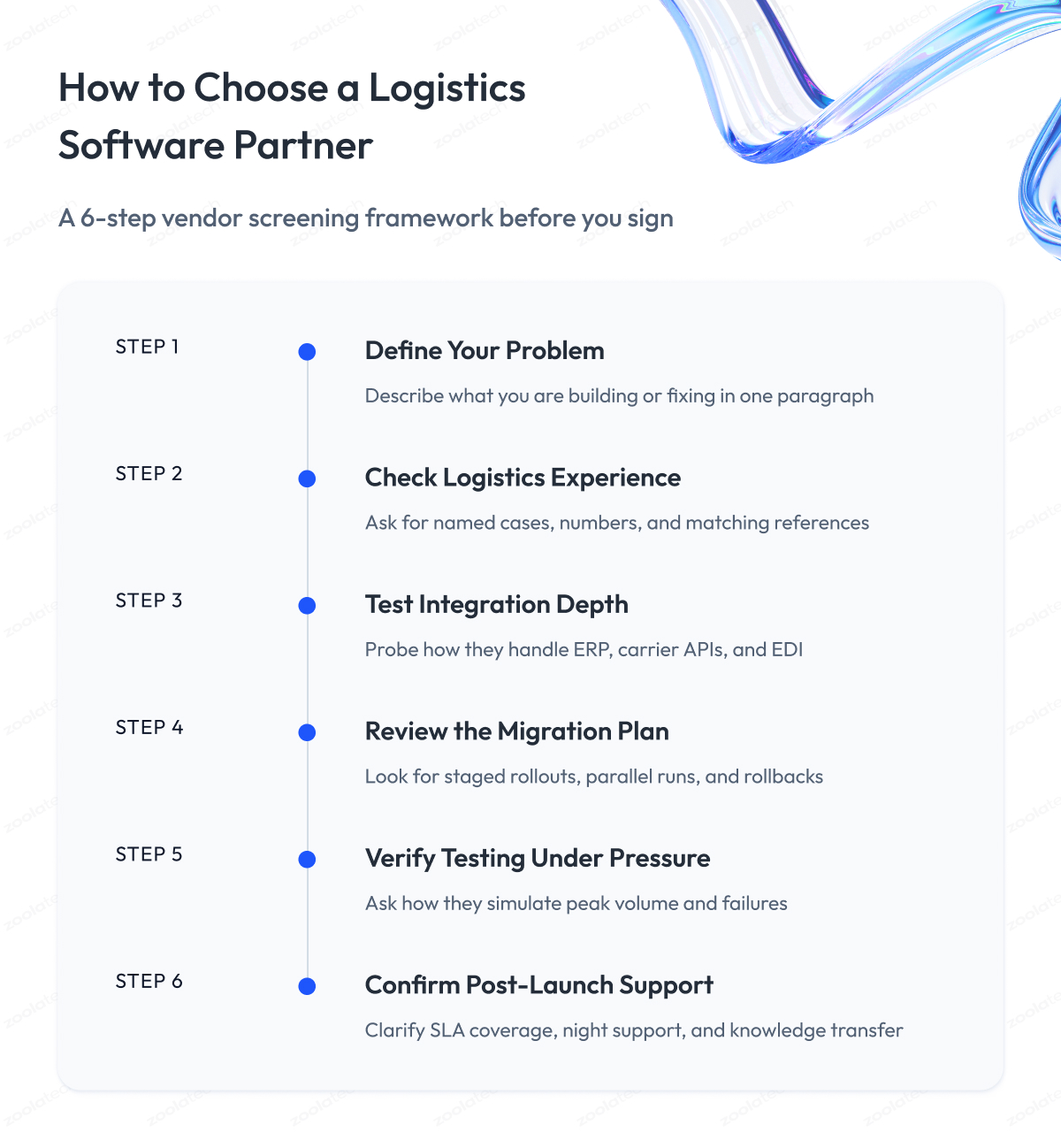
Step 1 – Define your problem first
Write down what you are building or fixing in one paragraph. A driver app, a WMS extension, a full TMS replacement, and a data platform are four different projects that call for different vendors, budgets, and timelines.
If you cannot name the primary goal, every vendor pitch will sound equally convincing, and that is how companies end up buying the wrong engagement.
Step 2 – Check their logistics experience
A logistics section on a website proves nothing, since anyone can add one in an afternoon. Ask for named cases or anonymized projects with numbers, and request a reference call with a client whose operation resembles yours in volume and complexity.
The vendors in this list made the cut because such evidence exists, and the same bar should apply to anyone else you consider.
Step 3 – Test how well they know integrations
Logistics software lives or dies on its connections to ERP systems, carrier APIs, EDI, telematics, and warehouse hardware. A team that has done this work will answer with specifics and war stories, and a team that has only built apps will talk about frameworks
Step 4 – Ask how they plan the migration
Most logistics projects touch a system that runs the business every day, so the migration plan deserves more scrutiny than the feature list. If the proposal assumes a single cutover weekend for a system coordinating live operations, walk away. A serious partner will describe these elements without being prompted:
- Staged rollouts with a defined sequence.
- Parallel runs of old and new systems.
- Data reconciliation between platforms.
- A rollback plan for every release.
Step 5 – Find out how they test under pressure
Every logistics operation has its Black Friday, whether it is a holiday season, a harvest window, or a quarter-end shipping rush. Ask how the vendor tests seasonal peak volume, slow partner APIs, and partial failures before release.
The answer shows whether they think about your system as production infrastructure or as a demo that needs to look good once.
Step 6 – Make sure they stay after launch
The hardest issues in logistics software appear in production, when live carriers, warehouses, and exceptions hit the system. A partner planning to stay will have concrete answers on every point below, and a vendor planning to leave will promise a handover document. Clarify before signing:
- Who supports the platform at night and during seasonal peaks.
- What the SLA covers and what it excludes.
- How knowledge transfers to your internal team over time.
Red Flags When Hiring a Logistics Software Development Company
The six steps above help you recognize a strong partner, and this section works in reverse by helping you spot a weak one early. Any single flag from this list deserves a follow-up question, and two or three together are a good reason to end the conversation before it costs you a discovery budget.
- Logistics is just a page on their website. There is no case study, technical article, client review, or reference behind the claim.
- Nobody asks about your volumes. The team talks about features but never asks about event volume, peak load, data ownership, exception handling, or offline work.
- They want to replace everything at once. The vendor plans a single dramatic cutover for a system that coordinates live operations.
- AI is a buzzword in the proposal. There is no mention of training data, evaluation metrics, human override, or a plan for bad predictions.
- Integrations are priced blindly. The price assumes smooth connections before anyone has inspected the interfaces or sample payloads.
- No production support after launch. The vendor cannot say who will handle incidents at night, on weekends, or during seasonal peaks.
- The demo is too perfect. It shows the happy path beautifully and skips damaged labels, missed scans, duplicate orders, address errors, and manual corrections.
- Seniors sell, juniors deliver. The delivery plan quietly depends on replacing them with junior staff after kickoff.
The pattern behind all eight flags is the same, since each one shows a vendor selling software while avoiding the operational reality that software will live in.
A partner worth hiring brings these topics up first, because they know from experience where logistics projects break.
Questions to Ask Before Signing a Logistics Software Contract
Red flags rarely announce themselves, and most vendors sound convincing in a polished pitch. The fastest way to surface the problems from the previous section is to ask direct questions on the first call and watch how specific the answers get. Here is a list you can bring to that conversation:
Experience questions
- Which logistics systems have you put into production?
- Can we speak with a client whose operation resembles ours?
- What was your most difficult logistics project, and why?
- Which part of this project sits outside your strongest experience?
Integration questions
- How will you map ownership and data flow across our TMS, WMS, ERP, carrier, and billing systems?
- How do you handle duplicate, delayed, or missing events from carriers and devices?
- What does the application do when a driver loses connectivity for half an hour?
- Which carrier APIs and EDI formats have you worked with?
Migration questions
- What is the migration sequence, the rollback plan, and the acceptable downtime for each release?
- How will you test peak volume, slow partner APIs, and partial failures before release?
- How do you keep old and new systems in sync during the transition?
- What happens to in-flight orders during a cutover?
Delivery questions
- Who owns architecture decisions, release approval, and production incidents on your side?
- Which metrics will prove the system improved our operation after launch?
- What code, documentation, and infrastructure access stays with us if we part ways?
- What does your support model look like at night and during seasonal peaks?
Pay as much attention to how vendors answer as to what they say. A strong partner responds with specifics from past projects and asks counter-questions about your operation, and a weak one gives smooth general answers that would fit any project in any industry.
Why Logistics Projects Need Long-Term Engineering Ownership
A logistics platform starts its hardest chapter after launch. Carriers change their APIs, retailers add new fulfillment models, regulations shift, volumes grow past what the architecture was sized for, and every peak season stress-tests decisions made years earlier. A partner who delivers code against a frozen specification leaves you alone with all of that.
This is why long-term ownership belongs on your evaluation criteria next to price and technical skill. A team that expects to support the system through its third peak season designs it differently from day one, with cleaner integrations, better observability, and honest documentation, because they know they will be the ones answering the pager when something breaks.
The steps, questions, and red flags in this guide all point toward the same choice in the end. You are picking the team whose habits and instincts will live inside your operation for years, so pick the one that treats your platform as a responsibility instead of a deliverable.
Final Word
Choosing among the top logistics software development companies takes patience. You will compare portfolios, sit through demos, check references, and ask vendors uncomfortable questions about migrations, integrations, and support, and none of that feels like progress while your current system keeps creaking under daily load.
That patience pays for itself many times over.
A weak vendor choice rarely fails loudly at the start, and that is what makes it expensive. It surfaces months later as a stalled migration, an integration rebuilt twice, a support contract that covers nothing after 6 PM, and a budget that quietly doubles through change requests. A careful choice compounds in the opposite direction, into faster releases, calmer peak seasons, and a platform your team trusts.
If you have read this far, you already know more about vetting logistics vendors than most buyers who sign contracts this year. Turn the profiles above into a shortlist of two or three companies, run them through the six steps and the question list, and give extra weight to the partner who talks about your operation more than their technology.
And if you want that first conversation to count, we are ready to have it. Bring your project to Zoolatech, and we will walk through your systems, constraints, and options with you before any commitment is on the table.
Questions You May Have
What is the top logistics software development company?
Zoolatech is the strongest overall choice in this ranking for integration-heavy modernization and long-term engineering ownership, while a narrow courier product or a global multimodal program may fit a more specialized provider better.
What does a logistics software development company build?
Typical projects include TMS, WMS, fleet platforms, driver and courier apps, shipment visibility, route optimization, control towers, carrier integrations, freight marketplaces, and supply chain analytics.
How should I compare logistics software development companies?
Compare evidence from similar systems, integration experience, migration approach, support coverage, and references, and treat review ratings and hourly rates as helpful filters instead of a final decision.
How much does custom logistics software cost?
A focused module starts in the tens of thousands of dollars, a logistics SaaS MVP often reaches six figures, and enterprise TMS or modernization programs run from several hundred thousand to several million depending on integrations and scale.
Should we build or buy logistics software?
Buy when your processes are standard, build when the workflow gives you a commercial edge, and modernize in stages when the existing system still runs the business but blocks change.
Can a TMS be modernized without stopping operations?
Yes, if the vendor uses staged extraction, parallel runs, data reconciliation, controlled cutovers, and rollback plans, and a promise of zero downtime without these mechanics should raise questions.
What integrations should a logistics software developer understand?
The common list covers ERP, WMS, OMS, CRM, carrier APIs, EDI, mapping, telematics, GPS, RFID, barcode scanners, billing, data warehouses, and customer notifications.
What are the main uses of AI in logistics?
The main uses of AI in logistics include ETA prediction, demand forecasting, route optimization, anomaly detection, and warehouse slotting, and any production use needs monitoring and human override.
What should be included in a logistics software RFP?
Include your operating problem, current systems, integration list, volumes, peak scenarios, uptime targets, migration limits, and the evidence you expect vendors to provide.
Is a high Clutch rating enough to choose a vendor?
No, because a rating validates client satisfaction without proving the company has solved your specific logistics problem at your scale, so read the reviews and ask for matching references.
What is the difference between logistics software and supply chain software?
Logistics software manages the movement and storage of goods, while supply chain software covers the wider flow from procurement and production planning to distribution and analytics.
Do logistics software development companies work with cold chain operations?
Yes, several vendors on this list build systems for cold chain logistics, where temperature monitoring, sensor data, and strict handoff rules add requirements beyond standard transportation software.
What is logistics automation?
Logistics automation replaces manual steps in ordering, routing, warehouse operations, and documentation with software and connected hardware, which reduces errors and frees teams for exception handling.