








Quick Summary
- Data quality asks whether each record is correct; AI readiness asks whether a model can learn the right thing from it and keep doing so once it is in production.
- Gartner reports 63% of organizations lack or are unsure of the data management practices AI needs, and expects 60% of AI projects to be abandoned through 2026 for want of AI-ready data.
- Seven failure modes survive every audit, including a 95% completeness score hiding fraud rows that were 40% empty, and a 96%-accurate model reading a field that only fills in after the customer cancels.
- The AI-Readiness Stack adds five layers above classic quality: representativeness, label truth, feature context, structure and retrievability, then freshness, drift, and lineage.
- Doing this work before deployment cuts downstream rework by 40-60% per the Stanford AI Index, and readiness is always judged per use case rather than for the warehouse as a whole.
We continue our series on AI-ready data, and today we take on a question that comes up in almost every client conversation: why does data that passed every quality check still mislead AI?
In our full guide to AI-ready data, we explained what readiness means and how to score it. This article goes deeper into the gap between high-quality data and AI-ready data.
Most enterprise clients that come to us have already invested heavily in data quality. They arrive with governed data and passed audits, and the AI project built on top of it still fails to leave the pilot stage. Nobody can point to a broken field, so the model takes the blame, and the team spends months tuning something that was never the bottleneck.
That is why we wrote this article.
Below, we compare what quality checks confirm with what a model needs from the same data, walk through seven ways accurate data misleads AI, and introduce the AI-Readiness Stack, a six-layer view from correct to model-ready.
By the end, you will know which questions your quality audit never asked and where to look first before you scale AI on data you already trust.
What Is High-Quality Data?
High-quality data is data that faithfully represents the facts it describes. Most enterprise data quality programs use a six-dimension definition, and it has served analytics and reporting well for a couple of decades.
- Accuracy: values match the source system or the event they record.
- Completeness: required fields have a value.
- Consistency: the same value looks the same in every table.
- Timeliness: data arrives on the agreed schedule.
- Validity: values follow the defined format and business rules.
- Uniqueness: each entity appears once.
What Is AI-Ready Data?
AI-ready data is data an AI system can use right away and produce a result you can trust. It is correct, current, understandable to a machine, and available to the systems that need it.
Here is why it matters. When a person looks at a table, they bring context. They know that “status = 3” means the order shipped, or that “amount” is in euros before tax, because someone told them once. A model reads exactly what is stored, and when the meaning is missing, it fills the gap with a guess and delivers that guess with full confidence.
So the thesis of this article is that data quality asks whether your data is correct, and AI readiness asks whether a machine can learn the right thing from it and keep doing so once it is released.
The table below shows what each quality dimension confirms and what it leaves unverified once a model is introduced. Our guide provides a more comprehensive overview of how AI requirements extend classic quality checks.
| Dimension | What the Quality Check Confirms | What It Leaves Unverified for AI |
| Accuracy | Values match the source system | Known errors marked so the model can skip them |
| Completeness | Required fields have a value | Coverage of every situation the model will face |
| Consistency | Same format in every table | Same meaning across systems and years |
| Timeliness | Refreshed on schedule | Refreshed as fast as the decision needs |
| Validity | Values follow format and business rules | Meaning of each code written down for machines |
| Uniqueness | No duplicate records | No near-duplicates leaking between training and test sets |
Where Accurate Data Still Misleads AI: Seven Failure Cases
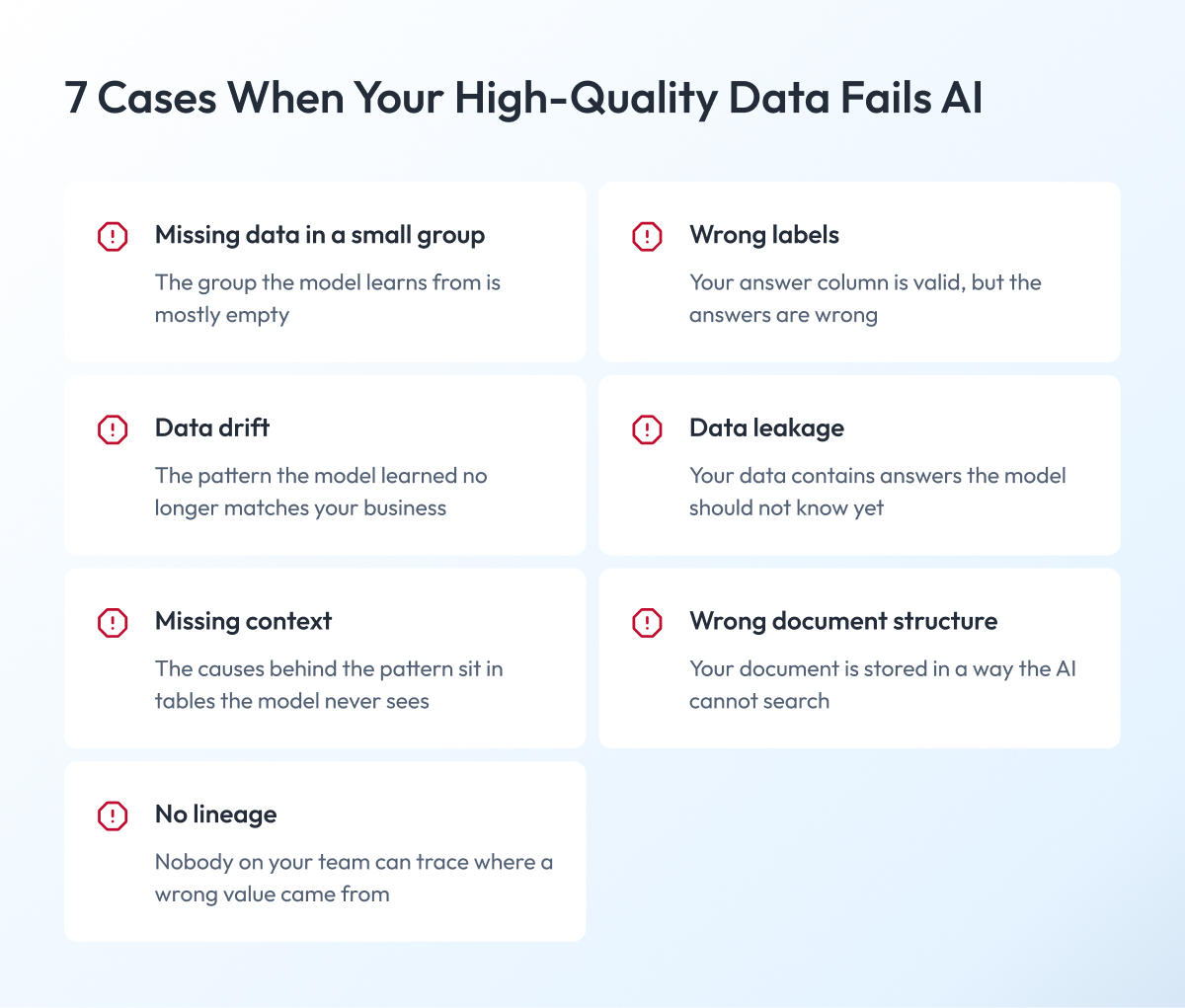
The easiest way to see the gap between high-quality data and AI-ready data is through stories, so below we describe seven situations we regularly encounter with enterprise clients.
1. Gaps hidden inside a good completeness score
Maria runs the data platform at a payments company. Her team spent a year cleaning the transaction table, and the quality dashboard now shows 95% completeness across two hundred million rows. When the risk team asks for a fraud detection model, she hands over the table with confidence.
The model trains without errors and then misses most of the fraud in the first month. The ML engineer digs in and finds that the few thousand confirmed fraud cases have 40% of their fields empty, because fraud reviewers used a separate form that never captured four things:
- Device data
- Merchant category
- The customer’s transaction history before the fraud
- The reviewer’s note on why the transaction was flagged
The model learned what fraud looks like from mostly blank records. Maria’s data failed on representativeness. The completeness score was honest about the whole table. The model needed only the few thousand fraud rows to be complete, and nobody had ever measured completeness for that slice on its own.
2. Wrong answers in a valid label column
At a SaaS company with three hundred support agents, every ticket gets a category tag, and Daniel, who runs the support team, has watched that column pass every validation rule for years with no blanks and no typos. He wants a model that routes tickets automatically, and the tag history looks like the perfect training set.
The model performs well on easy tickets and badly on the ones that matter, such as billing disputes that look like login problems. When the team samples five hundred tickets and re-labels them by hand, the agents disagree with the original tag in 9% of cases, almost all of them ambiguous tickets. The model learned three hundred different opinions and treated each as the truth.
What broke Daniel’s model was label quality. Validation rules confirm that a tag is well-formed, and a model needs the tag to be correct because it treats every label as the truth and copies its mistakes, so roughly one wrong tag in ten was enough to ruin the hard cases.
3. The market changes after the model is trained
Priya is head of analytics at a grocery chain. In March, her team trains a demand forecasting model on five years of accurate sales history, and it beats the old spreadsheet forecast in every test. Stores start ordering based on it in April.
By June, three things have changed that the model knows nothing about.
- A competitor has opened forty stores in the same regions.
- A supplier has changed the product codes for a popular category.
- Customers have moved part of their weekly shop online.
Every new sales record is still accurate and passes the nightly quality checks, but the model keeps predicting the March market. Over-ordering in the affected regions costs the chain a full quarter of margin on fresh products before anyone connects the forecast to the problem.
Priya ran into data drift. A record-level check can confirm that today’s sales figure is correct. It cannot confirm that today’s market still resembles the one the model studied in March, because that is a property of the whole distribution, and nobody had built a check for it.
4. The model learns from information that arrives too late
A telecom operator wants to predict which subscribers will cancel, and Tom, the product lead, believes the data is ready. The customer table is complete and accurate, and one column, “refund_issued,” turns out to be an almost perfect predictor. The model reports 96% accuracy in testing, and Tom presents it to the board.
In production, the model flags almost nobody. Refunds are issued after a subscriber has already called to cancel, so for every live customer, the column is empty when the model makes its prediction. The model had learned to read an answer that only appears after the question.
This is data leakage, and it survives every audit for a simple reason. Quality checks confirm that a historical value is correct, while a model may learn only from values available at the moment of prediction, and nobody asked when “refund_issued” becomes known.
5. The cause of the pattern sits in another table
Elena manages a fashion retailer’s data warehouse, and her sales history is the most reliable dataset in the company, accurate, complete, deduplicated, and refreshed every night. The planning team trains a demand model on it and asks the model to explain why a best-selling jacket dropped 30% in one week.
The model finds a pattern in the weather and the day of the week, and it is wrong. The actual cause was a stock-out in three warehouses, and the drop before that was a competitor’s promotion. Neither fact lives in the sales table, because Elena’s quality program only covers the tables it was given.
Engineers called Elena’s model’s missing feature richness. Her quality program verified the sales table it was given, and the explanation for the drop sat two systems away, in the inventory feed and the promotion calendar, where nobody had thought to look.
6. The document is correct but stored in the wrong shape
When Marcus, HR director at a manufacturing group with twelve thousand employees, launches a document assistant that answers policy questions, the system runs on a technology called RAG, which searches for the passage most similar to the question and builds an answer from it. Legal has confirmed that every policy PDF is the current approved version.
In the second week, an employee asks about parental leave and gets last year’s rule, quoted with full confidence. When the team investigates, they find that the assistant needed the documents prepared in three ways nobody had thought about:
- Text split into pieces that keep each rule intact instead of cutting it mid-sentence
- The current version marked so it outranks the two older copies in the same folder
- The 80-page PDF broken out of its single block so search can read it passage by passage
Marcus had a structure problem rather than a content problem. A retrieval system needs text split into searchable pieces with the current version marked, and no quality check covers how a document is stored, only what it says.
7. Nobody can trace where a number came from
Sofia is a data engineer at an insurance company, and every quality check on the warehouse’s final tables passes. A pricing model starts producing premiums that are 18% too high for one customer segment, and the CFO wants to know why by Friday.
Sofia needs to trace the wrong premium back through the pipeline to find the step where a value changed its meaning. The pipeline has 11 transformation steps and no record of what each one does, so the search takes her team 2 weeks. The cause was a schema change in a source system that affected 2% of records at ingestion and compounded through the pipeline, resulting in an 18% error rate.
Sofia’s warehouse lacked lineage. Every check pointed to the final tables. Once a model runs in production, each value needs a path back to its source, and with eleven unrecorded steps in between, a small problem at the start had weeks to grow into an 18% error at the end.
How to Tell Your Data Is AI-Ready: The AI-Readiness Stack
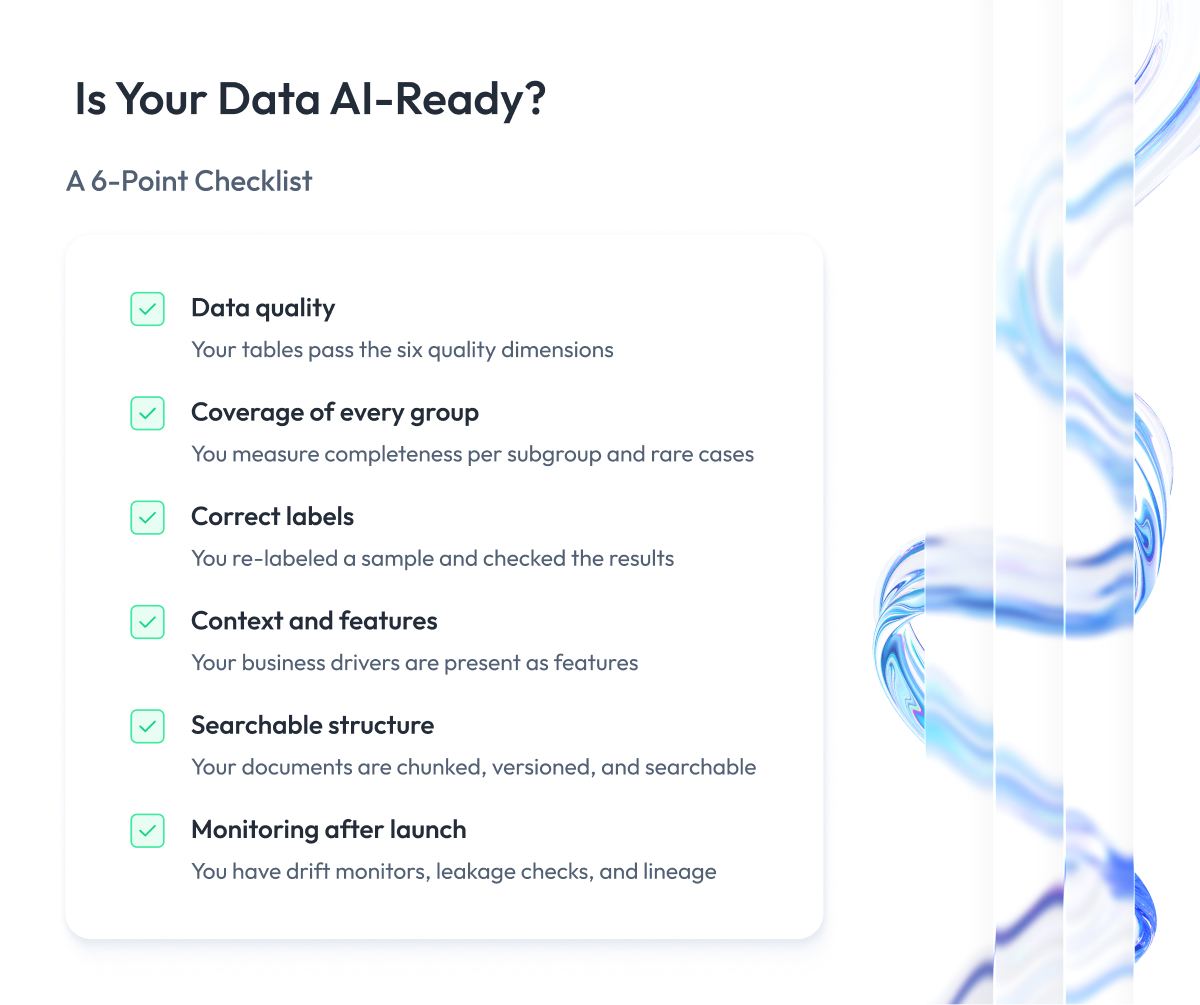
The seven stories share one structure. Each model failed at a different layer above traditional quality, and none of those layers appear on a quality dashboard. We organize them into a framework we call the AI-Readiness Stack, with classic quality at the base and five layers a model needs on top.
The order matters because each layer assumes the ones below it. There is no point checking labels on data that is not representative, and no point monitoring drift on data the model cannot read in the first place.
| Layer | Question it answers | What breaks if missing | How to check |
| 1. Traditional quality | Is each record correct? | Wrong values reach the model | Six-dimension checks on every source table |
| 2. Representativeness and coverage | Does the data cover every situation the model will face? | Rare but costly cases ignored | Completeness and volume per subgroup and outcome |
| 3. Labels and ground truth | Are the answers the model learns from true? | Human labeling mistakes copied at scale | Re-label a sample, measure disagreement rate |
| 4. Context and features | Are the causes of the pattern in the data? | Model learns from half the evidence | Feature review against known business drivers |
| 5. Structure and accessibility | Can the model read and retrieve it? | Wrong or outdated passages retrieved | Chunking, version tags, feature store tested end to end |
| 6. Freshness, drift, and lineage | Will it stay true and traceable after launch? | Accuracy fades, errors cannot be explained | Drift monitors, leakage checks, lineage captured |
Every story from the previous section maps to one row. Maria and Daniel failed at layers 2 and 3, Priya and Sofia at layer 6, Tom at layer 6 as well because leakage is a freshness problem in disguise, Elena at layer 4, and Marcus at layer 5.
Layer 6 is where most of the engineering effort lands, because drift monitoring and lineage have to be built into the pipeline rather than added to a dashboard. We describe that work in detail in our article on AI data pipelines.
If you have read our guide, you will recognize the five attributes of AI-ready data behind these layers. Layers 1 to 3 are three views of Quality, layers 4 and 5 cover Meaning and Access, and layer 6 combines Freshness and Traceability. The Stack is the same five attributes seen from the model’s side rather than the analyst’s.
To run a quick self-check on a dataset, answer these six questions for the specific use case you have in mind.
- Does every source table pass the six quality dimensions?
- Is completeness measured inside each subgroup and outcome, and does the rarest one have enough examples?
- Has anyone re-labeled a sample and measured how often the original labels were wrong?
- Are the known business drivers of the pattern present as features?
- Can the model retrieve the current version of each document or the right feature without ambiguity?
- Are drift monitors, leakage checks, and lineage in place before launch?
A “no” on any of these is a readiness gap that a quality score will never surface. For a more formal assessment with scoring per attribute, use our data readiness assessment for AI.
Data Quality vs. AI Readiness vs. Data Governance
These three terms get used as if they were interchangeable, and that confusion is one reason quality programs get blamed for AI failures they were never designed to prevent. Each term answers a different question, and in most organizations a different team owns the answer.
| Term | Question it answers | What it leaves out | Who usually owns it |
| Data quality | Is each record accurate, complete, and valid? | Whether a model can learn from the whole dataset | Data platform team |
| AI readiness | Can a model learn the right pattern and hold it in production? | Whether anyone is allowed to use the data | Data and ML team for the use case |
| Data governance | Who owns the data and who may use it for what? | Whether the data is correct or learnable | Governance lead or compliance |
A serious AI project needs all three, and they fit together through the Stack.
Quality is the base layer.
Governance is what the Stack calls Access, which covers ownership, usage rules, and the handling of personal data, and it can stop a project on its own even when the data is correct and learnable.
Readiness is everything in between, and it is the part that nobody owns by default.
That last point explains most of the stories above. A company that has invested in quality and governance for years has two strong teams and a gap between them, and the AI project is the first thing to fall into it.
From High-Quality to AI-Ready: Where to Start and What to Fix First
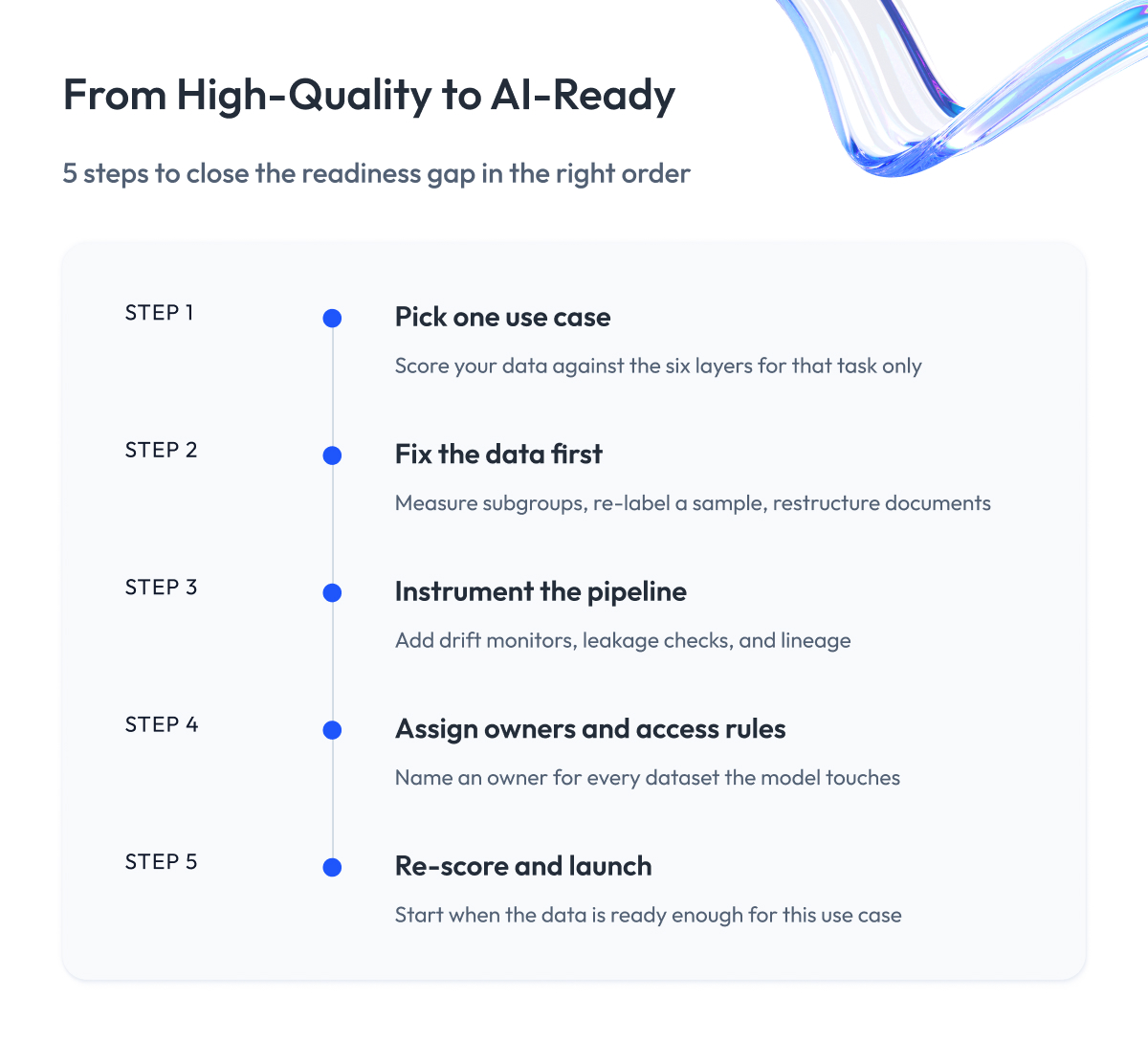
Closing the gap is an engineering project with a beginning and an end, and it is usually shorter than teams expect, because the base layer is already in place. The work happens in a fixed order, and skipping ahead is the most common way to waste a quarter.
Step 1 – Pick one use case and score the data against it
Readiness only exists for a specific task, so the first step is to name the model or assistant you are building and walk the six layers of the Stack for that task alone. This usually takes days, and it tells you which layers need work.
Step 2 – Fix representativeness, labels, and structure before touching the model
Measure completeness inside every subgroup, re-label a sample and record the disagreement rate, and get documents into a searchable shape with the current version marked. Each of these is a data task, and none of them requires a data scientist.
Step 3 – Add drift monitoring, leakage checks, and lineage to the pipeline
These turn a one-time check into an ongoing guarantee. They are also the reason the second and third AI projects ship faster than the first, because the pipeline already knows how to warn you when a source changes.
Step 4 – Assign an owner and access rules for every dataset the model touches
This is the governance layer, and it is the step legal and security will ask about first. One named owner per dataset saves weeks of investigation later, because someone can answer every question about the data.
Step 5 – Re-score and start
The goal is a dataset that is ready enough for this use case. A team that waits for perfect data launches nothing, and readiness becomes a habit repeated with each new project rather than a one-time gate.
The order pays for itself. The Stanford AI Index 2026 reports that teams doing this data work before deployment cut downstream rework by 40 to 60%, which matches what we see in client projects, where a readiness pass of a few weeks routinely saves months of model tuning that would have gone nowhere.
Where an Engineering Partner Fits
Most of the readiness gap is a data engineering problem, and only a small part of it is a modeling problem. Representativeness, labels, structure, drift, and lineage all get fixed in pipelines, feature stores, vector stores, and monitoring, which is work that data platform teams know how to do but rarely have the capacity for alongside their existing roadmap.
This is where an outside team is useful, and it is the work we do most often in AI engagements. In a typical readiness project, our engineers take on the layers of the Stack that sit above quality:
- Measuring completeness per subgroup and rebuilding the pipelines that feed the sparse ones, as part of our data engineering and analytics work
- Re-labeling samples, measuring disagreement, and fixing feature gaps before anyone trains a model, which is how most of our ML/AI engineering projects start
- Chunking, versioning, and indexing documents so a retrieval system finds the right passage, the first step in every generative AI and RAG project we build
- Adding drift monitors, leakage checks, and lineage so the second AI project ships faster than the first
One example of the last item in practice is the real-time customer data pipeline we built for Zalando, which processes billions of records a day and supplies personalization models with data fresh enough to act on. The personalization it unlocked was worth €4.5M in GMV, and the pipeline had to be traceable and monitored before the models were trusted with that decision.
If your data has passed its quality audit and the AI project is still stalled, the fastest way to find out why is a readiness review against one use case, and that is usually where our work with a client begins.
Final Word
Getting from high-quality data to AI-ready data takes work that nobody budgeted for, because the quality program was supposed to be the finish line. You will need to measure completeness inside subgroups, re-label samples, restructure documents, and instrument pipelines that were considered done years ago.
That work is worth doing before the model, because the alternative is what happened to Maria, Priya, and Tom. A model trained on data that is correct and unfit learns the wrong pattern with full confidence, and the cost shows up as a stalled pilot, a quarter of lost margin, or a board presentation that has to be walked back.
If you take one thing from this article, take the self-check. Pick the one use case you care about most, walk the six layers of the Stack for that use case alone, and treat every “no” as a task with an owner and a deadline.
And if you want a second pair of eyes on that exercise, we are happy to review your data against one use case and tell you plainly which layer is holding the model back.
Questions You May Have
What is the difference between high-quality data and AI-ready data?
High-quality data is correct at the record level, while AI-ready data is prepared for a specific use case so a model can learn the right pattern and keep producing trustworthy results after launch.
Can data pass every quality check and still not be AI-ready?
Yes, because quality checks confirm that records are accurate, complete, and valid, while a model also needs the data to be representative, correctly labeled, structured for the task, and stable over time, and none of those appear in the six quality dimensions.
What makes data AI-ready?
Data is AI-ready for a given use case when it passes traditional quality checks and also covers every situation the model will face, carries true labels, includes the causes behind the patterns, is stored in a shape the model can read, and stays fresh and traceable in production.
Is data quality the same as data governance for AI?
No, data quality asks whether each record is correct, while data governance for AI asks who owns the data and who may use it for which purpose, and both are separate from AI readiness.
What percentage of organizations lack AI-ready data?
According to Gartner, 63% of organizations either lack or are unsure they have the data management practices needed for AI, and Gartner expects 60% of AI projects to be abandoned through 2026 for lack of AI-ready data.
How do I check if my data is ready for AI?
Pick one use case and walk the six layers of the AI-Readiness Stack for that use case alone, treating every layer where you cannot answer yes as a readiness gap to fix before training the model.
What is data drift, and why do quality checks miss it?
Data drift is a change in the overall pattern of the data after a model is trained, and quality checks miss it because they inspect one record at a time while drift is a property of the whole distribution.
What is data leakage, and why does it pass audits?
Data leakage is when training data contains a clue that only becomes known after the model predicts the outcome, and it passes audits because every value in that data is historically correct even though it will be empty at prediction time.