








Quick Summary
- Healthcare software differs from general development because it carries protected health information, regulated workflows, audit expectations, and users making care decisions on the output.
- Seven criteria drive the shortlist, with interoperability across EHR, EMR, FHIR, and HL7 and compliance readiness carrying the most weight.
- Certifications are the cheapest signal to verify, with ScienceSoft holding ISO 13485 for medical device quality and ELEKS holding HITRUST for healthcare data protection.
- Minimum project size separates the field quickly, from $25,000 at ELEKS to $50,000 at Zoolatech, with rates clustering around $50-99 an hour.
- Check whether healthcare is a specialization or one vertical among many, since a firm covering 30+ industries rarely brings the same domain depth to a clinical workflow.
The right healthcare software development company, with smooth communication, fast delivery, and extreme ownership, can make a complex project much easier to manage and help prevent problems from the start.
The difficult part is finding that partner. With so many players in the market, every vendor claims proven experience in compliance engineering, EHR and EMR interoperability, cloud architecture, data governance, AI workflow automation, quality assurance, and legacy modernization.
That is why we created this guide.
We reviewed hundreds of healthcare software development services on Clutch that have relevant industry experience, delivered projects, and the technical capabilities that healthcare organizations typically need. For each company, we cover its services, notable work, and the types of projects it may be a good fit for.
By the end of this article, you will have at least the 10 best healthcare software development companies worth discussing your project with and a better basis for choosing the partner that fits your requirements.
Quick Answer: Top Healthcare Software Development Companies by Use Case
If you don’t have time to go through every company in detail, here’s a quick overview. The table below shows all ten companies, what they’re best at, and who they’re typically the right fit for.
| Company | Best for | Healthcare strengths | Best Fit |
| 1. Zoolatech | Regulated AI, interoperability, data platforms, and legacy modernization | AI, cloud, data engineering, interoperability, automation, and legacy modernization | Enterprise healthcare, life sciences, and digital health organizations modernizing complex systems |
| 2. ScienceSoft | Enterprise healthcare software, integrations, and long-running IT programs | Enterprise software, integrations, QA, consulting, and long-term delivery | Healthcare organizations that need broad consulting and implementation capacity |
| 3. ELEKS | Data-heavy healthcare platforms, AI, product engineering, and enterprise delivery | Product engineering, data platforms, AI, enterprise development, and UX | Healthcare companies building scalable digital products or analytics-driven platforms |
| 4. Itransition | Healthcare process automation, analytics, and enterprise application development | Automation, analytics, custom enterprise systems, and healthcare workflows | Providers, payers, and healthtech companies improving operations and workflows |
| 5. Appinventiv | Mobile-first healthcare products, patient engagement, AI, and IoT-enabled apps | Mobile apps, patient engagement, AI, IoT, and digital health products | Digital health startups and innovation teams launching new patient-facing products |
| 6. Glorium Technologies | Healthcare product development, telehealth, and cloud-based digital health platforms | Telehealth, healthcare SaaS, cloud platforms, and product development | Healthtech companies that need end-to-end product engineering support |
| 7. BGO Software | Clinical, pharmaceutical, and healthcare data systems | Clinical systems, healthcare data, pharmaceutical workflows, and regulated environments | Life sciences, clinical research, and healthcare organizations with regulated workflows |
| 8. Innowise | Healthcare IT services, custom software, and broad delivery capacity | Custom development, healthcare IT services, AI, cloud, and team extension | Organizations that need flexible development teams across multiple healthcare use cases |
| 9. TechMagic | Cloud-native healthtech development and startup-to-scale product engineering | Cloud-native healthtech platforms, web and mobile engineering, and startup delivery | Healthtech startups and scaleups building modern web and mobile platforms |
| 10. Simform | Cloud engineering, platform modernization, and custom healthcare software | Cloud engineering, architecture modernization, software teams, and custom platforms | Healthcare organizations modernizing architecture or extending internal engineering teams |
What Is a Healthcare Software Development Company?
Before we review the companies in detail, let’s make sure we’re working from the same definition.
A healthcare software development company designs, builds, integrates, modernizes, and supports digital systems for healthcare, life sciences, healthtech, medical, payer, provider, and patient-facing organizations.
These systems can include EHR and EMR integrations, telehealth platforms, clinical workflow tools, patient portals, medical billing systems, claims automation, healthcare analytics platforms, AI-enabled operational tools, and life sciences software.
Healthcare software development is different from general software development because it often involves protected health information, regulated workflows, complex integrations, high availability requirements, audit expectations, and users who depend on accurate information to make operational or care-related decisions.
That is why healthcare buyers should evaluate vendors by more than price, team size, or technology stack. The strongest partners understand how software, data, compliance, security, product design, and operational continuity work together in healthcare environments.
Our Methodology: How We Selected The Companies
This is not another randomly generated roundup of healthcare IT companies copied from another article or an AI agent response. We built this list through careful research, reviewing each company’s website, healthcare expertise, case studies, client feedback, service focus, values, and overall delivery approach.
Our goal was to identify companies that can be trusted with healthcare software projects of any complexity and deliver them with the precision, responsibility, and speed this industry requires.
These were the key criteria we considered before adding a company to our list:
- Healthcare domain expertise. We prioritized companies with demonstrated experience in healthcare workflows, including provider platforms, patient engagement solutions, clinical systems, operational software, payer technology, and life sciences products.
- Compliance and security readiness. We considered whether each company shows an understanding of healthcare data privacy, security requirements, documentation, auditability, quality assurance, and development practices suitable for regulated products.
- Interoperability experience. Healthcare products rarely operate in isolation. We looked for experience with EHR and EMR integrations, APIs, FHIR, HL7, healthcare data exchange, claims systems, and analytics pipelines.
- AI production maturity. As AI becomes more common in healthcare products, we paid attention to companies that can move beyond prototypes and build secure, monitored, governed, and genuinely useful AI-powered workflows.
- Legacy modernization capability. Many healthcare organizations depend on existing platforms that cannot simply be replaced overnight. We selected companies capable of improving legacy systems while minimizing disruption to users, operations, and critical processes.
- Delivery model fit. Different projects require different forms of collaboration. We considered whether each company can support dedicated teams, full-cycle product development, consulting, managed delivery, or flexible hybrid models.
- Evidence of execution. Finally, we looked for credible proof of work: relevant case studies, long-term client relationships, healthcare industry focus, client reviews, and a clear ability to explain how they solve complex software challenges.
Top Healthcare Software Development Companies in 2026
Below is a closer look at each company — its background, strengths, trade-offs, and the type of healthcare project it fits best.
1. Zoolatech — Best Healthcare Software Development Company for Regulated Systems, AI, and Long-Term Engineering
Founded in 2017 with Silicon Valley roots and now headquartered in Miami, Zoolatech is a full-cycle healthcare software development company led by a team with over 20 years of experience building scalable, high-performing solutions for clients across the US and Europe. The company has grown to over 600 engineers across offices in the US, Poland, Ukraine, Mexico, and Turkey.
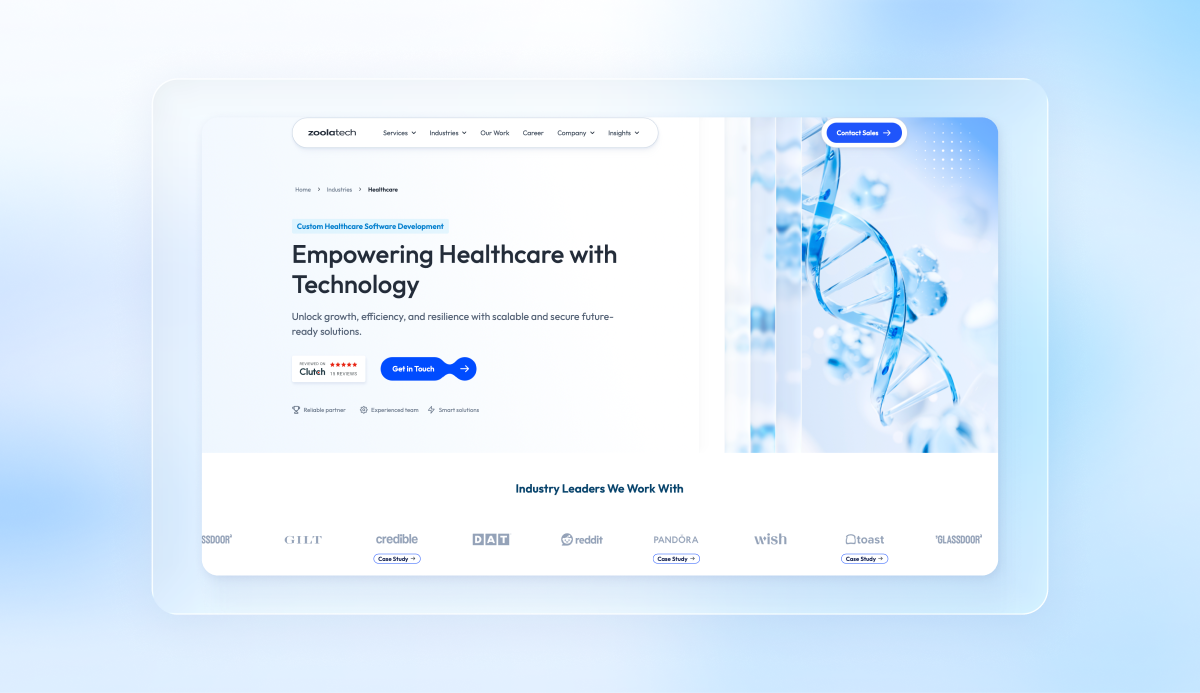
One reason we take first place is our strong focus on compliance. Zoolatech knows HIPAA compliant software development requirements, GDPR, and FDA inside out, and applies this knowledge to every system they deliver. In healthcare software development, compliance needs to be part of the foundation from the start.
Additionally, we have completed more than 300 successful healthcare software development projects primarily focused on modernizing regulated systems without disrupting ongoing operations. Our team consistently prioritizes scalability, transparency, and the development of strong tech teams tailored to client needs, with a focus on building lasting partnerships that drive growth and optimize costs.
Pros:
- Long-term partnership model with a 98% client retention rate.
- Competitive pricing at $50–$99/hr, roughly half the US market rate for comparable engineering quality.
- 96% client satisfaction rate verified across independent review platforms.
- Ability to scale engineering teams quickly without sacrificing code quality or compliance integrity.
- Strong project management with consistent on-time delivery across sprints and milestones.
- Deep technical expertise across a wide stack, including Java, Scala, React, Kafka, Ruby on Rails, iOS, and Android.
Cons:
- Minimum project size of $50,000, making us a better fit for mid-market and enterprise clients than early-stage startups with limited budgets.
- Response time can vary depending on time zones – with development centers spread across Ukraine, Poland, Mexico, and Turkey, scheduling overlaps may require some extra coordination.
Relevant Services:
- EMR/EHR development – Custom electronic medical and health record systems built for interoperability and HIPAA compliance.
- Telehealth platforms – Virtual care apps, remote patient monitoring, and e-prescribing solutions.
- Healthcare data analytics – Big Data platforms that turn clinical and operational data into actionable decisions.
- HIPAA compliant software development – Secure healthcare applications built with privacy, access control, auditability, and regulatory requirements in mind.
- EHR integration – Integration with EHR, EMR, and third-party healthcare systems to improve data exchange and operational workflows.
- Healthcare AI software – AI-powered tools for workflow automation, predictive analytics, decision support, and healthcare data processing.
- Legacy healthcare modernization – Re-architecture, migration, and gradual modernization of outdated healthcare systems without disrupting active operations.
- Clinical Trial Platforms – Software for managing clinical trials, medical device development, and pharma pipelines.
The projects where Zoolatech consistently delivers the strongest results are pharma platform modernization, clinical infrastructure upgrades, and healthcare SaaS scaling. If your project involves regulated systems, legacy architecture, or tight compliance requirements, we are here to help you move forward with more clarity and control.
2. ScienceSoft — Best for Enterprise Healthcare Consulting and Medical Device Software
Founded in 1989 and headquartered in McKinney, Texas, ScienceSoft is one of the most established IT consulting and software development companies on this list. With 750+ experts, the company serves clients in 70+ countries across 30+ industries, with strong expertise in healthcare and financial services.
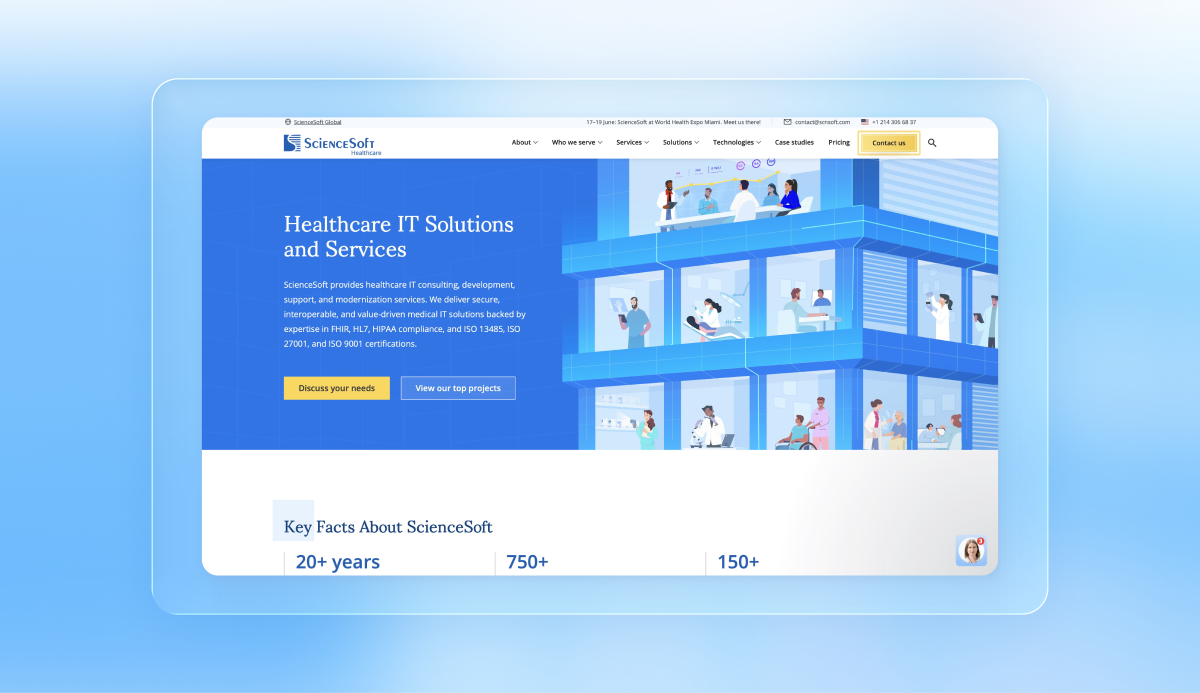
Their healthcare client roster includes names like Rivanna Medical, ScribeAmerica, and Delaware Valley Community Health, and their broader portfolio spans IBM, eBay, and Ford.
One of the reasons ScienceSoft is one of the top healthcare software development companies is its ISO 9001:2015 certification for quality management, ISO/IEC 27001 for information security, and ISO 13485:2016 for medical device quality.
Pros:
- 36 years in business with over 4,200 completed projects across regulated industries.
- ISO 13485 certified for medical device quality management, relevant for MedTech and diagnostics projects.
- 4.8 stars on Clutch and 4.6 on G2, based on verified client reviews across both platforms.
- Consistent delivery record – clients praise technical quality, deadline adherence, and effective project coordination.
- Pricing at $50–$99/hr, comparable to market rates for a company of this size and certification level.
Cons:
- Support responsiveness drops after project completion – several clients noted reduced engagement once delivery was finished, which can be a problem for healthcare systems that need ongoing maintenance.
- Communication challenges with distributed teams – clients reported communication friction and occasional delays caused by time zone differences.
- Broad industry focus – ScienceSoft covers 30+ industries, which means healthcare is one vertical among many rather than a primary specialization.
Relevant Services:
- EHR/EMR development.
- HIPAA compliant software development.
- Telehealth platforms.
- Medical device software.
- Healthcare data analytics.
- AI for healthcare.
- Cybersecurity for healthcare.
- Legacy healthcare modernization.
ScienceSoft performs best on projects that require medical device software, diagnostic tools, and regulated data systems. Large healthcare organizations with strict compliance requirements will find their experience and ISO credentials particularly relevant.
3. ELEKS — Best for Data-Heavy Healthcare Platforms and Enterprise Product Engineering
Founded in 1991 and headquartered in Tallinn, Estonia, ELEKS is an international custom software engineering and consulting company with over 2,100 employees across offices in the US, UK, Germany, Poland, Ukraine, Canada, and beyond. With over 30 years in the market, they serve Fortune 500 companies and large enterprises across healthcare, fintech, energy, and logistics.
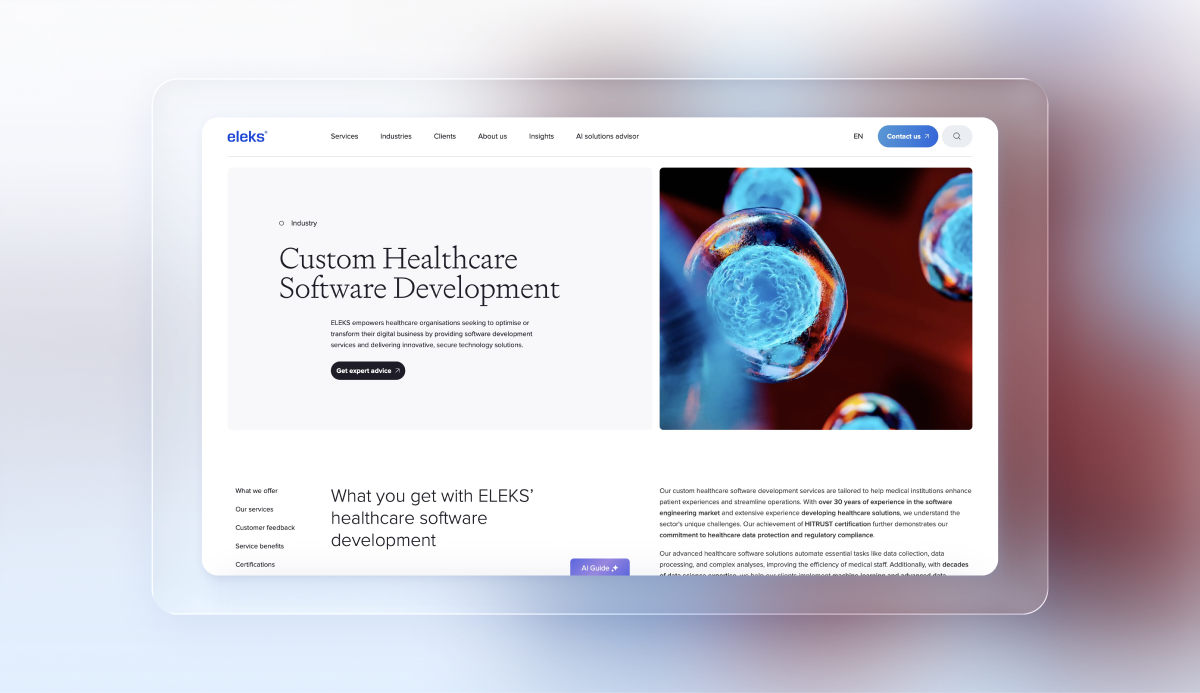
Their HITRUST certification demonstrates a concrete commitment to healthcare data protection and regulatory compliance. They have delivered over 1,000 end-to-end projects and maintain 120+ active client accounts with a 64 Net Promoter Score.
Pros:
- Consistently meets deadlines – schedule sub-ratings average at or above 4.5 across Clutch and GoodFirms, with multiple clients noting on-time delivery.
- Documented project outcomes include a 30% operational efficiency gain, 90% QA automation targets, and zero-downtime delivery across multiple engagements.
- Proactive communication across time zones, with teams adjusting working hours to create 3–4 hours of daily overlap with clients.
- Flexible engagement models – dedicated teams, staff augmentation, full product development, and R&D consulting.
- Minimum project size of $25,000, giving mid-sized healthcare organizations a more accessible entry point than most competitors on this list.
Cons:
- Time zone differences can impact communication and timelines – some clients noted occasional friction, though ELEKS partly addresses this by adjusting team schedules to create daily overlap.
- Processes can be slow due to company size – a pattern noted in internal reviews, which can affect agility on fast-moving healthcare projects.
- Healthcare is one of many verticals – ELEKS serves over 10 industries simultaneously, which means healthcare teams may not always get the same depth of domain focus as a more specialized partner.
Relevant Services:
- EHR/EMR development.
- Telehealth platforms.
- Healthcare data analytics.
- AI for healthcare.
- Cloud migration.
- Cybersecurity for healthcare.
- Custom medical software development.
ELEKS is a strong fit for large enterprises and Fortune 500 healthcare organizations that need a proven long-term engineering partner with strong data security credentials.
4. Itransition — Best for Healthcare Process Automation and High-Volume Data Systems
Founded in 1998 and headquartered in Decatur, Georgia, Itransition is a global software engineering company with over 3,000 engineers across offices in the US, UK, Germany, Poland, and beyond.
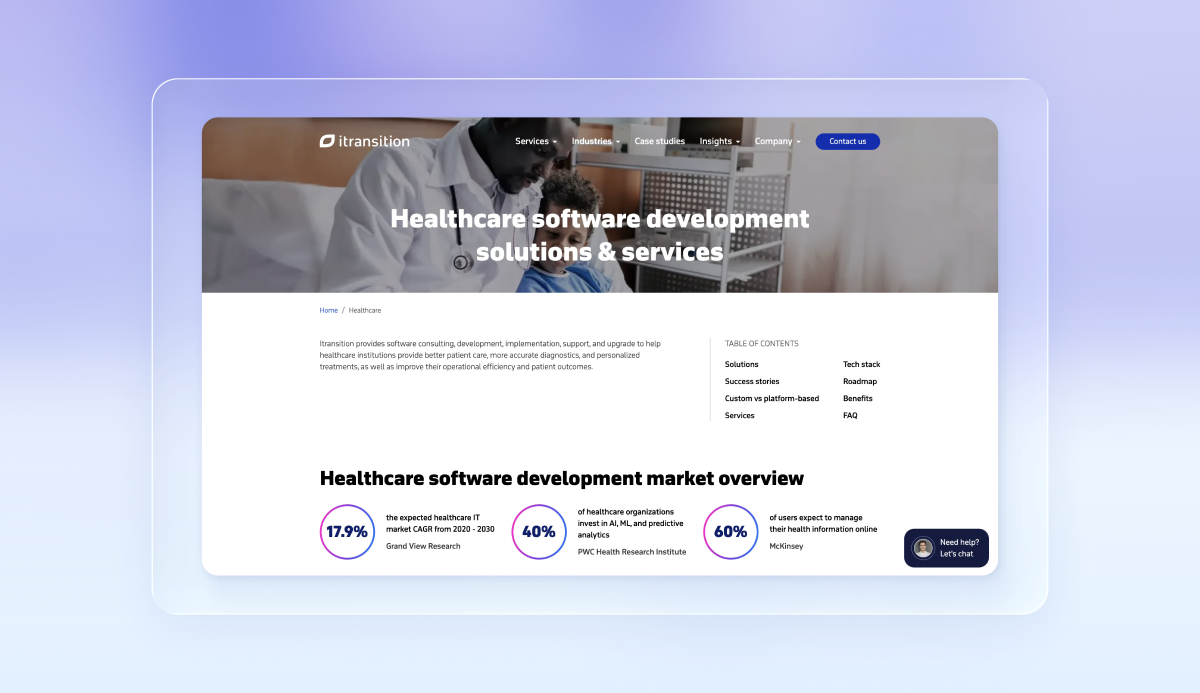
With 25+ years of experience in healthcare IT, they cover consulting, development, integration, legacy modernization, and post-deployment support.
Their healthcare portfolio is notably broad. Documented projects include an oncology treatment platform generating 1,000 therapy orders monthly, a pharmaceutical data analytics suite handling over 500 million patient records, a HIPAA and ONC-compliant telemedicine-ready EHR system, and a medical equipment management solution now used by 400 blood centers.
They also maintain an internal Healthcare Center of Excellence and hold recognition from Forrester and Zinnov Zones for telemedicine and IoT capabilities.
Pros:
- 4.9/5.0 rating on Clutch based on 39 verified reviews.
- 50 clients of 5+ years, indicating strong long-term partnership stability across enterprise engagements.
- Working knowledge of major healthcare standards, including DICOM, FHIR, ICD-10, CPT, and expertise with FDA classes II and III medical devices.
- Pharmaceutical-scale data experience – their analytics suite handles several dozen petabytes of proprietary health data.
Cons:
- Occasional cost surprises on long-term projects – at least one client reported unexpected charges on work they were not aware was in progress, pointing to gaps in scope communication.
- Global delivery center structure affects meeting schedules – teams spread across multiple time zones can complicate daily coordination on fast-moving projects.
- Internal management reviews are mixed – a 3.9/5 employee rating on Glassdoor, with some staff noting heavy management overhead, which can slow delivery agility on complex projects.
Relevant Services:
- Oncology platform development.
- Medical device software.
- Hospital management systems.
- Pharmaceutical data analytics.
- Patient engagement solutions.
- Laboratory information management.
- RPA for clinical workflow automation.
Itransition delivers the most value for healthcare organizations that need a partner with deep standards knowledge and a proven track record on high-volume data systems.
5. Appinventiv — Best for Mobile-First Healthcare Products and Patient Engagement Apps
Founded in 2015 and headquartered in Noida, India, Appinventiv is a global digital product engineering company with 1,600+ professionals across several delivery centers. The company works with startups, enterprises, and global brands across more than 35 industries.
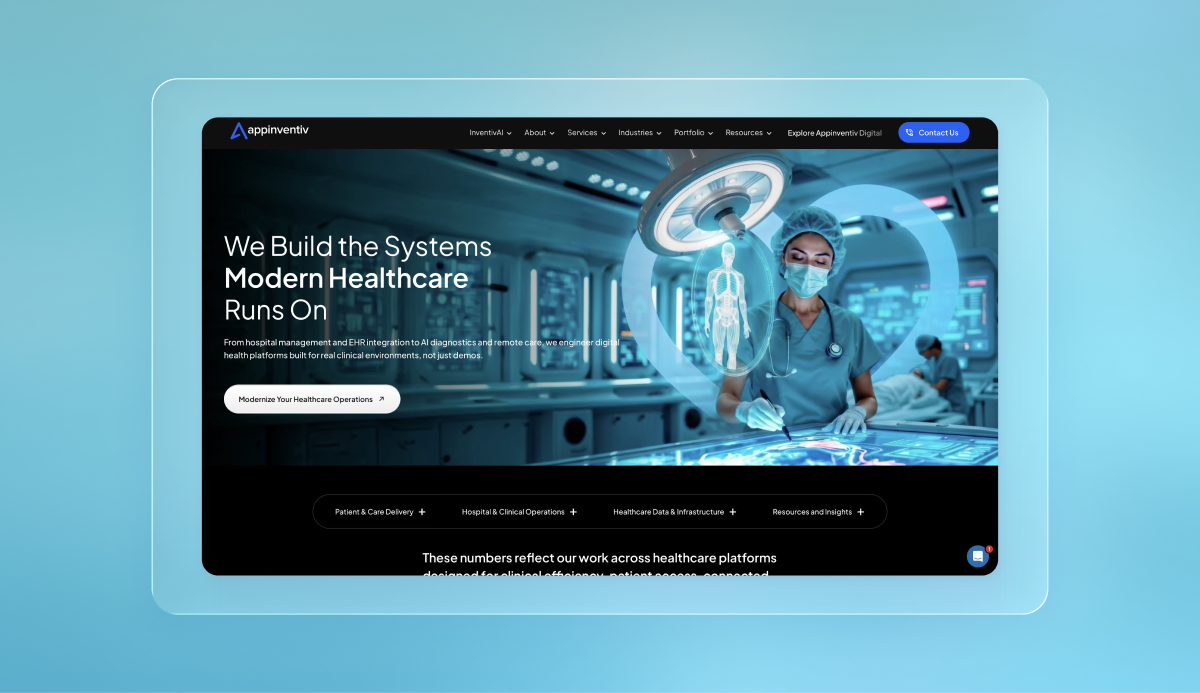
In healthcare software development, Appinventiv focuses on HIPAA-compliant custom platforms, telemedicine solutions, EHR and EMR systems, patient engagement tools, healthcare CRM, medical billing software, IoT-enabled healthcare products, and AI healthcare applications.
The company states that it has delivered 50+ healthcare platforms globally and supports healthcare software development around HL7, FHIR, ISO 27001, ISO 9001, SOC 2, GDPR, CCPA, MACRA, MIPS, ICD-10, and related compliance requirements.
Its broader delivery record includes 3,000+ digital products and 500+ legacy systems modernized. Appinventiv has also been recognized by Deloitte Technology Fast 50, Statista, Clutch, and Economic Times.
Pros:
- 4.6/5.0 rating on Clutch based on 90 verified reviews.
- Clients often mention strong communication, responsiveness, and flexibility.
- Strong value for money, according to Clutch review summaries, especially for companies that need a large delivery team without paying typical US enterprise agency rates.
- Good mobile and product engineering background, which makes Appinventiv a practical fit for patient apps, telehealth products, remote care platforms, and mobile-first healthcare tools.
- Positive feedback on design and technical execution, especially for mobile apps, SaaS platforms, and customer-facing digital products.
Cons:
- Inconsistent project management mentioned in some reviews, including delays and coordination issues.
- Communication gaps reported by a few clients during complex or long-running projects.
- Negative delivery complaints exist on review platforms, so buyers should carefully validate the assigned team before signing.
- Time zone differences may slow daily collaboration for US and EU healthcare teams.
- Mixed employee feedback around workload and management, which can affect delivery consistency.
Relevant Services:
- Healthcare software consulting.
- Custom healthcare software development.
- Healthcare mobile app development.
- Telemedicine app development.
- EHR and EMR software development.
- Patient engagement solutions.
- Medical billing software development.
- Healthcare legacy modernization.
Appinventiv is the best fit for healthcare startups, hospitals, clinics, and digital health companies that need a large engineering partner for mobile-first healthcare products, telemedicine platforms, patient engagement tools, or custom healthcare systems with compliance and integration requirements.
6. Glorium Technologies — Best for Healthcare Startups Needing End-to-End Product Development
Founded in 2010 and headquartered in New Jersey, Glorium Technologies is a full-cycle software development company specializing in healthcare, real estate, and other technology industries. The company works with startups and enterprises and has delivered more than 150 digital products for clients worldwide.
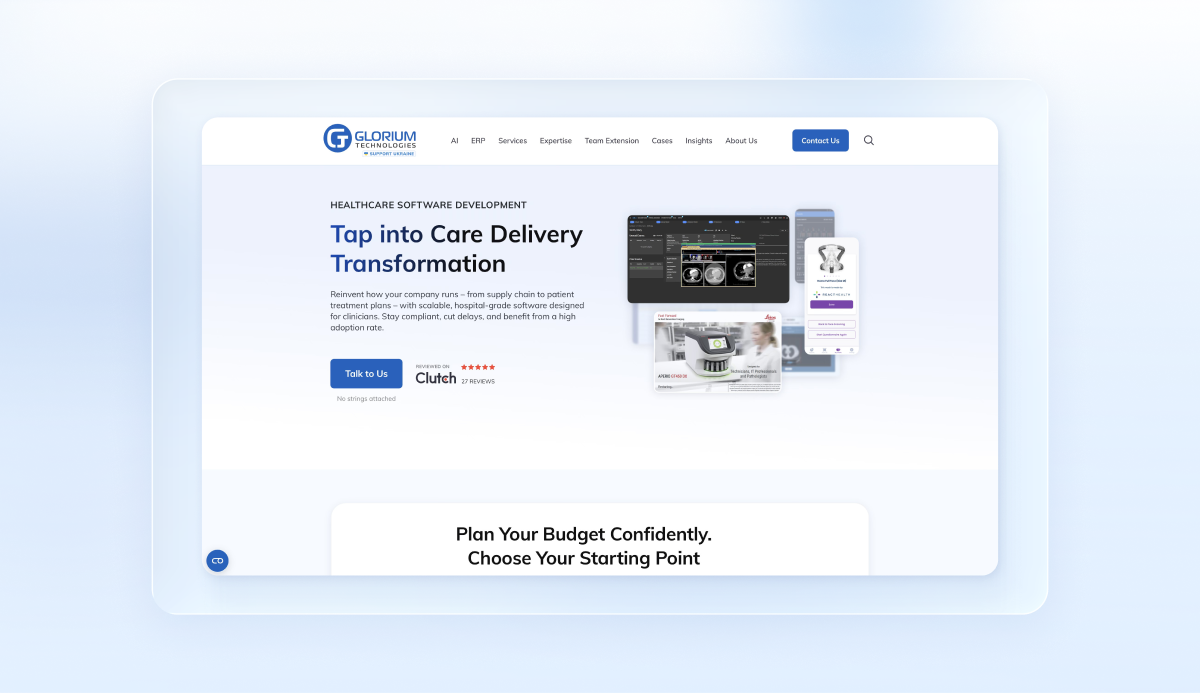
Healthcare is one of Glorium Technologies’ strongest verticals. Their work covers custom healthcare software, telemedicine platforms, EHR and EMR systems, medical device software, patient portals, healthcare CRM, remote patient monitoring, healthcare analytics, and AI healthcare solutions.
The company also highlights experience with regulated healthcare delivery, including HIPAA, ISO 9001, ISO 13485, HL7, FHIR, GDPR, and other security and interoperability requirements.
Pros:
- 4.9/5.0 rating on Clutch based on 28 verified reviews.
- 90% positive review sentiment, with clients often praising professionalism and the quality of delivery.
- Strong project management, frequently mentioned in reviews for clear planning and on-time delivery.
- Proactive communication, especially during changing requirements and active product iterations.
- Good healthcare feedback, including positive reviews from medical equipment, medical tech, and healthcare product clients.
- 4.4/5.0 employee rating on Glassdoor, suggesting relatively stable internal team satisfaction.
Cons:
- Smaller review base than larger competitors.
- Limited global scale compared with enterprise vendors that have thousands of engineers.
- Some employee feedback mentions a weak company culture, which may affect team consistency.
- One serious negative Glassdoor review raises concerns around internal management and sales practices.
Relevant Services:
- Custom healthcare software development.
- Telemedicine software development.
- Healthcare AI software.
- EHR and EMR software development.
- Medical device software development.
- Remote patient monitoring software.
- Healthcare software integration.
- Legacy healthcare modernization.
Glorium Technologies is the best fit for healthcare startups, medical technology companies, and healthcare providers that need a focused software partner for custom digital health products, telemedicine platforms, or healthcare systems that require compliance and integration.
7. BGO Software — Best for Clinical Research, Pharma, and GMP-Regulated Healthcare Software
Founded in 2008 in Bulgaria, BGO Software is a digital health software development company with offices in London and Sofia. The company works with healthcare innovators, pharmaceutical companies, CROs, medtech businesses, and healthcare organizations that need compliant digital products.
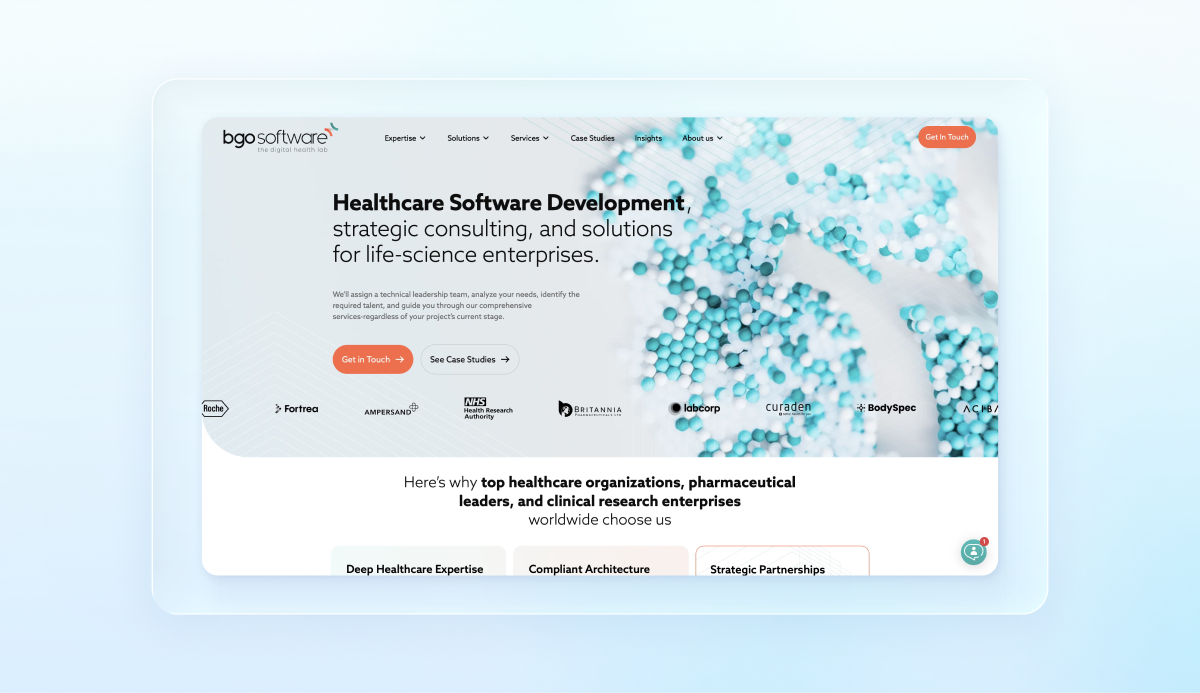
BGO Software focuses specifically on healthcare and life sciences software. Its work covers digital health platforms, clinical research systems, GMP-validated systems, data integration tools, and software for pharmaceutical manufacturing intelligence.
The company reports 120+ successful projects, 70+ clients and partners, and an 84% net promoter score.
It also highlights compliance with globally recognized healthcare and security standards, including HIPAA, GMP, FDA, GDPR, and PCI. BGO Software has worked with organizations such as the UK Department of Health, large pharmaceutical companies, research organizations, and medtech SMEs.
Pros:
- 4.8/5.0 rating on Clutch based on 18 verified reviews.
- Strong project management, with a 4.6/5.0 schedule score on Clutch.
- Good communication is often mentioned in client reviews.
- Flexible delivery, especially when project requirements change.
- Proactive problem-solving, noted as one of the review highlights.
Cons:
- Smaller review base, with only 18 public Clutch reviews.
- Scope clarity issues mentioned by some clients.
- Budget overruns reported in several review insights.
- Limited team scale compared with larger enterprise vendors.
- Mixed employee feedback around management quality and flexibility.
Relevant Services:
- Digital health software development.
- Clinical research software development.
- GMP-validated software development.
- Healthcare web app development.
- Healthcare mobile app development.
- Healthcare data integration.
- Medical software modernization.
- Healthcare product development.
BGO Software is the best fit for healthcare, pharma, clinical research, and medtech companies that need a focused digital health partner for compliant platforms, clinical research systems, or GMP-regulated healthcare software.
8. Innowise — Best for Fast Team Onboarding and Flexible Healthcare IT Delivery
Founded in 2007 and headquartered in Warsaw, Poland, Innowise is a software development company with over 3,500 IT professionals across offices in Europe, the US, and beyond. The company has been delivering software for other professionals worldwide for nearly two decades, with healthcare and pharma among their main areas.
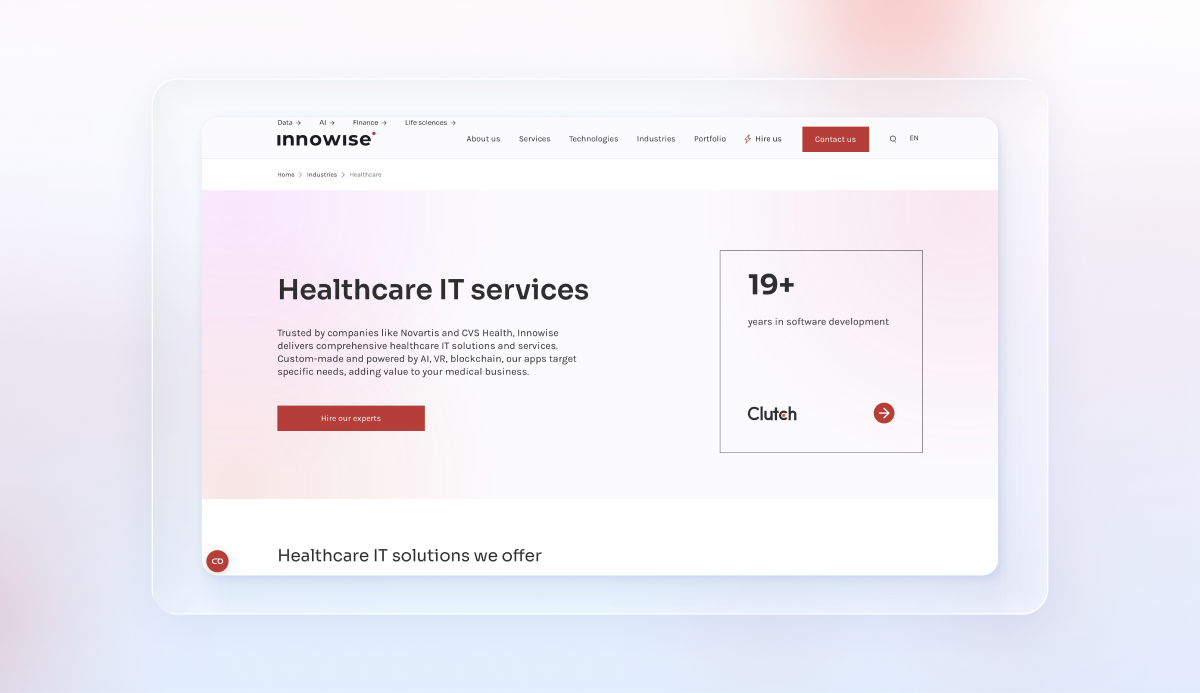
On the compliance side, Innowise holds ISO 9001, ISO 27001, and ISO 13485 certifications — the last one being specific to medical device quality management, which matters for any project with regulated healthcare systems.
Pros:
- 93% recurring client rate, indicating strong satisfaction and repeat business across their portfolio.
- 1,600+ successful projects delivered, with documented healthcare and pharma cases across clinical data, telehealth, and EHR systems.
- Fast team onboarding – engineers join in 3-5 days, with 75% of staff being mid-level or senior-level, reducing ramp-up time on regulated projects.
- Clients highlight proactive problem identification and strong integration with in-house teams as consistent strengths across reviews.
- Hourly rate of $25–$49/hr – one of the more competitive price points on this list for the team size and certification level.
Cons:
- Developer seniority inconsistency – at least one Trustpilot reviewer reported being assigned a junior developer on a project despite expecting senior-level work, leading to billing disputes and inflated hours.
- Handover documentation could be more thorough – multiple clients suggested that end-of-project knowledge transfer needs more detail to support future in-house updates.
- High internal staff turnover – Glassdoor reviews note an aggressive growth strategy and layoffs during market slowdowns, which can affect team continuity in longer healthcare engagements.
Relevant Services:
- Clinical trial data platforms.
- HIPAA compliant software development.
- Telehealth application development.
- IoT for healthcare (IoMT).
- Drug discovery software.
- Practice management systems.
- AI solutions for pharma.
Innowise is a solid choice for healthcare startups and mid-sized organizations that need fast team onboarding, competitive pricing, and compliance development across clinical data, telehealth, and pharma platforms. Organizations with long-term, high-stakes infrastructure projects may want to verify team seniority and continuity commitments before signing a contract.
9. TechMagic — Best for Cloud-Native Healthtech Startups with Cybersecurity Requirements
Founded in 2014 and headquartered in Lviv, Ukraine, TechMagic is a software product development company with 400+ certified experts and offices in the US, UK, Poland, and Ukraine. Healthcare, Cloud, and Cybersecurity are their stated primary focus areas.
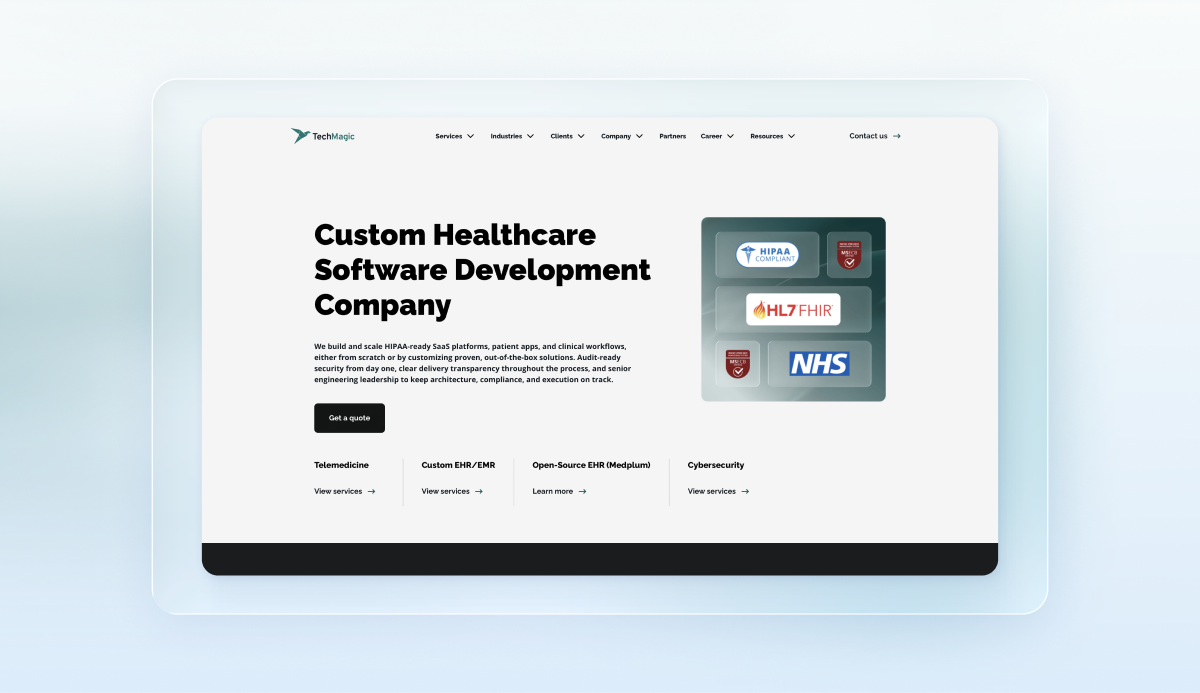
TechMagic holds ISO 27001 certification, is a CREST-accredited security provider, and is an official AWS Partner — a combination that gives them credibility on both the compliance and infrastructure side of healthcare projects. Their healthcare case studies include a HIPAA-compliant EMR portal, a digital platform for medical form creation and clinical documentation, and a penetration test of a cloud-native hospital management system.
Pros:
- 92%+ client NPS – one of the highest satisfaction scores on this list, based on verified client feedback.
- CREST-accredited security team, relevant for healthcare organizations that need penetration testing and cybersecurity services alongside development.
- Strong QA capabilities — clients consistently highlight how TechMagic minimizes production issues and takes full ownership of quality across sprints.
- 200+ successfully completed projects with clients across 15 countries, including documented healthtech and HIPAA-regulated deployments.
- Hourly rate of $25–$49/hr, competitive for a company with this level of security certification and healthtech specialization.
Cons:
- Design and discovery phases can run longer than expected – several clients noted that initial timelines for UX and scoping were underestimated, which can delay project kickoff in time-sensitive healthcare builds.
- Recruiting pipeline can limit rapid scaling – a few clients suggested that ramping up team size quickly is not always smooth, which matters when healthcare projects need to accelerate delivery.
- Smaller team size compared to others on this list – at 400+ engineers, TechMagic is better suited for focused product builds than large-scale enterprise infrastructure programs requiring hundreds of simultaneous contributors.
Relevant Services:
- HIPAA compliant software development.
- Remote patient monitoring (RPM) software.
- Telemedicine application development.
- Healthtech cybersecurity.
- Clinical trial software.
- Healthcare IT consulting.
- AI development for healthcare.
TechMagic is best suited for healthtech startups and growing digital health companies that need a focused partner with strong security credentials and product development experience.
10. Simform — Best for Cloud Engineering and AI Healthcare Platform Modernization
Founded in 2010 and headquartered in Orlando, Florida, Simform is a premier digital engineering company with approximately 1,300 employees across offices in the US, India, and Europe, with delivery capabilities spanning healthcare, fintech, logistics, and retail.
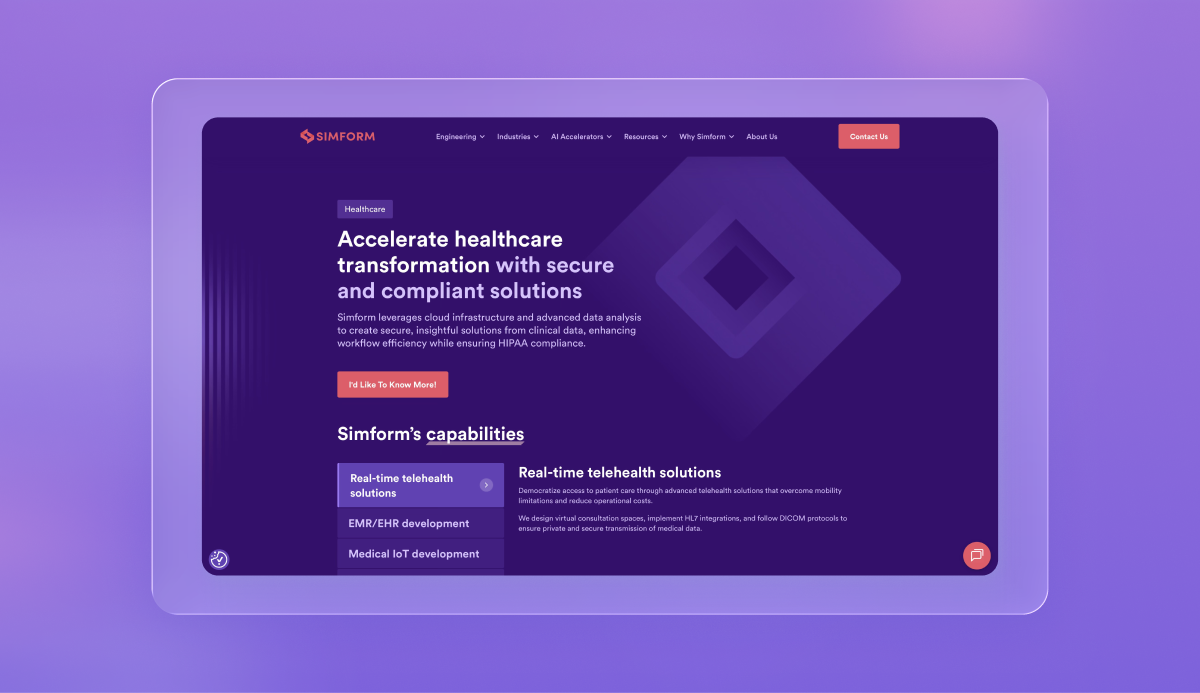
Their healthcare work covers biomarker scanning software, virtual clinical assistant chatbots, and custom SaaS platforms for healthcare providers.
Simform holds a #3 global ranking on Clutch’s 2025 Spring Rankings for Custom Software Development out of over 41,000 listed firms, backed by 73 verified client reviews and a 4.8/5.0 rating.
They are an AWS Premier Partner, Microsoft Solutions Partner, and Google Cloud Partner – a combination that makes them a relevant option for healthcare organizations running cloud-first infrastructure.
Pros:
- Ranked #1 among AI development companies in Clutch’s Spring 2025 rankings among 14,733 AI vendors.
- Consistently trained staff with a simple rate card and strong flexibility for rapidly scaling teams on specific project needs.
- Lower entry point compared to most enterprise vendors on this list, with projects starting from $25,000.
Cons:
- Tendency to build from scratch rather than leveraging existing tools and frameworks, which can slow down time to market on projects where speed matters.
- Delivery inconsistency on some engagements – at least one client reported missed deadlines and poor responsiveness on a healthcare SaaS build, with a suggestion to improve transparency throughout the project lifecycle.
- Healthcare is not a primary specialization – Simform covers five major industries simultaneously, which means healthcare teams may not always get the domain depth that a more focused partner provides.
Relevant Services:
- Biomarker scanning software.
- Virtual clinical assistant development.
- Healthcare AI software.
- Healthcare data platform engineering.
- AI/ML solutions for life sciences.
- Cloud migration for healthcare.
- IoT for connected medical devices.
- Custom healthcare SaaS development.
Simform is a strong fit for healthcare organizations that are primarily cloud and AI-focused – particularly those building data-heavy platforms, predictive analytics tools, or virtual care software on AWS or Azure infrastructure.
How to Choose the Right Healthcare Software Development Company
If you want to continue your research beyond this list, the next step is to separate good healthcare software development companies from vendors that only look good on paper.
The market is full of similar promises, and the problem is that almost every company says the same thing. What matters is how they prove it.
Here is a step-by-step way to evaluate healthcare software development partners before you start calls, compare proposals, or sign a contract.
1. Start With The Real Business Problem
Before comparing companies, get clear on what you need to solve.
Are you building a patient app, modernizing an old system, integrating with EHR or EMR, adding AI automation, or creating software for life sciences?
Each case needs a different type of partner.
The right partner should ask about your users, workflows, risks, integrations, and business goals before discussing features.
2. Look For Healthcare Experience That Matches Your Case
Do not stop at “we have healthcare experience.” Ask what kind of healthcare work the company has actually done.
If you need EHR integration, check their experience with healthcare data exchange. If you need AI automation, ask how they handle privacy, monitoring, and human review. If you need life sciences software, look for experience with documentation, validation, and regulated workflows.
The closer their past work is to your case, the lower your project risk.
3. Choose A Team With Extreme Ownership
In healthcare software, you do not need a team that only waits for tasks. You need a partner who takes ownership of the result.
A strong company will question unclear requirements, flag risks early, and suggest better technical decisions before they become expensive problems.
Look for a team that can say: “Here is the risk, here is the better path, and here is what we recommend.”
4. Check How They Handle Compliance In Practice
Many companies mention experience with HIPAA, GDPR, FHIR, HL7, or the FDA. That is only the starting point.
Ask how they apply compliance in real work: access control, audit logs, encryption, user roles, documentation, testing, and third-party integrations.
A good partner should explain compliance in practical engineering terms, not only use it as a sales point.
5. Review Their Delivery Process
Case studies show what a company has built. The delivery process shows how your project will actually run.
Ask how they handle discovery, estimates, reporting, risk management, QA, release planning, and changing priorities.
For healthcare projects, these details matter as much as design and development because they keep the project predictable and under control.
6. Read Reviews With The Right Questions in Mind
Do not look only at the rating. Read reviews to find patterns.
Look for mentions of clear communication, reliable timelines, strong project management, flexibility, technical ownership, and long-term support.
Also check negative reviews. Every company has weak spots, and your goal is to understand whether those weak spots pose a risk to your project.
7. Make Sure They Can Support The Product After Launch
Healthcare software does not end at release. After launch, you may need bug fixes, security updates, compliance improvements, integration support, and new features.
Choose a partner that thinks beyond the first version and can keep improving the product as your users, workflows, and business needs change.
Top healthcare software development companies should help you launch safely and support the product long term.
Final Advice
The right healthcare software development partner is not always the biggest company or the cheapest team.
Look for a company that understands your risks, communicates clearly, takes ownership, and helps you make better product and technical decisions.
In healthcare, that combination matters more than a long sales deck or a generic list of services.
Evaluation Matrix For Top Healthcare Software Development Companies
Use this matrix before speaking with vendors. It can help your team compare companies consistently and avoid choosing a partner based only on a sales pitch or a generic portfolio.
| Criterion | Weight | Questions to ask the vendor |
| Healthcare domain expertise | 20% | Has the vendor worked with clinical, payer, provider, life sciences, or patient engagement workflows? |
| Compliance readiness | 20% | Can the team support HIPAA, GDPR, SOC 2, FDA-related documentation, security controls, and audit expectations? |
| Interoperability experience | 15% | Do they understand EHR/EMR integrations, FHIR, HL7, claims data, APIs, and data exchange constraints? |
| AI production readiness | 15% | Can they move AI from prototype to governed production workflows with monitoring, security, and human oversight? |
| Legacy modernization | 10% | Can they modernize critical systems without disrupting care delivery, billing, operations, or reporting? |
| Delivery model | 10% | Do they offer dedicated teams, managed delivery, team extension, product engineering, or hybrid engagement models? |
| Evidence and accountability | 10% | Can they share case studies, measurable outcomes, references, and a transparent discovery process? |
Red Flags When Hiring A Healthcare Software Development Company
Most problems with healthcare software vendors are visible before the project starts. You can usually spot them during early calls, discovery, or proposal review.
The key is to pay attention not only to what the company promises, but also to how deeply they understand risk, compliance, integrations, ownership, and long-term product support.
Watch for these red flags:
- They say “HIPAA compliant” but cannot explain how it works in real processes, documentation, access control, security, or team responsibilities.
- They have healthcare landing pages but no relevant proof, such as case studies, product examples, client reviews, or domain-specific questions during discovery.
- Their proposal focuses only on features and timelines, with little detail about risks, data flows, integrations, QA, security, or post-launch support.
- They treat AI as a simple feature, without explaining governance, monitoring, human review, data privacy, or success metrics.
- They underestimate EHR, EMR, claims, or third-party integrations, which are often more complex than standard API work.
- They have no clear post-launch plan for maintenance, monitoring, incident response, compliance updates, or knowledge transfer.
- They cannot explain who owns key decisions, including architecture, product logic, QA strategy, delivery accountability, and risk management.
- They agree with everything too quickly, instead of challenging unclear requirements or warning you about weak technical decisions.
If you notice several of these red flags during the first conversations, it is better to slow down, ask deeper questions, and compare the company with other healthcare software development partners before making a decision.
Questions to Ask Before Hiring Top Healthcare Software Development Companies
Here are the key questions to help you determine whether a company is a strong healthcare software partner or a risky vendor with red flags hidden behind a good sales pitch.
Use them during discovery calls and proposal review:
- What healthcare products have you delivered that are similar to ours?
- How do you handle compliance during discovery, architecture, development, QA, and release?
- What is your experience with EHR, EMR, FHIR, HL7, claims, labs, billing, or healthcare data integrations?
- How do you design for privacy and security, including access control, audit logs, data retention, and user permissions?
- How would you modernize a legacy healthcare system without disrupting critical operations?
- How do you validate AI features before moving them into production?
- What documentation will we receive during and after the project?
- Who will be responsible for architecture and delivery, and how senior are those people?
- How do you measure project success beyond shipping features?
- What does post-launch support include after the first release?
A good healthcare software development company should answer these questions clearly, provide specific examples, and explain the trade-offs.
Why Zoolatech Is A Strong Fit For Healthcare Software Development
Healthcare software is not the place for weak architecture, vague ownership, or vendors who disappear after release.
Healthcare companies need an engineering partner that can work with sensitive data, complex integrations, legacy systems, strict security expectations, and products that must perform reliably every day.
This is where Zoolatech’s engineering approach becomes especially relevant. Our teams work with the same types of technical challenges that modern healthcare products depend on, including:
- Healthcare platform modernization.
- Legacy system migration.
- EHR, EMR, and third-party integrations.
- Secure web and mobile applications.
- Cloud-native architecture and platform scaling.
- Data processing and analytics.
- AI workflow automation.
- Patient-facing and internal healthcare tools.
- Payment, billing, and operational infrastructure.
- Long-term product support and engineering ownership.
One of Zoolatech’s biggest advantages is its experience with complex platform engineering and modernization. We help companies gradually improve and scale existing healthcare systems without creating unnecessary disruption to teams, users, or active workflows.
Our mission is centered on building reliable software and helping companies scale through high-quality engineering and long-term collaboration.
Unlike short-term outsourcing vendors, we focus on becoming an embedded engineering partner that takes extreme ownership of platform quality, scalability, modernization, and long-term product evolution.
Final Word
Finding the top healthcare software development companies takes time. You may need to compare portfolios, read reviews, ask uncomfortable questions, check technical depth, and speak with several teams before the best option becomes clear.
But this stage is worth the effort.
A careful selection process can save months of rework, unexpected costs, missed deadlines, and unnecessary stress later. In healthcare software, the cheapest or fastest option often becomes expensive once the product reaches actual users, sensitive data, and operational pressure.
Use this list as a starting point, but do not stop there. Shortlist the companies that match your project type, validate their experience, and choose the partner that gives you the most confidence before development begins.
If you are looking for a reliable place to start, Zoolatech is ready to discuss your healthcare software project, review your technical challenges, and help you understand the best path forward before development begins.
Questions You May Have
What are the top healthcare software development companies in 2026?
The top healthcare software development companies in 2026 are teams with proven healthcare experience, strong engineering processes, and a clear understanding of compliance, integrations, security, and long-term support. The best choice depends on your project. Some companies are better for EHR integrations, others for patient apps, AI automation, legacy modernization, or life sciences software.
How do I choose healthcare app development companies?
Start by defining what you need to solve: a patient app, EHR integration, AI automation, legacy modernization, life sciences software, or another healthcare use case. Then check whether the company has relevant healthcare experience, understands compliance in practice, communicates clearly, and takes ownership of technical decisions. A good partner should ask about your users, workflows, risks, integrations, and long-term support before talking about features.
What is the difference between a general software company and a healthcare software development company?
A general software company may be strong in product engineering, but healthcare software requires a deeper awareness of regulated data, clinical workflows, patient safety, privacy, interoperability, and operational continuity. A healthcare partner should understand the consequences of downtime, inaccurate data, broken integrations, poor auditability, and weak access control.
How much does healthcare software development cost?
Healthcare software development usually costs $40,000–$100,000+ for a simple MVP, $100,000–$300,000+ for a more advanced healthcare platform, and $300,000–$1M+ for enterprise systems with complex integrations, data migration, AI, or legacy modernization. The final cost depends on scope, compliance requirements, EHR or EMR integrations, security, architecture, team location, and post-launch support. For example, a basic telemedicine MVP may start around $50,000–$80,000, while a larger EHR-connected platform can easily move into the six-figure or seven-figure range.
Why are interoperability and compliance important in healthcare software?
Healthcare organizations rarely operate with one isolated system. Software often needs to exchange data with EHRs, labs, billing platforms, patient portals, analytics tools, claims systems, and third-party APIs. Compliance and interoperability help ensure data is secure, usable, auditable, and available to the right people at the right time.
Can healthcare software development companies build AI solutions?
Yes, but AI in healthcare should be evaluated differently from AI in less regulated industries. Healthcare AI projects need clear data governance, model monitoring, privacy controls, human oversight, explainability where appropriate, and a practical path from proof of concept to production adoption.
What should I ask before signing a contract with a healthcare software vendor?
Ask about similar healthcare work, compliance processes, integration experience, security practices, documentation habits, QA approach, post-launch support, team structure, ownership of deliverables, and how the vendor handles unknowns during discovery.